Polish Developer Talent Pool: The Complete 2026 Guide for Tech Companies Building Engineering Teams in Central Europe
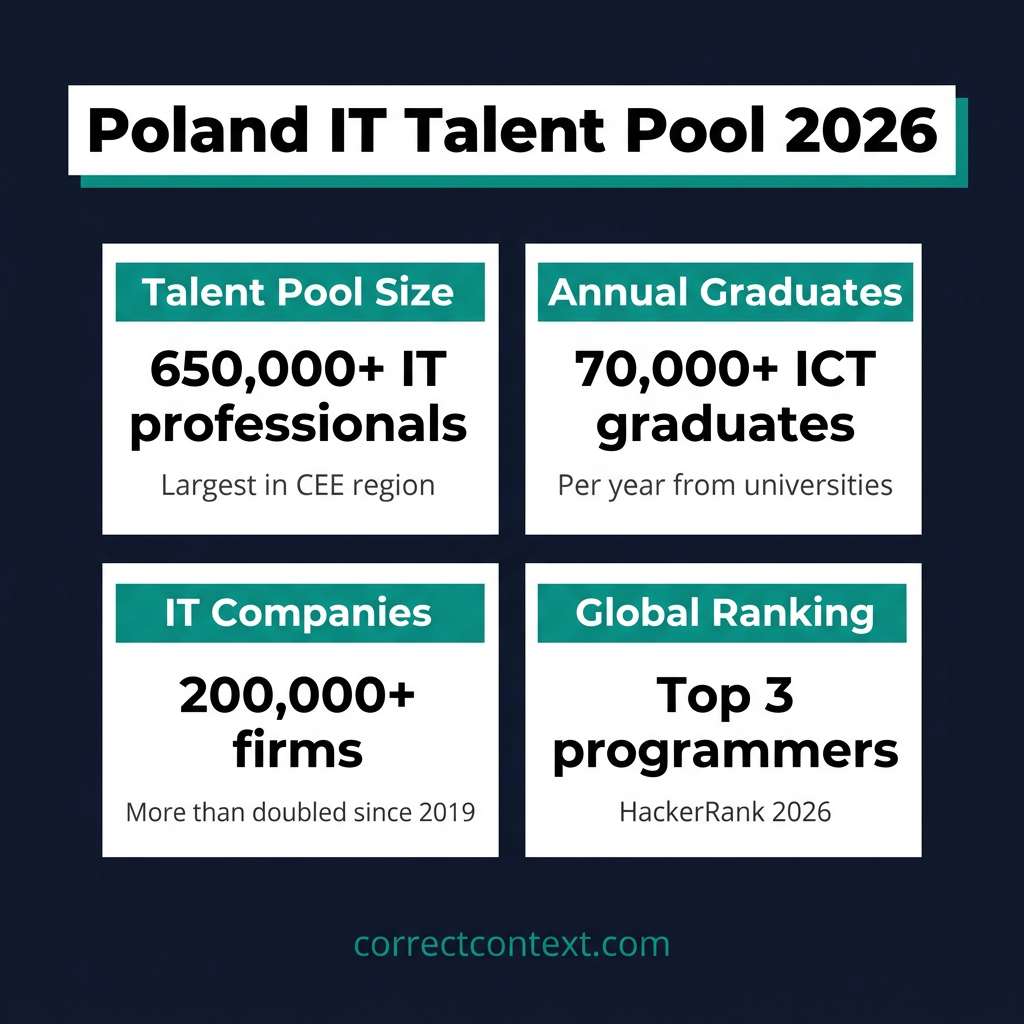
Poland now hosts over 650,000 IT professionals—the largest technology talent pool in Central and Eastern Europe. With ICT market value projected to hit USD 34.75 billion in 2026 and Polish developers ranking 3rd globally in programming skill according to HackerRank, the country has evolved far beyond its outsourcing origins into a genuine innovation hub. For CTOs and engineering leaders evaluating where to build or scale technical teams, understanding the depth, quality, and economics of the Polish developer talent pool isn’t optional—it’s strategic.
This guide breaks down everything you need to know about accessing Polish developer talent: the scale of the workforce, the quality of technical education, skill specializations, cost advantages, major tech hubs, and the practical realities of hiring in this market. Whether you’re considering nearshoring to Poland, opening an R&D center, or augmenting your existing team, the data here will inform your decision.
The Scale of Poland’s IT Talent Pool
Poland’s IT workforce has reached a scale that places it firmly among Europe’s top five technology talent markets. According to the 2026 Polish IT Market Report by RemoDevs, the sector now boasts over 650,000 IT professionals—positioning it as the largest talent pool in the CEE region and accounting for approximately 25% of all tech talent in Central and Eastern Europe.
This isn’t just about raw numbers. The growth trajectory matters. The ICT market value is projected to expand from USD 31.59 billion in 2025 to USD 34.75 billion in 2026, representing a compound annual growth rate (CAGR) of 10.02% through 2031 according to Mordor Intelligence. By 2031, the market could reach USD 56.01 billion. This sustained expansion reflects both organic growth and the continued influx of foreign direct investment into Poland’s technology sector.
The number of companies operating in Poland’s ICT field has exploded. According to Telecompaper, the count exceeded 200,000 in 2025—more than doubling since 2019. This proliferation of tech firms creates a competitive, dynamic environment that continuously upskills the workforce and drives innovation.
Annual Talent Pipeline: Universities and Graduates
A talent pool is only as sustainable as its replenishment rate. Poland’s university system produces approximately 70,000 ICT graduates annually, according to 2026 market data. This steady pipeline is supported by a network of world-class technical universities that consistently rank among Europe’s best.
The University of Warsaw and Warsaw University of Technology lead national rankings, with the University of Warsaw placing in the QS World University Rankings top 200 for Computer Science (ranked =188 globally in 2026). Other top institutions include:
- AGH University of Science and Technology (Krakow) — renowned for computer science and engineering, with strong industry partnerships and research programs
- Wroclaw University of Technology — strong industry connections and research output in embedded systems and robotics
- Gdansk University of Technology — leading technical institution in northern Poland with maritime tech and telecommunications focus
- Silesian University of Technology (Gliwice) — major engineering hub with automotive industry ties and industrial automation expertise
- Jagiellonian University (Krakow) — Poland’s oldest university with strong theoretical computer science and mathematics programs
- Poznan University of Technology — strong in software engineering, business applications, and logistics technology
These institutions don’t just produce volume—they produce quality. Polish graduates consistently demonstrate strong foundational skills in algorithms, data structures, and software engineering principles. The education system emphasizes mathematics and theoretical computer science, creating developers who can adapt to new technologies rather than just memorizing current frameworks. This theoretical foundation explains why Polish developers excel in competitive programming and algorithmic challenges.
International Olympiad Success
Poland’s strength in algorithmic thinking isn’t theoretical—it is proven on the global stage. In the International Olympiad in Informatics (IOI), Poland ranks as the 2nd most decorated country in history with 127 medals. This success in competitive programming translates directly into professional capabilities: Polish developers bring structured problem-solving approaches to software engineering challenges that developers from less rigorous educational backgrounds often lack.
The competitive programming culture in Poland runs deep. TopCoder, Codeforces, and similar platforms have thriving Polish communities. Many Polish developers cut their teeth on algorithmic challenges before entering professional software engineering, giving them a problem-solving mindset that proves valuable in complex system design and optimization tasks.
Developer Quality: Why Polish Programmers Rank Among the World’s Best
When evaluating a talent pool, quantity means little without quality. Polish developers have repeatedly demonstrated world-class capabilities across multiple benchmarking platforms and competitions.
HackerRank and Global Skill Rankings
According to HackerRank’s global programming assessments, Poland ranks 3rd worldwide among countries with the best programmers—behind only China and Russia. This isn’t a fluke or a single-year anomaly. Polish developers have maintained top-tier positions across multiple evaluation criteria:
- #1 globally in Java development
- #2 globally in Algorithms
- #2 globally in Python
- 98% score in speed and accuracy on HackerRank assessments
These rankings reflect the combination of strong mathematical education, competitive programming culture, and practical coding experience that characterizes Polish technical training. While other outsourcing destinations may focus on framework-specific training, Polish education emphasizes fundamental principles that transfer across technologies.
The Java #1 ranking is particularly significant for enterprise software development. Many large organizations rely on Java for backend systems, and Poland’s dominance in this language makes it an ideal sourcing location for enterprise development teams.
English Proficiency and Communication
Technical skill means little if developers can’t communicate effectively with international teams. Poland excels here as well. According to the EF English Proficiency Index 2025, Poland ranks 15th globally with a score of 600—placing it in the “Very High Proficiency” band. This exceeds the global average score of 488 by a significant margin.
For context, Poland’s English proficiency outranks many Western European countries and far exceeds that of typical outsourcing destinations. Most Polish developers speak English at B2 level or higher, enabling seamless integration into international teams without the communication barriers that often plague offshore engagements.
Breaking down the EF EPI scores by skill area reveals particular strengths:
- Reading score: 612 (excellent comprehension of technical documentation)
- Listening score: 597 (strong in meetings and video calls)
- Writing score: 557 (capable of clear written communication)
- Speaking score: 518 (functional verbal communication)
This profile aligns well with distributed software development, where reading documentation and participating in video calls constitute the majority of communication. Polish developers can consume English technical documentation, participate effectively in stand-ups and planning meetings, and write clear code comments and documentation.
Cultural Alignment with Western Business Practices
Beyond language, Polish developers share cultural affinities with Western European and North American business practices. Poland’s EU membership ensures familiarity with GDPR, data protection standards, and regulatory frameworks that align with Western requirements. The work culture emphasizes direct communication, punctuality, and results-oriented delivery—traits that reduce friction in cross-border collaborations.
Polish developers are accustomed to working with international clients. The country’s history as an outsourcing destination means most senior developers have years of experience collaborating with teams in Germany, UK, Netherlands, and the US. This experience shows in their understanding of Western business expectations, meeting etiquette, and project management approaches.
The direct communication style common in Polish business culture aligns well with agile methodologies and DevOps practices that emphasize transparency and rapid feedback. Polish developers typically feel comfortable raising concerns, asking clarifying questions, and pushing back on requirements that don’t make sense—behaviors that improve product quality but may be less common in cultures with strict hierarchical deference.
Poland’s Major Tech Hubs: Where the Talent Concentrates
While talent exists throughout Poland, it concentrates in several major metropolitan areas that have evolved into distinct tech ecosystems. Understanding these hubs helps target recruitment efforts and assess fit for different types of operations.
| City | Key Characteristics | Notable Strengths | Major Employers/Startups |
|---|---|---|---|
| Warsaw | Capital, largest talent pool, financial center | Fintech, enterprise software, AI/ML | Google, Microsoft, Samsung, ElevenLabs, multiple banks |
| Krakow | 2nd largest city, highest IT company density | Software development, R&D centers, gaming | IBM, ABB, Nokia, CD Projekt, Sabre |
| Wroclaw | Major tech park, strong university pipeline | Embedded systems, IoT, automotive tech | Nokia, Honeywell, Credit Suisse, Wroclaw Technology Park |
| Gdansk/Tricity | Northern hub, growing rapidly | Game development, e-commerce, maritime tech | Amazon, local game studios, logistics companies |
| Poznan | Logistics and trade heritage | E-commerce, logistics tech, ERP systems | Allegro (origins), local software houses |
| Lodz | Central location, lower costs | BPO, shared services, emerging tech | ECCO, BPO centers, growing startup scene |
Warsaw: The Capital of Polish Tech
Warsaw remains Poland’s undisputed tech capital. The city ranks 91st globally as a startup hub and hosts over 200 technology companies ranging from early-stage startups to multinational R&D centers. Microsoft’s USD 700 million investment in Azure Poland Central—the first hyperscale cloud region in Central and Eastern Europe—cements Warsaw’s status as a cloud gateway for the entire CEE bloc.
Warsaw offers the deepest talent pool and the highest salary levels in Poland. For companies requiring specialized skills in AI/ML, fintech, or enterprise architecture, Warsaw provides the largest concentration of senior-level talent. The city’s startup ecosystem has produced notable successes including ElevenLabs, which reached an $11 billion valuation in early 2026.
However, Warsaw’s advantages come with higher competition and cost. Office space commands premium rents, and developer salaries run 10–15% above national averages. Companies targeting Warsaw need compelling value propositions to attract talent in this competitive market.
Krakow: The R&D Capital
Krakow has emerged as Poland’s leading destination for R&D centers and software development outsourcing. The city hosts the highest density of IT companies in the country, creating a competitive environment that drives continuous skill development. Major global corporations including IBM, ABB, Nokia, Motorola, and Sabre have established significant R&D operations here.
The city’s strong academic foundations—Jagiellonian University and AGH University of Science and Technology produce thousands of CS graduates annually—combined with a lower cost of living than Warsaw, make Krakow attractive for companies seeking quality talent at moderate cost. The gaming industry has also taken root here, with CD Projekt (creators of The Witcher series) headquartered in the city.
Krakow’s R&D focus means the developer population skews toward experienced professionals working on complex products rather than simple outsourcing projects. For companies seeking to build genuine engineering capabilities rather than just coding capacity, Krakow offers a mature talent pool.
Wroclaw: The Innovation Hub
Wroclaw Technology Park (WPT) is home to more than 200 technology companies and serves as a magnet for innovation-focused firms. The city has developed particular strength in embedded systems, IoT, and automotive technology—sectors supported by the presence of companies like Nokia, Honeywell, and a cluster of automotive suppliers.
Wroclaw’s growing reputation for innovation, combined with a high quality of life and strong university pipeline from Wroclaw University of Technology, makes it an increasingly popular choice for companies seeking to differentiate from the Warsaw-Krakow mainstream. The city’s smaller size can be an advantage—less competition for talent means easier recruitment and higher retention.
Emerging Hubs: Gdansk, Poznan, and Beyond
While Warsaw, Krakow, and Wroclaw dominate, secondary cities are gaining traction. Gdansk/Tricity benefits from its northern location, strong game development cluster, and Amazon’s significant presence. Poznan leverages its logistics heritage for e-commerce and supply chain technology. Lodz offers central location and lower costs for BPO and shared services operations.
These emerging hubs often provide better value propositions for cost-conscious companies. Talent is less competed-for, salary expectations are lower, and office costs are significantly reduced. As remote and hybrid work normalize, these secondary markets become increasingly viable for distributed team building.
In-Demand Skills and Technology Specializations
Understanding what skills are available—and which are in highest demand—helps calibrate hiring expectations and compensation strategies.
Programming Languages by Market Share
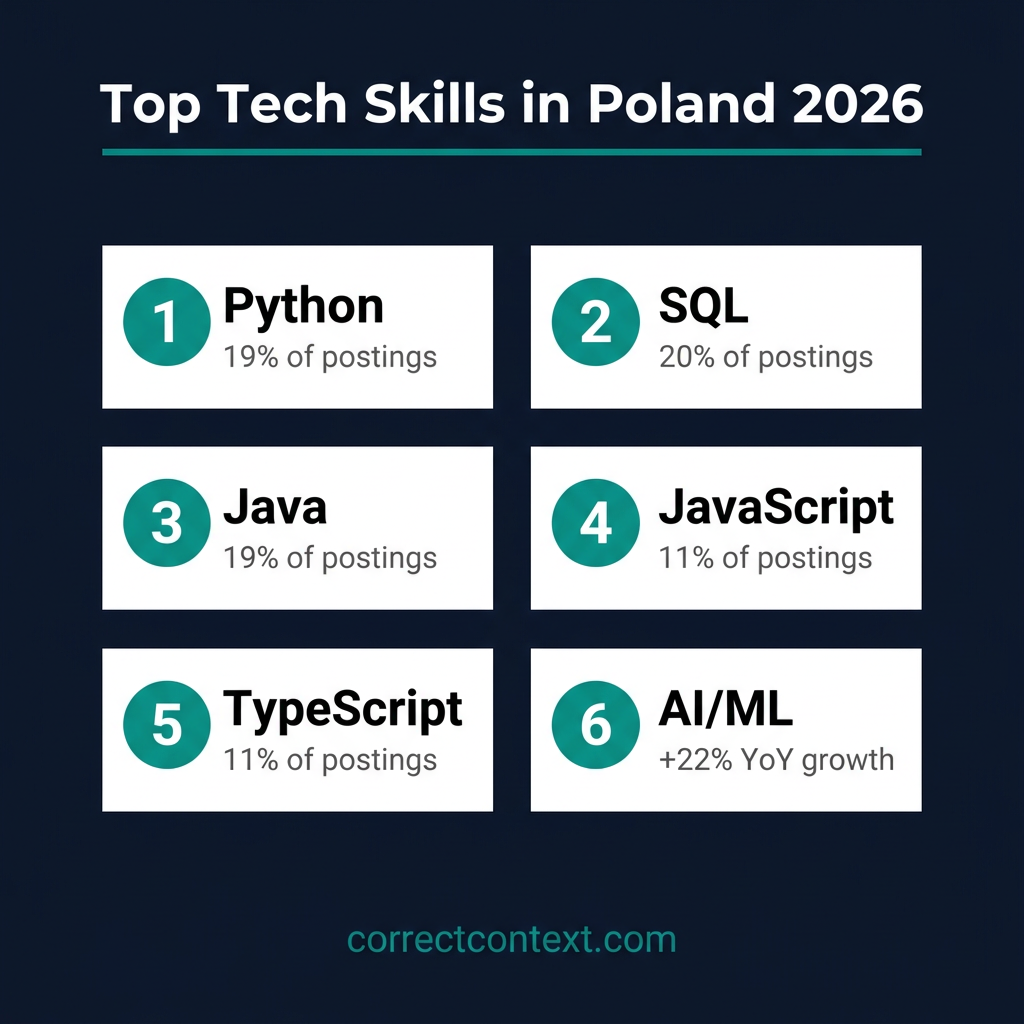
According to ITCompare’s 2025/2026 analysis of job postings in Poland, the most in-demand technologies break down as follows:
| Technology | Share of Job Postings | Primary Use Cases |
|---|---|---|
| SQL | ~20% | Databases, BI, Data Analytics |
| Python | 19% | Backend, AI/ML, Data Science |
| Java | 19% | Backend, Enterprise Applications |
| JavaScript | 11% | Frontend, Full Stack |
| TypeScript | 11% | Modern Frontend, Full Stack |
| PHP | 8% | Backend Web Development |
| C# / .NET | 6% | Backend, .NET Applications |
| C++ | 3% | Embedded Systems, Performance-Critical |
Emerging High-Growth Areas
While established languages dominate volume, emerging technologies show the fastest growth:
AI and Machine Learning: Job postings for AI/ML specialists have increased 22% year-over-year according to 2026 data. The “AI gold rush” driven by enterprise automation needs has created intense competition for professionals with expertise in TensorFlow, PyTorch, NLP, and MLOps. Senior AI/ML engineers now command average salaries of USD 80,400—significantly above general software engineering rates.
Cybersecurity: Security-related roles have seen a 39% surge in demand, driven by heightened digital threats and strict EU regulations including NIS2. Poland’s designation as the most cyber-attacked country globally—with over 1,000 weekly incidents—has elevated security to a national priority. Companies face fines up to EUR 10 million for NIS2 non-compliance, making security investment mandatory rather than optional.
Cloud Computing: Public cloud services are expanding at a 17.78% CAGR. Expertise in AWS, Azure, and Google Cloud Platform is increasingly essential, with cloud architects and DevOps engineers commanding premium compensation. Microsoft’s Azure Poland Central investment reflects the strategic importance of cloud infrastructure in the region.
Green Tech: Sustainability mandates are driving rapid adoption of renewable energy solutions in data centers and IT infrastructure, creating demand for specialists who understand energy-efficient computing and carbon-aware software design.
Frontend Development Trends
The frontend market in Poland has tightened significantly. React + TypeScript has become the de facto standard, with other frameworks like Angular considered advantageous but secondary. Full-stack capabilities—particularly Node.js on the backend—increasingly differentiate candidates in a competitive market.
Companies report that frontend recruitment requires higher bars than in previous years, with fewer postings but more stringent requirements. The shift toward TypeScript is nearly complete—developers without TypeScript experience face limited opportunities in modern frontend roles.
DevOps and Platform Engineering
DevOps expertise remains in short supply across Poland. Companies seeking Kubernetes, Terraform, CI/CD pipeline development, and infrastructure-as-code skills face particular challenges. This shortage is global, but Poland’s rapid cloud adoption has intensified local competition for these capabilities.
Platform engineering—treating internal infrastructure as a product—represents an emerging specialization where Polish developers are building expertise. Companies with advanced DevOps practices often find they can attract top talent by offering interesting technical challenges and modern tooling.
Cost Economics: The Polish Value Proposition
Cost advantage remains a significant factor in Poland’s appeal, though the market has evolved beyond pure labor arbitrage.
Salary Benchmarks by Seniority
According to 2026 market data from RemoDevs, developer salaries in Poland break down as follows for B2B contracts (the standard engagement model):
- Junior Developer: ~EUR 2,100 net monthly (approximately USD 26,000 annually)
- Mid-level Developer: ~EUR 4,395 net monthly (approximately USD 54,000 annually)
- Senior Developer: ~EUR 5,760 net monthly (approximately USD 70,000 annually)
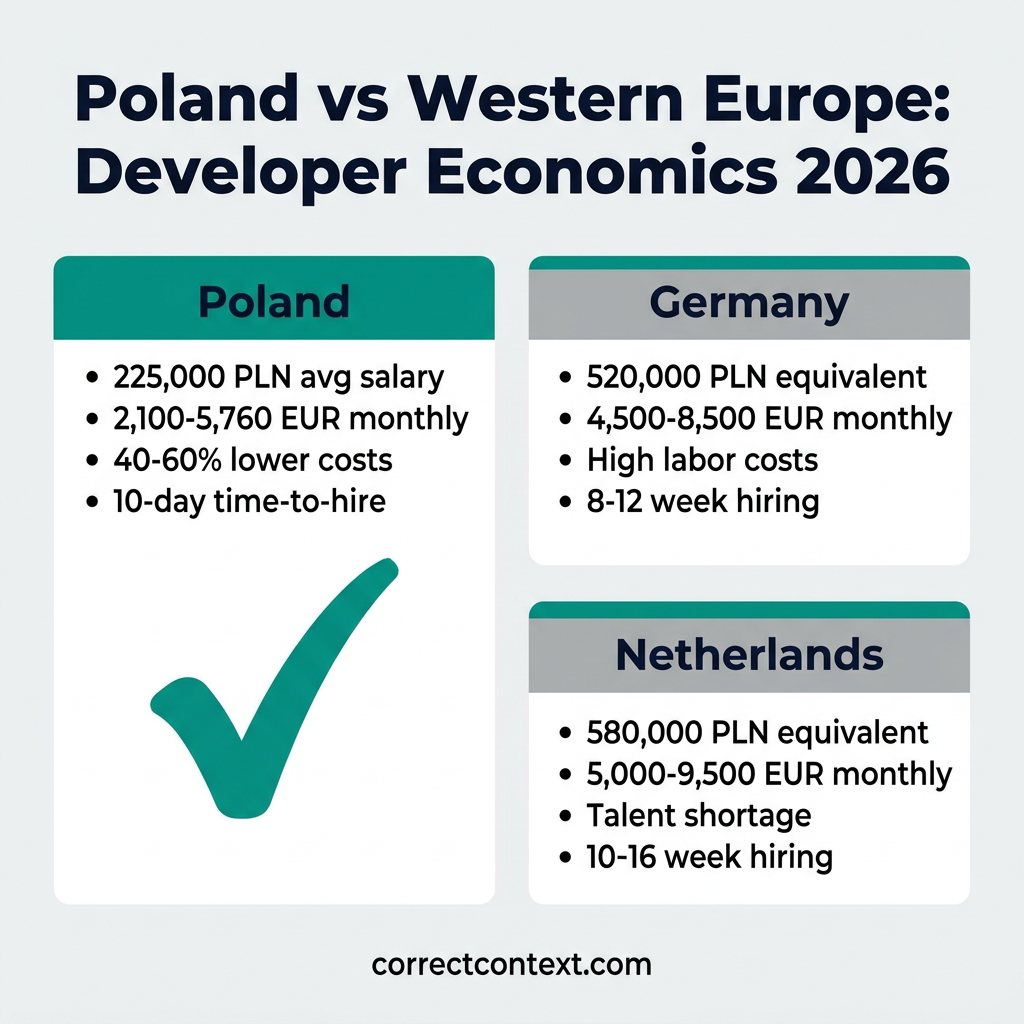
Annual salaries for experienced developers typically range from 225,000–231,000 PLN (approximately USD 55,000–57,000), though top talent in niche fields like AI/ML can command significantly more—senior AI/ML engineers average USD 80,400 annually.
Regional variations exist within Poland. Warsaw commands the highest premiums—seniors there can earn up to USD 70,000—while secondary cities like Lodz or Lublin may offer 15–20% lower rates for equivalent experience.
Comparison with Western Markets
The cost differential remains substantial. Polish developer costs run approximately 40–60% below Western European equivalents and roughly 2.5x lower than comparable US rates. For example:
- A senior developer in Germany might cost EUR 80,000–95,000 annually
- A senior developer in the Netherlands: EUR 85,000–100,000+
- A senior developer in the UK: GBP 70,000–90,000+
- A senior developer in the US: USD 140,000–180,000+
- A senior developer in Poland: USD 55,000–70,000
This differential persists even as Polish salaries grow. The key is that productivity-adjusted costs often favor Poland even more than raw salary comparisons suggest, given the high skill levels and strong work ethic documented earlier.
Contract Types: B2B vs Employment
Most Polish developers prefer B2B (business-to-business) contracts over traditional employment (UoP – Umowa o Prace). B2B contracts offer developers 13–26% higher net income due to different tax treatment, while providing employers with greater flexibility. For foreign companies hiring in Poland, understanding this preference is essential—many senior developers will only consider B2B arrangements.
B2B contracts also simplify engagement for foreign employers. Rather than navigating Polish employment law, companies contract with the developer’s business entity. This structure is well-understood by Polish developers and their accountants, making it the default for most professional relationships.
Hiring Speed and Time-to-Productivity
Speed matters in competitive markets. For vetted candidates, the average time-to-hire in Poland can be as low as 10 days—a significant advantage compared to the 8–16 week timelines common in Western Europe. This agility enables rapid team scaling and faster response to market opportunities.
Time-to-productivity is also favorable. Polish developers typically integrate quickly into international teams due to strong English skills, cultural alignment, and experience working with Western companies. Most developers can become productive contributors within 2–4 weeks of onboarding.
This rapid integration contrasts sharply with experiences in some offshore destinations, where cultural and communication barriers can extend ramp-up periods to 2–3 months. The productivity gains from faster onboarding partially offset salary differences.
The Hiring Landscape: Challenges and Realities
Despite the advantages, hiring in Poland isn’t without challenges. Understanding these realities helps set appropriate expectations and strategies.
Talent Shortages in Specialized Areas
While the overall talent pool is large, competition for specialists in DevOps, AI/ML, and cybersecurity is fierce. According to Mordor Intelligence, Poland posts 275% more tech vacancies per employed specialist than the OECD average, with 59% of firms citing hiring difficulties.
This shortage is most acute for senior-level specialists with 5+ years of experience in emerging technologies. Companies need to move quickly when they identify suitable candidates and be prepared to offer competitive packages that may include remote work options, professional development budgets, and equity participation.
The shortage isn’t uniform across all skill areas. Junior developers in common technologies (Java, PHP, basic frontend) remain relatively available. The challenge concentrates in specialized, high-demand niches where supply hasn’t caught up with rapidly growing demand.
Brain Drain and Remote Work Competition
Remote-work options have intensified competition for Polish talent. Developers can now work for companies in higher-pay markets (Germany, UK, US) while remaining in Poland, creating upward pressure on local compensation. This “brain drain” risk is real, though Poland’s strong universities continue to replenish the talent pipeline.
Smart employers counter this by offering hybrid arrangements, strong local career progression, and compensation that narrows the gap with remote opportunities—while still maintaining cost advantages. Companies that provide interesting technical challenges and career growth often retain talent even when remote options exist.
The remote work dynamic also creates opportunities. Polish developers working remotely for Western companies often return to local employment after 1–2 years, bringing back enhanced skills and experience. This “brain circulation” can benefit local employers who maintain relationships with departing talent.
Recruitment Dynamics in 2026
The Polish IT job market has rebounded strongly from earlier corrections. According to No Fluff Jobs, IT vacancies are up 68% year-on-year in 2025, with 44% more job postings than the previous year. The average number of postings per employer increased from 10 in 2024 to 17 in 2025.
However, this doesn’t mean easy hiring. The market has matured—82% of companies plan to recruit in 2026, but the focus has shifted from volume to quality and specialization. Generic software developers face more competition, while specialists with proven expertise in high-demand areas command premium attention.
Candidates are more selective than in previous years. Developers evaluate not just compensation but also technology stack, remote work policies, career development opportunities, and company culture. Employers need compelling value propositions beyond salary to attract top talent.
Strategic Considerations for Different Engagement Models
Companies can access Polish talent through multiple models, each with distinct trade-offs:
Direct Employment
Establishing a legal entity in Poland and hiring directly provides maximum control and integration. This model suits companies planning to build substantial teams (20+ developers) with long-term commitment. The downside is administrative complexity—Polish labor law, tax compliance, and payroll management require local expertise.
Direct employment works best when:
- Team size will exceed 20 developers
- Long-term commitment to Poland is strategic
- Full control over employment terms is required
- Local management capacity exists
Employer of Record (EoR)
An EoR arrangement allows companies to hire Polish developers without establishing a local entity. The EoR handles compliance, payroll, and benefits while the client manages day-to-day work. This model accelerates market entry and reduces administrative burden, making it ideal for initial team building (5–15 developers) or testing the market.
EoR works best when:
- Team size is 5–20 developers
- Speed to market is critical
- Administrative simplicity is valued
- Testing Poland before major commitment
Staff Augmentation
Staff augmentation through a Polish partner provides immediate access to pre-vetted talent with minimal commitment. This model works well for project-based work, rapid scaling during peak periods, or accessing specialized skills not available internally. Quality varies significantly by provider—due diligence is essential.
Staff augmentation works best when:
- Immediate capacity is needed
- Project duration is defined
- Specialized skills are required temporarily
- Internal recruitment capacity is limited
Outsourcing/Project-Based
Traditional outsourcing remains viable for well-defined projects with clear deliverables. Polish development shops offer strong technical capabilities at competitive rates. However, this model works best when requirements are stable and the project scope is well-understood upfront.
Project outsourcing works best when:
- Scope is well-defined
- Requirements are stable
- Internal technical oversight is limited
- Fixed budget is required
Future Outlook: Where the Polish Talent Pool Is Heading
Understanding trajectory helps inform long-term decisions. Several trends will shape Poland’s developer talent pool over the next five years.
Continued Market Growth
The ICT market is projected to reach USD 56.01 billion by 2031, maintaining a 10.02% CAGR. This growth will continue attracting foreign investment and creating demand for skilled developers. The sector’s share of GDP—currently 3.5–4.5%—will likely increase, further elevating the importance of technology skills in the economy.
AI Integration and Skill Evolution
AI tools are changing how developers work, but not replacing them. Polish developers are rapidly adopting AI coding assistants, using them to increase productivity rather than viewing them as threats. The skill set is evolving toward AI collaboration, prompt engineering, and higher-level system design rather than routine coding.
Companies hiring Polish developers should expect AI-augmented workflows. The value proposition shifts from pure coding speed to architectural thinking, problem decomposition, and AI tool orchestration.
Regulatory Environment
EU regulations including NIS2, AI Act, and evolving GDPR requirements will increase demand for compliance-aware developers. Security, privacy, and ethical AI development will become standard skill requirements rather than specializations. Polish developers’ EU context positions them well for these requirements.
Sustainability Focus
Green technology and sustainable computing will grow in importance. Data center energy efficiency, carbon-aware software design, and renewable energy integration will become standard considerations. Poland’s investments in green data centers position the country well for this transition.
Key Takeaways
- Scale: Poland’s 650,000+ IT professionals represent the largest talent pool in Central and Eastern Europe, with 70,000+ new graduates entering the market annually from world-class universities.
- Quality: Polish developers rank 3rd globally in programming skill (HackerRank), with particular strength in Java (#1), algorithms (#2), and Python (#2). The country ranks 2nd globally in IOI medals.
- Communication: 15th globally in English proficiency (EF EPI), with most developers at B2 level or higher—enabling seamless international collaboration without communication barriers.
- Cost: Developer costs run 40–60% below Western Europe and 2.5x below US rates, while maintaining high productivity and quality. Senior developers average USD 55,000–70,000 annually.
- Speed: Time-to-hire as low as 10 days for vetted candidates, with developers typically productive within 2–4 weeks due to cultural alignment and English proficiency.
- Hubs: Warsaw (enterprise/fintech/AI), Krakow (R&D/software), and Wroclaw (innovation/IoT) offer distinct advantages. Secondary cities provide better value for cost-conscious companies.
- Skills: Strong availability in Python (19%), Java (19%), SQL (20%), JavaScript/TypeScript (11% each); fastest growth in AI/ML (+22% YoY) and cybersecurity (+39%).
- Challenges: Competition for senior specialists is intense with 275% more vacancies per specialist than OECD average; remote work options from Western companies create upward compensation pressure.
- Engagement Models: EoR and staff augmentation suit initial market entry; direct employment becomes cost-effective at 20+ developers; B2B contracts preferred by most developers.
- Future: Market projected to reach USD 56 billion by 2031; AI integration changing skill requirements; EU regulatory compliance becoming standard expectation.
Frequently Asked Questions
How does Polish developer quality compare to other outsourcing destinations?
Polish developers consistently rank among the world’s best. HackerRank places Poland 3rd globally in programming skill, behind only China and Russia. Polish developers rank #1 globally in Java, #2 in algorithms, and #2 in Python. This places Poland significantly ahead of traditional outsourcing destinations like India or the Philippines in terms of raw technical capability.
The combination of strong technical education, competitive programming culture, and EU-standard quality processes creates a talent pool that rivals Western Europe at lower cost. Polish universities emphasize theoretical computer science and mathematics, producing developers who understand fundamentals rather than just framework syntax. This foundation enables faster learning of new technologies and better problem-solving in novel situations.
What are the main challenges of hiring developers in Poland?
The primary challenge is competition for senior specialists. With 275% more tech vacancies per employed specialist than the OECD average, experienced developers—particularly in AI/ML, DevOps, and cybersecurity—receive multiple offers simultaneously. Companies need to move quickly, offer competitive compensation, and provide compelling career progression.
Remote work options from Western European and US companies have created upward pressure on salaries, requiring employers to stay current with market rates. Additionally, the best developers often have multiple options, meaning employers need differentiated value propositions beyond compensation—interesting technical challenges, modern tech stacks, and career development opportunities.
Which Polish city is best for setting up a development center?
The answer depends on your specific needs. Warsaw offers the deepest talent pool and highest concentration of fintech/enterprise companies, but at the highest cost and competition. Krakow provides the best balance of talent availability, cost, and R&D ecosystem—it is the preferred choice for many multinational R&D centers seeking experienced professionals.
Wroclaw offers emerging strength in IoT and embedded systems with lower competition for talent. Gdansk/Tricity excels in game development and maritime technology. Poznan specializes in e-commerce and logistics tech. Many companies ultimately establish presence in multiple cities to diversify talent access and optimize cost-quality trade-offs.
Is the cost advantage of Polish developers sustainable long-term?
While Polish salaries are growing—driven by local demand and remote work competition—the cost differential with Western Europe and the US has persisted for decades. The key is that productivity-adjusted costs remain favorable. Polish developers’ high skill levels, strong English proficiency, and cultural alignment with Western business practices reduce hidden costs (communication overhead, rework, management time) that often erode savings in lower-cost destinations.
For the foreseeable future, Poland offers a sustainable balance of quality and cost. Even as absolute salaries increase, the gap with Western markets is likely to persist due to cost-of-living differences and the continuous influx of new graduates expanding the talent pool.
What engagement model works best for accessing Polish talent?
For companies new to Poland, starting with an Employer of Record (EoR) or staff augmentation arrangement allows market testing without legal entity setup. This approach provides speed and administrative simplicity while evaluating the talent pool. As teams scale beyond 15–20 developers, establishing a direct presence becomes cost-effective and provides greater control.
Project-based outsourcing works for well-defined deliverables but limits long-term knowledge accumulation and team building. Most companies eventually transition from initial EoR arrangements to direct employment as their Polish operations mature and scale.
How important is Polish language skills for managing developers?
For day-to-day technical work, Polish language skills are unnecessary. The vast majority of Polish developers speak English at B2 level or higher, and technical documentation, code comments, and professional communication occur in English. Most developers have years of experience working with international teams and are comfortable in English-only environments.
However, some knowledge of Polish can help with cultural integration and understanding local context. For HR, legal, and administrative matters, having Polish-speaking support is valuable. Many successful foreign companies in Poland operate with English as the working language while maintaining local support for administrative functions.
Sources
- RemoDevs — The 2026 Polish IT Market Report: Salaries, Trends & Talent (January 2026)
- Mordor Intelligence — Poland ICT Market Share, Size & Growth Outlook to 2031 (January 2026)
- Telecompaper — Polish ICT market expands nearly 4% in 2025 (2025)
- EF English Proficiency Index — Poland Fact Sheet 2025 (2025)
- ITCompare — The most in-demand IT technologies in Poland (2025/2026)
- Likims — Poland Among Top 3 Countries With The Best Programmers
- Agiliway — Poland’s Most Prominent Tech Hubs Overview 2026
- DevsData — Software Development in Poland: Market Overview for 2025