
For Enterprise COOs and VPs of Engineering, the journey of scaling tech teams often feels like navigating through a fog. As operations expand—whether through internal hiring or partnering with external providers—the lack of visibility into hiring progress and delivery output becomes a critical bottleneck. This “black box” scenario not only slows down innovation but also introduces significant business risk. When you cannot see the inner workings of your engineering hiring reporting or delivery metrics, how can you trust the process?
This article explores the core problem of limited visibility and explains why demanding weekly hiring metrics for engineering and delivery visibility for tech teams is essential at scale. We examine the metrics that matter, the transparency required from partners, and how enterprise units and Series A+ startups can leverage these insights to maintain control and accelerate growth.
The Cost of the Black Box in Engineering Teams
The traditional approach to scaling engineering teams often involves long feedback loops and opaque processes. A partner or internal talent acquisition team might promise results, but without regular, granular reporting for engineering teams, executives are left guessing. This lack of transparency leads to several critical issues.
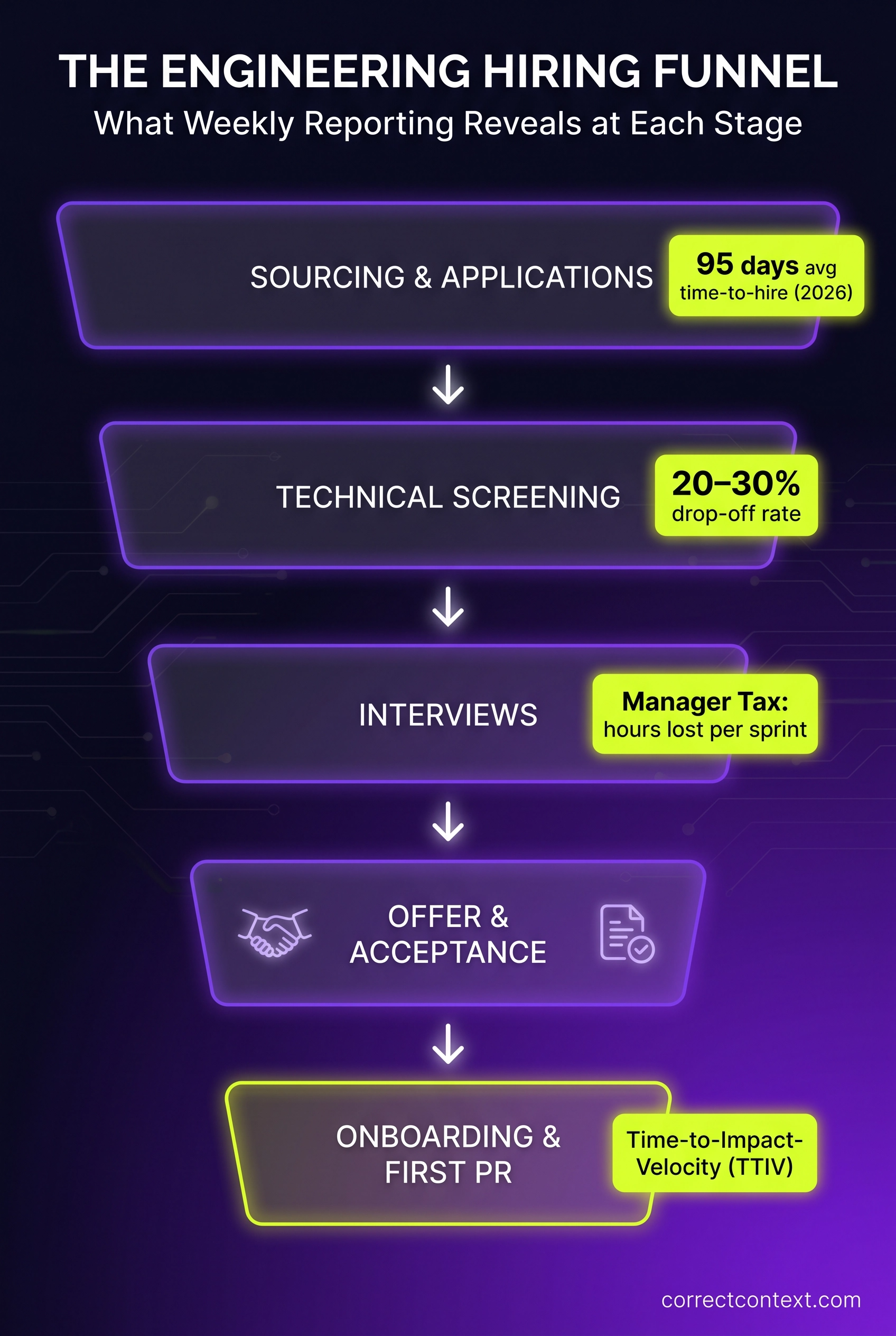
The first is inflated time-to-hire. According to recent industry benchmarks, the average time-to-hire for engineering roles has stretched to approximately 95 days in 2026, up from 65 days just a year prior [1]. Without weekly visibility into the hiring pipeline, bottlenecks remain unidentified until it is too late, compounding the delay and leaving critical product roadmap items stalled.
The second is what practitioners call Candidate Experience Debt (CXD)—the accumulated friction that damages your employer brand. High drop-off rates during technical assessments, which industry data shows average between 20–30% at the assessment stage alone, indicate process problems that could be resolved with better hiring metrics for engineering and faster iteration cycles.[1] Top engineers, who have multiple competing offers, will simply walk away from disorganized or disrespectful hiring processes.
The third and perhaps most damaging issue is delivery misalignment. When new hires or external teams finally begin work, the absence of delivery visibility for tech teams can lead to a growing gap between business objectives and engineering output. This manifests as an increased Technical Debt Ratio (TDR), missed sprint commitments, and delayed product launches—all of which erode stakeholder confidence.
| Risk Factor | Without Weekly Reporting | With Weekly Reporting |
|---|---|---|
| Time-to-Hire | 95+ days, untracked | Bottlenecks identified and resolved weekly |
| Candidate Drop-Off | Undetected until pipeline runs dry | Friction points surfaced and addressed in real time |
| Delivery Alignment | Misalignment discovered at sprint reviews | Continuous calibration against roadmap |
| Partner Accountability | Opaque, “trust us” model | Data-driven SLAs and escalation paths |
| Technical Debt | Accumulates silently | Tracked and managed proactively |
Why Weekly Reporting Is the Antidote
To combat these challenges, enterprise leaders must demand a rigorous cadence of reporting for engineering teams. Weekly updates transform the black box into a glass house, providing actionable insights that drive real-time decision-making.
Granular Engineering Hiring Reporting
A weekly engineering hiring reporting cadence should go far beyond basic vanity metrics such as total applications received. It must provide a comprehensive, layered view of the entire talent funnel.
Pipeline Velocity is the first dimension. How quickly are candidates moving from initial screening to technical interviews and through to offer? Tracking this weekly allows leaders to identify and remove friction points before they cascade into weeks-long delays. A pipeline that stalls at the technical screen stage, for example, signals a need to recalibrate the assessment process or the calibration criteria.
Time-to-Impact-Velocity (TTIV) is a more sophisticated metric that shifts the focus from the “offer accepted” date to the “onboarding break-even point.” It measures how fast a new engineer begins delivering meaningful value—a key signal being their “Time to First PR” (Pull Request), which indicates technical setup, codebase familiarity, and team integration.[1] Weekly tracking of onboarding progress ensures new hires are ramping up effectively and that the investment in hiring is generating returns on schedule.
The Manager Tax is the third critical dimension. Weekly reports must quantify the time senior engineers and tech leads spend on interviewing activities. If this “tax” is too high—consuming several hours per week per senior engineer—it directly cuts into sprint velocity and creates negative ROI for the department.[1] Tracking this metric weekly enables leaders to implement structured interview panels, time-boxed slots, and rotation schedules that protect engineering capacity.
Transparent Delivery Visibility for Tech Teams
Once teams are in place, the focus shifts to delivery. Weekly delivery visibility for tech teams is crucial for maintaining alignment and ensuring quality at pace.
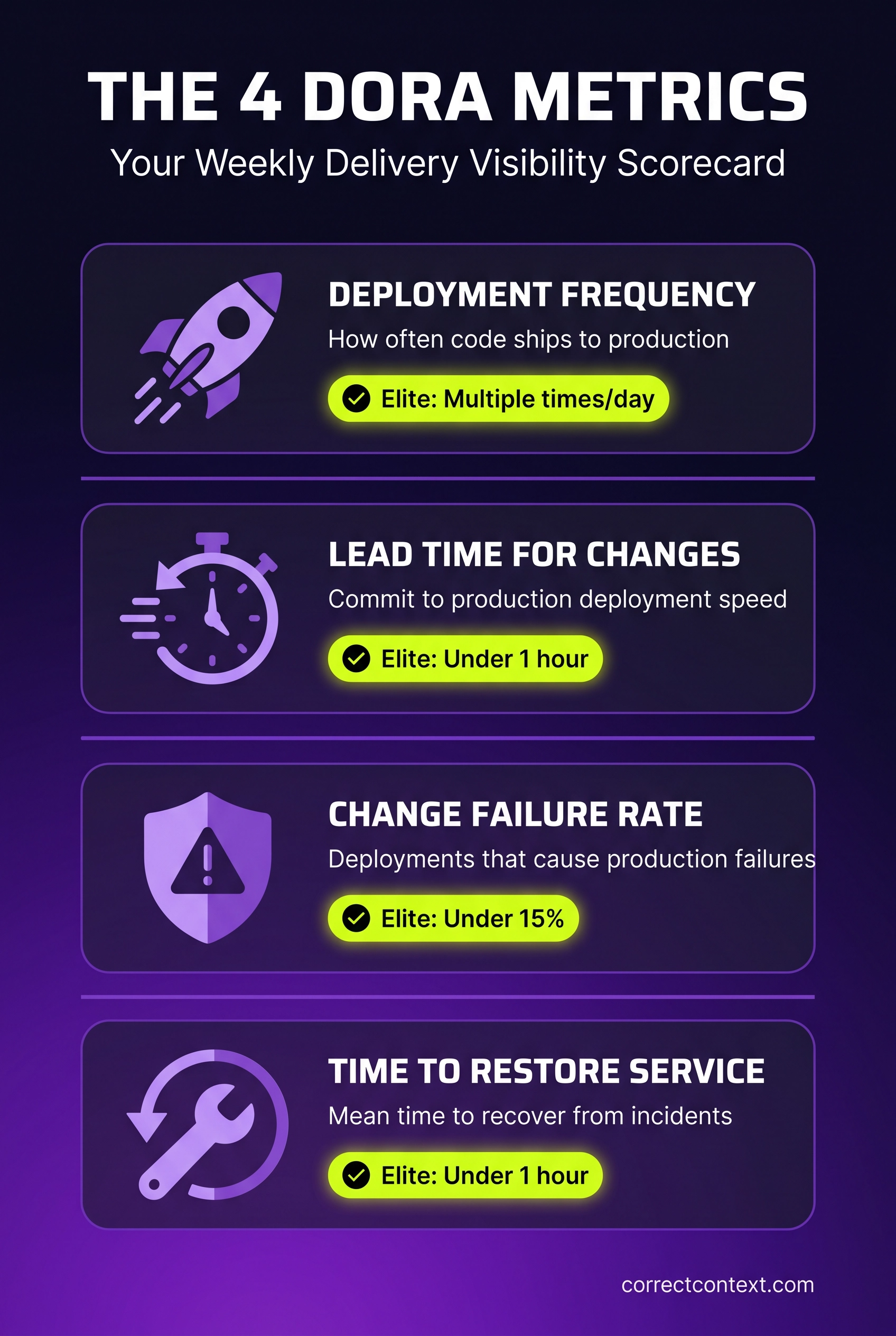
The DORA metrics—Deployment Frequency, Lead Time for Changes, Change Failure Rate, and Time to Restore Service—remain the gold standard for evaluating delivery performance.[2] Developed by Google’s DevOps Research and Assessment team, these four measures provide a balanced view of both speed and stability. Elite-performing teams deploy multiple times per day, have a lead time for changes of less than one hour, maintain a change failure rate below 15%, and restore service within one hour.[2] Weekly tracking of these metrics provides a pulse check on team efficiency and highlights where automation or process improvements are needed.
Sprint Velocity and Story Points provide a complementary view. Regular updates on completed story points versus planned capacity help leaders understand if teams are overcommitted or underperforming, enabling proactive resource reallocation rather than reactive firefighting at the end of a sprint.
Technical Debt Accumulation must also feature in weekly reports. Any shortcuts taken to meet deadlines should be logged and quantified, allowing management to address technical debt before it compounds into a systemic drag on delivery speed. McKinsey research confirms that companies implementing structured developer productivity measurement—including outcome, optimization, and opportunity-focused metrics—have achieved a 20–30% reduction in customer-reported product defects and a 60-percentage-point improvement in customer satisfaction ratings.[3]
Demanding Transparency from External Partners
For enterprises leveraging extended engineering teams, dedicated development teams, or building engineering hubs in Poland or the broader CEE region, transparency from partners is non-negotiable.
Many executives have experienced the pitfalls of vendors who refuse to share detailed candidate resumes, obscure their vetting processes, or quietly swap out senior talent for junior developers without notice.[4] In one documented case, a team that bypassed thorough vetting saw four to six weeks pass before any production delivery materialized—and even then, the code failed testing, requiring the client’s own engineers to spend significant time coaching and guiding the outsourced team, directly delaying business objectives by several months.[4]
To mitigate these risks, enterprise leaders must establish clear contractual expectations upfront:
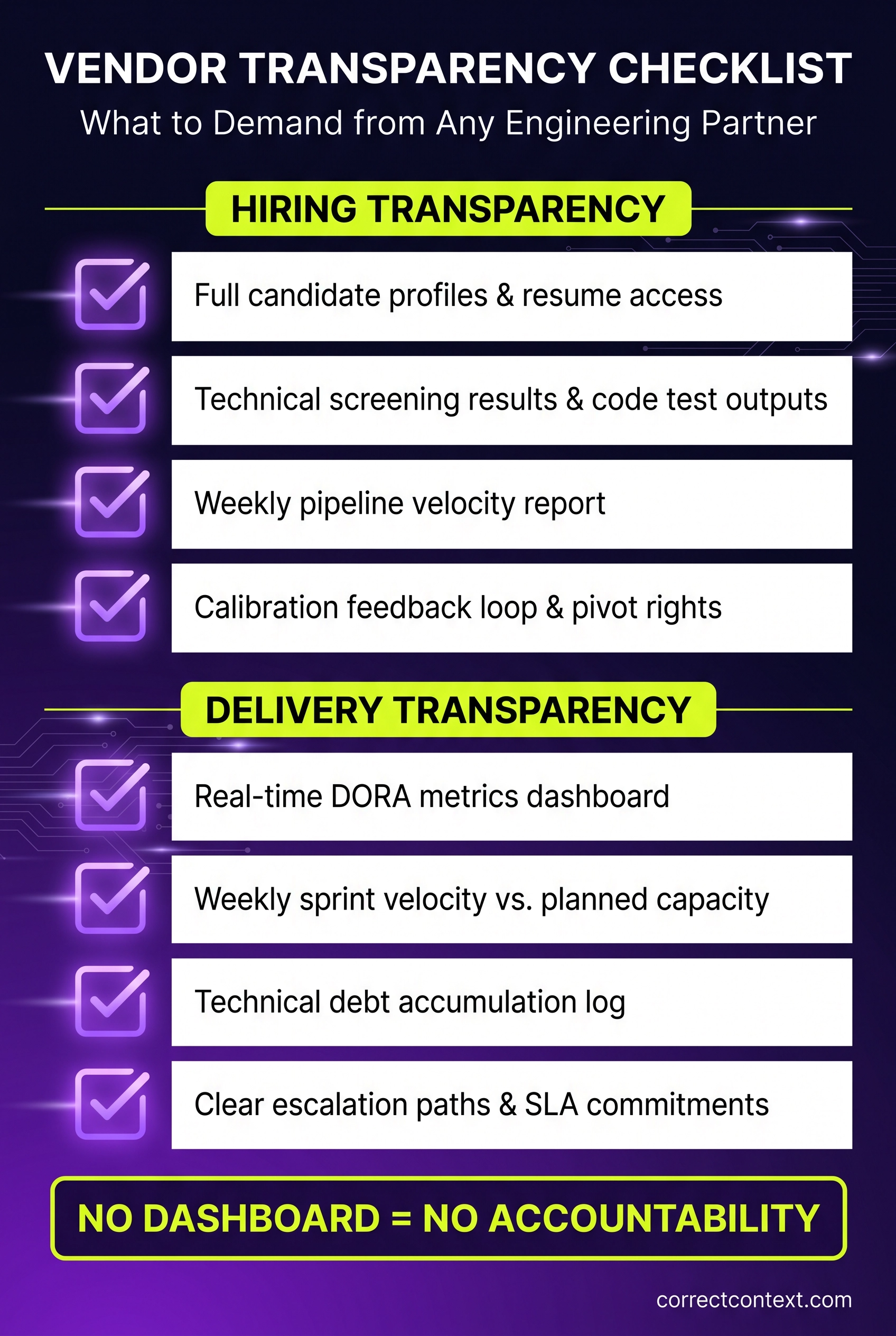
Open Access to Talent Data. Partners must provide full visibility into candidate profiles, technical screening results, and code test outputs. The ability to review resumes, provide calibration feedback, and pivot the search based on results is a baseline requirement, not a premium feature.
Real-Time Delivery Dashboards. Weekly reports should be supplemented with real-time dashboards that track both hiring metrics for engineering and DORA delivery metrics. This dual-layer visibility ensures that both the pipeline building the team and the team’s output are continuously monitored.
Clear Escalation Paths. A defined process for addressing bottlenecks or performance issues ensures that problems are resolved swiftly rather than festering into project-level crises. Partners who cannot articulate their escalation protocol are partners who are not prepared to be accountable.
Equal Replacement Clauses. Contracts should include provisions that require partners to replace talent at an equivalent or higher skill level, preventing the silent downgrade of engineering capability that is a common complaint among enterprise technology executives.[4]
The Strategic Advantage: Reporting as a Control Mechanism
Implementing weekly engineering hiring reporting and delivery visibility is not merely an administrative exercise; it is a strategic control mechanism that fundamentally changes the power dynamic between enterprises and their partners.
Gartner’s 2025 analysis of top strategic trends in software engineering highlights that talent density—the concentration of highly skilled professionals within teams—has become a key differentiator for high-performing engineering organizations.[5] But talent density cannot be achieved or maintained without the visibility to know who is on your team, how they are performing, and whether the pipeline is delivering the right profiles. Weekly reporting is the operational infrastructure that makes talent density a manageable, measurable goal rather than an aspiration.
For enterprise innovation units and fast-scaling Series A+ startups in FinTech, Software, and Media—particularly those operating across East Coast US, UK, DACH, and Nordics—this level of transparency provides three compounding advantages. First, it enables agility: the ability to pivot hiring strategies or reallocate delivery resources based on weekly data rather than quarterly reviews. Second, it drives cost control by identifying inefficiencies early, preventing the budget overruns associated with prolonged vacancies, high turnover, or undetected delivery underperformance. Third, it builds confidence across the organization, as data-driven insights create trust between engineering teams, management, and external partners.
As McKinsey has noted, software development has historically been “perennially undermeasured” compared to other critical business functions.[3] The leaders who close this measurement gap—by demanding rigorous, weekly reporting for engineering teams—are the ones who will scale their dedicated software teams, nearshore development teams, and engineering hubs in Europe with precision and speed. The black box era is over. The organizations that recognize this first will win the talent and delivery race.
Key Metrics to Track Weekly
| Metric | Category | What It Measures | Why It Matters |
|---|---|---|---|
| Pipeline Velocity | Hiring | Speed of candidate progression through funnel | Identifies bottlenecks before they delay hiring |
| Time-to-Impact-Velocity (TTIV) | Hiring / Onboarding | Time from hire to first meaningful contribution | Measures true ROI of the hiring investment |
| Manager Tax | Hiring | Senior engineer hours spent interviewing | Protects sprint velocity during hiring sprints |
| Deployment Frequency | Delivery (DORA) | How often code ships to production | Indicates team efficiency and automation maturity |
| Lead Time for Changes | Delivery (DORA) | Time from code commit to production deployment | Measures delivery speed and process efficiency |
| Change Failure Rate | Delivery (DORA) | Percentage of deployments causing failures | Balances speed with quality and stability |
| Time to Restore Service | Delivery (DORA) | Mean time to recover from production incidents | Measures operational resilience |
| Sprint Velocity | Delivery | Story points completed vs. planned | Tracks team capacity and commitment accuracy |
References
[1] Engineering Time-to-Hire Metrics That Actually Matter | Suitable AI
[2] DORA Metrics: How to measure Open DevOps Success | Atlassian
[3] Yes, you can measure software developer productivity
[4] How Transparent Is Your Software Outsourcing Vendor?
[5] Gartner Identifies the Top Strategic Trends in Software Engineering for 2025 and Beyond