
Maintaining culture in distributed teams has become one of the defining challenges for technology leaders in the 2020s. As organizations scale globally—hiring engineers across time zones, geographies, and cultural contexts—the fear that distributed setups erode company culture is not unfounded. It is, however, solvable. The question is not whether culture can survive in a distributed environment, but whether it can be intentionally built and sustained. For CTOs and enterprise leaders who are mid-to-late in their distributed journey, this article offers a grounded, data-backed answer: yes, it can. And here is how.
The Cultural Fragmentation Fear Is Real—But Misdiagnosed
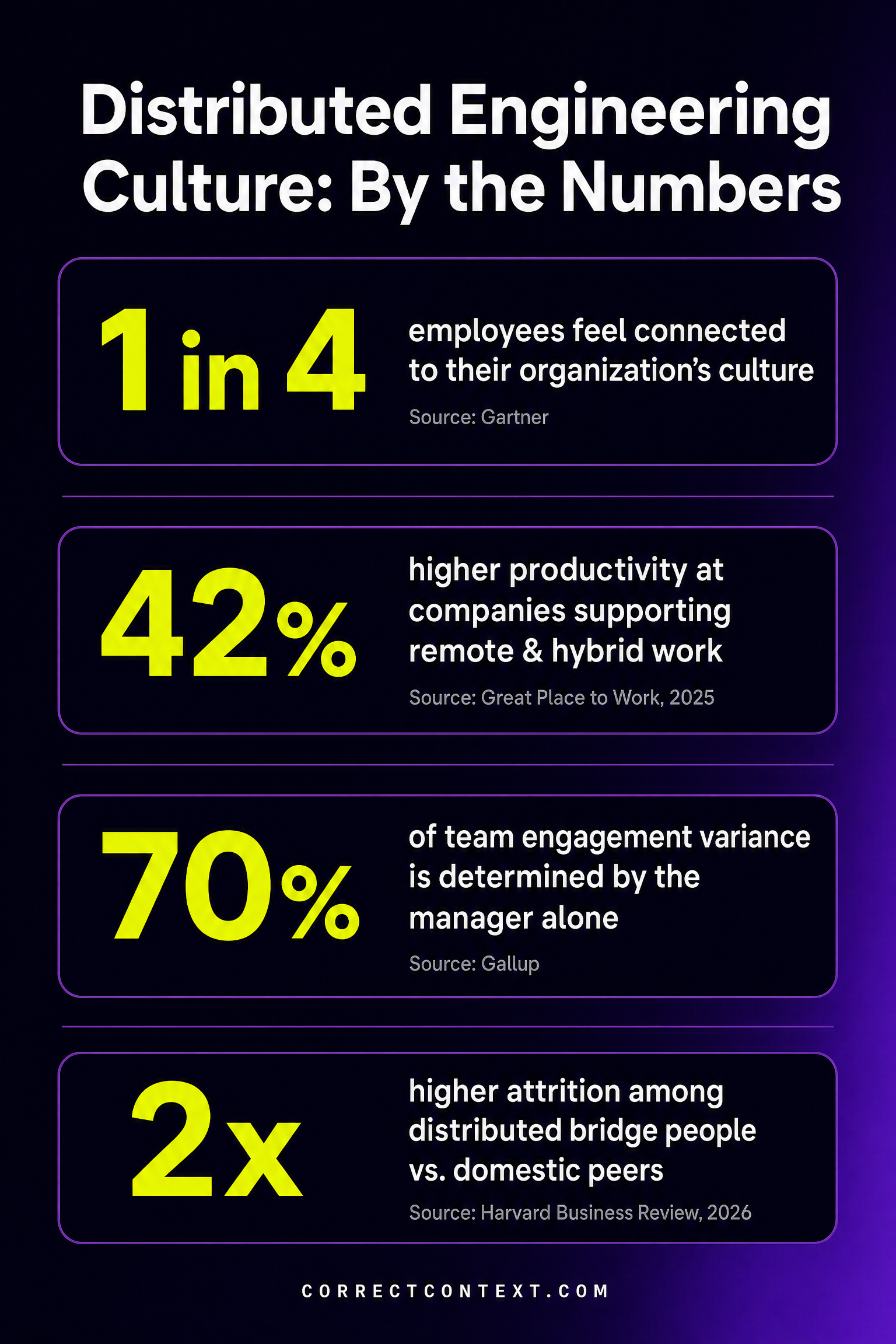
When engineering leaders talk about remote team culture, the anxiety usually centers on a few recurring themes: engineers who feel disconnected from the mission, teams that operate in silos, and a growing gap between what headquarters believes the culture to be and what distributed employees actually experience. These fears are well-founded. Gartner research shows that only 1 in 4 employees feels genuinely connected to their organization’s culture [1]. In distributed settings, that number almost certainly trends lower.
But here is the critical insight: most culture failures in distributed teams are not caused by distance itself. According to a 2026 Harvard Business Review analysis of global collaboration across Fortune 500 and Fortune 10 companies, collaboration breakdowns in distributed teams are primarily driven by organizational design failures, not cultural or geographic differences [2]. Time zones, language, and national culture create friction—but they are manageable. What determines success is how companies structure decision rights, knowledge sharing, and local leadership empowerment.
This reframing matters enormously for enterprise leaders. If you are attributing your distributed engineering culture challenges to the fact that your team is remote, you are solving the wrong problem.
Friction Amplifiers vs. Trust Multipliers
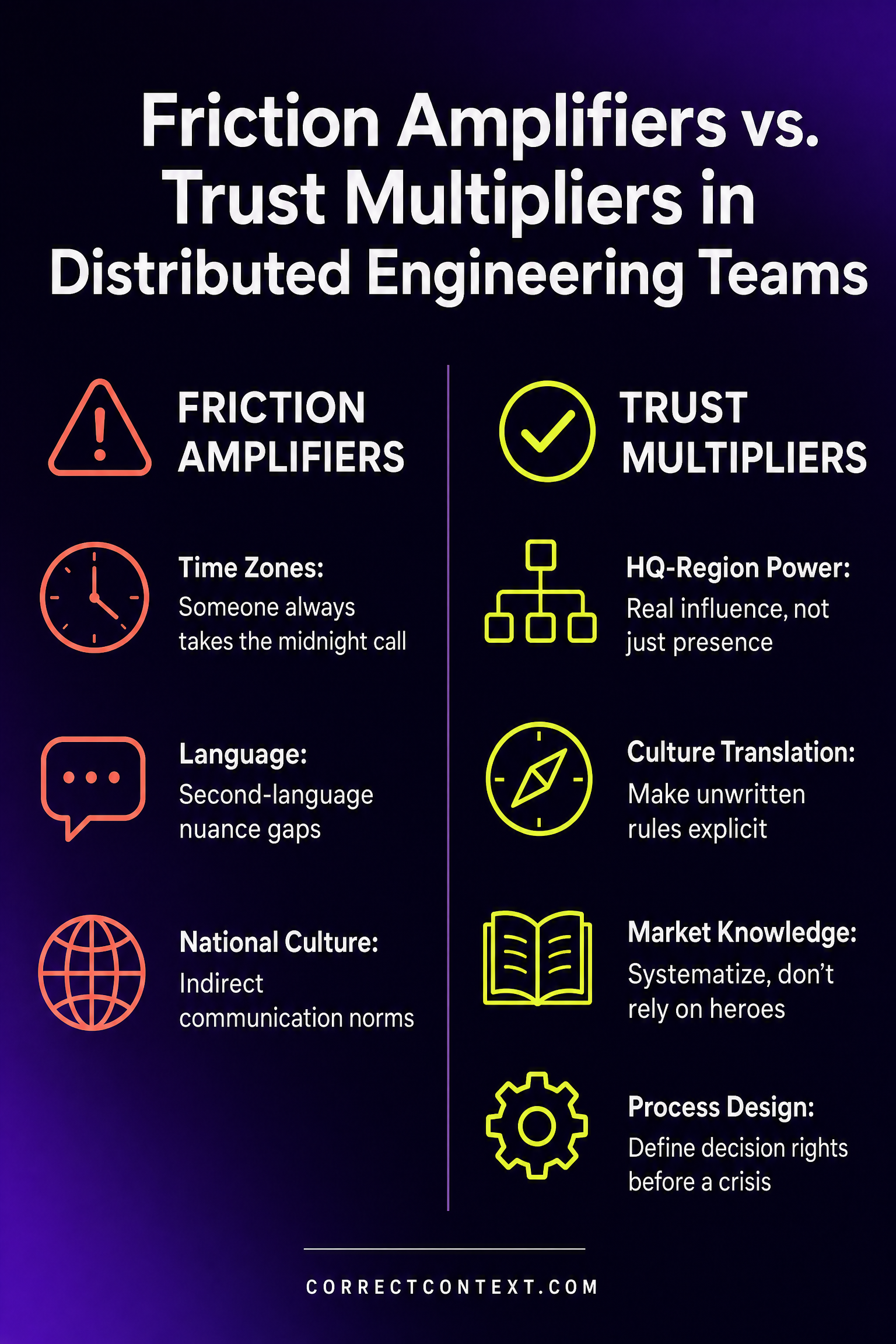
To build a resilient engineering culture in distributed teams, leaders must learn to distinguish between two categories of factors: those they can manage but not eliminate, and those they can actively design for better outcomes.
| Category | Elements | Leader’s Control |
|---|---|---|
| Friction Amplifiers | Time zones, language barriers, national cultural norms | Low — can be managed, not removed |
| Trust Multipliers | HQ-region power dynamics, company culture translation, market knowledge, process design | High — fully within organizational control |
The HBR research is clear: most organizations pour energy into friction amplifiers—trying to schedule fewer late-night calls or hiring bilingual managers—while neglecting the trust multipliers that actually determine whether a remote development team succeeds or fragments [2]. The organizations that build thriving distributed cultures are those that invest in the latter.
The Five Pillars of Intentional Distributed Engineering Culture
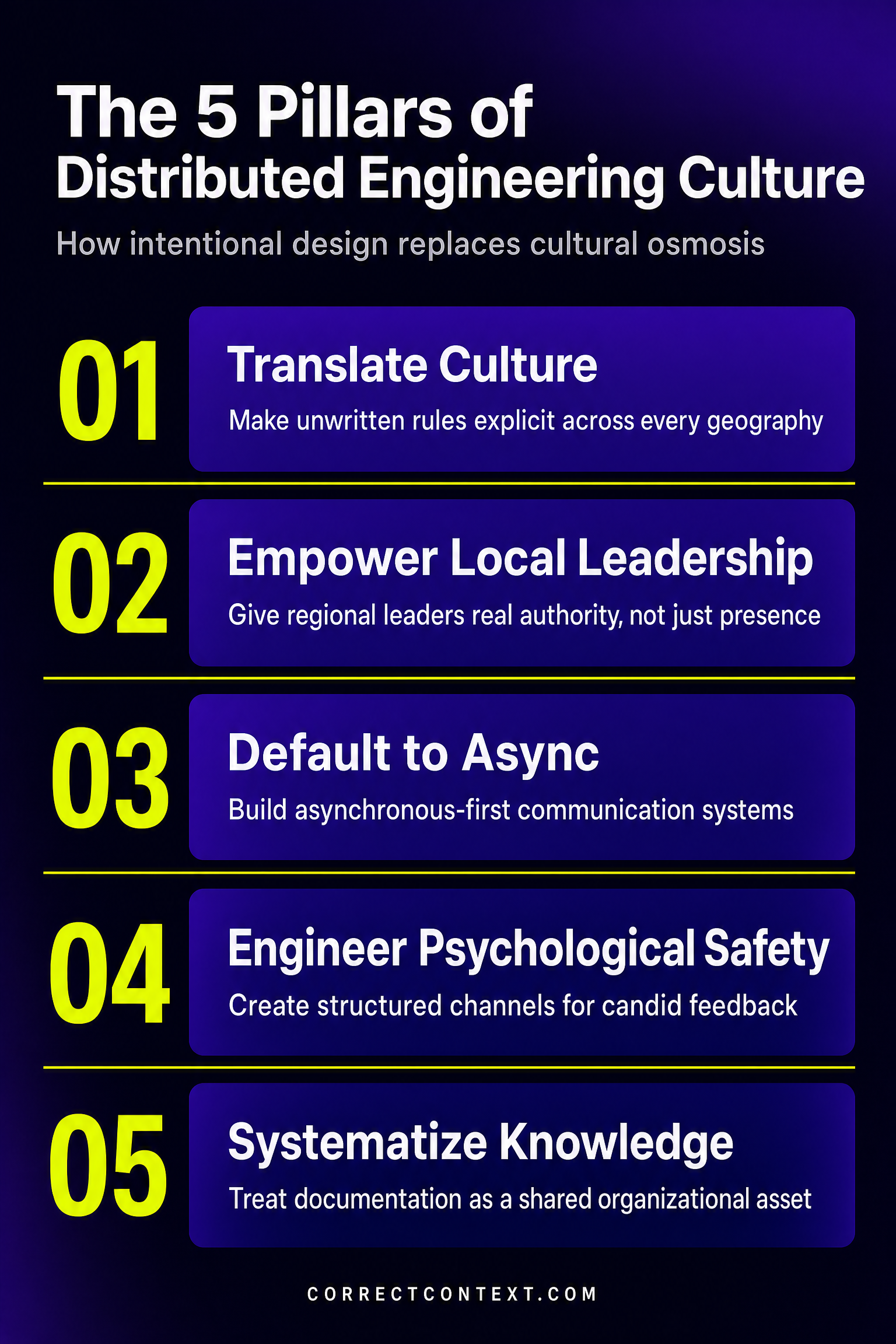
For enterprise innovation units and Series A+ startups scaling their dedicated software team or extended engineering team in regions like Poland or the broader CEE, the following five pillars form the foundation of a durable distributed culture.
1. Translate Culture, Don’t Assume It Travels
Headquarters culture rarely travels well on its own. Deloitte’s 2026 Global Human Capital Trends report, based on a survey of more than 9,000 business and HR leaders globally, emphasizes that purpose, values, and culture must evolve from static statements into living parts of the organization [3]. For distributed teams, this means explicitly defining what core values look like in practice across different geographies.
If your company values “radical transparency,” what does that mean for an engineer in Warsaw attending a planning call with New York leadership? If it means “speak up in real time,” that norm needs to be stated, modeled, and rewarded—not assumed. Companies that make their unwritten cultural rules legible to people who don’t share their language or context consistently outperform those that rely on cultural osmosis.
2. Empower Local Leadership—Genuinely
One of the most consistent findings in distributed team research is the gap between trust and influence. Regional leaders often report feeling respected but underpowered. They are trusted to execute, but not to shape strategy. This dynamic quietly erodes culture by signaling to local teams that their context, their market knowledge, and their judgment are secondary.
For organizations that hire developers in Poland or build an engineering hub in Europe, local leaders must have real decision-making authority. This means codifying which decisions are made locally, which require HQ input, and which are purely advisory. It also means creating formal mechanisms—strategy summits, reverse briefings, innovation pipelines—through which regional insights feed back into global strategy. The HBR research describes the people who carry this bridging work as “bridge people,” noting that their attrition runs roughly twice that of domestic peers [2]. Protecting and rewarding them is not just a culture investment; it is a talent retention imperative.
3. Default to Asynchronous Communication
The instinct to replicate in-office communication patterns in a distributed setting—through back-to-back video calls and synchronous standups across time zones—is one of the most common and costly mistakes in remote team culture management. Gallup research consistently shows that the manager alone accounts for 70% of the variance in team engagement [4]. When managers default to synchronous-only communication, they inadvertently exclude team members in inconvenient time zones and create a two-tier culture.
High-performing distributed teams build asynchronous-first communication systems: structured written updates, shared decision logs, and documented processes that allow any team member to contribute meaningfully regardless of when they are online. This is especially critical for cloud engineering teams, data engineering teams, and AI development teams, where deep work requires uninterrupted focus blocks that synchronous meeting cultures destroy.
4. Engineer Psychological Safety Deliberately
Psychological safety—the shared belief that team members can take interpersonal risks without fear of negative consequences—is a foundational element of high-performing engineering teams. In distributed environments, it does not emerge organically. It must be engineered.
The practical implications for team alignment in remote settings are significant. Leaders must create structured opportunities for engineers to raise concerns, propose ideas, and give candid feedback through channels that do not require speaking up in a live video call. Asynchronous retrospectives, anonymous pulse surveys, and regular one-on-ones focused on growth rather than status updates all contribute to building the psychological safety that enables remote software engineers to perform at their best.
5. Systematize Knowledge and Process
Ad-hoc knowledge sharing is the silent killer of distributed culture. When critical context lives in the heads of a few senior engineers at headquarters, or in Slack threads that new hires cannot access, the distributed team is perpetually operating at an information disadvantage. This creates a second-class experience that erodes belonging and alignment.
Organizations that scale software development successfully treat knowledge as a shared organizational asset. This means investing in documentation infrastructure, onboarding playbooks, and decision logs that are accessible to every member of the offshore development team or nearshore development team, regardless of their location or tenure.
The Productivity and Well-being Balance
A common misconception is that distributed work is inherently less productive. The data does not support this. A 2025 Great Place to Work study of 1.3 million employees found that productivity at companies supporting remote and hybrid work is nearly 42% higher than at typical U.S. workplaces [5]. Of the 2025 Fortune 100 Best Companies to Work For, 97 support remote or hybrid work.
However, the same research surfaces an important nuance: fully remote workers can experience higher levels of stress and isolation if the culture does not actively support them. The solution is not to bring everyone back to the office—McKinsey’s 2025 research confirms that the working model itself is far less important than the work environment leaders create [6]. The five core practices that drive performance—collaboration, connectivity, innovation, mentorship, and skill development—matter across all working models. The question is whether they are being intentionally designed for.
What This Means for Enterprise Leaders and Scaling Startups
For CTOs and enterprise innovation leaders managing a dedicated development team or an extended engineering team across geographies, the strategic takeaway is clear: distributed engineering culture is a design problem, not a distance problem. The organizations that thrive are those that treat culture as an intentional system to be built, not a natural byproduct of co-location.
For Series A+ startups in FinTech, Software, and Media scaling their startup development team globally, the window to establish strong cultural infrastructure is narrow. The habits, norms, and systems you build in the first 50 to 200 engineers will define your culture at 500. Investing in cultural design early—before fragmentation sets in—is significantly less costly than attempting a cultural repair at scale.
Whether you are building an AI development team, a platform engineering team, or a big data development team distributed across the US, UK, DACH, and CEE, the principles are the same: translate your culture explicitly, empower local leaders with real authority, default to asynchronous communication, engineer psychological safety, and systematize knowledge sharing. These are not soft initiatives. They are the operational infrastructure of a high-performing distributed engineering organization.
References
[1] Gartner. (2024). How to Connect a Distributed Workforce to Organizational Culture
[2] Harvard Business Review. (July 2026). How Highly Effective Global Teams Collaborate Across Cultures
[3] Deloitte Insights. (March 2026). 2026 Global Human Capital Trends: From Tensions to Tipping Points.
[4] Gallup. A Strategic Guide for Managing Hybrid and Remote Teams
[5] Great Place to Work. (2025). Remote Work Productivity Study: Surprising Findings From a 4-Year Analysis
[6] McKinsey & Company. (February 2025). Returning to the office? Focus more on practices and less on the policy
Table of content
Related articles



About the Author: Marta