
HR Compliance in Poland: The Complete 2026 Guide for IT Companies — UoP vs B2B Contracts, Labor Law Changes, and the PIP Reclassification Risk
Starting July 2026, Polish labor inspectors will gain unprecedented power to reclassify B2B contracts as employment agreements — exposing companies to retroactive social security payments, penalties, and compliance nightmares. If you hire developers in Poland, this is the most consequential regulatory shift in years. This guide breaks down everything you need to know about UoP vs B2B contracts, the 2026 labor law changes, and how to protect your business from reclassification risk.
The Polish Labor Law Landscape: Why 2026 Changes Everything
Poland has become one of Europe’s most attractive destinations for IT talent. With over 546,000 IT professionals, competitive salaries 40–60% below Western European levels, and a deep pipeline of engineering graduates from world-class universities like Warsaw University of Technology and AGH Krakow, the country draws companies from DACH, Benelux, the UK, and the US seeking to build or scale engineering teams.
But hiring in Poland is not plug-and-play. The regulatory environment is complex, and 2026 brings the most significant changes in years. The December 2025 amendment to the Act on the State Labour Inspectorate gives the National Labour Inspectorate (Państwowa Inspekcja Pracy, or PIP) new powers to reclassify civil-law contracts — including B2B agreements — as employment contracts if the working relationship resembles subordinate employment.
This is not theoretical. The changes take effect July 1, 2026, and reclassification decisions will be immediately enforceable. Companies found non-compliant face retroactive obligations to pay social security contributions (ZUS), compliance with all employment-related statutory entitlements, and penalties up to PLN 30,000 per worker.
UoP vs B2B: Understanding the Fundamental Difference
Before diving into compliance risks, you need to understand the structural differences between Poland’s two primary contract types for IT professionals.
Umowa o Pracę (UoP) — Employment Contract
The UoP is governed by the Polish Labour Code and represents the traditional employment relationship. Your company pays the employee a gross salary, withholds personal income tax (PIT), and remits both employee and employer social security contributions to ZUS. The employer bears the full administrative burden and cost of compliance.
Key characteristics of UoP:
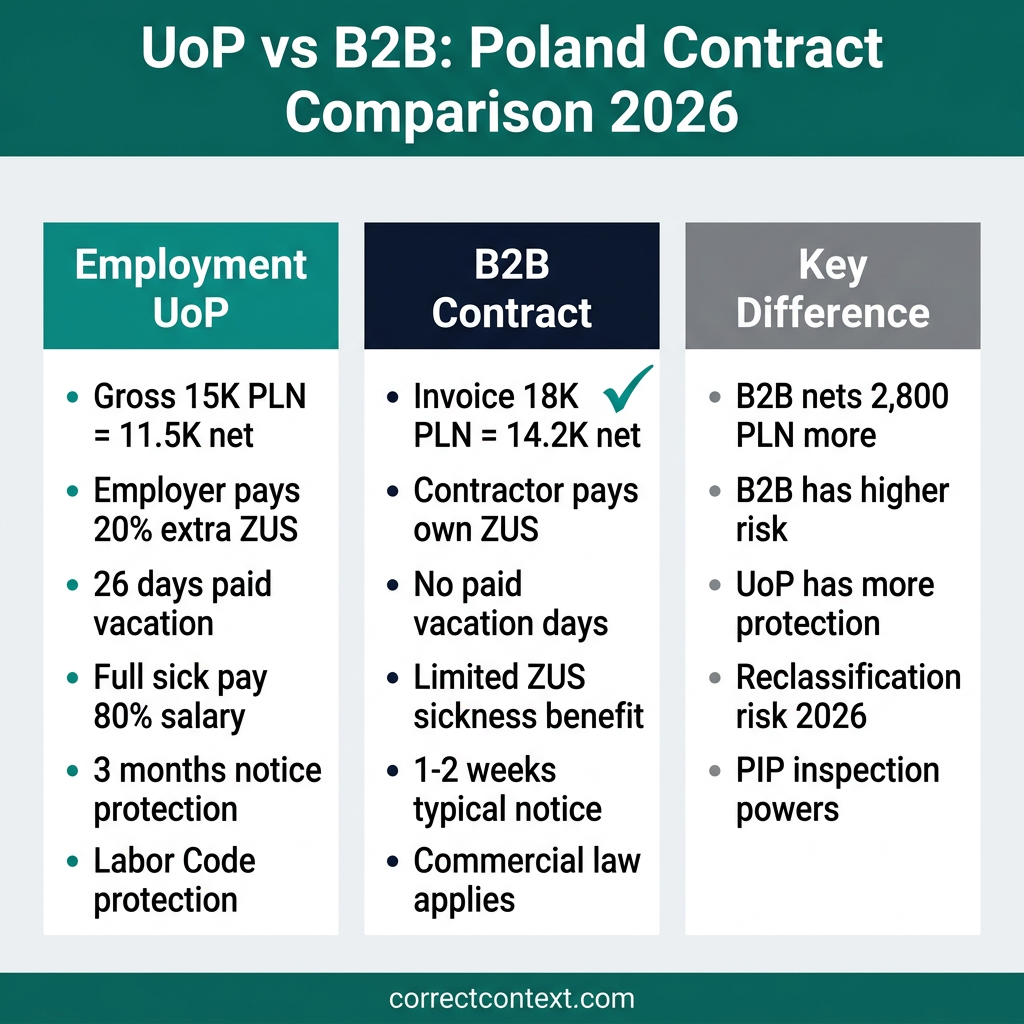
- Gross-to-net calculation: For a gross salary of PLN 15,000, the employee receives approximately PLN 11,527 net, while the employer’s total cost is approximately PLN 18,100
- Employer ZUS contributions: 19.21–22.41% of gross salary on top of the gross wage
- Paid annual leave: 20 or 26 days depending on employment history
- Sick pay: Employer pays 80% of salary for the first 33 days, then ZUS pays 80%
- Notice period: 1–3 months depending on tenure
- Job protections: Pregnant employees, pre-retirement workers, and others enjoy additional protections
B2B Contract — Civil-Law Agreement
A B2B contract means the contractor operates as a sole proprietorship (jednoosobowa działalność gospodarcza, or JDG) and invoices your company for services rendered. The contractor is an entrepreneur, not an employee, and assumes responsibility for their own taxes, social security, and business costs.
Key characteristics of B2B:
- Invoice-based payment: Contractor issues VAT invoices (or VAT-exempt invoices if below the PLN 200,000 threshold)
- Contractor-paid ZUS: The contractor pays their own social security contributions, which vary based on business age and revenue
- No paid leave: Every day off is unpaid — the contractor must factor this into their rate
- Limited sick pay: Only available if the contractor pays the voluntary sickness contribution (2.45%), and benefits are based on the ZUS contribution base (~PLN 4,765), not the actual billing rate
- Flexible termination: Notice periods are contractually defined — often 1–2 weeks or even immediate
- Full liability: The contractor bears full personal financial liability for their work
The Financial Reality: Cost Comparison with Real Numbers
Companies often choose B2B contracts for cost savings. But the math is more nuanced than it appears. Here’s a detailed breakdown at three common salary levels:
| Cost Component | UoP (15,000 PLN gross) | B2B (18,000 PLN invoice) |
|---|---|---|
| Employee/Contractor Net | 11,527 PLN | 14,240 PLN (lump-sum) / 13,709 PLN (flat tax) |
| Employer Total Cost | 18,100 PLN | 18,000 PLN |
| Social Security (ZUS) | Employer pays ~3,050 PLN | Contractor pays ~1,600 PLN (full ZUS) |
| Paid Vacation Cost | Included in gross | Contractor bears ~3,120 PLN/month equivalent |
| Sick Pay Coverage | 80% of salary guaranteed | ~2,000 PLN/month max if opted in |
| Notice Period Cost | 1–3 months protected | Contract-dependent, often minimal |
At the PLN 15,000 gross / PLN 18,000 invoice level, the B2B contractor takes home approximately PLN 2,800 more per month under lump-sum taxation. But this advantage diminishes when you factor in the contractor’s lost benefits, administrative costs, and risk premium.
For the employer, the total cost is nearly identical — PLN 18,100 for UoP versus PLN 18,000 for B2B. The savings are minimal, while the compliance risks are substantial.
Tax Systems for B2B Contractors
B2B contractors in Poland choose from three tax regimes:
1. Lump-sum tax (Ryczałt) — 12% for IT services
Tax is calculated on revenue (not profit) at a flat 12% rate for software developers, web developers, and IT consultants under PKD codes 62.xx–63.xx. No expense deduction allowed. Health insurance is fixed by revenue bracket (PLN 461, 769, or 1,384/month).
2. Flat income tax (Podatek liniowy) — 19%
Tax is calculated on income (revenue minus deductible expenses) at a flat 19% rate. Best for contractors with high business costs. Since 2022, health insurance (4.9% of income) is not deductible from tax.
3. Progressive tax scale (Skala podatkowa) — 12%/32%
Default rate of 12% up to PLN 120,000 income, 32% above. Rarely optimal for IT contractors earning above PLN 85,500 annually.
The 2026 Labor Law Changes: What Employers Must Know
Poland’s labor market is undergoing structural reforms in 2026. Here are the critical changes affecting IT employers:
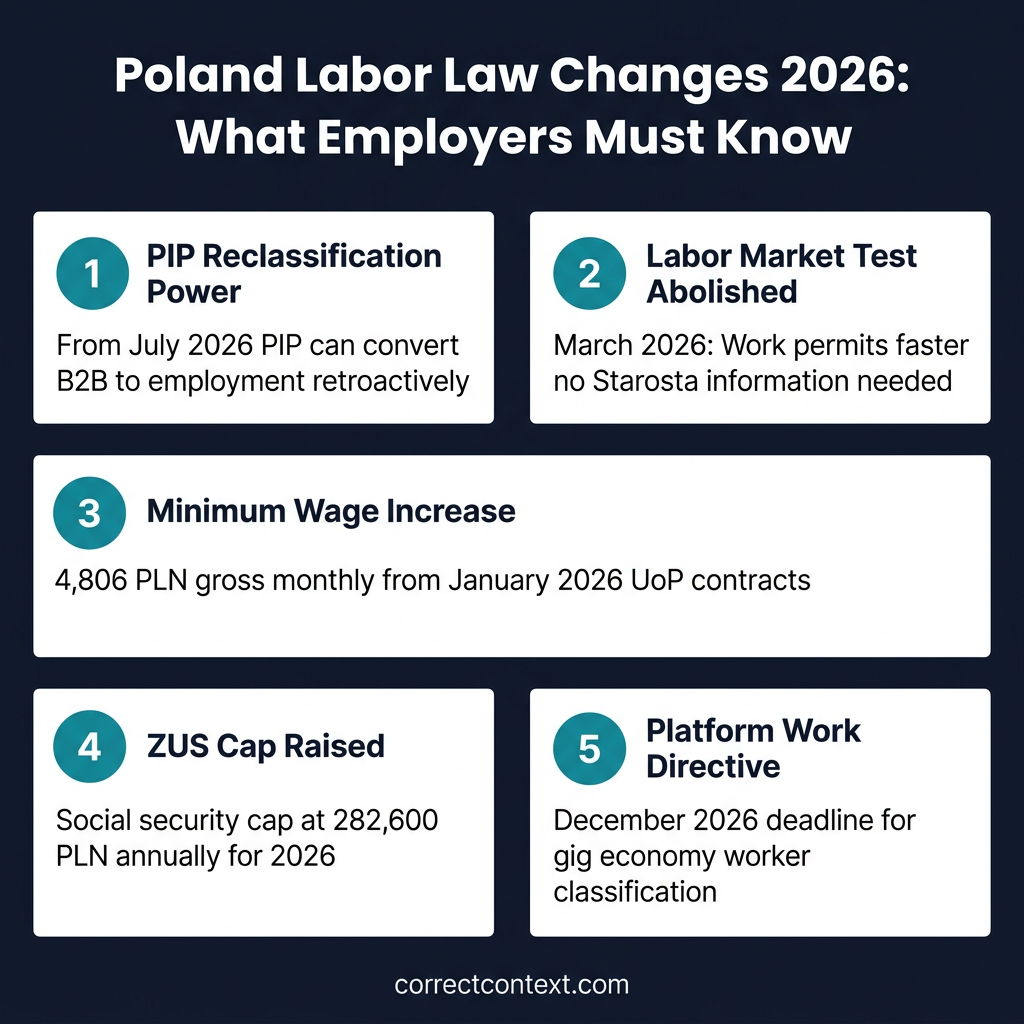
1. PIP Reclassification Powers (Effective July 1, 2026)
The most consequential change: the National Labour Inspectorate gains statutory authority to convert civil-law service contracts (B2B agreements, umowy zlecenia, umowy o dzieło) into standard employment contracts if the day-to-day reality resembles subordinate work.
Reclassification decisions are immediately enforceable, exposing employers to:
- Retroactive payment of all social security contributions (ZUS) with interest
- Compliance with all employment-related statutory entitlements (paid leave, sick pay, notice periods)
- Penalties up to PLN 30,000 per worker
- Potential work permit violations for foreign nationals (requiring ICT permits or standard work permits)
The distinction between B2B and employment depends on the actual nature of the working relationship, not just contractual terms. Key criteria include independence of work performance, legal framework, and personal performance obligation.
2. Labor Market Test Abolished (Effective March 2026)
Poland removed the “informacja starosty” (labor market test) from standard work-permit applications. Employers can now submit work-permit petitions with a signed employment contract, proof of qualifications, and standard corporate documents — cutting lead times by approximately one month.
This accelerates foreign hiring but increases the importance of proper contract classification. A reclassified B2B contract for a foreign national could invalidate their work authorization.
3. Minimum Wage Increase (Effective January 1, 2026)
The minimum monthly wage for UoP contracts is PLN 4,806 gross. While this doesn’t directly affect IT salaries, it sets the floor for employment contracts and affects ZUS contribution calculations.
4. ZUS Contribution Cap Raised (2026)
Social security contributions are capped at PLN 282,600 annually (approximately PLN 23,550 monthly). Beyond this threshold, neither employer nor employee pays additional pension or disability contributions.
5. Platform Work Directive (Deadline December 2026)
Poland must implement the EU Platform Work Directive by December 2026, further tightening classification rules for gig economy workers and potentially affecting how IT contractors are engaged.
| Regulatory Change | Effective Date | Impact on IT Employers |
|---|---|---|
| PIP B2B Reclassification Powers | July 1, 2026 | High — immediate enforcement, retroactive obligations |
| Labor Market Test Abolished | March 2026 | Positive — faster work permits for foreign hires |
| Minimum Wage Increase | January 1, 2026 | Low — IT salaries well above minimum |
| ZUS Cap Raised | January 1, 2026 | Moderate — affects high earners above PLN 23,550/month |
| Platform Work Directive | December 2026 | Moderate — additional classification requirements |
B2B Reclassification Risk: The Six Red Flags PIP Inspectors Look For
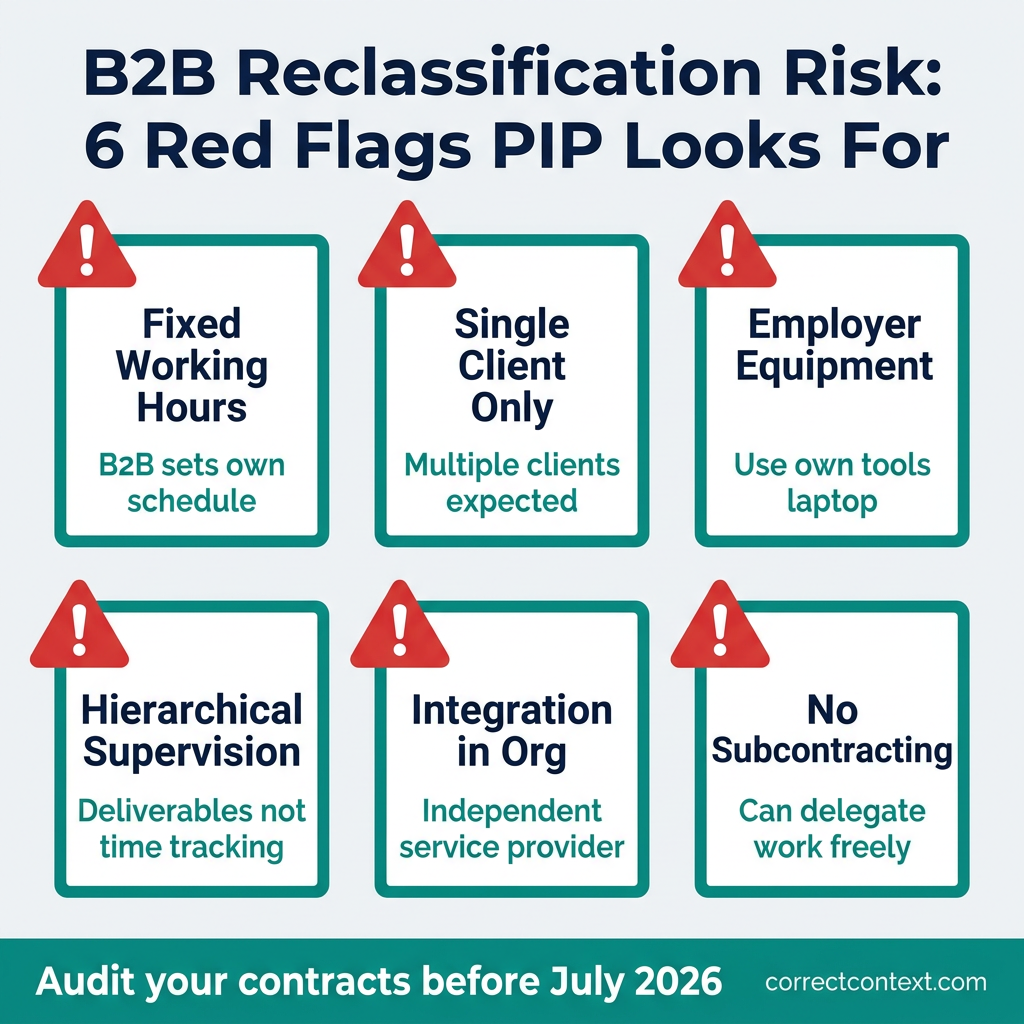
To avoid reclassification, you must ensure your B2B arrangements genuinely reflect independent contractor relationships. PIP inspectors evaluate multiple factors — no single factor is determinative, but the presence of several increases risk substantially.
Red Flag 1: Fixed Working Hours
B2B contractors should set their own schedules. If your contractor must work 9–5, attend daily standups at fixed times, or adhere to your company’s core hours, this resembles employment.
Risk mitigation: Define deliverables and deadlines, not working hours. Allow contractors to determine when and how they complete work.
Red Flag 2: Single Client Dependency
B2B contractors should serve multiple clients or at least have the contractual freedom to do so. A contractor working exclusively for your company for an extended period looks like an employee.
Risk mitigation: Contractually permit contractors to serve other clients. Don’t require exclusivity clauses unless genuinely justified by project confidentiality.
Red Flag 3: Employer-Provided Equipment
B2B contractors should use their own tools, laptops, software licenses, and equipment. Providing company equipment suggests subordination.
Risk mitigation: Require contractors to use their own equipment. If project requirements demand specific tools, consider equipment stipends rather than direct provision.
Red Flag 4: Hierarchical Supervision
B2B contractors should be managed by deliverables, not by time or process. If a manager directs how work is performed, monitors activity throughout the day, or controls methods, this indicates employment.
Risk mitigation: Define outcomes and acceptance criteria. Avoid micromanagement. Contractors should determine the methods and approaches they use.
Red Flag 5: Integration into Organizational Structure
B2B contractors should operate outside your organizational hierarchy. If they report to a manager, participate in employee performance reviews, or are included in org charts, this suggests employment.
Risk mitigation: Maintain clear separation. Contractors should have a primary point of contact for project coordination, not a reporting manager.
Red Flag 6: No Subcontracting Rights
B2B contractors should have the right to delegate or subcontract work. Employees must perform work personally; contractors should have flexibility.
Risk mitigation: Contractually permit subcontracting with appropriate confidentiality and quality safeguards.
GDPR and Data Protection Compliance
Beyond labor law, IT employers in Poland must navigate GDPR compliance. The General Data Protection Regulation applies fully in Poland, supplemented by the Polish Personal Data Protection Act.
Key requirements for HR data processing:
- Lawful basis: Employment contracts (Article 6(1)(b)) or legal obligations (Article 6(1)(c)) typically provide lawful basis for employee data processing
- Data minimization: Collect only data necessary for the employment relationship
- Retention limits: Employee data should not be retained indefinitely after employment ends
- Cross-border transfers: Transferring employee data outside the EU requires adequate safeguards (Standard Contractual Clauses, adequacy decisions, or binding corporate rules)
- Data subject rights: Employees have rights to access, rectification, erasure, and data portability
For B2B contractors, the lawful basis is typically contract performance (Article 6(1)(b)) or legitimate interest (Article 6(1)(f)), but the distinction matters. Misclassified contractors may have enhanced data subject rights as employees.
Work Permits and Foreign National Hiring
With 1.29 million foreign nationals now registered for social security in Poland, international hiring is no longer a backup plan — it’s core to workforce strategy. But 2026 changes affect how foreign IT professionals are engaged.
Work Permit Types
Type A: For foreign nationals employed by a Polish entity on UoP. Most common for direct hires.
Type B: For foreign nationals working as board members or representatives of Polish companies.
Type C: For intra-company transfers (ICT) — employees of foreign companies assigned to Polish branches.
Simplified procedure for Ukrainians: Ukrainian citizens can work legally with a simplified notification system (employer notifies the labor office within 7 days). This remains available through at least March 2027 but is expected to phase out gradually.
The B2B Risk for Foreign Nationals
Foreign nationals working on B2B contracts in Poland face heightened reclassification risk. If PIP reclassifies a B2B contract as employment:
- The foreign national may lack proper work authorization for employment
- The company may face penalties for illegal employment
- Residence permits may be jeopardized
For foreign hires, UoP with a proper work permit is often the safer path despite higher costs.
Compliance Checklist: Preparing for July 2026
Use this checklist to audit your Polish hiring practices before the PIP reclassification powers take effect:
Immediate Actions (Before July 2026)
- Audit all existing B2B contracts for reclassification risk factors
- Review contractor working practices — not just contract language
- Identify high-risk engagements (single client, fixed hours, company equipment)
- Consult Polish employment counsel on reclassification exposure
- Develop migration plans for high-risk contractors (convert to UoP or restructure engagement)
Contract Review
- Ensure B2B contracts specify deliverables, not time-based requirements
- Remove exclusivity clauses unless legally justified
- Add subcontracting rights with appropriate safeguards
- Clarify that contractors control methods and working hours
- Include limitation of liability clauses appropriate for commercial relationships
Operational Changes
- Train managers on contractor vs. employee distinctions
- Separate contractor onboarding from employee onboarding
- Ensure contractors use their own equipment and tools
- Avoid including contractors in employee performance management systems
- Document the business rationale for B2B engagements
Foreign National Compliance
- Verify work permit types match actual working arrangements
- Review B2B engagements with foreign nationals for reclassification risk
- Consider converting high-risk foreign B2B contractors to UoP with proper work permits
- Monitor changes to the simplified procedure for Ukrainian workers
Key Takeaways
- The July 2026 PIP reclassification powers are a game-changer. Polish labor inspectors can retroactively convert B2B contracts to employment, exposing companies to significant back-payment obligations and penalties.
- B2B cost savings are smaller than they appear. At typical IT salary levels, employer costs for UoP and B2B are nearly identical — approximately PLN 18,000/month for a mid-level developer.
- Six red flags trigger reclassification risk: Fixed working hours, single client dependency, employer-provided equipment, hierarchical supervision, organizational integration, and no subcontracting rights.
- Foreign nationals face heightened risk. Reclassified B2B contracts for foreign workers may invalidate work permits and residence authorizations.
- The labor market test abolition accelerates hiring. Work permits now process faster, but proper contract classification is critical.
- Audit before July 2026. Companies should review all B2B engagements, identify high-risk relationships, and develop remediation plans before the new powers take effect.
- Documentation matters. PIP evaluates actual working practices, not just contract language. Ensure reality matches contractual intent.
Frequently Asked Questions
What is the difference between UoP and B2B contracts in Poland?
UoP (Umowa o Pracę) is an employment contract governed by the Polish Labour Code. The employer pays gross salary, withholds taxes, and remits ZUS social security contributions. Employees receive paid vacation, sick pay, and job protections. B2B is a civil-law contract where the contractor operates as a sole proprietorship, invoices for services, and pays their own taxes and ZUS. B2B contractors have no paid leave, limited sick benefits, and fewer protections.
What are the new PIP reclassification powers in 2026?
Starting July 1, 2026, Poland’s National Labour Inspectorate (PIP) can reclassify B2B contracts and other civil-law agreements as employment contracts if the working relationship resembles subordinate employment. Reclassification decisions are immediately enforceable and expose employers to retroactive ZUS payments, compliance with employment entitlements, and penalties up to PLN 30,000 per worker.
How much does it cost to hire a developer in Poland on UoP vs B2B?
For a mid-level developer at PLN 15,000 gross monthly on UoP, the employer’s total cost is approximately PLN 18,100, and the employee receives PLN 11,527 net. For an equivalent B2B engagement at PLN 18,000 invoice, the employer pays PLN 18,000, and the contractor receives approximately PLN 14,240 net (under lump-sum taxation). The employer cost is nearly identical; the difference is in who bears the risk and administrative burden.
What triggers B2B reclassification in Poland?
PIP inspectors evaluate whether the working relationship resembles employment. Key risk factors include: fixed working hours (contractors should set their own schedule), single client dependency, use of employer equipment, hierarchical supervision, integration into organizational structure, and inability to subcontract. No single factor is determinative, but multiple factors increase reclassification risk.
Should foreign IT workers be hired on UoP or B2B in Poland?
For foreign nationals, UoP with a proper work permit is generally safer. If PIP reclassifies a B2B contract as employment, the foreign worker may lack proper work authorization, exposing both the worker and employer to penalties. The March 2026 abolition of the labor market test makes work permits faster to obtain, reducing the historical advantage of B2B for foreign hires.
What is the ZUS contribution cap in Poland for 2026?
Social security contributions (pension and disability) are capped at PLN 282,600 annually (approximately PLN 23,550 monthly). Above this threshold, neither employer nor employee pays additional pension or disability contributions. Health insurance (9% for employees) continues without cap.
Sources
- Woźniak Legal — Poland’s 2026 Labour Shake-Up: B2B Contracts at Risk (December 2025)
- VisaHQ — Polish employers warned: B2B contractors may be reclassified as employees from July 2026 (April 2026)
- b2b-vs-uop.pl — B2B Contract vs Employment in Poland 2026 — Complete Guide
- Freenance — B2B vs Employment Contract in Poland 2026 — Which Pays More?
- Ntiative — Four different contracts to employ staff in Poland (Updated: 2026)
- PolishTax — The True Cost of Hiring an Employee in Poland: Gross vs Net & Employer Cost (2026)
- Employsome — Hiring in Poland: Complete 2026 Employer Guide
- VisaHQ — Poland abolishes Labour-Market Test for most work-permit cases, accelerating foreign hiring (March 2026)
- Careers in Poland — New regulations for foreign workers in Poland in 2026
- ICLG — Data Protection Laws and Regulations Report 2025-2026 Poland
- Correct Context — IT Talent in Poland: The Complete 2025 Guide for Tech Companies
- ISACA — 1 in 3 Tech Pros Switched Jobs, Leaving 74% of Firms Worried About IT Talent Retention (2025)