
10 Ways to Build a High-Performance Engineering Culture in Polish Tech Companies (2025-2026)
Here’s a number that should keep every CTO in Poland awake at night: 36% of highly skilled tech professionals in Europe are actively considering changing employers in 2025, according to Universum’s Talent Outlook research. In the Polish IT market specifically, where competition for engineering talent has reached fever pitch, your company culture isn’t just a nice-to-have—it’s the single biggest competitive advantage you have.
But here’s the twist: most companies get culture wrong. They think it’s about free snacks, ping-pong tables, or mandatory fun. The data tells a different story. Google’s landmark Aristotle Project found that psychological safety—the belief that you won’t be punished for making mistakes—matters more than any other factor in building high-performing teams. Yet 73% of HR managers report change fatigue among their staff, and 55% say their current tools don’t help them meet their needs, according to Gartner’s 2025 HR predictions.
This article gives you 10 evidence-based strategies to build an engineering culture that attracts, retains, and gets the best out of Polish tech talent. These aren’t theoretical ideas—they’re practices that companies like Google, Spotify, and successful Polish startups have validated with results.
What Engineering Culture Actually Means (And Why Most Definitions Miss the Mark)
Before diving into the strategies, let’s get clear on what we’re talking about. Engineering culture isn’t your mission statement plastered on a wall. It’s the collection of shared values, behaviors, and practices that determine how your engineering team makes decisions, solves problems, and treats each other.
The Polish IT sector presents unique cultural considerations. With 53.8% of IT professionals on employment contracts (UoP) and 38.5% on B2B contracts according to Bulldogjob’s 2025 report, you’re managing a workforce with different employment relationships, risk profiles, and expectations. Add in the fact that Poland has become one of Europe’s top tech talent hubs—Warsaw, Krakow, and Wroclaw now rank alongside Berlin and Amsterdam for startup density—and the stakes for getting culture right have never been higher.
The attrition rate across European tech hit 17.4% in the last 12 months (Ravio Compensation Trends Report, October 2025). In Poland’s overheated IT market, that number is likely higher. Replacing an employee costs up to 200% of their annual salary according to SHRM research. For a senior software engineer earning PLN 25,000 monthly, that’s a PLN 600,000 hit every time someone walks out the door.
Culture is your defense against this exodus—and your offense for attracting the best talent.
1. Build Psychological Safety as Your Foundation
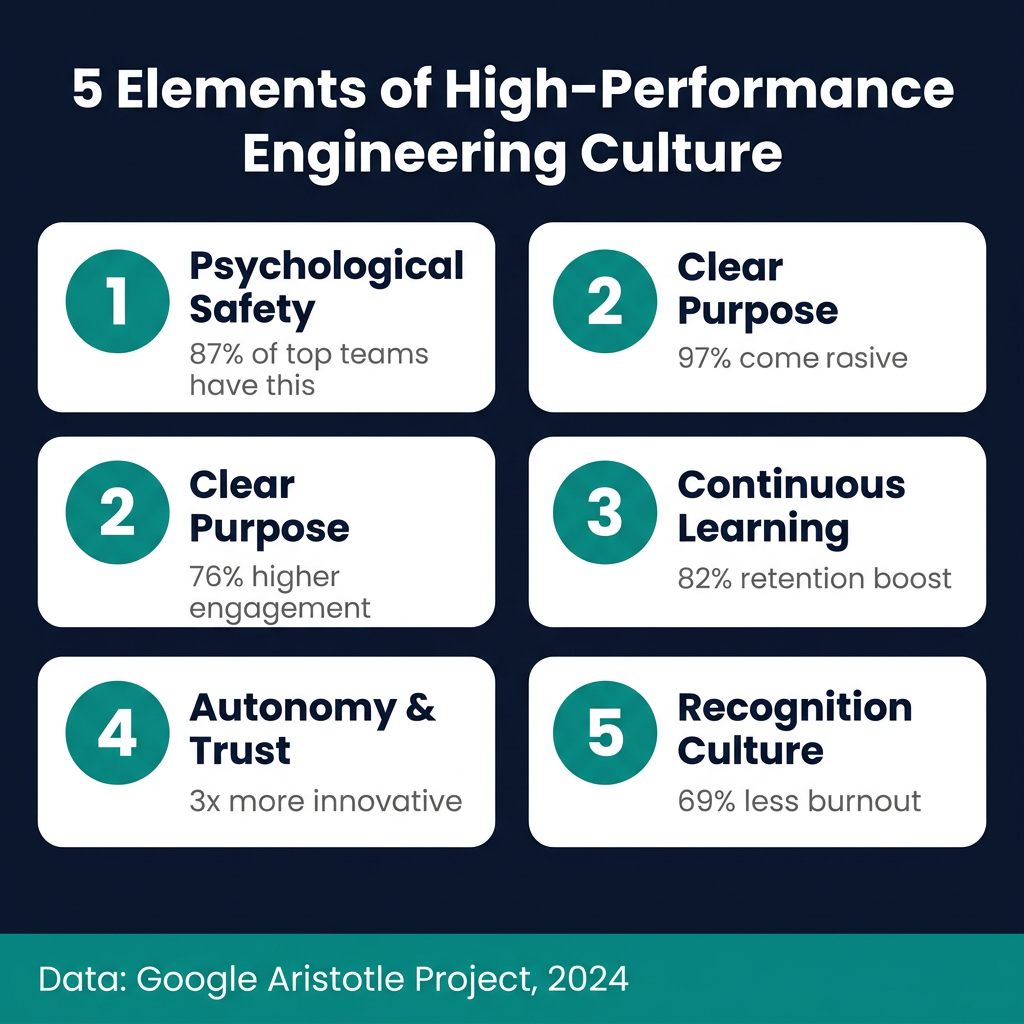
Google’s Project Aristotle studied 180 teams across the company to answer one question: What makes teams effective? After years of research, they found one factor mattered more than anything else: psychological safety.
Psychological safety means team members feel safe to take risks, admit mistakes, and voice dissenting opinions without fear of punishment or humiliation. It’s not about being nice—it’s about being able to have hard technical discussions without personal attacks.
How to implement this in Polish engineering teams:
- Model vulnerability from leadership: When CTOs and VPs openly discuss their own mistakes and learning moments, it signals that failure is part of the process. Share your “greatest hits” of bugs that made it to production and what you learned.
- Structure blameless postmortems: After any incident, focus on systemic factors rather than individual blame. Ask “How did our systems allow this to happen?” not “Who messed up?”
- Actively solicit dissent: In meetings, explicitly ask junior engineers for their opinions first. Research shows that when senior people speak first, junior voices get suppressed.
- Respond productively to failure: When someone admits an error, thank them for the transparency and focus on learning. The message should be: “I’m glad you told us. Let’s figure out how to prevent this next time.”
Polish workplace culture has historically valued hierarchy and deference to authority. Building psychological safety requires actively counteracting these tendencies. One engineering manager at a Krakow fintech told us: “I had to train myself to wait 10 seconds after asking a question in meetings. The silence feels uncomfortable, but that’s when the best ideas emerge.”
2. Define and Live Your Engineering Values
Values aren’t what you write on your careers page. They’re what you reward, what you punish, and what you tolerate. Netflix’s famous culture deck works because it explicitly states what behaviors get people promoted and what gets them fired.
How to develop engineering values that stick:
- Involve the team in defining them: Don’t hand down values from the C-suite. Run workshops where engineers discuss what behaviors they want to see more and less of.
- Make them specific and behavioral: “We value excellence” means nothing. “We ship code with >90% test coverage” is actionable.
- Integrate them into every people process: Use values in hiring rubrics, performance reviews, promotion criteria, and recognition programs. If they’re not in these systems, they don’t exist.
- Be willing to fire for values violations: Nothing destroys culture faster than tolerating a high-performer who treats people poorly. When you let toxic behavior slide, you signal that values are optional.
Consider how Spotify’s engineering culture emphasizes “aligned autonomy”—teams are aligned on goals but autonomous in how they achieve them. This value shapes everything from their squad structure to their decision-making processes.
Polish companies often struggle with this because of the cultural emphasis on consensus and avoiding conflict. Strong values require being explicit about trade-offs. For example: “We prioritize shipping speed over perfect code” is a value that will alienate some engineers and attract others. That’s the point—values are supposed to be polarizing.
3. Invest in Continuous Learning and Development
Here’s a statistic that should shape your L&D budget: 74% of employees say they’re more likely to stay if their employer invests in technology that supports career development (Gartner). Yet McKinsey’s 2025 HR Monitor found that 32% of employees don’t have the skills they need to perform in their current roles.
In tech, skills become obsolete fast. An engineer who isn’t learning is an engineer who is becoming less valuable. Your culture needs to make continuous learning non-negotiable.
Practical approaches for Polish engineering teams:
- Dedicate time for learning: Give engineers 10-20% time for self-directed learning, experimentation, and side projects. Google made this famous with their 20% time policy.
- Fund conference attendance: Send engineers to conferences like Devoxx Poland, infoShare, or international events. Require them to present learnings to the team afterward.
- Build internal tech talks: Weekly or bi-weekly sessions where engineers present on topics they’ve mastered. This builds expertise and presentation skills simultaneously.
- Support certifications and courses: Budget for AWS certifications, Coursera subscriptions, or advanced degrees. Make it clear that professional growth is expected and funded.
- Create rotation programs: Let engineers spend time in different teams or roles. A backend engineer who spends a month with the DevOps team gains invaluable perspective.
The Polish IT education system produces strong theoretical foundations, but the half-life of technical knowledge is shorter than ever. Companies that build learning cultures attract engineers who want to grow—and those are exactly the engineers you want.
4. Design for Autonomy and Ownership
Daniel Pink’s research on motivation identified three key drivers: autonomy, mastery, and purpose. Autonomy—the ability to direct your own work—ranks highest for knowledge workers.
Micromanagement kills engineering culture. Engineers are problem-solvers by nature. When you prescribe solutions instead of problems, you turn them into code monkeys—and they will leave for companies that treat them like adults.
How to build autonomy into your engineering culture:
- Define outcomes, not methods: Tell engineers what needs to be achieved and why. Let them figure out how. “Reduce API latency by 50%” is an outcome. “Rewrite the service in Go” is a method.
- Push decisions to the lowest level: The person closest to the problem usually has the best information to solve it. Create clear escalation paths, but default to local decision-making.
- Let teams own their services: Adopt a “you build it, you run it” model where teams are responsible for their code in production. This creates skin in the game and better engineering decisions.
- Minimize approval gates: Every approval process is a bottleneck and a signal of distrust. Automate what you can (tests, linting) and eliminate redundant human approvals.
Spotify’s squad model exemplifies this. Squads are small, cross-functional teams with clear missions and high autonomy. They decide what to build, how to build it, and how to work together. This structure scales autonomy without creating chaos.
In Poland, where many engineers have experience with outsourcing companies that often prescribe detailed specifications, offering genuine autonomy can be a powerful differentiator. One Warsaw-based CTO told us: “We lost candidates to Western companies until we started offering real ownership of features. Polish engineers want to build products, not just write code to spec.”
5. Create Clear Career Progression Paths
Here’s a sobering finding from iHire’s 2025 Talent Retention Report: 35.9% of workers quit a job in the past year, with lack of growth opportunities being a top driver. In tech specifically, engineers who don’t see a path forward will find one elsewhere.
Career progression in engineering isn’t just about becoming a manager. In fact, many excellent engineers make terrible managers—and forcing them into management roles to advance is a recipe for losing talent.
Best practices for career ladders:
- Offer parallel tracks: Create equivalent advancement paths for individual contributors (ICs) and managers. A Staff Engineer should have the same compensation and status as an Engineering Manager.
- Define clear competencies: For each level, specify what skills, behaviors, and impact are expected. Don’t leave promotion criteria vague or subjective.
- Publish salary bands: Transparency about compensation reduces anxiety and inequity. More companies are publishing salary ranges for each level.
- Provide regular career conversations: Managers should have dedicated career discussions with direct reports at least quarterly. Not performance reviews—career discussions focused on growth.
- Create visibility into opportunities: Make it easy for engineers to learn about open roles, internal mobility options, and stretch assignments.
Companies like Stripe and Airbnb have published their engineering ladders publicly, setting a standard for the industry. These frameworks typically span levels from Junior Engineer to Staff/Principal Engineer, with clear expectations for technical skills, system design, mentorship, and business impact at each stage.
For Polish companies competing with Western European and US firms, clear career progression is essential. Many Polish engineers leave because they see better growth opportunities abroad. Your culture needs to demonstrate that world-class career development happens here too.
6. Build Recognition into Daily Rituals
Recognition is one of the highest-ROI investments you can make in culture. According to Gartner, 69% of employees report less burnout when they receive regular recognition. Yet many engineering cultures suffer from a feedback desert—engineers ship features that drive millions in revenue and hear nothing.
Engineers are often uncomfortable with public praise, which leads managers to under-recognize. Fight this tendency. Recognition doesn’t have to be elaborate to be effective.
Recognition practices that work:
- Specific praise beats generic: “Great work on the checkout refactor” is weak. “The way you designed the retry logic prevented a cascade failure during yesterday’s traffic spike—that’s exactly the kind of systems thinking we need” is powerful.
- Recognize effort and learning, not just outcomes: Not every project succeeds. Recognize people who take on hard challenges, run good experiments, and learn from failures.
- Create peer recognition systems: Tools like Bonusly or even simple Slack channels where engineers can call out colleagues create a culture of appreciation.
- Celebrate milestones publicly: Ship announcements, demo days, and all-hands shoutouts make recognition visible and reinforce what the organization values.
- Write thoughtful promotion announcements: When someone gets promoted, explain specifically what they did to earn it. This teaches the organization what success looks like.
Polish culture can be reserved about praise, but that doesn’t mean engineers don’t need it. One engineering lead told us: “I started writing detailed thank-you notes to team members after big launches. It felt awkward at first, but the response was overwhelming. People save them.”
7. Optimize Your Meeting and Communication Culture
Nothing kills engineering productivity like death by meetings. The 2024 Stack Overflow Developer Survey found that technical debt is developers’ top frustration at work—but meeting overload runs a close second.
Engineering culture is partly defined by how engineers spend their time. If they’re in meetings all day, they can’t code. If communication is chaotic, they can’t focus.
Meeting culture best practices:
- Default to async: Most updates don’t need a meeting. Write them down. Use Loom for video updates. Reserve meetings for discussion and decision-making, not information-sharing.
- Protect maker time: Institute no-meeting blocks—common options are mornings, afternoons, or specific days. At minimum, protect engineers’ calendars from meetings during their peak productivity hours.
- Make meetings optional by default: If someone doesn’t need to be there, they shouldn’t be. Record meetings for those who can’t attend.
- End meetings early: If you’ve achieved the objective in 20 minutes, end the meeting. Don’t fill the scheduled time.
- Document decisions: Every meeting should produce written output—decisions made, action items with owners, and context for those who weren’t there.
Basecamp (now 37signals) has written extensively about their communication culture. They default to written communication, minimize meetings, and trust employees to manage their own time. The result: highly productive, deeply focused work.
Polish companies often inherit meeting-heavy cultures from corporate traditions. Breaking this pattern requires explicit leadership commitment. One CTO we spoke with implemented “Focus Fridays”—no meetings, no Slack expectations, just deep work. Productivity metrics improved 30%.
| Meeting Type | Purpose | Frequency | Max Duration |
|---|---|---|---|
| Daily Standup | Blocker identification, coordination | Daily | 15 minutes |
| Sprint Planning | Commit to sprint goals | Bi-weekly | 2 hours |
| Retrospective | Process improvement | Bi-weekly | 1 hour |
| 1:1s | Coaching, feedback, career discussion | Weekly | 30-60 minutes |
| Demo/Review | Showcase work, gather feedback | Bi-weekly | 1 hour |
| All-Hands | Company updates, alignment | Monthly | 1 hour |
8. Prioritize Technical Excellence and Sustainable Pace
Engineers want to work with other excellent engineers on technically challenging problems. They also want to go home at a reasonable hour. A culture that sacrifices quality for speed—or sustainable pace for crunch time—will drive away your best people.
The “crunch culture” common in some Polish IT companies (especially in gamedev and outsourcing) is increasingly unsustainable. Engineers have options, and they’re choosing companies that respect their time.
Building a culture of technical excellence:
- Invest in code review: Thorough code review isn’t a bottleneck—it’s how you maintain quality and spread knowledge. Make it a priority, not an afterthought.
- Maintain test coverage: Set minimum coverage thresholds and treat them seriously. The time you “save” by skipping tests is paid back tenfold in bugs and maintenance.
- Refactor regularly: Allocate time for paying down technical debt. If you only build new features, your codebase will become unmaintainable.
- Document decisions: Architecture Decision Records (ADRs) and thorough documentation ensure knowledge persists beyond individual engineers.
- Enforce sustainable pace: Crunch time should be rare and exceptional. If you’re constantly in emergency mode, that’s a planning failure, not an engineering failure.
Netflix’s culture memo famously states: “Adequate performance gets a generous severance package.” This sounds harsh, but it reflects their commitment to technical excellence. They’d rather pay someone to leave than tolerate mediocrity that drags down the team.
Polish engineering education produces strong theoretical foundations, but real-world software engineering requires additional skills: testing, observability, deployment practices, and system design. A culture that invests in these capabilities attracts engineers who want to build systems that last.
9. Foster Inclusion and Diversity
Diversity isn’t just a moral imperative—it’s a business one. Diverse teams make better decisions, build better products, and are more innovative. McKinsey research consistently shows that diverse companies outperform their peers.
The Polish tech sector has work to do on diversity. Women represent only about 25% of the IT workforce in Poland, below the European average. Building an inclusive culture isn’t just about hiring—it’s about creating an environment where everyone can thrive.
Inclusion practices for engineering teams:
- Examine your hiring process: Are job descriptions inclusive? Is your interview process standardized to reduce bias? Are you sourcing from diverse channels?
- Create inclusive spaces: Employee Resource Groups (ERGs), mentorship programs, and inclusive social events make underrepresented groups feel welcome.
- Address microaggressions: Train managers to recognize and address subtle behaviors that make people feel excluded. Culture is shaped by what you tolerate.
- Ensure pay equity: Regularly audit compensation for equity across gender, ethnicity, and other dimensions. Fix disparities when you find them.
- Diversify leadership: Representation matters. When underrepresented groups see people like them in leadership, they see a future for themselves.
Companies like Atlassian have published detailed playbooks for building inclusive engineering cultures. Their research shows that inclusion is a stronger predictor of team performance than diversity alone—you need both.
In Poland, where the tech sector has grown rapidly from a small base, building diverse teams requires intentional effort. The companies that succeed will have access to talent pools their competitors ignore.
10. Measure and Iterate on Culture
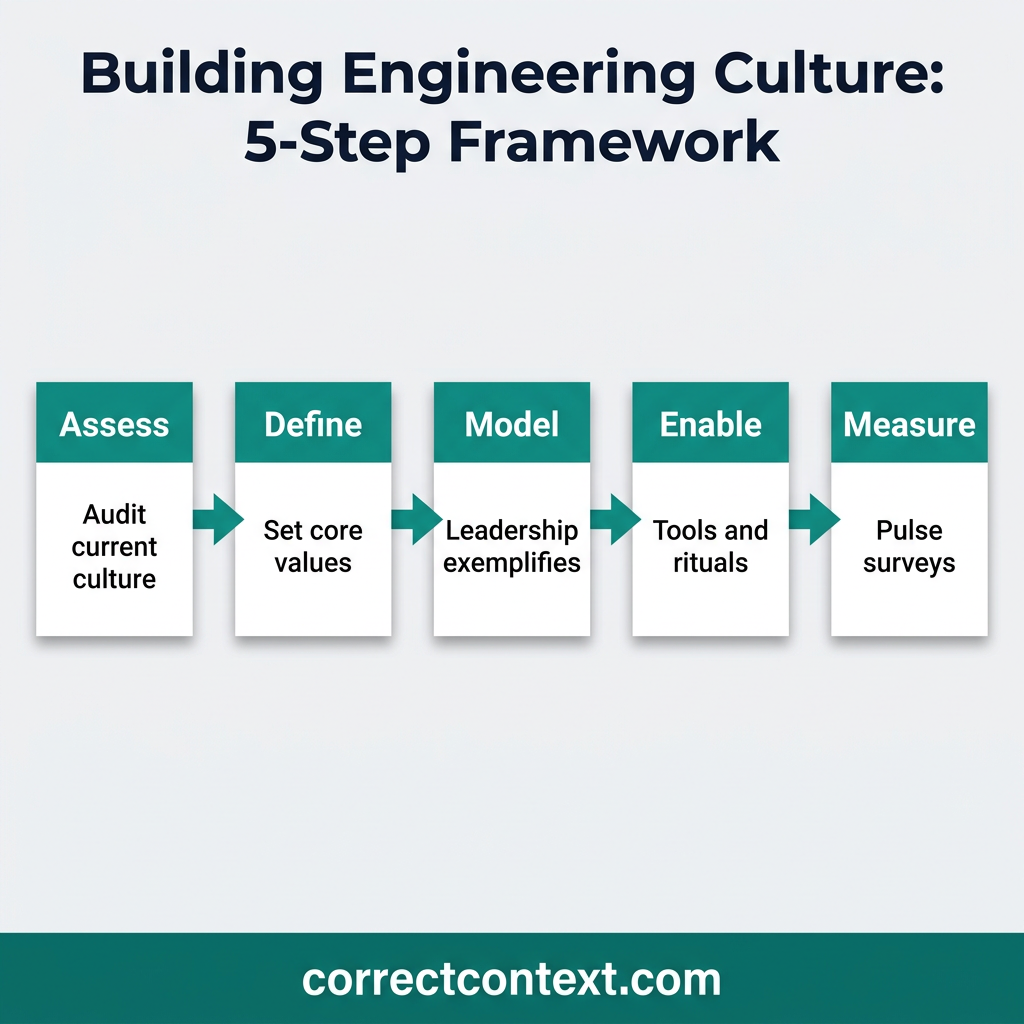
You can’t improve what you don’t measure. Engineering culture isn’t a “set it and forget it” initiative—it requires ongoing attention and iteration.
According to Gartner, 79% of HR managers report that employees’ expectations are evolving faster than organizational capabilities. Your culture needs to evolve too.
Metrics and practices for culture health:
- Run regular pulse surveys: Quarterly surveys with questions about psychological safety, autonomy, recognition, and growth opportunities. Track trends over time.
- Monitor retention metrics: Track voluntary turnover by team, tenure, and level. Exit interviews should include culture questions.
- Measure engagement: Tools like Culture Amp, Glint, or even simple surveys can track engagement metrics that predict retention.
- Analyze promotion and pay equity: Regularly review promotion rates and compensation across demographics to identify bias.
- Track hiring funnel metrics: Are you attracting diverse candidates? Where do they drop off? This reveals culture signals in your employer brand.
Netflix famously eliminated formal performance reviews in favor of ongoing feedback. They also emphasize “freedom and responsibility”—giving employees autonomy while holding them accountable for results. This culture isn’t static; it evolves as the company grows.
Polish companies can learn from these approaches. Start with simple metrics—quarterly engagement surveys, exit interview analysis, retention tracking. As you mature, add more sophisticated measurement.
Key Takeaways
Building a high-performance engineering culture isn’t about perks or slogans. It’s about creating an environment where talented engineers can do their best work. Here’s what to remember:
- Psychological safety is foundational. Without it, you won’t get the honest communication and risk-taking that innovation requires.
- Values must be lived, not just stated. What you reward, tolerate, and punish defines your real culture.
- Invest in growth. Engineers who aren’t learning will leave. Make continuous development part of your DNA.
- Autonomy attracts top talent. Micromanagement drives away the best engineers. Define outcomes, not methods.
- Clear career paths reduce turnover. Ambiguity about growth drives people to seek clarity elsewhere.
- Recognition is cheap and powerful. Specific, timely recognition costs nothing and drives engagement.
- Protect focus time. Meeting culture is a tax on productivity. Minimize it ruthlessly.
- Technical excellence matters. Engineers want to work with other excellent engineers on challenging problems.
- Inclusion drives performance. Diverse, inclusive teams build better products.
- Measure and iterate. Culture requires ongoing attention. Track metrics and adjust as you learn.
The Polish IT market in 2025-2026 will be defined by talent scarcity. Companies with strong engineering cultures will attract and retain the best engineers. Those without will struggle to compete. The choice—and the work required—is yours.
Frequently Asked Questions
How long does it take to change engineering culture?
Meaningful culture change takes 12-24 months. Quick fixes don’t work because culture is embedded in systems, habits, and unwritten rules. Start with one or two high-impact changes, demonstrate success, and build momentum. Changing hiring practices shows results faster than changing communication patterns.
What’s the biggest mistake companies make when trying to improve culture?
The biggest mistake is treating culture as an HR initiative rather than a leadership priority. Culture change requires CEO and CTO sponsorship. Another common error is focusing on surface-level changes (office design, perks) while ignoring deeper issues (psychological safety, autonomy, growth opportunities).
How do you maintain culture as you scale?
Culture gets harder to maintain as you grow because personal relationships get diluted. Solutions include: hiring for culture add (not just fit), documenting and teaching values explicitly, maintaining communication rhythms, and being willing to let go of people who don’t align with culture—even high performers.
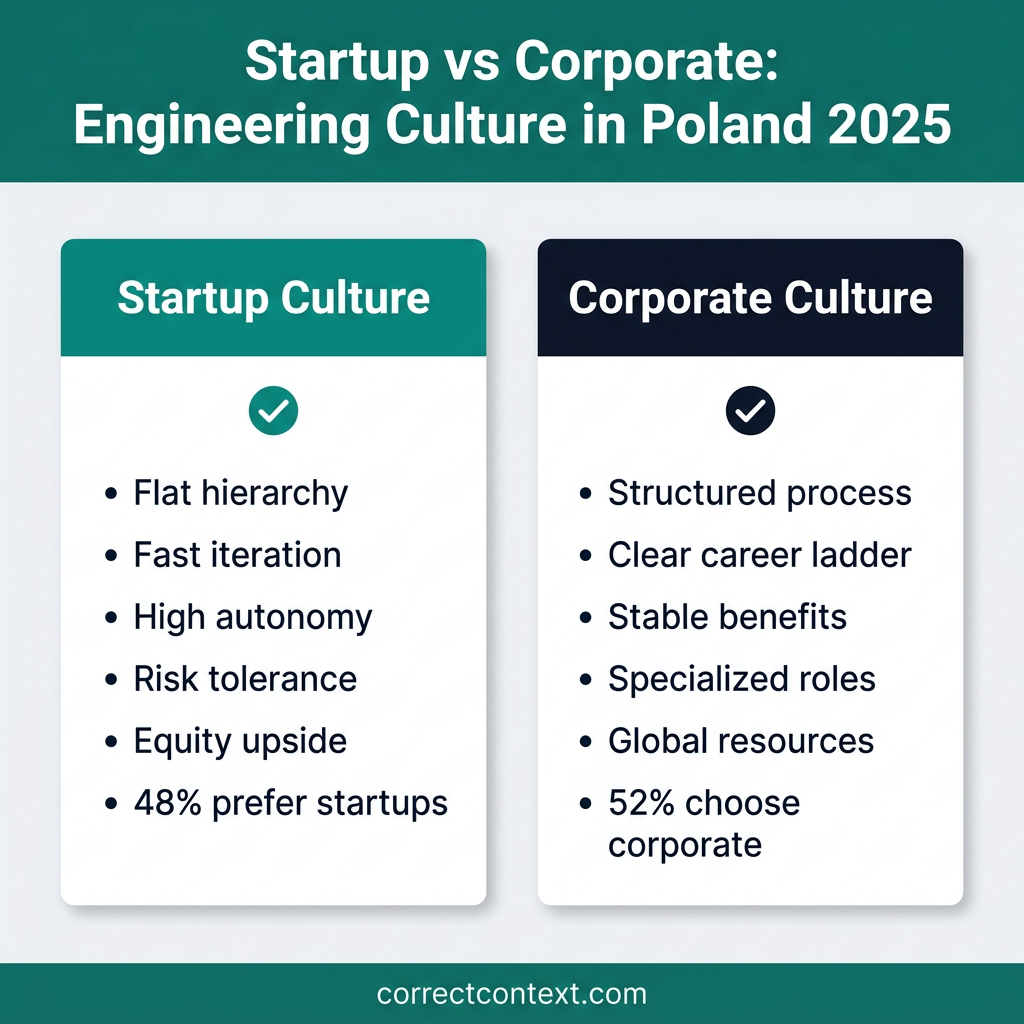
How does engineering culture differ between startups and enterprises in Poland?
Polish startups often emphasize speed, flat hierarchy, and generalist roles. Enterprises typically offer more structure, specialization, and stability. Neither is inherently better—different engineers thrive in different environments. The key is being explicit about what you offer so candidates can self-select.
Can you have a strong engineering culture with remote or hybrid teams?
Absolutely, but it requires more intentionality. Remote culture needs explicit communication norms, documented decision-making, and intentional relationship-building. Many Polish companies have successfully built strong remote cultures—GitLab’s all-remote playbook is a useful reference.
Sources
- Universum — The Great Re-Resignation: Insights from Talent Outlook 2025 (2025)
- Ravio — Retention Trends 2026: Attrition Rates Data and Employee Retention Strategies (October 2025)
- Gartner — Top Nine Workplace Predictions for CHROs in 2025 (January 2025)
- iHire — Talent Retention Report 2025 (2025)
- McKinsey — HR Monitor 2025 (2025)
- Thirst — 40 Must-Know Employee Retention Statistics for 2025 (2025)
- Bulldogjob — Salaries in the Polish IT Industry in 2025 (2025)
- Stack Overflow — 2024 Developer Survey (2024)
- Google — Project Aristotle: Understanding Team Effectiveness (2015, updated)
- Phenom — 25 Employee Retention Strategies to Keep Your Best Talent in 2025 (2025)
Putting It All Together: Your 90-Day Culture Action Plan
Reading about culture is easy. Changing it is hard. Here’s a practical 90-day plan to start building a high-performance engineering culture in your Polish tech company:
Days 1-30: Assess and Define
- Run an anonymous engagement survey focused on culture questions
- Conduct exit interviews with recent departures to understand why they left
- Hold workshops with engineering teams to define or refine values
- Audit your current people processes (hiring, reviews, promotions) for alignment with desired culture
- Interview high-performing teams to understand what’s working
Days 31-60: Pilot and Build
- Choose 2-3 high-impact changes to pilot (e.g., no-meeting blocks, blameless postmortems)
- Launch a recognition program or peer feedback system
- Begin regular career conversations with all engineers
- Implement one learning initiative (conference budget, tech talks, etc.)
- Train managers on psychological safety and inclusive leadership
Days 61-90: Measure and Scale
- Run a pulse survey to measure change
- Review pilot results and decide what to scale
- Document and communicate culture changes to the broader organization
- Address any resistance or blockers
- Plan the next wave of culture initiatives
Culture change is a marathon, not a sprint. The goal isn’t perfection in 90 days—it’s establishing momentum and demonstrating that culture is a priority.
The Business Case for Engineering Culture
If you’re a CEO or CFO reading this, you might be thinking: “This all sounds nice, but what’s the ROI?” Fair question. Here’s the business case:
Retention: Replacing an engineer costs 50-200% of their annual salary. If culture improvements reduce turnover by even 10%, the savings are substantial. A company with 50 engineers averaging PLN 20,000/month spends PLN 12M annually on salaries. A 10% reduction in turnover saves PLN 600K-2.4M in replacement costs.
Productivity: Engineers in high-trust, high-autonomy environments are more productive. Google’s research shows psychological safety is the #1 predictor of team effectiveness. A 10% productivity improvement across your engineering team is worth millions in delivered value.
Recruiting: Strong culture is your best recruiting tool. When engineers love where they work, they refer their talented friends. Referral hires are faster, cheaper, and higher quality than other sources. In Poland’s competitive market, culture is often the differentiator that wins candidates.
Innovation: Engineers who feel safe taking risks and experimenting produce more innovation. In a market where AI and new technologies are reshaping industries, innovation isn’t optional—it’s survival.
Customer outcomes: Ultimately, engineering culture drives product quality. Teams with strong cultures build better products, which drives customer satisfaction and business results.
The investment in culture—time, training, tools, events—pays for itself many times over through these channels.
Common Culture Pitfalls to Avoid
As you work on your engineering culture, watch out for these common mistakes:
1. Copying without adapting: Spotify’s model works for Spotify. It may not work for you. Take inspiration from successful companies, but adapt practices to your context. A 50-person Polish startup has different needs than a Silicon Valley unicorn.
2. Focusing on perks over substance: Free lunch is nice. Psychological safety is essential. Don’t confuse amenities with culture. Perks are easy; culture is hard.
3. Inconsistency between words and actions: If you say you value work-life balance but reward people for working weekends, your real value is visible. Culture is revealed by what you reward, not what you say.
4. Trying to change everything at once: Culture change takes time. Trying to implement all 10 strategies simultaneously will overwhelm your organization and produce superficial change. Start with 2-3 priorities and build from there.
5. Ignoring resistance: Some people will resist culture change, especially if they’re comfortable with the status quo. Address resistance directly. Sometimes this means coaching; sometimes it means parting ways.
6. Treating culture as HR’s job: Culture is a leadership responsibility. HR can support, but the CEO and CTO must own it. If leadership isn’t visibly committed, culture efforts will fail.
7. Neglecting remote/hybrid workers: If you have remote team members, culture must be intentionally designed for distributed work. Defaulting to in-office norms excludes remote colleagues.
Key Takeaways
Building a high-performance engineering culture isn’t about perks or slogans. It’s about creating an environment where talented engineers can do their best work. Here’s what to remember:
- Psychological safety is foundational. Without it, you won’t get the honest communication and risk-taking that innovation requires. Google’s research is clear: this matters more than anything else.
- Values must be lived, not just stated. What you reward, tolerate, and punish defines your real culture. Don’t write values you aren’t willing to enforce.
- Invest in growth. Engineers who aren’t learning will leave. Make continuous development part of your DNA. The Polish IT market is competitive; growth opportunities are table stakes.
- Autonomy attracts top talent. Micromanagement drives away the best engineers. Define outcomes, not methods. Trust your team.
- Clear career paths reduce turnover. Ambiguity about growth drives people to seek clarity elsewhere. Dual tracks for ICs and managers are essential.
- Recognition is cheap and powerful. Specific, timely recognition costs nothing and drives engagement. Don’t let good work go unnoticed.
- Protect focus time. Meeting culture is a tax on productivity. Minimize it ruthlessly. Default to async communication.
- Technical excellence matters. Engineers want to work with other excellent engineers on challenging problems. Don’t sacrifice quality for speed.
- Inclusion drives performance. Diverse, inclusive teams build better products. This isn’t just moral—it’s business-critical.
- Measure and iterate. Culture requires ongoing attention. Track metrics, gather feedback, and adjust as you learn.
The Polish IT market in 2025-2026 will be defined by talent scarcity. Companies with strong engineering cultures will attract and retain the best engineers. Those without will struggle to compete. The choice—and the work required—is yours.
Start today. Pick one strategy from this list and take action this week. Culture isn’t built in a day, but it is built one decision at a time.
Frequently Asked Questions
How long does it take to change engineering culture?
Meaningful culture change takes 12-24 months. Quick fixes don’t work because culture is embedded in systems, habits, and unwritten rules. Start with one or two high-impact changes, demonstrate success, and build momentum. Changing hiring practices shows results faster than changing communication patterns. Expect to see early signals in 3-6 months, meaningful change in 12 months, and full transformation in 18-24 months.
What’s the biggest mistake companies make when trying to improve culture?
The biggest mistake is treating culture as an HR initiative rather than a leadership priority. Culture change requires CEO and CTO sponsorship. Another common error is focusing on surface-level changes (office design, perks) while ignoring deeper issues (psychological safety, autonomy, growth opportunities). The third major mistake is inconsistency—saying one thing while rewarding another.
How do you maintain culture as you scale?
Culture gets harder to maintain as you grow because personal relationships get diluted. Solutions include: hiring for culture add (not just fit), documenting and teaching values explicitly, maintaining communication rhythms, and being willing to let go of people who don’t align with culture—even high performers. Many successful companies create culture playbooks or onboarding programs specifically focused on transmitting culture to new hires.
How does engineering culture differ between startups and enterprises in Poland?
Polish startups often emphasize speed, flat hierarchy, and generalist roles. Enterprises typically offer more structure, specialization, and stability. Neither is inherently better—different engineers thrive in different environments. The key is being explicit about what you offer so candidates can self-select. A startup that tries to act like a big corporation, or vice versa, will confuse and frustrate employees.
Can you have a strong engineering culture with remote or hybrid teams?
Absolutely, but it requires more intentionality. Remote culture needs explicit communication norms, documented decision-making, and intentional relationship-building. Many Polish companies have successfully built strong remote cultures—GitLab’s all-remote playbook is a useful reference. The principles are the same; the practices just need adaptation.
How do you handle culture fit vs. culture add?
“Culture fit” can become a euphemism for “people like us,” which reduces diversity. “Culture add” asks: what does this person bring that we don’t have? Both matter. You want people who share your core values (fit) but bring diverse perspectives and experiences (add). The key is being explicit about which values are non-negotiable and where diversity strengthens the team.
What if leadership doesn’t buy into culture change?
Culture change without leadership support is nearly impossible. If you’re a manager in this situation, focus on what you can control within your team. Build psychological safety, provide growth opportunities, and protect your team’s focus time. Document the results—retention, productivity, engagement. Use this evidence to make the case to leadership. Sometimes success at a small scale creates appetite for broader change.
Sources
- Universum — The Great Re-Resignation: Insights from Talent Outlook 2025 (2025)
- Ravio — Retention Trends 2026: Attrition Rates Data and Employee Retention Strategies (October 2025)
- Gartner — Top Nine Workplace Predictions for CHROs in 2025 (January 2025)
- iHire — Talent Retention Report 2025 (2025)
- McKinsey — HR Monitor 2025 (2025)
- Thirst — 40 Must-Know Employee Retention Statistics for 2025 (2025)
- Bulldogjob — Salaries in the Polish IT Industry in 2025 (2025)
- Stack Overflow — 2024 Developer Survey (2024)
- Google — Project Aristotle: Understanding Team Effectiveness (2015, updated)
- Phenom — 25 Employee Retention Strategies to Keep Your Best Talent in 2025 (2025)
- No Fluff Jobs — IT Job Market in Poland in 2025/2026 (2025)
- SignalFire — State of Tech Talent Report 2025 (2025)