Poland has quietly become one of Europe’s most compelling destinations for technology talent. With a developer pool exceeding 546,000 professionals, world-class universities producing thousands of computer science graduates annually, and labor costs that run 40–60% below Western European equivalents, Polish IT talent represents a genuine strategic advantage for companies building or scaling engineering teams in 2025 and beyond.
This guide breaks down everything you need to know about accessing, hiring, and retaining IT talent in Poland — from the major tech hubs and in-demand skills to salary benchmarks, hiring models, and the cultural factors that make Polish engineers some of the most sought-after in Europe.
The Scale of Poland’s IT Talent Pool
Poland’s technology workforce has grown dramatically over the past decade. According to data from LinkedIn and Ntiative’s 2024 Talent Insights report, there are now approximately 546,000 IT and tech professionals active in Poland — a figure that places the country firmly among Europe’s top five technology talent markets.
This pool encompasses not just software developers but also DevOps engineers, data scientists, cybersecurity specialists, QA engineers, cloud architects, and product managers. The diversity of skills available makes Poland suitable not only for execution-focused engineering work but increasingly for product-led R&D operations.
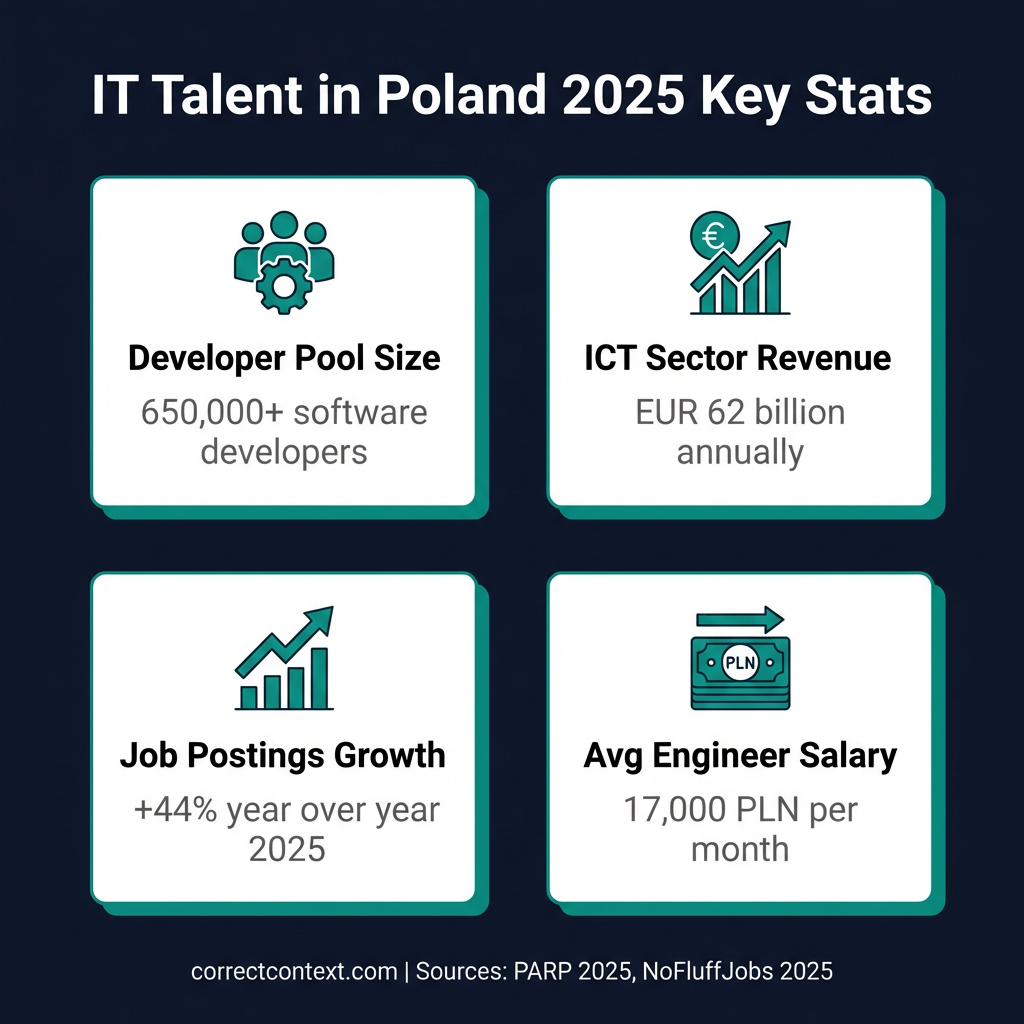
Several macro trends are shaping this pool:
- Return migration: For the first time since EU expansion, more IT professionals are returning to Poland from the UK and Ireland than emigrating there — a significant reversal driven by Poland’s rising wages, quality of life improvements, and post-Brexit uncertainty in British labor markets.
- University pipeline: Polish universities graduate approximately 50,000–60,000 computer science and engineering students per year. AGH University of Science and Technology, Warsaw University of Technology, and Wrocław University of Science and Technology consistently rank among Central Europe’s top technical institutions.
- Diaspora engagement: The broader Polish tech diaspora in Berlin, London, and Amsterdam increasingly maintains ties with Polish teams, enabling hybrid staffing models that blend diaspora expertise with on-the-ground Polish talent.
Poland’s Major Tech Hubs
IT talent in Poland is not evenly distributed — it clusters around five major cities, each with its own specializations and market dynamics.
Warsaw
As the capital and largest city, Warsaw is Poland’s primary financial technology hub. It hosts headquarters and regional offices for Google, Microsoft, Samsung, Accenture, and dozens of global banks and insurance companies. Warsaw’s developer talent pool skews toward enterprise software, fintech, and cloud-native development. Salaries are highest here — typically 10–15% above the national IT average.
Kraków
Kraków is arguably Poland’s most strategically important IT hub for international companies. It hosts the largest concentration of Global Business Services (GBS) and Shared Services Centers in Central Europe, with major operations from IBM, Capgemini, Shell, UBS, and Philip Morris. The city’s proximity to AGH and Jagiellonian University ensures a constant pipeline of engineering graduates. Kraków is particularly strong in Java, Python, data engineering, and cybersecurity.
Wrocław
Wrocław punches above its weight in software product development and hardware engineering. It hosts significant operations from NOKIA, HP, Volvo IT, and Google. The city’s tech scene has a strong culture of open-source contribution and agile delivery — a good fit for product companies building autonomous engineering teams.
Gdańsk / Tricity
The Tricity area (Gdańsk, Gdynia, Sopot) has emerged as a significant hub for e-commerce technology, gaming, and SaaS development. Intel, Amazon Web Services, and a growing number of Polish startups have established engineering operations here. The area’s quality of life — including access to the Baltic coast — makes it competitive for talent retention.
Poznań and Łódź
Both cities offer strong talent pools at salary points 15–20% below Warsaw, making them attractive for cost-conscious scaling. Poznań is strong in automotive software and embedded systems; Łódź has developed a growing SaaS and e-commerce tech scene.
In-Demand Skills and Technologies
Understanding what Polish developers are actually good at — and what the market demands — is critical for making sound hiring decisions.
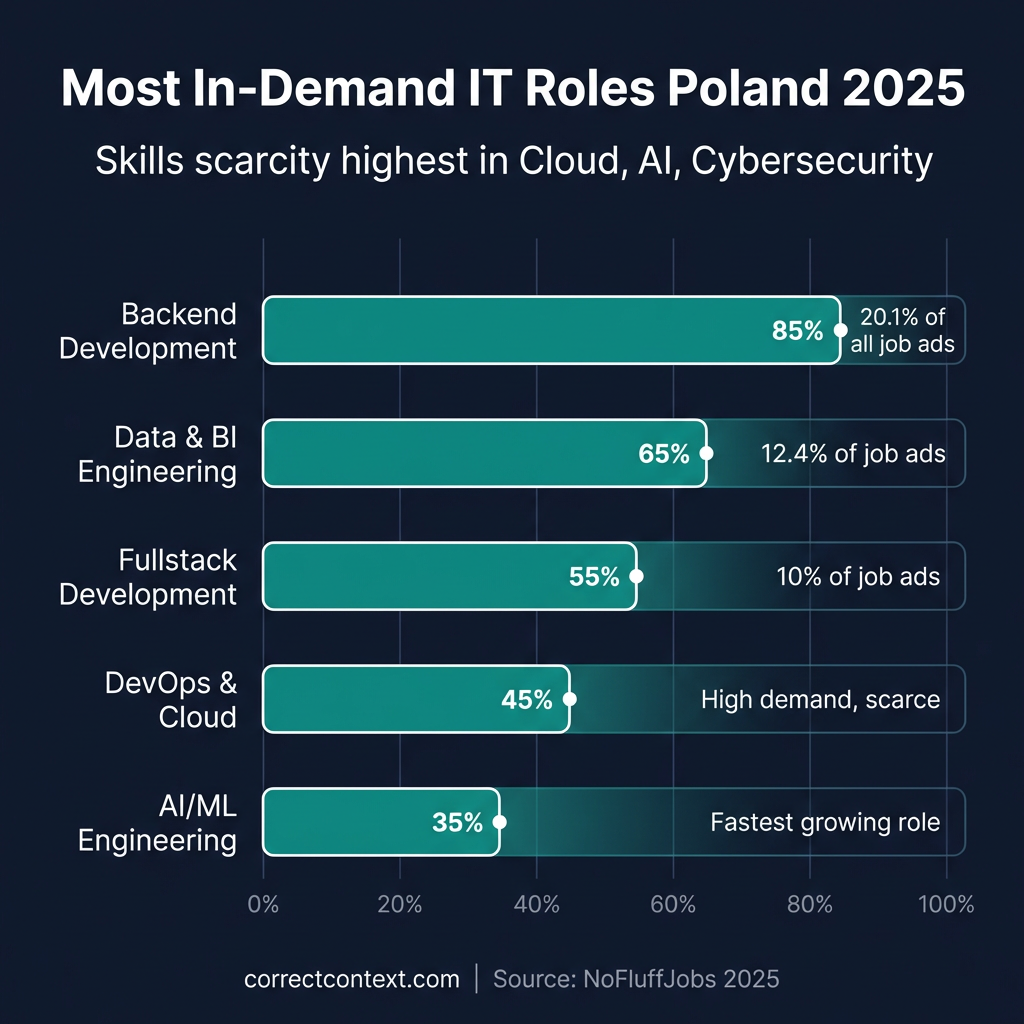
Based on 2024–2025 job market data from Bulldogjob, NoFluffJobs, and JustJoin.it:
Top Programming Languages
- JavaScript / TypeScript — Dominant in frontend and full-stack roles; strong React and Node.js ecosystem
- Python — Primary language for data engineering, ML/AI, and automation
- Java — Entrenched in enterprise backend and financial systems
- .NET / C# — Strong presence in enterprise, Windows-stack, and gaming adjacent work
- Go (Golang) — Growing demand driven by cloud-native infrastructure work
Infrastructure & DevOps
- Docker and Kubernetes — near-universal in senior roles
- Terraform — increasingly required for cloud infrastructure positions
- AWS, Azure, GCP — multi-cloud familiarity common in Warsaw and Kraków
Emerging Areas
AI engineering (LLM integration, MLOps, RAG architectures) has seen the sharpest growth in job postings since 2023. SQL and REST API competency remain near-universal baseline requirements across all technical roles.
| Technology | Share of Job Postings (2024) | Year-on-Year Change |
|---|---|---|
| SQL | 20.0% | +1.2% |
| REST API | 11.2% | +0.8% |
| Python | 9.7% | +2.1% |
| JavaScript/TypeScript | 9.3% | -0.4% |
| Kubernetes | 8.9% | +3.5% |
| React | 7.8% | +0.6% |
| Docker | 7.4% | +1.1% |
| Java | 6.8% | -1.3% |
Source: IT Job Market in Poland 2024/2025 Report (SlideShare/JustJoin.it)
Salary Benchmarks: What Polish IT Talent Actually Costs
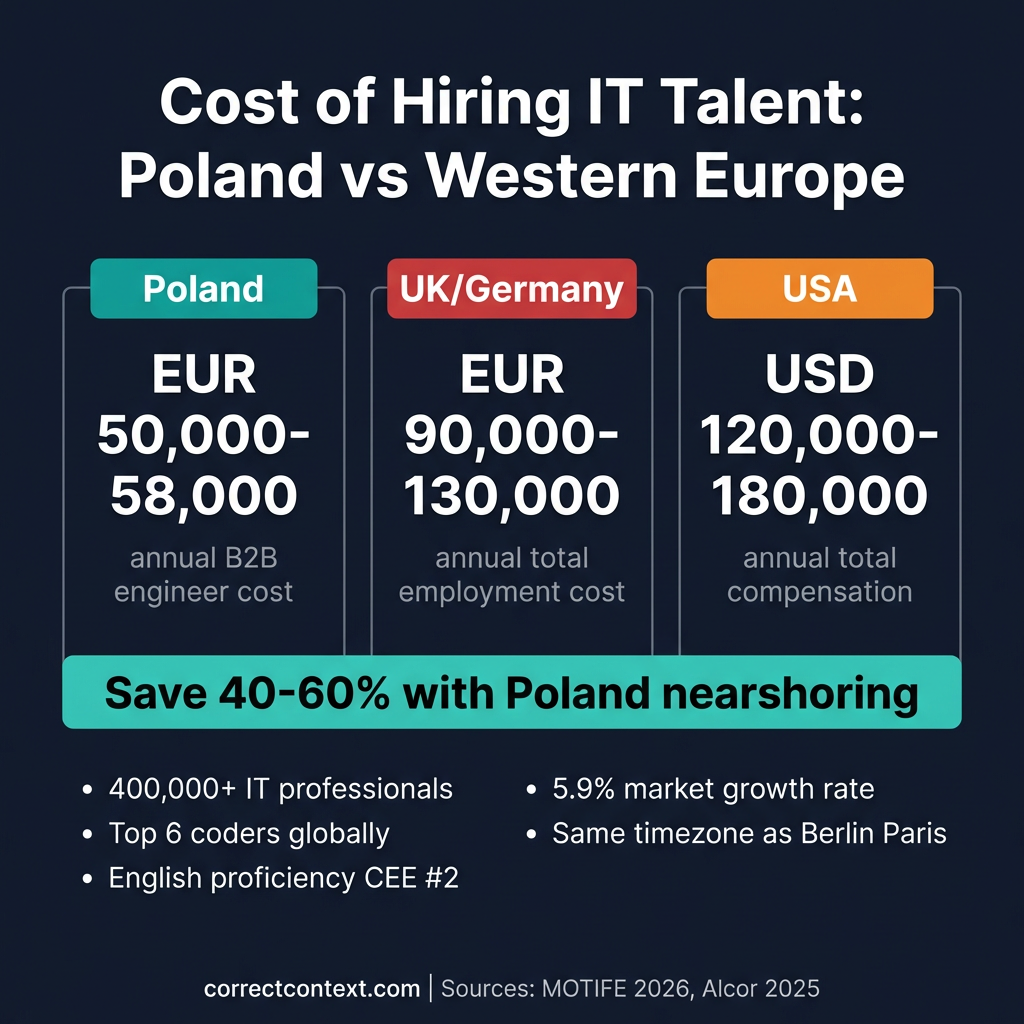
Poland offers one of the best cost-to-quality ratios in Europe for software engineering talent. The following benchmarks are based on 2024–2025 B2B contract rates (the dominant employment model in Polish IT) and employment contract (UoP) equivalents.
Frontend / Backend Developer Salaries (Monthly, B2B)
| Level | Frontend (PLN/month) | Backend (PLN/month) | ≈ EUR/month |
|---|---|---|---|
| Junior | 8,000–11,000 | 8,500–12,000 | €1,800–€2,700 |
| Mid-level | 12,500–18,000 | 13,000–20,000 | €2,900–€4,500 |
| Senior | 19,000–27,000 | 20,000–30,000 | €4,500–€6,800 |
| Lead / Principal | 26,000–33,000 | 28,000–38,000 | €6,000–€8,500 |
Source: itentio.com Frontend Developer Salary Report 2024; Bulldogjob Salary Survey 2025
For comparison, equivalent senior engineer roles in Germany or the Netherlands typically command €7,000–€12,000/month — meaning Poland delivers comparable skill at 40–60% lower cost. The Accelerance 2024 Global Software Outsourcing Rates Guide puts average CEE nearshore developer rates at $37–$101/hour, with Poland toward the higher end of CEE due to its advanced skill level and strong English proficiency.
Specialist Premium Roles
Data engineers, DevOps/SRE leads, and AI/ML engineers command premiums of 20–40% above standard backend rates. Senior cloud architects in Warsaw can exceed 45,000 PLN/month on B2B contracts — still well below equivalent German or UK market rates.
Warsaw vs. Secondary Cities
Companies willing to hire outside Warsaw can achieve meaningful savings. Mid-level developers in Łódź or Poznań typically command 15–20% lower rates than Warsaw equivalents for comparable skill levels. Kraków rates sit roughly 5–10% below Warsaw despite similar talent density, partly offset by higher competition from multinational GBS operations.
Hiring Models: How Companies Actually Access Polish Talent
There are four primary models for accessing IT talent in Poland, each with different trade-offs on speed, cost, control, and compliance complexity.
1. Direct Employment (via Polish Entity or EOR)
The highest-control model. Companies either establish a Polish legal entity (sp. z o.o. — equivalent to a Ltd.) or use an Employer of Record (EOR) service to hire directly under Polish labor law. EOR services like Correct Context handle all payroll, ZUS (social security) contributions, and compliance without requiring the client to establish a local entity. This model is ideal for companies that want dedicated, loyal employees without the overhead of full entity setup.
Key compliance considerations under Polish labor law:
- Standard employment contract notice periods: 2 weeks (under 6 months), 1 month (1–3 years), 3 months (over 3 years)
- Employer ZUS contributions add approximately 20–23% on top of gross salary
- Mandatory 20 days annual leave (increasing to 26 days after 10 years of service)
- B2B contracts (self-employment) remain the most popular model in Polish IT — roughly 60–65% of senior developers operate this way
2. Staff Augmentation
Fastest time-to-hire. A Polish staffing partner provides pre-vetted developers who work under the client’s direction but remain employed by the agency. Correct Context operates this model for international tech companies needing to scale engineering capacity in weeks rather than months. Typical placement timelines are 2–4 weeks for mid/senior roles.
3. Managed IT Teams / Project Outsourcing
The client contracts a Polish software house or delivery partner who takes full responsibility for a team, codebase, and deliverables. Lower management overhead, but less day-to-day control over talent. Works well for product-adjacent work (e.g., a separate mobile app or internal tooling).
4. R&D Center / Captive Delivery Center
Multinational companies with sustained demand (typically 30+ engineers) often establish their own Polish entities. This offers maximum long-term cost efficiency and culture alignment but requires 6–18 months of setup investment. Companies like Google, Samsung, Intel, and McKinsey have all taken this route for their Polish operations.
The English Proficiency Advantage
One of Poland’s most underrated assets is language proficiency. According to the EF English Proficiency Index, Poland consistently scores in the top 15 globally for English ability. In the IT sector specifically, B2-level or higher English is the norm, not the exception — enabling smooth integration into distributed teams across Europe and North America.
This stands in contrast to some lower-cost alternatives in Southeast Asia or Latin America where communication friction can offset the cost benefits. Polish developers routinely participate in direct client-facing meetings, technical architecture discussions, and sprint planning with minimal translation overhead.
Beyond English, Poland’s cultural proximity to Western Europe — shared business norms, similar working hours, overlapping time zones with both UK (GMT+1) and Central European (GMT+2) markets — reduces the coordination costs that erode the value of more distant offshoring relationships.
Education Quality and Talent Pipeline
Poland produces some of Europe’s strongest computer science graduates. The country has a long tradition of mathematical and algorithmic excellence — Polish teams have historically performed well in competitive programming olympiads and ACM ICPC competitions.
Top technical universities feeding the Polish IT talent pipeline:
- AGH University of Science and Technology (Kraków) — Particularly strong in computer science, automation, and telecommunications
- Warsaw University of Technology — One of Poland’s most prestigious technical institutions; strong in software engineering and AI research
- Wrocław University of Science and Technology — Excellent in computer science and electronics; feeds heavily into local tech giants
- Poznań University of Technology — Strong in embedded systems and industrial IT
- Gdańsk University of Technology — Growing in biotech-adjacent software and maritime tech systems
Beyond formal education, Poland has a robust bootcamp and retraining ecosystem. Codecool, SDA (Software Development Academy), and numerous corporate training programs have significantly expanded the mid-career retraining pipeline over the past five years, broadening the talent pool beyond traditional CS graduates.
Challenges and Honest Limitations
No talent market is without friction. Companies accessing Polish IT talent should be aware of several real challenges:
Competition for Senior Talent is Fierce
Poland’s reputation as a tech hub means senior engineers — particularly those with cloud, AI/ML, or distributed systems backgrounds — receive multiple competing offers. Time-to-hire for senior roles has lengthened from 4–6 weeks in 2021 to 8–14 weeks in 2024. Companies relying on passive sourcing (job boards alone) struggle more than those with active headhunting operations or strong employer brands in the local market.
Salary Inflation in Core Tech Hubs
Warsaw and Kraków have seen meaningful salary inflation since 2020. While still competitive versus Western Europe, the gap has narrowed. Mid-level developers who earned 12,000–14,000 PLN/month in 2020 now command 15,000–18,000 PLN/month for equivalent roles. Companies should benchmark salary expectations annually rather than relying on multi-year-old data.
B2B Compliance Complexity
The prevalence of B2B contracting creates legal complexity for international companies unfamiliar with Polish regulations. ZUS contribution obligations, IP assignment provisions under Polish copyright law, and the distinction between service contracts (umowa o dzieło, umowa zlecenia) and employment contracts require careful legal structuring — particularly following Poland’s tightening of bogus self-employment rules in recent years.
Remote-First Expectations
Post-pandemic, the majority of Polish IT professionals expect remote or hybrid arrangements. Companies requiring full on-site presence face a significantly narrowed candidate pool and must offer meaningful compensation premiums to attract talent willing to commute daily.
What Makes Poland’s IT Talent Market Different in 2025
Several factors distinguish Poland’s current IT market from its Central European peers and from its own trajectory five years ago.
First, the market has matured beyond pure cost arbitrage. Companies no longer come to Poland only because it is cheap — they come because Polish teams deliver high-quality product work with strong ownership cultures. Polish engineers are increasingly taking product management, architecture, and technical leadership roles that were historically kept onshore at Western headquarters.
Second, AI fluency is spreading rapidly. Polish developers have adopted AI-assisted development tools (GitHub Copilot, Cursor, Claude) at rates comparable to Western European peers. This is compressing junior-level output gaps and raising the effective productivity ceiling for teams built in Poland.
Third, the startup ecosystem is maturing. Warsaw and Kraków now host growing clusters of Polish-founded SaaS companies — Booksy, Brainly, DocPlanner, Infermedica — that have raised significant Series B and C rounds. This creates a competitive dynamic where multinational GBS centers compete with well-funded local startups for the same senior talent, pushing the overall market toward higher engineering standards.
How to Build a Successful IT Team in Poland
Based on experience placing and managing engineering teams across Warsaw, Kraków, and Wrocław, several practices consistently produce better outcomes:
- Lead with employer brand: Polish engineers research companies extensively before applying. A credible engineering blog, GitHub presence, or conference participation matters more than a competitive salary alone for attracting senior candidates.
- Move fast on offers: The window between technical interview completion and offer acceptance is narrow. Candidates routinely have 2–3 competing offers. Companies that take 2+ weeks to extend a formal offer lose a disproportionate share of their top choices.
- Invest in onboarding: Polish developers are self-directed but benefit from structured onboarding that clarifies team norms, codebase context, and decision-making processes. The first 90 days heavily predict 12-month retention outcomes.
- Respect the B2B norm: Insisting on employment contracts when the candidate preference is B2B creates unnecessary friction. A well-structured B2B arrangement via an EOR or compliant local entity addresses both parties’ needs.
- Localize management: Remote teams led entirely from abroad — with no Polish-market awareness, no local HR presence, and no understanding of local norms around feedback, hierarchy, and work-life expectations — underperform consistently compared to teams with at least partial local management.
Correct Context: Your Partner for Polish IT Talent
Correct Context specializes in helping international technology companies build and scale engineering teams in Poland. Our services span the full talent lifecycle: market mapping and headhunting, employer of record and payroll compliance, staff augmentation, and retained talent management.
We operate across Warsaw, Kraków, Wrocław, and Gdańsk, with deep networks in the technology and product engineering communities that take years to build. Whether you need two senior engineers on a 6-month project or a 30-person dedicated R&D team, we can structure the right engagement model for your needs and risk tolerance.
The Polish IT market rewards companies that approach it strategically — with current salary data, compliant hiring structures, and genuine investment in the people they hire. We help you get all three right from day one.
Sources
- Ntiative, Poland’s Tech Talent Pool in 2024 – Movers and Shakers. ntiative.com
- Accelerance, Global Software Outsourcing Rates and Trends Guide 2024. accelerance.com
- Bulldogjob, Frontend Developer Salary in Poland in 2025. bulldogjob.com
- itcompare.pl, The Most In-Demand IT Technologies in Poland 2025/2026. itcompare.pl
- EEN Poland / Polish Investment & Trade Agency, The IT/ICT Sector in Poland — Report 2025. een.org.pl
- DevsData, Software Development in Poland: Market Overview for 2025. devsdata.com
- Itelence, Why Poland Attracts High-Value IT, SSC & GBS Investments in 2026. itelence.com
Table of content
- The Scale of Poland’s IT Talent Pool
- Poland’s Major Tech Hubs
- In-Demand Skills and Technologies
- Salary Benchmarks: What Polish IT Talent Actually Costs
- Hiring Models: How Companies Actually Access Polish Talent
- The English Proficiency Advantage
- Education Quality and Talent Pipeline
- Challenges and Honest Limitations
- What Makes Poland’s IT Talent Market Different in 2025
- How to Build a Successful IT Team in Poland
- Correct Context: Your Partner for Polish IT Talent
- Sources
Related articles



About the Author: Duke Vu