
AI in HR and Recruitment: The Complete 2025 Guide for Polish Tech Companies
Here’s a number that should stop every HR director and CTO in their tracks: 88% of companies worldwide now use some form of artificial intelligence in their hiring process. If you’re still reviewing resumes manually while your competitors deploy AI-powered screening tools, you’re not just moving slowly—you’re moving backward. This comprehensive guide examines how AI is transforming HR and recruitment in Poland and across Europe, what the data actually says about its effectiveness, and how tech companies can implement these tools without falling into the algorithmic bias traps that have plagued early adopters.
What This Guide Covers
This article draws on research from Harvard Business Review, LinkedIn’s 2025 Future of Recruiting report, Gartner’s AI Hype Cycle, SHRM benchmarking data, and Poland-specific studies from Randstad Enterprise and AWS. You’ll find concrete statistics on AI adoption rates, measurable ROI data, implementation frameworks, and the specific challenges Polish companies face when integrating AI into their talent acquisition processes. Whether you’re running a startup in Krakow’s tech hub or scaling an enterprise team in Warsaw, this guide provides the strategic foundation for making informed decisions about AI in recruitment.
The Current State of AI in Recruitment: By the Numbers
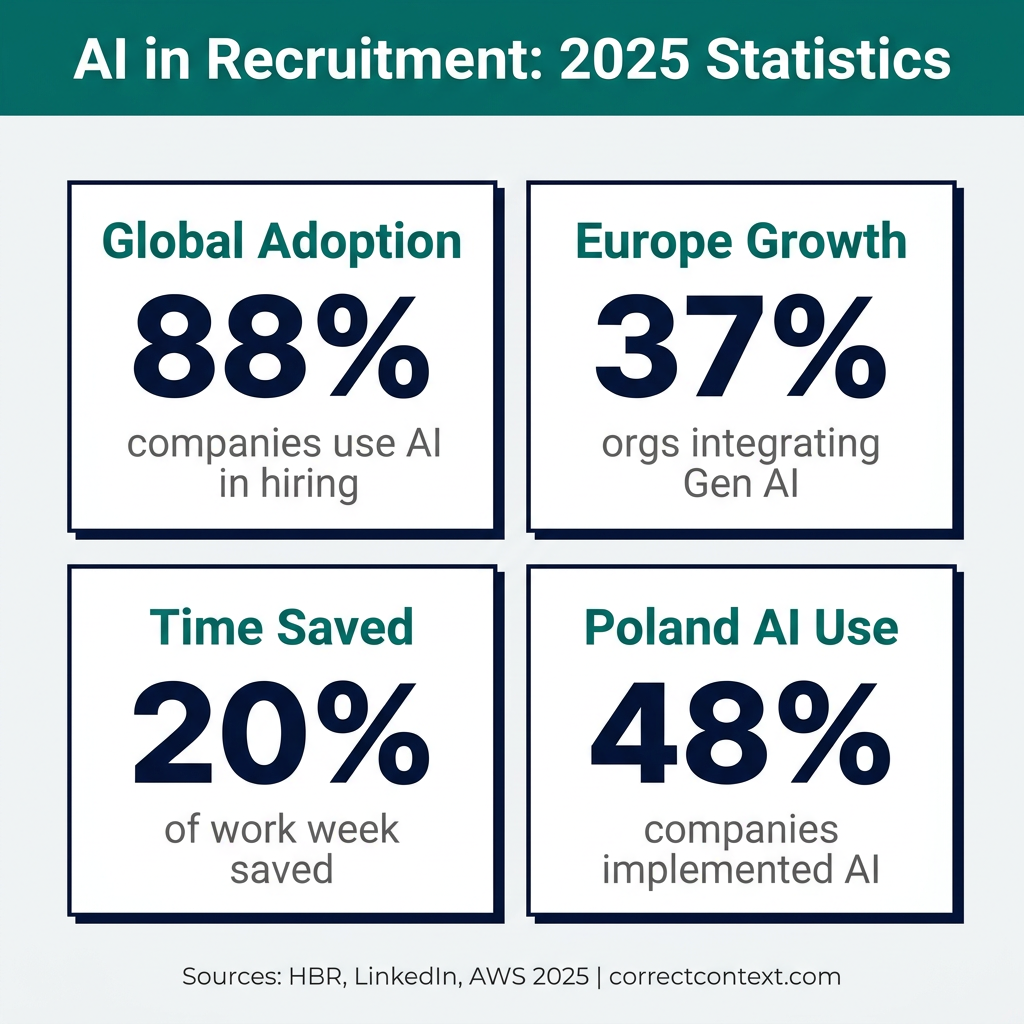
The recruitment industry has reached an inflection point. According to research published in Harvard Business Review in late 2025, approximately 88% of companies globally have integrated some form of AI into their hiring workflows. This isn’t limited to tech giants—this adoption spans industries, company sizes, and geographies. Gartner’s 2025 Hype Cycle for AI in Human Resources places recruitment AI firmly in the “Slope of Enlightenment,” indicating the technology has moved past initial hype and disillusionment into practical, measurable value delivery.
In Europe specifically, LinkedIn’s 2025 Future of Recruiting report reveals that 37% of organizations are now actively integrating or experimenting with generative AI tools in their hiring processes—up from just 26% the previous year. This represents one of the fastest adoption curves for any HR technology in the past decade. The Benelux region, which often serves as a bellwether for trends that reach Poland 12-18 months later, shows 75% of talent acquisition professionals agreeing that AI will fundamentally change how organizations hire.
Poland presents a particularly interesting case study. According to the 2026 AWS and Strand Partners report “Unleashing the Potential of AI in Poland,” 48% of Polish companies have now implemented artificial intelligence in some form—placing Poland in second place across Europe for AI adoption growth rate. The percentage jumped from 34% to 48% in a single year. For HR specifically, Randstad Enterprise’s 2025 Talent Trends research indicates that 34% of Polish companies are already using automation to identify workers with specific skills and potential for internal mobility.
However, these headline numbers mask important nuances. The same AWS report notes that while Polish companies have successfully passed the mass adoption phase, many remain trapped in basic applications rather than deep technological integration. This gap between adoption and maturity is particularly pronounced in HR and recruitment, where the stakes—legal compliance, bias prevention, candidate experience—are uniquely high.
What AI Actually Does in Modern Recruitment
Before examining outcomes, let’s establish what “AI in recruitment” actually means in practice. The term encompasses several distinct technologies, each with different capabilities and risk profiles:
Resume Screening and Parsing
Natural Language Processing (NLP) algorithms analyze resumes and cover letters to identify qualifications, skills, and experience relevant to specific roles. Modern systems go far beyond keyword matching—they can understand context, recognize equivalent qualifications across different educational systems, and identify transferable skills that human reviewers might miss. According to Provitrac’s 2025 research, AI screening tools can review approximately 1,000 resumes in the time it takes a human recruiter to grab a coffee.
Candidate Sourcing
AI-powered sourcing tools scan LinkedIn, GitHub, Stack Overflow, and other platforms to identify passive candidates who match specified criteria. These systems learn from successful hires to refine their search parameters over time. LinkedIn’s own AI-Assisted Messaging feature, used by companies in the top quartile of adoption, correlates with a 9% higher likelihood of making quality hires compared to minimal usage.
Interview Scheduling and Coordination
Intelligent scheduling bots eliminate the email ping-pong typically required to coordinate interviews across multiple stakeholders’ calendars. While seemingly mundane, this automation saves recruiters approximately 20% of their work week according to LinkedIn’s 2025 data—equivalent to one full workday weekly that can be redirected to strategic activities.
Video Interview Analysis
Some platforms now offer AI analysis of recorded video interviews, assessing factors like communication clarity, emotional intelligence markers, and even technical knowledge through response analysis. This remains one of the more controversial applications, with significant debate around validity and bias risks.
Predictive Analytics for Quality of Hire
Advanced systems analyze patterns in historical hiring data to predict which candidates are most likely to succeed, stay with the company long-term, and advance internally. SHRM’s 2025 benchmarking data shows organizations using AI-powered recruitment tools report a 50% improvement in quality-of-hire metrics.
| AI Application | Primary Function | Time Savings | Maturity Level |
|---|---|---|---|
| Resume Screening | Parse and rank candidate qualifications | 75-90% reduction in screening time | High |
| Candidate Sourcing | Identify passive candidates from external databases | 60-80% reduction in sourcing time | High |
| Interview Scheduling | Automate calendar coordination | ~20% of recruiter work week | Very High |
| Video Analysis | Assess communication and fit markers | Variable | Medium |
| Predictive Analytics | Forecast candidate success probability | Improves outcomes vs speed | Medium |
The Measurable ROI of AI Recruitment Tools
The business case for AI in recruitment rests on three pillars: speed, quality, and cost. The data supporting each is substantial.
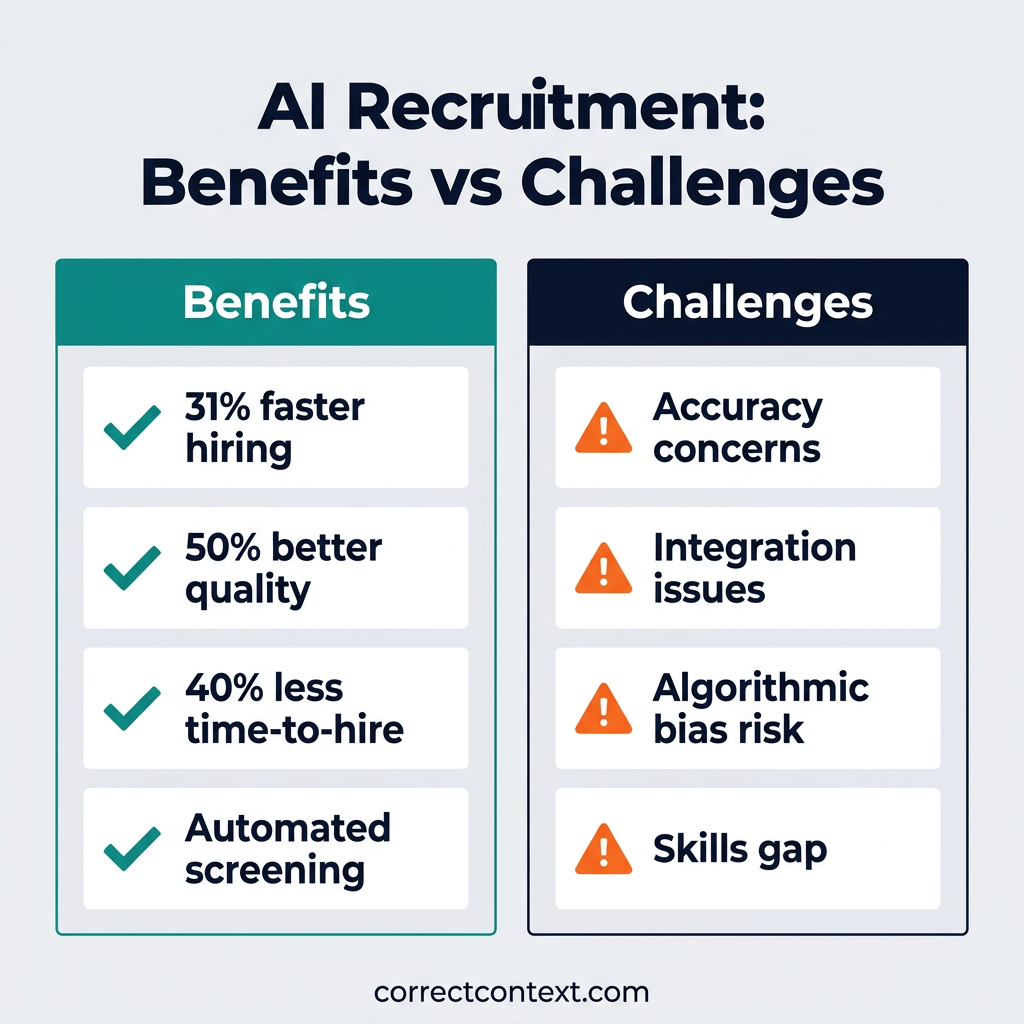
Speed: Organizations using AI-powered recruitment report 31% faster hiring times according to SHRM’s 2025 benchmarking report. Screenz.ai’s 2026 industry analysis of 50,000+ AI-assisted video interviews found that ATS integration with AI screening tools cuts time-to-hire by 40%. For Polish tech companies competing for scarce engineering talent, this speed advantage can mean the difference between securing a top candidate and losing them to a faster-moving competitor.
Quality: The same SHRM data shows a 50% improvement in quality-of-hire metrics for organizations using AI-powered tools. LinkedIn’s research adds nuance: companies making frequent use of AI-Assisted Messaging are 9% more likely to make quality hires, while companies with the most skills-based searches are 12% more likely to make quality hires. The mechanism is straightforward—AI handles routine tasks, freeing recruiters to invest more time in candidate relationships and rigorous assessment.
Cost: While harder to quantify precisely, recruitment automation ROI calculations consistently show positive returns within 6-12 months for mid-to-large organizations. SenseLoaf’s 2025 analysis notes that with over 73% of companies now investing in recruitment automation and AI adoption in HR climbing to 43% (up from 26% in 2024), the technology has shifted from competitive advantage to competitive necessity.
The Bias Problem: What the Research Actually Shows
For all its benefits, AI in recruitment carries significant risks that Polish companies must understand and mitigate. The Harvard Business Review research from late 2025 puts the issue plainly: while one camp believes algorithms reduce human bias, the other warns that algorithms can reproduce and even amplify existing inequalities at scale. Both perspectives capture part of the truth.
A 2025 study published in the Journal of Business Ethics found that awareness of gender bias in an algorithm significantly deterred women from applying—including those who were most qualified for the job. This suggests that the mere perception of AI bias can create self-reinforcing talent pipeline problems. The research in HBR emphasizes a crucial point often missed in popular discussions: when AI is adopted, it reshapes what counts as “fair” in the first place. Organizations must actively define fairness criteria rather than assuming algorithmic neutrality.
The sources of AI bias in recruitment are well-documented:
Training Data Bias: AI systems learn from historical hiring decisions. If those decisions favored certain demographics, educational backgrounds, or experience patterns, the AI will codify and potentially amplify those preferences. A 2025 Taylor & Francis study on reducing AI bias in recruitment found that 39 HR professionals and AI developers identified historical data quality as the primary source of algorithmic discrimination.
Proxy Variable Bias: Even when protected characteristics (gender, age, ethnicity) are excluded from algorithms, correlated variables can serve as proxies. Zip code, university attended, or even extracurricular activities can inadvertently encode demographic information.
Interaction Bias: AI video analysis tools have shown particular susceptibility to bias based on accent, speaking style, or cultural communication patterns that don’t correlate with job performance.
The regulatory environment is tightening. California’s AI workplace regulations, discussed in the Washington Post in late 2025, represent a template that European regulators are likely to follow. Polish companies operating across EU markets should anticipate similar requirements for AI transparency, auditability, and human oversight in hiring decisions.
AI in the Polish Context: Specific Opportunities and Challenges
Poland’s tech recruitment market has characteristics that make AI adoption both more urgent and more complex than in Western European markets.
The Talent Crunch: Poland’s IT sector employs over 546,000 professionals according to LinkedIn and Ntiative data, with demand continuing to outpace supply. In this environment, speed of hire is critical. The 31% faster hiring times enabled by AI aren’t just convenient—they’re competitive necessities.
The Language Factor: Polish-English bilingualism creates unique opportunities for AI tools. NLP systems trained primarily on English data may miss nuances in Polish resumes or communication patterns. Conversely, Polish companies that implement bilingual AI systems can access both local and international talent pools more effectively than monolingual competitors.
Regulatory Alignment: As an EU member state, Poland operates under GDPR and the forthcoming EU AI Act, which classifies recruitment AI as “high-risk.” This creates compliance obligations around data protection, algorithmic transparency, and human oversight that don’t exist in all markets. The companies that build compliant systems now will have significant advantages as regulations tighten.
The Skills Gap: According to the AWS report, while 48% of Polish companies have adopted AI, deep integration remains limited. This creates a talent paradox: companies need AI-skilled recruiters to implement AI recruitment tools effectively. LinkedIn data shows that TA professionals recognizing the need to bulk up AI skills has surged—but demand for relationship-building skills has increased 14x in Netherlands job postings, suggesting the human element remains irreplaceable.
| Factor | Poland Context | Implication for AI Adoption |
|---|---|---|
| Talent Supply | 546K+ IT professionals, high demand | Speed advantage of AI is critical |
| Language | Bilingual Polish-English market | Need bilingual NLP capabilities |
| Regulation | EU AI Act, GDPR compliance required | Build compliant systems from start |
| AI Maturity | 48% adoption but shallow integration | Opportunity for differentiation through depth |
| Competition | Intense for top engineering talent | AI as competitive necessity, not advantage |
Implementation Framework: How to Deploy AI Recruitment Tools
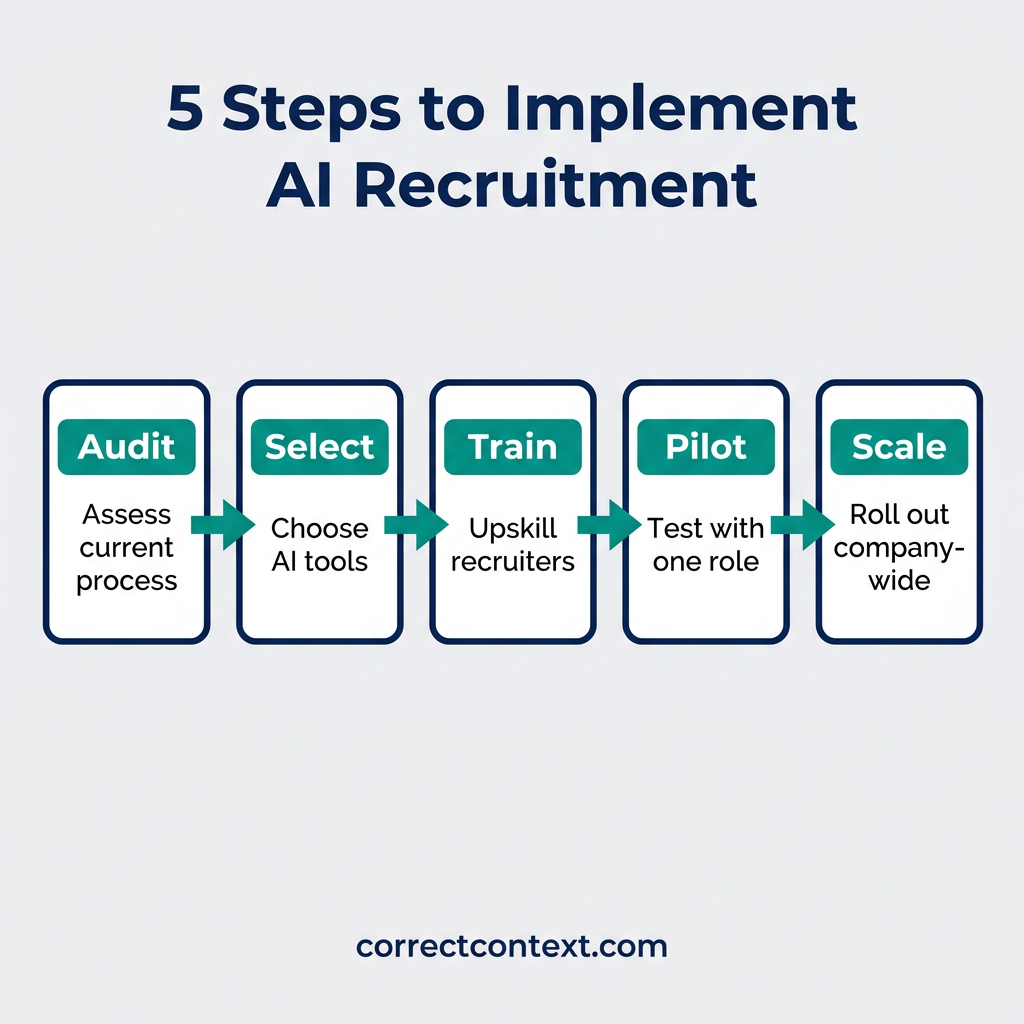
Based on the research and best practices from organizations like Uber, Siemens, and Deutsche Bahn, here’s a practical framework for implementing AI recruitment tools in Polish tech companies:
Phase 1: Audit and Strategy (Weeks 1-2)
Before purchasing any tools, conduct a thorough audit of your current recruitment process. Map time-to-hire, cost-per-hire, quality-of-hire metrics, and candidate experience scores. Identify the highest-friction points—typically initial screening, scheduling, and sourcing for niche technical roles. Define what “fairness” means for your organization specifically, as the HBR research emphasizes. Document your current diversity metrics to establish baselines for monitoring algorithmic impact.
Phase 2: Tool Selection (Weeks 3-4)
Evaluate tools against three criteria: capability, compliance, and integration. For Polish companies, GDPR compliance and EU AI Act readiness should be non-negotiable requirements. Integration with your existing ATS (whether Greenhouse, Workday, or a Polish-specific platform like Element ATS) will determine adoption success. Request bias audit reports from vendors—reputable providers should have third-party assessments of their algorithms.
Phase 3: Training and Change Management (Weeks 5-6)
LinkedIn’s research consistently shows that recruiter AI literacy determines implementation success. Establish an “AI playground” where recruiters can experiment with tools in low-risk environments before deploying on live candidates. Pair technical training with soft skills development—the relationship-building, communication, and advisory capabilities that differentiate human recruiters from algorithms. Deutsche Bahn’s Kerstin Wagner emphasizes: “By leveraging AI strategically, our recruiters gain valuable time to focus on meaningful, personal interactions with candidates.”
Phase 4: Pilot Implementation (Weeks 7-10)
Start with one high-volume role or one technical specialty. Monitor metrics obsessively: time-to-hire, candidate satisfaction, diversity of shortlisted candidates, and hiring manager satisfaction. Compare pilot results against historical benchmarks. Watch for unexpected bias indicators—if your shortlisted candidates suddenly become more homogeneous, your AI may be encoding hidden preferences.
Phase 5: Scale and Optimize (Ongoing)
Roll out successful implementations company-wide. Establish quarterly bias audits and annual third-party algorithmic assessments. Continuously train the AI on your successful hires to improve prediction accuracy. Most importantly, maintain human oversight—AI should inform decisions, not make them autonomously.
The Future Trajectory: Where AI Recruitment Is Heading
Gartner’s Hype Cycle for AI in Human Resources 2025 provides a roadmap of what’s coming. Several technologies currently in the “Innovation Trigger” phase will mature over the next 2-5 years:
Recruiter AI Agents: Beyond tools that assist recruiters, autonomous agents that handle end-to-end recruitment workflows for specific role types are emerging. These remain in early stages but represent the next frontier.
AI-Enabled Interview Intelligence: Real-time analysis of interview conversations to guide hiring managers toward better questions and more consistent evaluation. LinkedIn is already experimenting with recording and analyzing recruiter interview transcripts to identify improvement areas.
Agentic AI in HR: AI systems that can take actions rather than just providing recommendations—scheduling interviews, sending offers, negotiating start dates within predefined parameters.
For Polish tech companies, the strategic imperative is clear: master current-generation AI recruitment tools now to build the organizational capability and data foundations that next-generation systems will require. The 48% of Polish companies that have adopted AI are in position to capture these advances. The 52% that haven’t are falling behind a curve that’s accelerating, not linear.
Key Takeaways
- AI adoption is now universal, not optional. With 88% of companies using AI in hiring and 48% of Polish companies implementing AI broadly, this technology has shifted from competitive advantage to competitive necessity.
- The ROI is measurable and substantial. 31% faster hiring, 50% improvement in quality-of-hire metrics, and 20% of recruiter time freed for strategic activities.
- Bias risks are real and require active mitigation. AI can amplify existing biases if not carefully monitored. Define fairness explicitly, audit algorithms regularly, and maintain human oversight.
- Poland has unique advantages in AI recruitment. Bilingual capabilities, strong technical talent pool, and EU regulatory alignment create opportunities for companies that implement thoughtfully.
- Implementation requires more than technology. Success depends on recruiter training, change management, and building compliant systems from the ground up.
- The human element remains irreplaceable. As AI handles routine tasks, relationship-building, strategic advisory, and complex decision-making become more valuable recruiter skills.
- Skills-based hiring is the natural companion to AI recruitment. 94% of TA professionals believe accurate skills assessment is crucial for quality of hire—and AI makes skills-based hiring at scale practical.
Frequently Asked Questions
Is AI recruitment legal under Polish and EU law?
Yes, but with important caveats. GDPR requires transparency about automated decision-making and grants candidates rights to human review of AI-influenced decisions. The forthcoming EU AI Act classifies recruitment AI as “high-risk,” requiring conformity assessments, risk management systems, and human oversight. Polish companies should ensure their AI recruitment tools are compliant with both frameworks—reputable vendors will have documentation supporting this.
How much does AI recruitment software cost?
Costs vary widely based on functionality and scale. Entry-level AI screening tools start around €200-500 monthly for small teams. Enterprise platforms with full ATS integration, predictive analytics, and compliance features can run €2,000-10,000+ monthly. Most vendors offer per-user or per-hire pricing models. Given the 31% faster time-to-hire and 50% quality improvement documented in SHRM research, positive ROI typically occurs within 6-12 months for companies hiring 20+ roles annually.
Will AI replace recruiters?
No—but it will transform the role. The data consistently shows that demand for human skills is increasing as AI handles routine tasks. LinkedIn found that Dutch employers were 14x more likely to list “relationship development” as a required recruiter skill in 2024 compared to 2023. The recruiters who thrive will be those who use AI to become strategic talent advisors, not those who compete with AI on speed or volume.
How do I know if my AI tools are biased?
Monitor diversity metrics in your shortlisted and hired candidates compared to your applicant pool. If certain demographics are disproportionately filtered out at screening stages, investigate immediately. Request bias audit documentation from vendors. Consider third-party algorithmic audits annually. Most importantly, maintain human review of AI recommendations—no algorithm should make final hiring decisions autonomously.
What’s the first step for a Polish startup with limited HR resources?
Start with interview scheduling automation—it’s low-risk, delivers immediate time savings (approximately 20% of recruiter time), and builds organizational comfort with AI tools. Once that’s established, add AI-powered sourcing for hard-to-fill technical roles. Reserve resume screening AI for high-volume positions where the time savings justify the compliance overhead. Focus on tools that integrate with your existing ATS to minimize implementation complexity.
Sources
- Harvard Business Review — “New Research on AI and Fairness in Hiring” (December 2025)
- LinkedIn — “The Future of Recruiting 2025” (2025)
- SHRM — “2025 Recruiting Executives Benchmarking Report” (2025)
- Randstad Enterprise — “Talent Trends for Business Services Companies in Poland” (2025)
- AWS/Strand Partners — “Unleashing the Potential of AI in Poland 2026” (2026)
- Taylor & Francis — “Reducing AI bias in recruitment and selection: an integrative review” (2025)
- SAGE Journals — “Fair AI in hiring: Experimental evidence on how biased hiring algorithms deter women applicants” (2025)
- Screenz.ai — “AI Screening Tools: 2026 Industry Benchmarks” (2026)
- SenseLoaf — “Measuring the ROI of Recruitment Automation” (2025)
- Correct Context — “IT Talent in Poland: The Complete 2025 Guide” (2025)
Table of content
- What This Guide Covers
- The Current State of AI in Recruitment: By the Numbers
- What AI Actually Does in Modern Recruitment
- The Measurable ROI of AI Recruitment Tools
- The Bias Problem: What the Research Actually Shows
- AI in the Polish Context: Specific Opportunities and Challenges
- Implementation Framework: How to Deploy AI Recruitment Tools
- The Future Trajectory: Where AI Recruitment Is Heading
- Key Takeaways
- Frequently Asked Questions
- Sources
Related articles



About the Author: Duke Vu