
In today’s capital-constrained environment, many U.S. enterprise executives and fast-growing Series A+ startups are grappling with a critical decision: when is the right time to expand into Europe? The fear of committing too early often leads to shelving European expansion plans. However, data from the last decade reveals a stark reality: delaying expansion is significantly riskier than moving forward now. Missed growth, forfeited market share, and the opportunity cost of waiting can severely hamper a company’s global trajectory and valuation.
This article explores the hidden costs of delaying European expansion, the undeniable cost of delaying expansion, and why building an engineering team Poland / CEE or a nearshore development team is a strategic move that enterprise innovation units and scaling tech companies cannot afford to postpone.
The Massive Opportunity Cost of Waiting
Europe is the largest B2B software market outside of the United States. With a GDP of $18 trillion and a consumer base of nearly 500 million people, it represents roughly one-third of all global revenue for public software businesses [1]. Yet, de-prioritizing European expansion timing is a common mistake driven by a fear of the unknown and a desire to control costs.
The truth is, importing a proven product and go-to-market motion from the U.S. into a new geography like Europe is often lower risk than expanding into a new customer segment or developing brand-new product features domestically [1]. Elite founders and enterprise leaders are actively prioritizing Europe right now because the consequences of waiting are higher than ever.
Lost Revenue and Slower Growth
According to a comprehensive analysis of 50 B2B software IPOs over the last 15 years, Europe is a major driver of later-stage growth and valuation [2].
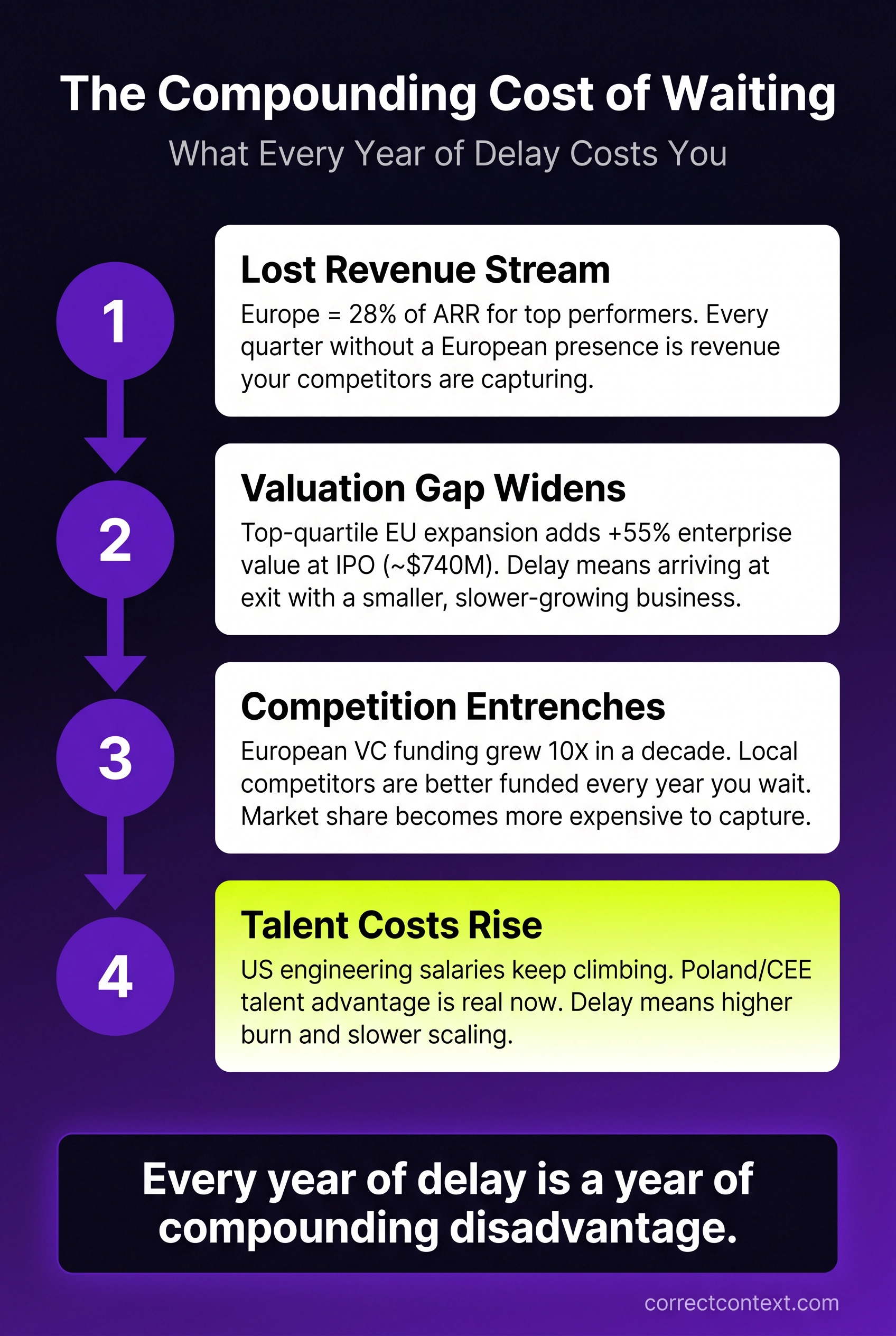
- Significant Revenue Contribution: For top-quartile businesses, Europe contributes an average of 28% of global Annual Recurring Revenue (ARR) at the point of IPO. That equates to around $80 million in ARR for a typical company going public today [2].
- Accelerated Growth Rates: Companies that expand internationally arrive at IPO growing 5% faster year-on-year than they would have relying solely on their U.S. business [2].
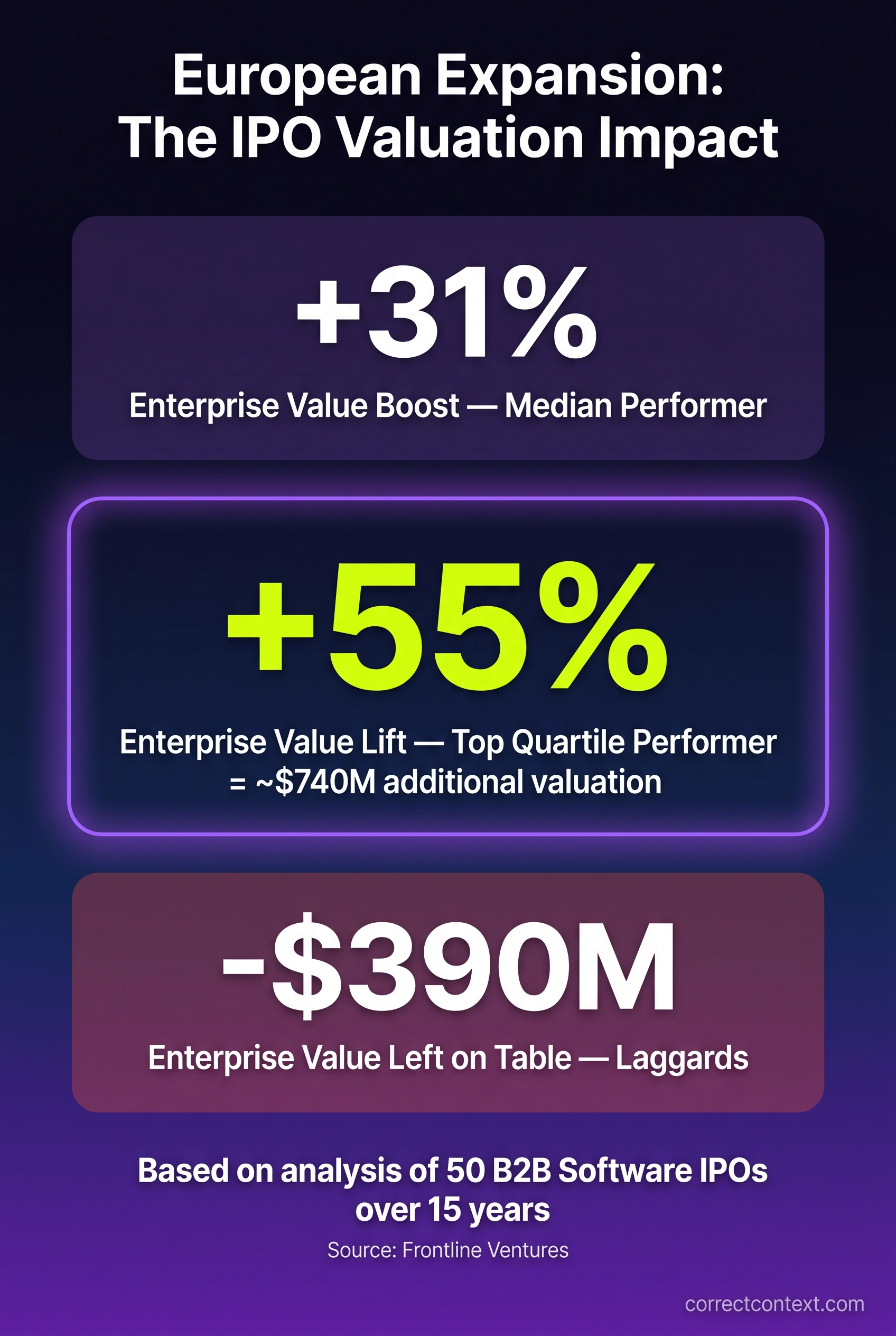
- The Laggard Penalty: Bottom-quartile performers who delayed or poorly executed their European strategy left approximately $390 million in enterprise value on the table [2].
Every month of delay is a month of forfeited revenue and compounding growth. In fact, another study on the EU-Mercosur trade agreement highlighted that delays can cost billions in foregone GDP and missing exports [3], illustrating the macroeconomic scale of hesitation in European markets.
The Valuation Uplift You Are Missing
The expansion opportunity cost becomes glaringly obvious when looking at exit valuations. High-growth software companies are valued on a multiple of their forward revenues. Because European expansion provides both a larger revenue base and an elevated growth rate, it has an outsized impact on valuation.
For the median company, a successful European expansion provides a 31% boost in Enterprise Value at IPO. For top-quartile performers, that uplift reaches a staggering 55% [2]. For a typical company arriving at IPO today, that translates to a $740 million increase in valuation—nearly a whole unicorn generated just from a well-executed expansion to Europe [2].
Delaying your entry means you are actively choosing to forgo this valuation premium, allowing competitors who move faster to capitalize on the market and secure higher valuations.
The Rising Stakes: Capital and Competition in Europe
Timing and conditions couldn’t be more ideal for U.S.-based software companies to expand into Europe, but the window is highly competitive. Venture capital raised by European companies has increased tenfold over the last decade, scaling to over $90 billion in 2022, and the number of new companies being funded in Europe is nearly on par with the U.S. [1].
This influx of capital means that the European startup ecosystem is stronger than ever. If you wait, you risk conceding valuable market share to high-quality, well-funded local competitors [1]. The pace of innovation in Europe is accelerating, and U.S. businesses must move quickly to establish their presence before local incumbents solidify their dominance.
The Talent Advantage: Scaling Teams in Europe
One of the most compelling reasons to accelerate your European expansion is access to world-class, cost-effective tech talent. As AI reshapes the tech job market and local hiring in the U.S. becomes increasingly difficult and expensive, building an offshore development team or a remote software engineers team in Europe offers a massive strategic advantage.
The Cost-Efficiency of Poland and CEE
When evaluating the cost of delaying expansion, you must consider the savings you are missing out on by not leveraging a dedicated development team in Central and Eastern Europe (CEE), particularly Poland.
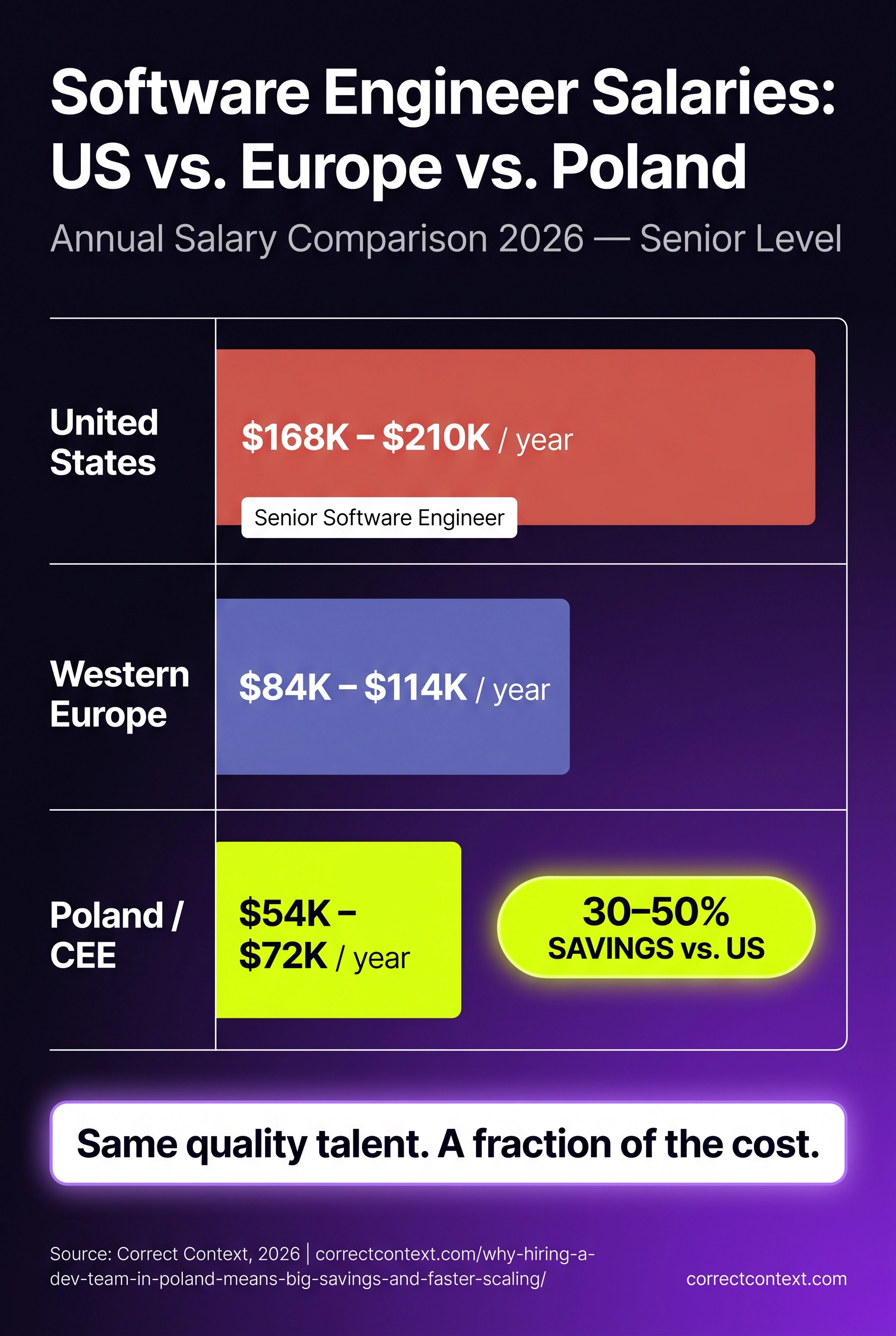
In the U.S., a senior software engineer can easily cost between $168,000 and $210,000 annually [4]. In contrast, a senior engineer in Poland typically ranges from $54,000 to $72,000 a year [4]. This represents a 30-50% cost savings, even after factoring in recruitment, management, and overhead [4] [5].
| Region | Junior Developer | Mid-Level Developer | Senior Developer | Specialized (e.g., AI/LLM) |
|---|---|---|---|---|
| United States | $88,000 | $120,000–$150,000 | $168,000–$210,000 | $240,000–$900,000 |
| Western Europe | $42,000–$54,000 | $60,000–$78,000 | $84,000–$114,000 | $96,000–$138,000 |
| Poland (CEE) | $24,000–$33,600 | $36,000–$50,400 | $54,000–$72,000 | $60,000–$96,000 |
| Table 1: Global AI and Software Engineer Salary Breakdown 2026 [4] |
By choosing to hire developers Poland, companies can build an extended engineering team that is highly skilled, English-proficient, and culturally aligned, all while drastically reducing their burn rate. This is not just about cheap labor; it is about smart capital allocation. The savings generated by a nearshore developers Europe strategy can be reinvested into product development, marketing, or further expansion.
Quality Without Compromise
Poland ranks third globally in STEM education quality and is a recognized powerhouse for tech talent [5]. Global giants like Google, Microsoft, and IBM have established major R&D centers in the country [4]. Whether you need a data engineering team, a cloud engineering team with AWS / Azure / GCP engineers team expertise, or a specialized AI development team, Poland delivers top-tier talent.
For enterprise innovation units looking to deploy enterprise ai tools or capitalize on ai trends enterprise, the ability to hire ai engineers in Poland provides a massive competitive edge. You can build a robust machine learning engineers team or a data analytics team at a fraction of the cost of a Silicon Valley equivalent, allowing for faster experimentation and deployment of corporate ai use cases.
Overcoming the Operational Hurdles
A common reason executives delay expansion is the perceived complexity of setting up international operations. Navigating foreign labor laws, payroll, and office management can be daunting. However, this is where partnering with an Employer of Record Poland (EoR) or utilizing EoR Europe services becomes invaluable.
Organizations like Correct Context specialize in the hiring of IT core teams offshored or nearshored to Poland and CEE. They handle recruitment, payrolls, HR, accounting, law, and office management, allowing you to hire employees without entity and hire in Europe without company.
This employment compliance Europe solution removes the operational friction of expansion. You can build tech hub Poland or an engineering hub Europe quickly and compliantly, focusing your internal resources on strategy and product rather than administrative overhead. Whether you need to scale engineering teams, find an offshore team for startup, or deploy a DevOps team for hire, leveraging payroll services Poland and EoR models accelerates your time-to-market.
Conclusion: The Time to Act is Now
The cost of delaying expansion is no longer a theoretical debate; it is a measurable financial penalty. By waiting, U.S. enterprises and scaling startups are leaving millions in revenue and valuation on the table, conceding ground to European competitors, and missing out on the massive cost advantages of scaling teams Europe.
Expanding into Europe is not a high-risk gamble; it is a disciplined execution of a proven model. By leveraging the exceptional talent pool in Poland and CEE through a dedicated software team or platform engineering team, and utilizing an Employer of Record CEE to eliminate operational friction, companies can capture the European market efficiently and profitably.
Do not let the fear of the unknown stall your global growth. The data is clear: the most successful companies do not wait for the perfect moment; they create it.
References
[1] Frontline Ventures. (2023). Expanding to Europe: Why US Startups Shouldn’t Wait | Frontline
[2] Bristow, J. (2021). European Expansion can lift IPO valuation by 55% | by Jamie Bristow | At the Front Line | Medium
[3] European Centre for International Political Economy (ECIPE). (2026). Time is Money: The Cost of Delaying the Ratification of the EU-Mercosur Trade Agreement |
[4] Correct Context. (2026). Why Hiring a Dev in Team in Poland Means Big Savings-and Faster Scaling
[5] Nortal. (n.d.). CEE Tech Teams | Cost Efficiency, Quality, and Skill. Retrieved from