
In 2024, 67% of European tech companies reported difficulty filling senior engineering roles domestically [1]. By early 2026, that pressure has only intensified. As enterprise innovation units and rapidly scaling Series A+ startups look beyond their borders to solve the talent crunch, Central and Eastern Europe (CEE)—and Poland in particular—has emerged as a strategic default rather than a mere alternative. Yet, for CTOs and enterprise leaders late in their evaluation of nearshore options, a lingering fear remains: will these highly skilled engineers leave quickly?
This article examines the reality of engineering retention Poland, analyzing the data on developer stability, the structural factors that drive long-term loyalty, and how companies can build dedicated teams that outlast the typical tech industry churn.
The State of Developer Churn: US vs. Europe vs. Poland
To understand the stability of Polish engineering teams, we must first contextualize the broader tech industry’s attrition landscape. The global tech sector has long been characterized by high turnover. In the US, tech attrition runs at 13–18% annually, heavily driven by continuous poaching and a pervasive job-hopping culture [2]. The average tenure of a software engineer at a major tech company often hovers around 1.5 to 3 years [3].
In contrast, the European tech market, and specifically the CEE region, presents a very different picture. Across European tech in 2025, the average attrition rate was 17.4% [4]. However, when looking specifically at engineering roles, the attrition rate drops to an impressive 12%—the lowest across all job functions for the second consecutive year [4].
When we zoom in on Poland, the numbers are even more compelling. Companies that have operated CEE engineering teams for three or more years report retention rates averaging 85% [1]. Furthermore, specialized recruitment and nearshoring partners operating in Poland frequently report retention rates exceeding 86%, and sometimes as high as 95.7% for dedicated nearshore units [5] [6].
| Region / Market | Average Annual Attrition Rate | Key Drivers of Turnover / Retention |
|---|---|---|
| United States | 13% – 18% | Continuous poaching, high salary jumps between roles, job-hopping culture [2]. |
| Europe (Overall Tech) | 17.4% | Salary stagnation vs. market rates, restructuring in operations [4]. |
| Europe (Engineering Only) | 12% | Prioritizing job security post-layoffs, stable work environments [4]. |
| Poland / CEE (Dedicated Teams) | 5% – 15% (85%+ Retention) | Strong cultural alignment, emphasis on technical depth, B2B contractor stability [1] [5]. |
| India (Offshore Comparison) | 20% – 30% | Highly saturated market, frequent poaching for marginal salary gains [7]. |
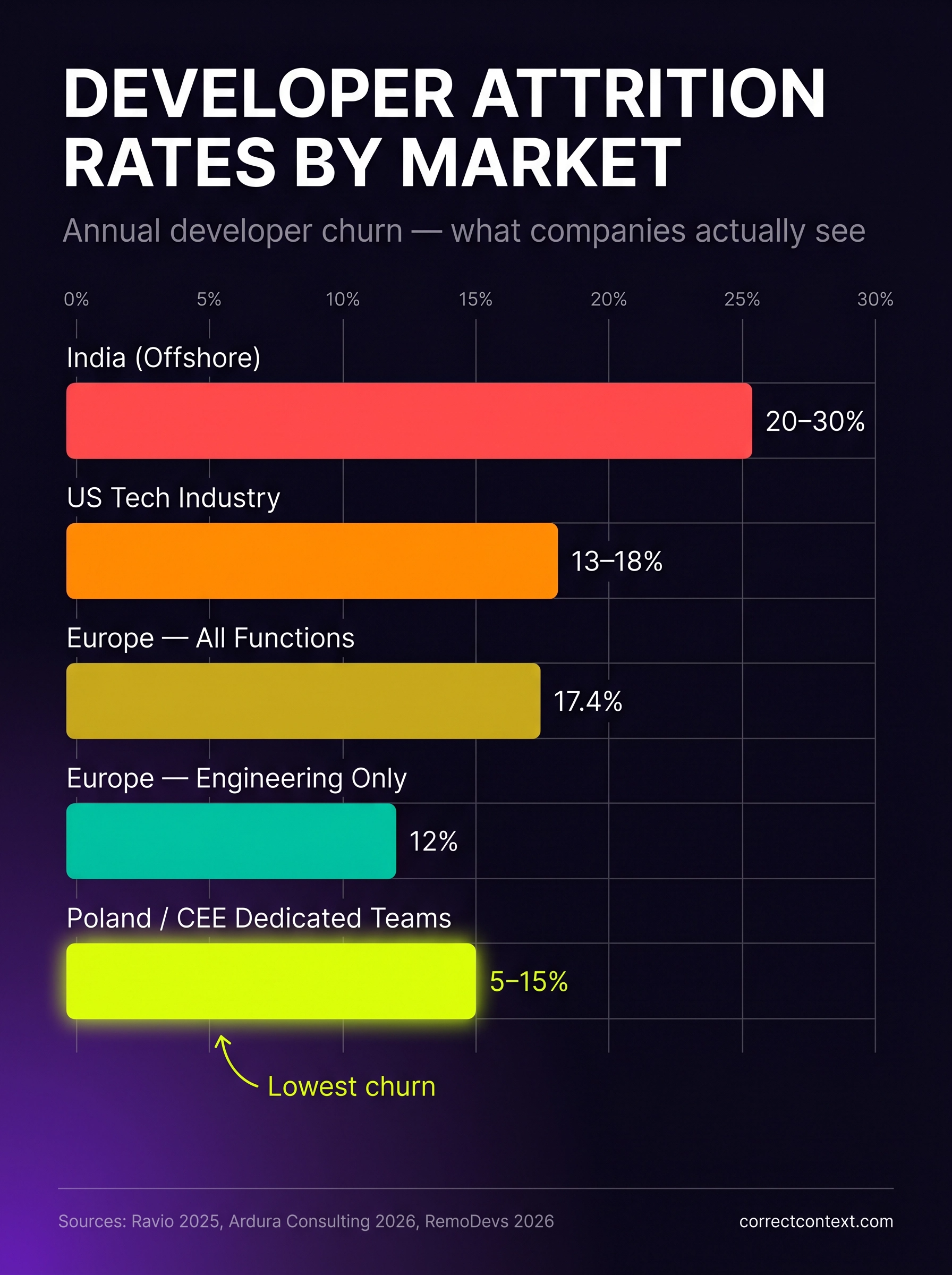
The data clearly indicates that developer retention CEE is significantly stronger than in the US or traditional offshore markets like India. But what is driving this Poland engineering stability?
Structural Advantages Driving Long-Term Retention in Poland
The high retention rates observed in Polish engineering teams are not accidental; they are the result of structural, cultural, and economic factors unique to the region.
1. The B2B Contracting Model
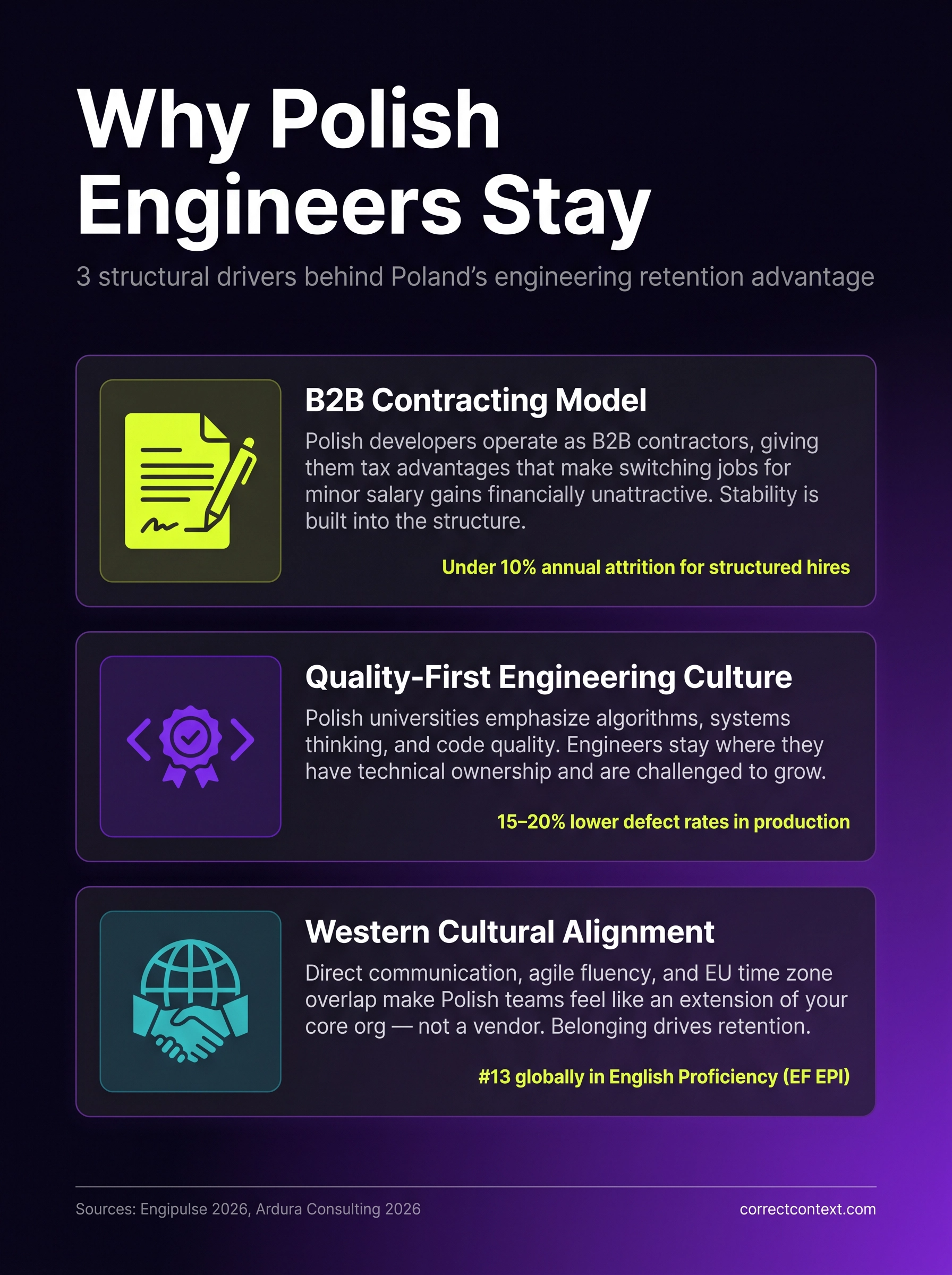
In Poland, the standard engagement model for senior developers working with foreign companies is a B2B (business-to-business) contract [2]. Under this model, the developer operates as a sole proprietorship, invoicing the client monthly. This structure offers significant tax advantages for the developer, resulting in higher net take-home pay compared to standard employment contracts. Because these financial benefits are substantial, developers are less incentivized to jump ship for minor gross salary increases, leading to greater long-term stability.
2. Deep Technical Tracks and Quality-First Culture
Polish engineering culture is deeply rooted in rigorous academic training. Universities in Poland emphasize algorithms, data structures, and systems thinking [1]. This produces engineers who value technical depth and problem-solving over short-term velocity gains.
When engineer churn Europe does occur, it is often because developers feel they are stagnating technically. Polish engineers tend to stay in roles where they are challenged, where they have ownership of the product, and where code quality is prioritized. Companies that treat their nearshore teams as true extensions of their core engineering units—rather than mere ticket-takers—see significantly higher retention.
3. Cultural Alignment and Direct Communication
Communication friction is a leading cause of frustration and turnover in distributed teams. Poland ranks 13th globally in the EF English Proficiency Index, and its business culture closely mirrors Western expectations [1]. Polish developers are known for their direct communication style; they will push back on unrealistic requirements and suggest architectural alternatives during standups [7]. This collaborative, rather than hierarchical, dynamic fosters a sense of ownership and belonging, which is critical for long-term retention.
The Hidden Cost of Attrition (And the ROI of Stability)
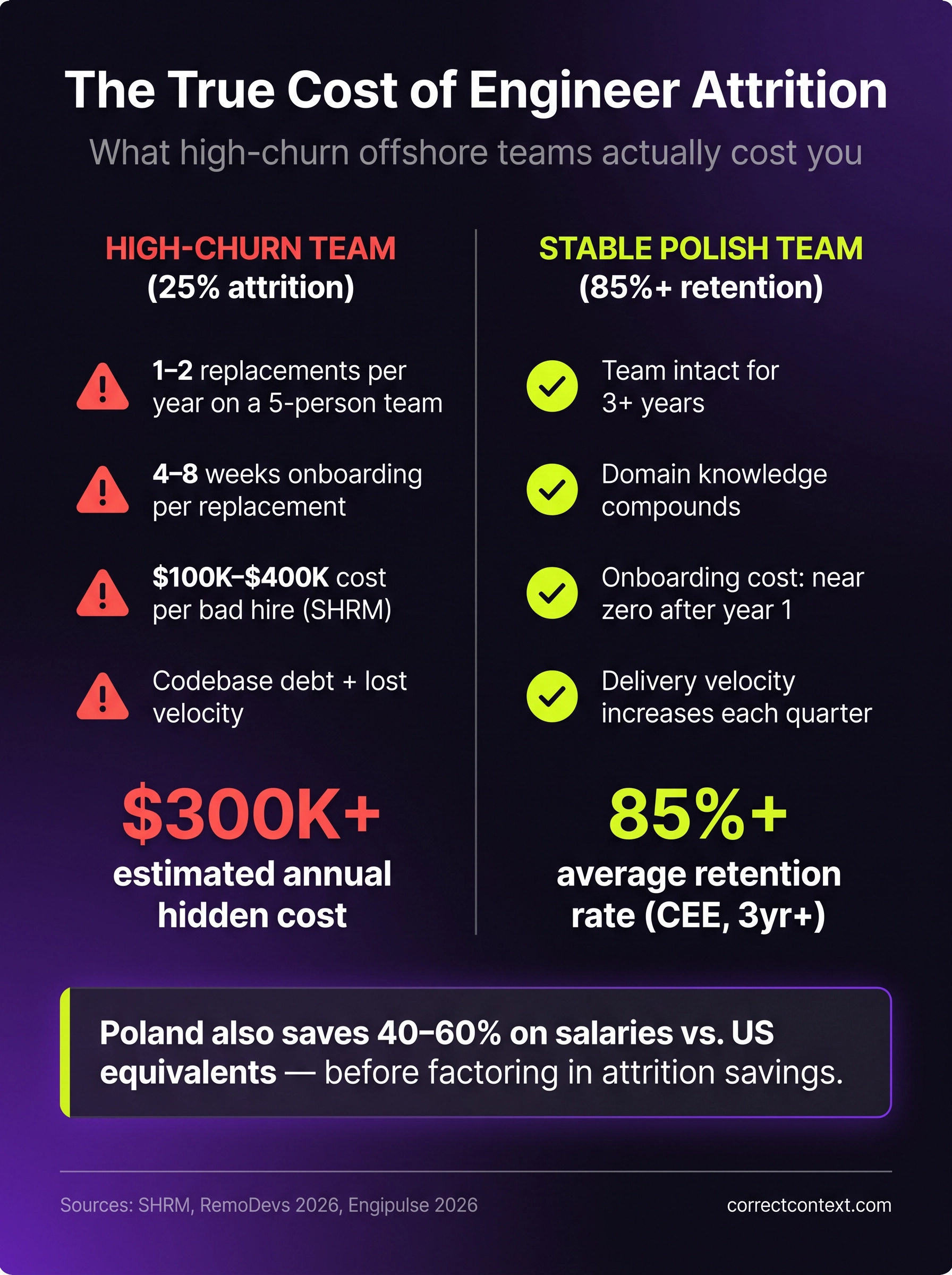
For enterprise innovation units and globally scaling startups, the cost of a bad hire or high turnover is astronomical. The Society for Human Resource Management (SHRM) estimates the cost of a bad hire at 50–200% of the employee’s annual salary [2]. For a senior engineer earning $200,000, that is a $100,000 to $400,000 loss, factoring in lost productivity, recruitment fees, onboarding time, and codebase debt.
When evaluating the ROI of a nearshore development team, the calculation must extend beyond the initial salary arbitrage. While hiring software developers Poland offers a 40–60% cost reduction compared to US equivalents, the true value lies in the compounding productivity of a stable team.
Consider a 12-month project with a 5-person team. In a market with 25% attrition, you can expect at least one replacement, requiring 4-8 weeks of onboarding [7]. This adds months of reduced productivity. In Poland, where retention averages 85% or higher, that team remains intact, deepening their domain knowledge and accelerating delivery velocity over time.
How to Maximize Retention in Your Polish Engineering Hub
While the baseline stability of Polish tech talent is high, companies must actively manage their distributed teams to maintain these retention rates. The difference between successful and failed nearshore engagements almost always comes down to structure [1].
- Implement a Dedicated Team Model: Dedicated teams with clear product ownership outperform staff augmentation arrangements by 2-3x on delivery metrics and show significantly lower attrition [1]. Give your Polish team autonomy and treat them as a core part of your R&D organization.
- Ensure Tooling Parity: Teams using identical development environments, observability stacks, and deployment pipelines to headquarters integrate faster and feel more valued [1].
- Provide Visible Career Pathways: Engineers leave roles that lack growth. Ensure that your extended engineering team in Poland has clear opportunities for advancement, whether into principal engineering roles or architectural leadership.
- Partner with the Right Employer of Record (EoR): Navigating the Polish market requires local expertise. Partnering with a specialized provider like Correct Context ensures seamless handling of recruitment, payrolls, HR, accounting, and legal compliance (EoR Poland). This allows you to build a build tech hub Poland without the administrative burden of establishing a local entity, ensuring your developers are paid on time and supported locally.
Conclusion
For CTOs and enterprise leaders evaluating their global engineering strategy, the fear of high attrition in distributed teams is valid, but misplaced when it comes to Poland. The data confirms that engineering retention Poland is exceptionally strong, driven by favorable contracting models, a culture of technical excellence, and deep alignment with Western business practices.
By building a dedicated development team in Poland, companies are not just cutting costs; they are investing in long-term stability, higher code quality, and predictable delivery velocity.
References
[1] Engipulse. “Why CEE Engineering Teams Are Becoming the Default Choice for Scaling Tech Companies in 2026.” Engipulse, 2026.
[2] RemoDevs. “Calculating the ROI of Hiring Polish Software Engineers for US Companies.” RemoDevs, 2026.
[3] Stack Overflow. What’s the average tenure of an engineer at a big tech company? (Ep. 434) – Stack Overflow
[4] Ravio. “Retention trends 2026: attrition rates data and employee retention strategies.” Ravio, 2025.
[5] Nortal. “CEE Tech Teams | Cost Efficiency, Quality, and Skill Augmentation.” Nortal, 2026.
[6] nCube. “Nearshore Software Development in Poland.” nCube, 2026.
[7] Ardura Consulting. “Nearshoring: Poland vs India vs Ukraine — Decision Guide 2026.” Ardura Consulting, 2026.
Table of content
Related articles



About the Author: Marta