
10 Developer Onboarding Best Practices That Reduce Time-to-Productivity by 60% (2026 Guide)
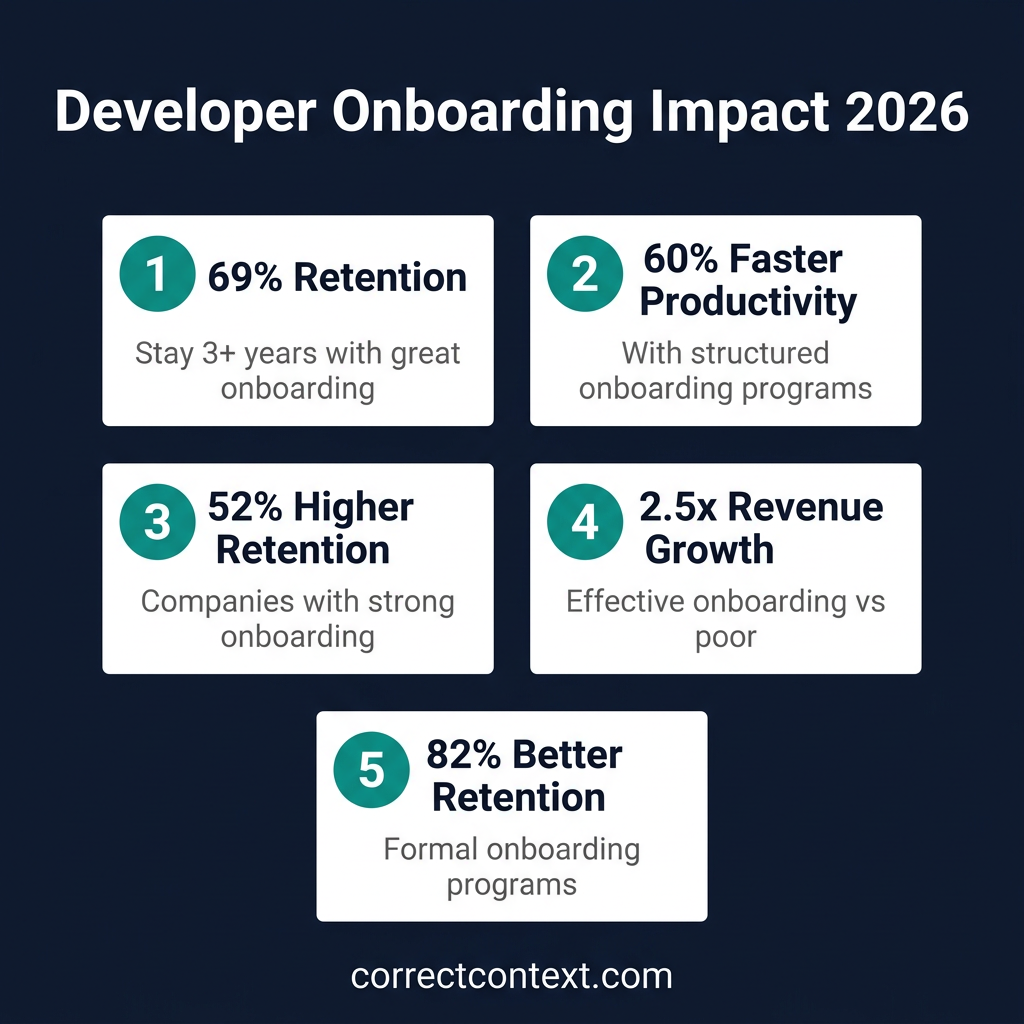
Here is a sobering statistic: only 12% of employees believe their organization does a good job onboarding new hires, according to Gallup research. Yet companies with structured onboarding programs retain 82% more new hires and see productivity gains exceeding 70%. For engineering teams, where the cost of a bad hire can reach 200% of annual salary and time-to-productivity directly impacts sprint velocity, getting onboarding right is not optional—it is a competitive advantage.
This guide breaks down ten evidence-based developer onboarding best practices that leading tech companies use to cut ramp-up time, improve code quality, and retain engineering talent. Whether you are building a startup team in Warsaw or scaling a distributed engineering organization across Europe, these practices will help you turn new hires into productive contributors faster.
Why Developer Onboarding Matters More Than Ever
The stakes for getting developer onboarding right have never been higher. The global onboarding software market is projected to grow from $1.77 billion in 2024 to $2.12 billion in 2025, reflecting increased recognition of onboarding’s business impact. For software engineering specifically, the challenges are unique: complex technical environments, distributed teams across time zones, and the pressure to ship code quickly without compromising quality.
Poland’s IT sector exemplifies these dynamics. With over 546,000 IT professionals and a market that saw 21% year-over-year growth in recruitment processes during Q1 2025, Polish tech companies are competing fiercely for talent. The difference between retaining a senior engineer for three years versus losing them within the first 90 days often comes down to the onboarding experience.
The 10 Developer Onboarding Best Practices
1. Start Before Day One with Structured Pre-boarding
The onboarding clock starts ticking the moment a candidate accepts your offer, not their first day on the job. Companies that implement structured pre-boarding reduce first-day anxiety and accelerate time-to-first-commit by an average of five days.
Effective pre-boarding for developers includes:
- Hardware provisioning and delivery: Ship laptops, monitors, and peripherals to remote hires at least one week before start date. Include setup instructions and IT contact information.
- Access preparation: Create email accounts, provision GitHub/GitLab access, set up VPN credentials, and configure Slack or Teams accounts before day one.
- Documentation access: Grant read-only access to engineering handbooks, architecture documentation, and code style guides.
- Welcome communication: Send a personalized welcome message from the hiring manager and team members, including a schedule for the first week.
- Administrative completion: Use e-signature software to handle tax forms, NDAs, and benefits enrollment—saving up to 40 hours per month for a 100-person company.
Research from Digitate shows that automation of pre-boarding tasks can reduce overall onboarding time by five days. For a senior engineer billing at $150 per hour, that is $6,000 in recovered productivity per hire.
2. Implement a 30-60-90 Day Structured Framework
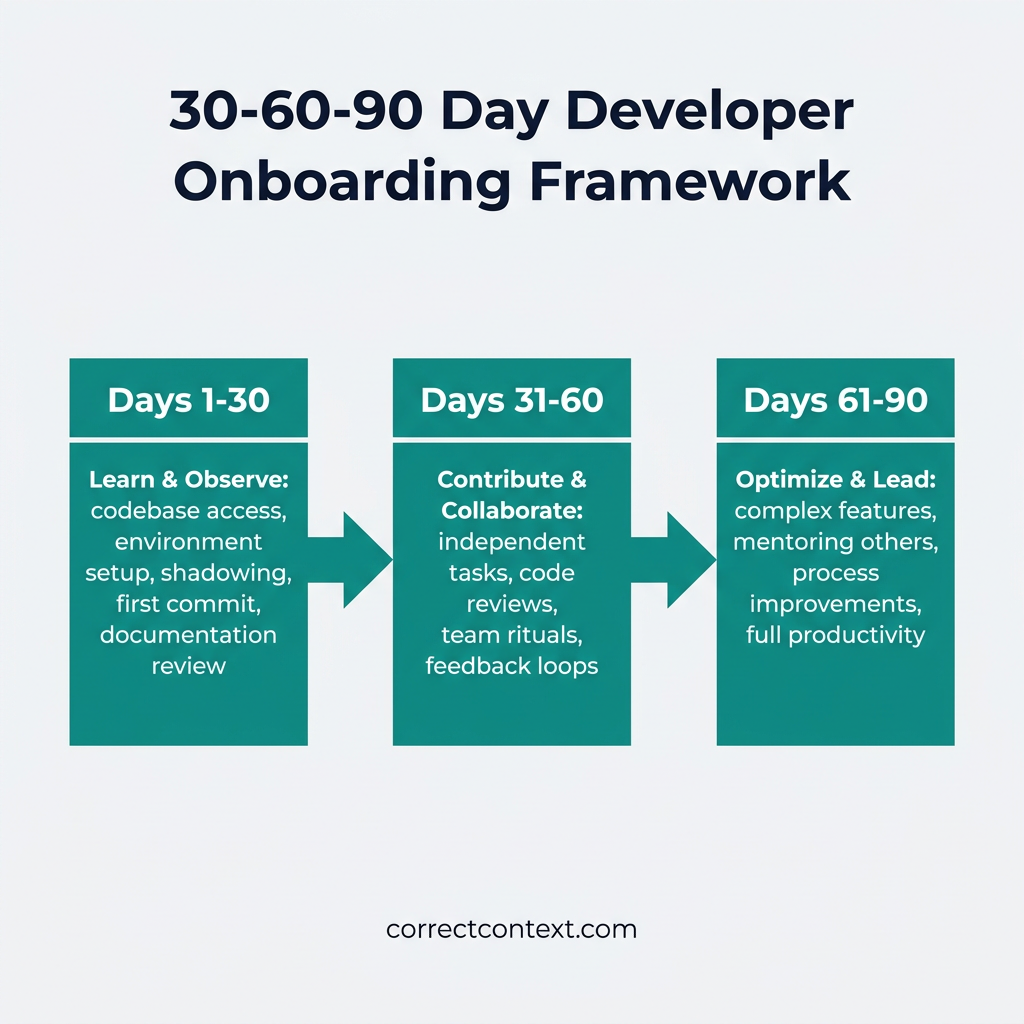
The 30-60-90 day plan is the backbone of effective developer onboarding. This framework divides the first three months into distinct phases with clear goals, learning objectives, and performance expectations.
Days 1-30: Learn and Observe
The first month focuses on environment setup, codebase familiarization, and understanding team dynamics. Key milestones include:
- Complete development environment setup with documented tooling
- Submit first pull request (typically documentation or minor bug fix)
- Shadow senior engineers during code reviews and architecture discussions
- Complete security and compliance training
- Meet all team members and cross-functional stakeholders
- Review architecture decision records (ADRs) and system documentation
Days 31-60: Contribute and Collaborate
The second month transitions from observation to active contribution:
- Take ownership of well-defined features or bug fixes
- Participate actively in code reviews (both giving and receiving)
- Attend sprint planning, retrospectives, and standups as a full participant
- Complete first significant feature deployment to production
- Establish regular 1:1 cadence with manager and mentor
Days 61-90: Optimize and Lead
The final month of the onboarding period focuses on full integration:
- Independently scope and deliver complex features
- Contribute to technical design discussions and architecture reviews
- Begin mentoring newer team members or interns
- Identify and propose process improvements
- Achieve full productivity parity with team expectations
Companies using structured 30-60-90 day plans report new hires reaching full productivity two months faster than those using ad-hoc onboarding approaches.
3. Assign an Onboarding Buddy, Not Just a Manager
Manager involvement makes onboarding 3.5 times more effective, according to Gallup research. But managers cannot—and should not—handle onboarding alone. This is where the onboarding buddy system proves invaluable.
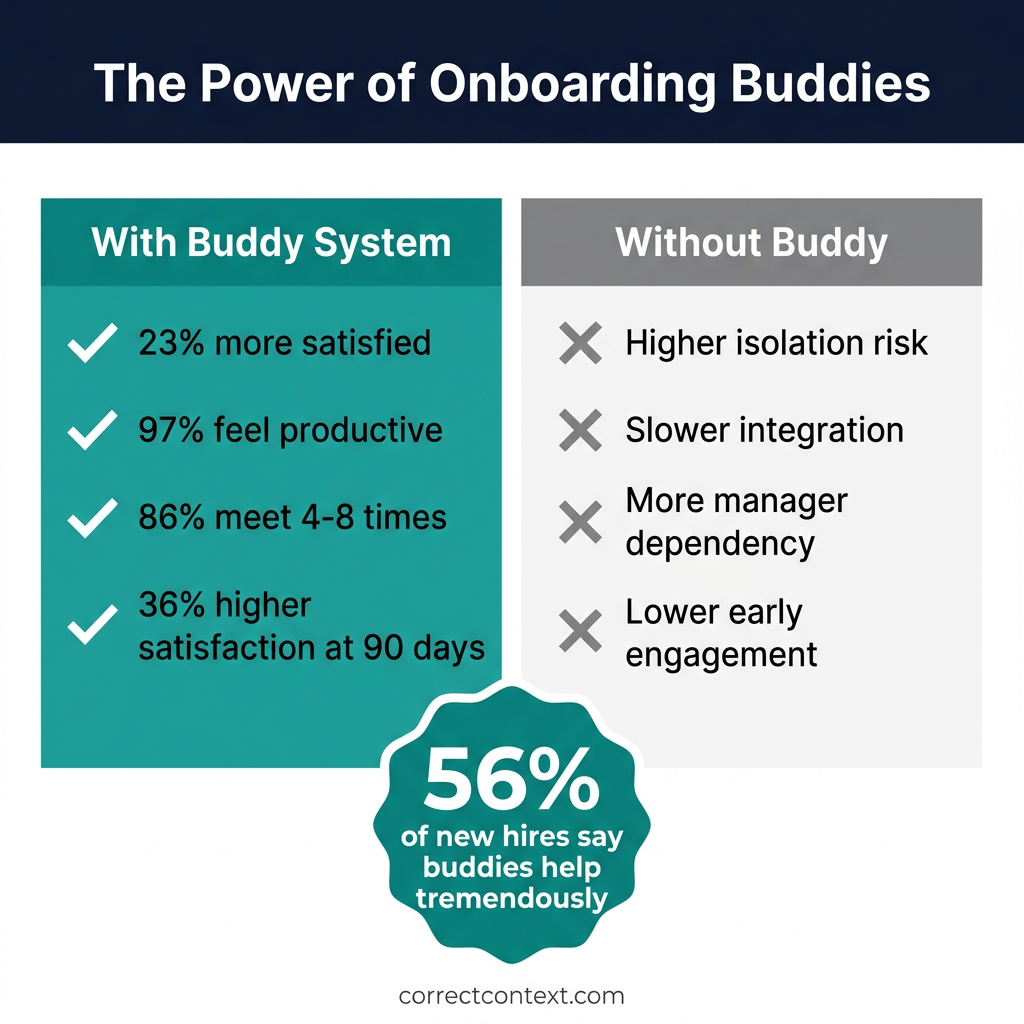
Microsoft’s research on their buddy program revealed compelling results: new hires with buddies were 23% more satisfied with their onboarding experience overall, and this satisfaction increased to 36% after 90 days. Even more striking, 97% of new hires who met with their buddy more than eight times in their first 90 days reported feeling productive quickly.
An effective onboarding buddy:
- Is a peer (not a manager) at a similar level or slightly senior
- Has been with the company at least six months
- Is willing to dedicate 30-60 minutes weekly for the first three months
- Can answer “stupid questions” without judgment
- Introduces the new hire to informal networks and social norms
Importantly, a buddy is not a replacement for formal mentorship or management oversight. Buddies handle the social integration and day-to-day questions; managers handle performance, career development, and escalations.
4. Automate Environment Setup with Infrastructure as Code
Nothing kills first-week momentum like spending three days troubleshooting local environment setup. Leading engineering organizations treat developer environment setup as a first-class engineering problem, using infrastructure as code (IaC) to automate the process.
Best practices for environment automation include:
- Docker-based development environments: Containerize the entire stack so new hires run a single command to get a working environment.
- Setup scripts and makefiles: Provide one-command setup scripts that install dependencies, configure databases, and seed test data.
- Documentation in code: Keep setup instructions in version control alongside the code, not in a separate wiki that becomes outdated.
- CI/CD verification: Run setup scripts in CI to ensure they stay functional as dependencies change.
Companies that reduce environment setup time from days to hours see measurable improvements in new hire satisfaction and earlier first contributions.
5. Design a Progressive Code Contribution Pathway
Throwing new developers into complex production code on day one is a recipe for anxiety and bugs. Instead, design a progressive pathway that builds confidence through increasingly complex contributions.
| Week | Contribution Type | Example Tasks | Success Criteria |
|---|---|---|---|
| 1 | Documentation | Fix README errors, add code comments, update API docs | PR merged, feedback incorporated |
| 2 | Test Writing | Add unit tests for existing functions, improve coverage | Tests pass, coverage increased |
| 3 | Bug Fixes | Well-defined bugs with clear reproduction steps | Fix deployed, no regressions |
| 4 | Small Features | UI tweaks, API endpoint additions, config changes | Feature shipped, monitoring clean |
| 6-8 | Medium Features | End-to-end user stories, integration work | Independent delivery |
| 9-12 | Complex Work | Architecture changes, performance optimization | Full team member velocity |
This progression serves multiple purposes. It builds technical familiarity gradually, establishes code review relationships with team members, creates early wins that boost confidence, and provides natural checkpoints for feedback and adjustment.
6. Prioritize Cultural Integration Alongside Technical Training
Technical skills get developers hired; cultural fit determines whether they stay. Research from BambooHR shows that 80% of employees who receive clear cultural orientation during onboarding hold their organization in high regard. Meanwhile, 44% of employees who feel connected to their workplace would recommend it to others.
For engineering teams, cultural integration includes:
- Understanding “how we work”: Document and communicate engineering values, decision-making processes, and communication norms.
- Meeting key stakeholders: Schedule intentional introductions to product managers, designers, QA engineers, and support staff.
- Learning the unwritten rules: Every engineering team has norms—when to escalate, how to handle disagreements, what “done” really means. Buddies help decode these.
- Building social connections: Remote teams need structured social time—virtual coffee chats, team games, or in-person meetups when possible.
Companies that treat cultural onboarding as seriously as technical onboarding see 18 times more dedication from new hires compared to those with weak cultural integration.
7. Establish Clear Feedback Loops and Check-ins
Sixty percent of companies do not set milestones or goals for new employees during onboarding. This is a critical mistake. Without clear expectations and regular feedback, new hires are left guessing about their performance and progress.
Effective feedback loops include:
- Weekly 1:1s with managers: Use this time to discuss progress, blockers, and adjustments to the onboarding plan.
- 30-60-90 day formal reviews: Structured check-ins at each milestone to assess progress against the plan.
- Anonymous feedback surveys: Ask new hires about their onboarding experience at 30 and 90 days to identify process improvements.
- Code review feedback: Ensure code reviews are constructive and educational, not just gatekeeping.
Research from Harvard Business Review found that 20% of employee turnover happens within the first 45 days. Regular check-ins during this vulnerable period directly address the confusion and uncertainty that drive early departures.
8. Document Everything—and Keep It Current
Engineering teams are notorious for outdated documentation. But for onboarding, current documentation is essential. New hires rely heavily on written resources during their first weeks, and stale documentation creates frustration and wasted time.
High-impact documentation for onboarding includes:
| Document Type | Purpose | Maintenance Owner |
|---|---|---|
| Engineering Handbook | Cultural values, processes, communication norms | Engineering leadership |
| Architecture Decision Records | Why systems are built the way they are | Tech leads |
| API Documentation | How to interact with internal services | Service owners |
| Runbooks | How to handle common incidents | On-call engineers |
| Setup Guides | Environment configuration step-by-step | Platform/DevOps team |
| Code Style Guides | Linting rules, naming conventions, patterns | Language guilds |
The key is assigning explicit ownership for documentation maintenance. When everyone owns documentation, nobody does. Rotate documentation updates into sprint work quarterly to prevent drift.
9. Adapt for Remote and Hybrid Work Realities
Fifty-five percent of organizations offered virtual onboarding processes in 2023, and that number has only grown. For distributed engineering teams, onboarding requires additional intentionality to overcome the isolation and disconnection that 58% of remote new hires report feeling.
Remote-specific onboarding best practices:
- Over-communicate: In offices, new hires absorb information through osmosis. Remote hires need explicit communication about context and norms.
- Use video deliberately: First-week introductions should be on video. Record important sessions for timezone flexibility.
- Ship physical welcome packages: Company swag, handwritten notes, and useful tools create tangible connection to the organization.
- Schedule timezone-friendly interactions: Ensure new hires in different time zones have meaningful synchronous time with their team.
- Create virtual watercoolers: Dedicated channels for non-work chat, random coffee pairings, and team celebrations.
Research from McKinsey’s 2025 analysis found that 77% of remote employees report greater productivity when working offsite—but only when they have sufficient tools and support. Onboarding is where that support foundation is built.
10. Measure and Iterate on Onboarding Effectiveness
You cannot improve what you do not measure. Leading organizations track specific metrics to evaluate and continuously improve their onboarding programs.
Key onboarding metrics include:
- Time-to-first-commit: Days from start to first merged code contribution
- Time-to-productivity: Days until new hire reaches expected velocity
- 90-day retention rate: Percentage of hires still employed at 90 days
- 1-year retention rate: Percentage of hires still employed at one year
- New hire satisfaction scores: Survey results at 30 and 90 days
- Manager confidence ratings: Manager assessment of readiness at 90 days
- Early code quality metrics: Bug rates and review cycles for new hire contributions
Set targets for each metric and review them quarterly. For example: “90% of new hires reach full productivity within 90 days” or “95% 90-day retention rate.” When metrics fall short, investigate and adjust the onboarding process.
Key Takeaways
- Onboarding starts before day one. Pre-boarding activities like hardware provisioning and access setup can reduce time-to-productivity by five days.
- Structure beats improvisation. The 30-60-90 day framework provides clear milestones and reduces the time to full productivity by up to two months.
- Buddies matter. New hires with onboarding buddies are 23% more satisfied and 97% more likely to feel productive quickly.
- Automation accelerates integration. Infrastructure-as-code for environment setup and automated provisioning eliminate first-week friction.
- Progressive complexity builds confidence. Start new hires with documentation and tests, then progress to bugs and features.
- Culture is as important as code. 80% of employees with clear cultural orientation hold their organization in high regard.
- Feedback prevents early turnover. 20% of turnover happens in the first 45 days; regular check-ins catch issues early.
- Documentation requires ownership. Assign explicit owners to keep onboarding resources current.
- Remote onboarding needs extra intentionality. Over-communication, video presence, and virtual social connections are essential.
- Measure to improve. Track time-to-productivity, retention rates, and satisfaction scores to continuously refine your program.
Frequently Asked Questions
How long should developer onboarding take?
Full productivity typically takes 60-90 days for mid-level developers and 90-120 days for senior engineers or those working in complex domains. However, structured onboarding programs can reduce this by 30-50% compared to ad-hoc approaches. The goal is not to rush the process but to ensure each phase—learning, contributing, and optimizing—is given appropriate time and support.
What is the cost of poor developer onboarding?
Poor onboarding is expensive. Replacing an employee costs 21% of their annual salary on average. For a senior engineer earning $120,000, that is $25,200 in replacement costs alone. Add lost productivity (typically 3-6 months of reduced output), team disruption, and re-recruiting effort, and the total cost can exceed 200% of annual salary. Conversely, companies with strong onboarding see 2.5 times more revenue growth and 1.9 times better profit margins.
How do you onboard developers in different time zones?
Time zone distributed onboarding requires asynchronous documentation, recorded video sessions, and intentional synchronous overlap. Provide comprehensive written resources that new hires can consume independently. Record all orientation sessions. Schedule at least 2-3 hours of synchronous overlap daily during the first two weeks for real-time questions and relationship building. Rotate meeting times so the burden of odd hours is shared across the team.
Should onboarding be the same for junior and senior developers?
No. While the framework—30-60-90 days, buddy system, feedback loops—remains consistent, the content and pace should adapt. Senior developers may skip basic technical training but need deeper context on architecture, decision-making history, and stakeholder relationships. Junior developers need more structured technical guidance and pair programming. Customize the milestones within the framework based on experience level.
How can small teams with limited resources implement effective onboarding?
Small teams can focus on high-impact, low-cost practices: document the essentials (setup, architecture, processes), assign a buddy for social integration, create a simple 30-60-90 day checklist, and schedule weekly check-ins. Use open-source tools and templates rather than building custom onboarding platforms. The investment in structured onboarding pays dividends even for teams making just a few hires per year.
Sources
- Gallup — Onboarding New Employees: A Perspective Paper (2024)
- SHRM — Don’t Underestimate the Importance of Effective Onboarding (2025)
- Devlin Peck — Employee Onboarding Statistics: Top Trends & Insights (2025)
- BambooHR — Onboarding Infographic and Research (2024)
- Harvard Business Review — To Retain New Hires, Spend More Time Onboarding Them (2018, updated 2024)
- OnShift — How Onboarding Buddies Can Revolutionize The New Hire Process (2024)
- High5 Test — In-Depth Employee Onboarding Statistics & Trends in 2025
- Digitate — Automation and AI: Superheroes in Disguise (2024)
- Cortex — Developer Onboarding: Checklist & Best Practices for 2025
- FullScale — The 90-Day Developer Onboarding Best Practices That Actually Works (2025)
Table of content
- Why Developer Onboarding Matters More Than Ever
- The 10 Developer Onboarding Best Practices
- 1. Start Before Day One with Structured Pre-boarding
- 2. Implement a 30-60-90 Day Structured Framework
- 3. Assign an Onboarding Buddy, Not Just a Manager
- 4. Automate Environment Setup with Infrastructure as Code
- 5. Design a Progressive Code Contribution Pathway
- 6. Prioritize Cultural Integration Alongside Technical Training
- 7. Establish Clear Feedback Loops and Check-ins
- 8. Document Everything—and Keep It Current
- 9. Adapt for Remote and Hybrid Work Realities
- 10. Measure and Iterate on Onboarding Effectiveness
- Key Takeaways
- Frequently Asked Questions
- Sources
Related articles



About the Author: Duke Vu