
As US, UK, and Nordic enterprises race to build high-performance engineering teams, Europe has emerged as one of the most attractive destinations for technical talent. Poland and the broader Central and Eastern European (CEE) region, in particular, offer an exceptional pool of senior developers with deep expertise in Big Data analytics, Cloud infrastructure (AWS, Azure, GCP), AI/ML, and platform engineering. The cost-to-quality ratio is compelling. The time zone overlap with Western Europe is practical. The talent density is real.
But hiring engineers in Europe is not the same as hiring in your home market. The legal landscape is layered, country-specific, and actively enforced. For enterprise HR leaders and legal teams late in the evaluation process, the risks are not theoretical. They are operational, financial, and in some cases criminal. This article breaks down the most common legal mistakes hiring Europe-bound companies make, and explains what it actually takes to build a compliant engineering team across EU borders.
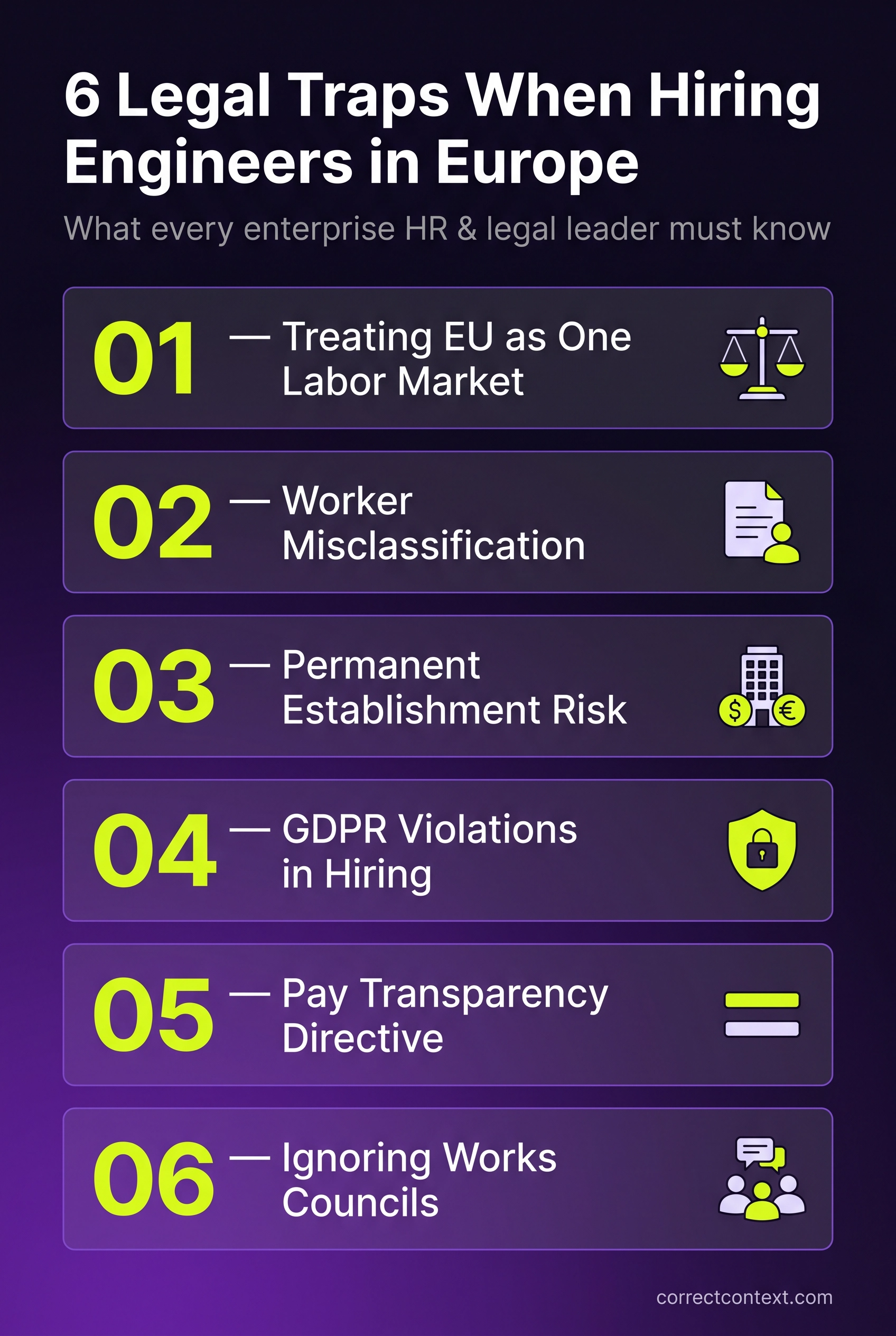
Mistake 1: Treating Europe as a Single Labor Market
The most widespread misconception among US and UK companies expanding into Europe is that the EU functions as a unified employment jurisdiction. It does not. EU Directives set minimum standards, but each of the 27 member states implements those standards differently through national legislation, and national courts enforce national law [1].
Consider the EU Working Time Directive (2003/88/EC), which limits the average working week to 48 hours, mandates 11 consecutive hours of daily rest, and requires at least four weeks of paid annual leave per year. On paper, this sounds straightforward. In practice, Germany, Poland, France, and the Netherlands each implement these rules with different reference periods, different opt-out mechanisms, and different record-keeping obligations [1]. A company that applies a single employment contract template across its European engineering hub is almost certainly non-compliant in at least one jurisdiction.
The EU Transparent and Predictable Working Conditions Directive, which came into force in August 2022, added further complexity. Employers must now provide written disclosure of probationary period conditions, training entitlements, applicable collective agreements, and overtime arrangements at the start of employment [1]. Many organizations have not updated their onboarding documentation since this directive came into force.
Mistake 2: Misclassifying Engineers as Independent Contractors
This is arguably the single most costly compliance mistake in tech hiring across Europe. Companies that want to move fast and avoid the administrative burden of formal employment often engage engineers as independent contractors. It feels efficient. It is frequently illegal.
European labor authorities have become increasingly aggressive in pursuing misclassification cases. Eurofound research covering 28 EU member states found that 79% of national correspondents reported a “significant” fraudulent use of self-employment [2]. The legal tests for determining employment status vary by country, but the common thread is clear: if a contractor works full-time for your company, uses your equipment, follows your schedule, and cannot substitute another person to do the work, they are an employee in the eyes of the law.
The financial consequences are severe. Authorities can require companies to pay years of back taxes, social security contributions, and statutory benefits. In Hungary and Romania, courts impose significant financial penalties on top of the reclassification itself. In the UK, the IR35 legislation places the burden of correct classification squarely on the hiring company, not the contractor [2]. Poland’s National Labour Inspectorate has the authority to fine companies up to PLN 30,000 per violation, and has been actively exercising that authority [2].
For companies building a dedicated software team or an extended engineering team in Poland or CEE, the only safe approach is formal employment or engagement through a compliant Employer of Record structure.
Mistake 3: Ignoring Permanent Establishment Risk
Hiring engineers Europe-wide without understanding Permanent Establishment (PE) risk is one of the most dangerous hidden traps in cross-border hiring. PE is a tax concept: if your company has a sufficient taxable presence in a foreign country, that country can tax a portion of your global profits.
Remote workers can inadvertently create PE exposure. If an engineer in Poland regularly concludes contracts on behalf of your company, or if their home office is effectively at the disposal of the enterprise on a continuous basis, local tax authorities may assert that a PE exists [3]. The OECD’s November 2025 update to the Model Tax Convention introduced a new two-part framework: a 50% working time benchmark and a commercial reason test [3]. However, this guidance only applies where bilateral tax treaties incorporate the updated commentary, and enforcement remains highly localized.
The practical implication is significant. A PE finding can trigger corporate income tax, profit attribution obligations, and mandatory payroll withholding in the host country, creating a compliance burden that can easily exceed the cost savings that motivated the hiring decision in the first place [3].
Mistake 4: GDPR Violations in the Hiring Process
GDPR is not a consumer privacy regulation that sits outside the employment context. It applies to every piece of personal data your company collects, processes, or transfers in connection with hiring and employment, and European Data Protection Authorities are actively enforcing it [1].
Common violations in the hiring engineers Europe context include:
Transferring candidate and employee data to US-based HR platforms without Standard Contractual Clauses (SCCs) or another valid transfer mechanism. Many US companies assume that using a major SaaS HR platform is sufficient. It is not, unless the platform has a compliant data transfer mechanism in place and your company has documented its reliance on it.
Using AI-driven screening tools without a clear legal basis under GDPR Article 6 and without providing candidates with meaningful transparency about automated decision-making. Several EU Data Protection Authorities have issued enforcement actions specifically targeting AI-based recruitment tools.
Retaining candidate data indefinitely. GDPR requires that personal data be kept only as long as necessary for the purpose for which it was collected. Candidate data from unsuccessful applications must be deleted within a defined retention period, which varies by country but is typically three to six months.
GDPR fines can reach €20 million or 4% of global annual turnover, whichever is higher [4]. For an enterprise operating at scale, a single enforcement action can be materially damaging.
Mistake 5: Underestimating the EU Pay Transparency Directive
The EU Pay Transparency Directive represents a fundamental shift in how employers must manage compensation across Europe, and many foreign companies are not ready for it. The transposition deadline passed on June 7, 2026, with only Italy, Slovakia, Lithuania, and Malta implementing the Directive on time [5].
The Directive’s requirements are extensive. Employers must provide candidates with salary range information before interviews. They cannot ask candidates about pay history. Employees have the right to request information about average pay levels broken down by sex for comparable roles. Companies with more than 250 employees must publish gender pay gap reports annually starting June 2027 [5].
For companies building offshore development teams or nearshore development teams in Europe, the Directive creates immediate obligations around pay structure documentation, job evaluation methodologies, and internal pay equity analysis. Companies that have historically relied on informal, market-rate-based compensation practices will need to formalize their approach significantly.
Mistake 6: Ignoring Works Councils and Collective Consultation Rights
In Germany, Austria, the Netherlands, France, and Belgium, Works Councils hold legally binding co-determination rights over a wide range of employment decisions. These are not advisory bodies. They have the legal authority to block or nullify decisions that affect working conditions, and they exercise that authority regularly [1].
Introducing productivity monitoring software, changing working time arrangements, or executing collective redundancies without prior Works Council consultation can render those decisions legally void. In Germany, a social plan must be negotiated with the Works Council before any collective redundancy proceeds. Proceeding without it does not just attract penalties. It invalidates the dismissals themselves, creating reinstatement obligations and significant financial exposure [1].
For US and UK companies accustomed to at-will employment frameworks, this is a genuinely unfamiliar constraint. The assumption that management has unilateral authority to restructure teams or introduce new tools simply does not hold in much of Europe.
The Compliance Gap: What the Numbers Say
The scale of the compliance challenge is reflected in enforcement data. Since 2010, EU companies have paid the equivalent of USD 43 billion in fines and settlements across various regulatory frameworks [6]. GDPR enforcement alone has generated hundreds of millions of euros in fines annually since 2018. Employment law violations, while less publicized, carry equally significant financial exposure.
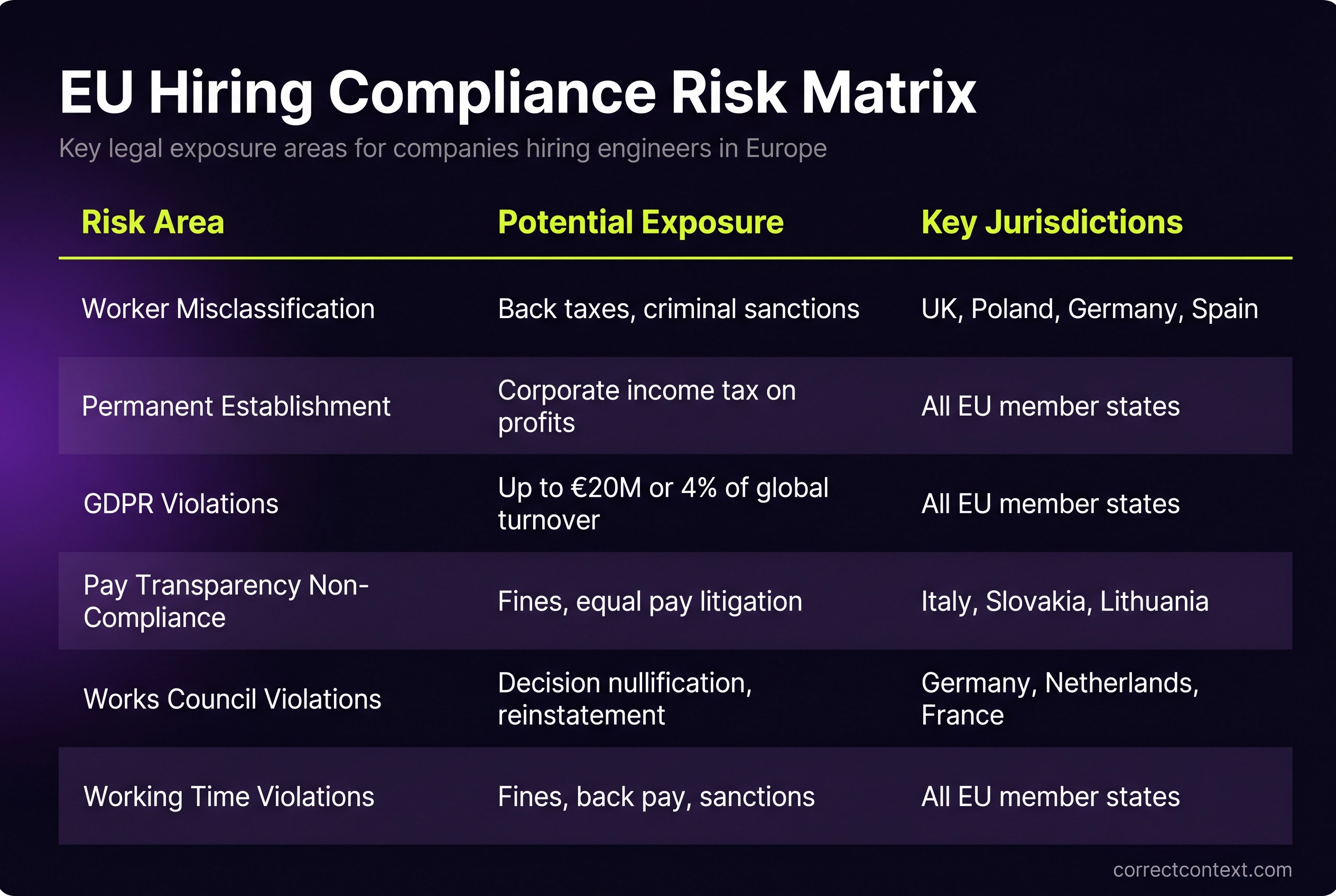
| Legal Risk Area | Potential Exposure | Key Jurisdictions |
|---|---|---|
| Worker Misclassification | Back taxes, social contributions, criminal sanctions | UK, Poland, Germany, Spain, Netherlands |
| Permanent Establishment | Corporate income tax on attributed profits | All EU member states |
| GDPR Violations | Up to €20M or 4% of global turnover | All EU member states |
| Pay Transparency Non-Compliance | Administrative fines, equal pay litigation | Italy, Slovakia, Lithuania (from June 2026) |
| Works Council Violations | Nullification of decisions, reinstatement orders | Germany, Netherlands, France, Austria |
| Working Time Violations | Fines, back pay, regulatory sanctions | All EU member states |
The Solution: Local Expertise Through an Employer of Record
Given the complexity and the stakes, the question for enterprise HR and legal leaders is not whether they need local expertise. It is how to acquire it efficiently without building an entire legal and HR infrastructure in each target country.
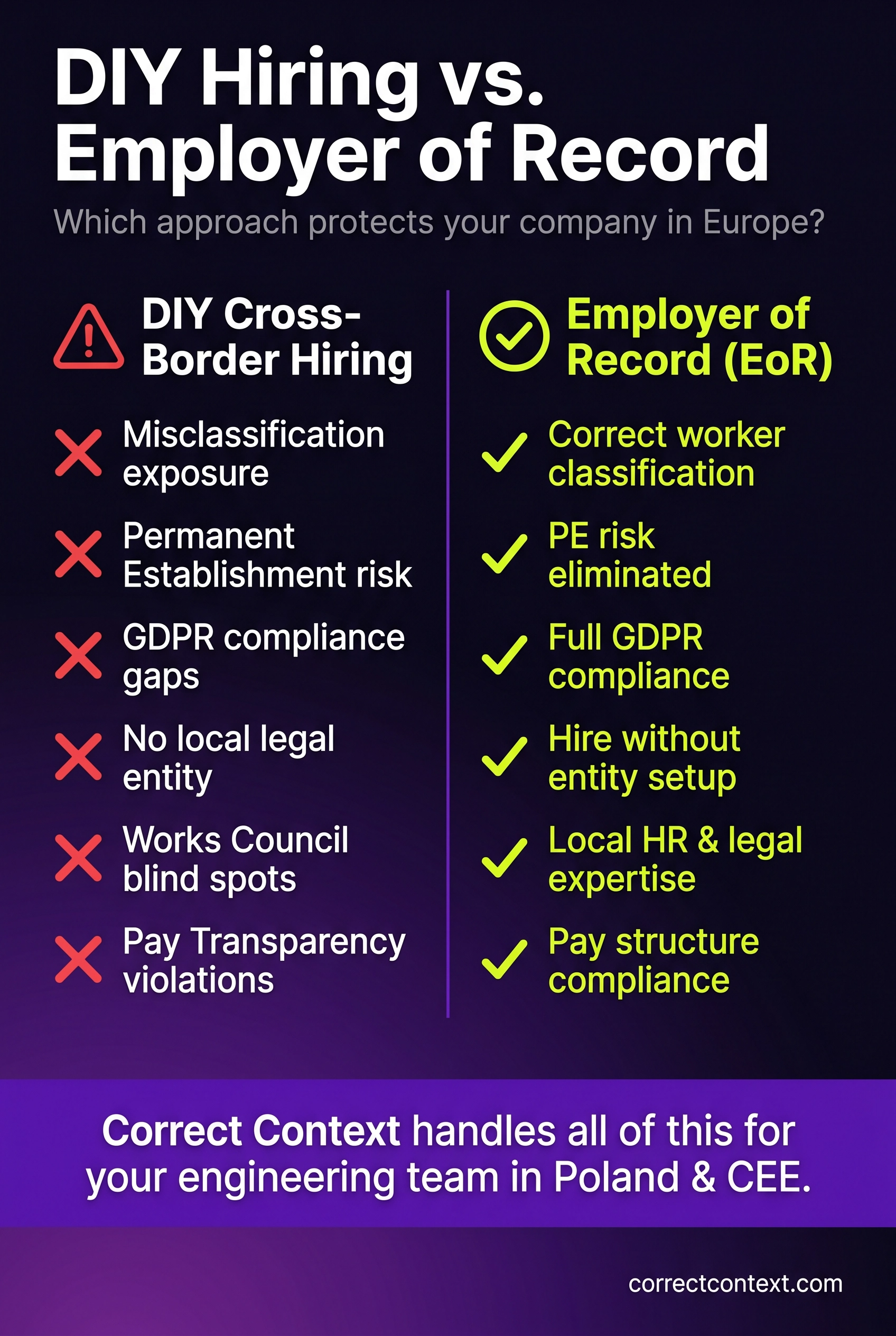
This is precisely the value proposition of an Employer of Record (EoR) in Poland or across the CEE region. An EoR acts as the legal employer of your engineering team, managing payroll, taxes, statutory benefits, employment contracts, and ongoing compliance with local labor law [7]. This model allows companies to hire in Europe without a company entity, eliminating the PE risk, misclassification exposure, and administrative burden of local entity setup.
For companies building a dedicated development team in Poland, an EoR structure provides immediate access to the talent market with full legal compliance from day one. For enterprises scaling a nearshore development team across multiple CEE countries, a single EoR partner with regional expertise can manage the complexity of multiple jurisdictions simultaneously.
Correct Context offers exactly this model. As a specialist in building IT core teams in Poland and CEE, Correct Context provides recruitment, payroll, HR, accounting, legal compliance, and office management, without requiring clients to establish local infrastructure. Whether you need a data engineering team, a cloud engineering team with AWS/Azure/GCP expertise, or an AI development team focused on machine learning, the compliance framework is built in.
Conclusion: Compliance Is Not Optional
The legal risks of hiring engineers in Europe without proper local support are not edge cases. They are predictable, well-documented, and actively enforced. Misclassification, PE exposure, GDPR violations, pay transparency obligations, and Works Council rights represent a compliance matrix that requires genuine local expertise to navigate.
For enterprise HR and legal leaders evaluating whether to build a European engineering team, the relevant question is not whether the talent is worth pursuing. It clearly is. The question is whether your organization has the legal infrastructure to hire compliantly, or whether you need a local partner to do it right.
The cost of getting it wrong, measured in back taxes, fines, reinstatement orders, and reputational damage, consistently exceeds the cost of getting it right from the start.\
References
[1] European Labor Law Compliance Mistakes to Avoid
[2] G-P, Contractor Misclassification in Europe: 2026 Compliance Guide
[4] Fines / Penalties – General Data Protection Regulation (GDPR)
[5] EU Pay Transparency Directive: The Deadline for Transposition Has Passed—What Now?
[6] Europe’s Biggest Corporate Lawbreakers at Home and Abroad – Good Jobs First
[7] Remote, How to use an Employer of Record in Poland