
The global tech talent shortage is an escalating crisis for enterprise leaders. By 2026, the United States alone is projected to face a software engineer shortage exceeding 1.2 million professionals [1]. As artificial intelligence, cloud computing, and big data accelerate the pace of digital transformation, the competition for specialized talent in major Western hubs like San Francisco, New York, and London has reached a fever pitch. In response, many enterprise innovation units and rapidly scaling Series A+ startups are looking across the Atlantic.
Building a European tech hub—particularly in Central and Eastern Europe (CEE)—has become a strategic imperative for companies seeking to scale engineering teams efficiently without compromising on quality. The region offers access to a massive talent pool, with Poland alone hosting over 546,000 IT professionals [2]. However, the decision to build a European tech hub is complex. Timing is everything. Expanding too early can drain resources and distract leadership, while expanding too late can result in missed market opportunities and stifled innovation. This article explores the strategic timing of building a tech hub, helping CTOs, COOs, and enterprise leaders decide whether now is the right time to scale engineering internationally.
The Strategic Advantage of a European Tech Hub
The allure of Europe, and specifically the CEE region, is grounded in compelling data. The European tech sector has seen remarkable growth, with its ecosystem valuation soaring to nearly $4 trillion—a fourfold increase over the past decade [3]. For US and UK companies, the primary drivers for establishing an engineering hub in Europe are talent availability, cost efficiency, and cultural alignment.
Access to a Deep, Highly Skilled Talent Pool
The CEE region has quietly transformed into Europe’s growth engine for IT. Poland is the regional powerhouse, boasting the largest IT talent pool in CEE and producing tens of thousands of computer science graduates annually from top-tier technical universities such as AGH University of Science and Technology and Warsaw University of Technology [2]. The region is particularly strong in high-demand areas: AI development teams, data engineering teams, cloud engineering teams (AWS, Azure, GCP), and backend development. In 2024, the CEE IT market expanded at an average annual rate of 10.9% between 2020 and 2024, with Poland leading in market size at EUR 27 billion [4].
Favorable Cost-to-Quality Ratio
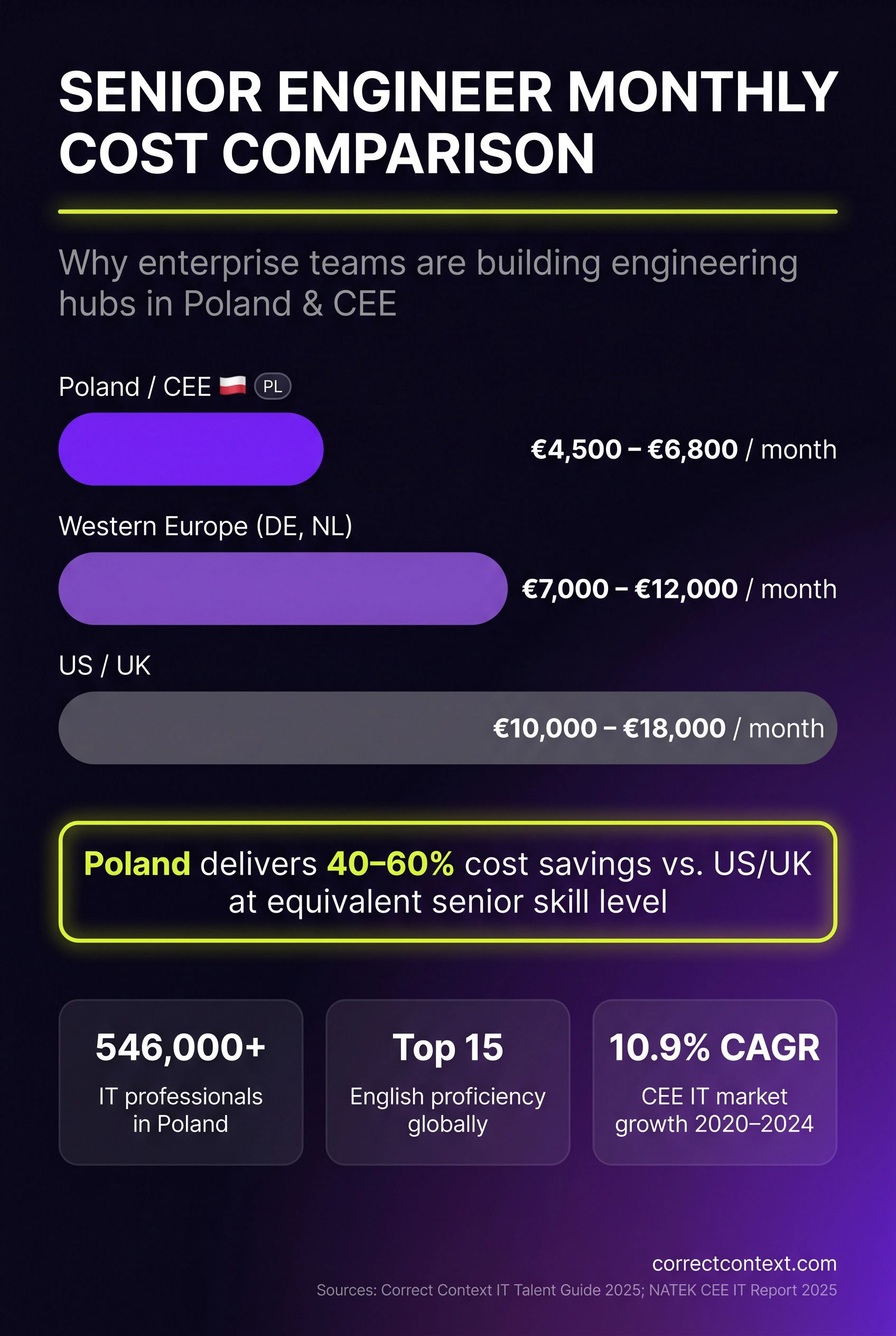
While salaries in Poland have risen steadily, they remain highly competitive compared to Western markets. A senior software engineer in Poland typically costs between €4,500 and €6,800 per month on a B2B contract [2]. In contrast, equivalent roles in the US or UK can command double or triple that amount. This allows companies to scale engineering teams rapidly, securing top-tier talent for the cost of mid-level engineers back home. According to Nortal’s 2026 analysis, mid-level AI/ML engineers in Poland start around €2,700/month, while senior specialists average €4,300—compared to significantly higher UK equivalents [5].
Cultural and Operational Alignment
Unlike offshore destinations in entirely different time zones, Europe offers significant operational advantages for US East Coast and UK companies. The time zone overlap allows for synchronous collaboration during critical morning hours. Furthermore, English proficiency in Poland is exceptionally high—the country consistently ranks in the top 15 globally on the EF English Proficiency Index—ensuring seamless integration into global, distributed teams [2]. Polish engineers routinely participate in direct client-facing meetings, technical architecture discussions, and sprint planning with minimal communication friction.
| Factor | Poland / CEE | US / UK | Western Europe (DE, NL) |
|---|---|---|---|
| Senior Engineer Monthly Cost | €4,500–€6,800 | €10,000–€18,000 | €7,000–€12,000 |
| English Proficiency | Top 15 globally | Native | High |
| Time Zone Overlap (US East Coast) | 5–6 hours | Same | 5–6 hours |
| IT Talent Pool Size | 546,000+ (Poland alone) | Highly competitive | Competitive |
| Annual IT Market Growth (2020–2024) | 10.9% CAGR | Moderate | Low–Moderate |
Sources: Correct Context IT Talent Guide 2025 [2]; NATEK CEE IT Market Report 2025 [4]
When to Build a European Tech Hub: The Readiness Signals
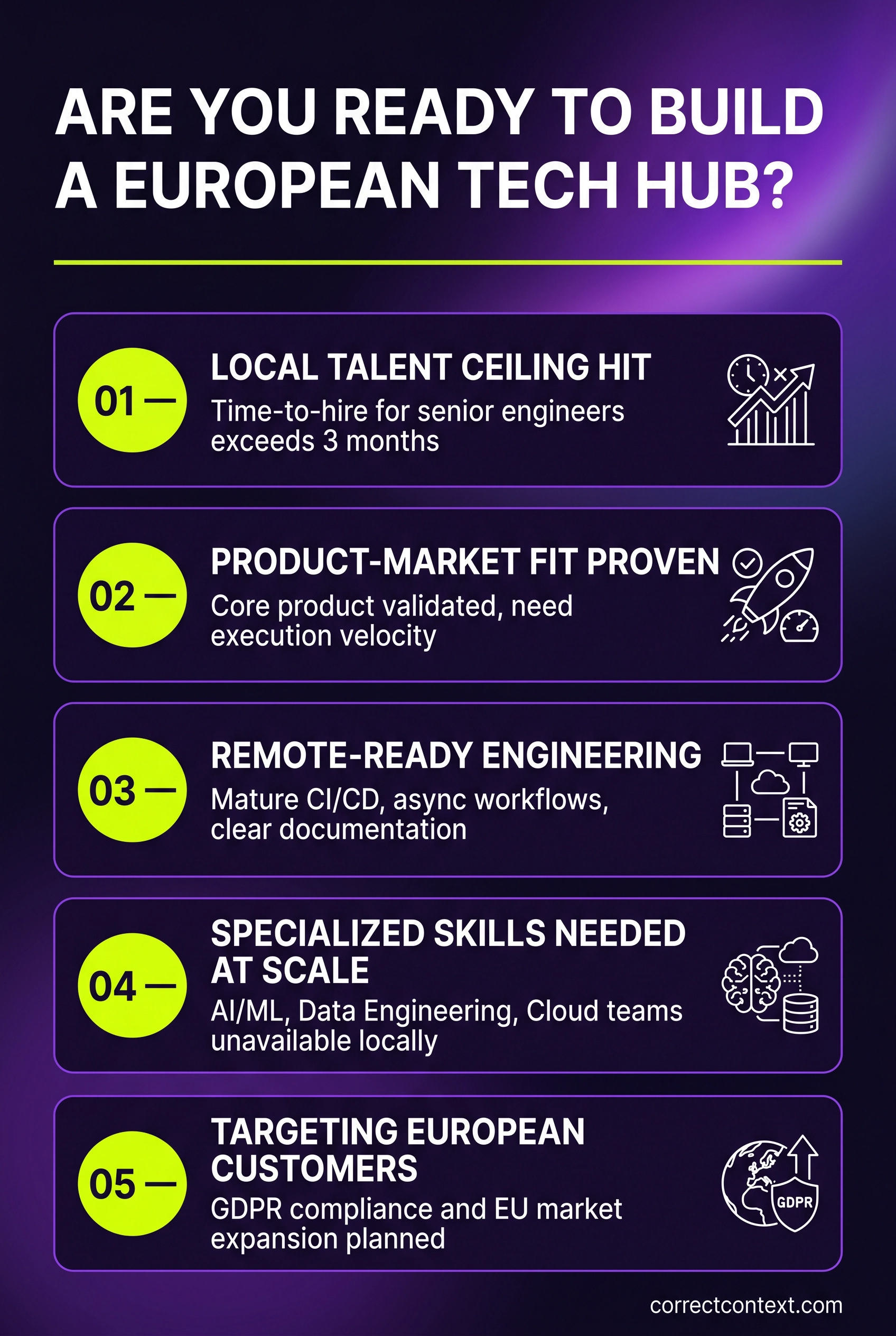
Deciding to scale software development internationally requires a clear assessment of organizational readiness. A company is typically ready to build a European tech hub when several of the following conditions are met.
1. You Have Hit a Local Talent Ceiling
If your time-to-hire for critical roles—such as an AI development team, a machine learning engineers team, or a DevOps team for hire—stretches into months, and your local talent pipeline is exhausted, it is time to look abroad. The ManpowerGroup’s 2025 Talent Shortage survey found that IT and data skills remain the hardest to find in the UK labor market [6]. When local competition forces you to compromise on quality or overpay significantly for average talent, a nearshore development team in Europe offers a strategic release valve.
2. You Have Proven Product-Market Fit and Need to Scale
For Series A+ startups, establishing a remote engineering hub makes sense only after achieving strong product-market fit. If the core product is validated and the primary challenge is executing the roadmap faster to capture market share, an extended engineering team in Europe can provide the necessary velocity. At this stage, the cost savings can be reinvested directly into product development and go-to-market activities.
3. Your Engineering Processes Are Mature
A successful international hub requires mature, well-documented engineering processes. If your team already operates effectively in a remote or hybrid environment, uses robust CI/CD pipelines, and has clear technical documentation, integrating a remote software engineers team in Europe will be significantly smoother. Companies that have already mastered asynchronous communication and sprint-based delivery are best positioned to succeed.
4. You Need Specialized Skills at Scale
When enterprise innovation units need to build specialized capabilities—such as a big data development team, a data analytics team, or a platform engineering team—finding an entire squad locally can be nearly impossible. The IDC estimates that 90% of organizations worldwide will be affected by the software engineer shortage by 2026 [1]. CEE hubs excel at providing dedicated development teams that can take full ownership of complex technical domains, from MLOps architectures to cloud-native infrastructure.
5. You Are Targeting European Customers or Regulatory Compliance
If your product roadmap includes expansion into European markets, having an engineering hub in Europe is not just a talent play—it is a strategic necessity. Local engineers understand GDPR compliance, EU data residency requirements, and regional product nuances far better than remote teams operating from outside the region.
When Not to Build a European Tech Hub: The Warning Signs
Conversely, expanding internationally at the wrong time can be a costly mistake. Here are the scenarios where you should pause before building a tech hub abroad.
1. You Are Still Searching for Product-Market Fit
If your core product is still undergoing rapid, fundamental pivots, the communication overhead of managing a distributed team can be fatal. Early-stage startups need tight, synchronous feedback loops between product, design, and engineering. An offshore development team is a poor choice when the product direction is highly volatile and requires daily realignment.
2. Your Engineering Culture Relies on Physical Proximity
If your company culture heavily depends on ad-hoc, in-person whiteboarding to solve problems, a remote hub will struggle. Without a deliberate shift toward asynchronous communication and rigorous documentation, the European team will feel isolated and disconnected from the core business—leading to high turnover and misaligned deliverables.
3. You Lack Leadership Bandwidth
Establishing a successful hub requires significant attention from engineering leadership. If the CTO or VP of Engineering is already stretched too thin firefighting daily operational issues, they will not have the bandwidth to oversee the critical initial phases of hiring, onboarding, and integrating the new team. A poorly managed hub is worse than no hub at all.
4. You Are Doing It Solely to Cut Costs
If the only motivation is to find the absolute cheapest developers available, a European hub—especially in maturing markets like Poland—is the wrong approach. The true value of a nearshore development team in CEE lies in the cost-to-quality ratio, not just absolute cost savings. Treating the hub as a low-tier execution center rather than a core engineering partner will lead to high turnover, poor code quality, and ultimately a failed expansion.
The Implementation Strategy: How to Execute Without the Overhead
Once the decision is made to proceed, the execution strategy is critical. Setting up a legal entity in a foreign country involves navigating complex labor laws, tax regulations, and administrative overhead. For many companies, this is a significant deterrent.
This is where leveraging an Employer of Record (EoR) or a dedicated staffing partner becomes invaluable. Using an employer of record Poland or EoR CEE allows companies to hire employees without entity and onboard top-tier talent quickly and compliantly. Partners like Correct Context specialize in building dedicated software teams offshored or nearshored to Poland. They handle recruitment, payroll, HR, accounting, and office management—allowing the client to focus entirely on engineering execution and product delivery.
This model provides the best of both worlds: the client retains full operational control over the engineering team Poland / CEE, while the local partner absorbs the administrative and compliance burden. For companies that eventually want to establish a captive R&D center, this approach also serves as a low-risk pilot phase to validate the market before committing to full entity setup.
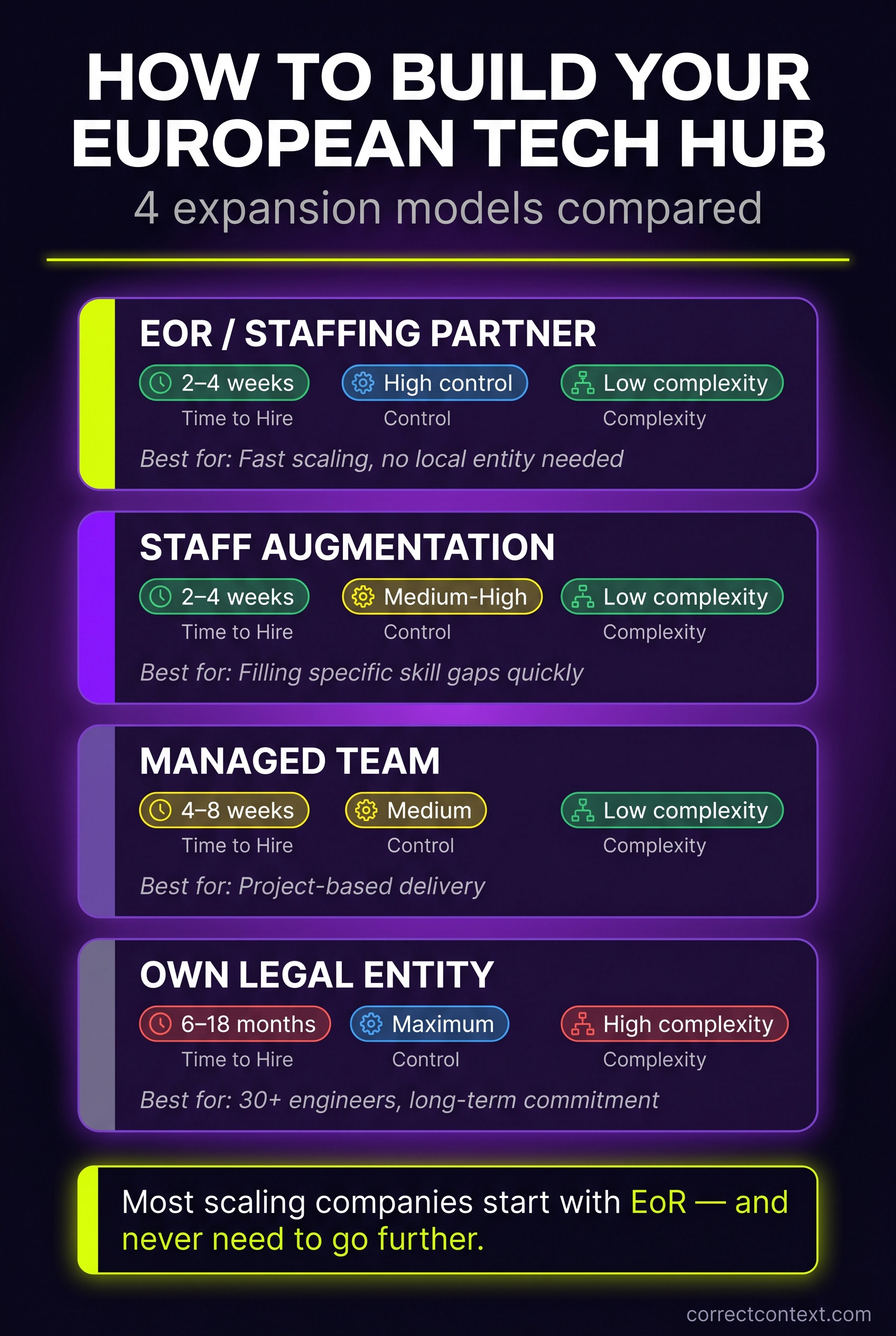
| Expansion Model | Time to First Hire | Control Level | Setup Complexity | Best For |
|---|---|---|---|---|
| EoR / Staffing Partner | 2–4 weeks | High | Low | Fast scaling, no local entity |
| Staff Augmentation | 2–4 weeks | Medium-High | Low | Specific skill gaps |
| Own Legal Entity | 6–18 months | Maximum | High | 30+ engineers, long-term |
| Managed Team | 4–8 weeks | Medium | Low | Project-based delivery |
Source: Correct Context IT Talent Guide 2025 [2]
Conclusion
The decision to build a European tech hub is a defining moment for scaling tech companies and enterprise innovation units. When timed correctly—driven by a need for specialized talent, mature processes, and a desire to accelerate product delivery—it can be a massive competitive advantage. The CEE region, led by Poland, offers an unparalleled combination of deep technical expertise, cultural alignment, and cost efficiency that is difficult to replicate elsewhere.
However, enterprise leaders must honestly assess their organizational readiness. Expanding too early, or for the wrong reasons, can create friction that slows the company down. By recognizing the right signals and leveraging strategic partners for employment compliance Europe and talent acquisition, companies can successfully navigate the complexities of engineering expansion in Europe and secure the engineering talent they need to thrive in the years ahead.
References
[1] Tecla, “Tech Talent Shortage in 2025: Causes, Impact, & Solutions,”
[2] Correct Context, IT Talent in Poland: The Complete 2025 Guide for Tech Companies – Grow your Core IT Teams.
[3] Sifted, 10 key findings from Atomico’s State of European Tech report | Sifted
[4] NATEK, CEE IT 2025: Europe’s Growth Engine for IT and Beyond – NATEK Work IT with us
[5] Nortal, “Poland IT hiring: employer costs, talent pool, and market trends,”
[6] Experis, “Closing the digital skills gap: The 2025 talent shortage,”
Table of content
Related articles



About the Author: Marta