
10 Critical Developer Salary Trends in Poland for 2025-2026: A Data-Driven Guide for Tech Hiring Managers
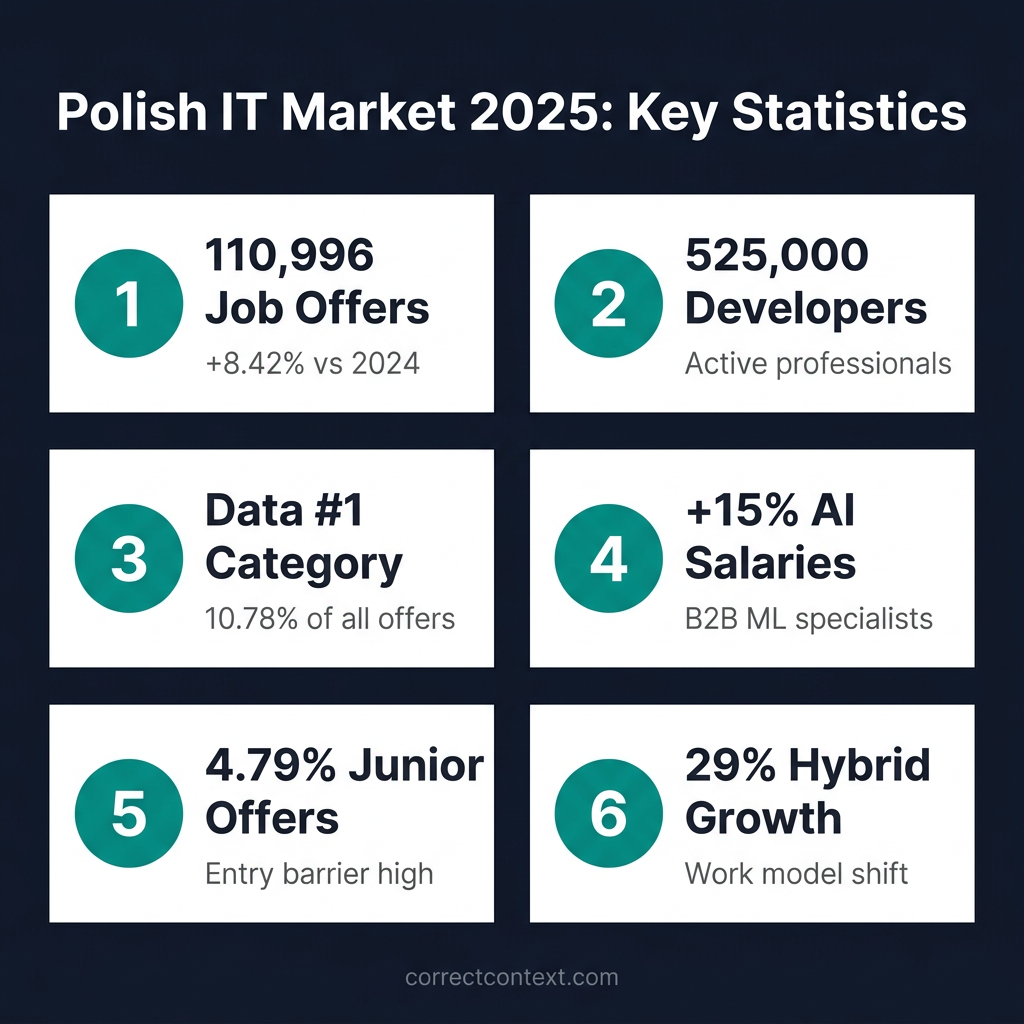
Here is a number that should get your attention: Polish software engineers with AI and machine learning skills saw their salaries jump by 15% on B2B contracts in 2025, while the overall IT job market posted 110,996 new openings—an 8.42% increase from the previous year. Poland’s tech talent market has stabilized after the volatility of 2023-2024, but the rules have changed. The era of “easy money” hiring is over. What remains is a mature, competitive market where specialization, contract type, and location create significant compensation gaps that smart hiring managers can leverage—or ignore at their peril.
This article breaks down ten critical salary trends shaping Poland’s developer market in 2025-2026. Whether you are building an engineering team from scratch, scaling existing operations, or comparing Poland to Western European alternatives, these data points will inform your budgeting, hiring strategy, and competitive positioning. We will examine real salary figures, contract type implications, regional variations, and the specialization premiums that are redefining what “competitive compensation” means in the Polish tech sector.
1. The Market Has Stabilized—But Selectivity Is the New Normal
After two consecutive years of decline, the Polish IT job market rebounded in 2025. According to the JustJoinIT Salary Report 2026, which analyzed nearly 111,000 job postings, the number of listings increased by 8.42% year-over-year. This marks a definitive turning point. The post-pandemic correction that saw hiring freezes and layoffs across the tech sector has given way to a more measured, sustainable growth pattern.
But do not mistake stabilization for a return to the “Eldorado” days of 2021-2022. Piotr Nowosielski, CEO of job portals justjoin.it and rocketjobs.pl, puts it bluntly: “We are far from the euphoria of 2021-2022, when record numbers of job offers created a true paradise for developers. Today’s market demands greater selectivity and perseverance from specialists.”
For hiring managers, this means two things. First, the panic hiring that drove inflated salaries has subsided. Second, the candidates who remain active are more deliberate about their choices. They are not jumping at every offer—they are evaluating fit, growth potential, and compensation packages with greater scrutiny. The days of candidates receiving five offers in a week and choosing the highest bidder are largely over. Today’s Polish developers are asking harder questions about technical challenges, team quality, and career trajectories.
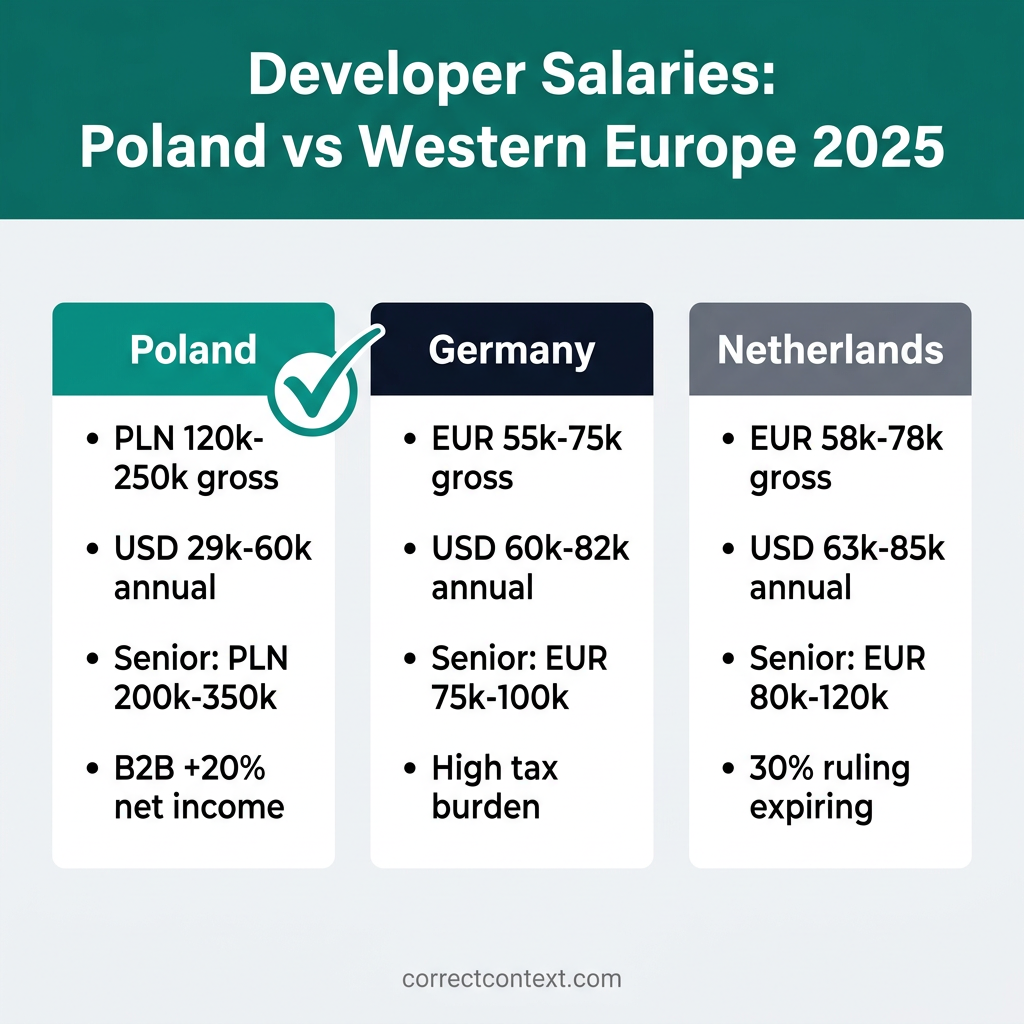
The stabilization is particularly evident in salary ranges. While certain specializations (AI, Data, DevOps) command premium increases, generalist developer salaries have flattened. The median software engineer salary in Poland now ranges from PLN 120,000 to 250,000 gross annually (approximately USD 29,000–60,000), with senior developers reaching PLN 200,000–350,000+ depending on specialization and contract type. These figures represent modest growth from 2024, suggesting the market has found a new equilibrium.
What this means practically: if you have a solid employer brand, interesting technical challenges, and fair compensation, you can hire quality developers without engaging in bidding wars. But if your offer is generic—another CRUD application, another outsourcing body shop—you will struggle regardless of salary. The developers you want have options, and they are increasingly selective about which opportunities they pursue.
2. Data Has Overtaken JavaScript as the Hottest Recruitment Category
For the first time in the history of JustJoinIT’s reporting, the Data category has overtaken JavaScript as the strongest recruitment segment, accounting for 10.78% of all job offers in 2025. This shift reflects a broader transformation in how companies approach technology investment and represents a fundamental reorientation of the Polish tech job market.
Data engineers, data scientists, and analytics specialists are no longer supporting roles—they are core to business strategy. The report notes that “data has become the backbone of modern organizations,” and companies are backing this statement with their hiring budgets. Data specialists command premium salaries across all experience levels, with senior data engineers regularly earning 15-20% above their software engineering counterparts.
This trend has implications for hiring managers in two directions. If you are building data capabilities, expect to pay competitively and move quickly—top data talent receives multiple offers within days of entering the market. The supply of experienced data engineers has not kept pace with demand, particularly for candidates with both technical skills and business domain knowledge. Conversely, if you are hiring generalist JavaScript developers, the supply-demand dynamic has shifted in your favor. The market is less overheated, and negotiation leverage has partially returned to employers.
The rise of data roles also reflects Poland’s maturation as a tech market. Five years ago, Polish developers were primarily hired for cost-effective implementation of specifications written elsewhere. Today, Polish data scientists are designing recommendation engines, Polish data engineers are building real-time analytics pipelines, and Polish analytics teams are driving business decisions. This evolution from “execution” to “decision-making” is reflected in compensation premiums.
What should you do if you need data talent? Consider alternative pathways. Many companies are upskilling existing software engineers in data engineering rather than competing for scarce external candidates. Others are hiring junior data analysts with strong SQL skills and training them in modern data stack tools. The shortage is real, but it is not insurmountable with creative approaches.
| Technology Category | % of Job Offers 2025 | Salary Trend | Market Status |
|---|---|---|---|
| Data (Data Science, Analytics, Engineering) | 10.78% | +12-18% | High demand, shortage |
| JavaScript/Frontend | 10.12% | Stable | Balanced |
| Java | 8.45% | Stable | Moderate demand |
| Python | 7.89% | +10% | Strong demand |
| DevOps/Cloud | 6.92% | +15% | High demand |
| AI/ML | 4.56% | +15% | Critical shortage |
| Mobile (iOS/Android) | 4.23% | Stable | Moderate demand |
| C++ | 3.87% | +5% | Niche, specialized |
3. AI and Machine Learning Specialists Command Premium Salaries
The 15% salary increase for AI and ML specialists on B2B contracts isn’t a media hype cycle—it is a direct reflection of business investment priorities. Pavlo Deshchynskyy, COO at N-iX, observes: “Developers who learned how to work with GenAI tools instead of competing against them gained better job security and stronger pay growth, while purely ‘execution-only’ roles became harder to justify.”
This premium extends beyond pure AI research roles. Engineers who can integrate AI capabilities into existing products, design AI-enabled systems, and navigate data governance in AI contexts are all commanding above-market rates. The skill set has expanded from “can train a model” to “can deploy, secure, and operationalize AI in production environments.” Companies need engineers who understand not just the algorithms but the infrastructure, monitoring, and ethical considerations of production AI systems.
For hiring managers, the AI talent shortage presents a strategic choice. You can compete for scarce senior AI specialists at premium rates, or you can invest in upskilling existing engineering teams. Many Polish companies are choosing the latter path, partnering with universities and training providers to build internal AI capabilities rather than fighting for the limited pool of experienced practitioners. This approach requires patience—upskilling takes 6-12 months—but builds sustainable competitive advantage.
The salary data supports this approach. Entry-level AI roles in Poland start around PLN 15,000–18,000 monthly on B2B contracts, while senior AI engineers with 5+ years of experience can command PLN 35,000–50,000+ monthly. These figures represent a 20-30% premium over equivalent generalist software engineering roles. The premium is even higher for AI engineers with domain expertise in high-value sectors like finance, healthcare, or autonomous systems.
What is driving this demand? Polish companies are building AI-powered products for global markets. International companies are establishing AI R&D centers in Poland to access talent at lower costs than Silicon Valley or London. And the EU’s AI Act is creating compliance requirements that demand specialized expertise. All three trends point to sustained demand for AI talent through 2026 and beyond.
4. The Junior Developer Market Has Collapsed—Here’s What It Means
Perhaps the most striking statistic from the 2025 data: junior developers (0-2 years experience) are competing for just 4.79% of all job offers. This represents a fundamental restructuring of entry-level hiring in Poland’s tech sector and poses serious challenges for recent graduates while creating opportunities for strategic employers.
Several factors converged to create this bottleneck. First, the economic uncertainty of 2023-2024 led companies to prioritize experienced hires who could contribute immediately. When budgets are tight, the luxury of 6-month onboarding periods for juniors disappears. Second, remote work normalized access to mid-level and senior talent across Poland and beyond, reducing the historical need to “grow” junior developers locally. Why invest in training a junior when you can hire a productive mid-level developer from another city? Third, coding bootcamps and university programs graduated large cohorts just as hiring slowed, creating a supply glut.
The implications are severe for recent graduates but create opportunities for strategic hiring managers. Companies that invest in structured junior programs—apprenticeships, mentorship tracks, and clear progression paths—can access motivated talent at below-market rates while building long-term loyalty. The key is commitment: juniors know the market is tough, and they will gravitate toward employers who demonstrate genuine investment in their growth.
For roles requiring immediate productivity, however, the message is clear: budget for mid-level hires. The hidden costs of trying to squeeze senior output from junior developers—code quality issues, technical debt, mentorship overhead, and eventual turnover when they leave for better opportunities—often exceed the salary differential. A PLN 12,000 junior who produces PLN 8,000 worth of value and requires 10 hours weekly of senior mentorship is more expensive than a PLN 20,000 mid-level who produces PLN 18,000 worth of value independently.
The junior market collapse also has implications for Poland’s long-term talent pipeline. If companies stop hiring juniors, where will the mid-level and senior developers of 2028-2030 come from? Forward-thinking companies are treating junior hiring as a strategic investment in future talent availability, even at short-term cost. They are building relationships with universities, offering internships, and creating structured programs that convert graduates into productive team members over 12-18 months.
5. B2B Contracts Deliver 20-30% More Net Income Than Employment
One of the defining characteristics of Poland’s IT labor market is the prevalence of B2B (business-to-business) contracts. According to the Bulldogjob IT Community Survey 2025, 38.5% of IT professionals work on B2B contracts, compared to 53.8% on traditional employment contracts (Umowa o Pracę, or UoP). This split has significant compensation implications that every hiring manager must understand.
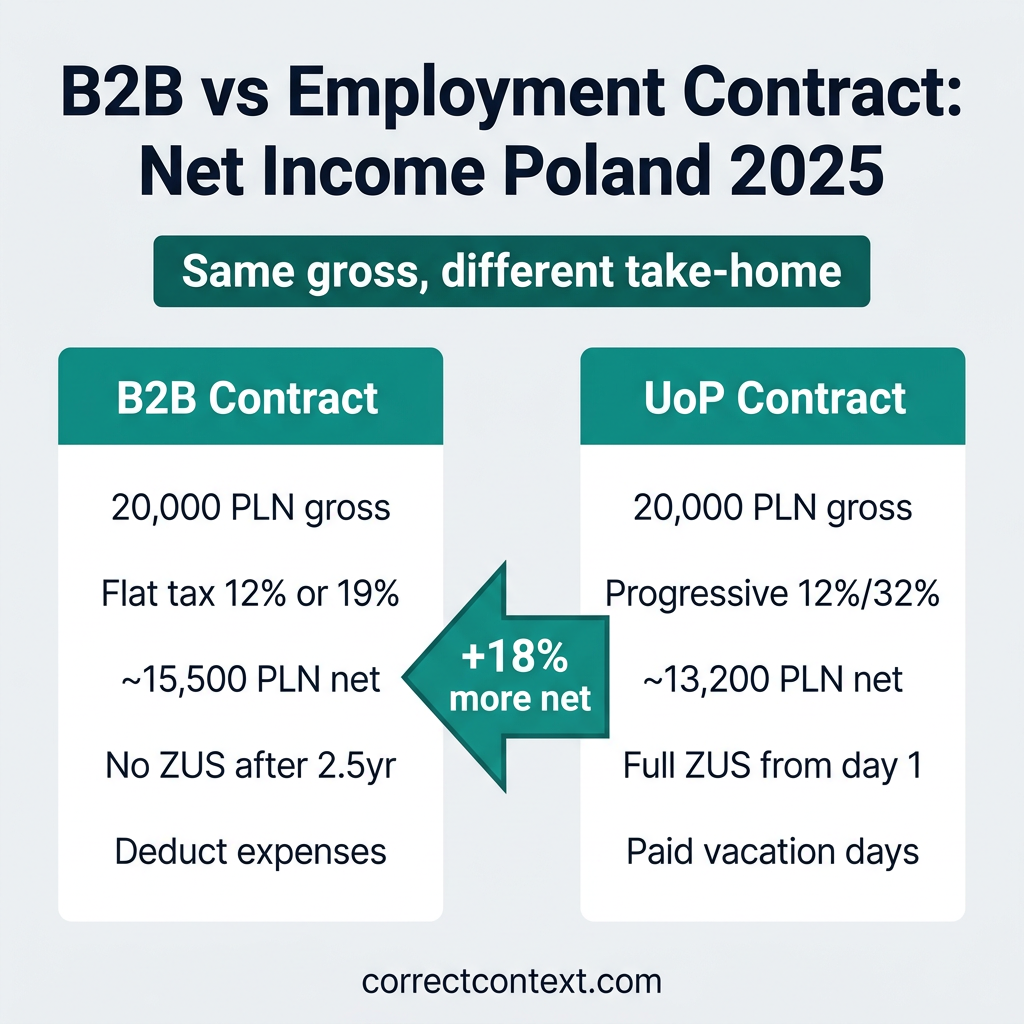
On identical gross amounts, B2B contracts typically yield 20-30% more net income for the contractor. The math works as follows: B2B contractors can choose between a 12% flat tax (ryczałt) or 19% linear tax, while employees face progressive taxation (12% up to PLN 120,000 annually, then 32%). Additionally, B2B contractors pay reduced ZUS (social security) contributions after 2.5 years, while employees pay full contributions from day one.
Consider a concrete example: at PLN 20,000 monthly gross, a B2B contractor on the 12% flat tax takes home approximately PLN 15,500 net. An employee on the same gross takes home roughly PLN 13,200—a difference of nearly PLN 2,300 monthly, or 18% more for the B2B contractor. Over a year, this gap compounds to PLN 27,600 in additional net income for the B2B contractor.
| Component | B2B Contract (12% flat) | UoP Employment | Difference |
|---|---|---|---|
| Gross monthly | PLN 20,000 | PLN 20,000 | — |
| Tax rate | 12% flat | 12% then 32% | Progressive vs flat |
| ZUS (social security) | ~PLN 1,400 | ~PLN 2,700 | -PLN 1,300 |
| Health contribution | ~PLN 1,100 | ~PLN 1,550 | -PLN 450 |
| Net monthly | ~PLN 15,500 | ~PLN 13,200 | +PLN 2,300 |
| Annual net difference | ~PLN 27,600 more on B2B | ||
For hiring managers, this creates both opportunities and obligations. You can offer “lower” gross salaries on B2B contracts while delivering higher net compensation to the developer. A PLN 18,000 B2B offer can match or exceed a PLN 20,000 employment offer in take-home pay. However, B2B contractors are not covered by Polish labor law protections—no paid vacation, no notice period protections, no sick pay, no parental leave. Companies that treat B2B contractors as “cheap employees” rather than genuine business partners risk legal reclassification and reputational damage.
The legal landscape around B2B contracts is evolving. Polish tax authorities have increased scrutiny of “false self-employment” arrangements where contractors function as de facto employees. The key differentiators are: contractors control their work schedule and methods, contractors bear business risk (can lose money), contractors work for multiple clients, and contractors use their own tools and equipment. Violating these principles can result in back taxes, penalties, and forced reclassification.
6. Location Still Matters: Warsaw, Kraków, and Wrocław Lead
Remote work has normalized, but location continues to influence salary expectations and availability. According to the Bulldogjob survey, Kraków leads Polish cities for employment contract salaries at PLN 11,511 monthly average, followed by Warsaw at PLN 10,743 and Wrocław at PLN 10,137. These figures represent gross monthly salaries for mid-level professionals and demonstrate persistent regional premiums.
On B2B contracts, the pattern holds with interesting variations. Large companies (500+ employees) in major cities pay B2B contractors an average of PLN 23,669–24,696 monthly net, while small companies (under 50 employees) average PLN 19,377. The city-company size interaction is significant: a senior developer at a large Warsaw-based tech company will typically earn 25-30% more than an equivalent role at a small regional firm.
What is driving Kraków’s salary leadership? The city has developed a particularly strong outsourcing and R&D center ecosystem, with major international tech companies establishing significant operations there. This concentration of large employers has created competitive pressure that drives salaries above Warsaw levels, despite Warsaw’s larger overall market. Kraków’s lower cost of living compared to Warsaw also means these salaries go further—Kraków developers enjoy higher real purchasing power.
For international hiring managers, this geography matters less than it once did. Remote hiring from Poland means you can access talent across all three major hubs—and the secondary cities of Gdańsk, Poznań, and Łódź—without paying Warsaw premiums. A fully remote Polish developer in Lublin or Białystok may accept 10-15% below Warsaw rates while delivering equivalent output. However, for roles requiring hybrid or on-site presence, budget for the 10-15% salary premium that Warsaw and Kraków command.
The talent pool distribution is worth noting. Poland has approximately 525,000–546,000 IT professionals according to multiple sources including LinkedIn and Ntiative’s Talent Insights report. Warsaw holds the largest concentration (roughly 30%), followed by Kraków (20%) and Wrocław (12%). The Kraków market has been particularly dynamic, driven by a combination of established outsourcing centers, a growing startup ecosystem, and strong university pipelines from AGH University of Science and Technology and Jagiellonian University.
7. Mid-Level Developers Face the Biggest Expectation Gap
Here is a counterintuitive finding from the JustJoinIT research: mid-level professionals earn up to 21% less than advertised salary ranges suggest. This expectation gap—the difference between what job postings promise and what candidates actually receive—represents the largest discrepancy at the mid-level and creates both challenges and opportunities in the hiring process.
Several dynamics explain this gap. First, mid-level developers often overestimate their market value based on headline numbers from senior roles or hot specializations. They see a job posting for “senior Python developer PLN 30,000” and assume their 3 years of Python experience puts them in that range, not realizing the posting targets 8+ years with specific framework expertise. Second, companies structure their offers more conservatively at this level, knowing that mid-level hires carry higher risk than seniors but demand more compensation than juniors. A bad mid-level hire can do significant damage before their limitations become apparent. Third, the sheer volume of mid-level candidates (relative to junior and senior) creates competitive pressure that moderates salaries.
For hiring managers, this gap represents an opportunity for transparent positioning. Being explicit about salary ranges—and where a candidate falls within them based on skills assessment—can differentiate your offer in a market where candidates feel misled by inflated job postings. The companies that build trust through salary transparency are winning the mid-level talent that will become their senior engineers in 3-5 years.
The data also suggests that mid-level developers are the most likely to switch roles for marginal salary increases. While seniors prioritize growth opportunities and juniors prioritize learning, mid-level candidates are often motivated by immediate compensation improvements. Understanding this motivation helps structure offers that balance salary with other value propositions. A mid-level developer considering a switch for PLN 2,000 more monthly might be retained with a clear promotion path to senior level and a PLN 1,000 increase now.
The expectation gap also has implications for retention. Mid-level developers who discover they are underpaid relative to market rates—or relative to their own expectations—are flight risks. Regular market benchmarking and proactive compensation adjustments can prevent the surprise resignations that disrupt team stability.
8. Remote Work Is Standard—But Hybrid Is Growing Fast
Remote work remains the dominant model in Polish tech, but the trend is shifting. Hybrid work arrangements grew by 29% in 2025, according to JustJoinIT data, as companies push for more in-person collaboration while retaining location flexibility. This shift has significant salary and hiring implications that managers must navigate.
This shift has salary implications. Fully remote roles at international companies often pay Western European or US rates adjusted for Polish cost of living—typically 20-40% above local Polish employers. A Polish developer working remotely for a Berlin-based startup might earn €50,000–60,000 annually, while the same role at a Warsaw-based company pays PLN 180,000–220,000 (€42,000–51,000). Hybrid roles at Polish companies usually pay local market rates but may offer flexibility premiums for critical skills.
The Stack Overflow Developer Survey 2025 confirms that remote work preferences vary by experience level. Junior developers often prefer office environments for mentorship access, recognizing that informal learning happens more naturally in physical proximity to senior colleagues. Mid-level developers are the swing vote—many will accept hybrid arrangements if the compensation and growth prospects are right. Senior developers increasingly demand full remote flexibility, having proven their ability to deliver independently and valuing the lifestyle benefits of location independence.
For hiring managers, the strategic question is whether to compete on location flexibility or salary. Companies that can offer genuine full-remote positions often secure candidates at 10-15% salary discounts compared to hybrid requirements. The ability to work from anywhere in Poland (or beyond) is worth real money to many developers. Conversely, companies requiring office presence need to budget for location premiums to attract top talent—typically 10-15% above market for hybrid, 20%+ for full on-site.
The hybrid growth also reflects a maturation of remote work practices. Companies that went fully remote in 2020-2021 discovered the limitations: onboarding suffered, team cohesion eroded, and spontaneous collaboration disappeared. The hybrid model attempts to capture the benefits of both approaches—focused individual work from home, collaborative problem-solving in the office. Getting the balance right is challenging but increasingly necessary for competitive positioning.
9. The Talent Pool Is Massive—But Specialized Skills Are Scarce
Poland’s IT talent pool of 525,000+ professionals places it among Europe’s top five technology markets. Polish universities graduate over 15,000 ICT students annually, and the country’s strong mathematical and engineering education tradition produces developers with solid theoretical foundations. The scale is genuinely impressive—Poland has more developers than Norway, Denmark, and Finland combined.
However, scale does not equal availability. The market has shifted from “hiring volume” to “hiring for impact,” as Pavlo Deshchynskyy notes: “Our partners are no longer looking for ‘hands to code’; they are looking for minds to solve problems.” This shift reflects the maturity of Poland’s tech sector and the increasing complexity of the products being built.
This specialization premium is evident across multiple domains. Cloud and DevOps engineers with AWS, Azure, or GCP certifications command 15-20% premiums over generalist sysadmins. The shift to cloud-native architectures has created demand for skills that did not exist in the curriculum five years ago. Cybersecurity engineers with compliance experience (SOC2, ISO27001, GDPR) are in critical shortage as regulatory requirements multiply. Platform engineering—the emerging discipline of internal developer platforms—attracts premium rates as companies recognize the productivity benefits of self-service infrastructure. Data engineering specialists in modern data stacks (Snowflake, Databricks, dbt, Airflow) earn above-market compensation as organizations invest in analytics capabilities.
For hiring managers, the lesson is to map your actual needs against market availability before setting salary expectations. A “senior developer” in a generic sense might be available at PLN 25,000 monthly. A “senior platform engineer with Kubernetes, Terraform, and GitOps experience” might cost PLN 35,000+ for the same nominal seniority level. The more specific your requirements, the more you should budget for scarcity premiums.
The specialization trend also has implications for team structure. Rather than hiring rare specialists at premium rates, some companies are building teams of solid generalists and upskilling them in specific technologies. This approach requires time and training investment but can yield more loyal, well-rounded teams. The choice between buying specialized talent and building it internally depends on timeline pressure, budget constraints, and long-term strategic priorities.
10. Western European Comparison: Poland’s Cost Advantage Persists
The final trend is contextual: Poland’s salary advantage relative to Western Europe remains substantial despite domestic growth. A senior software engineer in Germany earns €75,000–100,000 annually (PLN 320,000–430,000), while the equivalent Polish senior earns PLN 200,000–350,000. The gap is narrower than five years ago but still significant—30-50% depending on specialization and company type.
This comparison matters for two reasons. First, it explains why international companies continue to expand Polish operations despite salary inflation. The total cost of employment—including taxes, benefits, and office costs—still runs 40-60% below Western European equivalents. A German company can build a 20-person engineering team in Poland for the cost of a 12-person team in Berlin, with equivalent or higher output quality.
Second, the gap creates retention pressure: Polish developers with English fluency and remote work capabilities can access international salaries without leaving home. The rise of remote-first international companies has created a dual labor market in Poland—developers working for local employers at Polish rates, and developers working remotely for international employers at 20-40% premiums. This bifurcation is reshaping compensation expectations and creating retention challenges for Polish companies.
The Hays Poland Salary Guide 2026 describes the market as entering a “phase of stabilisation” after post-pandemic volatility. Salaries are still rising, but at more measured rates. For 2026, expect 5-8% increases for in-demand specializations (AI, Data, DevOps) and 2-4% for generalist roles—roughly in line with inflation. This moderation is welcome news for hiring managers who struggled to budget during the wild swings of 2021-2023.
The comparison with Western Europe also highlights Poland’s value proposition beyond cost. Polish developers operate in the same timezone as Berlin, Amsterdam, and Stockholm—enabling real-time collaboration impossible with Asian outsourcing destinations. They share European cultural references and business practices. And Poland’s EU membership provides legal certainty and data protection compliance that simplifies international operations. The cost advantage is important, but it is not the only factor driving Poland’s popularity as a tech destination.
Strategic Implications for International Hiring Managers
Understanding these ten trends is valuable, but applying them to your specific hiring situation requires strategic thinking. Here are practical recommendations for different scenarios.
If You Are Building a New Team in Poland
Start with a hybrid contract strategy. Core team members—those you want long-term and who will shape your culture—should be on employment contracts (UoP). This provides stability, legal clarity, and aligns with Polish expectations for permanent roles. Specialized contractors for specific projects or peak workloads can operate on B2B arrangements, giving you flexibility without permanent headcount commitments.
Budget realistically. The days of hiring senior Polish developers at Eastern European discount rates are over. Expect to pay PLN 25,000–35,000 monthly for experienced talent, with premiums for AI, Data, and DevOps specializations. Factor in the 20-25% employer ZUS contributions for employment contracts when calculating total costs.
Consider location arbitrage. If you are fully remote, look beyond Warsaw and Kraków. Cities like Wrocław, Gdańsk, Poznań, and Łódź offer strong talent pools at 10-15% salary discounts. Developers in smaller cities often value remote opportunities more highly and may accept lower compensation for the flexibility to stay in their preferred location.
If You Are Scaling an Existing Polish Team
Audit your current compensation against market rates. The 2025 stabilization means salary expectations have reset. If you have not adjusted salaries since 2023, you may be at risk of losing key people to competitors or remote international opportunities. The cost of replacing a senior developer—recruitment fees, onboarding time, lost productivity—far exceeds the cost of proactive retention adjustments.
Invest in specialization. Rather than hiring more generalist developers, identify which specialized skills will drive your business forward and upskill existing team members. The 15-20% premiums for specialized roles reflect scarcity, but that scarcity is partly artificial—many developers could acquire these skills with proper training investment.
Address the mid-level expectation gap transparently. Your mid-level developers likely believe they are underpaid based on headline job posting numbers. Proactive communication about how your compensation is structured, where they sit in your ranges, and what progression looks like can prevent surprise departures.
If You Are Comparing Poland to Other Nearshore Options
Poland’s primary competitors for European nearshore development are Romania, Ukraine (despite current challenges), and the Baltic states (Estonia, Latvia, Lithuania). Each has different trade-offs.
Romania offers lower salaries—typically 15-25% below Polish equivalents—but a smaller talent pool and less developed startup ecosystem. Ukraine has exceptional technical talent at very competitive rates, but geopolitical risk and infrastructure challenges make it suitable only for companies with high risk tolerance. The Baltics offer EU membership and strong digital infrastructure but have tiny talent pools compared to Poland’s 525,000+ developers.
Poland’s sweet spot is the combination of scale, quality, and EU stability. You can build 50+ person teams in Poland with reasonable effort. Replicating that scale in Estonia or Latvia would exhaust the available talent pool. For companies prioritizing stability and long-term growth, Poland remains the standout option in Central and Eastern Europe.
The Future Outlook: What to Expect in 2026 and Beyond
Looking ahead, several factors will shape Poland’s developer salary landscape.
AI adoption will accelerate the specialization trend. As AI coding assistants become more capable, the value of generalist “code production” will decline, while the value of architectural thinking, system design, and AI integration will increase. Developers who position themselves as “AI-enabled architects” rather than “coders” will command premium rates.
EU regulatory requirements will create new skill premiums. The AI Act, DORA (Digital Operational Resilience Act), and evolving GDPR enforcement will drive demand for compliance-aware engineers. Developers who understand both technical implementation and regulatory requirements will be increasingly valuable.
Remote work normalization will continue pressuring local salary structures. As more Polish developers work for international companies at above-local rates, Polish employers will need to respond with competitive packages or accept higher turnover. The dual labor market phenomenon is not temporary—it reflects a permanent shift in how talent accesses opportunities.
Demographic shifts will eventually tighten the market. Poland’s population is aging, and while the current talent pool is substantial, long-term growth in developer supply is uncertain. Companies building for the 2030s should consider how they will attract and retain talent in a potentially tighter market.
Key Takeaways
- The market has stabilized after 2023-2024 volatility, with 110,996 job offers in 2025 representing sustainable 8.42% growth rather than boom-bust cycles
- Data and AI specializations command premiums—Data overtook JavaScript as the top recruitment category, and AI/ML salaries jumped 15% year-over-year
- Junior developers face a collapsed market with only 4.79% of offers targeting entry-level candidates, creating both challenges and opportunities
- B2B contracts deliver 20-30% more net income than employment contracts on identical gross amounts, but carry legal and ethical obligations
- Location premiums persist in Warsaw, Kraków, and Wrocław, but remote hiring unlocks national talent pools at lower cost
- Mid-level developers face expectation gaps—they earn up to 21% less than advertised ranges suggest, creating transparency opportunities
- Hybrid work grew 29% in 2025, challenging the remote-first consensus of previous years and requiring strategic positioning
- Specialized skills carry scarcity premiums—cloud, security, platform engineering, and data engineering command above-market rates
- Poland’s cost advantage persists at 30-50% below German and Dutch equivalents, driving continued international investment
- 2026 projections suggest 5-8% increases for in-demand roles and 2-4% for generalists—predictable growth for budget planning
Frequently Asked Questions
What is the average software developer salary in Poland in 2025?
The average software developer salary in Poland ranges from PLN 120,000 to 250,000 gross annually (approximately USD 29,000–60,000), according to multiple industry sources including JustJoinIT, Bulldogjob, and Optiveum. Mid-level developers with 3-5 years of experience typically earn PLN 17,000–25,000 monthly gross, while senior developers command PLN 26,000–35,000+. Actual compensation varies significantly by specialization, with AI/ML and Data engineers earning 15-20% above these averages. Contract type also matters—B2B contractors take home 20-30% more net income than employees on identical gross amounts. Location creates additional variation, with Kraków and Warsaw commanding 10-15% premiums over secondary cities.
Is it better to hire developers on B2B contracts or employment contracts in Poland?
The choice depends on your priorities and risk tolerance. B2B contracts offer 20-30% cost efficiency for equivalent net compensation to the developer, plus greater flexibility for both parties. They are particularly common in Polish tech, with 38.5% of IT professionals working on B2B arrangements. However, B2B contractors lack labor law protections (paid vacation, notice periods, sick leave), and misclassification risks exist if contractors function as de facto employees. Employment contracts provide legal clarity and employee protections but cost more for the same net pay. Many Polish tech companies use a hybrid approach: core team on employment, specialized contractors on B2B. The key is ensuring B2B arrangements meet legal requirements for genuine self-employment, including contractor control over work methods, business risk bearing, and multiple clients.
How does Poland compare to other European countries for tech hiring?
Poland offers a compelling combination of large talent pool (525,000+ IT professionals), strong technical education, English proficiency, and cost efficiency. Developer salaries run 30-50% below German and Dutch equivalents while delivering comparable output quality. The timezone alignment with Western Europe (CET) enables real-time collaboration impossible with Asian outsourcing destinations. Poland’s EU membership provides legal certainty and GDPR compliance. For US companies, Poland offers European market access at rates significantly below Western European competitors. The main trade-off is slightly lower English proficiency than the Netherlands or Nordic countries, though this gap has narrowed significantly among younger developers and those in international-facing roles.
What are the biggest challenges hiring developers in Poland right now?
The primary challenges are: (1) junior talent scarcity—only 4.79% of job offers target entry-level candidates, making fresh graduate hiring extremely competitive; (2) specialization premiums—in-demand skills (AI, Data, DevOps) command significant salary premiums and short market times; (3) remote competition—Polish developers can access international remote roles at above-local rates, creating retention pressure; (4) expectation gaps—mid-level candidates often expect salaries closer to senior ranges based on headline job posting numbers; and (5) B2B complexity—navigating the legal and ethical requirements of Poland’s prevalent contractor model requires expertise. Successful hiring managers address these challenges through transparent communication, competitive positioning, and creative talent development approaches.
Which Polish cities offer the best value for tech hiring?
Warsaw offers the largest talent pool and highest salaries (PLN 10,743 average monthly on employment contracts). Kraków follows closely (PLN 11,511) with strong outsourcing and startup ecosystems—note that Kraków salaries now exceed Warsaw’s due to concentration of international R&D centers. Wrocław (PLN 10,137) provides excellent value with a growing tech scene and lower costs than Warsaw. For remote-first companies, secondary cities like Gdańsk, Poznań, and Łódź offer strong talent at 10-15% salary discounts. The best value depends on your office requirements: for hybrid teams, Wrocław and Kraków offer strong talent pools with lower real estate costs than Warsaw. For fully remote roles, geographic arbitrage opportunities exist across Poland’s smaller cities, with developers in Lublin, Białystok, or Szczecin potentially accepting 15-20% below Warsaw rates.
How much should I budget for a senior developer in Poland in 2026?
For 2026, budget PLN 26,000–35,000 monthly gross for a senior software engineer (5+ years experience) on an employment contract in major Polish cities. On B2B contracts, equivalent talent costs PLN 22,000–30,000 gross (delivering similar net income due to tax differences). Specialized roles (AI/ML, Data Engineering, DevOps) command 15-25% premiums above these ranges. Remote roles at international companies may require budgets of PLN 30,000–45,000 to compete with Western European offers. Remember that total employment costs include ZUS contributions (employer-paid social security), which add approximately 20-25% on top of gross salary for employment contracts. For B2B contracts, the gross amount is the total cost. Budget an additional 10-15% for Warsaw and Kraków location premiums if requiring on-site presence.
Sources
- JustJoinIT — IT Salary Report in Poland 2026 (2025 data)
- Bulldogjob — Salaries in the Polish IT industry in 2025
- Stack Overflow — 2025 Developer Survey
- WhatIsTheSalary — Software Engineer Salary in Poland (2026)
- VeritaHR — Poland Salary Guide 2026
- Optiveum — IT Salaries in Poland 2025
- Correct Context — IT Talent in Poland: The Complete 2025 Guide
- WifiTalents — Poland Tech Industry Statistics 2026
- RemoDevs — The 2026 Polish IT Market Report
- Motife — Understanding IT Salaries in Poland 2026
Table of content
- 1. The Market Has Stabilized—But Selectivity Is the New Normal
- 2. Data Has Overtaken JavaScript as the Hottest Recruitment Category
- 3. AI and Machine Learning Specialists Command Premium Salaries
- 4. The Junior Developer Market Has Collapsed—Here’s What It Means
- 5. B2B Contracts Deliver 20-30% More Net Income Than Employment
- 6. Location Still Matters: Warsaw, Kraków, and Wrocław Lead
- 7. Mid-Level Developers Face the Biggest Expectation Gap
- 8. Remote Work Is Standard—But Hybrid Is Growing Fast
- 9. The Talent Pool Is Massive—But Specialized Skills Are Scarce
- 10. Western European Comparison: Poland’s Cost Advantage Persists
- Strategic Implications for International Hiring Managers
- The Future Outlook: What to Expect in 2026 and Beyond
- Key Takeaways
- Frequently Asked Questions
- What is the average software developer salary in Poland in 2025?
- Is it better to hire developers on B2B contracts or employment contracts in Poland?
- How does Poland compare to other European countries for tech hiring?
- What are the biggest challenges hiring developers in Poland right now?
- Which Polish cities offer the best value for tech hiring?
- How much should I budget for a senior developer in Poland in 2026?
- Sources
Related articles



About the Author: Duke Vu