
Scaling an engineering team from a handful of founders to a robust unit of 20 professionals is one of the most consequential transitions a Series A+ startup will face. It is the inflection point where you move from “building a product” to “building an organization.” For CTOs at Tech/Product-first startups in FinTech, Software, and Media—whether based on the US East Coast, in the UK, DACH, or the Nordics—the pressure is immense. Move too fast, and you risk operational chaos; move too slowly, and competitors will outpace you.
This guide provides a practical, data-backed approach to scale engineering team Poland, addressing the core uncertainty of gradual growth and the strategic sequence of hiring that separates thriving engineering organizations from ones that stall.
The Post-Series A Reality Check
When the Series A funding hits the bank, the immediate impulse is often to hire as fast as possible. The reality in 2026 is more nuanced. Venture investment has rebounded strongly, with the median Series A round in 2025 reaching approximately $15 million according to Crunchbase data, yet the hiring playbook has fundamentally changed [1]. According to Ravio’s 2026 Compensation Trends report, early-stage companies now operate at a 27% hiring rate—down 35% from the 49% rate seen two years ago [1]. Boards want headcount tied to clear milestones, not a growth-at-all-costs mentality.
The core challenge is not simply finding talent; it is finding the right talent in the correct sequence to build a sustainable engineering team Poland / CEE. Hiring out of order—such as bringing on junior developers before establishing technical leadership—inevitably leads to technical debt and organizational friction that can take a year to unwind. Most Series A companies operate effectively with engineering teams of 8 to 20 people, though this varies significantly based on product complexity and industry [1].
Why Poland Is the Strategic Choice for Scaling Tech Teams in Europe
For companies building a nearshore development team or extended engineering team, Poland has emerged as the premier European destination. The country offers a rare convergence of deep technical expertise, cost efficiency, and mature infrastructure that no other single CEE market can match at scale.
A Deep and Highly Educated Talent Pool
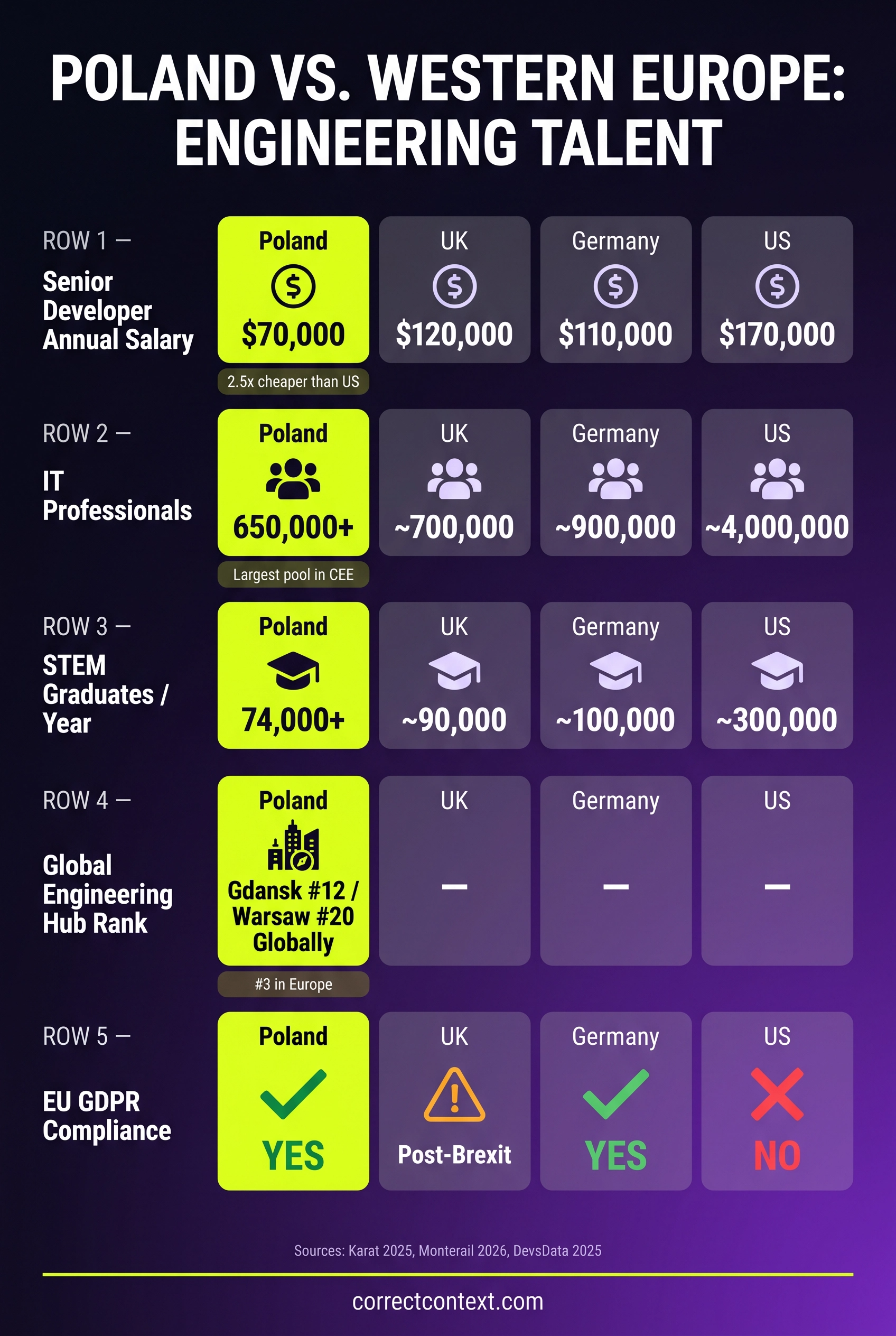
Poland boasts over 650,000 IT professionals, making it the largest tech talent pool in Central and Eastern Europe [2]. Critically, the quality of this talent is exceptional: 31% of 25–34-year-olds hold a master’s degree or equivalent, nearly double the OECD average [3]. This density of highly educated professionals is crucial when you need senior architects and tech leads who can take ownership of complex systems from day one.
Polish engineers consistently rank at the top of international coding competitions, with the country placing second globally in the International Olympiad in Informatics [2]. Over 74,000 STEM graduates enter the workforce annually, ensuring a continuous pipeline of fresh talent [2]. Warsaw and Gdańsk rank among the top 20 cities globally for hiring engineers Poland startup, with Gdańsk ranked #3 in Europe and #12 globally, and Warsaw #5 in Europe and #20 globally, according to Karat’s 2025 engineering talent hub analysis [2].
Cost Efficiency Without Compromising Quality
While salaries in Poland have risen with demand, they remain highly competitive compared to Western markets. A senior Java developer in the US may earn around $170,000 annually; the same developer in Poland earns up to $70,000—a cost advantage of approximately 2.5x while maintaining equivalent technical standards [4]. This differential allows startups to stretch their Series A funding further, building a dedicated development team with more seniority and depth than would be possible in London, Amsterdam, or Berlin.
Alignment with Western Business Standards
As an EU member state, Poland adheres to GDPR and EU regulatory frameworks, providing legal certainty for companies in regulated sectors like FinTech [2]. English proficiency is high, with Poland ranking #15 globally on the EF English Proficiency Index in the “Very high” band [3]. Time zone alignment with the UK and DACH markets ensures that collaboration with a remote development team in Poland is seamless.
The hyperscaler vote of confidence is also telling. Microsoft committed a €720 million investment in Polish data centre infrastructure in February 2025, and Google, AWS, and Azure all maintain significant Polish engineering presences [3]. When the world’s most scrutinized tech companies choose Poland, they are conducting due diligence on behalf of every startup that follows.
The Strategic Hiring Sequence: From 1 to 20
Scaling from a small core team to 20 engineers requires a deliberate, phased approach. The sequence is everything. Get it wrong and you either move too slowly or create organizational debt that takes a year to unwind.
Phase 1: Establishing Technical Leadership (Engineers 1–3)
If your founding team lacks strong technical leadership, this must be your first priority—before any other engineering hire. The engineering lead will make the early architectural decisions that your product lives on for years. They will set the engineering culture and be the person who interviews and evaluates every subsequent hire. A wrong decision here cascades through every hire you make afterward [1].
Following the lead, your next hires should be senior engineers who own things. These are experienced professionals who can take complete ownership of specific product areas—people who look at a problem, figure out the right approach, and ship it without needing to be told what to build. At this stage, strong generalists beat narrow specialists. You want someone who can learn a new domain in a week, not someone who only knows one framework well [1].
Phase 2: Building the Core Execution Engine (Engineers 4–10)
Once you have solid technical leadership and clear ownership in place, you can begin adding mid-level engineers. These developers benefit from the mentorship and structure provided by your senior team, and they are more readily available in the Polish market. Many will grow into senior roles as the company scales, solving future hiring problems before they start.
A healthy team composition at this stage is approximately 25% senior, 50% mid-level, and 25% junior developers [6]. This ratio ensures sufficient mentorship capacity while maintaining execution velocity. Critically, do not introduce dedicated engineering managers yet. In the first 6 to 12 months post-Series A, the CTO or technical co-founder should handle management. All early hires should write code [1].
Phase 3: Scaling and Specialization (Engineers 11–20)
As your team grows beyond 10 engineers, coordination becomes a significant challenge. This is the point where you should introduce dedicated engineering managers to handle the operational aspects of the team, freeing your technical leaders to focus on architecture and strategy.
During this phase, you can also begin hiring specialized roles. Depending on your product’s requirements, this might include a data engineering team, a cloud engineering team with AWS / Azure / GCP engineers, a machine learning engineers team, or a DevOps team for hire. These specialized hires are most effective when they join a team that already has a strong generalist foundation.
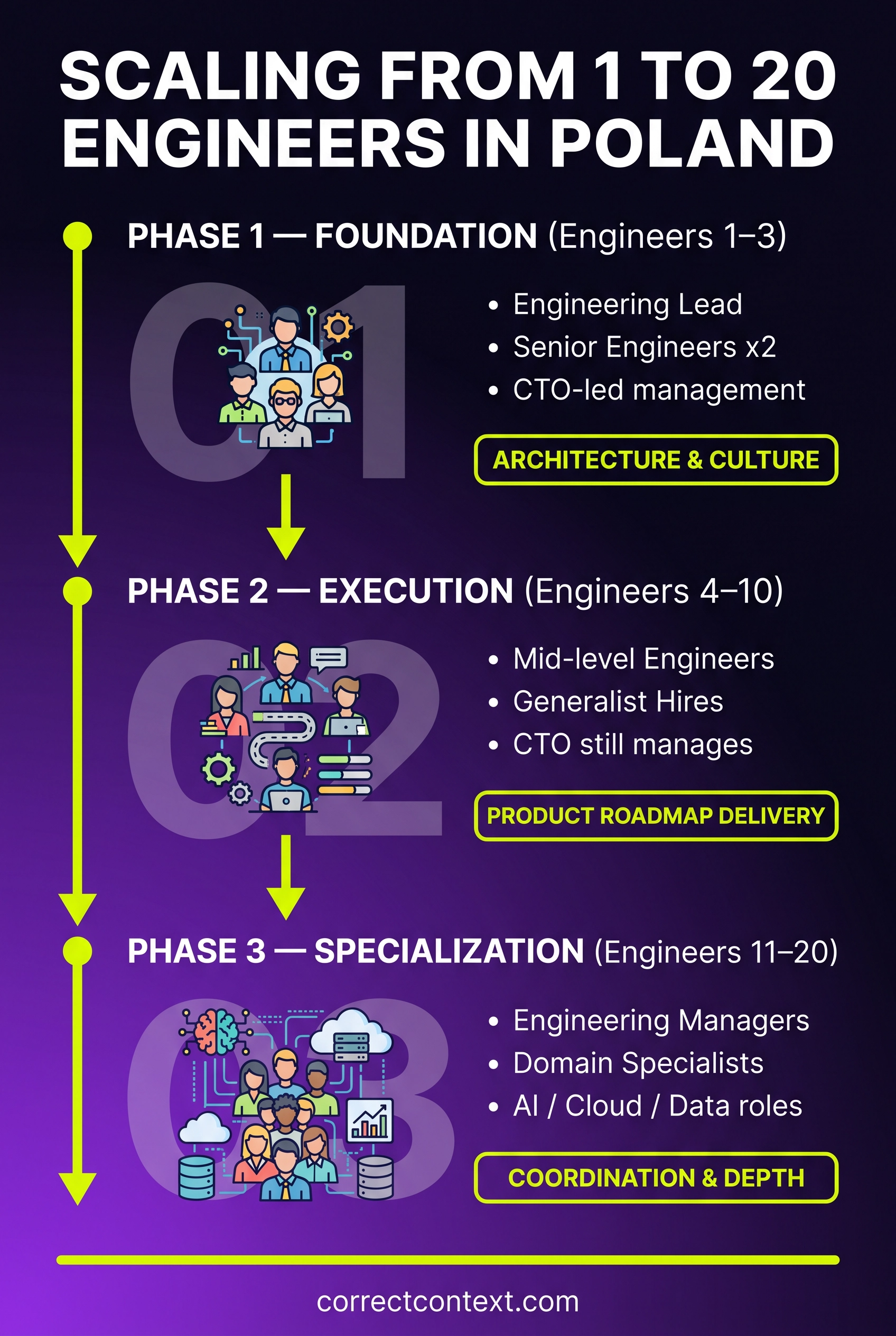
| Phase | Team Size | Key Hires | Management Model | Primary Focus |
|---|---|---|---|---|
| Foundation | 1–3 | Engineering Lead, 2 Senior Engineers | CTO/Founder-led | Architecture, culture, ownership |
| Execution | 4–10 | Mid-level Engineers, Generalists | CTO/Founder-led | Product roadmap delivery |
| Specialization | 11–20 | Engineering Managers, Specialists | Dedicated EM layer | Coordination, domain depth |
Common Mistakes That Derail Scaling Teams
Understanding the pitfalls is as important as knowing the right sequence. Several patterns consistently derail otherwise promising engineering organizations.
Lowering the hiring bar under pressure. When roles have been open for two months and the board is asking about progress, the temptation to settle is enormous. But a B-level hire becomes the ceiling for every subsequent hire they influence. B players know other B players. One bad hire can poison the talent pool in ways that are hard to see until it is too late [1].
Inflating titles too early. Naming your first engineering hire the CTO sounds good in a press release, but it creates a title problem when the company reaches Series B and that person cannot operate at the required scale. It is far better to provide paths to advancement and let people earn titles as the company grows [1].
Premature specialization. There is always pressure to hire narrow specialists early. A Machine Learning Infrastructure Engineer with Kafka experience is a real role at a 200-person company. At a 15-person startup, you need quick learners who can cross domains. If you need specialized AI development team members or big data development team engineers later, you can add those roles once your generalist foundation is solid [1].
Chasing big-name logos. Engineers from Google or Meta can be incredible startup hires, but large-company engineers are often accustomed to scaled systems, specialized tooling, and clear product requirements. They may struggle with the ambiguity and pace of a 15-person startup. Evaluate for fit at your current stage, not just resume brand [1].
| Metric | Poland | UK | Germany | US |
|---|---|---|---|---|
| Senior Developer Annual Salary | ~$70,000 | ~$120,000 | ~$110,000 | ~$170,000 |
| IT Professionals | 650,000+ | ~700,000 | ~900,000 | ~4,000,000 |
| STEM Graduates/Year | 74,000+ | ~90,000 | ~100,000 | ~300,000 |
| Global Engineering Hub Rank (Gdańsk) | #12 globally | — | — | — |
| English Proficiency (EF Index) | #15 globally (“Very High”) | Native | #10 (“Very High”) | Native |
| EU GDPR Compliance | Yes | Post-Brexit framework | Yes | No |
Sources: Karat 2025 Engineering Talent Hub Analysis [2], Monterail 2026 [3], DevsData 2025 [4]
The Role of Employer of Record (EoR) in Scaling Without Infrastructure
Navigating the legal and administrative complexities of hiring engineers Poland startup without a local entity can be a significant barrier. This is where an Employer of Record Poland becomes a strategic enabler rather than a mere administrative convenience.
An EoR Poland allows you to hire in Europe without company establishment, handling payroll, HR, employment compliance, accounting, and local law. This means you can focus entirely on building your product and managing your offshore development team, while the EoR manages the administrative burden. For startups that want to move fast—deploying their first Polish engineers within weeks rather than months—this model is transformative.
Employment compliance Europe is not a trivial matter. Polish labor law, social security contributions, and tax regulations require local expertise. An EoR CEE with established infrastructure can absorb this complexity, providing a compliant, scalable employment framework that grows with your team. This is precisely the model that Correct Context provides: a full-service platform for build tech hub Poland that includes recruitment, payroll, HR, accounting, legal, and office management, without the client needing to build any local infrastructure.
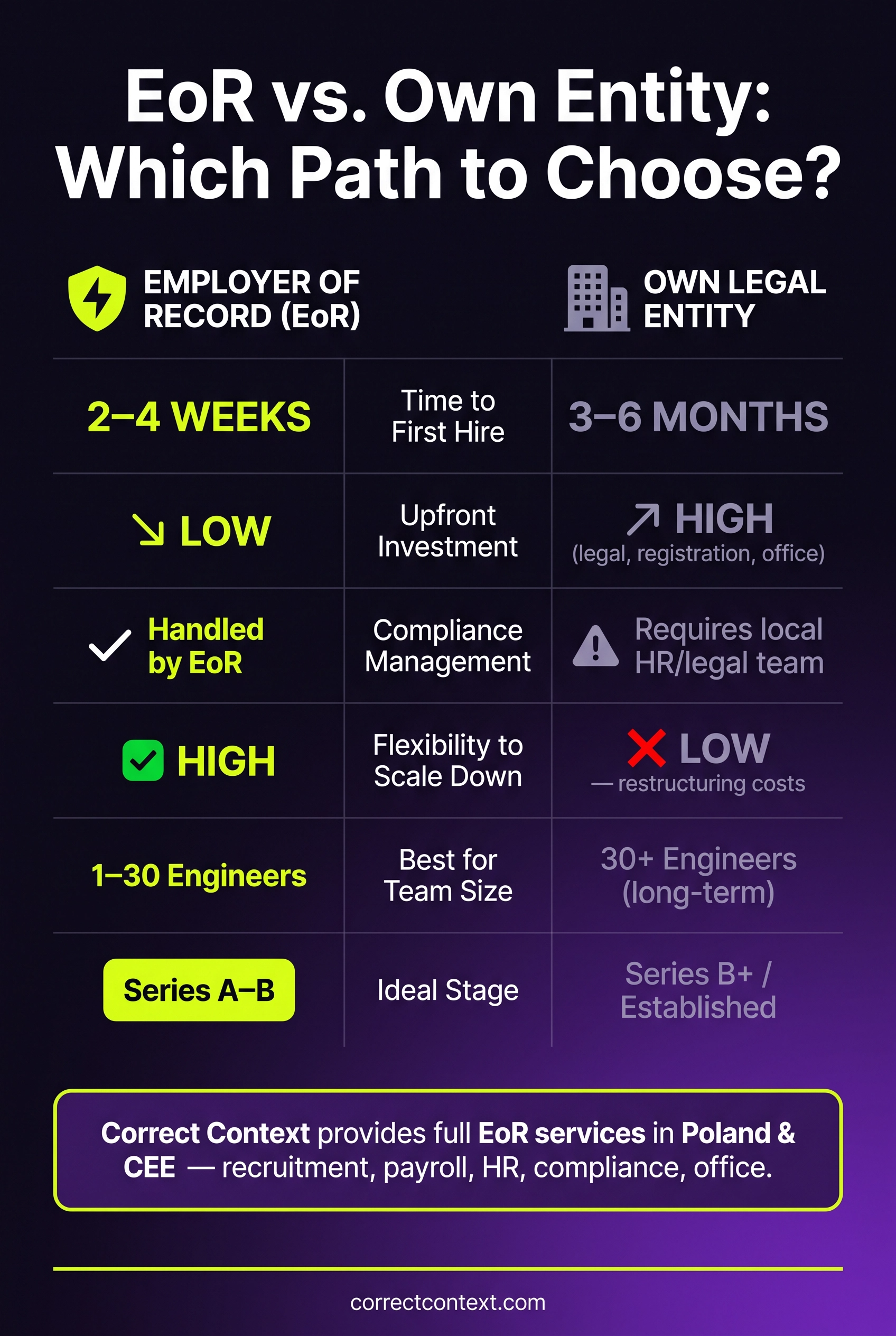
| Factor | Employer of Record (EoR) | Own Legal Entity |
|---|---|---|
| Time to first hire | 2–4 weeks | 3–6 months |
| Upfront investment | Low | High (legal, registration, office) |
| Compliance management | Handled by EoR | Requires local HR/legal team |
| Flexibility to scale down | High | Low (restructuring costs) |
| Best for team size | 1–30 engineers | 30+ engineers (long-term) |
| Ideal stage | Series A–B | Series B+ / established presence |
Conclusion: The Practical Growth Path
Scaling tech teams Europe is not a single decision—it is a sequence of decisions made over 12 to 18 months, each one building on the last. For Series A+ CTOs building a Poland team growth strategy, the practical path is clear: establish technical leadership first, build a generalist execution engine, then layer in specialization and management as coordination demands it.
Poland provides the talent depth, cost efficiency, and regulatory alignment to make this scaling path viable. With over 650,000 IT professionals, world-class universities producing 74,000 STEM graduates annually, and cities like Warsaw and Gdańsk ranking among the top 20 global engineering hubs, the infrastructure for hiring engineers Poland startup is mature and proven [2] [3].
The companies that succeed at this transition are not the ones that hire fastest. They are the ones that hire in the right order, maintain high standards under pressure, and leverage the operational support—whether through an EoR Poland or a dedicated nearshore partner—to focus their energy on what matters: building a product that wins.
References
[1] Kore1. How to Scale Your Engineering Team After Series A: A Startup Staffing Guide
[2] Karat. Poland’s Top Nearshore Hubs for CIOs Hiring Engineers. (June 2025).
[3] Monterail. (May 2026). Why Poland Is The Hub For European High-Scale Engineering In 2026
[4] DevsData. Software Development in Poland: Market Overview for 2025. (January 2025).
[5] Ravio. 2026 Compensation Trends Report.
[6] Carneiro, Bernardo. Medium. Scaling engineering teams in a healthy way | by Bernardo Carneiro