
Your company’s competitive edge lies in its intellectual property. But when it comes to expanding your engineering team Poland or building a dedicated development team in Central and Eastern Europe, fear of IP leakage or weak IP ownership is one of the most common concerns among enterprise legal, compliance, and security stakeholders. The good news: with the right legal framework in place, IP protection for Poland developers can be as robust as in any Western jurisdiction.
Poland now hosts over 650,000 IT professionals—the largest technology talent pool in Central and Eastern Europe [1]. The country’s software development market is projected to grow from USD 9.2 billion in 2026 to USD 18.1 billion by 2036 [2]. For Fortune 5000 enterprises and Series A+ startups in FinTech, Software, and Media, Poland represents a compelling destination for nearshore and offshore engineering. Yet the legal framework governing IP rights in Poland for software differs significantly from that of the United States, and those differences can expose enterprises to serious risk if not properly managed.
This guide is designed for enterprise legal, compliance, and security stakeholders who are late in their research and need a definitive answer: can IP be fully protected when hiring engineers in Poland? The answer is yes—but only if you know exactly what to do.
Why Poland’s IP Laws Differ from the US
The most important thing to understand upfront is that Poland does not recognize the American “work for hire” doctrine for independent contractors. In the US, work created by a contractor within the scope of a written agreement can automatically belong to the commissioning party. In Poland, this is not the case [3].
Under the Polish Copyright and Related Rights Act of 1994 (most recently amended in 2024 to align with EU directives), intellectual property rights default to the creator unless a formal, written agreement explicitly transfers them [4]. This applies to software developers Poland, freelancers, and B2B contractors alike. If your contracts are not localized to Polish law, you may be paying for software you do not legally own.
Poland is a member of the World Trade Organization and the World Intellectual Property Organization (WIPO), and its IP regulations are grounded in EU law. The Polish Patent Office oversees patents and industrial designs, while the Ministry of Culture and National Heritage governs copyright. This institutional framework provides a strong enforcement environment—but only for rights that have been properly secured [5].
The Two Types of Copyright: Moral vs. Economic Rights
Polish copyright law draws a critical distinction between two categories of rights that every enterprise must understand before hiring engineers IP risk can be properly assessed.

Moral rights protect the personal bond between a creator and their work. They include the right to authorship, the right to be identified as the author, and the right to the integrity of the work. Crucially, moral rights are perpetual, non-transferable, and cannot be waived outright—though they can be limited by mutual contractual agreement [6]. This means that even after a full IP transfer, a Polish developer retains the right to be acknowledged as the author of the code they wrote.
Economic rights are the commercially relevant rights: the right to use, reproduce, distribute, modify, and sublicense the work. Economic rights can be transferred in full to an employer or client, and this is the transfer that enterprises must secure through their contracts [6].
The table below summarizes the key differences:
| Feature | Moral Rights | Economic Rights |
|---|---|---|
| Transferable | No | Yes (in writing) |
| Waivable | Partially (by agreement) | Yes |
| Duration | Perpetual | 70 years post-author death |
| Relevant for enterprise IP | Low | High |
| Requires written contract | N/A | Yes, under pain of nullity |
IP Transfer Under Employment Contracts
For enterprises that directly employ engineers in Poland—either through a local entity or via an employer of record Poland—the legal framework is relatively favorable. Under Article 74 of the Polish Copyright Act, if an employee creates a computer program as part of their employment duties, the economic copyrights automatically transfer to the employer upon creation, unless the employment contract states otherwise [7].
This automatic transfer is a significant advantage of direct employment over contractor arrangements. However, it is not unconditional. The transfer only applies to works created within the scope of the employee’s defined duties. If an engineer creates software outside the scope of their role, the employer does not automatically acquire those rights. It is therefore essential that employment contracts clearly define the scope of duties and include explicit IP assignment provisions as a belt-and-suspenders measure.
IP Transfer Under B2B and Contractor Agreements
The situation becomes considerably more complex when engaging engineers through B2B cooperation contracts, contracts of mandate, or specific work contracts. In these cases, the transfer of economic copyrights is not automatic. If no written agreement explicitly transfers the rights, Polish law assumes that only a non-exclusive license has been granted—not full ownership [7].
For enterprises building an offshore development team or remote development team through contractor arrangements, the following requirements are non-negotiable for a valid IP transfer:
- The agreement must be in written form. Verbal agreements and email exchanges are insufficient and legally void for IP transfer purposes [3].
- The clause must explicitly state the transfer of economic copyrights, not merely imply it.
- The agreement must specify the fields of exploitation—the precise ways the software may be used, including reproduction, modification, distribution, and sublicensing.
- The agreement must indicate the moment of transfer (e.g., upon delivery, upon acceptance, or upon payment).
- The agreement must address derivative rights—the right to modify, translate, or adapt the software.
- Any standard or pre-existing code used by the contractor must be explicitly excluded from the transfer scope or licensed separately.
Failure to address any of these elements can render the transfer clause partially or wholly void, leaving the enterprise with far weaker rights than anticipated [3].
The EoR Double-Transfer Challenge
An increasing number of enterprises use an Employer of Record CEE or EoR Europe solution to hire in Poland without establishing a local legal entity. This is a practical and cost-effective approach, but it introduces a specific IP complication that is often overlooked.
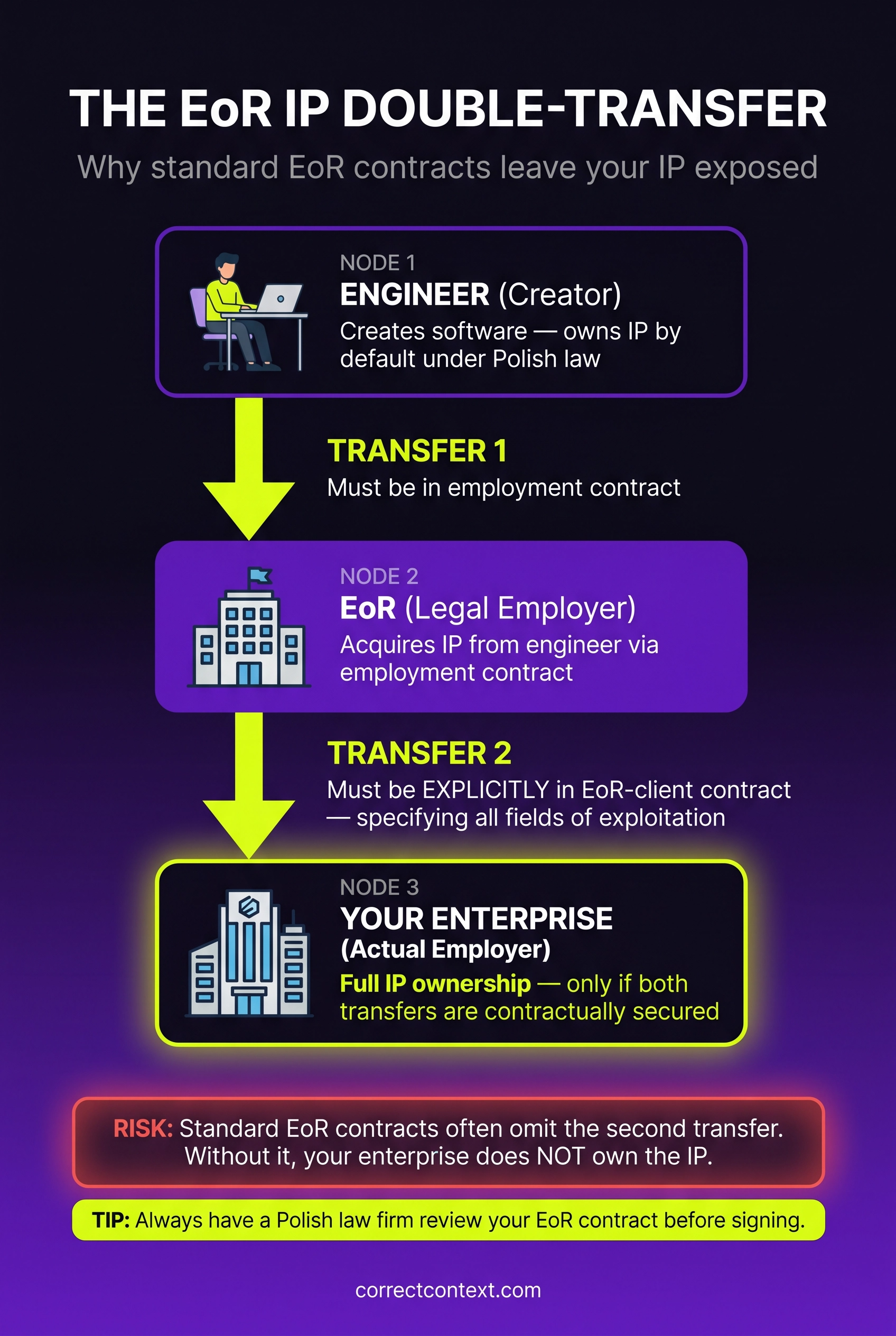
In a standard employment relationship, the employer acquires IP rights directly from the employee. In an EoR arrangement, however, the IP must be transferred twice: first from the engineer to the EoR (the legal employer), and then from the EoR to the client enterprise (the actual employer) [8].
“In addition to liability clauses, it is also particularly important to pay attention to the acquisition of intellectual property rights when using an EOR… There is a double-transfer of IP. First, the legal employer (the EOR) acquires the IP and then can transfer the rights to the client (the actual employer). This second transfer requires the inclusion of a properly worded provision in the contract, specifying precisely all relevant fields of exploitation.” — Dentons [8]
Standard EoR contracts often do not include adequately detailed IP transfer provisions. Before signing with any EoR Poland provider, enterprise legal teams must scrutinize the contract to ensure that the second-stage transfer is explicit, comprehensive, and covers all required fields of exploitation. Engaging a Polish law firm to review the EoR contract is strongly recommended.
Practical Checklist for Enterprise IP Protection
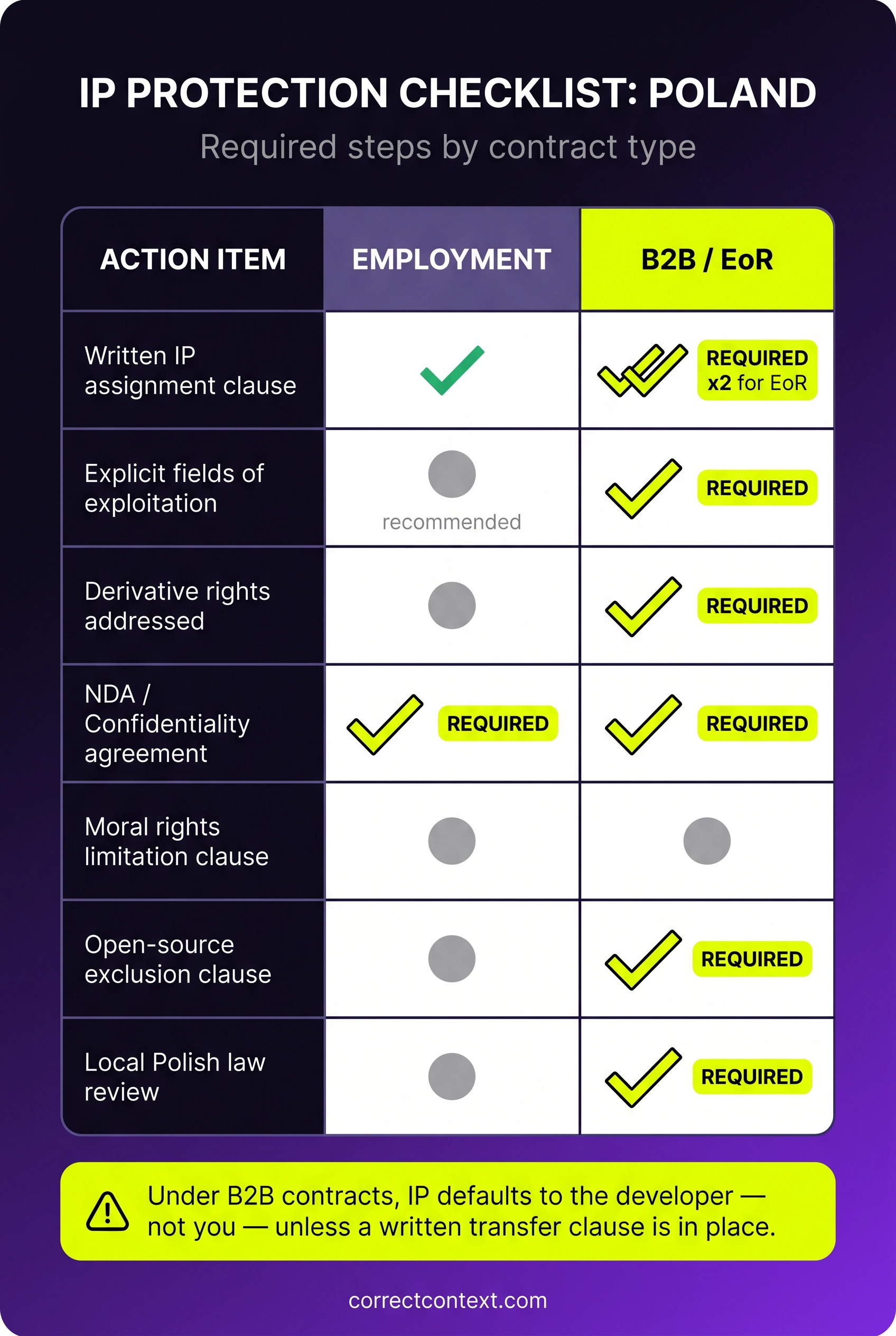
The following checklist summarizes the key steps enterprises should take to protect their IP when building an engineering hub Europe or hiring a dedicated software team in Poland:
| Action Item | Employment Contract | B2B / Contractor | EoR Arrangement |
|---|---|---|---|
| Written IP assignment clause | Recommended | Required | Required (x2) |
| Explicit fields of exploitation | Recommended | Required | Required |
| Derivative rights addressed | Recommended | Required | Required |
| NDA / confidentiality agreement | Required | Required | Required |
| Moral rights limitation clause | Recommended | Recommended | Recommended |
| Open-source exclusion clause | Recommended | Required | Required |
| Local Polish law review | Recommended | Required | Required |
Open Source and Third-Party IP Contamination
One additional risk that enterprise security stakeholders must account for is open-source contamination. Polish developers, like their counterparts globally, frequently use open-source libraries and frameworks in their work. If the IP transfer clause does not explicitly exclude open-source components, or if the contractor fails to disclose their use of third-party code, the enterprise may inadvertently acquire IP encumbered by open-source licenses [3].
Contracts should require contractors to disclose all third-party and open-source components used in the development of the software, and to provide appropriate indemnification in the event that undisclosed third-party IP creates a future infringement claim.
Enforcement and Remedies
Poland’s EU membership provides a strong enforcement framework for IP rights. Copyright infringement claims can be brought before district courts, and remedies include cease-and-desist orders, removal of infringing content, damages, and disgorgement of profits [6]. Criminal liability for copyright infringement is also possible under Polish law.
The limitation period for copyright claims is generally three to six years, depending on the nature of the claim. Enterprises should maintain thorough documentation of all IP assignments and agreements to support enforcement actions if needed.
Conclusion
IP protection for Poland developers is not only possible—it is well-supported by a mature legal framework grounded in EU directives and international treaties. The key is knowing where the risks lie and structuring your agreements accordingly. Whether you are building a nearshore development team, scaling your AI development team, or establishing a platform engineering team in Poland, the legal tools to protect your core IP are available and enforceable.
The primary risks—defaulting to non-exclusive licenses under B2B contracts, failing to address derivative rights, and overlooking the EoR double-transfer requirement—are all avoidable with proper legal preparation. Partnering with an experienced provider that understands both the talent landscape and the legal requirements of employment compliance Europe is the most reliable path to building a secure, high-performing engineering team Poland without sacrificing your intellectual property.
Correct Context specializes in the hiring of IT core teams offshored and nearshored to Poland and the CEE region, providing end-to-end support including recruitment, payroll, HR, legal, accounting, and EoR services—so you can build your extended engineering team with complete confidence.
References
[1] Correct Context. Polish Developer Talent Pool: The Complete 2026 Guide for Tech Companies – Grow your Core IT Teams.
[2] Future Market Insights. IT Software and Service Analysis in Poland Market Size, Share & Forecast to 2036 | FMI
[3] Legalmondo. Poland – IP and Copyright clauses you need to get right in your contract – Legalmondo
[4] Hogan Lovells. A long awaited amendment to Polish copyright law
[5] Rippling. Protecting IP Ownership and Rights in Poland: 6 Things Employers Need to Know.
[6] Dudkowiak & Putyra. Copyright: Key regulations and principles | Dudkowiak & Putyra
[7] After Legal Law Firm. Copyright in IT Projects in Poland – After Legal Law Firm
[8] Dentons. Employers of Record – Polish perspective