
Staff Augmentation vs Full-Time Hiring: The Complete 2026 Guide for Tech Leaders
Here is a number that should stop every CTO and VP of Engineering in their tracks: 70% of CIOs globally report skills shortages as their number one barrier to digital transformation. Not budget. Not technology. Not executive buy-in. Skills. The talent you need to execute your roadmap simply is not available through traditional hiring channels.
This is not a temporary market fluctuation. Gartner’s 2026 predictions show that 94% of CIOs expect major plan changes by 2026, yet only 48% of digital initiatives succeed. The old playbook — post a job, wait for applicants, interview for weeks, hire full-time — is breaking down under the weight of project urgency, skills scarcity, and budget pressure.
This guide gives you a data-driven framework for deciding when to use IT staff augmentation versus full-time hiring. We will examine the true costs (not just the obvious ones), the speed differential, the risk profiles, and the strategic factors that should drive your decision. By the end, you will have a clear decision matrix you can apply to every hiring scenario your team faces in 2026.
What Is Staff Augmentation, Really?
Staff augmentation is a flexible workforce model where external professionals are temporarily embedded into your in-house team. Unlike outsourcing an entire project, augmentation keeps you in control. Your internal managers direct the work. The augmented staff simply extends your capacity.
In 2026, this model has matured significantly. It is no longer limited to junior developers filling short-term gaps. Organizations are now augmenting senior architects, data scientists, AI/ML engineers, DevSecOps specialists, and even CTOs on an interim basis. The quality of talent available through augmentation has risen dramatically as more experienced professionals choose the flexibility and variety of contract work.
The key distinction: augmented staff work within your processes, tools, and management structure. They attend your standups, use your Jira, commit to your GitHub repositories. This is not offshore development where work is handed off to a separate team. This is expanding your team capacity with external talent that functions as part of your organization.
How Staff Augmentation Differs from Other Models
Understanding staff augmentation requires distinguishing it from related but distinct workforce models:
Staff Augmentation vs. Managed Services: In a managed services arrangement, you hand off an entire function or project to an external provider. They control the deliverables, the timeline, and the methodology. With staff augmentation, you retain control. The external professionals work under your direction, using your processes, reporting to your managers.
Staff Augmentation vs. Project Outsourcing: Project outsourcing means hiring a vendor to deliver a specific outcome — a built application, a completed migration, a delivered website. Staff augmentation means hiring individuals who become part of your team to work on whatever priorities you define.
Staff Augmentation vs. Freelance Marketplaces: Freelance platforms connect you with individual contractors, but the vetting, onboarding, and management burden falls entirely on you. Staff augmentation providers handle sourcing, screening, payroll, compliance, and ongoing support, delivering talent that is ready to contribute.
Staff Augmentation vs. Consulting: Consultants typically advise, recommend, and create strategies. They deliver reports and presentations. Augmented staff execute — they write code, configure systems, manage infrastructure, and deliver working software.
The right choice depends on your needs. If you need advice, hire consultants. If you need a finished product without involvement, use project outsourcing. If you need capacity expansion with control, choose staff augmentation.
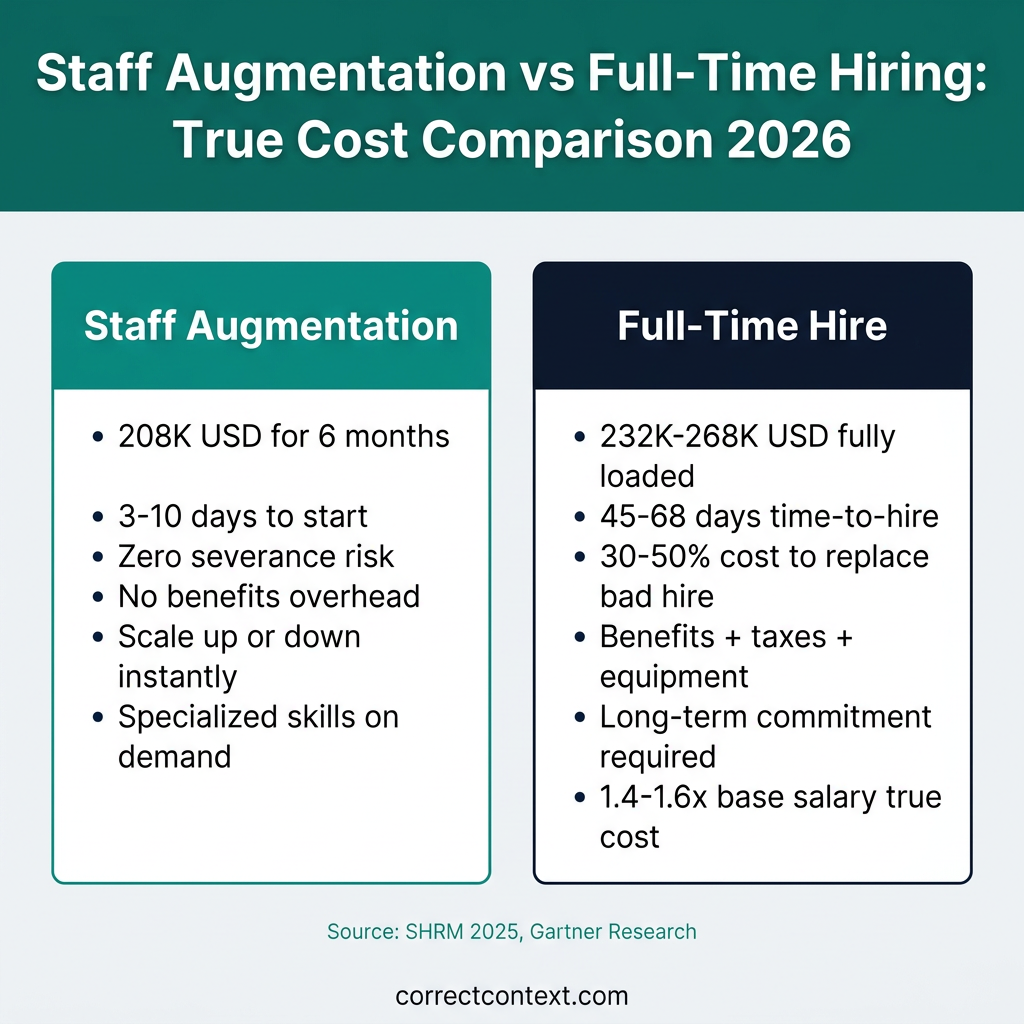
The True Cost Comparison: Beyond Base Salary
Most cost comparisons between staff augmentation and full-time hiring fail because they compare hourly rates to base salaries. This is comparing apples to oranges. To make an accurate comparison, you need to calculate the fully-loaded cost of employment.
Why Base Salary Is Misleading
When finance teams evaluate hiring options, they often look at the base salary and stop there. A $150,000 engineer versus a $200 per hour contractor seems like an easy comparison. But this misses the majority of the cost picture.
The fully-loaded cost of an employee includes benefits, taxes, recruiting fees, onboarding, equipment, workspace, and the management overhead required to support them. In the United States, these additional costs typically add 40% to 60% to the base salary. In Europe, with higher social charges and more generous benefits, the multiplier can be even higher.
Then there is the hidden cost of time. The 45 to 68 days to hire, the 30 to 60 days to onboard, the months before full productivity — these represent real costs that do not appear on the salary line but significantly impact project timelines and budgets.
Finally, there is the risk cost. A bad hire does not just waste the salary paid. It wastes recruiting fees, onboarding investment, team disruption, lost productivity, and the cost of replacement. SHRM puts this at 30% to 50% of first-year salary. Other studies put it higher. When you factor in the opportunity cost of delayed projects and the morale impact on the remaining team, the true cost of a bad hire can approach or exceed the annual salary.
Full-Time Employee True Costs
For a software engineer with a $150,000 base salary in the United States, the actual cost to the employer typically runs 1.4 to 1.6 times that base salary. Here is the breakdown:
| Cost Component | Amount (USD) |
|---|---|
| Base salary | $150,000 |
| Benefits (health, dental, vision) | $18,000 – $25,000 |
| Payroll taxes (FICA, FUTA, state) | $11,475 |
| 401(k) match (4% typical) | $6,000 |
| PTO (15 days average, paid non-working) | $8,654 |
| Recruiting cost (20-30% of salary) | $30,000 – $45,000 |
| Onboarding and training | $5,000 – $15,000 |
| Equipment and workspace | $3,000 – $8,000/year |
| Total First-Year Cost | $232,000 – $268,000 |
That $150,000 engineer actually costs between $232,000 and $268,000 in their first year. And that assumes they work out. If they do not, the Society for Human Resource Management (SHRM) reports that a bad hire costs 30% to 50% of the employee’s first-year salary to replace. Some estimates put the total cost of a bad hire at 50% to 200% of annual salary when you factor in lost productivity, team disruption, and the cost of restarting the hiring process.
Staff Augmentation True Costs
A senior contractor at $200 per hour working full-time (2,080 hours annually) would cost $416,000 per year. At first glance, this looks significantly more expensive than the fully-loaded FTE cost of $232,000 to $268,000.
But this comparison misses three critical factors that flip the analysis:
Factor 1: Utilization Rate. FTEs cost the same whether they are working productively or waiting for work. Contractors can be engaged and disengaged to match actual workload. If your project needs a senior cloud architect for six months, the contractor costs six months times hours worked. An FTE hired for the same project remains on payroll for 12 months before anyone discusses letting them go — and severance if they do.
Here is the math: A six-month engagement with a contractor at $200 per hour (1,040 hours) costs $208,000. That is comparable to six months of a fully-loaded $240,000 FTE, without the recruiting cost, severance risk, or organizational commitment.
Factor 2: Time-to-Productivity. FTE hiring in specialized IT roles takes 45 to 90 days from job posting to start date, then another 30 to 60 days before the new hire is fully productive. That is 75 to 150 days of full cost before full value. A contractor from a quality staffing firm with a pre-vetted talent network can start in 3 to 10 business days and is productive from day one.
Factor 3: Specialized vs. Core Skills. Your hiring strategy should differ based on where a skill sits on the core-to-commodity spectrum. Core competency skills — those central to your competitive advantage — need institutional knowledge, long-term investment, and deep organizational context. Hire FTEs for these. Specialized point skills — deep expertise needed for specific projects like a CyberArk implementation, NetSuite migration, or Kubernetes cluster setup — are not needed ongoing. Staff augmentation is the optimal model here.
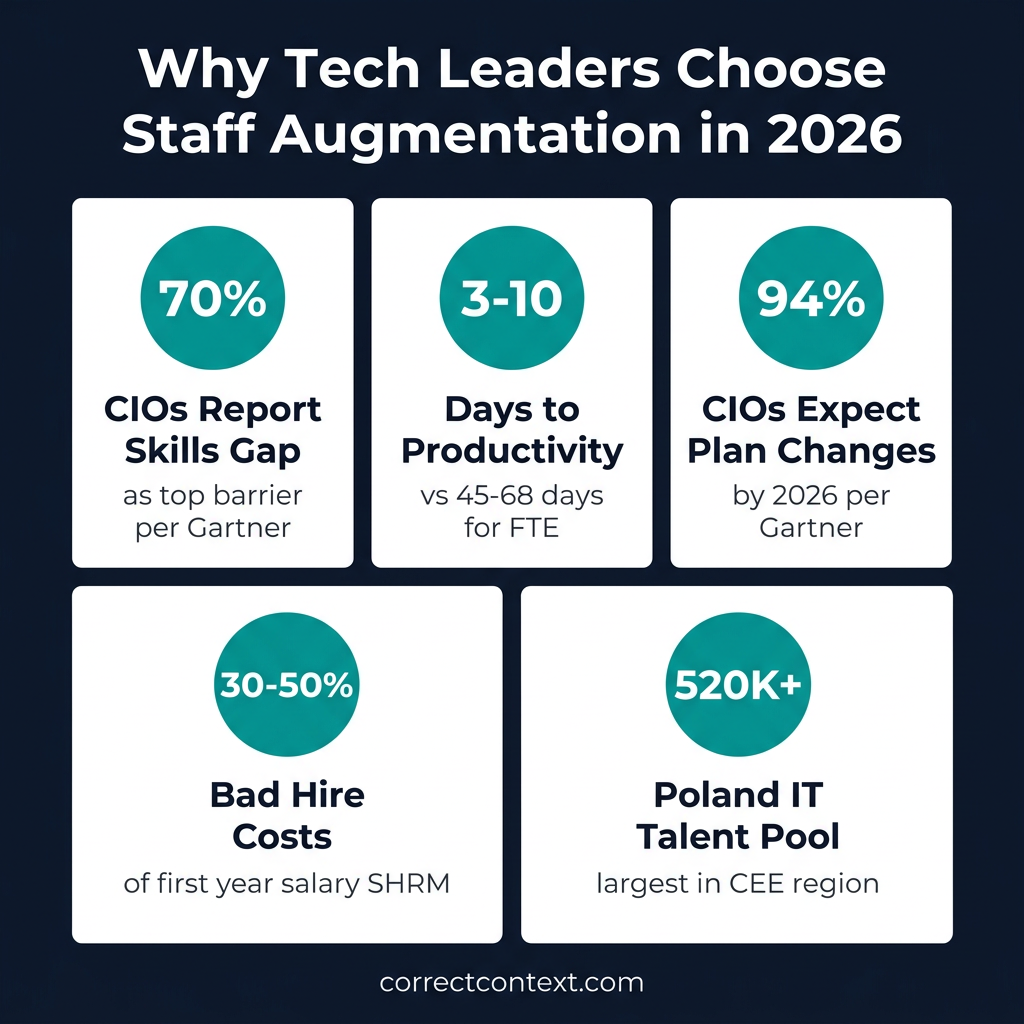
Speed to Productivity: The Hidden Cost of Delay
In 2026, speed is not a luxury. It is a competitive necessity. The average time-to-hire for technical roles has increased from 36 to 44 days in 2023 to a reported 68.5 days in mid-2025, according to industry data. That is more than two months from application to offer acceptance — and that does not include the notice period or onboarding time.
The Competitive Cost of Slow Hiring
Every day a critical role sits unfilled is a day your project slips, your team is understaffed, and your competitors potentially gain ground. In software development, speed to market is often the difference between capturing a market and playing catch-up.
Consider a typical scenario: Your team needs a senior backend engineer to build a new API that unlocks a key customer feature. The feature is committed to customers for next quarter. If you go the full-time hiring route, you face 45-68 days to hire, 30 days notice period, and 30-60 days to full productivity. That is 105-158 days before the engineer is contributing at full capacity. If your quarter is 90 days, you have already missed the commitment.
With staff augmentation, you can have a pre-vetted senior engineer starting within 3-10 business days. They are productive immediately because they arrive with the specific skills you need. The API gets built. The customer commitment is met. The revenue is recognized.
This is not a theoretical advantage. In the 2026 market, where 94% of CIOs expect major plan changes and project scopes shift constantly, the ability to spin up capacity quickly is a core competitive capability.
For time-sensitive projects — a security remediation with a compliance deadline, a product launch with a committed date, a migration that cannot wait — the time-to-productivity difference is a critical factor that purely cost-based analysis misses.
Time-to-Hire Benchmarks by Role
| Role Type | Time-to-Hire (Days) | Time-to-Productivity (Days) |
|---|---|---|
| Junior Developer (FTE) | 30-45 days | 60-90 days |
| Senior Engineer (FTE) | 45-68 days | 75-120 days |
| Specialized Architect (FTE) | 60-90 days | 90-150 days |
| Staff Augmentation (any level) | 3-10 days | 3-10 days |
The difference is stark. While your competitor waits 75 days for their new senior engineer to become productive, you could have a contractor contributing value for 65 of those days. In a six-month project, that productivity gap can mean the difference between hitting your deadline and missing it.
Risk Profile: The Cost of Getting It Wrong
Hiring involves risk. The question is not whether to take risks, but which risks to take and how to manage them.
Understanding Risk in Workforce Decisions
Every hiring decision carries risk. The FTE model concentrates risk in the hiring decision itself — getting it wrong is expensive and difficult to unwind. The augmentation model distributes risk across the engagement — you can adjust quickly if things are not working, but you face different risks around knowledge continuity and team integration.
Smart risk management starts with honest assessment. What is the real cost of a bad hire in this role? For a junior developer on a non-critical project, the cost is manageable. For a CTO who will set technical direction for years, the cost of getting it wrong is potentially company-threatening. Match your risk mitigation to the actual risk.
For high-risk roles, augmentation offers a valuable risk mitigation tool: the trial period. You can engage a senior candidate on a contract basis, observe their performance in your actual work environment, and make the FTE decision with real data rather than interview impressions. This “try before you buy” approach significantly reduces the risk of expensive bad hires.
For roles where knowledge continuity is critical, FTE hiring reduces the risk of knowledge loss. When an FTE leaves, you typically have notice time for knowledge transfer. When an augmented resource leaves, the departure can be more abrupt. Mitigate this through documentation requirements, overlapping engagements, and ensuring your FTE team maintains sufficient knowledge of critical systems.
Full-Time Hiring Risks
Bad Hire Risk: SHRM data shows that replacing a bad hire costs 30% to 50% of first-year salary. For a $150,000 engineer, that is $45,000 to $75,000 in direct costs, plus the indirect costs of team disruption, lost productivity, and morale impact. Some studies put the total cost at 50% to 200% of annual salary.
Severance and Legal Risk: Terminating an FTE involves legal considerations, severance obligations, and potential unemployment claims. In many jurisdictions, this process takes months and carries significant financial exposure.
Commitment Risk: When you hire an FTE, you are making a long-term commitment. If project priorities change, if funding shifts, if the market turns — you are still committed to that salary, those benefits, that headcount.
Staff Augmentation Risks
Knowledge Continuity Risk: When an augmented staff member leaves, they take their project knowledge with them. This risk can be mitigated through documentation requirements, knowledge transfer sessions, and overlapping engagements.
Cultural Integration Risk: External staff may not fully integrate with your team culture. This risk is managed through careful selection, clear communication of expectations, and treating augmented staff as team members rather than outsiders.
Ramp-Down Risk: When the engagement ends, you lose that capacity immediately. This is actually a feature, not a bug — it is the flexibility you paid for. But it requires planning to ensure continuity.
The key difference: staff augmentation has trial periods built in. If an augmented resource is not working out, you can end the engagement with minimal friction. If an FTE is not working out, you face months of performance management, potential legal exposure, and significant replacement costs.
The Poland Advantage: Why Location Matters in 2026
When considering staff augmentation, geography matters. Poland has emerged as Europe’s premier destination for high-value IT staff augmentation, and the data explains why.
Why Poland Leads Central and Eastern Europe
The Central and Eastern Europe (CEE) region has become a powerhouse for IT talent, and Poland sits at the center of this ecosystem. With over 520,000 IT professionals, Poland represents roughly 25% of the entire CEE tech talent pool. This concentration creates a self-reinforcing cycle: more companies establish operations in Poland, which attracts more talent, which attracts more companies.
Poland’s emergence as a tech hub is not accidental. It is the result of deliberate investments in education, a strong mathematical and engineering tradition, EU membership providing regulatory alignment and freedom of movement, and a business-friendly environment that encourages foreign investment.
The major tech hubs — Warsaw, Krakow, and Wroclaw — each have distinct characteristics. Warsaw, as the capital and largest city, offers the deepest talent pool and the most established ecosystem of tech companies and service providers. Krakow, with its strong university presence and quality of life, attracts talent from across the region. Wroclaw has emerged as a center for R&D operations, with major global companies establishing development centers there.
For companies considering staff augmentation, this geographic concentration means access to a large, diverse talent pool with varying specializations and experience levels. Whether you need a junior developer for a straightforward implementation or a senior architect for a complex system design, the Polish market can deliver.
Talent Pool Scale: Poland is home to over 520,000 IT professionals — the largest talent pool in Central and Eastern Europe. Polish universities produce approximately 15,000 computer science graduates annually, creating a steady pipeline of new talent.
Quality of Education: Poland ranks 7th globally in the HackerRank programming skills assessment. Polish engineers consistently demonstrate strong problem-solving abilities, solid computer science fundamentals, and practical coding skills.
English Proficiency: Communication is often the biggest challenge in international staffing. Poland ranks 15th globally in the EF English Proficiency Index, with strong business English skills common among IT professionals.
Time Zone Alignment: Poland operates in Central European Time (CET), providing significant overlap with Western European business hours and workable overlap with US East Coast hours. This enables real-time collaboration that is difficult with offshore locations in Asia.
Cultural Compatibility: Polish business culture emphasizes direct communication, strong work ethic, and quality focus — values that align well with Western European and North American organizations.
Cost Efficiency: While Polish developer salaries have risen with demand, they remain 40% to 60% below Western European equivalents for comparable skills and experience. This creates a compelling value proposition: Western-quality capabilities at Central European cost.
For companies in the DACH region, Benelux, UK, and Nordics, Poland represents the optimal nearshoring destination — close enough for easy travel and cultural alignment, cost-effective enough to justify the engagement, and talent-rich enough to scale.
Real-World Example: Scaling with Polish Talent
Consider a German fintech company that needs to build a new mobile banking platform. They need 8-10 additional engineers for a 9-month project. Local hiring in Munich would cost €80,000-€120,000 per engineer in base salary, plus 40-50% in additional costs, plus 2-3 months to hire. Total cost: approximately €1.2-€1.8 million, with significant delay before the team is productive.
Alternatively, they engage a Polish staff augmentation provider. They get experienced engineers at €45-€65 per hour fully loaded. The team starts within 2 weeks. Total cost for 9 months: approximately €650,000-€950,000. They save 30-50% on costs and gain 6-8 weeks of productivity.
This is not a theoretical scenario. It is a pattern we see repeatedly with companies across DACH and Benelux. The combination of Polish talent quality, cultural alignment, timezone overlap, and cost efficiency makes staff augmentation from Poland a strategic advantage.
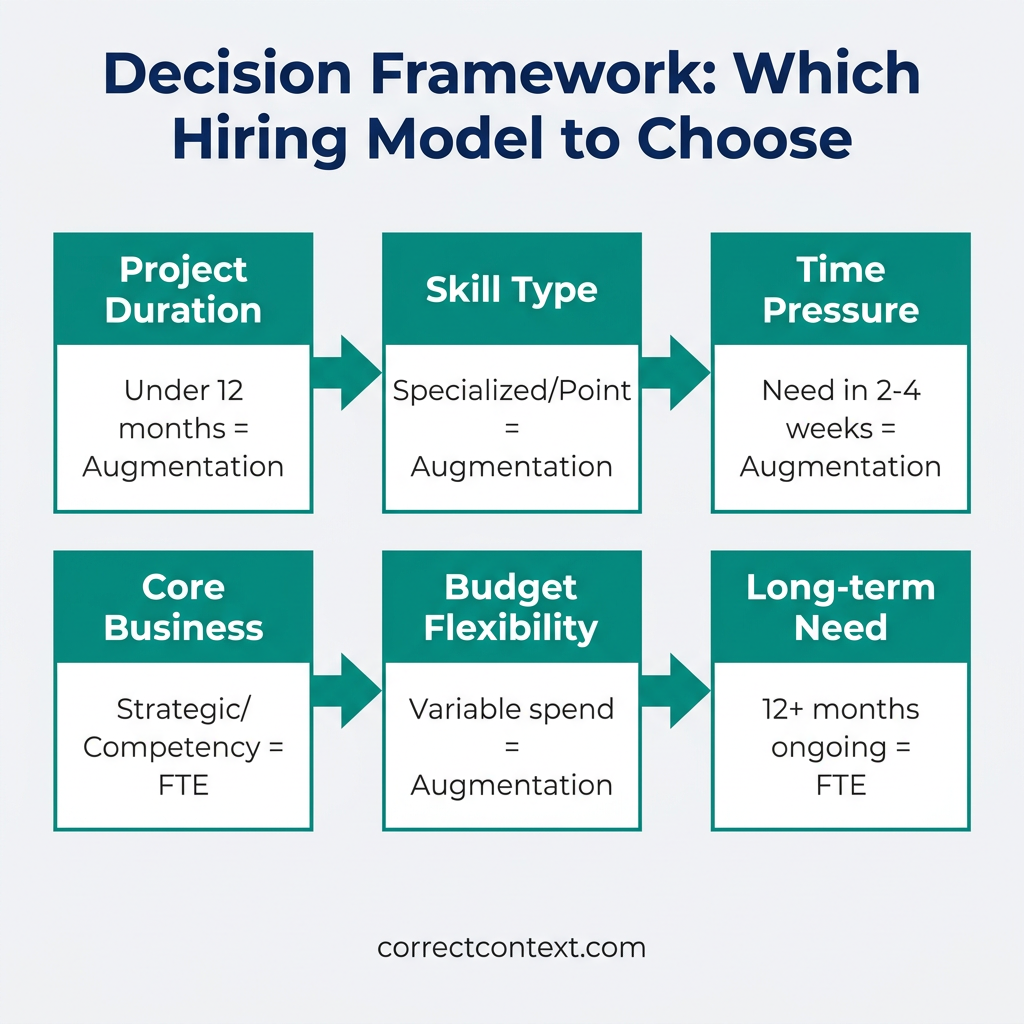
The Decision Framework: Six Questions to Guide Your Choice
Use these six questions to determine the right model for a specific role or project:
How to Apply This Framework
These six questions are not a rigid checklist but a guide for structured decision-making. Start with Question 1 and work through them in order. In most cases, the answers will point clearly toward either FTE or augmentation. When the answers conflict — for example, a project-based need that requires deep institutional knowledge — that is a signal to consider hybrid approaches or to break the work into components that can be handled by different models.
Document your decisions and revisit them periodically. A role that made sense as augmentation six months ago might now warrant FTE status if the need has become ongoing and strategic. Conversely, an FTE role might shift to augmentation if the work has become more standardized or if you need to reduce fixed costs.
Share this framework with your leadership team and hiring managers. Alignment on when to use each model prevents ad-hoc decisions driven by habit or personal preference. It ensures that your workforce strategy supports your business strategy rather than working at cross-purposes.
Question 1: Is this need ongoing (12+ months) or project-based?
Ongoing need signals FTE. If you need this capability permanently — a senior architect who will own your infrastructure for years, a VP of Engineering who will build your organization — hire full-time. The long-term investment in institutional knowledge, cultural alignment, and organizational commitment pays off.
Project-based or uncertain need signals augmentation. If you need this capability for a defined project, if the roadmap beyond six months is unclear, or if you are testing a new initiative — use augmentation. The flexibility to scale down without severance or organizational disruption is worth the hourly premium.
Question 2: Is this a core skill or specialized/niche skill?
Core to business signals FTE. Skills central to your competitive advantage — your proprietary algorithms, your unique data pipelines, your customer-facing platform — need people deeply invested in your success. Hire FTEs who will build institutional knowledge and long-term commitment.
Specialized, point-in-time skills signal augmentation. Skills needed for specific projects but not ongoing — a Salesforce integration specialist, a security auditor, a Kubernetes migration expert — are perfect for augmentation. You get deep expertise without the long-term commitment.
Question 3: How time-sensitive is the start?
Can wait 60-90 days signals FTE. If your timeline allows for proper sourcing, interviewing, and onboarding, the long-term benefits of an FTE may justify the wait.
Need within 2-4 weeks signals augmentation. If you have a compliance deadline, a committed product launch, or a critical gap that is blocking the team — augmentation is your only viable option. The speed differential is too significant to ignore.
Question 4: Do you need institutional knowledge to build?
Yes, deep context needed signals FTE. Roles that require understanding your legacy systems, your customer nuances, your organizational history — these need people who will be around long enough to accumulate that knowledge.
No, specialist can self-orient signals augmentation. Roles where the work is self-contained, where the requirements are clear, where the deliverables are well-defined — these can be effectively handled by augmented staff.
Question 5: How important is budget flexibility?
Fixed budget, predictable costs signals FTE. If you need predictable monthly costs and have the budget authority to commit to headcount, FTE provides that stability.
Variable spend, project-based budget signals augmentation. If you need to match costs to project phases, if your funding is milestone-based, if you need the ability to pause spending — augmentation converts fixed costs to variable costs.
Question 6: What is your risk tolerance for a bad hire?
Low risk tolerance, need stability signals FTE. If a bad hire would be catastrophic — a CTO who steers the wrong technical direction, a senior architect who makes poor foundational decisions — the thorough vetting of FTE hiring is worth the time.
Higher risk tolerance, can pivot quickly signals augmentation. If you can tolerate some trial and error, if you can replace a resource quickly without major disruption, augmentation’s built-in trial period is an advantage.
Hybrid Models: The Best of Both Worlds
The most sophisticated organizations do not choose between staff augmentation and full-time hiring. They use both strategically, creating a hybrid workforce that combines the stability of FTEs with the flexibility of augmentation.
Building Your Workforce Strategy
Effective workforce planning in 2026 requires thinking beyond the binary choice of FTE versus contractor. It requires a strategic approach that matches talent models to business needs, creating a portfolio of workforce options that can adapt as those needs change.
Start by mapping your current and projected needs against the decision framework. Which roles are core to your competitive advantage? These should be FTE. Which needs are project-based or specialized? These are candidates for augmentation. Which needs are uncertain or experimental? Start with augmentation and convert to FTE if the need solidifies.
Build relationships with staff augmentation providers before you need them. The best providers maintain deep talent pools and can respond quickly to urgent requests — but only if they understand your business, your culture, and your technical requirements. Invest time in onboarding your augmentation partners just as you would onboard an FTE.
Create clear pathways for conversion. The best augmented staff may become your best FTE hires. Structure your augmentation agreements with conversion options that make sense for both parties. A contractor who has proven their value over six months is a lower-risk FTE hire than a candidate from a traditional recruiting process.
Measure what matters. Track time-to-productivity, not just time-to-hire. Track total cost of engagement, not just hourly rates. Track project outcomes, not just headcount. The goal is not to minimize cost or maximize headcount — it is to deliver business results efficiently and effectively.
The Core-and-Flex Model: Maintain a core team of FTEs who own the architecture, the culture, and the long-term direction. Augment with contractors for project surges, specialized skills, and experimental initiatives. This gives you stability where you need it and flexibility where you need it.
The Try-Before-You-Buy Model: Use augmentation to bring in talent on a contract basis. If they prove valuable and a long-term need emerges, convert them to FTE. This reduces the risk of bad hires and gives you real-world data on fit and performance.
The Knowledge Transfer Model: Bring in augmented specialists for specific projects with a mandate to transfer knowledge to your FTE team. The contractor delivers the immediate need while upskilling your permanent team for the future.
McKinsey’s workforce research suggests that by 2030, 75% of work will be done by humans with AI, and 25% will be done by AI. The human work that remains will increasingly be done by blended teams of FTEs and augmented specialists, assembled for specific initiatives and disbanded when complete.
The Future of Workforce Planning
Looking ahead, the distinction between FTE and augmented staff will likely blur. More professionals will choose portfolio careers, moving between contract and employment based on life circumstances and professional interests. Companies will need to become adept at engaging talent in whatever form it is available, rather than insisting on traditional employment relationships.
The skills required for workforce management will evolve. HR teams will need to understand project management, vendor management, and contract law alongside traditional employment practices. Managers will need to lead blended teams with different employment statuses, motivations, and career paths. Finance teams will need to evaluate workforce investments based on outcomes and value delivered, not just cost per hour.
The organizations that thrive will be those that embrace this flexibility. They will build systems and processes that can accommodate various engagement models. They will create cultures that include and motivate people regardless of employment status. And they will measure success by business outcomes, not by headcount or employment mix.
Key Takeaways
- Calculate true costs, not just base salaries. A $150,000 engineer costs $232,000 to $268,000 fully loaded. Compare that to augmentation costs over the same period, not just hourly rates.
- Factor in time-to-productivity. The 75-150 days before an FTE is fully productive represents real cost and missed opportunity that augmentation avoids.
- Match the model to the need. Core, ongoing, strategic needs favor FTEs. Project-based, specialized, urgent needs favor augmentation.
- Consider Poland for European nearshoring. With 520,000+ IT professionals, strong English skills, and 40-60% cost savings versus Western Europe, Poland offers the optimal combination of quality and value.
- Use the six-question framework. Project duration, skill type, time pressure, institutional knowledge needs, budget flexibility, and risk tolerance — these six questions will guide you to the right decision.
- Hybrid models often work best. The most effective workforce strategies combine FTE stability with augmentation flexibility, using each where it delivers the most value.
- Manage knowledge continuity proactively. When using augmentation, require documentation, schedule knowledge transfer, and ensure your FTE team maintains system knowledge.
- Build relationships with augmentation partners. The best results come from providers who understand your business, not from transactional engagements with strangers.
Frequently Asked Questions
Is staff augmentation more expensive than full-time hiring?
It depends on the timeframe and utilization. For short-term needs (under 12 months), augmentation is typically more cost-effective when you factor in recruiting costs, benefits, and the risk of bad hires. For long-term, fully-utilized roles (12+ months), full-time hiring usually has lower per-hour costs. The key is calculating the fully-loaded cost of employment (1.4-1.6x base salary) and comparing it to augmentation costs over the same period.
How quickly can augmented staff start contributing?
Quality staff augmentation firms can typically place pre-vetted candidates within 3-10 business days. These candidates are productive from day one because they arrive with the specific skills needed for the role. Compare this to 45-68 days for full-time hiring plus 30-60 days for onboarding.
What about knowledge continuity when augmented staff leave?
This is a valid concern and should be managed proactively. Require documentation as a deliverable. Schedule knowledge transfer sessions before the engagement ends. Consider overlapping engagements where the outgoing resource trains their replacement. For critical systems, ensure your FTE team has sufficient knowledge to maintain and extend the work.
Can augmented staff integrate with our team culture?
Yes, when managed properly. Treat augmented staff as team members, not outsiders. Include them in team communications, standups, and social activities. Set clear expectations about communication norms, working hours, and collaboration tools. The cultural fit is primarily a function of how you integrate people, not their employment status.
When should I choose Poland specifically for staff augmentation?
Poland is optimal for European companies (DACH, Benelux, UK, Nordics) and US East Coast companies needing European timezone coverage. Choose Poland when you need high-quality engineering talent, strong English communication, cultural compatibility with Western business practices, and cost savings of 40-60% versus local hiring.
Can I convert an augmented resource to full-time if they work out?
Most staff augmentation agreements allow for conversion to full-time employment, typically with a conversion fee that decreases over time. This “try before you buy” approach is one of the major advantages of augmentation — you get real-world performance data before making a long-term commitment.
How do I ensure quality when using staff augmentation?
Quality assurance in staff augmentation starts with selecting the right provider. Look for firms with rigorous vetting processes, technical assessments, and reference checks. Insist on interview rights — you should meet and approve any candidate before they start. Set clear expectations and metrics from day one. And establish regular check-ins to address any issues before they become problems.
What types of roles work best for staff augmentation?
Staff augmentation works best for roles that are project-based, specialized, or urgent. Common examples include: cloud migration specialists, security auditors, data engineers for specific pipelines, mobile developers for a new app launch, QA engineers for a testing surge, and DevOps specialists for infrastructure setup. Roles requiring deep institutional knowledge or ongoing strategic ownership are better suited for FTE hiring.
How do I manage a blended team of FTEs and augmented staff?
Managing a blended team requires intentional inclusion. Assign augmented staff to specific projects with clear deliverables. Include them in team meetings, standups, and communications. Provide access to the same tools and resources as FTEs. Set clear expectations about working hours, communication norms, and escalation paths. And most importantly, treat them as team members — the quality of their work and their integration will reflect the quality of your management.
Sources
- Gartner — CIO Talent Planning for 2025 Survey: IT Skills Gap Research (2025)
- Gartner — Top Predictions for IT Organizations and Users in 2026 and Beyond (October 2025)
- SHRM — 2025 Recruiting Benchmarking Report (2025)
- Workplace Intelligence — 2026 Forecast: Workforce Trends Report (October 2025)
- Stack Overflow — Developer Survey 2025 (2025)
- Devico — Outsourcing Software Development to Poland: Market Overview for 2026 (2025)
- McKinsey — Future of Work and Workforce Trends (2025)
- PwC — AI Jobs Barometer: Global Workforce Analysis (2025)