
When scaling engineering teams fast, a predictable trap awaits most technology leaders: growth slows you down before it speeds you up. You close a significant funding round, commit to an aggressive product roadmap, and suddenly find yourself needing to staff three new engineering pods simultaneously.
For Enterprise innovation units, Fortune 5000 tech enterprises, and Series A+ startups operating in FinTech, Software, and Media across the Eastcoast US, UK, DACH, and Nordics, the pressure is immense. Staggering hires over a year feels safer, but when your runway is burning and competitors are shipping features, parallel hiring engineers becomes the only viable strategy.
However, multiple hiring streams create massive coordination issues. The core problem solved by getting this right is mitigating coordination risk—ensuring you don’t lose visibility and control while scaling rapidly. This article explores whether to centralize or decentralize hiring execution and provides a framework for scaling multiple teams without descending into organizational chaos.
The Mathematical Reality of Hiring at Scale
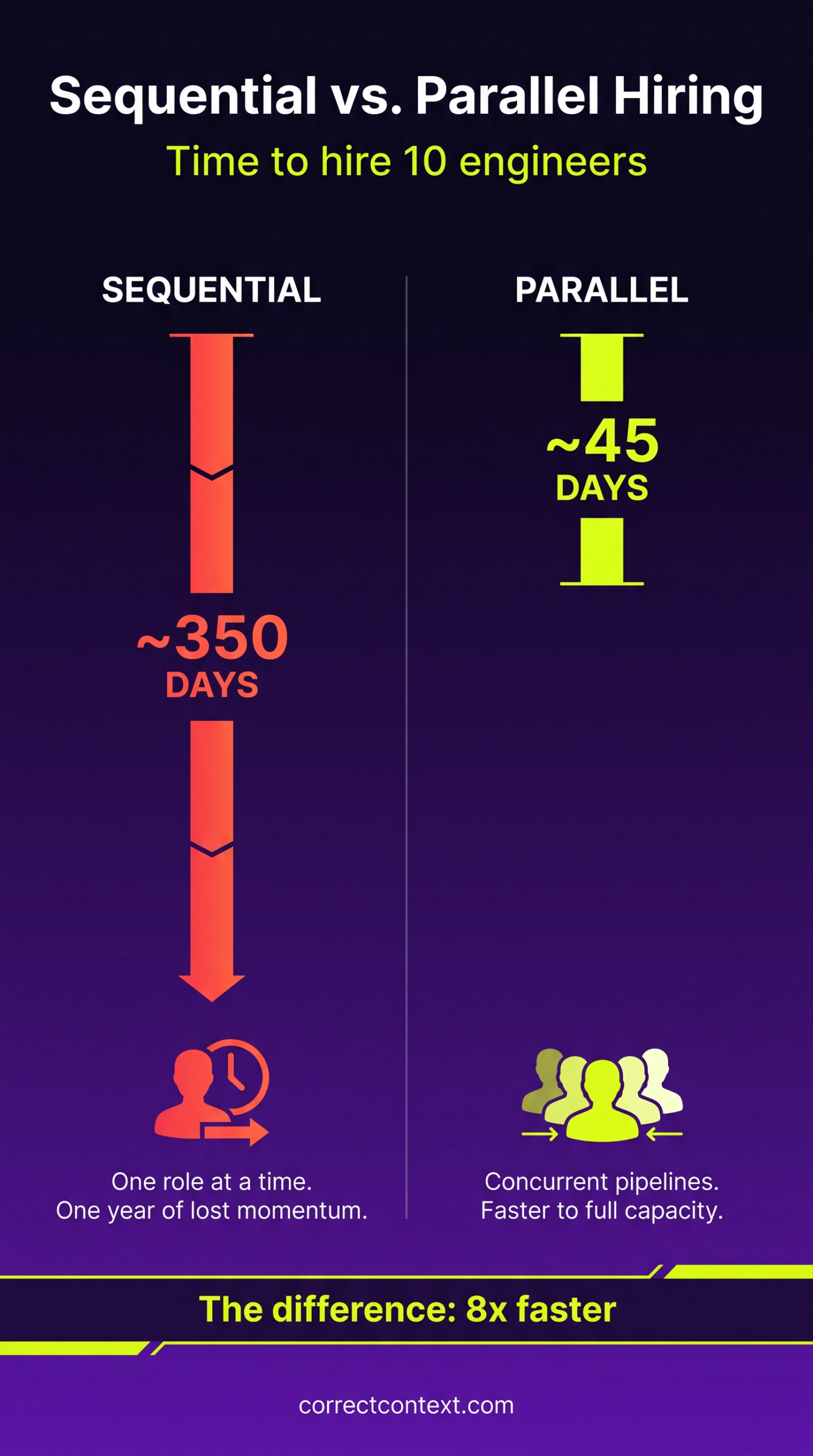
Before deciding how to structure your hiring, you must understand the cost of sequential hiring. The average time to hire a software engineer is approximately 35 days, with 50% of companies reporting processes exceeding 30 days [1]. If you need to hire ten engineers and approach it sequentially, you are looking at nearly a full calendar year before your last engineer starts writing code.
Every week a role stays open does not just cost you one week of lost output from that individual; it costs you the momentum of the entire team. Your existing engineers absorb the load, covering vacant seats, which leads to burnout and slower deployment cycles.
The True Cost of a Bad Hire
When rushing to hire developers Poland or build an engineering team Poland / CEE, the temptation to lower your hiring bar is immense. But the financial penalty for a bad hire is severe.
According to the U.S. Department of Labor, the cost of a bad hire is at least 30% of the employee’s first-year expected earnings [2]. However, the Society for Human Resource Management (SHRM) provides a more comprehensive framework that includes lost productivity, onboarding time, and management drain. They estimate that replacing a mid-level technical employee costs between 100% to 150% of their annual salary [2].
A single bad hire not only drains financial resources but also poisons the talent pool. B-level hires evaluate candidates against their own standards and refer other B-level talent, creating a cascading degradation of engineering quality.
Centralized vs. Decentralized Hiring: Which Model Wins?
When scaling multiple teams, a critical decision for any CTO or Head of Engineering is whether to centralize or decentralize the recruitment process.
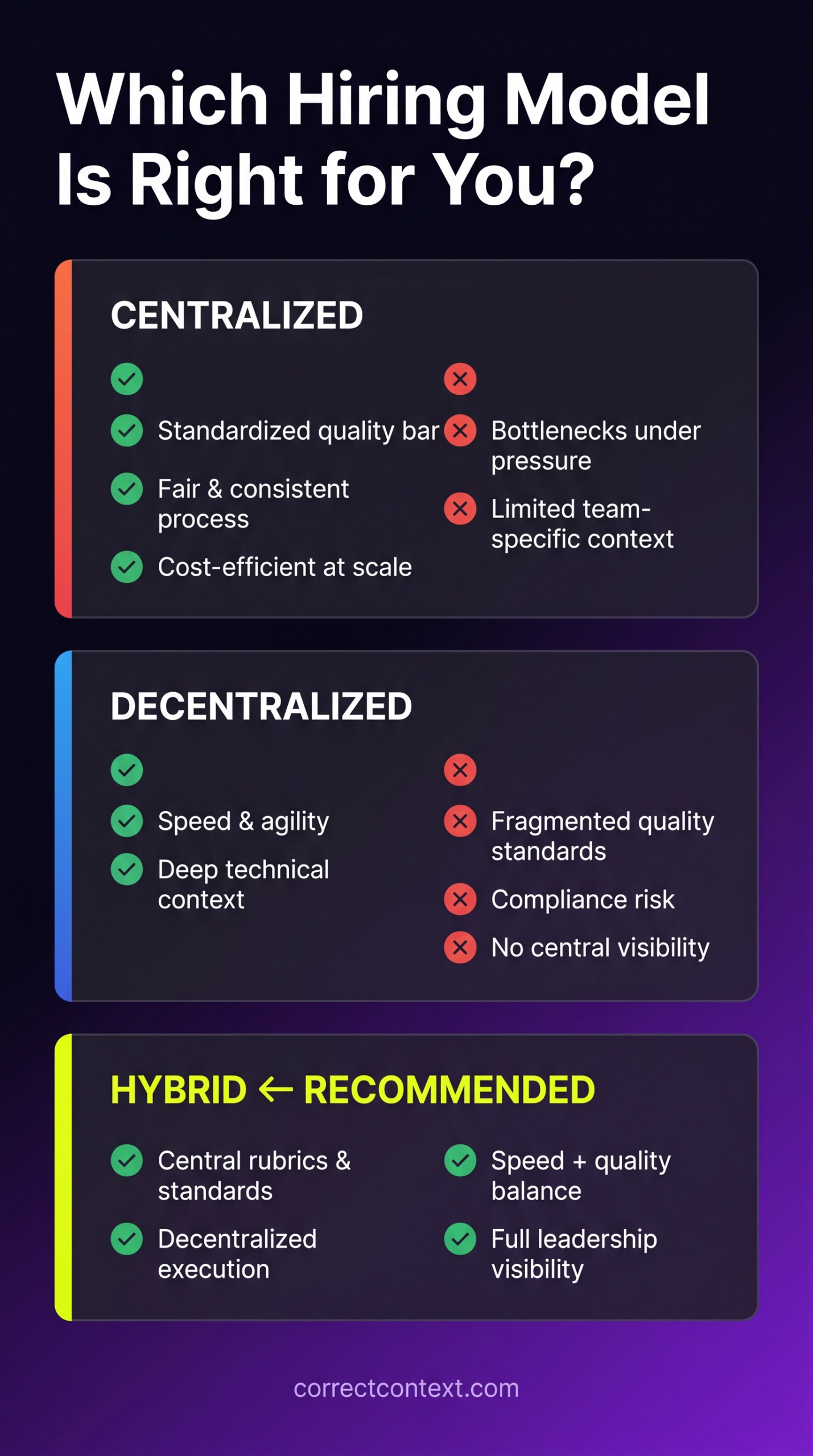
The Centralized Model
In a centralized recruitment model, a single unit—often corporate HR or a specialized talent acquisition team—handles all hiring decisions and responsibilities [3].
Advantages:
- Standardization: Ensures universal standards for recruitment, improving overall hiring quality and maintaining a consistent employer brand.
- Efficiency at Scale: Centralizing responsibilities allows specific employees to focus entirely on recruitment, freeing up engineering leads to focus on product development.
- Fairness: Standardized requirements mean every applicant follows the same process, reducing bias.
Disadvantages:
- Lack of Flexibility: A centralized team may have a limited understanding of the highly specific technical needs of a particular engineering pod.
- Bottlenecks: If the central team is overwhelmed, they become a single point of failure, slowing down the entire engineering hiring coordination process.
The Decentralized Model
Decentralized recruiting means each hiring manager or dedicated technical lead is solely responsible for recruitment decisions within their unit [3].
Advantages:
- Speed and Agility: Hiring managers can tailor policies to their specific needs and move quickly to secure top talent.
- Deep Context: Technical leads have firsthand knowledge of the working environment and the exact technical stack required (e.g., specific cloud engineering team requirements like AWS, Azure, or GCP).
Disadvantages:
- Fragmented Standards: Different teams may grade candidates on entirely different curves, leading to inconsistent engineering quality across the organization.
- Compliance Risks: Harder to ensure fair hiring practices and maintain comprehensive record-keeping.
The Hybrid Approach: Centralized Standards, Decentralized Execution
For organizations looking to build a dedicated development team or an extended engineering team, a hybrid approach often yields the best results. The central talent team establishes universal evaluation rubrics, technical assessment platforms, and compensation bands. However, the actual interviewing and final selection are decentralized to the specific engineering pods where the candidate will work.
This model allows you to maintain a high, standardized quality bar while giving technical leads the autonomy they need to build their teams.
A Framework for Parallel Hiring Execution
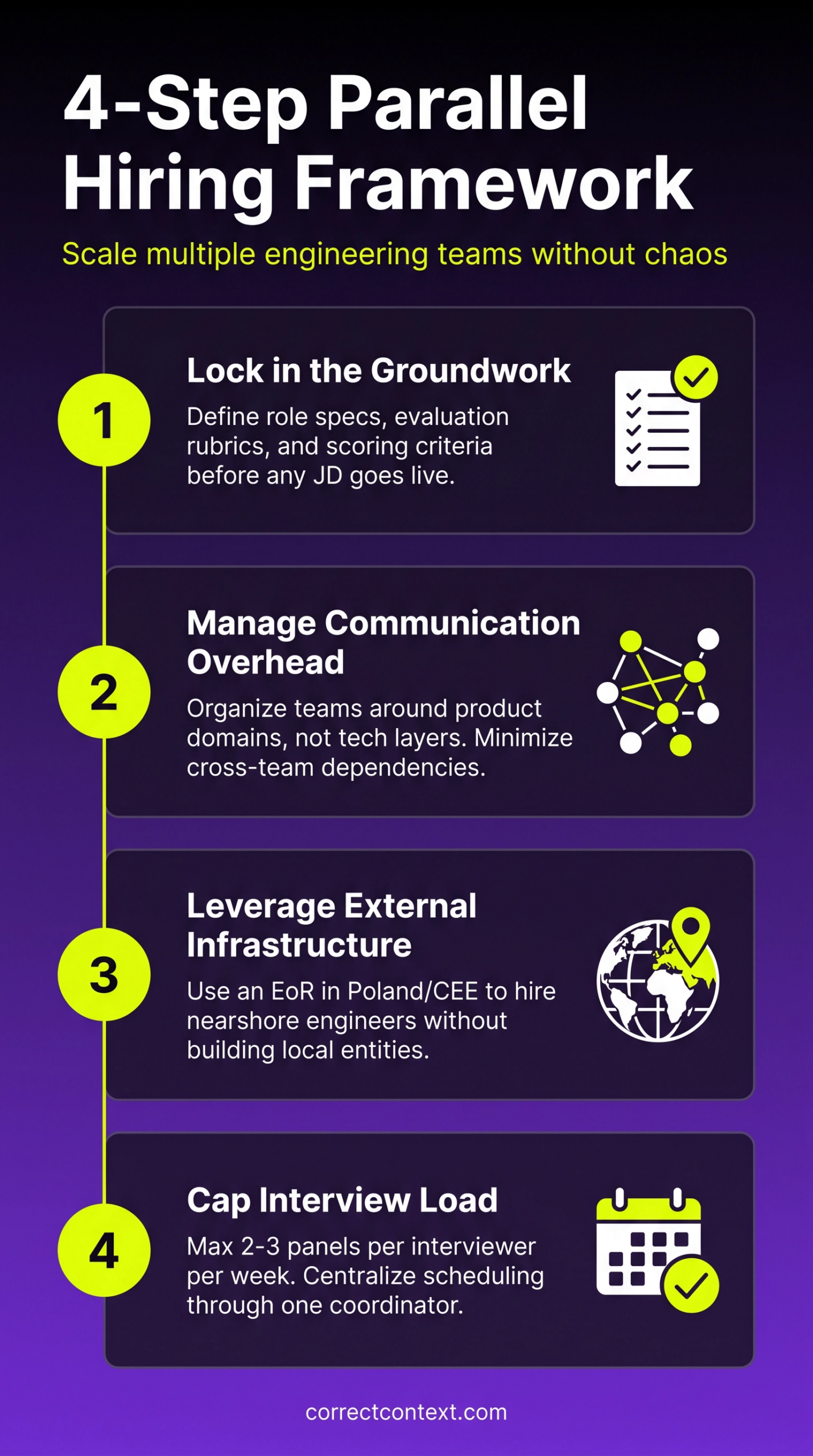
To successfully execute parallel hiring engineers without losing control, you must build the infrastructure before you start recruiting.
1. Lock in the Groundwork
Before a single job description goes live, define detailed role specs for each position. Establish consistent evaluation rubrics across all roles, covering technical assessments, system design prompts, and scoring criteria. If you skip this step, volume will erode your quality bar rapidly. Ten different interviewers grading on ten different curves is a recipe for disaster [1].
2. Manage Communication Overhead
As you scale, communication complexity increases exponentially. The formula $n(n-1)/2$ dictates the number of communication paths within a team [4].
When you hire rapidly, you must structure teams to minimize cross-team dependencies. Organize around product domains rather than technical layers (e.g., frontend vs. backend). A startup development team that owns a feature end-to-end can move fast without waiting on anyone else [4].
3. Leverage External Infrastructure
Building a massive internal recruiting apparatus for a temporary hiring surge creates fixed costs you will carry long after the surge passes. This is where partnering with specialized providers becomes a strategic advantage.
For companies looking to scale software development rapidly, leveraging an Employer of Record Poland or an EoR Europe allows you to hire a nearshore development team without the administrative burden of establishing a local legal entity.
At Correct Context, we specialize in the hiring of IT core teams offshored and nearshored to Poland and the CEE region. We handle recruitment, payroll, HR, accounting, and compliance, allowing you to focus entirely on engineering output. Whether you need an AI development team, data analytics team, or DevOps team for hire, leveraging existing infrastructure allows you to scale parallel hiring streams without adding cognitive load to your existing leadership.
4. Cap Interview Load
Running ten interview loops in the same week will crush your existing engineering team. Cap each interviewer at two to three panels per week, and stagger final rounds [1]. Centralize scheduling through one coordinator to keep everyone moving without duplicate asks.
Conclusion
Scaling engineering teams fast is not just an execution problem; it is an organizational design problem. Parallel hiring engineers is necessary when roadmaps are aggressive, but it requires rigorous preparation. By choosing a hybrid hiring model, defining clear rubrics upfront, and leveraging external infrastructure like offshore development teams via an EoR, CTOs can scale multiple teams simultaneously without sacrificing quality or losing control.
References
[1] Paraform. How to Hire 10+ Engineers at Once: Scaling a Multi-Role Technical Search (May 2026)
[2] INOP. Cost of a Bad Hire: 2026 Statistics with DOL and SHRM Source Citations
[3] Harver. Centralized vs. Decentralized Recruitment in Your HR Department
[4] Scaling Engineering Teams Without Losing Velocity — JustSteveKing