
Poland Startup Ecosystem 2026: The Complete Guide for Founders, Investors, and Tech Leaders
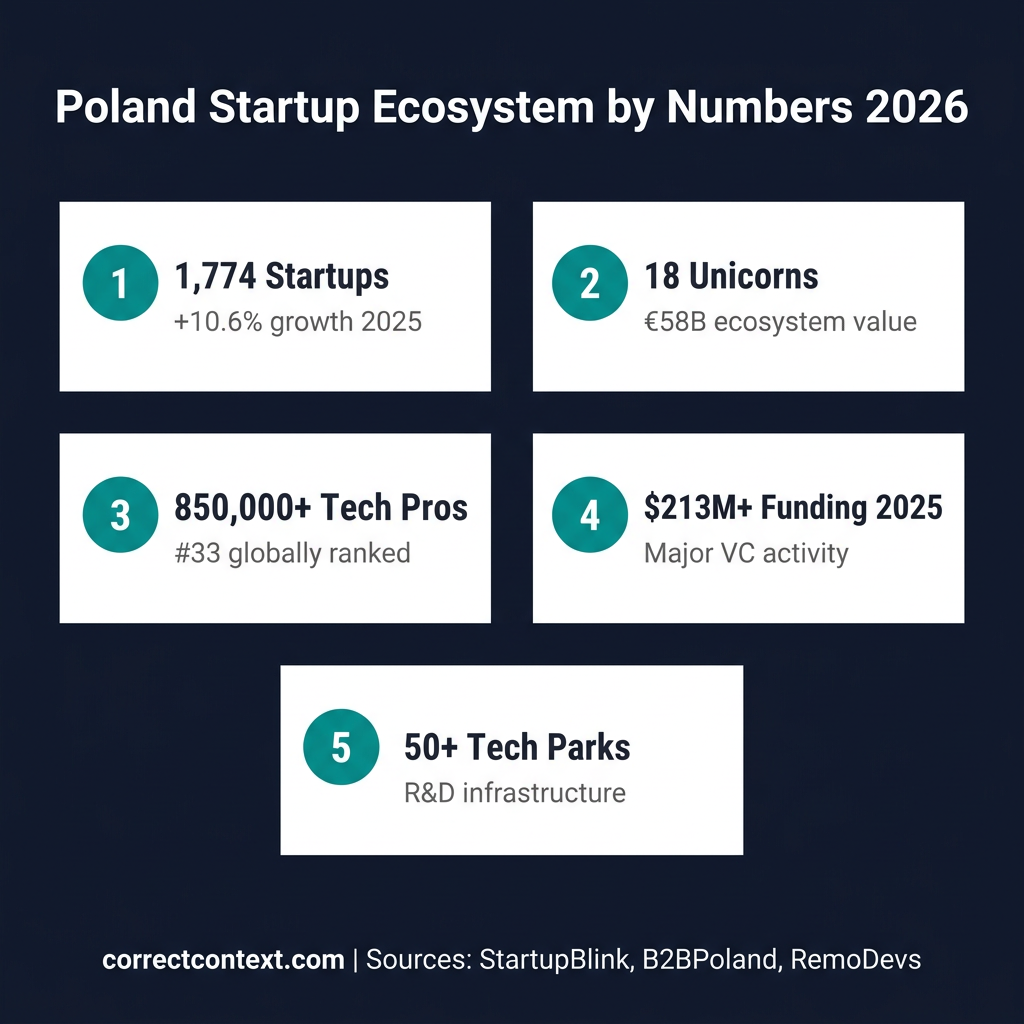
Poland has quietly built one of Europe’s most dynamic startup ecosystems. With 1,774 active startups, 18 unicorn companies, and a tech talent pool exceeding 850,000 professionals, the country now ranks #33 globally in the StartupBlink ecosystem index. Yet most international founders and investors still underestimate what Poland has become. This guide breaks down the data, the hubs, the funding landscape, and the hiring realities you need to understand before building or investing in Polish tech.
Why Poland’s Startup Ecosystem Matters in 2026
The narrative around European startups has long focused on London, Berlin, and Paris. But Poland has been building something different — and arguably more sustainable. While Western European hubs struggle with talent shortages and skyrocketing costs, Poland offers a rare combination: world-class engineering talent at 40–60% below Western European salary levels, a maturing venture capital ecosystem, and infrastructure that rivals any major European market.
According to StartupBlink’s 2025 data, Poland’s ecosystem grew by 10.6% year-over-year — a growth rate that outpaces many Western European markets. The total startup funding in 2025 exceeded $213 million, with particular strength in fintech, AI/ML, gaming, and enterprise software. B2BPoland’s research places the total ecosystem value at approximately €58 billion, driven by 18 unicorn companies that have emerged from the Polish market.
For founders considering where to launch, and for investors evaluating where to deploy capital, Poland represents what economists call an “arbitrage opportunity” — high-quality outputs at structurally lower costs. But that window is closing. As NTIATIVE’s 2026 Krakow Tech Market Report notes: “The ‘Krakow discount’ compared to Western Europe remains significant at roughly 20–30%, but the market is no longer ‘cheap.’ Success in 2026 requires a sharp Employer Value Proposition that highlights the technical challenge and stability, alongside a competitive salary.”
The transformation of Poland’s tech sector has been remarkable. Just a decade ago, Poland was primarily known as an outsourcing destination — a place where Western companies sent work to be done cheaply. Today, Poland produces globally competitive products, from AI-powered fintech platforms to enterprise software used by Fortune 500 companies. The country’s startups are no longer mere copycats of Western models; they’re developing genuine innovations and expanding internationally from day one.
The Three Tech Hubs: Warsaw, Krakow, and Wroclaw
Poland’s startup ecosystem isn’t concentrated in a single city. Instead, it spans three major hubs, each with distinct characteristics, advantages, and specializations. Understanding these differences is critical for founders deciding where to locate, and for hiring managers building distributed teams.
Warsaw: The Capital and Startup Headquarters
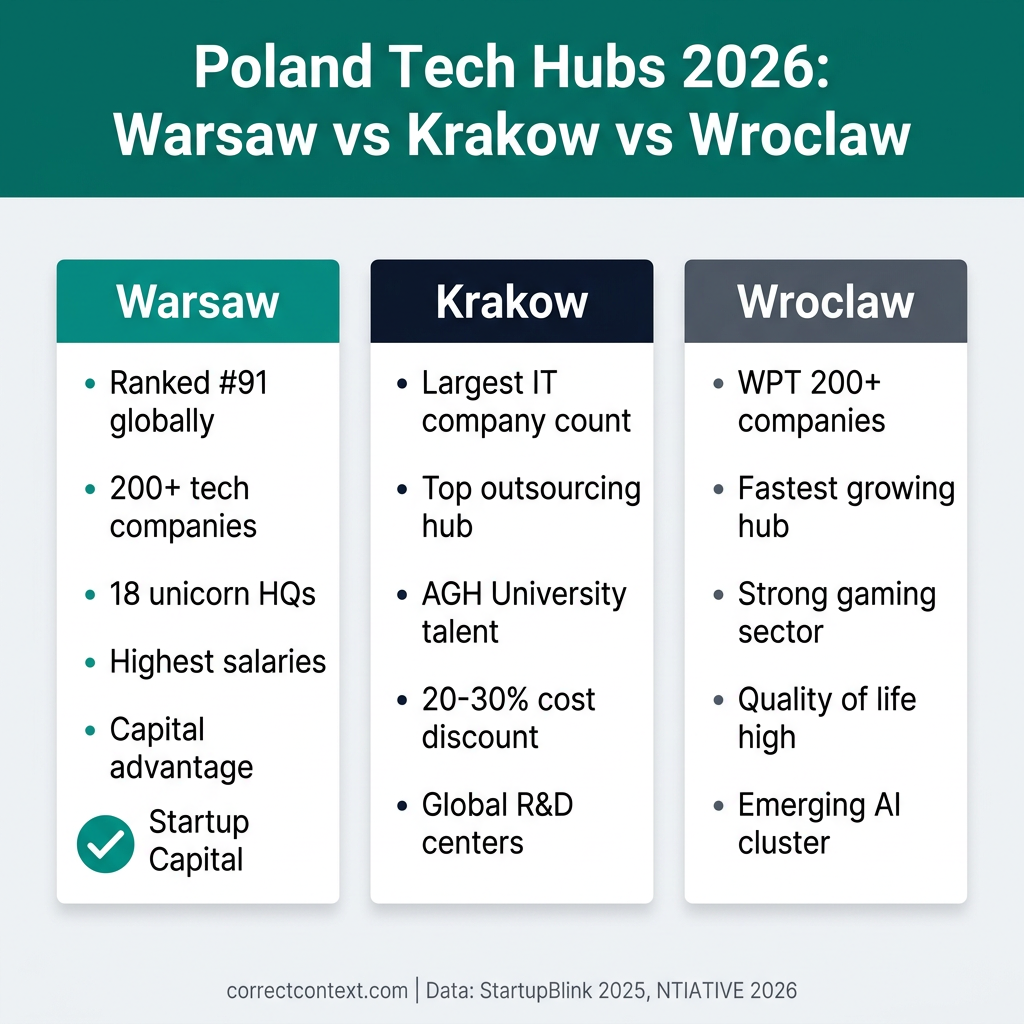
Warsaw ranks #91 globally as a startup hub and remains Poland’s undisputed center for venture capital, corporate innovation, and high-growth startups. The city hosts over 200 tech companies, including the headquarters of Poland’s unicorn companies and the Polish offices of global giants like Google, Microsoft, and Amazon.
For startups, Warsaw offers several strategic advantages:
- Access to capital: The majority of Poland’s active VCs, including Innovation Nest, Market One Capital, and bValue, maintain offices in Warsaw. Founders here have the shortest path to investor meetings.
- Highest salary benchmarks: Warsaw commands the top of the Polish salary range. Senior developers at Google Warsaw (L5 level) earn €90,000–€130,000+ in total compensation, setting the ceiling for the market.
- Corporate customers: As Poland’s business capital, Warsaw offers the densest concentration of potential B2B customers, particularly in fintech, enterprise software, and professional services.
- International connectivity: Warsaw’s airport offers direct flights to every major European hub, making it the natural choice for startups with international ambitions.
- Government support: Warsaw hosts the headquarters of Poland’s development agencies and innovation programs, including the National Centre for Research and Development (NCBR).
The trade-off is cost. Office space in central Warsaw runs 30–50% higher than in Krakow or Wroclaw. Talent competition is fiercest here, with retention challenges as engineers frequently receive multiple competing offers. The city’s traffic congestion and higher cost of living also factor into employee satisfaction.
Despite these challenges, Warsaw remains the default choice for startups seeking rapid scaling and international expansion. The concentration of resources — capital, talent, customers, and infrastructure — creates network effects that are difficult to replicate elsewhere in Poland.
Krakow: The Engineering and Outsourcing Powerhouse
Krakow has the largest number of IT companies in Poland, making it the country’s most competitive environment for tech talent. But that competition exists for a reason: Krakow produces exceptional engineers.
The city’s secret weapon is AGH University of Science and Technology, consistently ranked among Europe’s top technical universities. Combined with Jagiellonian University — one of Europe’s oldest and most prestigious institutions — Krakow produces a steady pipeline of highly educated technical talent. The city’s academic heritage creates a culture of intellectual rigor that permeates its tech sector.
Krakow’s tech scene has evolved through several distinct phases:
- Outsourcing era (2000s–2010s): Global companies established delivery centers in Krakow to access cost-effective engineering talent. IBM, Motorola, and SAP built significant operations here, creating the infrastructure for a tech economy.
- R&D transition (2010s–2020s): As talent quality became apparent, companies shifted from pure outsourcing to product development. Krakow became a center for genuine innovation, not just cost arbitrage. Google, Microsoft, and Amazon opened engineering offices here.
- Startup emergence (2020s–present): The latest phase sees Krakow-born startups achieving international scale, supported by local accelerators and an increasingly active angel investor community. Companies like Brainly and Estimote prove that Krakow can produce global products.
For startups, Krakow offers the 20–30% cost discount that NTIATIVE identified, combined with exceptional technical depth. The city’s engineers are often described as having a “product mindset” — a result of years working on real products rather than just maintenance and support. The challenge is retention — engineers here receive frequent recruitment outreach from both local and international employers.
Krakow’s quality of life is another draw. The city’s historic center, vibrant cultural scene, and proximity to mountain resorts make it attractive to young professionals. For startups competing for talent, this lifestyle advantage can offset salary differences with Warsaw.
Wroclaw: The Emerging Innovation Cluster
Wroclaw represents Poland’s fastest-growing tech hub. The Wroclaw Technology Park (WPT) hosts more than 200 technology companies, and the city has developed particular strength in gaming, AI for business applications, and enterprise software.
Wroclaw’s rise reflects a broader pattern in European tech: as established hubs become expensive and competitive, talent and companies migrate to emerging cities that offer better quality of life and lower costs. Wroclaw has positioned itself perfectly to capture this migration.
Wroclaw’s advantages include:
- Quality of life: Consistently ranked among Poland’s most livable cities, Wroclaw offers lower costs than Warsaw with comparable amenities. The city’s compact center, numerous islands and bridges, and relaxed atmosphere appeal to young professionals.
- Strong university pipeline: Wroclaw University of Science and Technology produces approximately 3,000 IT graduates annually. The city’s academic institutions have strong ties to local industry, creating smooth pathways from education to employment.
- Gaming sector density: Wroclaw hosts a cluster of successful game studios, including Techland (Dying Light), creating a talent pool with specialized skills in graphics, real-time systems, and interactive media. This gaming heritage feeds into broader tech capabilities in visualization and real-time computing.
- Less competition for talent: While this is changing rapidly, Wroclaw still offers easier hiring than Warsaw or Krakow for equivalent skill levels. Engineers here are less likely to be actively recruited by the global giants.
- Cost efficiency: Office space and salaries run 15–25% below Warsaw levels, stretching startup capital further.
For early-stage startups operating on limited capital, Wroclaw offers the best cost-efficiency ratio in Polish tech. As one founder quoted in Agiliway’s 2026 hub analysis noted: “We get 90% of the Warsaw talent quality at 70% of the cost.”
Wroclaw’s challenge is ecosystem maturity. The city has fewer VCs, less corporate innovation activity, and a smaller overall network than Warsaw or Krakow. Founders here may need to travel more for investor meetings and partnership development.
The Talent Landscape: 850,000+ Tech Professionals
Poland’s most significant competitive advantage is its talent pool. RemoDevs estimates there are over 850,000 tech professionals in Poland, making it one of Europe’s five largest technology talent markets. This isn’t just about quantity — Polish developers consistently rank among the world’s most skilled in international programming competitions and technical assessments.
Educational Foundation
Poland’s technical talent pipeline starts with its education system. The country produces approximately 80,000 IT graduates annually from its universities and technical schools. Key institutions include:
- Warsaw University of Technology: Poland’s largest technical university, with strong programs in computer science, electronics, and telecommunications.
- AGH University of Science and Technology (Krakow): Known for engineering excellence and strong industry partnerships.
- Wroclaw University of Science and Technology: A major producer of software engineers with particular strength in embedded systems and gaming.
- Gdansk University of Technology: The leading technical institution in northern Poland, with growing strength in AI and data science.
Beyond formal education, Poland has a strong culture of self-directed technical learning. Coding bootcamps, online courses, and community-led workshops supplement university education. Polish developers are overrepresented on platforms like GitHub and Stack Overflow relative to the country’s population.
Salary Benchmarks and Cost Structure
Understanding Polish developer compensation requires grasping the B2B contract structure that dominates the market. Unlike most European countries where traditional employment (UoP — Umowa o Pracę) is standard, Polish IT professionals increasingly prefer B2B contracts, which function as sole proprietorship arrangements.
| Experience Level | UoP Gross (PLN/month) | B2B Net Invoice (PLN/month) | USD Equivalent (B2B) |
|---|---|---|---|
| Junior (0–2 years) | 8,000–12,000 | 10,000–15,000 | $2,500–$3,800 |
| Mid-level (2–5 years) | 14,000–20,000 | 18,000–25,000 | $4,500–$6,300 |
| Senior (5+ years) | 20,000–30,000 | 25,000–40,000 | $6,300–$10,000 |
| Lead/Principal | 30,000–45,000 | 40,000–60,000+ | $10,000–$15,000+ |
The B2B structure offers significant advantages for both parties. For developers, the 12% lump-sum tax rate (ryczałt) available under Poland’s IP Box regime means net take-home can be 15–30% higher than equivalent gross salaries under UoP. For employers, B2B contracts eliminate ZUS (social security) contributions and simplify termination procedures.
For international companies, these numbers represent substantial savings. According to Alcor’s 2026 research, hiring senior developers in Poland costs approximately 52% less than equivalent roles in the United States. Even compared to Western Europe, Polish talent typically costs 40–55% less while delivering comparable technical output.
The European Context: Talent Scarcity and Poland’s Position
Poland’s talent advantage exists within a broader European context of acute tech talent shortage. ManpowerGroup’s 2026 Global Talent Shortage Survey found that 72% of employers globally report difficulty filling open roles, with AI/ML, cybersecurity, and cloud roles the hardest to fill.
Large European companies — those with 1,000+ employees — face the most severe challenges, with talent shortage rates exceeding 74%. This scarcity has driven a structural shift in hiring patterns, with companies increasingly looking to Central and Eastern Europe as a solution.
Poland benefits from this shift but also faces internal pressures. JustJoin.it recorded a 68% year-over-year increase in IT job postings in H1 2025, driven by the AI investment cycle. This demand surge is creating wage pressure, particularly for AI/ML engineers, cloud architects, and cybersecurity specialists.
The talent shortage is particularly acute in specialized roles. According to Euronews’ reporting on the 2026 Global Talent Shortage report, “AI and IT emerge as some of the hardest roles to fill for employers and recruiters.” Companies that can secure AI/ML talent in Poland have a significant competitive advantage — but they must move quickly and offer compelling packages.
Building Your First Team: Research-Backed Strategies
For founders launching startups in Poland, team-building represents both the highest-leverage activity and the most common failure point. Research from CB Insights, Stanford Graduate School of Business, and the University of Maryland provides clear guidance on what works.
The Wrong Team Kills Startups
CB Insights’ analysis of 431 failed VC-backed startups since 2023 found that 23% of failures were attributed to the wrong team — making it the third most common cause of failure after lack of market need (43%) and running out of capital (70%). The capital failures are themselves often downstream of team problems: poor execution burns cash faster, and weak teams struggle to raise follow-on funding.
The research reveals a critical pattern: team problems rarely manifest as obvious incompetence. More commonly, they appear as:
- Skill gaps: Teams lacking the technical or commercial capabilities required for their specific market
- Alignment failures: Co-founders with different visions for the company’s direction
- Cultural mismatches: Early hires who don’t share the company’s values or working style
- Relationship breakdowns: Personal conflicts that poison team dynamics
These problems are particularly dangerous in early-stage startups because there’s no organizational depth to absorb them. In a 10-person company, one wrong hire represents 10% of the team — and potentially 100% of a critical function.
The Hybrid Team Formation Strategy
Research from the University of Maryland’s Smith School of Business, published in the Academy of Management Journal, identified a specific team formation pattern that predicts startup success. The study analyzed hundreds of technology startups and found that teams formed through a “hybrid strategy” — combining interpersonal bonds with resource-seeking — dramatically outperformed alternatives.
Professor Rajshree Agarwal, one of the study’s authors, explains: “There are basically two ways co-founders find each other. The first is all about interpersonal bonds created through prior experiences — perhaps college friends, former colleagues, or family members. The second is by seeking out people who have the capabilities and competencies needed. A hybrid formation strategy works best.”
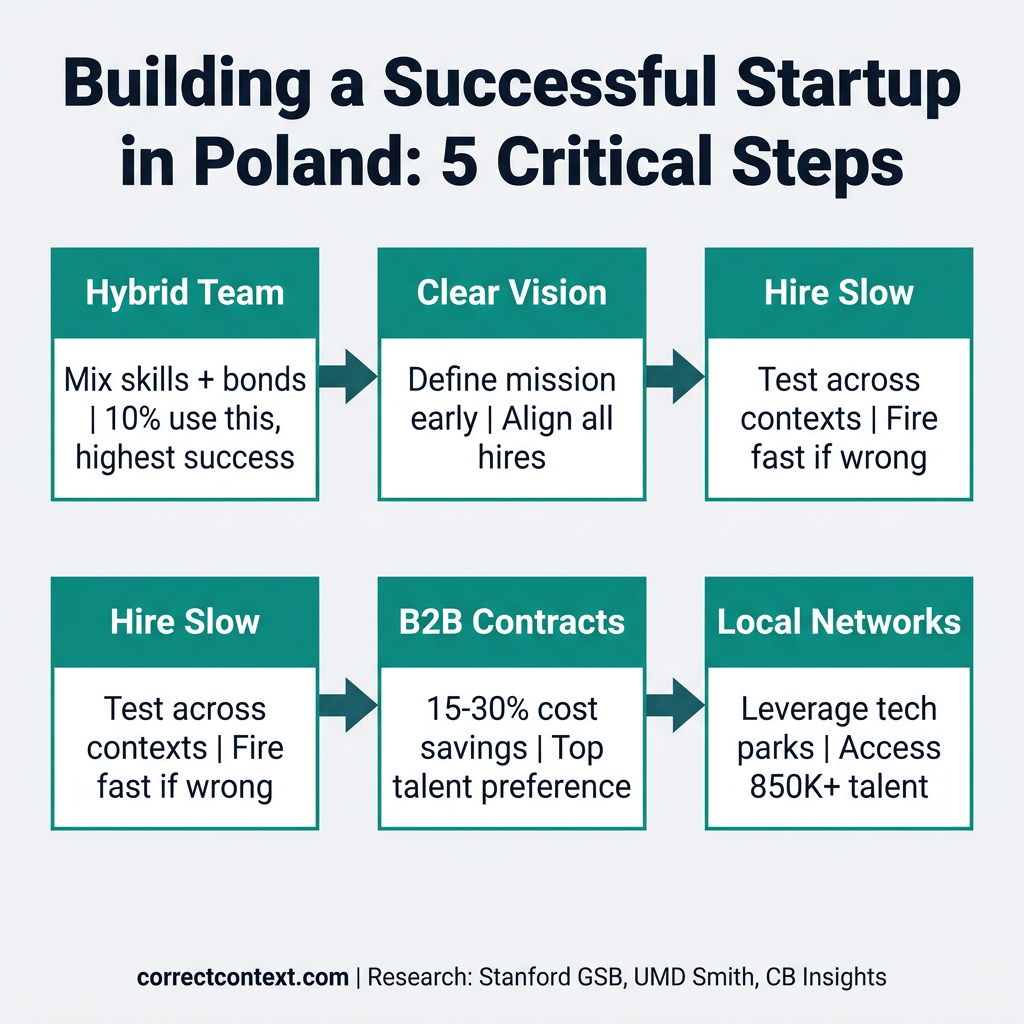
The data is striking: only about 10–15% of startup teams use the hybrid approach, but these teams show significantly higher performance in funding raised, productivity, and profitability. The mechanism is what researchers call “transactive memory systems” — the combined knowledge within the team of who knows what and how the team uses this shared knowledge to solve problems.
Professor Gilad Chen adds: “Founding teams have a lot of key decisions to make and they need to swiftly come to agreement on the best alternative among many options. Each member is important not because they are just dividing and conquering all of these tasks, but also because they’re brainstorming and problem-solving on what should be the right solution. For that, team members need complementary skills, but they also need to trust in each other.”
For Polish founders, this research has practical implications:
- Don’t hire only for skills: Technical capability matters, but trust and shared values matter equally
- Don’t hire only for relationships: Friends and family can create blind spots and make hard decisions impossible
- Test working relationships: Work on real projects together before formalizing co-founder relationships
- Seek complementary capabilities: The most effective teams combine different strengths, not clones of the founder
The “Hire Slow, Fire Fast” Principle
Stanford GSB Professor Lindred Greer, who has studied startup teams for over a decade, offers what she calls her favorite advice from VCs: “Hire slow, fire fast.”
The principle addresses a common failure pattern: founders, under pressure to build quickly, rush into hiring relationships without adequate vetting. Then, when problems emerge, they delay termination due to emotional attachment, legal concerns, or simple procrastination.
Greer’s research shows that in a startup — where a single person represents 15–20% of the team — the wrong hire can corrupt culture and derail progress within months. Yet many founders take six months or longer to remove problematic team members, during which damage compounds.
“One of the things that can really break an early-stage team is bringing in the wrong person and then not having any idea how to fire them,” Greer notes. “That can be a train wreck, especially if there’s equity involved.”
The “hire slow” component means:
- Extended evaluation periods: Give candidates real tasks similar to their intended role, with 2–4 week trial periods when possible
- Multi-context assessment: Spend time with candidates in different settings — one-on-one, in groups, in social situations
- Value alignment verification: Test whether candidates genuinely share the company’s mission, not just its compensation
- Reference depth: Talk to multiple people who’ve worked with the candidate, not just provided references
Greer describes one CEO’s technique: “He arranged his office so that when he’s at his desk, he looks out at his secretary. When people come in for an interview, his big thing is to watch how they interact with his secretary. If they’re kind and courteous or dismissive and abrupt, that’s a strong yes or no indicator.”
The “fire fast” component requires emotional discipline. Founders must recognize the sunk cost fallacy — the tendency to continue with something because of previously invested resources — and act decisively when team members aren’t working out. Greer recommends setting clear performance expectations and timelines, then following through if they’re not met.
Designing the Work Before Hiring the Role
Leadership expert Angela Hodgson, writing in Startups Magazine, identifies a more fundamental mistake: hiring before designing how the team actually works.
“The problem usually isn’t who founders hire,” Hodgson writes. “It’s that they hire before designing how the team actually works. Instead of designing the work, founders hire the role.”
This manifests in skipped job descriptions, unclear expectations, and frustration when hires “don’t deliver” — when expectations were never clearly defined. Hodgson observes that “job descriptions are skipped because they feel too corporate, too slow, or unnecessary when ‘everything’s changing anyway.’ That lack of upfront clarity tends to show up later; usually as frustration that a hire ‘isn’t delivering’, when expectations were never clearly defined in the first place.”
The solution is explicit design of:
- Decision rights: Who decides what, and how are decisions made?
- Communication patterns: How does information flow? What’s the meeting rhythm?
- Performance standards: What does good work look like? How is it measured?
- Role boundaries: Where does one role end and another begin?
Hodgson emphasizes that this design work isn’t bureaucratic overhead — it’s the foundation of team effectiveness. “High-performing startup teams don’t wait until things break to get clear. They are open and honest from the start about purpose, expectations, and contributions.”
Avoiding the “Hiring in Your Own Image” Trap
Another common pattern Hodgson identifies is founders hiring people who feel familiar — similar backgrounds, similar thinking styles, similar personalities. “On the surface, it feels efficient. Over time, it can create blind spots.”
When everyone thinks the same way, challenges don’t get challenged. Decisions aren’t tested. Diversity of perspective disappears. The business stagnates because everyone is solving problems from the same angle.
“High-performing teams are built on complementary skills, not clones,” Hodgson writes. “The most effective founders I work with take time to reflect on their own strengths, gaps and energy, then hire around that and not in their own image.”
This doesn’t mean hiring for “culture fit” in the superficial sense of personal compatibility. It means hiring for “culture add” — people who share the company’s core values but bring different perspectives, skills, and approaches.
The Funding Landscape: VCs, Angels, and Corporate Investors
Poland’s venture capital ecosystem has matured significantly. While still smaller than Western European markets, it now offers genuine funding pathways from seed through growth stages.
Active VC Funds in Poland
Several VC firms maintain active presences in Poland:
- Innovation Nest: Early-stage focus, strong track record in B2B SaaS. Portfolio includes Booksy and Infermedica.
- Market One Capital: Fintech and marketplace specialists with a pan-European perspective.
- bValue: Seed and Series A investments across sectors, with particular strength in e-commerce and consumer.
- Speedinvest: Vienna-based but active in Polish deals, particularly fintech and industrial tech.
- OTB Ventures: Deep tech and infrastructure focus, backing ambitious technical founders.
- Experior Venture Fund: Early-stage fund with a portfolio of Polish startups.
International funds increasingly participate in Polish rounds, particularly at Series A and beyond. The presence of global firms like Index Ventures, Accel, and Insight Partners in Polish deals has normalized over the past three years. This international participation brings not just capital but also networks, expertise, and validation.
Corporate Innovation and CVC
Poland’s large corporate sector — including banks, insurers, and retailers — has developed active corporate venture capital and innovation programs. These provide alternative funding pathways, particularly for B2B startups that can demonstrate customer traction.
Major corporate innovation programs include:
- PKO Bank Polski: Fintech-focused accelerator and CVC with significant deployment capacity.
- ING Poland: Innovation lab and startup partnership program with a focus on sustainable finance.
- mBank: Fintech accelerator with equity investments and partnership opportunities.
- Orange Polska: Telecom and digital services innovation, including 5G applications.
- PKN Orlen: Energy sector innovation, increasingly focused on renewables and cleantech.
For startups, corporate partnerships offer advantages beyond capital: immediate customer access, industry expertise, and credibility. The trade-off is potential conflicts of interest and slower decision-making.
Government Support Programs
The Polish government offers various support programs for startups, though navigating them requires patience:
- National Centre for Research and Development (NCBR): Grants and co-financing for R&D projects.
- Polish Development Fund (PFR): Equity and debt financing for growth-stage companies.
- PARP (Polish Agency for Enterprise Development): Support for international expansion and innovation.
These programs can provide non-dilutive capital but often involve complex application processes and reporting requirements. They’re most suitable for capital-intensive businesses or those with significant R&D components.
Key Takeaways
- Poland is a major European tech hub: With 1,774 startups, 18 unicorns, and 850,000+ tech professionals, Poland ranks #33 globally and offers genuine scale for founders and investors.
- Three distinct hubs offer different advantages: Warsaw for capital and corporate customers, Krakow for technical depth and R&D, Wroclaw for cost-efficiency and quality of life.
- Talent costs 40–60% below Western Europe: Senior developers in Poland earn $6,300–$10,000/month on B2B contracts — competitive locally but substantially below Western European equivalents.
- The B2B contract structure is dominant: Understanding Poland’s unique B2B (sole proprietorship) contract model is essential for hiring — it offers 15–30% cost savings and is preferred by most senior developers.
- Team formation strategy predicts success: Research shows hybrid teams — combining interpersonal bonds with complementary skills — dramatically outperform alternatives, yet only 10–15% of startups use this approach.
- Hire slow, fire fast: The most successful founders take extended time evaluating candidates across multiple contexts, then act decisively when team members aren’t working out.
- The wrong team kills startups: 23% of startup failures are attributed to team problems — making it the third most common cause of failure after market need and capital.
- Design work before hiring roles: Founders who define decision rights, communication patterns, and performance standards before hiring see better outcomes than those who hire for abstract “roles.”
- Avoid hiring in your own image: Teams built on complementary skills and diverse perspectives outperform teams of clones.
- The funding ecosystem is maturing: Active local VCs, increasing international participation, and corporate innovation programs provide multiple funding pathways.
Success Stories: Polish Startups That Went Global
Poland’s startup ecosystem has produced genuine global successes — companies that have scaled internationally, raised significant capital, and proven that Polish founders can compete on the world stage. Understanding these success stories provides lessons for new founders and validation for investors considering the market.
Brainly: The Education Unicorn
Brainly, founded in Krakow in 2009, has become the world’s largest student community and knowledge-sharing platform. With over 300 million users globally, Brainly raised $148 million in total funding and achieved unicorn status. The company’s success demonstrates several key lessons:
- Global ambition from day one: Brainly didn’t start as a Polish education platform — it launched with international expansion in mind, supporting multiple languages from the beginning.
- Technical excellence: The company’s engineering team in Krakow built infrastructure capable of serving hundreds of millions of users, proving Polish teams can handle massive scale.
- Retention of technical talent: Despite being headquartered in New York, Brainly maintained significant engineering operations in Krakow, showing that Polish talent can be retained even as companies internationalize.
Estimote: Pioneering the Beacon Economy
Estimote, founded in 2012, created the world’s first beacon platform for proximity-based computing. The company’s hardware and software products have been deployed by major retailers, airports, and venues worldwide. Estimote raised over $60 million from investors including Andreessen Horowitz and raised the profile of Polish hardware startups.
The Estimote story illustrates the potential for Polish startups in hardware and IoT — categories that require both strong engineering and manufacturing capabilities. The company’s success helped establish Poland as a viable location for hardware innovation, not just software.
Bolt (formerly Taxify): The Mobility Challenger
While founded by Estonian Markus Villig, Bolt has significant Polish operations and represents the type of regional success story that inspires Polish founders. Bolt’s rise to challenge Uber in European and emerging markets demonstrates that European startups can compete with well-funded American competitors.
For Polish founders, Bolt’s trajectory shows that:
- Regulatory arbitrage is possible: Bolt navigated complex European regulatory environments more effectively than Uber in many markets
- Capital efficiency matters: Bolt raised less capital than Uber but achieved significant market share through focused execution
- Regional focus can win: Rather than competing globally from day one, Bolt built strength in Europe and Africa before expanding
The Next Generation
Beyond the established unicorns, a new generation of Polish startups is emerging with global ambitions:
- Booksy: The beauty and wellness booking platform has expanded to multiple international markets and raised significant growth capital
- Infermedica: An AI-powered health diagnosis platform that has partnered with major healthcare providers globally
- Packhelp: Custom packaging platform serving e-commerce businesses across Europe
- Spacelift: Infrastructure-as-code platform for DevOps teams, competing in the global DevOps tooling market
These companies share common characteristics: technical excellence, global ambition from early stages, and strong founding teams that combine technical and commercial capabilities.
Challenges and Risks
While Poland’s startup ecosystem offers significant opportunities, founders and investors should understand the challenges and risks:
Talent Retention Pressure
The ISACA Tech Workplace and Culture survey of 7,726 technology professionals found that one-third of tech professionals changed jobs in the last two years, and 74% of organizations are concerned with attracting and retaining tech talent. The top reasons for leaving are desire for higher compensation (43% for those under 35), improved career prospects, and desire for more interesting work.
For startups, this means retention is as important as recruitment. Competitive compensation, clear growth paths, and interesting technical challenges are essential.
Regulatory Complexity
Poland’s regulatory environment, while improved, still presents challenges. The recent PIP (Polish Investment Program) reclassification risk has created uncertainty around B2B contracts. Labor law changes and evolving tax regulations require careful navigation.
Founders should invest in good legal counsel and stay current on regulatory developments. The cost of compliance is significantly lower than the cost of non-compliance.
Limited Late-Stage Capital
While early-stage funding is increasingly available, Poland still lacks the depth of late-stage capital found in London or Berlin. Startups seeking Series B and beyond often need to look to international investors, which requires building relationships and demonstrating traction.
This capital gap is gradually closing as international VCs become more active in Poland, but it remains a constraint for the highest-growth companies.
Founder Experience Gap
Poland’s startup ecosystem is relatively young, meaning there’s a limited pool of serial founders with experience scaling companies from zero to significant revenue. First-time founders often make avoidable mistakes around team building, fundraising, and go-to-market strategy.
The solution is active mentorship — successful founders sharing lessons learned — and increased participation by experienced operators in the ecosystem.
Frequently Asked Questions
Is Poland still cost-competitive for hiring in 2026?
Yes, but the gap is narrowing. Poland still offers 40–60% cost savings compared to Western Europe, but salaries have been rising 10–15% annually in high-demand roles. The “growth at all costs” era has ended, and the market now requires competitive compensation packages. Companies that succeed combine fair compensation with strong technical challenges and clear career growth paths.
Should I hire on B2B or UoP contracts?
For most tech roles, B2B is the market standard and preferred by senior developers. B2B contracts offer 15–30% higher net income for the same employer cost due to Poland’s favorable tax treatment of IP income. However, UoP (traditional employment) may be appropriate for junior hires who value stability, or for roles where long-term retention is critical. Many companies use a hybrid approach: B2B for most developers, UoP for key leadership roles.
Which Polish city is best for launching a startup?
It depends on your needs. Warsaw offers the best access to venture capital and corporate customers, making it ideal for B2B startups and companies seeking rapid growth. Krakow provides exceptional technical talent and established R&D infrastructure, suited for deep tech and product-focused companies. Wroclaw offers the best cost-efficiency ratio and is particularly strong for gaming and AI startups. Many successful companies maintain presence across multiple hubs.
How hard is it to hire developers in Poland?
Hiring difficulty varies significantly by role and location. AI/ML engineers, cloud architects, and cybersecurity specialists are in extremely high demand across all hubs. Senior full-stack developers receive multiple offers monthly. However, Poland’s large talent pool (850,000+ professionals) means that companies with strong employer brands, competitive compensation, and interesting technical challenges can hire successfully. The key is moving quickly — top candidates are typically on the market for less than two weeks.
What are the biggest mistakes foreign companies make when hiring in Poland?
Common mistakes include: (1) Underestimating salary expectations — Polish developers research international benchmarks and know their market value; (2) Ignoring the B2B preference — forcing UoP contracts eliminates most senior candidates; (3) Slow hiring processes — top candidates accept other offers while foreign companies navigate internal approvals; (4) Cultural assumptions — Polish engineers value direct communication, technical autonomy, and work-life balance; (5) Neglecting employer branding — in a competitive market, companies must actively sell their mission and culture.
How does the Polish startup ecosystem compare to other CEE countries?
Poland is the largest and most mature startup ecosystem in Central and Eastern Europe. It has more startups, more unicorns, and more venture capital activity than Czechia, Hungary, or Romania combined. The country’s larger population (38 million) and stronger economy create deeper talent pools and more substantial domestic markets. However, Estonia and Lithuania offer more startup-friendly regulatory environments and simpler corporate structures. Many companies choose to incorporate in Estonia while building teams in Poland.
Sources
- StartupBlink — Poland Startup Ecosystem Rankings (2025)
- B2BPoland — Polish Innovation Hubs & Technology Centers (2026)
- RemoDevs — Why Poland is a Hotspot for Tech Talent in 2026
- NTIATIVE — Krakow Tech Talent Market Realities (2026)
- CB Insights — Why Startups Fail: Top 9 Reasons (2026)
- University of Maryland Smith School — Here’s the Best Way To Build a Startup Team (2021)
- Stanford Graduate School of Business — How to Build a Better Startup Team (2016)
- Startups Magazine — The Mistake Most Founders Make When Building Their First Team (2026)
- Alcor — Polish Developers: Portrait, Salaries, and Insights for 2026
- Euronews — Talent Shortage: These Are the Hardest Roles to Fill in Europe (2026)
Table of content
- Why Poland’s Startup Ecosystem Matters in 2026
- The Three Tech Hubs: Warsaw, Krakow, and Wroclaw
- The Talent Landscape: 850,000+ Tech Professionals
- Building Your First Team: Research-Backed Strategies
- The Funding Landscape: VCs, Angels, and Corporate Investors
- Key Takeaways
- Success Stories: Polish Startups That Went Global
- Challenges and Risks
- Frequently Asked Questions
- Is Poland still cost-competitive for hiring in 2026?
- Should I hire on B2B or UoP contracts?
- Which Polish city is best for launching a startup?
- How hard is it to hire developers in Poland?
- What are the biggest mistakes foreign companies make when hiring in Poland?
- How does the Polish startup ecosystem compare to other CEE countries?
- Sources
Related articles



About the Author: Duke Vu