
AI in HR and Recruitment: The Complete 2025 Guide for Tech Companies
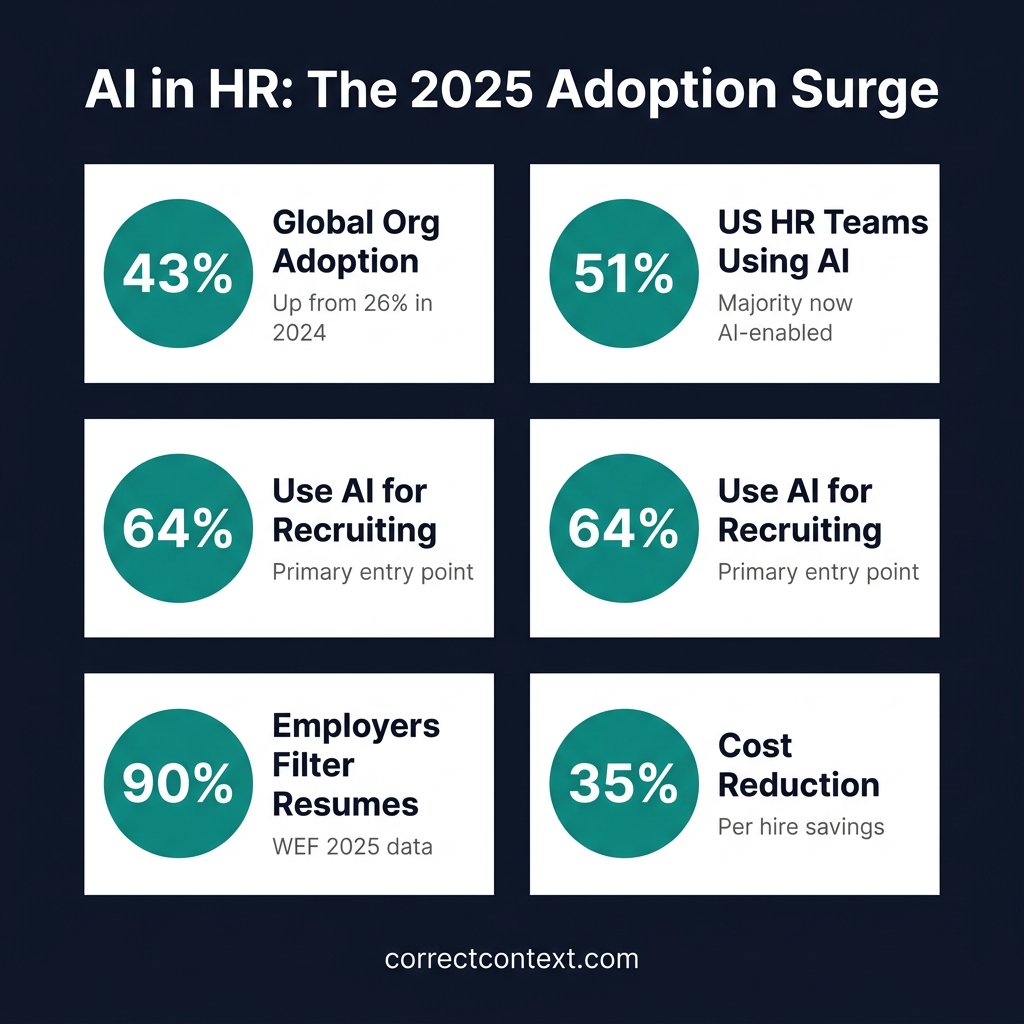
In 2025, artificial intelligence crossed a critical threshold in human resources: 43% of organizations worldwide now use AI for HR and recruiting tasks, up from just 26% in 2024. That is not incremental growth—that is a 65% year-over-year jump that signals a fundamental shift in how companies find, evaluate, and hire talent. For CTOs and VPs of Engineering building technical teams in Poland and across Europe, understanding this shift is no longer optional. It is a competitive necessity.
This guide examines the current state of AI in recruitment, the measurable ROI it delivers, the risks and ethical concerns that keep legal teams awake at night, and what it means for companies hiring IT talent in the Polish and CEE markets. We will look at real data from SHRM, LinkedIn, and the World Economic Forum. We will examine case studies from Unilever and L’Oréal. And we will separate the genuine productivity gains from the marketing hype.
The implications extend beyond HR departments. When 90% of employers use AI to filter résumés, the way engineers format their CVs, the keywords they include, and the platforms they use to apply all become strategic decisions. For hiring managers, understanding how AI screening works—and its limitations—is essential to ensuring top candidates are not filtered out before human review.
The State of AI Adoption in Recruitment: By the Numbers
The numbers tell a clear story. According to SHRM’s 2025 Talent Trends research, 51% of U.S. organizations now use AI to support HR-related activities. Of those organizations, 64% apply AI specifically to recruiting, interviewing, or hiring—making talent acquisition the primary entry point for AI adoption in HR, ahead of learning, performance management, or workforce planning.
This pattern holds globally. The World Economic Forum reports that roughly 90% of employers now use AI to filter or rank résumés. Whether you are applying to a Series A startup in Warsaw or a Fortune 500 company in London, your CV is almost certainly being processed by an algorithm before a human ever sees it.
The adoption curve is accelerating. HeroHunt.ai’s 2025 Year in Review notes that AI in recruiting went from “experimental to essential” in a single year. The 43% global adoption rate represents a tipping point: AI is now the default, not the exception, in talent acquisition.
This rapid adoption is driven by several converging factors. First, the volume of applications per job posting has increased dramatically. A single engineering role at a well-known tech company can receive 500-1000 applications. Manual screening is simply not scalable. Second, the war for technical talent has intensified. Companies that can identify and engage qualified candidates faster gain a decisive advantage. Third, the technology has matured. Early AI recruitment tools were rudimentary keyword matchers; modern systems use sophisticated natural language processing and machine learning to assess candidate fit.
Regional Variations: Where Poland and Europe Stand
Europe presents a more fragmented picture than the U.S. The UK leads European HR tech adoption with a market valued at $2.27 billion in 2025 and the highest AI recruitment tool adoption on the continent. Germany follows closely, driven by its large industrial base and persistent skilled labor shortages. Poland, while trailing the UK and Germany, is catching up rapidly.
Research published in the Biblioteka Nauki (Polish Scientific Library) in 2025 found that 51.5% of Polish companies reported not using AI at all in HR processes—suggesting significant headroom for growth. This lag creates both risk and opportunity: Polish companies that adopt AI recruitment tools now may gain a first-mover advantage in talent acquisition efficiency, while those that wait risk being outmaneuvered by faster-moving competitors.
For Western European and U.S. companies hiring in Poland, this dynamic matters. If your competitors are using AI to screen and engage candidates faster, their time-to-hire advantage compounds. A two-week head start on a senior Python developer in Wrocław or Kraków can mean the difference between securing top talent and settling for second choice.
The Polish IT talent market is particularly suited for AI recruitment tools. With over 546,000 IT professionals and thousands of computer science graduates entering the market annually, the volume of potential candidates is substantial. However, the distribution of talent across multiple cities—Warsaw, Kraków, Wrocław, Gdańsk, Poznań—creates coordination challenges that AI tools can help solve.
The Adoption Gap: Large Enterprises vs. Startups
AI recruitment adoption is not uniform across company sizes. Large enterprises with dedicated HR technology budgets and compliance teams have moved fastest. According to LinkedIn data, 76% of large enterprises (10,000+ employees) use some form of AI in recruitment, compared to just 31% of companies with fewer than 200 employees.
This gap creates a competitive dynamic. Startups and scale-ups that adopt AI recruitment tools can punch above their weight, competing for the same talent as larger companies with more established employer brands. The key is selecting tools appropriate for their scale and hiring volume.
What AI Actually Does in Recruitment: Five Core Use Cases
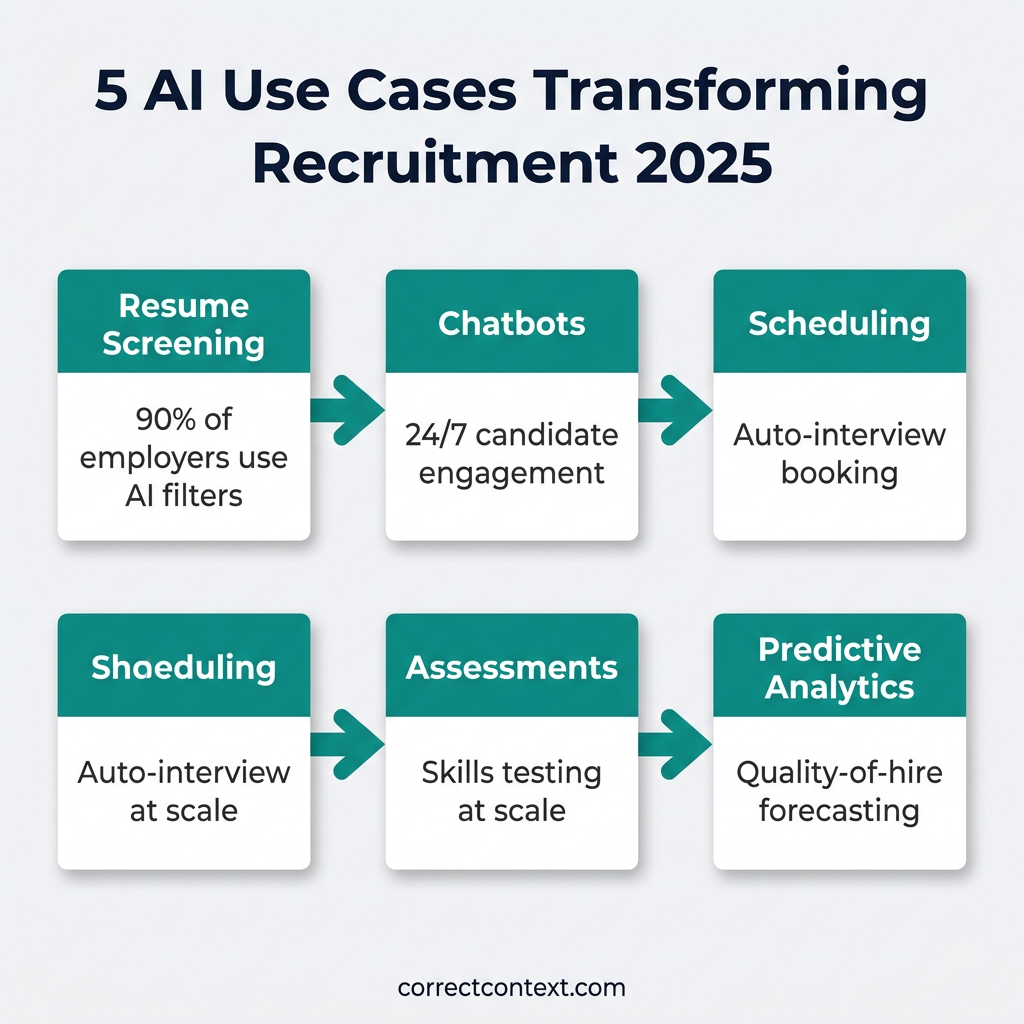
Understanding AI in recruitment requires moving beyond the buzzwords. Here are the five primary use cases where AI is delivering measurable value in 2025:
1. Resume Screening and Parsing
This is the most mature and widely deployed AI recruitment application. Machine learning algorithms analyze résumés and applications, extracting relevant skills, experience, and qualifications, then ranking candidates against job requirements.
The efficiency gains are substantial. Manual resume review typically takes recruiters 20-30 seconds per CV for initial screening. AI systems process the same volume in milliseconds. For high-volume roles—graduate programs, customer service positions, or junior developer openings—this automation eliminates a significant bottleneck.
Modern resume parsing goes beyond simple keyword matching. Natural language processing (NLP) algorithms understand context and synonyms. A system trained on engineering roles knows that “Python,” “Django,” and “Flask” are related, that “senior developer” and “staff engineer” may indicate similar experience levels, and that a candidate who “architected microservices” likely has different skills than one who “maintained legacy systems.”
However, the technology has a documented dark side. Amazon famously scrapped an AI recruiting tool in 2018 after discovering it systematically discriminated against women. The system was trained on a decade of hiring data that reflected the male-dominated tech industry, and it learned to penalize résumés containing the word “women’s” (as in “women’s chess club captain”). This case remains a cautionary tale cited in EEOC enforcement guidance.
The Amazon case illustrates a fundamental challenge: AI systems learn from historical data, and if that data reflects past biases, the AI will codify them. For companies implementing AI screening, this means auditing training data and regularly testing for disparate impact is not optional—it is essential.
2. AI-Powered Chatbots and Candidate Engagement
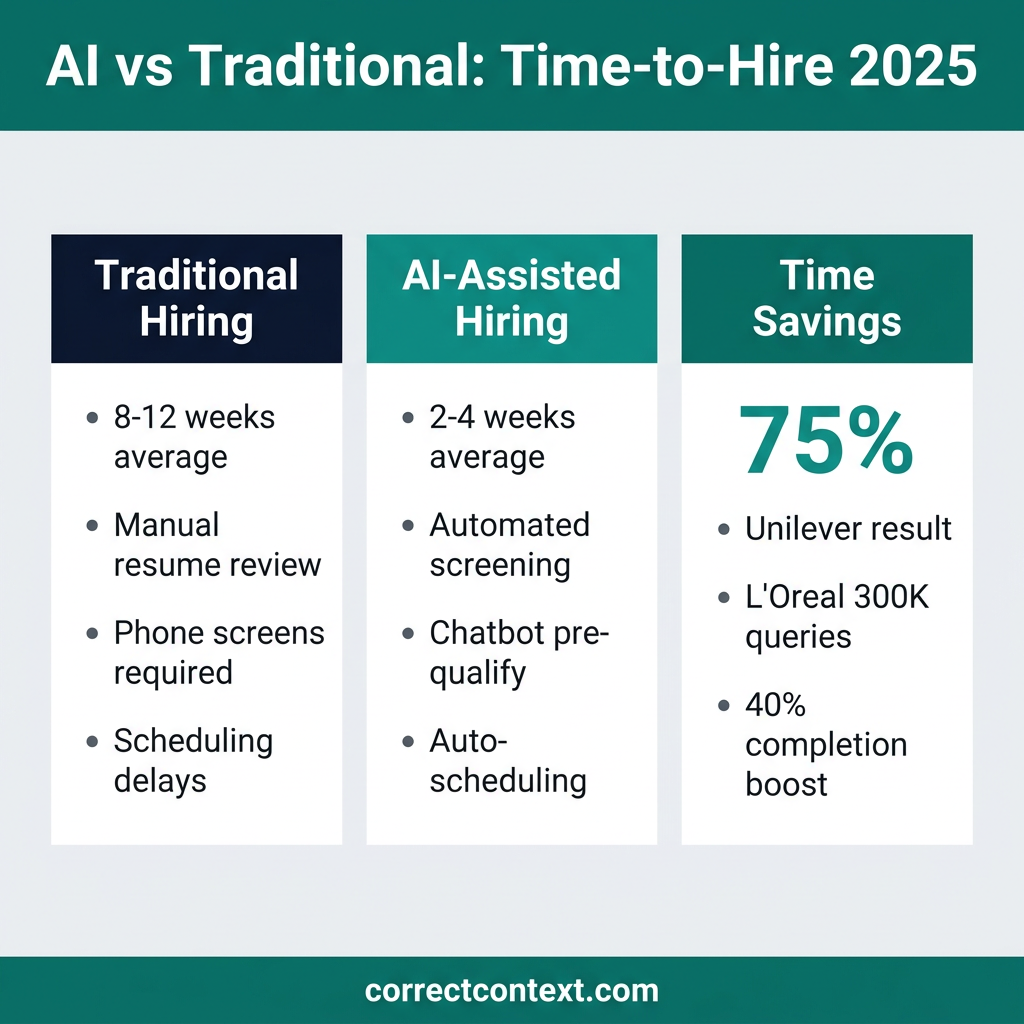
Recruitment chatbots handle candidate queries, pre-screen applicants, and schedule interviews 24/7. L’Oréal’s chatbot integration handles over 300,000 candidate queries annually and has boosted application completion rates by 40%. For candidates, this means instant responses instead of waiting days for recruiter follow-up. For employers, it means capturing interest while it is hot.
Modern chatbots go beyond scripted responses. Natural language processing allows them to understand context, answer complex questions about benefits or company culture, and escalate nuanced inquiries to human recruiters when appropriate. A candidate asking about remote work policies, visa sponsorship, or technical stack details can receive accurate, immediate answers.
The candidate experience impact is significant. Research from the Talent Board shows that candidate satisfaction drops by 50% when response time exceeds 48 hours. Chatbots eliminate this delay entirely, providing the immediate engagement that candidates expect in a consumer-grade experience.
For technical roles, chatbots can also conduct initial technical screening. A candidate might be asked to solve a simple coding problem or answer technical questions before being passed to a human recruiter. This filters out unqualified applicants early, saving engineering time for interviews that matter.
3. Interview Scheduling and Coordination
The administrative overhead of scheduling interviews—checking calendars, finding mutual availability, sending invites, handling reschedules—consumes an estimated 30% of recruiter time. AI scheduling tools integrate with calendar systems and email to automate this entirely.
The impact on candidate experience is significant. A candidate who can book an interview slot immediately after a positive phone screen is more likely to remain engaged than one who waits 48 hours for a coordinator to propose times. In a competitive market where top candidates have multiple offers, this speed matters.
Advanced scheduling AI can also optimize for interviewer load balancing, ensuring that no single hiring manager is overburdened while others remain underutilized. It can account for time zones—a critical feature for companies hiring across Europe and beyond. And it can handle the inevitable reschedules with minimal friction.
4. Skills Assessment and Testing
AI-driven assessment platforms evaluate technical skills, cognitive abilities, and even cultural fit through standardized tests. These tools can administer coding challenges, language proficiency exams, or situational judgment tests at scale, then score responses instantly.
For technical hiring, this is particularly valuable. A platform like HackerRank, Codility, or TestGorilla can evaluate hundreds of coding submissions simultaneously, ranking candidates by solution quality, efficiency, and style—tasks that would require an army of senior engineers if done manually.
The quality of AI assessment has improved dramatically. Early systems simply checked whether code produced the correct output. Modern systems analyze code structure, efficiency, adherence to best practices, and even potential security vulnerabilities. Some platforms use AI to generate adaptive tests that adjust difficulty based on candidate performance, providing a more accurate measure of ability.
However, critics note that standardized tests can miss important qualities: creativity, collaboration skills, and the ability to navigate ambiguous requirements. The best implementations use AI assessment as a filter, not a final verdict, ensuring that candidates who test well still proceed to human interviews.
5. Predictive Analytics and Quality-of-Hire Forecasting
The most sophisticated AI recruitment tools analyze historical hiring data to predict which candidates are likely to succeed, stay longer, or advance faster. By correlating pre-hire attributes (education, experience, assessment scores) with post-hire outcomes (performance reviews, tenure, promotion velocity), these systems identify patterns that human recruiters might miss.
For example, an analysis might reveal that candidates from certain universities perform well in the first year but have higher turnover, while candidates with non-traditional backgrounds (bootcamps, self-taught) have lower initial performance but higher long-term retention. These insights can inform hiring strategy.
This use case remains controversial. Critics argue that predictive models can perpetuate existing biases if trained on biased historical data. If a company’s engineering leadership has historically favored candidates from specific backgrounds, an AI trained on that data will codify those preferences, creating a self-reinforcing cycle.
Proponents counter that properly audited AI can reduce human bias by standardizing evaluation criteria. A human recruiter might unconsciously favor candidates who remind them of themselves; an AI applies the same criteria to everyone. The key is ensuring those criteria are fair.
The ROI Case: What AI Recruitment Actually Delivers
For CFOs and VPs of Engineering evaluating AI recruitment investments, the key question is simple: what is the return? Here is what the 2025 data shows.
Cost Per Hire Reduction
According to research from Rohan Manchanda analyzing 50 years of hiring economics, AI implementations are achieving 32-35% cost reductions from baseline trends. To understand the significance of this, consider the historical context: cost per hire in the U.S. surged from $1,823 in 2000 to $4,125 by 2019—a 4.4% compound annual growth rate driven by increased complexity, compliance requirements, and competition for talent. AI is reversing this decades-long trend.
TheHireHub.ai’s 2026 ROI calculator reports that AI recruitment delivers measurable ROI within 90 days, reducing cost-per-hire by 35% on average. For a company hiring 50 engineers annually at $4,000 cost-per-hire, that is a $70,000 annual savings—before accounting for the value of faster time-to-fill.
Cost reductions come from several sources. Reduced agency fees are significant: companies using AI sourcing tools report 40% lower reliance on external recruiters. Time savings translate directly to cost savings: recruiters handling twice the requisition load with AI assistance means lower per-hire labor costs. And better quality-of-hire means lower turnover costs, which can exceed 100% of annual salary for technical roles.
| Metric | Traditional Hiring | AI-Assisted Hiring | Improvement |
|---|---|---|---|
| Average Cost Per Hire (US) | $4,125 | $2,680 | -35% |
| Time-to-Hire (Engineering) | 8-12 weeks | 4-6 weeks | -50% |
| Resume Screening Time | 20-30 sec/CV | <1 sec/CV | -99% |
| Candidate Response Time | 24-48 hours | Instant | -100% |
| Agency Fee Reduction | 15-25% of salary | 5-10% of salary | -40% |
Time-to-Hire Compression
Time-to-hire is where AI delivers its most visible impact. Impress.ai reports that AI recruitment automation reduces time-to-hire by 75% in 2025. Unilever’s AI screening program achieved exactly this result, compressing their hiring cycle from months to weeks.
For engineering teams, this translates directly to product velocity. A vacant senior developer position costs not just the salary saved, but the features not shipped, the bugs not fixed, and the technical debt accumulated. Reducing time-to-hire from 10 weeks to 4 weeks means 6 additional weeks of productive engineering work—per hire.
The opportunity cost of slow hiring is particularly acute in competitive markets. A candidate who receives an offer in 2 weeks is more likely to accept than one who waits 8 weeks—during which time they may have interviewed elsewhere and received competing offers. Speed is a competitive weapon.
Productivity Gains for Recruiters
AI does not just reduce costs—it reallocates recruiter time from administrative tasks to high-value activities. When AI handles resume screening, scheduling, and initial candidate queries, human recruiters can focus on relationship building, offer negotiation, and strategic workforce planning.
OpenAI’s 2025 State of Enterprise AI report found that employees at companies with AI tools save an average of 40-60 minutes per day. For recruiters, that time adds up to 3-5 hours weekly—time that can be redirected to candidate engagement and hiring manager consultation.
This reallocation matters for job satisfaction. Recruiters often report that administrative tasks are the least satisfying part of their work. By automating these tasks, AI allows recruiters to focus on the human elements of hiring: understanding candidate motivations, selling the opportunity, and ensuring cultural fit.
Quality of Hire Improvements
Beyond speed and cost, AI promises better hiring decisions. By analyzing larger candidate pools and assessing skills more objectively, AI tools can identify qualified candidates who might be overlooked in manual processes.
The data here is more mixed. Some studies show AI-assisted hiring produces higher-performing employees; others suggest the correlation is weak. The key variable appears to be implementation: companies that use AI to expand their candidate pool and standardize assessments see quality improvements; companies that use AI simply to reduce recruiter headcount may not.
For technical roles, AI assessment tools can identify candidates with strong problem-solving skills regardless of educational background. This “skills-based hiring” approach can diversify the talent pipeline and surface candidates from non-traditional paths.
The Bias Problem: When AI Discriminates at Scale
For all its efficiency gains, AI in recruitment carries significant risks. The same automation that processes thousands of résumés in seconds can also perpetuate discrimination at scale.
The Amazon Case and Its Legacy
Amazon’s abandoned AI recruiting tool remains the most cited example of algorithmic bias in hiring. Trained on a decade of hiring data that reflected the male-dominated tech workforce, the system learned to downgrade résumés containing references to women’s colleges or women’s organizations. Amazon engineers attempted to neutralize the bias, but could not guarantee the system would not find other proxies for gender. The project was scrapped.
The lesson: AI systems trained on biased historical data will reproduce and often amplify those biases. If your engineering team has historically favored candidates from specific universities or with specific demographic profiles, an AI trained on that data will codify those preferences.
The Amazon case is not unique. Multiple studies have found that AI recruitment tools can discriminate based on race, age, disability, and other protected characteristics—sometimes in subtle ways that are difficult to detect.
The Workday Lawsuit
In 2024, Derek Mobley filed an employment discrimination lawsuit against Workday, alleging that their algorithm-based job applicant screening system discriminated against applicants based on race, age, and disability. The case highlights a critical legal question: when an AI system makes a discriminatory hiring decision, who is liable? The vendor who built the system, or the employer who deployed it?
Legal experts are sounding alarms. As University of Washington researcher Kyra Wilson told Fortune: “You kind of just get this positive feedback loop of, we’re training biased models on more and more biased data.” The result can be “oddball results” that perpetuate decades-long patterns of discrimination.
The Workday case is particularly significant because Workday is a major HR technology vendor used by thousands of companies. If the allegations are proven, the liability implications could be substantial—not just for Workday, but for every company using their screening tools.
How Bias Creeps Into AI Systems
Understanding how bias enters AI systems is essential for mitigation. There are several pathways:
Training data bias: If historical hiring data reflects past discrimination, the AI learns those patterns. A company that historically hired predominantly from certain universities will train an AI that favors those universities.
Proxy variables: Even when protected characteristics (race, gender, age) are removed from training data, AI systems can find proxies. Zip codes may correlate with race; graduation years may indicate age; certain extracurricular activities may signal gender.
Feedback loops: AI systems that learn from hiring decisions can create self-reinforcing cycles. If an AI recommends candidates and hiring managers consistently select from those recommendations, the AI learns that its recommendations are “correct”—even if the hiring managers have biases.
Evaluation criteria bias: The criteria used to evaluate candidates may themselves be biased. If “culture fit” is defined as similarity to existing employees, the AI will favor candidates who match the current demographic profile.
Regulatory Response: NYC Local Law 144
New York City has taken the lead in regulating AI hiring tools. NYC Local Law 144, effective since 2023, requires bias audits for AI hiring tools and mandates that employers disclose to candidates when AI is used in hiring decisions. Similar legislation is being considered in other jurisdictions.
The law requires annual independent bias audits conducted by third parties, with results published publicly. Employers must also notify candidates that AI is being used and provide information about the characteristics being evaluated.
For companies hiring in Europe, the EU AI Act adds another layer of compliance. The Act classifies AI systems used for recruitment as “high-risk,” requiring conformity assessments, risk management systems, and human oversight. Penalties for non-compliance can reach 6% of global annual revenue.
Mitigation Strategies
Organizations can take concrete steps to reduce AI bias risk:
- Audit training data: Review the historical data used to train AI systems for demographic imbalances. If the data is biased, the AI will be biased.
- Demand vendor transparency: Insist that AI vendors disclose how their models were trained and what bias testing has been conducted. Reputable vendors should provide bias audit reports.
- Conduct disparate impact analysis: Regularly analyze whether AI screening produces different outcomes for protected classes. This is both a legal requirement in many jurisdictions and a best practice.
- Maintain human oversight: Ensure AI recommendations are reviewed by human recruiters before final decisions. The EU AI Act mandates this for high-risk AI systems.
- Document everything: Maintain records of AI system performance and bias testing for legal defense. In the event of a discrimination claim, documentation of good-faith efforts to prevent bias may be critical.
- Test for proxy discrimination: Even if protected characteristics are excluded from training data, test whether the AI produces disparate outcomes that correlate with protected classes.
AI in Recruitment: A Framework for Decision-Makers
For CTOs, VPs of Engineering, and HR leaders evaluating AI recruitment tools, the decision framework should balance efficiency gains against risk exposure. Here is a practical approach:
When AI Makes Sense
- High-volume roles: Graduate programs, junior positions, or any role receiving 100+ applications per opening. The efficiency gains scale with volume.
- Standardized skill requirements: Positions where technical skills can be objectively tested (coding, language proficiency, certifications). AI excels at objective assessment.
- Time-sensitive hiring: When time-to-hire directly impacts product delivery or revenue. AI’s speed advantage is most valuable when hiring delays have business consequences.
- Geographic expansion: When entering new markets where local recruitment expertise is limited. AI tools can help navigate unfamiliar talent markets.
- Seasonal or project-based hiring: When hiring volumes spike unpredictably. AI scales more easily than human recruiter headcount.
When to Proceed with Caution
- Senior or specialized roles: Executive positions or niche technical roles where cultural fit and strategic judgment matter more than check-box qualifications. AI may miss the nuanced factors that determine success in these roles.
- Small candidate pools: When the total addressable candidate market is small, aggressive AI filtering may exclude viable candidates. For roles with fewer than 50 potential candidates globally, manual review may be more appropriate.
- High-compliance environments: Industries or jurisdictions with strict anti-discrimination enforcement. The legal risk of AI bias may outweigh efficiency gains in these contexts.
- Roles requiring creativity or innovation: AI assessment tools often favor conventional qualifications over unconventional backgrounds. For roles where creativity is essential, this may be a limitation.
| Factor | Favors AI Adoption | Suggests Caution |
|---|---|---|
| Application Volume | 100+ per role | <20 per role |
| Role Seniority | Junior to Mid-level | Senior/Executive |
| Skill Assessment | Standardized/objective | Subjective/judgment-based |
| Time Pressure | Critical path hiring | Flexible timeline |
| Compliance Risk | Low-risk jurisdiction | High-regulation (EU, NYC) |
| Internal Expertise | AI-literate HR team | Limited technical HR capacity |
| Candidate Pool Size | Large (500+) | Small (<50) |
| Role Criticality | High-volume, replaceable | Business-critical, unique |
Vendor Evaluation Criteria
When selecting AI recruitment vendors, consider these factors:
Bias testing and auditing: Does the vendor provide evidence of bias testing? Have they conducted disparate impact analysis? Do they offer regular audit reports?
Transparency: Can the vendor explain how their algorithms work? Black-box systems are harder to defend in discrimination claims.
Compliance certifications: Does the vendor comply with relevant regulations (GDPR, EU AI Act, NYC Local Law 144)? Do they provide documentation to support your compliance efforts?
Integration capabilities: Does the system integrate with your existing ATS, HRIS, and calendar systems? Poor integration reduces adoption and effectiveness.
Customization options: Can you adjust the algorithms to reflect your specific hiring criteria? One-size-fits-all systems may not align with your needs.
Support and training: Does the vendor provide adequate training for your HR team? AI tools are only effective if used correctly.
The Future of AI in Recruitment: 2026 and Beyond
Looking ahead, several trends will shape AI’s evolution in recruitment:
AI “Recruiter” Agents
The next frontier is autonomous AI agents that manage end-to-end recruitment workflows. These systems will not just screen résumés but proactively source candidates, conduct initial interviews, negotiate offers, and manage onboarding—escalating to humans only for complex decisions.
Early versions of these agents are already emerging. Some platforms offer AI interviewers that conduct structured video interviews, analyzing not just responses but tone, body language, and communication style. While controversial—critics question whether AI can fairly assess interpersonal skills—the technology is advancing rapidly.
Generative AI for Job Descriptions and Outreach
Large language models are already being used to write job descriptions, personalize candidate outreach, and generate interview questions. As these tools improve, they will enable hyper-personalized candidate engagement at scale.
The risk is homogenization: if every company uses AI to write job postings, they may all sound the same. The opportunity is optimization: AI can A/B test job description language to identify what attracts the best candidates.
Integration with Workforce Planning
AI recruitment tools will increasingly connect with broader workforce planning systems, predicting future hiring needs based on project pipelines, attrition models, and business growth forecasts. This integration will enable more strategic talent acquisition.
For example, an AI system might analyze product roadmaps and predict that the company will need 15 additional backend engineers in Q3, then automatically initiate sourcing and screening to ensure candidates are ready when needed.
Regulatory Maturation
As AI recruitment becomes ubiquitous, expect more jurisdictions to follow NYC’s lead with bias audit requirements and transparency mandates. The EU AI Act establishes a template that other regions may adopt. Compliance will become a core competency for HR tech vendors and their customers.
We may also see the emergence of industry standards for AI bias testing, similar to security certifications for software. Vendors that can demonstrate compliance with these standards will have a competitive advantage.
The Human Role Redefined
As AI handles more recruitment tasks, the human recruiter’s role will evolve. Rather than screening résumés and scheduling interviews, recruiters will focus on candidate experience design, hiring manager consultation, offer negotiation, and strategic workforce planning.
The recruiters who thrive will be those who can leverage AI tools effectively while providing the human judgment that AI cannot replicate. Technical literacy will become as important as interpersonal skills.
Key Takeaways
- AI adoption in recruitment has reached a tipping point: 43% of organizations worldwide now use AI for HR and recruiting, up from 26% in 2024. The technology has moved from experimental to essential.
- The ROI is measurable and significant: AI implementations deliver 32-35% cost-per-hire reductions and 50-75% time-to-hire improvements. For high-volume hiring, the business case is compelling.
- Resume screening is the dominant use case: 90% of employers now use AI to filter or rank résumés. Understanding how these systems work is essential for both employers and candidates.
- Bias risk is real and legally significant: The Amazon and Workday cases demonstrate that AI can perpetuate discrimination at scale, with serious legal consequences. Bias audits and human oversight are essential.
- Regulation is tightening: NYC Local Law 144 and the EU AI Act establish compliance requirements that will spread to other jurisdictions. Proactive compliance is cheaper than reactive remediation.
- Human oversight remains essential: The most effective implementations use AI to augment, not replace, human judgment. The goal is better decisions, not just faster decisions.
- Poland and CEE present a mixed picture: With 51.5% of Polish companies not yet using AI in HR, early adopters may gain competitive advantage. However, the EU AI Act’s requirements apply fully in Poland.
- Not all roles are suitable for AI screening: Senior, specialized, or creative roles may require human judgment that AI cannot replicate. Match the tool to the use case.
- Vendor selection matters: Choose vendors with demonstrated bias testing, transparency, and compliance certifications. The cheapest option may be the most expensive in the long run.
- The technology is evolving rapidly: Today’s capabilities will seem primitive by 2027. Stay informed about emerging trends and be prepared to adapt.
Frequently Asked Questions
What percentage of companies use AI in recruitment?
According to 2025 data from SHRM and HeroHunt.ai, 43% of organizations worldwide use AI for HR and recruiting tasks, up from 26% in 2024. In the U.S., 51% of organizations use AI for HR-related activities, with 64% of those applying AI specifically to recruiting and hiring. The World Economic Forum reports that 90% of employers now use AI to filter or rank résumés.
Does AI recruitment reduce cost-per-hire?
Yes. Research from 2025 shows AI implementations achieve 32-35% cost reductions from baseline trends. For a typical U.S. company, this means reducing cost-per-hire from approximately $4,125 to around $2,680. TheHireHub.ai reports that AI recruitment delivers measurable ROI within 90 days. Cost reductions come from reduced agency fees, lower recruiter time per hire, and decreased turnover due to better quality-of-hire.
Can AI recruitment tools be biased?
Yes. AI systems trained on biased historical data can perpetuate and amplify discrimination. Amazon famously scrapped an AI recruiting tool that discriminated against women after discovering it penalized résumés containing references to women’s organizations. The Workday lawsuit alleges algorithmic discrimination based on race, age, and disability. Regular bias audits, disparate impact analysis, and human oversight are essential to mitigate these risks.
What is the EU AI Act’s impact on recruitment AI?
The EU AI Act classifies AI systems used for recruitment as “high-risk,” requiring conformity assessments, risk management systems, human oversight, and documentation. Companies hiring in the EU must ensure their AI recruitment tools comply with these requirements. Penalties for non-compliance can reach 6% of global annual revenue. The Act applies fully in Poland and all EU member states.
How much time does AI save in recruitment?
AI recruitment automation reduces time-to-hire by 50-75% according to multiple 2025 studies. Unilever achieved a 75% reduction using AI screening. Resume screening time drops from 20-30 seconds per CV to under one second. Recruiters save an estimated 40-60 minutes per day on administrative tasks, allowing them to focus on higher-value activities like candidate relationship building and strategic workforce planning.
Should small companies use AI recruitment tools?
For small companies with low application volumes (<20 per role), the efficiency gains may not justify the cost and compliance complexity. AI recruitment delivers the highest ROI for high-volume hiring or specialized technical roles where screening efficiency matters most. Small companies should evaluate whether their hiring volume justifies the investment and whether they have the internal expertise to implement AI tools effectively.
What are the main use cases for AI in recruitment?
The five primary use cases are: (1) Resume screening and parsing—analyzing and ranking résumés at scale; (2) AI-powered chatbots—handling candidate queries and pre-screening 24/7; (3) Interview scheduling—automating calendar coordination and rescheduling; (4) Skills assessment—conducting standardized technical and cognitive tests; and (5) Predictive analytics—forecasting quality-of-hire based on historical data.
How can companies prevent AI bias in hiring?
Key mitigation strategies include: auditing training data for demographic imbalances; demanding vendor transparency about model training and bias testing; conducting regular disparate impact analysis; maintaining human oversight of AI recommendations; documenting all bias testing and compliance efforts; and testing for proxy discrimination even when protected characteristics are excluded from training data.
What is NYC Local Law 144?
NYC Local Law 144, effective since 2023, requires bias audits for AI hiring tools used by employers in New York City. Employers must conduct annual independent bias audits, publish results, and notify candidates when AI is used in hiring decisions. The law applies to any automated employment decision tool (AEDT) used to substantially assist or replace discretionary decision-making in hiring. Violations can result in civil penalties. Similar legislation is being considered in Illinois, California, and other jurisdictions.
How is AI changing the role of recruiters?
AI is transforming recruiters from administrative processors to strategic talent advisors. As AI handles resume screening, scheduling, and initial candidate queries, human recruiters focus on relationship building, offer negotiation, hiring manager consultation, and candidate experience design. The recruiters who thrive will combine technical literacy with strong interpersonal skills, using AI as a tool to enhance rather than replace human judgment.
Sources
- SHRM — The Role of AI in HR Continues to Expand (2025)
- HeroHunt.ai — AI Adoption in Recruiting: 2025 Year in Review
- High5 Test — 25+ AI Recruiting Statistics in the U.S. (2024-2025)
- Rohan Manchanda — How AI is Transforming Hiring Costs: A 50-Year Analysis (2025)
- TheHireHub.AI — ROI of AI Recruitment: Calculator + Guide (2026)
- Impress.ai — How AI Recruitment Automation Reduces Time-to-Hire by 75% in 2025
- Fortune — Workday and Amazon’s Alleged AI Employment Biases (2025)
- Forbes — What The Workday Lawsuit Reveals About AI Bias (2025)
- Reuters — Amazon Scraps Secret AI Recruiting Tool That Showed Bias Against Women (2018)
- MiHCM — AI and Recruitment: The Ultimate 2025 Guide
- New York Times — Recruiters Use A.I. to Scan Résumés (2025)
- CNET — AI Saves Workers Less Than an Hour Each Day, OpenAI Report Finds (2025)
- Biblioteka Nauki — Artificial Intelligence in the Functioning of HR Processes: Poland and Ukraine Comparison (2025)
- DigiDai — European HR Tech Ecosystem Analysis 2025
- EmployArmor — Amazon’s AI Hiring Tool Lawsuit: What Employers Must Learn