
Enterprise artificial intelligence adoption typically begins with a surge of enthusiasm. Data science teams build impressive models in isolated environments, demonstrating significant potential for business value. However, the transition from these promising prototypes to reliable, production-grade applications often reveals a critical bottleneck: the lack of robust operational infrastructure. This challenge has driven the rapid rise of Machine Learning Operations (MLOps), a discipline that adapts traditional DevOps practices for the unique complexities of machine learning models. The question for many enterprise innovation and data units is no longer whether MLOps is valuable, but rather when the investment in a dedicated MLOps team becomes essential, and when it might be premature.
For large tech enterprises and globally scaling Series A+ startups, particularly in FinTech, Software, and Media, overengineering AI operations too early can be as detrimental as underinvesting in them. Building a dedicated AI development team requires strategic timing to ensure that the infrastructure supports, rather than stifles, innovation. This article explores the critical indicators that signal the need for an MLOps team, the phases of enterprise AI maturity, and a framework for deciding when to introduce formalized MLOps practices versus keeping AI operations simple.
The Cost of Ignoring MLOps in Production
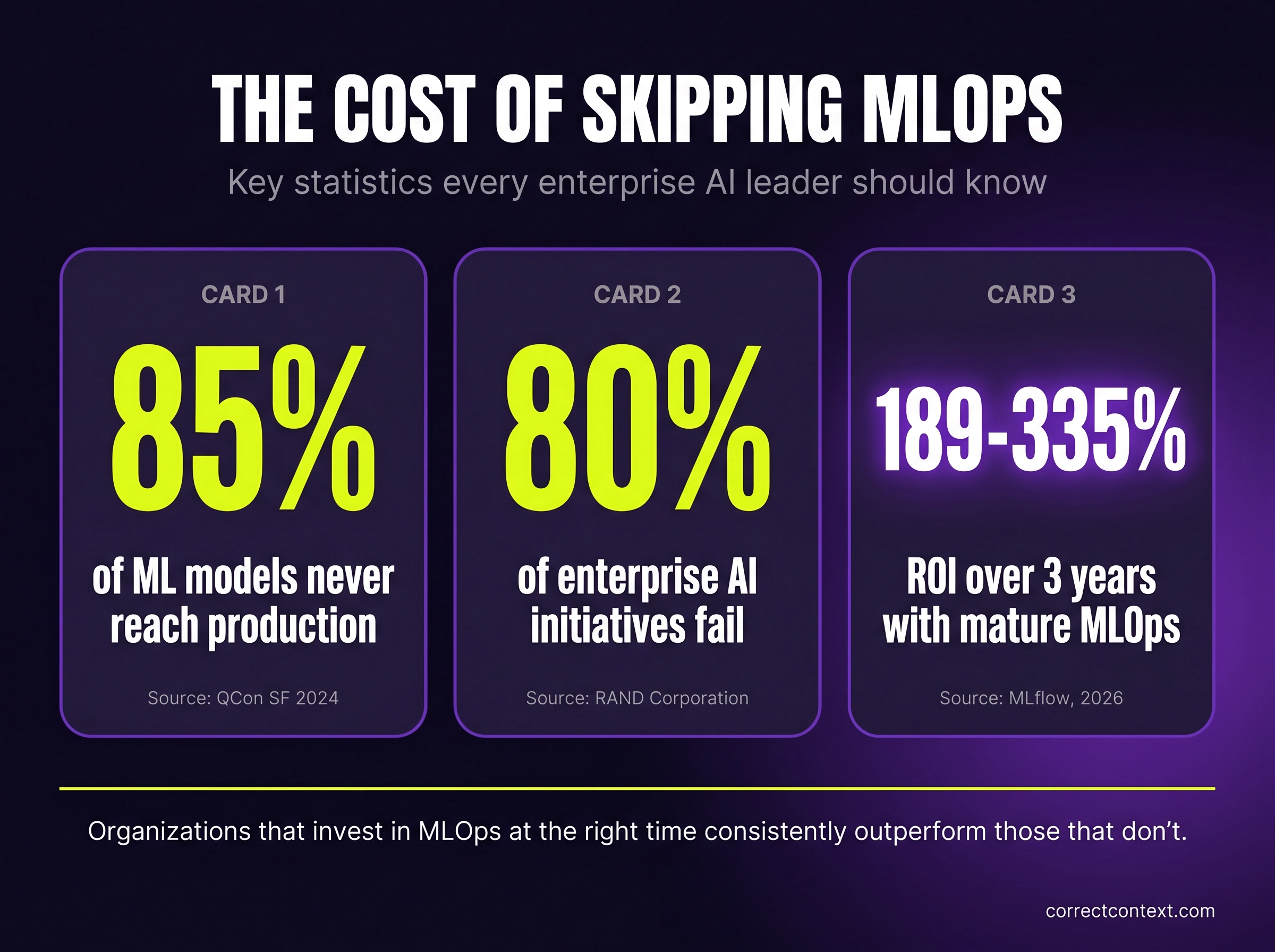
The consequences of deploying machine learning models without adequate operational support are stark. According to industry analyses, a staggering 85% of machine learning models never make it past the lab environment [1]. This failure rate is primarily driven not by technical shortcomings in the models themselves, but by organizational and process-driven failures. When models transition from controlled experiments to real-world applications, they encounter issues such as data drift, changing user behavior, and evolving upstream systems, all of which can rapidly degrade performance.
Without an MLOps team to monitor and manage these deployments, enterprises face what is often termed the “prototype graveyard.” High-quality proofs of concept become dead ends because they lack the necessary authentication, reproducibility, validation, and regulatory traceability required for production systems [2]. The financial impact of these stalled initiatives is substantial, encompassing sunk engineering hours, delayed product features, and lost revenue opportunities. Conversely, organizations that implement comprehensive MLOps strategies report returns on investment (ROI) ranging from 189% to 335% over three years [3].
Understanding the Enterprise AI Maturity Model
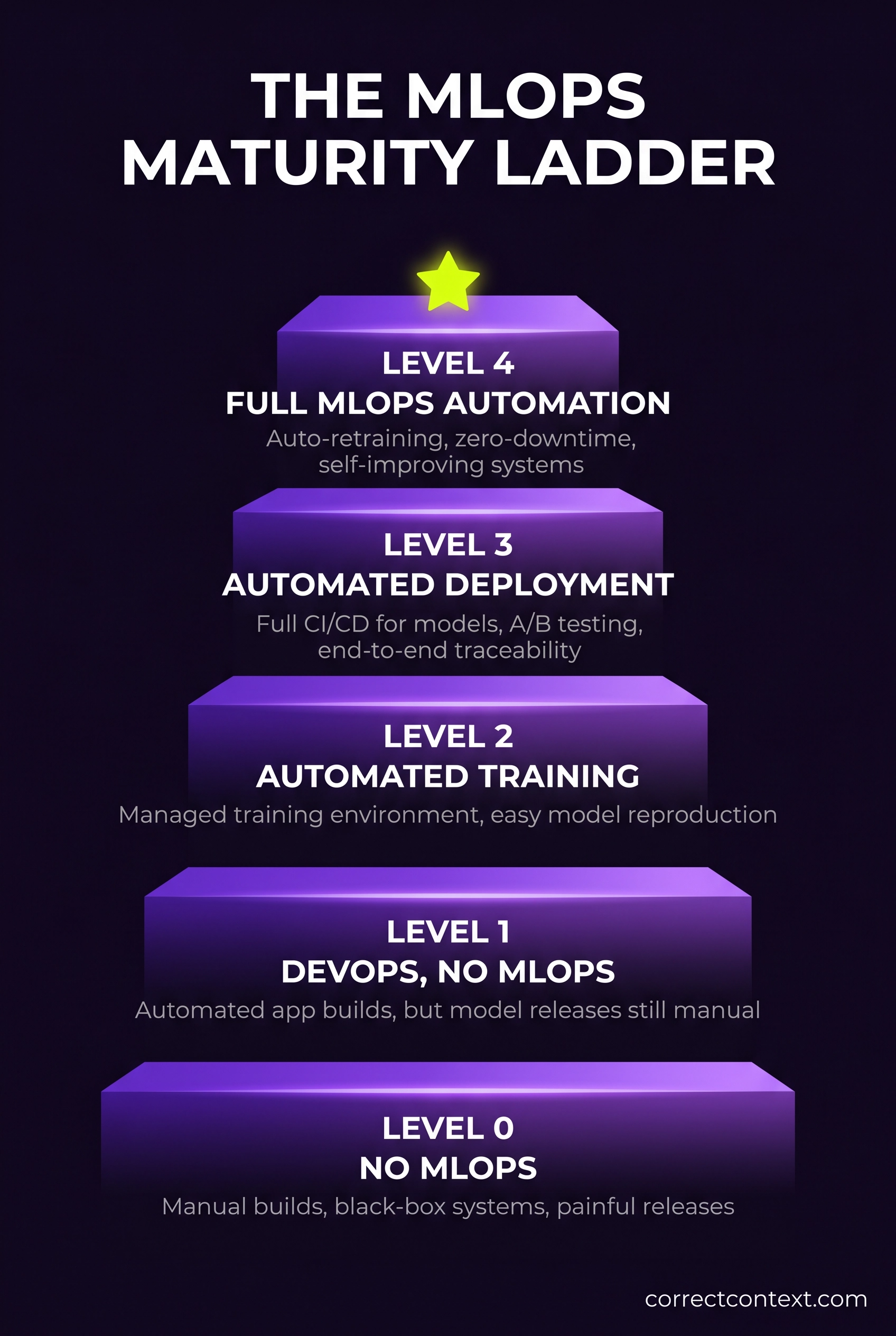
To determine when an MLOps team is necessary, it is helpful to assess the organization’s current stage within the MLOps maturity model. Microsoft’s framework outlines five distinct levels of technical capability that characterize the evolution of machine learning operations [4]:
| Maturity Level | Description | Key Characteristics |
|---|---|---|
| Level 0: No MLOps | Manual processes dominate model creation and deployment. | Difficult to manage the full lifecycle; releases are painful; systems exist as “black boxes” with little post-deployment feedback. |
| Level 1: DevOps, No MLOps | Basic automation for application code, but ML models remain manual. | Automated builds for applications, but model releases still rely heavily on data teams; limited production feedback. |
| Level 2: Automated Training | The training environment is fully managed and traceable. | Easy to reproduce models; automated model training; centralized tracking of training performance; manual but low-friction releases. |
| Level 3: Automated Model Deployment | Full traceability and automated releases. | Entire environment managed (train > test > production); integrated A/B testing; automated tests for all code. |
| Level 4: Full MLOps Automated Operations | The system is fully automated and easily monitored. | Retraining triggered automatically based on production metrics; approaching a zero-downtime system. |
Organizations operating at Level 0 or Level 1 often rely on the heroic efforts of individual data scientists to push models into production. While this may suffice for initial experiments, it becomes unsustainable as the number of models and the complexity of the data grow.
When You Don’t Need a Dedicated MLOps Team
Despite the clear benefits of MLOps, introducing a specialized team too early can lead to unnecessary overhead and slow down initial exploration. There are specific scenarios where keeping AI operations simple is the more prudent approach.
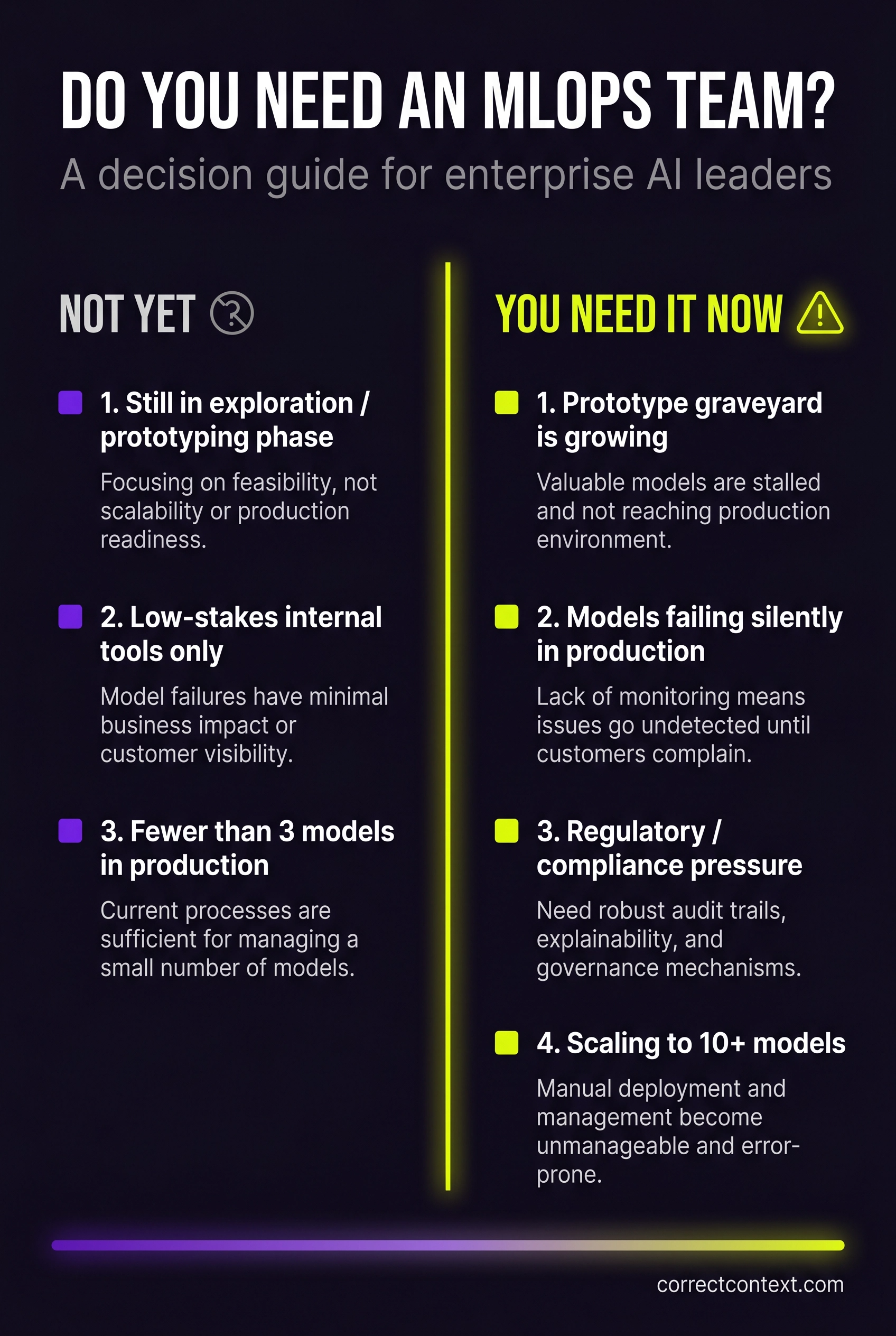
1. The Exploration and Prototyping Phase
If your enterprise is still in the early stages of exploring AI capabilities, the primary focus should be on demonstrating value rather than building scalable infrastructure. During this phase, data scientists need the flexibility to experiment rapidly without the constraints of rigorous deployment pipelines. Imposing MLOps requirements too early can stifle creativity and delay the development of compelling proofs of concept. If the goal is simply to validate a hypothesis or secure executive buy-in, a dedicated MLOps team is overkill.
2. Low-Stakes Internal Tools
When developing machine learning models for internal use cases where the consequences of failure are minimal, the rigorous governance and monitoring provided by MLOps may not be necessary. For example, a model designed to recommend internal training courses to employees does not require the same level of operational oversight as a credit scoring algorithm in a FinTech application. In these low-stakes scenarios, the existing software developers or data engineering team can often manage the deployment using standard DevOps practices.
3. Limited Model Volume and Complexity
If an organization only maintains one or two simple models in production, the operational burden is generally manageable without specialized personnel. A small machine learning engineers team can often handle the manual retraining and deployment processes required for a limited portfolio. The ROI of an MLOps team is realized when the volume and complexity of models outpace the capacity of the data science team to manage them manually.
Signs Your Enterprise Needs an MLOps Team
As AI initiatives scale and become more integrated into core business processes, the need for formalized MLOps practices becomes undeniable. Recognizing the tipping point is crucial for maintaining the momentum of AI adoption. The following indicators suggest that it is time to invest in a dedicated MLOps team.
1. The “Prototype Graveyard” is Expanding
If your data science team is consistently producing high-performing models that fail to reach production, or if deployments take months to execute, it is a clear sign that the operational infrastructure is lacking. An MLOps team bridges the gap between development and production, establishing automated pipelines that ensure models can be deployed reliably and efficiently.
2. Silent Model Failures in Production
Machine learning models are not static; their performance degrades over time as the real-world data they encounter diverges from the data they were trained on. If your organization is experiencing silent model failures—where predictions become inaccurate without triggering any system alerts—you need the specialized monitoring capabilities that MLOps provides. Traditional application monitoring tools track metrics like CPU usage and memory, but they cannot detect data drift or feature distribution shifts. An MLOps team implements automated drift detectors and continuous evaluation guardrails to catch quality defects before they impact the business [1].
3. Regulatory and Compliance Pressures
For enterprises in highly regulated industries such as FinTech and Healthcare, deploying AI models without rigorous governance is a significant risk. Auditors and regulators increasingly require transparent artifact management, traceable decision records, and automated bias tests. If your organization struggles to explain why a model made a specific decision or cannot prove that a model is fair and unbiased, an MLOps team is essential. They implement policy-as-code approaches that codify promotion rules and generate comprehensive audit trails [1].
4. Scaling the AI Portfolio
When the number of machine learning models in production grows from a handful to dozens or hundreds, manual management becomes impossible. Data scientists spend an increasing amount of their time on operational firefighting—retraining models, troubleshooting deployment issues, and managing infrastructure—rather than developing new capabilities. An MLOps team orchestrates end-to-end workflows that treat training, evaluation, deployment, and monitoring as reusable building blocks, enabling the organization to scale its AI operations efficiently.
Building Your MLOps Capability: The Strategic Approach
Deciding to invest in MLOps does not necessarily mean immediately hiring a massive internal team. For many enterprises, particularly those looking to optimize costs and access specialized talent quickly, partnering with an offshore development team or a nearshore development team offers a strategic advantage.
Correct Context specializes in providing access to highly skilled engineering teams in Poland and CEE. By leveraging our services, enterprises can hire developers in Poland to build a robust AI development team without the overhead of establishing local infrastructure. Whether you need to scale your cloud engineering team, integrate AWS / Azure / GCP engineers, or build a dedicated MLOps team, our Employer of Record (EoR) services in Europe ensure seamless employment compliance and payroll management. This approach allows large tech enterprises and fast-growing startups to access affordable, senior-level talent and build a specialized tech hub that accelerates their AI maturity.
In conclusion, the decision to invest in an MLOps team hinges on the scale, complexity, and criticality of your AI initiatives. While early-stage exploration and low-stakes models can often be managed with existing resources, the transition to enterprise-wide, production-grade AI demands the rigorous operational infrastructure that only MLOps can provide. By carefully assessing your organization’s maturity level and recognizing the signs of operational strain, you can ensure that your AI investments deliver sustained, measurable business value.
References
[1] Galileo. The MLOps Guide to Transform Model Failures Into Production Success
[2] Domino Data Lab. Why AI Projects Fail: MLOps Lessons for Leaders | Domino.ai
[4] Microsoft Learn. MLOps Maturity Model – Azure Architecture Center | Microsoft Learn