
AI Recruitment Tools: The Complete Guide for HR Leaders and Hiring Managers in 2025
In 2025, 43% of organizations now use AI for HR tasks—up from just 26% in 2024. Yet only 26% of job candidates trust that AI will evaluate them fairly. This tension between rapid adoption and candidate skepticism defines the current state of AI recruitment tools. Whether you are a CTO scaling engineering teams, an HR director managing high-volume hiring, or a founder building your first technical team, understanding how to deploy AI in recruitment is no longer optional—it is a competitive necessity.
This guide examines the real data behind AI recruitment tools: what works, what does not, where the risks lie, and how organizations in Poland and across Europe are navigating this transformation. We will cover adoption statistics, ROI benchmarks, bias concerns, compliance requirements, and practical implementation strategies based on research from SHRM, Gartner, McKinsey, EY Poland, and other credible sources.
The State of AI Recruitment in 2025: By the Numbers
The adoption of AI recruitment tools has accelerated dramatically. According to SHRM’s 2025 Talent Trends research, 43% of organizations now use AI for HR tasks—representing a 65% year-over-year increase from 26% in 2024. This is not a gradual shift; it is a rapid transformation of how companies source, screen, and select candidates.
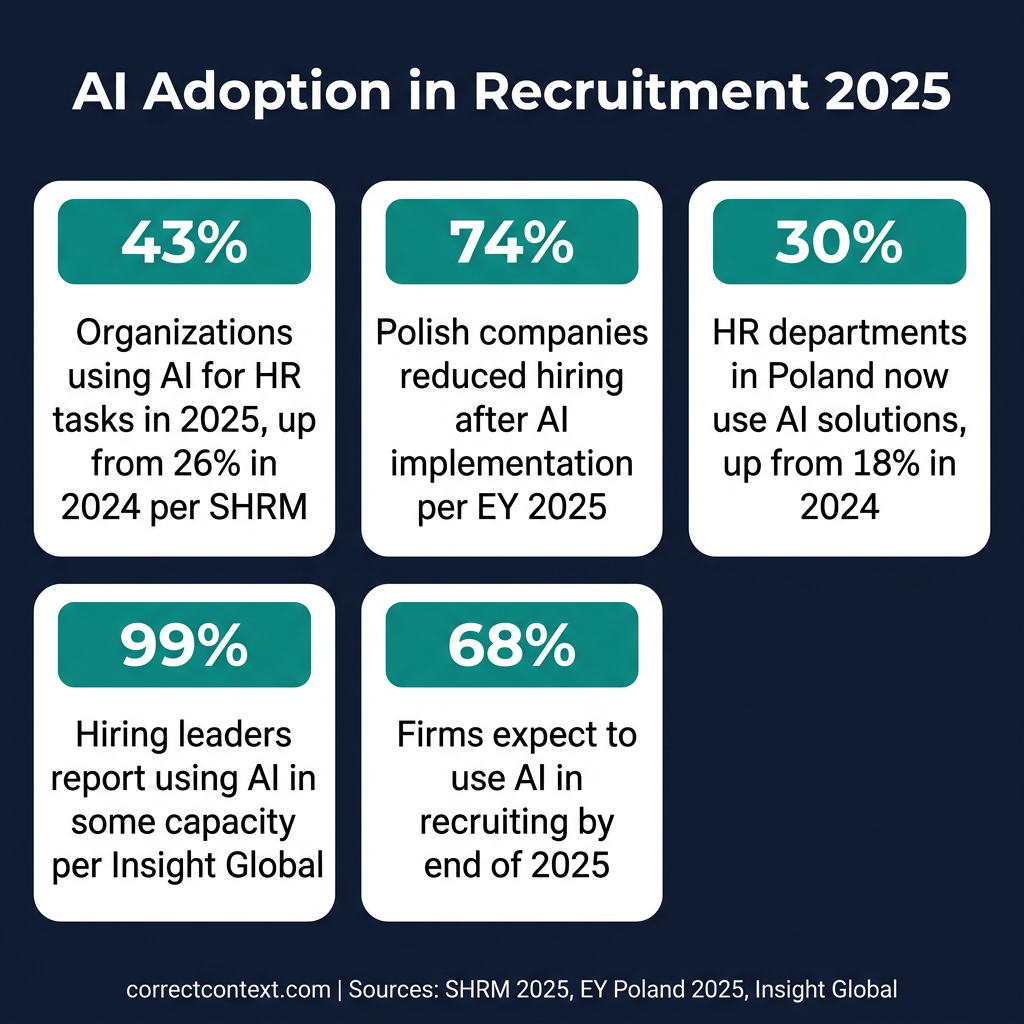
The scope of AI adoption extends beyond simple automation. Insight Global’s 2025 AI in Hiring Survey found that 99% of hiring leaders report using AI in some capacity during the hiring process. Nearly two in three teams used some form of AI when hiring in the past year, according to Workable’s 2024 survey. Looking ahead, 68% of firms expect to use AI in recruiting by the end of 2025, and 62% of employers anticipate using AI for most or all hiring steps by 2026.
Poland reflects this global trend with notable intensity. EY Poland’s “How Polish Companies Implement AI” survey—conducted among 499 Polish companies in Q4 2025—revealed that 74% of organizations reduced hiring as a result of implementing artificial intelligence. AI solutions are now deployed in 30% of HR departments, up significantly from 18% in 2024. HR ranks among the fastest-adopting functions, trailing only IT (51%) and cybersecurity.
This adoption is not limited to large enterprises. According to BCG’s January 2025 research, 70% of AI experimentation inside companies occurs in HR, with talent acquisition representing the top use case. Service sector AI use rose to 40% in 2025 from 25% in 2024, while manufacturing adoption increased to 26% from 16%.
What AI Recruitment Tools Actually Do
AI recruitment tools have evolved far beyond simple resume keyword matching. Modern systems function as comprehensive talent intelligence platforms that automate and optimize multiple stages of the hiring funnel. Understanding these capabilities is essential for evaluating which tools align with your organization’s needs.
Resume Screening and Candidate Matching
AI-powered resume screening uses natural language processing and machine learning to parse candidate documents, extract relevant skills and experience, and match applicants against job requirements. Unlike traditional keyword-based ATS filters, modern AI systems understand context, synonyms, and transferable skills. According to HireVue data from early 2024, nearly 20 million assessments and video interviews were completed in just the first quarter.
The efficiency gains are substantial. Teams using AI screening report up to 40% faster time-to-shortlist for volume roles, according to Eightfold AI’s 2025 benchmarks. AI resume parsing and deduplication reduce paid resume database spend by approximately 15%, per HireEZ’s 2024 analysis.
Interview Scheduling and Coordination
AI-led scheduling eliminates the back-and-forth emails that traditionally consume recruiter time. GoodTime’s 2024-2025 data shows that AI-led scheduling reduces interview coordination time by 60-80%. Paradox’s Olivia chatbot has demonstrated the ability to automate over 90% of end-to-end hiring tasks, with candidate response times dropping from 7 days to under 24 hours.
According to Talent Board’s 2025 research, 41% of talent acquisition teams piloted AI scheduling in 2024, with 23% standardizing it in 2025. This adoption reflects the clear ROI: automated candidate FAQs save recruiters 4-8 hours per week, according to Paradox and Brazen case studies.
Video Interviews and Assessment
AI-powered video interviewing platforms analyze candidate responses, assess communication skills, and provide structured evaluations. Video interview summarization reduces review time per candidate by approximately 60%, according to HireVue and Spark Hire data from 2024-2025. Coding interview AI aids cut grading time by 50% or more while increasing rubric adherence, per HackerRank’s research.
Meta is currently piloting AI to pair candidates with interviewers, transcribe conversations, and evaluate responses—a signal of where enterprise hiring is headed. However, these capabilities come with significant caveats regarding bias and fairness that we will examine later.
Chatbots and Candidate Engagement
Intelligent chatbots handle candidate inquiries, provide application status updates, and guide applicants through the hiring process. Phenom’s 2024 State of Candidate Experience report found that 20% of audited large employers use intelligent chatbots on career sites, while 29% employ AI personalization in candidate experiences.
The impact on candidate experience is measurable. Career site AI recommendations can lift apply conversion by 10-20%, according to Phenom’s benchmarks. Automated Q&A deflects 30-50% of recruiter FAQs from inboxes, allowing human recruiters to focus on high-value interactions.
The ROI of AI Recruitment: Efficiency, Cost, and Quality
Organizations do not adopt AI recruitment tools because they are novel—they adopt them because they deliver measurable business results. The data on ROI is compelling across multiple dimensions.
Time-to-Hire Reductions
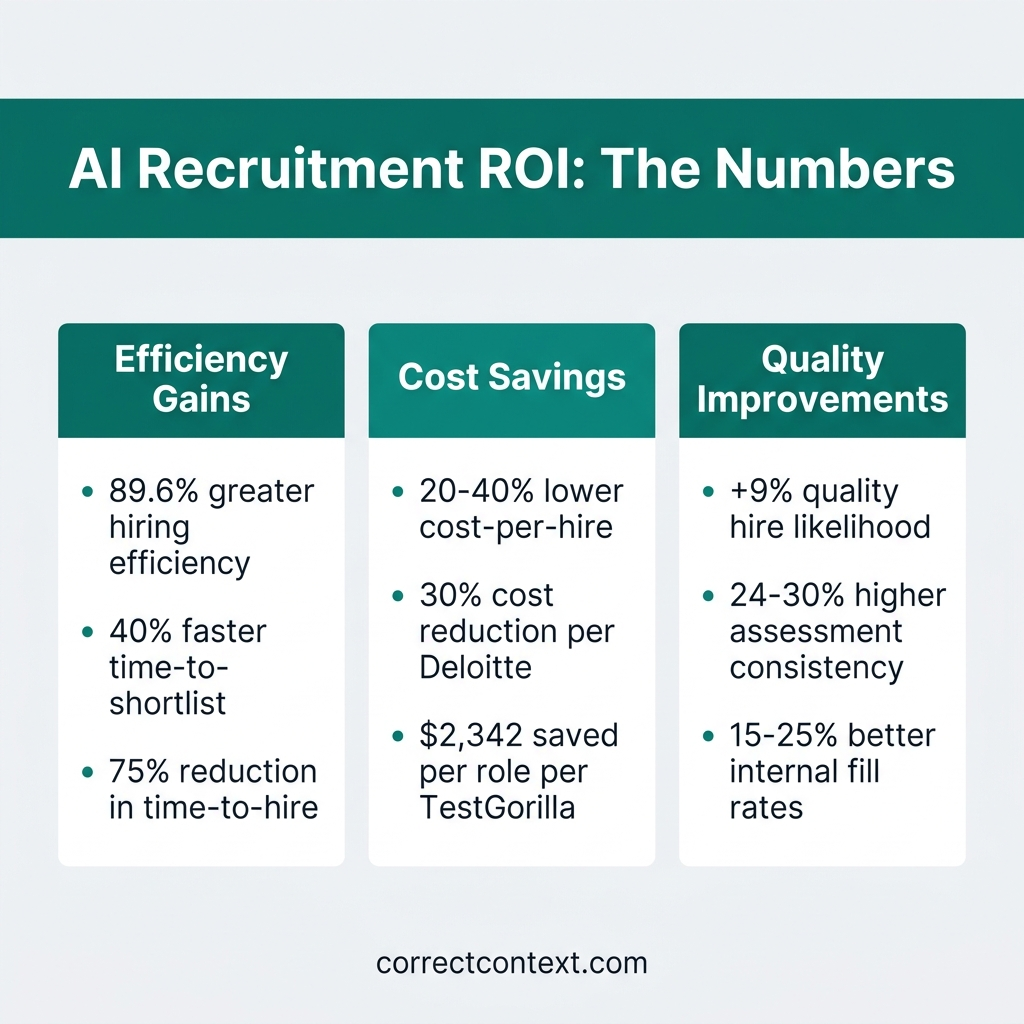
Speed matters in competitive talent markets. Workable’s 2024 AI in Hiring Survey found that organizations using AI report 89.6% greater hiring efficiency and 85.3% time savings. AI recruitment automation reduces time-to-hire by 75% by streamlining candidate screening, engagement, and scheduling through intelligent automated workflows.
Specific process improvements tell the story: AI-assisted messaging reduces manual InMail drafting time by approximately 60%, according to LinkedIn’s 2025 data. GenAI summarization reduces meeting notes time for intake and kickoffs by approximately 70%, per Otter.ai and Fireflies.ai research. Automated reference checking with AI reduces cycle time by 2-4 days, according to Xref and SkillSurvey.
Cost Per Hire Improvements
The financial impact is equally significant. Teams report 20-40% lower cost-per-hire when AI automates screening and scheduling, according to Greenhouse and GoodTime’s 2025 research. Deloitte reports that AI-powered recruitment trends reduce cost-per-hire by 30%. TestGorilla’s 2024 study indicates that skill-based hiring tools save $2,342 per role and 792 hours per hire.
For high-volume hiring, the savings compound. Automation adopters fill 64% more jobs and submit 33% more candidates per recruiter, according to Indeed and Bluehorn’s 2024 study. Unilever’s AI-driven ATS implementation shrank hiring time from 4 months to 4 weeks, saving 50,000 recruiter hours.
Quality of Hire Improvements
Beyond speed and cost, AI tools can improve hiring outcomes. LinkedIn’s Future of Recruiting 2025 report found that companies using AI-assisted messaging are 9% more likely to make a quality hire. Teams using structured, AI-supported interviews see 24-30% higher assessment consistency, according to Harvard Business Review’s 2024 research.
AI-based skills inference improves internal mobility match rates by approximately 25%, per Gartner’s 2025 research. Internal mobility platforms with AI skills graphs increased internal fill rates by 15-25%, according to combined Gartner and Eightfold data from 2024-2025.
The Bias Problem: When AI Amplifies Discrimination
For all their benefits, AI recruitment tools carry significant risks—particularly around bias and discrimination. The same data-driven approaches that enable efficiency can also perpetuate and amplify existing inequalities if not carefully managed.
How AI Learns Bias
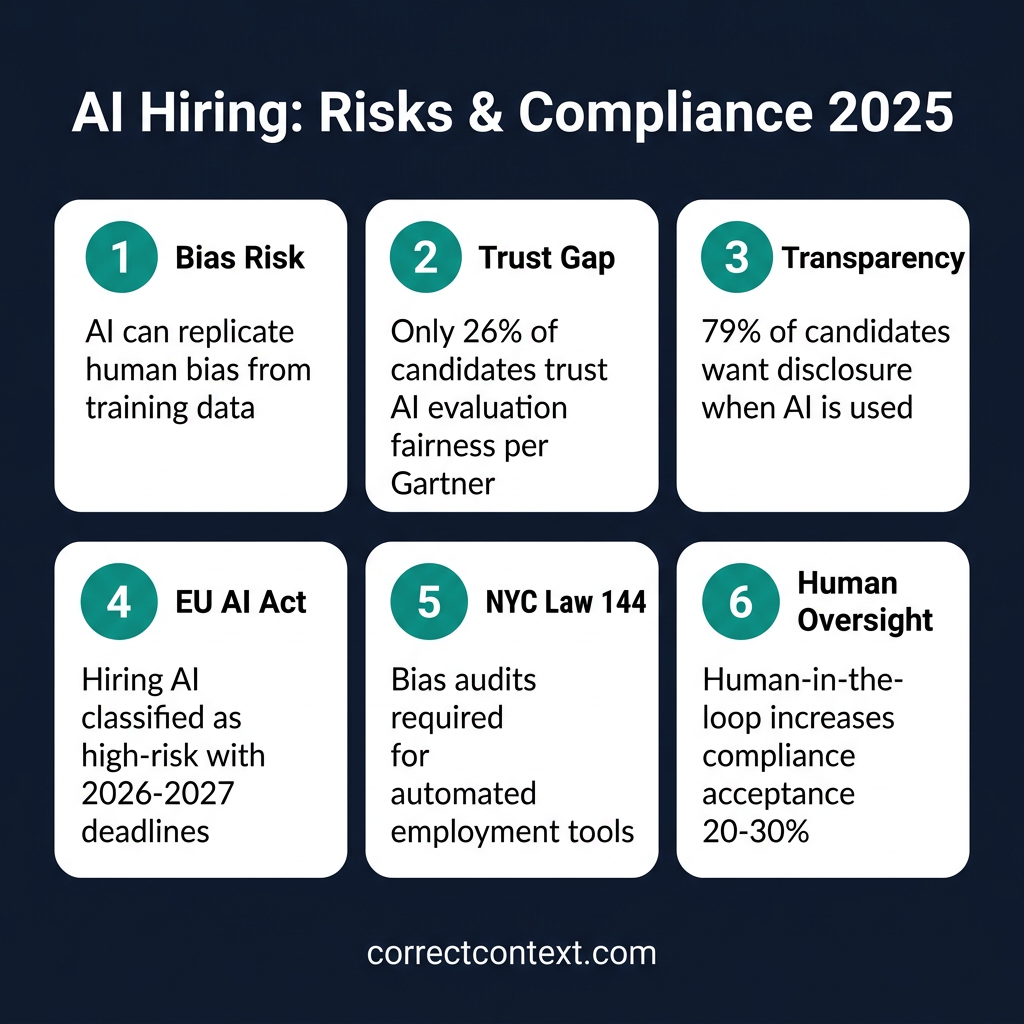
AI algorithms trained on historical hiring data learn from past decisions—including biased ones. If an organization’s historical hiring favored certain demographics, schools, or backgrounds, an AI system trained on that data will replicate those patterns. As Purdue University’s Mitch Daniels School of Business research confirms, algorithms trained on past candidates show the same level of subgroup differences as the data upon which they were trained.
The University of Washington’s 2025 research confirmed what many job seekers had documented informally: AI systems screening job applications systematically discriminate against Black candidates. Speech-to-text accuracy gaps can introduce bias, with some groups facing automatic speech recognition error rates up to 22%, according to University of South Australia research reported in The Guardian in May 2025.
Real-World Consequences
The legal and reputational risks are substantial. In 2022, iTutorGroup Inc., a China-based tutoring company, settled a lawsuit brought by the EEOC over age discrimination by AI hiring tools—the first such case involving AI software. More recently, the Mobley v. Workday case opened the door to treating AI vendors as employment agencies under Title VII, potentially expanding liability.
A 2024 Gallup survey found that 93% of Fortune 500 CHROs are integrating AI into business practices, yet only about one-third of employees knew their employer uses AI tools in hiring. This transparency gap compounds the risk: 79% of candidates want transparency when AI is used in hiring, according to HireVue’s 2024-2025 research.
Candidate Trust Deficit
Gartner’s July 2025 survey revealed a stark trust gap: only 26% of job applicants trust AI will fairly evaluate them, even though 52% believe AI could theoretically improve hiring. This skepticism is not unfounded—candidates understand that algorithms can encode bias.
However, candidates are not universally opposed to AI. HireVue found that 67% of candidates are comfortable with AI screening as long as a human makes the final decision. Glassdoor’s 2024 economic research similarly shows that candidates broadly accept AI screening when human oversight is maintained. The key is transparency and maintaining human accountability.
Compliance and Regulation: The Legal Landscape
As AI recruitment tools proliferate, regulators worldwide are establishing frameworks to govern their use. HR leaders must navigate an evolving compliance landscape that varies by jurisdiction.
The EU AI Act
The European Union’s AI Act, published in the Official Journal in 2024, classifies AI used for employment and worker management as high-risk. This classification triggers significant compliance obligations including conformity assessments, risk management systems, and human oversight requirements. The grace periods for most high-risk obligations phase in through 2026-2027, meaning organizations must prepare now.
The Act introduces complaint rights for individuals and requires lifecycle conformity assessments for high-risk systems. Organizations using AI recruitment tools in the EU must maintain detailed documentation, ensure human oversight, and be prepared to demonstrate compliance.
United States: Fragmented but Evolving
In the US, regulation is developing at the state and local level. New York City’s Local Law 144 requires bias audits for Automated Employment Decision Tools (AEDTs) used in hiring and promotions. The Illinois AI Video Interview Act requires notice, consent, and data handling disclosures for AI video interviews. Maryland law limits employers’ use of facial recognition in interview decisions without consent.
California’s Civil Rights Council approved new regulations effective October 1, 2025, that directly address how employers use AI in employment decisions. The EEOC has issued technical assistance warnings on Title VII and ADA risks in algorithmic hiring tools.
United Kingdom and Global Standards
The UK’s Information Commissioner’s Office issued 296 recommendations and 42 advisory notes to audited AI HR tool providers in 2024. The OECD AI Principles, referenced in compliance frameworks globally, emphasize human oversight and bias mitigation. Implementing human-in-the-loop review increased compliance acceptance by 20-30%, according to OECD research.
AI Recruitment Tools: Comparison of Leading Platforms
The AI recruitment tool market includes established ATS providers with AI features and specialized AI-native platforms. Understanding the landscape helps organizations select tools aligned with their needs.
| Platform | Primary AI Features | Best For | Key Differentiator |
|---|---|---|---|
| Greenhouse | AI-assisted messaging, job description optimization, candidate matching | Mid-market to enterprise | Strong integration ecosystem, bias reduction focus |
| Lever | AI sourcing, candidate recommendations, predictive analytics | Growth-stage companies | CRM + ATS combination, collaboration features |
| Workable | AI candidate sourcing, resume screening, interview scheduling | SMB to mid-market | Built-in video interviews, extensive job board distribution |
| iCIMS Talent Cloud | AI matching, chatbot, video interviewing, skills taxonomy | Large enterprises | Scalability, 800+ integrations, enterprise security |
| Eightfold AI | Deep learning matching, skills inference, internal mobility | Enterprise talent intelligence | Project-based hiring, career pathing, DEI analytics |
| HireVue | Video interviewing, game-based assessments, AI evaluation | High-volume hiring | Structured assessments, massive assessment volume |
| Paradox (Olivia) | Conversational AI, scheduling, candidate engagement | High-volume, frontline | Natural language processing, 90%+ task automation |
| Textio | Language optimization, bias detection in job posts | Employer branding | Proven bias reduction (25-50%), inclusive language |
Selection criteria should include: integration capabilities with existing HR systems, compliance features for relevant jurisdictions, transparency in AI decision-making, human oversight mechanisms, and proven bias mitigation approaches. Cost models vary significantly—enterprise platforms like iCIMS start around $14,000 annually, while SMB-focused tools like Zoho Recruit offer free tiers.
Best Practices for Implementing AI Recruitment Tools
Successful AI recruitment implementation requires more than selecting the right software. Organizations must establish governance frameworks, train teams, and maintain human oversight.
Establish AI Governance
Before deploying AI recruitment tools, organizations should establish clear policies governing their use. This includes defining which decisions require human review, setting thresholds for AI recommendations, and documenting how AI fits into the overall hiring process. Model documentation—”model cards”—reduced audit prep time by approximately 40%, according to Partnership on AI’s 2024 research.
Bias audits typically identify 2-5 adverse impact hotspots across funnel stages, according to independent AEDT auditors. Regular auditing should be built into the governance framework, not treated as a one-time compliance exercise.
Train Recruiters and Hiring Managers
AI tools are only as effective as the people using them. Talent Board’s 2025 research found that 72% of TA leaders plan to upskill teams on AI tools in the next 12 months. Training should cover not just tool mechanics but also bias awareness, compliance requirements, and when to override AI recommendations.
Communication is critical: 58% of recruiters feel AI reduces busywork, letting them focus on candidate relationships, according to Greenhouse’s 2024 research. Framing AI as an enabler of better human connections—not a replacement for them—improves adoption.
Maintain Human Oversight
The most effective AI implementations maintain meaningful human involvement. While 80% of organizations using AI hiring tools say they do not reject applicants without human review, the quality of that review matters. Human reviewers should be trained to identify potential bias in AI recommendations and empowered to override them.
University of Washington research found that people mirror AI systems’ hiring biases—when AI preferred non-white candidates, participants did too. Unless bias is obvious, people were willing to accept the AI’s biases. This underscores the need for structured human review processes, not just nominal oversight.
Be Transparent with Candidates
Given that 79% of candidates want transparency when AI is used in hiring, organizations should proactively disclose their AI use. This includes explaining what the AI evaluates, how decisions are made, and what role humans play. Transparency builds trust and may actually improve candidate experience—61% of job seekers say AI-written job ads are easier to understand than human-written ones, according to Greenhouse’s 2025 survey.
AI Recruitment in Poland: Local Context and Considerations
Poland’s recruitment market has unique characteristics that affect AI tool implementation. Understanding these local factors helps organizations adapt global best practices to the Polish context.
High AI Adoption, Significant Restructuring
EY Poland’s research reveals that Polish companies are aggressive AI adopters—but with significant workforce implications. The 74% of organizations that reduced hiring after AI implementation reflects a market prioritizing efficiency gains over headcount growth. This creates an “AI gap”—a skills shortage caused by the lack of junior roles that traditionally fed talent pipelines.
For organizations hiring in Poland, this means the available talent pool may shift toward more experienced candidates, potentially increasing competition for senior roles. AI recruitment tools can help identify transferable skills and non-obvious candidates, but hiring managers should adjust expectations regarding junior-level availability.
Strong Technical Talent Pool
Poland’s IT sector remains robust despite AI-driven hiring reductions. According to Talent Place’s research, Poland is home to over 50,000 AI and data professionals, with 94% of Polish companies reporting higher revenues thanks to AI adoption. The country’s 400,000+ developer talent pool continues to attract foreign investment.
For organizations using AI recruitment tools in Poland, the abundance of technical talent means AI systems have rich data to work with—but also that competition for top candidates remains intense. Speed and candidate experience matter: the companies that win talent will be those that use AI to accelerate hiring while maintaining human connection.
EU Compliance Requirements
As an EU member state, Poland is subject to the EU AI Act’s high-risk AI requirements. Organizations using AI recruitment tools for Polish hiring must prepare for conformity assessments, human oversight obligations, and documentation requirements. The 2026-2027 grace period deadlines mean preparation should begin now.
The Future of AI Recruitment: Trends to Watch
The AI recruitment landscape continues to evolve rapidly. Several trends will shape how organizations hire in the coming years.
Agentic AI and Autonomous Recruiting
Gartner’s Hype Cycle for AI in HR 2025 identifies “Agentic AI in HR” and “Recruiter AI Agent” as emerging innovations. These systems go beyond recommendation to autonomous action—scheduling interviews, sending offers, and managing candidate communications without human intervention for routine cases. While promising, these capabilities amplify the need for robust governance and oversight.
Skills-Based Transformation
The shift from credential-based to skills-based hiring accelerates with AI enablement. Gartner’s research shows that skills taxonomies plus AI tagging cut req-to-intake time by approximately 30%. Internal mobility platforms with AI skills graphs are increasing internal fill rates by 15-25%. Organizations that invest in skills ontologies and AI-powered matching will access broader talent pools.
Generative AI in Candidate Communication
Generative AI is transforming how recruiters communicate with candidates. LinkedIn’s 2025 research found that GenAI personalization in outreach increased positive response rates by 5-12%. AI-generated job descriptions reduce time-to-publish by approximately 40% and decrease biased language by 25-50%, according to Textio’s data. These capabilities will become standard, not differentiating.
Regulatory Maturation
As the EU AI Act’s grace periods expire and US state laws proliferate, compliance will become a core competency for HR teams. Responsible AI job postings approached 1% of all AI postings by 2025, up from near zero in 2019, according to Indeed Hiring Lab—indicating growing organizational focus on ethical AI. Vendors that cannot demonstrate bias mitigation and transparency will face market rejection.
Key Takeaways
- AI recruitment adoption has accelerated dramatically—43% of organizations now use AI for HR tasks, up from 26% in 2024. The technology has moved from experimental to essential.
- ROI is measurable and substantial: 20-40% lower cost-per-hire, 75% reduction in time-to-hire, and 89.6% greater hiring efficiency for organizations using AI effectively.
- Bias remains a critical risk. AI systems trained on historical data replicate historical biases. Only 26% of candidates trust AI evaluation fairness, and regulatory scrutiny is intensifying.
- Compliance requirements are expanding rapidly. The EU AI Act classifies hiring AI as high-risk, with grace periods expiring 2026-2027. US state and local laws are proliferating.
- Human oversight is non-negotiable. The most effective implementations use AI to augment human decision-making, not replace it. Candidates accept AI screening when humans make final decisions.
- Poland reflects global trends with local intensity. 74% of Polish companies reduced hiring after AI implementation, creating an “AI gap” in junior talent. The country’s strong technical talent pool remains attractive for foreign investment.
- Transparency builds trust. 79% of candidates want disclosure when AI is used in hiring. Organizations that communicate clearly about their AI use will differentiate positively.
Frequently Asked Questions
Will AI recruitment tools replace human recruiters?
No. The data consistently shows that AI augments rather than replaces human recruiters. While AI can automate repetitive tasks like resume screening and interview scheduling, human judgment remains essential for evaluating cultural fit, building candidate relationships, and making final hiring decisions. In fact, 58% of recruiters report that AI reduces busywork, allowing them to focus on higher-value candidate interactions. The most effective implementations maintain human oversight at critical decision points.
How can organizations prevent AI bias in hiring?
Preventing AI bias requires a multi-layered approach. First, audit training data for historical bias before deploying AI systems. Second, implement regular bias audits of AI outputs—typically identifying 2-5 adverse impact hotspots. Third, maintain human-in-the-loop review for all AI recommendations, which increases compliance acceptance by 20-30%. Fourth, use tools like Textio that specifically focus on bias reduction in job descriptions and communications. Finally, communicate transparently with candidates about AI use and provide channels for appeals.
What compliance requirements apply to AI recruitment tools in the EU?
The EU AI Act classifies AI used for employment and worker management as high-risk, triggering significant obligations. Organizations must conduct conformity assessments before deploying high-risk AI systems, implement risk management systems throughout the AI lifecycle, ensure human oversight with ability to override AI decisions, maintain detailed technical documentation, and provide transparency to candidates about AI use. Grace periods for most obligations phase in through 2026-2027, but preparation should begin immediately.
How do candidates feel about AI in recruitment?
Candidate sentiment is mixed but manageable with transparency. Only 26% of job applicants trust AI will fairly evaluate them, yet 67% are comfortable with AI screening as long as a human makes the final decision. 79% of candidates explicitly want transparency when AI is used in hiring. The key insight: candidates do not oppose AI itself—they oppose opaque, unaccountable AI. Organizations that communicate clearly about their AI use, explain what the AI evaluates, and maintain human accountability will maintain candidate trust.
What ROI can organizations expect from AI recruitment tools?
ROI varies by implementation quality and use case, but benchmark data shows consistent benefits. Organizations report 20-40% lower cost-per-hire, 75% reduction in time-to-hire, and 89.6% greater hiring efficiency. For high-volume hiring, automation adopters fill 64% more jobs and submit 33% more candidates per recruiter. Quality improvements include 9% higher likelihood of quality hires and 24-30% higher assessment consistency. These benefits compound over time as systems learn and processes mature.
Sources
- SHRM — AI in HR (2025 Talent Trends), 2025
- Gartner — Artificial Intelligence in HR, January 2025
- LinkedIn — Future of Recruiting 2025, 2025
- EY Poland — How Polish Companies Implement AI (via Poland Insight), Q4 2025
- HireTruffle — 100 AI Recruitment Statistics You Need to Know Heading Into 2026, September 2025
- McKinsey — The State of AI in 2025, January 2025
- Deloitte — 2026 Global Human Capital Trends, 2025
- HireVue — Candidate Perceptions of AI in Hiring, 2024-2025
- Gartner — Hype Cycle for AI in Human Resources 2025, 2025
- U.S. EEOC — AI and Title VII Technical Assistance, 2023-2024
- European Union — EU AI Act (Official Journal), 2024
- University of Washington — People Mirror AI Systems’ Hiring Biases, November 2025
- Purdue University — Algorithmic Bias in Hiring: Fact or Myth?, 2025
- Workable — AI in Hiring 2024 Survey, 2024
- Glassdoor Economic Research — Candidate Attitudes Toward AI, 2024
- Greenhouse — AI in Job Ads Survey, 2025
- Talent Place — AI Talent Pool in Poland Report, 2025
- Textio — JD Optimization with AI, 2024-2025
- Paradox — Olivia Case Studies, March 2025
- Eightfold AI — AI Screening Benchmarks, 2025
Table of content
- The State of AI Recruitment in 2025: By the Numbers
- What AI Recruitment Tools Actually Do
- The ROI of AI Recruitment: Efficiency, Cost, and Quality
- The Bias Problem: When AI Amplifies Discrimination
- Compliance and Regulation: The Legal Landscape
- AI Recruitment Tools: Comparison of Leading Platforms
- Best Practices for Implementing AI Recruitment Tools
- AI Recruitment in Poland: Local Context and Considerations
- The Future of AI Recruitment: Trends to Watch
- Key Takeaways
- Frequently Asked Questions
- Sources
Related articles



About the Author: Duke Vu