
Outsourcing vs Nearshoring to Poland: The Complete 2026 Guide for Tech Leaders
Global IT spending is projected to hit $6.31 trillion in 2026—a 13.5% jump from the previous year, according to Gartner’s latest forecast. For engineering leaders at mid-to-large enterprises, this surge creates both opportunity and pressure. The opportunity: technology investment is accelerating at a pace unseen since the pandemic. The pressure: finding qualified developers locally has never been harder.
This guide examines the strategic choice facing CTOs and VPs of Engineering in 2026: outsourcing versus nearshoring, with a specific focus on Poland as the premier nearshoring destination for Western European and US companies. We will analyze real cost data, quality benchmarks, risk factors, and decision frameworks based on current market research from Gartner, Forrester, and industry specialists.
Understanding the Global IT Talent Landscape in 2026
Before diving into outsourcing models, we need to understand why companies are looking beyond their borders for engineering talent. The data tells a clear story that engineering leaders cannot ignore.
The Talent Shortage Reality
According to research cited by Brainhub, enterprises worldwide risk losing approximately $8.4 trillion in revenue by 2030 due to a lack of experienced workforce. This is not a hypothetical future scenario—it is happening now. The global talent shortage has forced companies to continuously search for IT employees outside their home countries, fundamentally reshaping how engineering teams are built.
The software and IT services market is experiencing explosive growth that shows no signs of slowing. Forrester forecasts that global tech spending will reach $5.6 trillion in 2026, with nearly two-thirds of growth coming from software and computer equipment. HG Insights projects worldwide IT investment at $4.96 trillion over the next 12 months. This demand is creating an unprecedented squeeze on available engineering talent that traditional hiring approaches cannot solve.
Consider what this means in practical terms. Every major company is becoming a technology company. Banks need mobile developers. Retailers need AI specialists. Manufacturers need IoT engineers. Healthcare providers need security experts. The competition for the same limited pool of talent has driven salaries to unsustainable levels in major tech hubs and created hiring timelines that stretch six months or longer for critical roles.
Where the Talent Lives
Central and Eastern Europe (CEE) has emerged as a critical talent reservoir that smart companies are tapping into. According to Dreamix, the CEE region holds over 3.5 million employed ICT specialists—the largest regional tech workforce in Europe. This concentration represents a strategic advantage that becomes more valuable as Western European and US talent markets tighten.
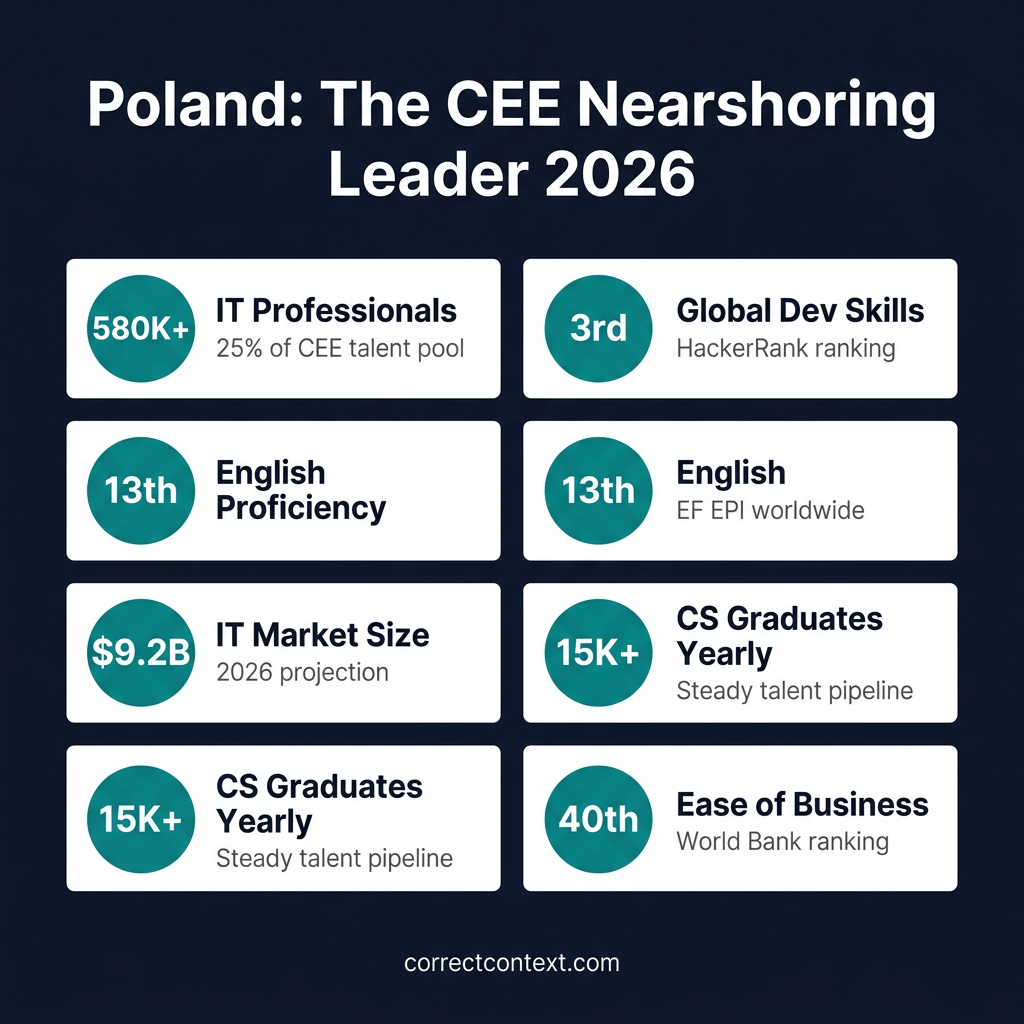
Poland alone is home to more than 580,000 IT professionals, representing approximately 25% of all Eastern European tech talent and about 3.5% of Poland’s national workforce. To put this in perspective, Poland’s developer population is roughly equivalent to the entire tech workforce of several smaller European countries combined.
This concentration matters for several reasons. When you nearshore to Poland, you are tapping into the deepest talent pool in the region—a pool that has been developing for decades through STEM-focused education and post-2010 tech ecosystem growth. The density of talent creates network effects: developers learn from each other, move between companies bringing new perspectives, and build a shared professional culture that emphasizes quality and continuous improvement.
Defining the Models: Outsourcing, Nearshoring, and Offshoring
These terms are often used interchangeably in casual conversation, but they represent distinctly different strategic approaches with different risk profiles, cost structures, and management requirements. Understanding the differences is essential for making the right choice for your specific situation.
Traditional Outsourcing
Outsourcing, in its broadest sense, means contracting work to an external organization—regardless of location. The defining characteristic is that another company handles the work, not your own employees. This can be domestic (onshoring), regional (nearshoring), or distant (offshoring).
The outsourcing model has evolved significantly over the past two decades. Early outsourcing was often transactional—companies sent specific tasks to vendors and received deliverables back. Modern outsourcing relationships are more collaborative, with external teams functioning as extensions of internal departments rather than simple service providers.
Nearshoring: The Regional Advantage
Nearshoring means partnering with service providers in neighboring or nearby countries—places that are a quick flight away and share similar business hours. According to Index.dev, nearshoring offers significant advantages through geographical proximity, cultural alignment, and time zone compatibility.
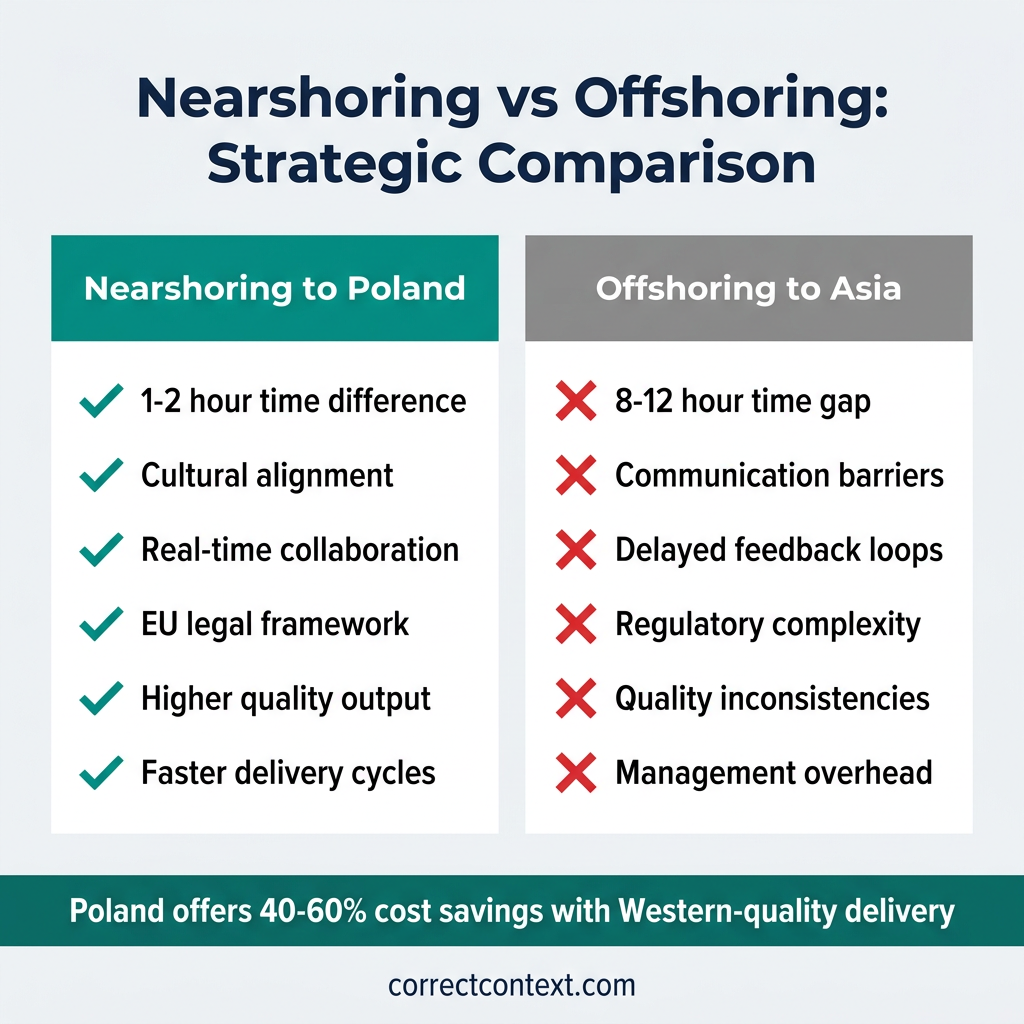
For European companies, Poland represents the ideal nearshoring destination. The time difference is minimal—typically one to two hours—which means teams can work synchronously during normal business hours. For US companies, nearshoring typically means Canada or Latin America, though some East Coast companies are finding that Polish teams can provide partial overlap with their morning hours.
The key benefits of nearshoring extend beyond simple convenience:
- Time zone overlap: 1-2 hour differences enable real-time collaboration, immediate feedback, and synchronous problem-solving
- Cultural alignment: Shared business norms, communication styles, and professional expectations reduce friction
- Travel accessibility: Same-day or next-day site visits are feasible for relationship building and critical project phases
- Legal framework compatibility: EU regulations provide familiar structures for data protection, IP rights, and contract enforcement
- Quality standards: Proximity to Western markets has driven adoption of international best practices and quality benchmarks
Offshoring: The Distance Trade-off
Offshoring means working with partners in more distant regions—typically Asia (India, Philippines, Vietnam) or parts of Africa. The traditional appeal is maximum cost reduction, with hourly rates often 50-70% below Western levels.
However, offshoring comes with significant challenges that can erode the apparent cost savings. According to ScioDev, common communication breakdowns in offshore development include time zone mismatches that eliminate real-time interaction, delayed feedback loops that stall progress, and cultural differences that lead to misunderstood requirements and costly rework.
The 8-12 hour time gap between Europe and Asia means that when your team in Frankfurt is starting their day, your offshore team in Bangalore is ending theirs. Questions asked in the morning get answered the next day. Urgent issues wait overnight. This asynchronous workflow can work for well-defined, modular tasks but becomes problematic for complex, collaborative development.
Why Poland Dominates the European Nearshoring Market
Poland has become the go-to destination for software development nearshoring, and this is not accidental. Let us examine the specific factors that put Poland ahead of alternatives like Romania, Ukraine, Czechia, or offshore destinations.
1. Unmatched Talent Scale and Quality
Poland’s 580,000+ IT professionals represent the largest concentration in Central and Eastern Europe. But quantity without quality is meaningless. Fortunately, Polish developers rank 3rd worldwide in programming skills according to HackerRank’s global developer assessment—behind only China and Russia.
This ranking is based on actual coding challenge performance across millions of developers globally. It measures not just theoretical knowledge but practical problem-solving ability—the exact skill that matters for real software development.
Poland graduates over 15,000 computer science students annually, creating a steady pipeline of new talent. The country’s technical universities have produced engineers now leading teams at Meta, Grammarly, and GitLab. This is not accidental—it is the product of decades of STEM-focused education and a post-2010 tech ecosystem boom that has created opportunities for ambitious engineers to build world-class careers at home.
The quality of Polish engineering education is particularly strong in mathematics and theoretical computer science—foundations that prove valuable in emerging fields like AI, machine learning, and data engineering.
2. Exceptional English Proficiency
Communication is the make-or-break factor in distributed development. You can hire the world’s best programmer, but if you cannot communicate requirements effectively, the project will fail.
In 2022, Poland ranked 13th in the EF EPI rating of English proficiency out of 111 countries—classified as “very high proficiency.” Polish developers frequently work on foreign projects and use English as their daily working language. Most Polish developers have been learning English since primary school, and the language is standard in technical universities and professional environments.
This contrasts sharply with many offshore destinations where language barriers create friction, misunderstandings, and project delays. When you work with Polish developers, you can expect fluent communication in meetings, clear written documentation, and the ability to understand nuance and context.
3. Strategic Location and Time Zone
Poland sits in the heart of Europe, sharing time zones with Western European capitals. Warsaw is one hour ahead of Berlin, Amsterdam, and Paris. London is one hour behind. This overlap enables real-time standups, immediate feedback, and synchronous problem-solving.
Consider the practical implications. A development team in Warsaw can participate in your daily standup at 9 AM Berlin time (10 AM Warsaw time). They are available for questions throughout your business day. Code reviews happen in real-time. Urgent issues get immediate attention. This synchronous workflow is impossible with offshore teams separated by 8-12 hours.
Poland has 12 international airports with excellent connections to major European cities. A CTO in Munich can have breakfast with their team in Warsaw and be back home the same evening. This travel accessibility enables the relationship-building and face-to-face collaboration that strengthens distributed teams.
4. Political and Economic Stability
As a member of the EU, UN, OECD, and NATO, Poland offers political and economic stability that translates to business predictability. The country ranks 40th in the World Bank’s Ease of Doing Business ranking—ahead of many Western European competitors.
This stability matters for long-term investments. When you build a team in Poland, you can be confident that the legal framework, currency, and business environment will remain stable. The country has weathered global economic challenges while maintaining growth and has a track record of honoring international agreements and protecting foreign investments.
The Polish government actively supports foreign investment through special economic zones, tax incentives, and streamlined business registration. EU membership means GDPR compliance, intellectual property protections, and familiar contract law that reduces legal risk.
5. Cultural Alignment with Western Business Practices
Poland’s business culture has been shaped by decades of collaboration with Western European and American companies. Polish developers understand agile methodologies, direct communication, and outcome-oriented work styles. They are accustomed to flat hierarchies, peer code reviews, and taking ownership of problems.
This cultural fit reduces the friction that plagues offshore engagements. Polish developers will push back on unclear requirements, suggest better approaches, and communicate proactively about blockers. They expect to be treated as partners in problem-solving, not just implementers of specifications.
As noted by Itelence, software development in Poland benefits from the country’s deep integration with Western European business norms, creating natural alignment on professional interaction, problem-solving approaches, and communication styles.
Cost Analysis: Real Numbers for 2026
Cost is always a factor in outsourcing decisions, but smart leaders look at value rather than just price. Here is what the data actually shows for developer rates across different regions and engagement models.
Hourly Rate Comparisons by Region
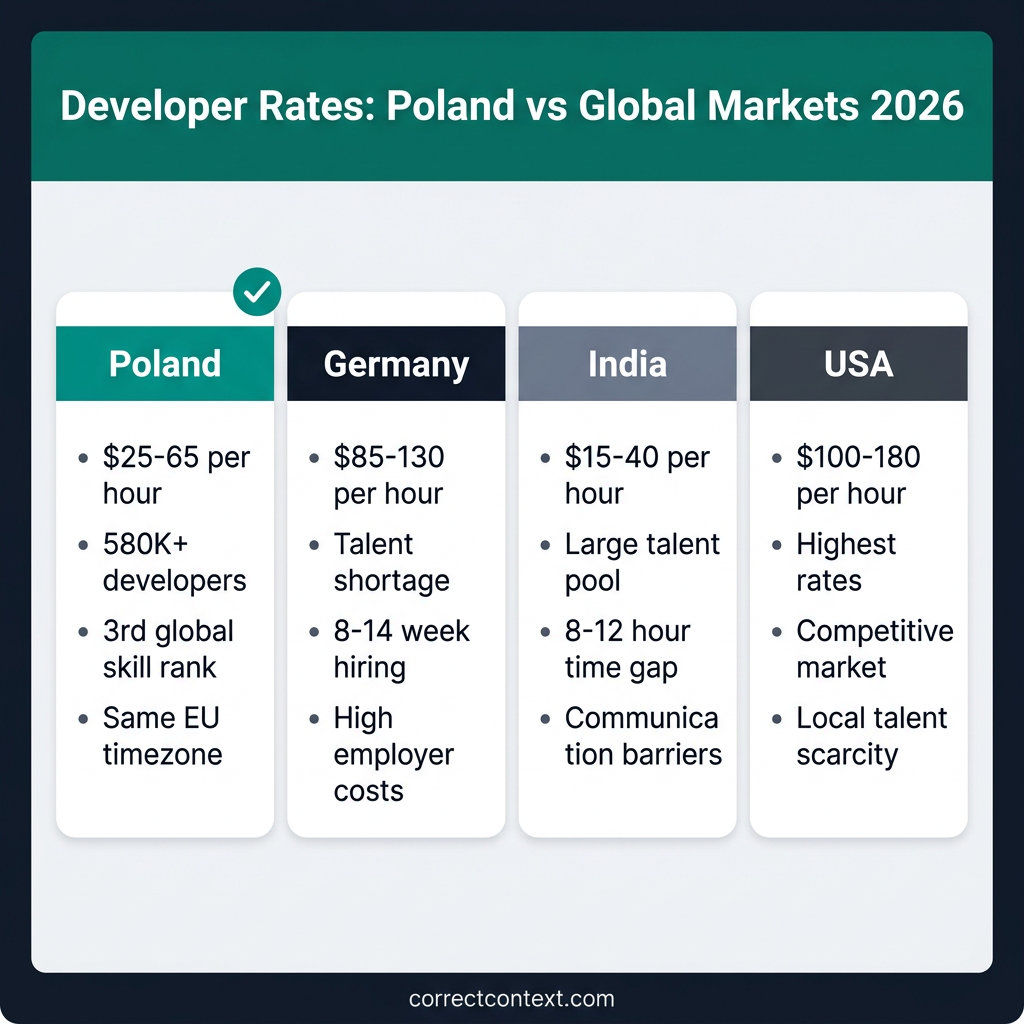
| Region/Country | Junior Developer | Mid-Level Developer | Senior Developer | Lead/Architect |
|---|---|---|---|---|
| Poland | $25-40/hr | $35-55/hr | $45-65/hr | $55-80/hr |
| Germany | $60-80/hr | $80-100/hr | $100-130/hr | $120-150/hr |
| United Kingdom | $50-70/hr | $75-100/hr | $100-140/hr | $130-180/hr |
| United States | $80-120/hr | $120-160/hr | $150-200/hr | $180-250/hr |
| India | $15-25/hr | $20-35/hr | $30-50/hr | $40-65/hr |
| Romania | $20-35/hr | $30-50/hr | $40-60/hr | $50-75/hr |
| Ukraine | $20-35/hr | $30-50/hr | $40-60/hr | $50-75/hr |
Source: Compiled from Lemon.io, Brainhub, Innowise, and Webellian rate data for 2026
According to Lemon.io’s analysis of 2,400+ vetted developers, senior Polish developers cost 36% less than US seniors at the same vetting bar. The median rate for senior Poland developers is approximately $41.70/hour.
Technology-Specific Rates in Poland
Rates vary by technology stack and specialization. Here is the breakdown for Poland in 2026:
| Technology | Mid-Level Rate | Senior Rate | Notes |
|---|---|---|---|
| Java | $35-50/hr | $50-70/hr | Strong enterprise demand |
| Python | $40-55/hr | $55-75/hr | AI/ML specialization premium |
| JavaScript/TypeScript | $35-50/hr | $50-70/hr | Full-stack commands 12-13% premium |
| React/Angular | $35-50/hr | $50-70/hr | High frontend demand |
| Cloud (AWS/Azure/GCP) | $45-60/hr | $60-85/hr | DevOps/SRE specializations |
| AI/ML Engineering | $50-70/hr | $70-100/hr | Fastest-growing segment |
| Mobile (iOS/Android) | $35-50/hr | $50-70/hr | Cross-platform expertise valued |
Source: Brainhub, Qubit Labs, and Devico market analysis 2026
Total Cost of Ownership: Beyond Hourly Rates
Smart CTOs look beyond hourly rates to total cost of ownership (TCO). Offshore development in India or Southeast Asia may offer lower hourly rates, but hidden costs often erode the savings:
Management overhead: Offshore teams require more hands-on management due to time zone gaps and communication barriers. You may need additional project managers, more detailed documentation, and more frequent status checks. This overhead can add 15-25% to project costs.
Rework costs: Misunderstood requirements lead to rework that can add 20-40% to project timelines. When teams cannot ask clarifying questions in real-time, assumptions get baked into code that later needs to be refactored.
Travel costs: Annual visits to offshore locations are expensive and time-consuming. A week-long trip to India costs thousands in flights, hotels, and lost productivity. These costs are lower for nearshore destinations where shorter, more frequent visits are feasible.
Quality control: Additional QA resources may be needed to maintain standards when working with less experienced offshore teams. The cost of finding and fixing bugs late in the development cycle far exceeds the cost of preventing them.
As CEInterim notes in their 2025 analysis, nearshoring is not just about hourly wages anymore—it is about the total cost to serve. Products get to customers faster, capital is not tied up in slow-moving stock, and operational risk is reduced.
The Business Case: When Nearshoring to Poland Makes Sense
Nearshoring is not the right solution for every situation. Here is a framework for determining when Poland nearshoring aligns with your strategic objectives.
Ideal Scenarios for Poland Nearshoring
1. Complex Product Development
When you are building core intellectual property, not just commoditized features, you need developers who can understand business context, challenge assumptions, and contribute to product decisions. Polish developers’ strong product focus and technical depth make them ideal for this work.
Complex products require developers who can navigate ambiguity, make architectural decisions, and understand the “why” behind requirements. These skills correlate with experience and education quality—areas where Polish developers excel.
2. Long-Term Team Extension
If you need engineers who will stay with your project for years, not months, Poland offers advantages. The average tenure for developers placed through quality nearshoring partners is approximately 2.5 years—significantly higher than the 1.8-year global average.
High turnover destroys productivity. When developers leave, they take institutional knowledge with them. Projects stall while new team members get up to speed. Poland’s lower turnover rates mean more stable teams and more predictable delivery.
3. Real-Time Collaboration Requirements
When your development process depends on daily standups, immediate code reviews, and synchronous problem-solving, the 1-2 hour time difference with Poland is a game-changer compared to the 8-12 hour gaps typical of offshore arrangements.
Agile methodologies assume synchronous collaboration. Sprint planning, retrospectives, and pair programming all work better when teams share working hours. Nearshoring preserves these agile practices; offshoring forces asynchronous workarounds.
4. Compliance and Security Sensitivity
For projects involving personal data, financial information, or regulated industries, Poland’s EU membership provides GDPR compliance, strong IP protections, and familiar legal frameworks. This is critical for fintech, healthtech, and enterprise SaaS companies.
Data breaches and compliance failures can cost millions in fines and reputational damage. Working within the EU legal framework reduces these risks and simplifies compliance audits.
5. Scaling Existing Teams
When you need to add 5-20 engineers to an existing team quickly, Poland’s deep talent pool and established recruitment infrastructure enable faster scaling than most alternatives. Quality nearshoring partners can deliver vetted candidates within 2-6 weeks.
Speed matters in competitive markets. The ability to scale engineering capacity quickly can be the difference between capturing an opportunity and watching a competitor get there first.
When Offshoring Might Still Make Sense
Offshoring to India or Southeast Asia remains viable for specific use cases:
- Cost-sensitive maintenance work on legacy systems: When budgets are extremely tight and the work is well-defined, offshore rates can be compelling.
- 24/7 support operations: Time zone differences become an advantage when you need round-the-clock coverage.
- Highly commoditized development with extremely detailed specifications: When requirements can be specified exhaustively upfront, communication barriers matter less.
- Projects where management overhead can be absorbed by large internal teams: Large enterprises with established offshore management capabilities may find the economics work.
However, even these use cases are increasingly being reconsidered as nearshoring costs become more competitive and quality expectations rise. The hidden costs of offshoring—management overhead, rework, and delayed delivery—often offset the hourly rate advantage.
Risks and Challenges: The Honest Assessment
No outsourcing model is without risk. Here are the challenges specific to Poland nearshoring and how to mitigate them.
Challenge 1: Talent Competition and Turnover
The global shortage of skilled developers affects Poland too. Polish developers receive multiple offers and can command premium rates. This dynamic staff turnover risk is real, particularly for developers with in-demand skills like AI/ML and cloud architecture.
Mitigation: Work with nearshoring partners who have proven retention strategies. Competitive compensation, interesting projects, and clear career progression are essential. Quality partners will have data on their historical retention rates—ask for it. Also consider what you can offer that competitors cannot: exposure to cutting-edge technology, direct impact on product decisions, or opportunities for international travel.
Challenge 2: Recruitment Complexity
Finding the right developers in a foreign market requires knowledge of local job boards, salary expectations, and effective sourcing channels. For companies new to the Polish market, this can be overwhelming. The best developers are often not actively looking for jobs and require sophisticated outreach to engage.
Mitigation: Partner with established recruitment firms or Employer of Record (EoR) providers who already have access to large talent pools and relationships with top specialists. They can provide multiple vetted candidates quickly. These partners understand the local market dynamics and can position your opportunities effectively.
Challenge 3: Integration with Existing Teams
Any distributed team faces integration challenges. Cultural differences, communication styles, and process variations can create friction. Remote team members may feel isolated or excluded from informal decision-making.
Mitigation: Invest in onboarding and relationship building. Regular video calls, periodic in-person meetings, and clear documentation of processes and expectations help bridge gaps. Polish developers’ cultural alignment with Western practices makes this easier than with offshore alternatives, but it still requires intentional effort.
Challenge 4: Legal and Administrative Complexity
Employment law, tax regulations, and administrative requirements in Poland differ from other jurisdictions. Setting up a legal entity is possible but time-consuming and requires ongoing compliance effort.
Mitigation: Use an Employer of Record (EoR) service to handle legal employment, payroll, and compliance without establishing a local entity. This approach allows you to hire Polish developers as full-time team members while the EoR manages local employment obligations. You get the benefits of a dedicated team without the administrative burden.
Poland’s Tech Ecosystem: Beyond the Numbers
Understanding the human and ecosystem factors helps explain why Poland has become such a dominant nearshoring destination. The country has built a self-reinforcing technology ecosystem that continues to strengthen.
Major Tech Hubs
Warsaw: The capital and largest tech hub, with a vibrant startup scene, the deepest talent pool, and the highest concentration of multinational tech offices. Google, Microsoft, Amazon, and Meta all have significant Warsaw presences. The city offers the widest range of specializations and experience levels.
Kraków: Known for its rich history and growing tech industry, Kraków has a thriving startup ecosystem and is home to major R&D centers. The city produces a steady stream of graduates from Jagiellonian University and AGH University of Science and Technology. Kraków offers slightly lower costs than Warsaw with comparable talent quality.
Wrocław: Rapidly becoming a hub for tech startups and software development companies, Wrocław has attracted significant investment due to its quality of life, lower costs than Warsaw, and strong technical universities. The city has a particularly strong game development and embedded systems community.
Gdańsk: The northern coastal city has emerged as a technology and innovation center, with a growing number of successful startups and software companies taking advantage of the city’s unique character and technical talent. Gdańsk offers access to talent from the Tricity metropolitan area.
Łódź and Poznań: Secondary hubs offering good talent at slightly lower costs, with growing tech communities and improving infrastructure. These cities can be good options for cost-sensitive projects or when primary hubs are saturated.
Global Tech Presence
Poland is home to offices from the world’s leading technology companies. This presence has created a virtuous cycle: global companies train local talent, who then bring world-class practices to the broader ecosystem. Companies with significant Polish operations include:
- Google (Warsaw, Wrocław) — Engineering and cloud infrastructure teams
- Microsoft (Warsaw) — Development and support operations
- Amazon (multiple cities) — AWS teams and retail technology
- Meta/Facebook (Warsaw) — Content moderation and engineering
- IBM (multiple cities) — Services and product development
- Cisco (Kraków) — R&D and engineering
- Intel (Gdańsk) — Hardware and software engineering
- Capgemini (multiple cities) — Consulting and technology services
- HSBC, UBS, and other financial services firms with tech centers
This global presence validates Poland as a serious technology destination and ensures that local developers are familiar with enterprise-scale systems, security practices, and professional development methodologies.
Making the Decision: A Framework for CTOs
How do you decide whether nearshoring to Poland is right for your organization? Here is a practical decision framework based on the experiences of engineering leaders who have successfully built Polish teams.
Step 1: Assess Your Requirements
Start by honestly evaluating your needs across these dimensions:
- Time sensitivity: Do you need developers who can participate in daily standups and provide immediate feedback? Or can your workflow accommodate asynchronous communication?
- Complexity: Is this core IP development requiring deep product understanding, or commoditized feature work that can be specified in detail upfront?
- Duration: Is this a short-term project or a long-term team extension? Longer engagements favor building dedicated teams.
- Budget constraints: What is your total budget, including management overhead and quality control? Consider TCO, not just hourly rates.
- Compliance needs: Do you require GDPR compliance, IP protections, or specific security certifications?
Step 2: Evaluate Location Options
Score each potential location against your requirements:
| Criteria | Poland | Romania | Ukraine | India | Germany (Local) |
|---|---|---|---|---|---|
| Cost (1-5, 5=lowest) | 4 | 4 | 4 | 5 | 1 |
| Talent Pool Depth (1-5) | 5 | 3 | 3 | 5 | 3 |
| Time Zone Alignment (1-5) | 5 | 4 | 4 | 1 | 5 |
| English Proficiency (1-5) | 5 | 4 | 3 | 3 | 5 |
| Political Stability (1-5) | 5 | 4 | 2 | 4 | 5 |
| EU Legal Framework (1-5) | 5 | 5 | 1 | 1 | 5 |
| Cultural Alignment (1-5) | 5 | 4 | 3 | 2 | 5 |
Poland scores highest or near-highest across all criteria except pure cost, where it is competitive but not the absolute cheapest. For most strategic engagements, the combination of quality, stability, and alignment creates superior value.
Step 3: Choose Your Engagement Model
There are three primary ways to engage Polish development talent:
Project-Based Outsourcing: You hire a Polish development agency to deliver a defined project with specific deliverables and timelines. You pay for outcomes, not hours. Best for: Well-scoped projects with clear requirements and fixed deadlines. Risk: Less control over the development process and team composition.
Dedicated Team (Team Augmentation): You hire a team of Polish developers who work exclusively on your projects as an extension of your in-house team. You manage the developers directly; the partner handles employment and administration. Best for: Long-term product development requiring ongoing collaboration and deep product knowledge.
Direct Employment via EoR: You hire Polish developers as full-time employees, but an Employer of Record handles legal employment, payroll, and compliance. The developers are dedicated to your company and integrated into your culture. Best for: Companies wanting full control and long-term commitment without establishing a local entity.
Step 4: Select the Right Partner
If you choose to work with a nearshoring partner rather than hiring directly, evaluate potential partners on:
- Track record: How long have they been operating? What is their client retention rate? Look for partners with 5+ years of experience and case studies in your industry.
- Vetting process: How do they assess technical skills, communication ability, and cultural fit? Rigorous technical assessments and behavioral interviews are essential.
- Domain expertise: Do they have experience in your industry and technology stack? Specialized partners often deliver better results than generalists.
- Retention rates: What is their average developer tenure? High turnover destroys value. Look for partners with retention rates above 85% annually.
- References: Can they connect you with current clients for candid feedback? Speak to at least two references before making a decision.
Key Takeaways
- Poland offers the best balance of cost, quality, and risk mitigation for European and US companies seeking nearshore development talent. No other location matches Poland’s combination of deep talent pool, high skill levels, and cultural alignment.
- With 580,000+ IT professionals, Poland has the largest and deepest tech talent pool in Central and Eastern Europe—roughly 25% of the entire CEE region’s tech workforce.
- Developer rates in Poland ($25-65/hr) deliver 40-60% cost savings compared to Western Europe and the US, while maintaining high quality standards that meet or exceed offshore alternatives.
- Time zone alignment (1-2 hours from Western Europe) enables real-time collaboration that offshore alternatives cannot match. This synchronous workflow preserves agile practices and accelerates delivery.
- Polish developers rank 3rd globally in programming skills and 13th in English proficiency—critical factors for productive collaboration on complex technical projects.
- EU membership provides GDPR compliance, IP protections, and legal predictability that reduce business risk and simplify compliance for regulated industries.
- The total cost of ownership for nearshoring often beats offshore options when management overhead, rework, and quality are factored in. Hourly rates tell only part of the story.
- Nearshoring is ideal for complex product development, long-term team extensions, and projects requiring close collaboration between business and engineering teams.
- Employer of Record services enable companies to hire Polish developers as dedicated team members without establishing a local legal entity, reducing administrative burden and time-to-productivity.
Frequently Asked Questions
What is the difference between nearshoring and offshoring?
Nearshoring means outsourcing to nearby countries with similar time zones and cultural alignment—like a German company working with Polish developers. Offshoring means outsourcing to distant regions, typically Asia, with significant time zone differences. Nearshoring prioritizes collaboration and quality; offshoring prioritizes cost reduction. The time zone difference is the most practical distinction: nearshore teams work during your business hours; offshore teams do not.
How much can I save by nearshoring to Poland compared to hiring locally in Germany?
Typical savings range from 40-60% on salary costs. A senior developer in Germany costs €80-130/hour, while an equivalent Polish developer costs $45-65/hour. When you factor in reduced recruitment timelines (2-6 weeks vs 8-14 weeks) and faster time-to-productivity, the business case becomes even stronger. Total cost of ownership savings often exceed 50% when management overhead and quality are considered.
Is the quality of Polish developers comparable to Western European developers?
Yes. Polish developers rank 3rd globally in programming skills according to HackerRank. Major tech companies including Google, Microsoft, Amazon, and Meta operate significant development centers in Poland. The country’s strong technical education system produces engineers who compete at the highest global levels. Many Polish developers have experience working on international projects and are familiar with Western business practices and quality standards.
How do I handle legal employment and compliance for Polish developers?
You have three options: (1) Establish a Polish legal entity, which takes time and ongoing administrative effort; (2) Work with a development agency that employs the developers; or (3) Use an Employer of Record (EoR) service that handles legal employment, payroll, and compliance while the developers work as your dedicated team members. Most companies choose option 3 for the combination of control and administrative simplicity.
What is the typical timeline for building a team in Poland?
With an experienced nearshoring partner, you can have your first vetted candidates within 1-2 weeks and a fully onboarded team within 4-6 weeks. This is significantly faster than the 8-14 week timelines typical in tight Western European labor markets. The deep talent pool in Poland means less time spent searching and more time spent selecting the right fit.
How do I manage intellectual property when working with Polish developers?
Poland’s EU membership means strong IP protections governed by familiar European legal frameworks. Work with partners who have clear IP assignment clauses in their contracts. If using an EoR model, ensure your employment agreements include comprehensive IP assignment and confidentiality provisions. The legal framework is similar to what you would encounter in Germany or France, reducing uncertainty.
What technologies are Polish developers strongest in?
Polish developers excel across the full modern technology stack, with particular strength in Java, Python, JavaScript/TypeScript, cloud platforms (AWS, Azure, GCP), and AI/ML engineering. The country’s strong mathematical education tradition produces excellent data engineers and AI specialists. Poland also has strong communities in mobile development, DevOps, and cybersecurity.
How do Polish developers compare to Ukrainian or Romanian developers?
Poland offers a larger talent pool (580K+ vs ~300K in Ukraine and ~200K in Romania) and higher English proficiency. Poland also benefits from greater political stability and EU membership. Ukrainian and Romanian developers can be excellent choices for specific projects, particularly when cost is the primary concern, but Poland generally offers the best overall package for most nearshoring scenarios.
What are the main risks of nearshoring to Poland?
The primary risks are talent competition (developers receive multiple offers), recruitment complexity (requires local market knowledge), integration challenges (distributed teams always face friction), and administrative overhead (unless using an EoR). These risks are manageable with the right partner and are generally lower than the risks associated with offshore alternatives.
Can US companies benefit from nearshoring to Poland?
Yes, though the value proposition differs from European companies. East Coast companies can achieve partial time zone overlap (Polish developers work late afternoon/evening hours). US companies benefit from the same quality and cost advantages as European companies. Many US companies find that the quality premium of Polish developers justifies the slightly higher rates compared to Latin American alternatives.
Sources
- Gartner — Worldwide IT Spending Forecast 2026 (April 2026)
- Forrester — Global Technology Spending Forecast 2026 (2026)
- HG Insights — 2026 Global IT Spend Report (February 2026)
- Brainhub — Software Nearshoring to Poland: Rates & Conditions 2026 (January 2026)
- Devico — Outsourcing Software Development to Poland: Market Overview 2026 (2026)
- Innowise — Why Outsource Software Development to Poland 2026 (2026)
- Lemon.io — Software Developer Salary in Poland 2026 (2026)
- Index.dev — IT Nearshoring vs Offshoring: Strategic Guide 2025 (2025)
- Itelence — Nearshoring vs Offshoring 2026: Why Poland Leads (2026)
- ScioDev — Communication Challenges in Offshore Development 2025 (2025)
- Dreamix — Software Development in Eastern Europe 2026 Overview (2026)
- Engipulse — CEE Tech Talent in 2026 (2026)
- CEInterim — Nearshoring vs Offshoring 2025: Costs, Risks & ROI (2025)
- HackerRank — Which Country Would Win in the Programming Olympics (2016, methodology still referenced)
- EF Education First — English Proficiency Index 2022
- Future Market Insights — Poland IT Software and Service Market Report (2026)