
In an era where the pace of digital transformation dictates market leadership, scaling engineering capacity is no longer optional—it is a survival imperative. For enterprise innovation and data units, Fortune 5000 companies, and rapidly growing Series A+ Startups across the US East Coast, UK, DACH, and Nordics, the pressure to deliver is immense. However, a significant barrier remains: the fear of losing control. When considering how to integrate external engineering teams, many technology leaders worry about creating silos, compromising quality, or losing visibility into daily operations.
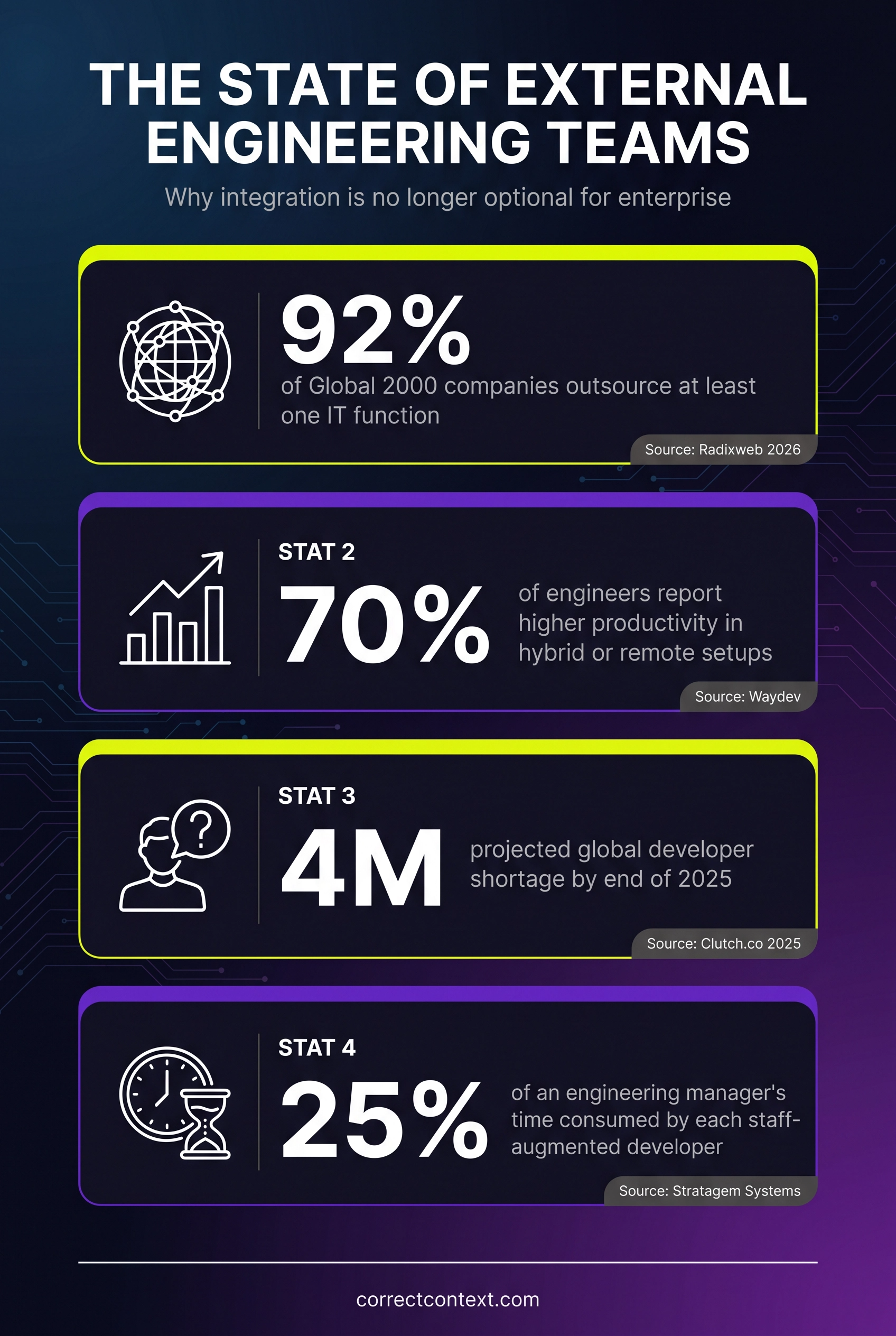
The global software development market is projected to reach $1.04 trillion by 2030, driven by an acute talent shortage that could leave the industry short of 4 million developers by the end of 2025 [1]. This reality forces organizations to look beyond their immediate borders. Yet, the question remains: can external teams integration happen without chaos? The answer is yes—provided that enterprises adopt a structured approach that treats hybrid engineering teams not as temporary vendors, but as true extensions of their core operations.
The Core Problem: The Fear of Silos and Chaos
When evaluating whether to scale engineering teams, enterprise leaders often hesitate. The primary problem is the fear that managing external developers will lead to fragmented communication, misaligned goals, and a loss of standards. This apprehension is rooted in outdated outsourcing models where work was thrown over the wall, leading to a “black box” scenario where internal teams lost visibility and external teams lost context.
Today, 70% of engineering teams report higher productivity when working remotely or in hybrid setups [2]. The challenge is not the physical distance—it is the operational disconnect. Without deliberate integration strategies, offshore development teams or nearshore development teams can easily become isolated silos. This isolation breeds redundancy, slows down release cycles, and ultimately erodes the ROI of the initiative. To prevent this, organizations must shift their mindset from “outsourcing tasks” to “integrating talent.”
Consider the numbers: 92% of Global 2000 enterprises already outsource at least one IT function [3]. The practice is not fringe—it is mainstream. The differentiator between organizations that succeed and those that struggle is not whether they use external teams, but how deeply those teams are integrated into the fabric of the organization.
Shifting from Vendors to Partners: The Dedicated Team Model
The traditional staff augmentation model, while flexible, often treats engineers as plug-and-play resources. This approach requires significant management overhead—up to 25% of an engineering manager’s time per augmented developer [4]. For complex enterprise systems, this is unsustainable and counterproductive.
Instead, successful organizations are turning to the dedicated development team model. This approach involves hiring a complete, self-managed team that integrates deeply with the internal organization. Whether you hire developers in Poland or establish an engineering hub in Europe, the goal is long-term alignment, not short-term task completion.
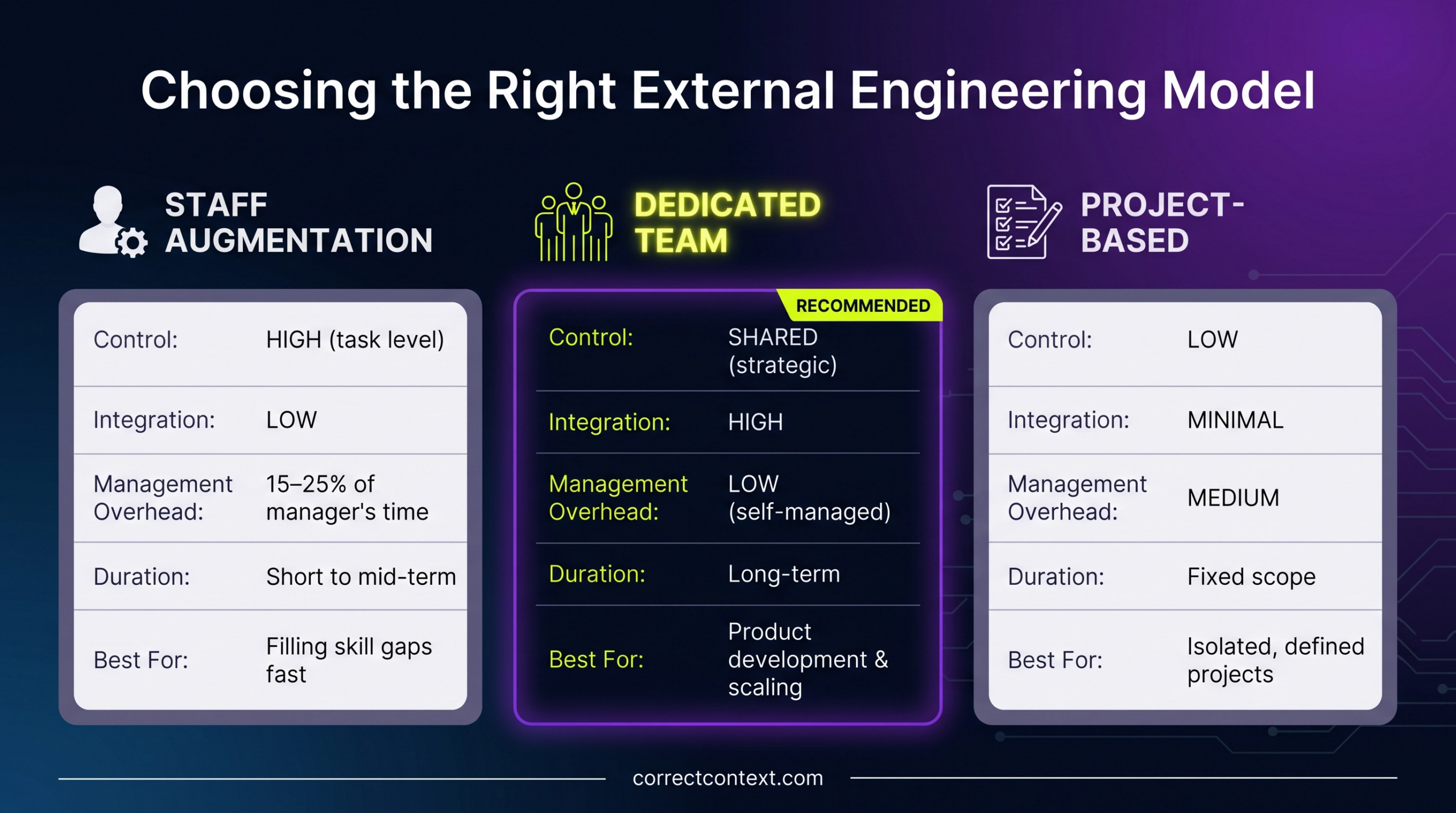
| Model | Control Level | Integration Depth | Management Overhead | Best Use Case |
|---|---|---|---|---|
| Staff Augmentation | High (task level) | Low | 15–25% of manager’s time | Short-term skill gaps |
| Dedicated Team | Shared (strategic) | High | Low (self-managed) | Long-term product development |
| Project-Based | Low | Minimal | Medium | Isolated, well-defined projects |
By leveraging a dedicated software team, enterprises gain a partner that understands the product vision, adheres to internal coding standards, and participates in the same agile ceremonies. This deep integration is particularly crucial when building specialized units, such as an AI development team, a data engineering team, or a cloud engineering team, where domain knowledge and contextual understanding are paramount to delivering quality outcomes.
Best Practices for Integrating External Engineering Teams
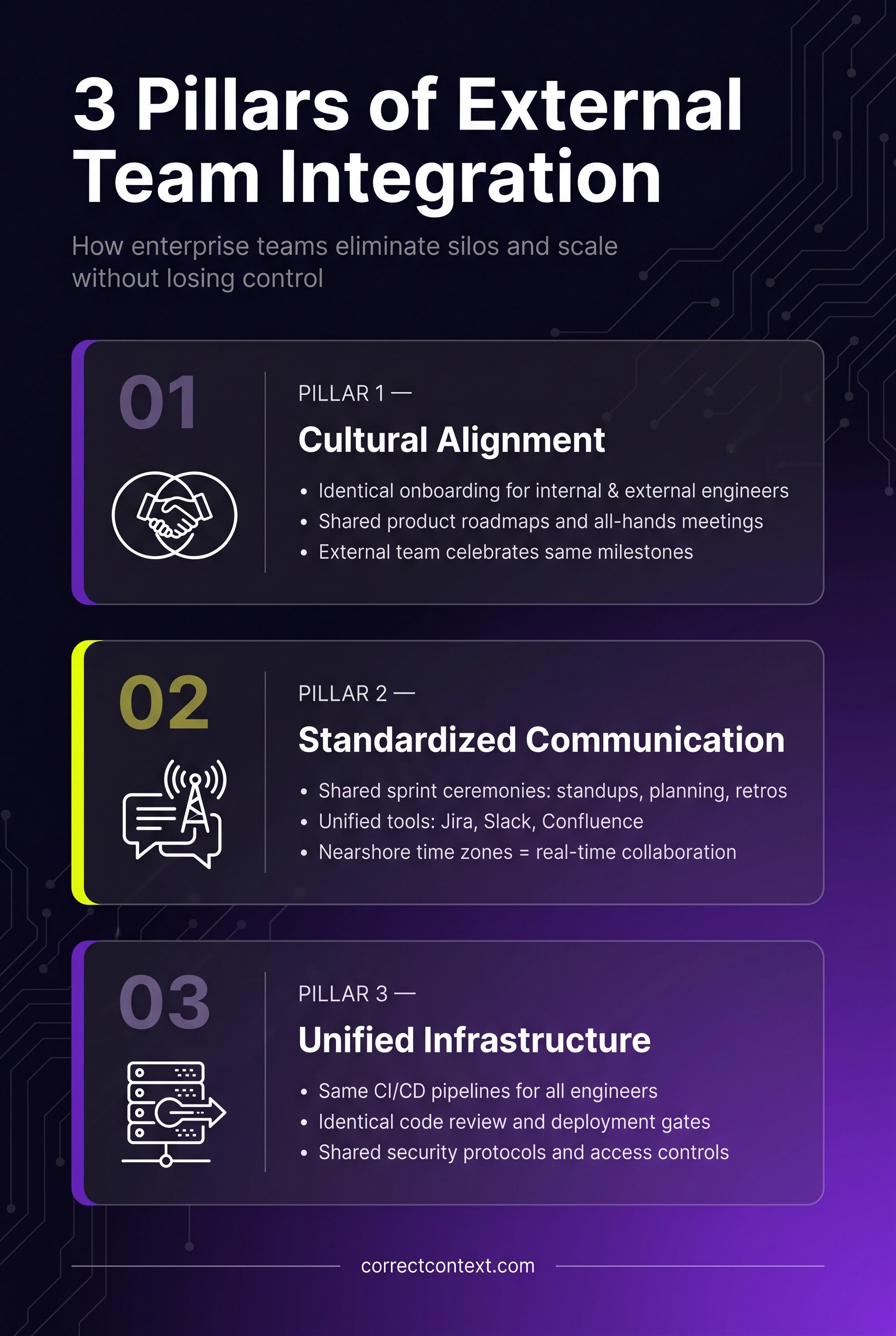
Achieving seamless integration requires deliberate action across three pillars: culture, communication, and infrastructure.
1. Cultural Alignment and Shared Goals
The foundation of a successful hybrid engineering team is a shared culture. External developers must understand the “why” behind the product, not just the “what.” This means including them in all-hands meetings, sharing product roadmaps, and celebrating joint successes. When you hire AI engineers or a backend development team, they should feel as much a part of the company as the engineers sitting in headquarters. Onboarding should be identical for external and internal team members, covering company values, coding standards, and product philosophy.
2. Standardized Communication and Ceremonies
Communication is the lifeblood of integration. Research indicates that every additional hour of time-zone gap can add approximately 0.7 hours of communication overhead [5]. This highlights the strategic advantage of utilizing nearshore developers in Europe for companies in the UK, DACH, and Nordics, or establishing a nearshore development team with overlapping business hours for US East Coast firms. The time-zone alignment that nearshoring to Poland and the CEE region provides is not a minor convenience—it is a structural productivity advantage.
Standardizing ceremonies—daily stand-ups, sprint planning, and retrospectives—ensures everyone operates on the same cadence. Utilizing tools like Jira, Slack, and Confluence creates a shared operational layer that prevents the formation of information silos. The remote software engineers team should have the same access to documentation, decision logs, and product backlogs as any internal engineer.
3. Unified Infrastructure and Tooling
To avoid chaos, external teams must operate within the same development environments, CI/CD pipelines, and security protocols as the internal team. A DevOps team for hire can help establish these unified pipelines, ensuring that code committed by an extended engineering team undergoes the same rigorous testing and security checks as internally generated code. This unified approach mitigates risk and ensures consistent quality across the entire codebase. Access controls, code review processes, and deployment gates should be identical regardless of whether the engineer is internal or external.
The Role of an Employer of Record (EoR)
For enterprises looking to establish a remote development team or a full engineering team in Poland / CEE without the administrative burden of setting up a local legal entity, partnering with an Employer of Record in Poland or EoR Europe is a strategic accelerator. An EoR handles recruitment, payroll, HR compliance, accounting, and office management—removing the operational complexity that typically delays or derails international team expansion.
Using payroll services in Poland through an EoR ensures full compliance with local labor laws, reducing legal risks while providing the external team with the stability and benefits of full-time employment. This model is highly effective for companies looking to hire in Europe without a company entity, offering a streamlined path to scale software development without the 12–18 month timeline typically required to establish a foreign subsidiary. The EoR CEE model is particularly well-suited for enterprises in FinTech, Media, and Software that need to move fast while maintaining compliance.
Leveraging Specialized Talent: AI, Data, and Cloud
The demand for specialized skills is a primary driver of external team integration. The global AI market is projected to grow from $279 billion in 2024 to $1.81 trillion by 2030 [1], making it increasingly difficult to hire AI programmers or hire AI coders locally at scale. By integrating an external machine learning engineers team or big data development team, enterprises can accelerate their AI initiatives without waiting for the local talent market to catch up.
Whether it is exploring enterprise AI tools, tracking AI trends in enterprise, or implementing corporate AI use cases at scale, a specialized external team brings focused expertise that is difficult and expensive to build internally. Similarly, as cloud infrastructure grows in complexity, a dedicated AWS / Azure / GCP engineers team or platform engineering team can ensure scalable, secure, and cost-optimized deployments. The data analytics team and big data development team models are particularly effective when integrated with internal data governance frameworks, ensuring that external engineers operate within the same data quality and compliance standards.
Measuring Success: Visibility Without Micromanagement
One of the most common concerns among enterprise leaders is how to maintain visibility without resorting to micromanagement. The answer lies in metrics, not surveillance. Establishing clear OKRs, sprint velocity benchmarks, code quality metrics, and deployment frequency targets provides objective visibility into team performance. These metrics apply equally to internal and external engineers, reinforcing the principle that the dedicated development team is held to the same standards as the internal team.
Regular business reviews—monthly or quarterly—between the enterprise leadership and the external team’s account management layer ensure strategic alignment is maintained over time. This structured governance model replaces the informal oversight that works in co-located settings but breaks down in distributed ones.
Conclusion: Control Through Integration
The fear of losing control when scaling with external teams is valid, but it is entirely preventable. By moving away from transactional outsourcing and embracing deep integration through the dedicated team model, enterprises can treat external teams as true internal extensions. When you establish a unified culture, standardized communication, and shared infrastructure, you eliminate silos and mitigate chaos.
Whether you are an enterprise looking to build a tech hub in Poland, a FinTech startup seeking affordable senior developers, or a media company that needs to scale software development rapidly, the key to success lies in how well you integrate. With the right approach—and the operational support of an EoR Poland or EoR Europe partner—you can scale engineering teams rapidly, securely, and with full confidence that your standards will be upheld.
References
[1] https://clutch.co/resources/state-of-software-development
[2] https://waydev.co/hybrid-work-engineering-teams/
[3] https://radixweb.com/blog/global-it-outsourcing-statistics
[4] https://www.stratagem-systems.com/blog/staff-augmentation-vs-dedicated-team-2026
[5] https://branch8.com/posts/offshore-engineering-team-productivity-metrics-2026