For rapidly scaling engineering teams, the pressure to deliver product milestones often clashes with the reality of an overstretched internal recruiting function. What begins as a strategic effort to build core competencies in-house can quickly devolve into a bottleneck that stifles innovation and delays critical releases. As the global demand for specialized tech talent outpaces supply, engineering leaders are increasingly questioning whether their current hiring models are sustainable. At a certain point, the traditional approach of relying solely on internal recruiters stops making sense, and recognizing this inflection point is critical for maintaining momentum.
This article explores the systemic in house hiring limitations for engineering teams, the hidden costs of internal recruiting bottlenecks, and the strategic indicators that signal it is time to pivot toward external support models, such as nearshoring or staff augmentation. Designed for enterprise innovation units and globally scaling Series A+ startups in the FinTech, Software, and Media sectors, this guide provides actionable insights to help you build resilient and scalable engineering teams.
The Growing Crisis in Tech Talent Acquisition
The landscape for acquiring software engineering talent has fundamentally shifted. While the overall number of software engineers is growing, the demand for highly specialized roles—particularly in artificial intelligence (AI), machine learning (ML), cloud architecture, and big data—is accelerating at an unprecedented rate. According to industry forecasts, the demand for software engineering roles is expected to grow by 22% to 24% by 2029 [1].
This surge in demand has created a severe global talent shortage. The International Data Corporation (IDC) estimates that 90% of organizations worldwide will be affected by the software engineer shortage, potentially resulting in $5.5 trillion in losses due to product delays and impaired competitiveness [2]. In the United States alone, the shortage of software engineers is projected to exceed 1.2 million by 2026 [2].
The Specialization Gap
The talent shortage is not distributed evenly. It is most acute in specialized domains that require deep expertise. For instance, the demand for AI specialists nearly doubled between 2024 and 2025, with job postings mentioning AI spiking by 1,800% in the US [2]. Similarly, there is a massive deficit in cybersecurity professionals, with a global gap estimated at nearly five million engineers [2]. Big data and data engineering roles are also under pressure, with 38% of businesses reporting a data talent shortage [2].
When internal recruiting teams are tasked with filling these highly specialized roles, they often struggle. Generalist recruiters may lack the deep technical understanding required to accurately assess a candidate’s proficiency in complex architectures like AWS, Azure, or GCP, or their ability to build scalable data pipelines. This lack of specialization leads to longer time-to-hire, lower quality candidate pipelines, and increased frustration for engineering managers who must spend more time screening unqualified applicants.
| Specialization | Reported Shortage | Key Driver |
|---|---|---|
| AI / ML Engineers | Demand nearly doubled YoY (2024–2025) | AI adoption across all industries |
| Cybersecurity Experts | ~5 million global gap | Cloud adoption, data breach risks |
| Big Data / Data Engineers | 38% of businesses report shortage | Data-driven decision-making, AI tooling |
| Cloud / DevOps Engineers | 34% of tech leaders actively seeking | Multi-cloud deployments (98% of enterprises) |
| Full-Stack Developers | Market growing 25% annually | Product versatility and cost-effectiveness |
Source: ManpowerGroup Global Talent Shortage Report; Nash Squared Digital Leadership Report [2]

The Hidden Costs of Internal Recruiting Bottlenecks
When in-house hiring fails to keep pace with organizational growth, the costs extend far beyond the recruiting budget. The most significant impact is felt in lost productivity and delayed revenue generation.
Vacancy Drag and Lost Productivity
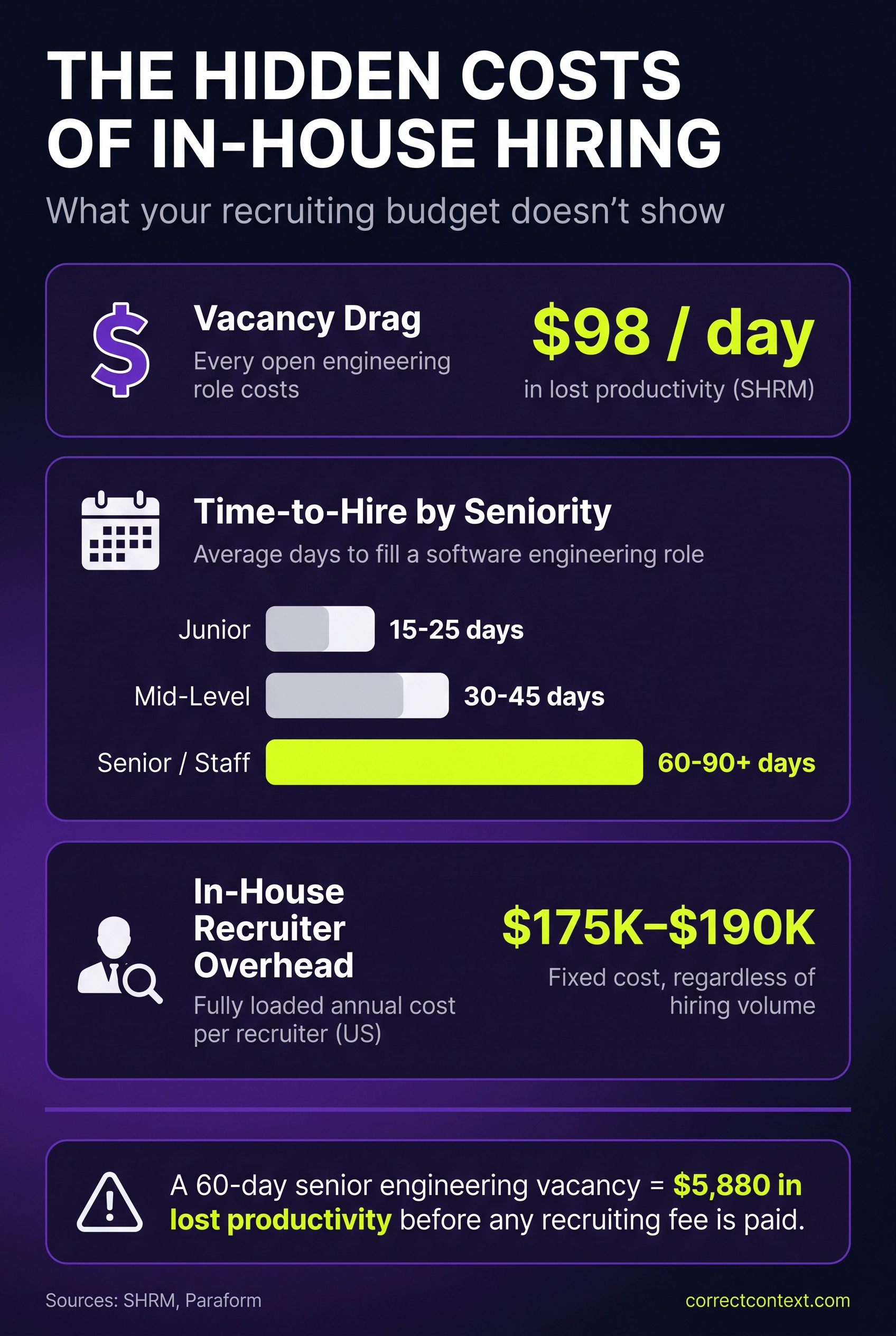
Every day a critical engineering role remains unfilled represents a tangible financial loss. The concept of “vacancy drag” quantifies this impact: open roles cost roughly $98 per day in lost productivity, according to SHRM [3]. For a senior software engineer with an annual compensation of $260,000, a 60-day vacancy bleeds nearly $6,000 before a single recruiting fee is paid [3].
Moreover, the average time-to-hire for software engineers has stretched considerably. Depending on the region and the seniority of the role, it can take anywhere from 35 to over 90 days to fill a position [1]. For senior or staff-level roles, the process often drags on for months, as these candidates are rarely active job seekers and require sophisticated passive sourcing strategies.
| Role Level | Average Time-to-Hire | Primary Challenge |
|---|---|---|
| Junior (0–2 years) | 15–25 days | High volume of unqualified applicants |
| Mid-Level (3–5 years) | 30–45 days | Candidate experience and competing offers |
| Senior / Staff (6+ years) | 60–90+ days | Passive candidates; multi-round approvals |
Source: Talmatic, “Average Time to Hire a Software Engineer in 2026” [1]
The Burden on Engineering Leadership
When internal recruiters are overwhelmed, the burden of sourcing and screening candidates inevitably falls on engineering leadership. Every hour a technical lead or engineering manager spends reviewing resumes or conducting initial phone screens is an hour diverted from product development, architectural planning, or mentoring existing team members [3].
This dynamic creates a vicious cycle: as the team falls behind on deliverables due to open headcount, existing engineers are forced to take on more work, leading to burnout and increased attrition. The departure of key personnel then exacerbates the hiring crisis, placing even more pressure on the already strained recruiting function.
The True Cost of In-House Recruiting
The financial model of in-house recruiting is often misunderstood. While it may appear cost-effective on the surface, the fully loaded cost of an internal recruiter—including salary, benefits, ATS licenses, LinkedIn Recruiter seats, and sourcing tools—can range from $175,000 to $190,000 annually in the US [3]. This cost is fixed, regardless of hiring volume. During periods of rapid scaling engineering hiring, the internal team may be overwhelmed, necessitating expensive contingency agency fees on top of existing overhead. Conversely, during slower hiring quarters, the organization is paying for idle capacity. This lack of elasticity makes purely in-house models inefficient for companies experiencing dynamic growth phases.
Recognizing the Signs: When to Pivot Your Hiring Strategy
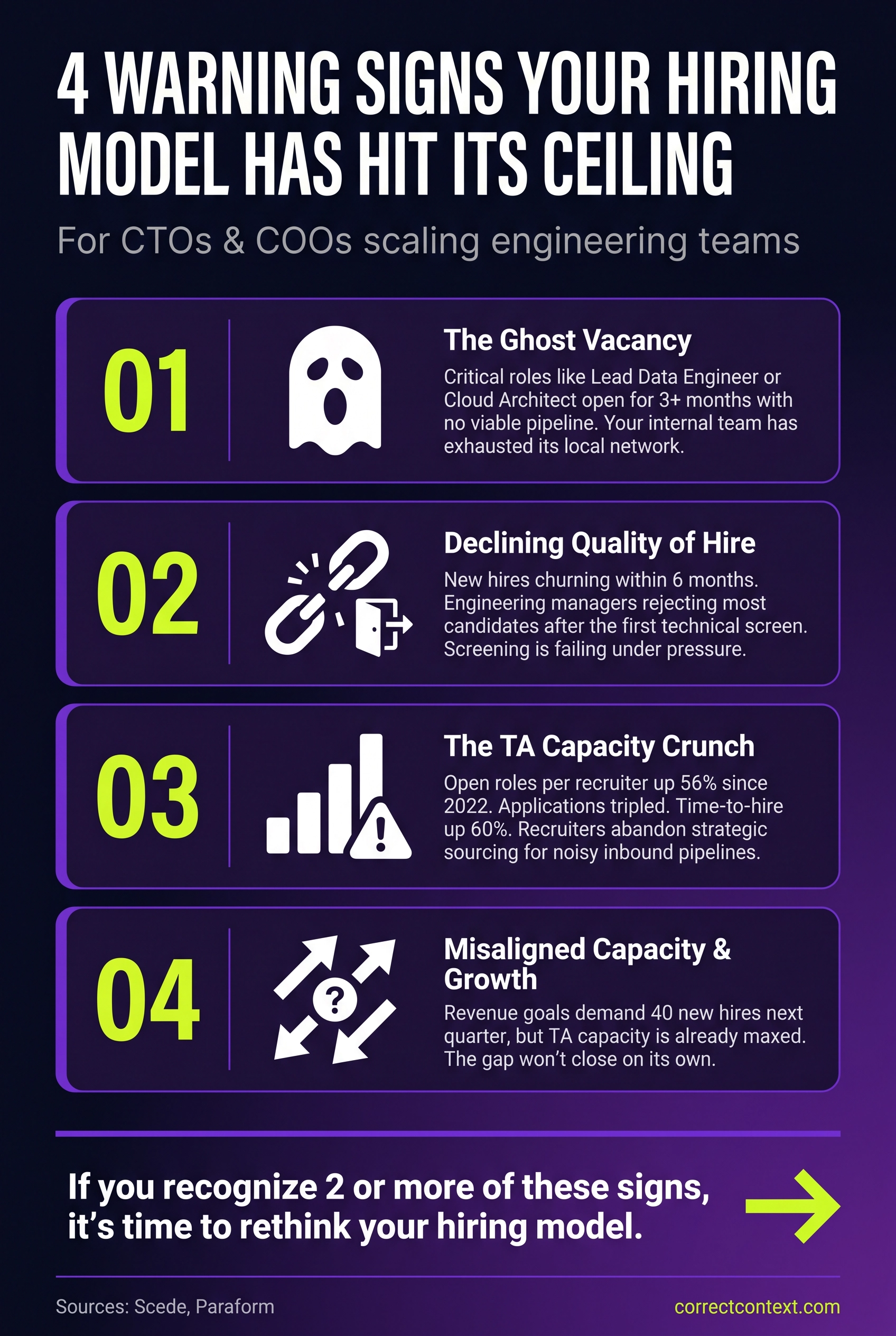
How do you know when your in house hiring limitations are actively harming your business? Engineering leaders must monitor specific indicators that signal the internal recruiting engine is stalling.
- The “Ghost” Vacancy Phenomenon. If critical engineering roles—such as Lead Data Engineer or Cloud Architect—have remained open for months without a viable pipeline of candidates, your internal team has likely exhausted its local network. Specialized roles require proactive, targeted outreach to passive candidates, a time-intensive process that overwhelmed internal recruiters often abandon in favor of easier-to-fill positions.
- Declining Quality of Hire. When recruiting teams are pressured to fill seats quickly, the quality of candidates often suffers. If engineering managers are rejecting a high percentage of candidates after the first technical interview, or if new hires are churning within the first six months, the screening process is failing. A mis-hire for a senior engineering role can cost hundreds of thousands of dollars in lost productivity, onboarding time, and diverted team bandwidth [3].
- The TA Capacity Crunch. The data is stark: since 2022, the average number of open roles per internal recruiter has jumped by 56%, while application volumes have nearly tripled [4]. Meanwhile, time-to-hire is up 60% and hiring teams are running 42% more interviews per hire than just three years ago [4]. This capacity crunch forces recruiters to abandon strategic sourcing and rely heavily on inbound applications, resulting in noisy pipelines filled with unqualified candidates.
- Misaligned Capacity and Growth Projections. A common point of failure occurs when revenue goals dictate aggressive hiring targets, but talent acquisition capacity is not scaled accordingly. If leadership is planning 40 new hires next quarter but the recruiting team is already at full capacity, the gap will not close on its own. Recruiting breaks during rapid growth not because of a lack of effort, but because hiring capacity planning is not aligned to revenue expectations [4].
The Strategic Alternative: Scaling with External Support
When internal recruiting bottlenecks threaten to derail your product roadmap, clinging to a purely in-house model is a strategic error. High-growth tech companies and enterprise innovation units are increasingly turning to external models to achieve the scale and velocity required to compete. The recruitment outsourcing market is already worth over $11 billion and is projected to reach $32.6 billion by 2032, a trajectory driven by companies that have concluded external support simply works [5].
The Power of Nearshoring and Staff Augmentation
For companies based in the US East Coast, the UK, DACH, or the Nordics, building a dedicated development team or an extended engineering team in regions like Poland and the broader Central and Eastern Europe (CEE) area offers a compelling solution. This approach, often facilitated by an Employer of Record Poland (EoR) model, allows companies to bypass local talent shortages and tap into a deep pool of highly skilled software developers Poland and across the CEE region.
The key advantages of this model are substantial. First, it dramatically accelerates time-to-market. By partnering with specialized firms that maintain active networks of pre-vetted engineers, companies can assemble a remote development team in a fraction of the time it takes to hire locally. Second, it provides access to elite specialization. Whether you need to hire AI engineers, build a data analytics team, or assemble a cloud engineering team, specialized nearshore partners have the domain expertise to identify and attract top-tier talent in areas where local markets are chronically undersupplied. Third, it offers elastic scalability. External models provide the flexibility to scale software development capacity up or down based on project demands, without the fixed overhead of maintaining a large internal recruiting staff. Finally, it delivers operational efficiency. Utilizing payroll services Poland or employment compliance Europe through an EoR Europe provider allows your organization to hire globally without the administrative burden of establishing a local legal entity.
Building a Resilient Engineering Hub
The goal is not simply to outsource tasks, but to strategically build an engineering hub Europe that functions as a seamless extension of your core business. By integrating nearshore developers Europe into your existing engineering culture, agile processes, and quality standards, you create a resilient, globally distributed team capable of sustaining rapid innovation cycles.
For Series A+ startups, securing an offshore team for startup growth provides the necessary velocity to achieve critical milestones while maintaining a sustainable burn rate. For Fortune 5000 enterprises, deploying a specialized machine learning engineers team or a platform engineering team through a nearshore partner ensures that digital transformation initiatives are not delayed by local hiring constraints.
Conclusion
The insistence on building every engineering capability purely through in-house hiring is a legacy mindset that fast-growing tech companies can no longer afford. When scaling engineering hiring becomes a constraint rather than an enabler of growth, it is time to reassess the strategy. The evidence is clear: talent shortages are deepening, internal recruiting capacity is under unprecedented strain, and the cost of a slow hire is far greater than most organizations account for.
By recognizing the in house hiring limitations of internal recruiting—from capacity crunches and vacancy drag to the inability to source highly specialized talent—engineering leaders can make informed decisions about when to outsource hiring. Embracing flexible, globally distributed models like nearshoring in the CEE region empowers organizations to build tech hub Poland capabilities, access affordable senior developers, and ultimately build high-performing dedicated software teams that drive innovation and secure a competitive advantage in an increasingly complex technological landscape.
References
[1] Talmatic. “Average Time to Hire a Software Engineer in 2026.” Talmatic Blog, May 2026.
[2] Tecla. “Tech Talent Shortage in 2025: Causes, Impact, & Solutions.” Tecla Blog, December 2025.
[3] Paraform. “The True Cost of Hiring: Agency vs. In-House vs. Embedded.” Paraform Blog, April 2026.
[4] Scede. “The TA Capacity Crunch: 56% More Roles, Smaller Teams, Slower Hiring.” Scede Blog, August 2025.
[5] Rangam. “What Every Business Owner Needs to Know about Outsourced Recruitment.” Rangam Blog, March 2026.