
The artificial intelligence revolution is no longer just a boardroom talking point; it is a measurable business imperative. In 2025 alone, companies spent an estimated $37 billion on generative AI, representing a massive 3.2x year-over-year increase [1]. Yet, despite this unprecedented influx of capital, the stark reality remains that the vast majority of enterprise AI initiatives fail to deliver meaningful return on investment. According to research from the RAND Corporation, over 80% of AI projects fail—double the failure rate of traditional IT efforts [2]. Even more alarming, a 2025 MIT study found that 95% of organizations deploying generative AI saw zero measurable return [3].
For CTOs and data leaders steering mid-stage AI projects at Fortune 5000 enterprises or scaling Series A+ startups, these statistics are a blaring siren. The problem is rarely the intelligence of the models themselves. Instead, the root cause of these spectacular failures lies deep within the infrastructure. AI initiatives fail because organizations attempt to deploy sophisticated machine learning tools on top of fragile, fragmented, and inadequate backend architectures.
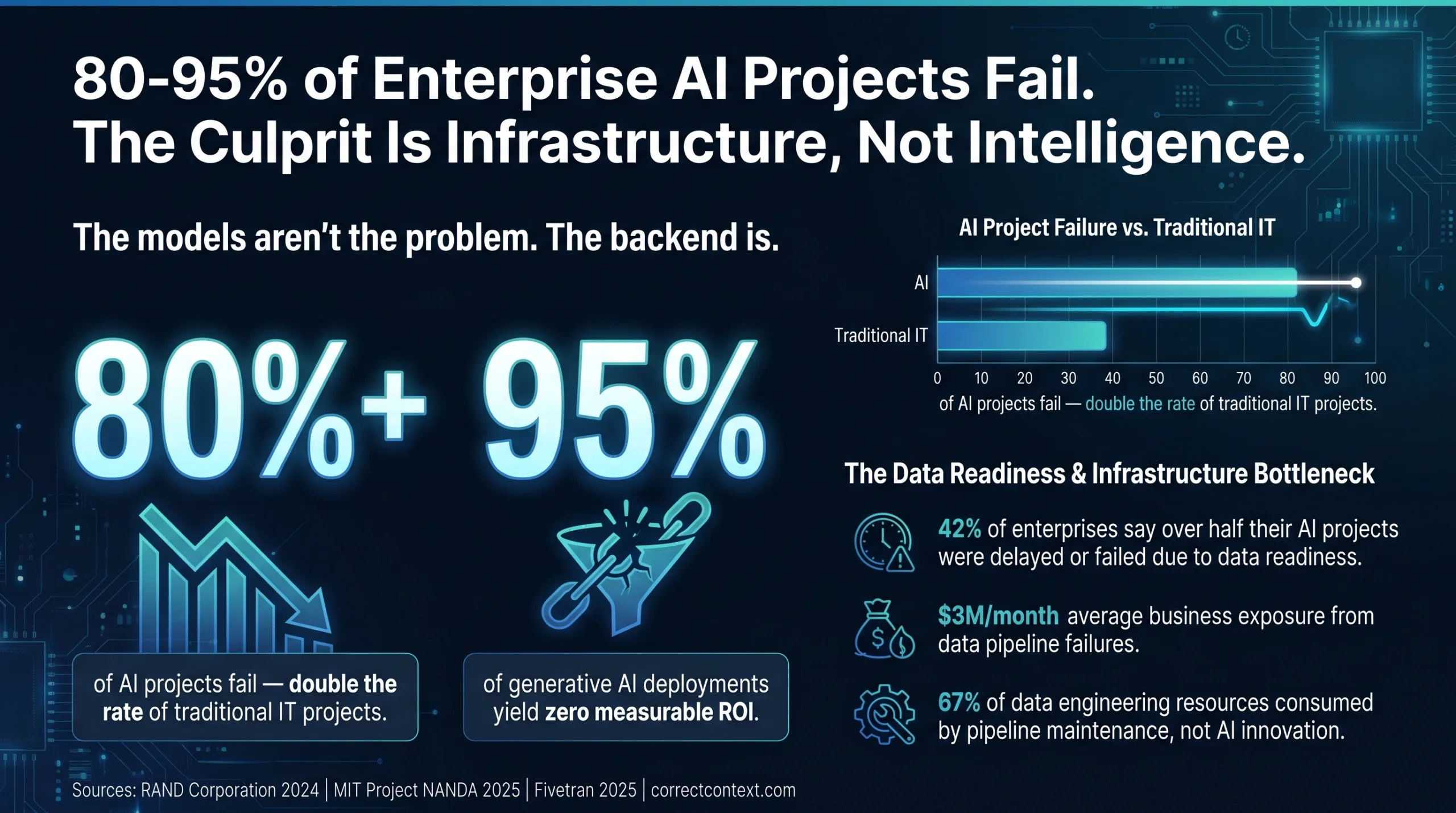
Without robust AI backend architecture, scalable data pipelines, and a dedicated backend development team, even the most advanced algorithms will collapse under the weight of production demands. This article explores the critical architecture gaps that doom AI projects, why strong backend engineering is the non-negotiable foundation for success, and how strategic decisions around hiring—such as partnering with an offshore development team or nearshore developers in Europe—can bridge the talent gap and secure your AI investments.
The Illusion of the AI Prototype
In the controlled environment of a proof-of-concept (PoC) or a polished vendor demo, AI models often perform flawlessly. Data scientists can manually clean datasets, fine-tune parameters, and showcase impressive accuracy metrics. However, transitioning from a static prototype to a dynamic production environment exposes the true fragility of the underlying systems.
The RAND Corporation’s comprehensive analysis of AI project failures identified that one of the primary culprits is underinvestment in infrastructure [2]. When models move to production, they require continuous streams of fresh, high-quality data. If the AI infrastructure cannot support automated data pipelines, real-time monitoring, and seamless deployment, the model’s accuracy rapidly degrades.
“Organizations that quickly move from prototype to prototype often find that they are completely blind to failures that arise after the AI model has been completed and deployed. Robust infrastructure allows the engineering team to detect when a deployed model needs maintenance.” [2]x
This disconnect highlights a fundamental misunderstanding of what it takes to build scalable AI systems. An AI project is not just a data science endeavor; it is fundamentally a software engineering challenge. Relying solely on data scientists to build production-grade systems is a recipe for disaster.
The Infrastructure Gap: Why AI Initiatives Fail
To understand why AI projects stall, we must examine the specific backend and data infrastructure failures that plague modern enterprises.
1. The High Cost of Fragile Data Pipelines
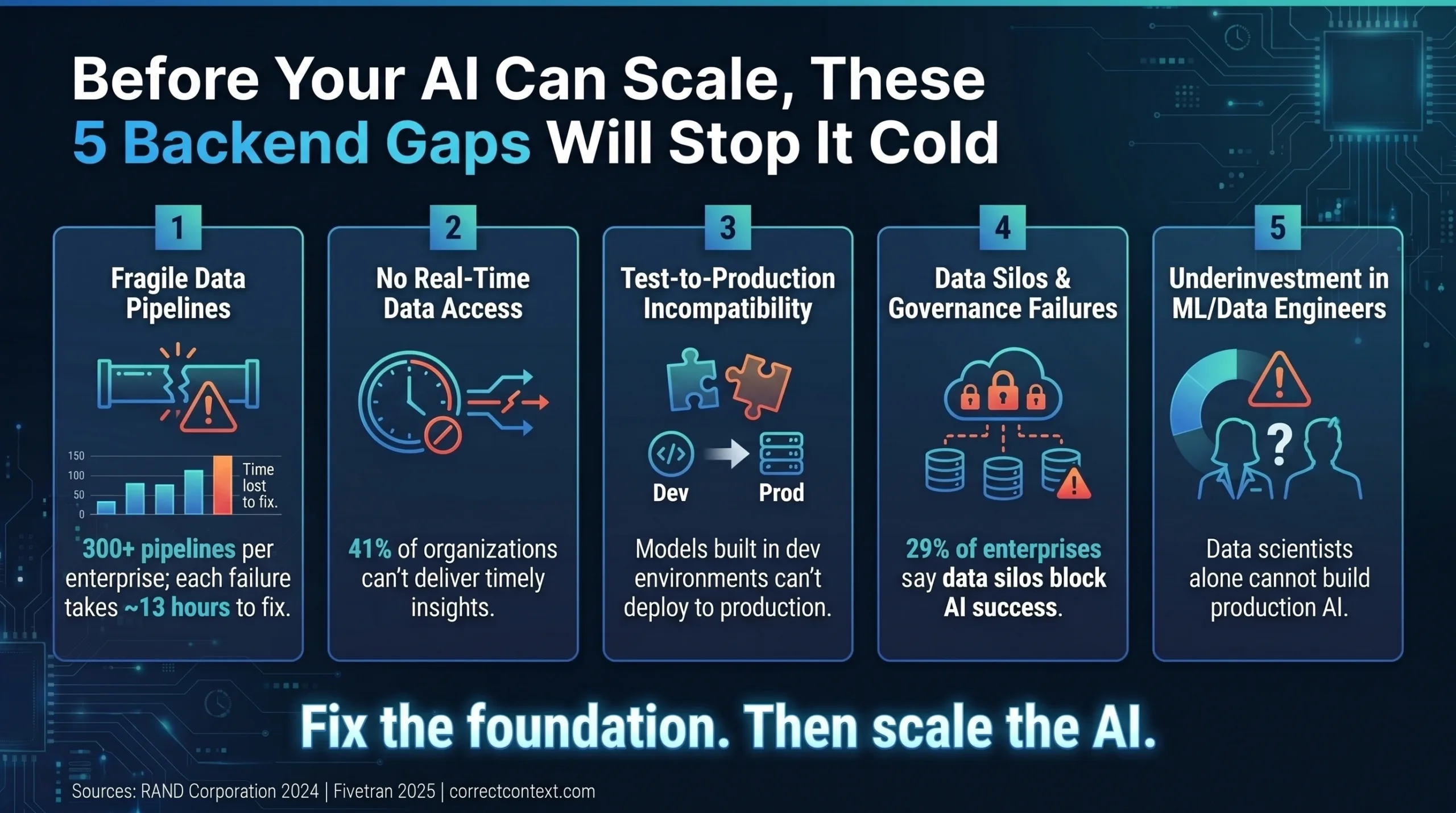
AI models are only as good as the data that feeds them. Unfortunately, many organizations struggle to maintain the complex web of data pipelines required for enterprise-grade AI. A 2025 survey by Fivetran revealed that 42% of enterprises report their AI projects have been delayed, underperformed, or failed entirely due to data readiness issues [4].
The financial toll of these failures is staggering. Industry reports indicate that data pipeline failures cost enterprises an average of $3 million per month in business exposure, with 97% of senior data leaders admitting that pipeline issues have slowed their analytics or AI initiatives [5]. When the average enterprise manages over 300 data pipelines—and each failure takes roughly 13 hours to resolve—the resulting downtime paralyzes AI innovation [5].
Furthermore, the Fivetran study found that 67% of highly centralized enterprises still spend over 80% of their data engineering resources merely maintaining pipelines, leaving virtually no capacity for actual AI development [4]. A strong data engineering team is essential to build resilient pipelines that automate data integration, ensuring that AI models receive the real-time, high-quality data they require.
2. Scalability and Real-Time Processing Bottlenecks
AI backend architecture must handle massive volumes of data with exceptionally low latency. Generative AI and predictive models require significant computational power and rapid data retrieval to function effectively in user-facing applications.
Many legacy backend systems were designed for traditional CRUD (Create, Read, Update, Delete) operations, not the intensive workloads of modern AI. When these systems are forced to process complex AI tasks, they create severe bottlenecks. According to Fivetran, 41% of organizations report that the lack of real-time data access prevents their AI models from delivering timely insights [4].
Without a platform engineering team capable of designing distributed systems, implementing efficient caching layers, and optimizing database queries, the AI application will suffer from unacceptable latency, leading to poor user experiences and eventual abandonment.
3. The Deployment and MLOps Disconnect
Developing an AI model is only half the battle; deploying and maintaining it in production is where the real complexity lies. The discipline of Machine Learning Operations (MLOps) bridges the gap between data science and backend engineering, yet many organizations lack this critical capability.
Without robust MLOps practices, deploying models becomes a manual, error-prone process. The RAND report noted instances where AI models could not be deployed from test environments to production because the production environments were incompatible with the model’s requirements [2]. A skilled DevOps team for hire or dedicated MLOps engineers are necessary to build the CI/CD (Continuous Integration/Continuous Deployment) pipelines that automate model testing, deployment, and monitoring.
Why You Need to Invest in Backend Foundations First
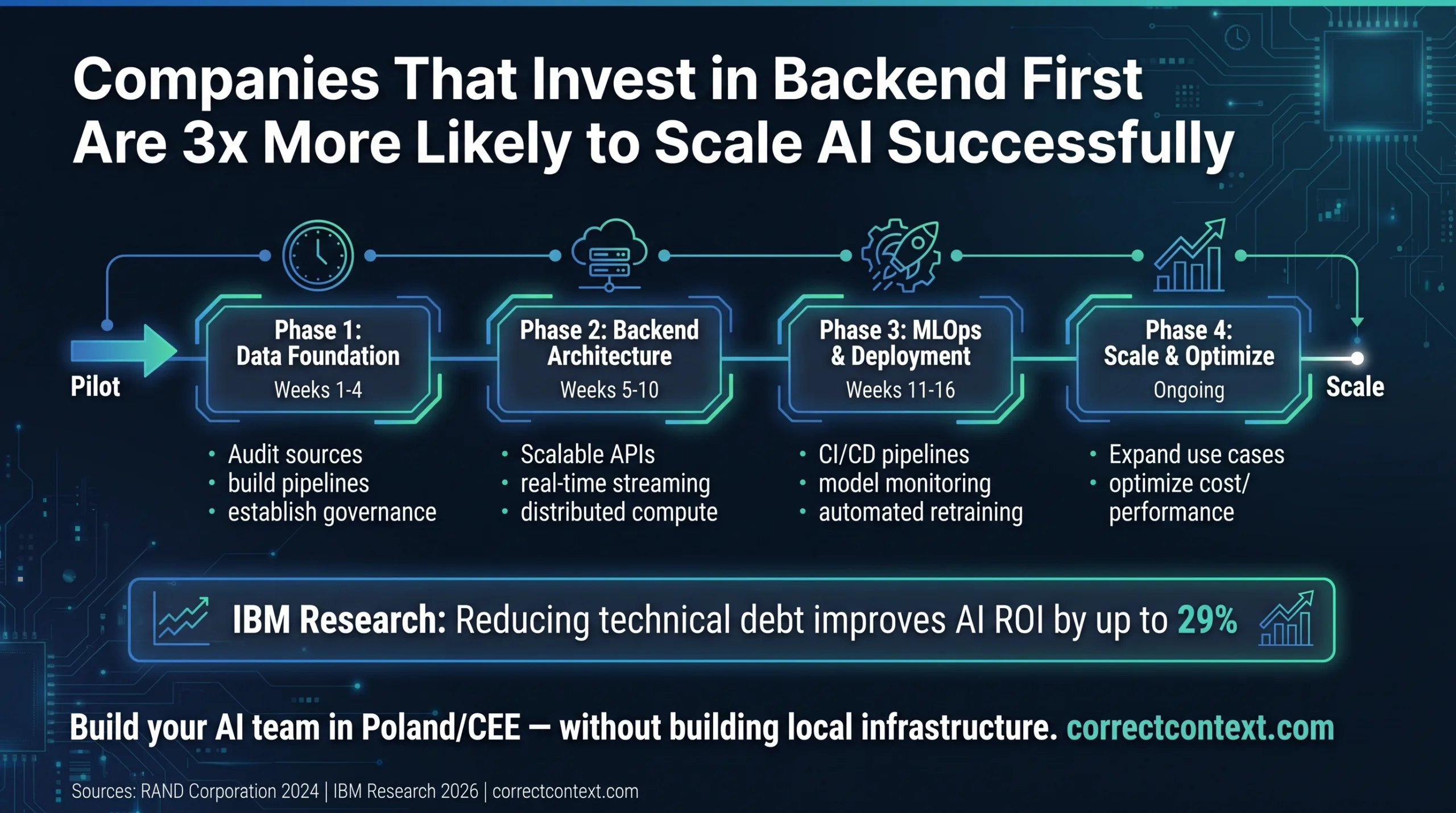
For CTOs and data leaders, the message is clear: before investing millions in advanced AI models, you must first secure your backend and data foundations. Building a strong infrastructure is not just a technical prerequisite; it is a strategic business decision that directly impacts ROI.
Paying Down Technical Debt Yields Real Returns
Attempting to bolt AI onto legacy systems is a costly mistake. Research from IBM demonstrates that paying down technical debt from legacy systems can improve AI ROI by up to 29%, as it significantly reduces friction and rework [6]. By investing in a modern backend for AI, organizations create a stable platform that accelerates future AI initiatives.
Enabling the Data Science Team
Data scientists are highly specialized professionals whose primary value lies in algorithm development and statistical analysis. When they are forced to spend their time troubleshooting broken data pipelines or wrestling with deployment scripts, their productivity plummets. By establishing a strong backend development team, you free your data scientists to focus on what they do best, thereby maximizing the value of your AI talent.
Future-Proofing for Scale
As AI adoption continues to accelerate, the demands on your infrastructure will only grow. Gartner predicts that 40% of agentic AI projects will fail by 2026 [7], emphasizing the need for robust systems that can support increasingly autonomous and complex AI agents. A scalable backend architecture ensures that your systems can handle increased workloads, new data sources, and more sophisticated models without requiring a complete rebuild.
Overcoming the AI Engineering Talent Shortage
Recognizing the need for strong backend engineering is the first step; acquiring the necessary talent is the second, and often more difficult, challenge. The global tech industry is currently facing a severe shortage of qualified software engineers. The IDC estimates that 90% of organizations worldwide will be affected by the software engineer shortage in the coming years [8].
The demand for AI-related skills is particularly acute. In Q1 2025, the U.S. saw a 25.2% year-over-year increase in AI-related job postings [9]. As enterprises race to build their AI capabilities, competition for top-tier machine learning engineers, cloud engineering teams (with AWS / Azure / GCP experience), and backend developers has driven salaries to unprecedented heights.
The Strategic Advantage of Nearshoring to Poland and CEE
For enterprises and Series A+ startups located in the US East Coast, UK, DACH, and Nordics, competing for local talent is often prohibitively expensive and time-consuming. This is where strategic outsourcing becomes a critical lever for success.
Building a dedicated development team or an extended engineering team in regions with deep technical expertise can rapidly close the talent gap. Poland and the broader Central and Eastern European (CEE) region have emerged as premier destinations for sourcing elite technical talent.
By choosing to hire developers in Poland or establish an engineering hub in Europe, companies gain access to a vast pool of highly educated, experienced professionals. The region is renowned for its rigorous STEM education and its developers’ proficiency in complex backend architecture, big data analytics, and cloud infrastructure.
Scaling Without the Administrative Burden
One of the primary concerns for CTOs considering an offshore development team or nearshore development team is the administrative and legal complexity of international hiring. However, modern employment solutions have eliminated these barriers.
Utilizing an Employer of Record (EoR) in Poland or an European employer of record allows companies to hire employees without an entity in the target country. Services like those provided by Correct Context enable organizations to seamlessly hire in Europe without a company, handling all aspects of recruitment, payroll services in Poland, HR, accounting, and employment compliance in Europe.
This model allows startups and enterprises to quickly scale software development and deploy an affordable senior developers team—whether you need a startup development team, a big data development team, or an AI development team—without the overhead of building local infrastructure.
Conclusion: Build the Foundation Before the Penthouse
The failure of enterprise AI is rarely a failure of artificial intelligence itself; it is a failure of software engineering. When 80% of AI projects fail [2] and 95% of generative AI deployments yield zero ROI [3], the common denominator is consistently weak infrastructure, fragile data pipelines, and a lack of robust backend architecture.
For CTOs and data leaders, the path forward requires a paradigm shift. Before you can harness enterprise AI tools or capitalize on AI trends in the enterprise, you must invest in the foundational systems that make AI possible. This means prioritizing scalable AI systems, modernizing data pipelines, and, most importantly, assembling a world-class engineering team.
Whether you choose to build this team internally or leverage a remote software engineers team through a trusted EoR in CEE, the mandate is clear: strong backend engineering is not optional. It is the bedrock upon which successful, scalable, and profitable AI initiatives are built. Do not let your AI ambitions collapse under the weight of weak infrastructure. Invest in the backend, secure your data, and empower your organization to truly use AI tools inside the corporation for measurable, lasting impact.
References
[1] Menlo Ventures. 2025: The State of Generative AI in the Enterprise. December 2025.
[2] RAND Corporation. The Root Causes of Failure for Artificial Intelligence Projects and How They Can Succeed. August 2024.
[3] SR Analytics / MIT Project NANDA. Why 95% of AI Projects Fail and How Data Fixes It. February 2026.
[4] Fivetran. Fivetran Report Finds Nearly Half of Enterprise AI Projects Fail Due to Poor Data Readiness. May 2025.
[5] Yahoo Finance. Data Pipeline Failures Cost Enterprises $3 Million per Month. March 2026.
[6] IBM Research. How to Maximize AI ROI in 2026.
[7] Gartner. Gartner: 40% of agentic AI projects will fail, making humans indispensable.
[8] Tecla. Tech Talent Shortage in 2025: Causes, Impact, & Solutions. December 2025.
[9] Veritone. AI Jobs on the Rise: Q1 2025 Labor Market Analysis. May 2025.
Table of content
Related articles



About the Author: Marta