
10 Reasons Software Engineers Quit (And How to Keep Your Best Developers)
Here is a sobering statistic: 83% of software developers suffer from burnout, according to a 2021 study by Haystack Analytics. Even more alarming, 81% of those developers reported that their burnout worsened during the pandemic due to increased workload and pressure. Yet despite these challenges, the tech industry continues to hemorrhage talent at an unsustainable rate.
The Work Institute’s 2025 Retention Report reveals that 75% of employee departures were preventable. That means three out of four engineers who walked out your door could have been saved with the right interventions. For CTOs and engineering leaders, understanding why developers quit is not just an HR concern—it is a business-critical priority that directly impacts product velocity, team morale, and your bottom line.
In this comprehensive guide, we break down the top 10 reasons software engineers quit their jobs, backed by the latest research from 2024-2025. More importantly, we provide actionable strategies to address each issue so you can build a team that stays, grows, and thrives.
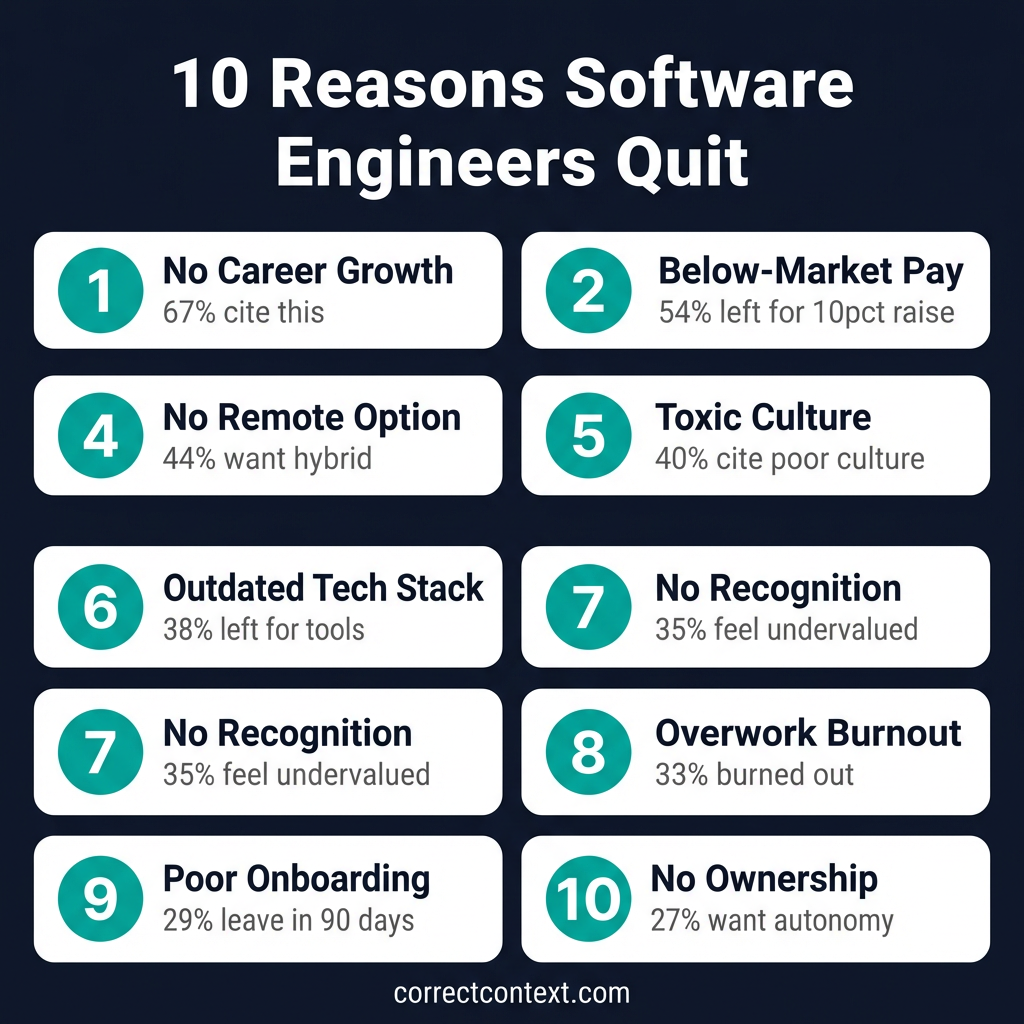
1. Lack of Career Growth and Development Opportunities
The number one reason developers quit? Stagnation. According to the Work Institute 2025 Retention Report, career development remains the primary cause of employee turnover across all industries—and tech is no exception. When engineers stop learning, they start looking.
Developers are knowledge workers who thrive on mastery. Stack Overflow’s 2025 Developer Survey found that 69% of developers spent time in the last year learning new coding techniques or programming languages. They invest in themselves constantly, and they expect their employers to support that growth.
The problem compounds when companies lack clear career ladders. Senior engineers hit a ceiling where the only path forward is management—a role many technical professionals neither want nor are suited for. Without dual career tracks that offer advancement, compensation growth, and influence without requiring people management, your best individual contributors will eventually leave.
How to Fix It
- Build dual career tracks: Create parallel paths for individual contributors (ICs) and managers, with equivalent compensation and prestige at each level
- Define clear competencies: Make promotion criteria transparent so engineers know exactly what skills to develop
- Invest in learning: Allocate budget for conferences, courses, certifications, and dedicated learning time
- Rotate challenging assignments: Give senior engineers opportunities to work on new technologies, architectures, or domains
2. Below-Market Compensation
While money is rarely the only factor, it is often the catalyst that pushes an already-disengaged developer out the door. The Dice 2025 Tech Salary Report found that only 41% of tech professionals reported being either “very” or “somewhat” satisfied with their compensation—an all-time low.
Engineers talk. They know what their peers earn at other companies, and they have access to salary data from levels.fyi, Glassdoor, and industry surveys. When they discover they are underpaid by 20-30% compared to market rates, loyalty evaporates quickly.
The Work Institute’s research emphasizes that pay is a signal, not a solution to turnover. Competitive compensation will not fix toxic culture or poor management, but uncompetitive pay will accelerate departures of already-frustrated employees.
How to Fix It
- Conduct regular market analysis: Benchmark salaries quarterly, not annually, against relevant peer companies
- Be proactive with adjustments: Do not wait for resignation threats to offer raises
- Consider total compensation: Equity, bonuses, benefits, and perks matter as much as base salary
- Be transparent about pay bands: Transparency builds trust and reduces speculation
3. Burnout and Unsustainable Workloads
The Haystack Analytics study found that 83% of developers suffer from burnout—a staggering figure that should alarm every engineering leader. Burnout is not just feeling tired; it is a state of chronic physical and emotional exhaustion that destroys productivity, creativity, and health.
The Nectar HR 2025 Employee Survey found that 41% of employees are currently experiencing burnout at work. For developers, the causes are familiar: insane workloads, unrealistic deadlines, constant context switching, and the pressure to be “always on.”
Burnout is particularly dangerous because it is contagious. When one team member burns out, others pick up the slack, accelerating their own path to exhaustion. Before long, you have a team running on fumes, making poor technical decisions and shipping buggy code.
How to Fix It
- Set realistic deadlines: Involve engineers in estimation and protect them from arbitrary business timelines
- Limit work in progress: Reduce context switching by limiting concurrent projects
- Enforce time off: Require minimum vacation usage and model healthy boundaries from leadership
- Monitor for burnout signals: Watch for decreased productivity, cynicism, and disengagement
- Address root causes: Burnout is a systemic problem, not an individual weakness
4. Poor Management and Leadership
Developers do not quit companies—they quit managers. The Work Institute 2025 report identifies managers as the linchpin for employee turnover. A bad manager can destroy morale, stifle growth, and drive away top performers faster than any other factor.
Common management failures in tech include: micromanaging engineers who need autonomy, making technical decisions without consulting the team, failing to provide regular feedback, taking credit for team wins while blaming individuals for losses, and lacking the technical literacy to understand what their team actually does.
The 2025 Retention Report from HR Oasis notes that empathetic, technically literate managers can cut churn by 25% or more. Management quality is not a “nice to have”—it is a retention superpower.
How to Fix It
- Train your managers: Technical excellence does not equal management competence—invest in leadership training
- Promote carefully: Do not force senior ICs into management roles; let them choose their path
- Require regular 1:1s: Weekly 30-minute meetings between managers and direct reports are non-negotiable
- Collect upward feedback: Survey teams about management quality and act on the results
- Remove bad managers quickly: One toxic manager can poison an entire team
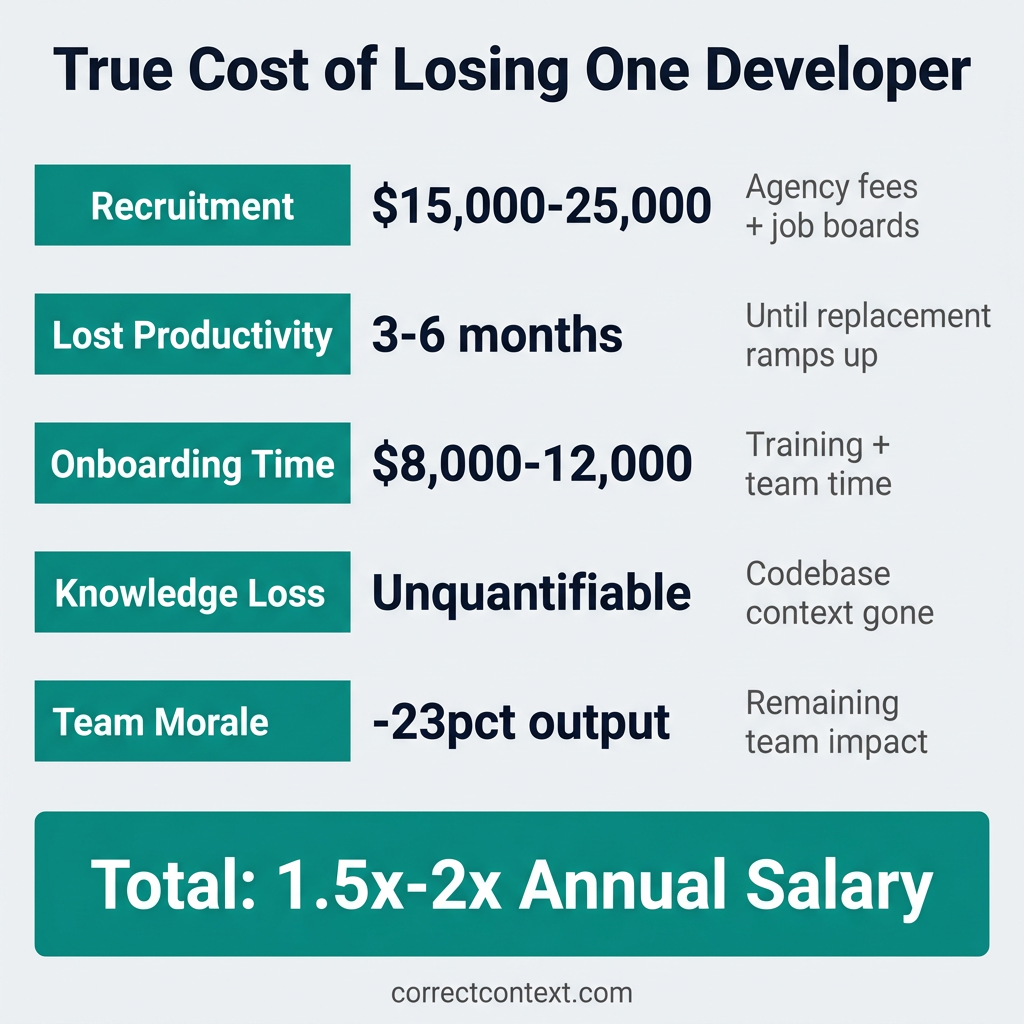
5. Lack of Remote and Flexible Work Options
The pandemic permanently changed developer expectations about where and how work happens. The Work Institute 2025 report confirms that remote and hybrid work is a transformative workplace practice and here to stay. Companies that force rigid return-to-office policies risk losing talent to more flexible competitors.
Stack Overflow’s 2025 survey shows significant variation in remote work preferences by region, but the trend is clear: developers value flexibility. For many, the ability to work from home, avoid commutes, and manage personal responsibilities is worth as much as a salary increase.
The Nectar HR survey found that in-office work arrangement was most important for men, workers at companies with 501-1,000 employees, and 35 to 44-year-olds—but this does not mean they want full-time office presence. It means they want options.
How to Fix It
- Offer genuine flexibility: Let teams choose their work arrangement within business constraints
- Invest in remote infrastructure: Ensure distributed team members have equal access to information and opportunities
- Measure output, not hours: Focus on results rather than time spent in seats
- Create intentional in-person moments: Use office time for collaboration, not individual work
6. Boring, Repetitive, or Meaningless Work
Engineers want to solve interesting problems. When they spend months maintaining legacy code, fixing bugs in systems they did not build, or working on features that never ship, they disengage. As one developer told researchers: “They know that elsewhere, they could spend 70% of their time on important development work instead of 30%.”
The iHire 2025 Talent Retention Report found that 56.3% of workers reported being “very satisfied” or “somewhat satisfied” with their current job—but that leaves nearly half who are neutral or dissatisfied. Meaningful work is a key differentiator.
Developers also want to see the impact of their work. When code ships but nothing changes, when features are built but never used, or when projects are canceled after months of effort, engineers lose faith in the mission.
How to Fix It
- Connect work to impact: Show engineers how their code helps users and drives business outcomes
- Balance maintenance with innovation: Reserve capacity for greenfield projects, not just technical debt
- Let engineers influence the roadmap: Give them a voice in what gets built and why
- Ship frequently: Nothing kills motivation like code that sits in branches for months
7. Toxic Culture and Poor Team Dynamics
Here is a striking finding from BarRaiser research: toxic company culture is 10.4 times more likely to contribute to employee attrition than salary. Ten times. Culture is not a soft, fuzzy concept—it is a hard business metric that directly predicts turnover.
Toxic culture manifests in many ways: blame-oriented postmortems, siloed teams that hoard information, public criticism of mistakes, exclusionary behavior, and tolerance of brilliant jerks who produce code but destroy collaboration.
The Nectar HR survey found that 83% of employees say that believing in the company’s mission is important to them, and 84% say that believing the company’s core values are important. When culture and values are just posters on the wall, engineers notice—and they leave.
How to Fix It
- Define and live your values: Make core values explicit and use them in hiring and promotion decisions
- Psychological safety: Create an environment where people can admit mistakes and ask questions without fear
- Zero tolerance for toxicity: Remove high-performers who damage team culture
- Build cross-functional relationships: Break down silos between engineering, product, and design
8. Poor Work-Life Balance
The Nectar HR 2025 survey found that 39% of employees were currently experiencing the Sunday Scaries—that dread of Monday morning that signals deeper work-life balance issues. For developers, the always-on culture of Slack notifications, pager duty, and “quick questions” at 10 PM erodes personal time.
The iHire 2025 report highlights that a positive work environment and strong work/life balance were top factors keeping employees on board. When companies respect boundaries, they earn loyalty.
Work-life balance is particularly challenging in distributed teams across time zones. When some team members are expected to attend late-night or early-morning meetings regularly, burnout follows.
How to Fix It
- Async-first communication: Default to documentation and recorded updates instead of meetings
- Respect working hours: Do not send messages or schedule meetings outside local business hours
- Right-size on-call: Ensure on-call rotations are fair and compensated
- Lead by example: When leaders send emails at midnight, they signal that behavior is expected
9. Lack of Recognition and Appreciation
Engineers are not robots who only care about code. They are humans who need to feel valued. The 2025 HR Oasis research emphasizes that real-time acknowledgment of impact, visibility to leadership, and clarity on how work matters to the business are critical retention factors.
Recognition gaps often appear in subtle ways: a major release ships with no celebration, a complex refactor that prevents outages goes unnoticed, or only vocal self-promoters get credit while quiet contributors are overlooked.
The Work Institute notes that favorable ratings undermine employee engagement and retention. When feedback is uniformly positive without specific recognition of exceptional work, top performers feel their extra effort is invisible.
How to Fix It
- Specific praise: “Your refactoring reduced API latency by 40%” beats “great job” every time
- Public recognition: Celebrate wins in team meetings, all-hands, and company channels
- Career visibility: Give high performers opportunities to present to leadership
- Peer recognition: Create systems for team members to acknowledge each other
10. Outdated Technology and Technical Debt
Engineers want to work with modern tools and practices. When they are stuck maintaining COBOL systems, fighting with decade-old frameworks, or drowning in technical debt with no approval to refactor, they feel their skills stagnating.
Stack Overflow’s 2025 survey shows developers are eager to adopt new technologies. Over 36% of respondents learned how to use AI-enabled tools for their job or to advance their career in the last year. They want to work at companies that embrace innovation, not resist it.
Technical debt is not just an engineering problem—it is a retention problem. When engineers spend their days wrestling with fragile systems, fixing regressions, and apologizing to users for outages caused by ancient infrastructure, they look for exits.
How to Fix It
- Allocate debt reduction time: Reserve 20% of capacity for refactoring and modernization
- Invest in tooling: Give engineers the best tools available—hardware, software, and infrastructure
- Stay current: Regularly evaluate and adopt technologies that improve productivity
- Let engineers lead: Involve the team in technology decisions and migrations
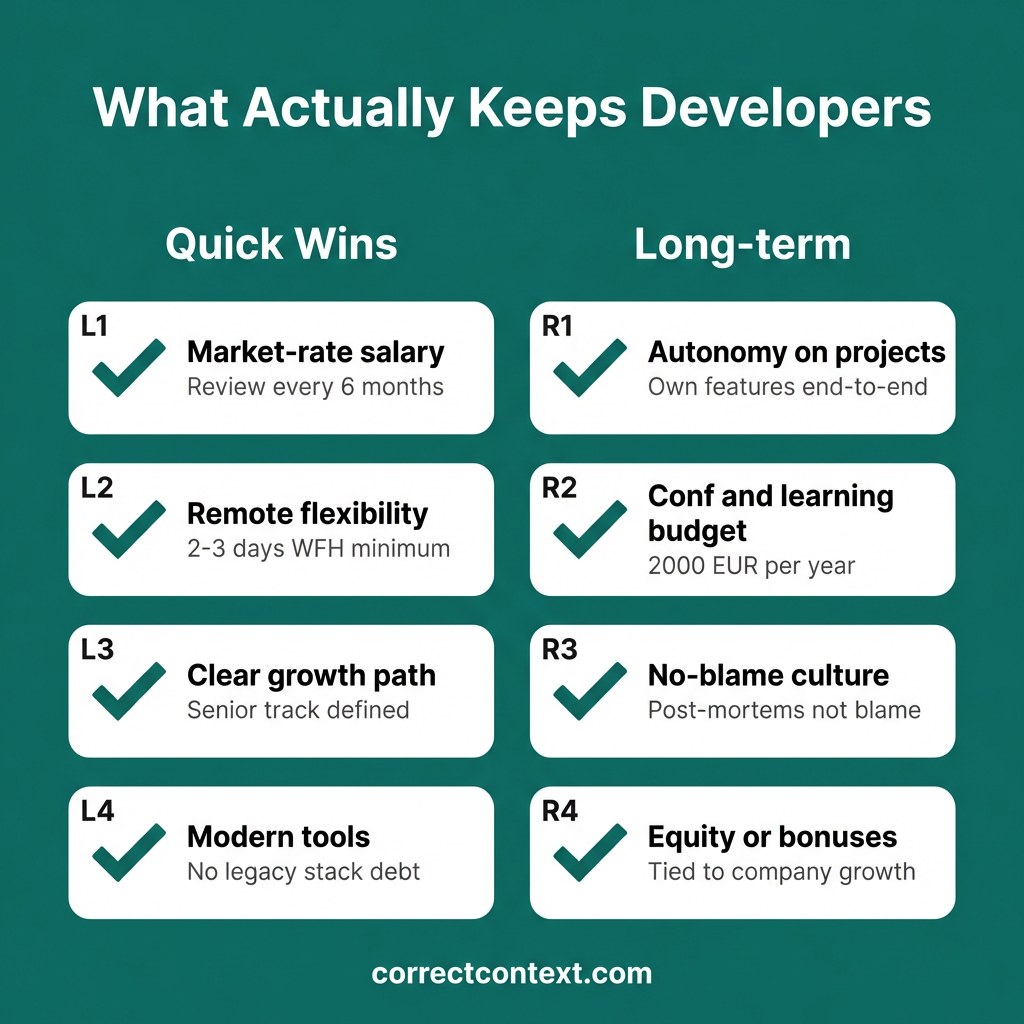
The Cost of Turnover: Why Retention Matters
Before we discuss solutions, let us quantify the problem. High5 Test research estimates that voluntary employee turnover costs U.S. businesses close to a trillion dollars every year. For individual companies, the cost of replacing a developer ranges from 50% to 200% of their annual salary when you factor in recruitment, onboarding, lost productivity, and team disruption.
The Work Institute found that only 11% of employers strongly agree that they consistently track costs of turnover. Most companies know turnover is expensive but do not measure exactly how expensive—so they underinvest in retention.
| Cost Factor | Impact |
|---|---|
| Recruitment fees | 15-25% of annual salary |
| Interview time | 40-60 hours of engineering time |
| Onboarding | 3-6 months to full productivity |
| Lost knowledge | Institutional memory walks out the door |
| Team morale | Remaining team questions their own future |
Building a Retention-First Engineering Culture
Retention is not a one-time initiative—it is a continuous practice woven into how you hire, manage, and grow your team. Here is a framework for building an engineering culture where developers want to stay:
| Retention Pillar | Actions | Frequency |
|---|---|---|
| Listen | Stay interviews, pulse surveys, exit interviews | Monthly / Quarterly |
| Develop | Career ladders, learning budgets, mentorship | Continuous |
| Compensate | Market benchmarking, proactive adjustments | Quarterly |
| Support | Manager training, burnout monitoring, flexibility | Daily |
| Recognize | Public praise, promotions, impact visibility | Weekly |
Key Takeaways
- 83% of developers suffer from burnout—address workload and work-life balance as urgent priorities
- 75% of departures are preventable—retention is within your control
- Career development is the #1 reason people leave—invest in growth paths for ICs and managers
- Toxic culture is 10.4x more damaging than low pay—culture is your highest-leverage retention tool
- Managers are the linchpin—great managers cut churn by 25% or more
- Compensation satisfaction is at an all-time low—benchmark proactively and adjust before people ask
Frequently Asked Questions
How do I know if my developers are at risk of quitting?
Watch for warning signs: decreased engagement in meetings, reduced code quality, missed deadlines, increased sick days, and withdrawal from team activities. The best approach is proactive: conduct regular “stay interviews” to understand satisfaction before people start looking elsewhere.
Should I match counteroffers when developers threaten to leave?
Counteroffers rarely solve the underlying issues. Research shows that employees who accept counteroffers often leave within 6-12 months anyway. Instead of relying on counteroffers, build a culture where people do not want to look for other jobs in the first place.
How much should I invest in developer retention?
Calculate your actual turnover costs—including recruitment fees, interview time, onboarding productivity loss, and knowledge drain. Most companies find that investing 20-30% of those costs in proactive retention (better management, career development, compensation adjustments) delivers positive ROI.
What is the most cost-effective retention strategy?
Improving management quality has the highest ROI. Training managers to be empathetic, technically literate, and effective at career development can reduce churn by 25% or more with relatively modest investment.
Sources
- Haystack Analytics — 83% of Developers Suffer From Burnout (2021)
- Work Institute — 2025 Retention Report: Employee Retention Truths in Today’s Workplace
- Stack Overflow — 2025 Developer Survey
- Dice — 2025 Tech Salary Report
- iHire — Talent Retention Report 2025
- Nectar HR — Employee Turnover and Retention Statistics 2025
- BarRaiser — Essential Employee Turnover Stats 2025
- HR Oasis — Developer Retention 2026
Ready to build a team that stays and thrives? At Correct Context, we help companies hire and retain top engineering talent in Poland and the CEE region. Our 98% probation pass rate and 2.5-year average tenure speak to our focus on quality matches that last. Contact us to learn how we can help you build your dream team.
Table of content
- 1. Lack of Career Growth and Development Opportunities
- 2. Below-Market Compensation
- 3. Burnout and Unsustainable Workloads
- 4. Poor Management and Leadership
- 5. Lack of Remote and Flexible Work Options
- 6. Boring, Repetitive, or Meaningless Work
- 7. Toxic Culture and Poor Team Dynamics
- 8. Poor Work-Life Balance
- 9. Lack of Recognition and Appreciation
- 10. Outdated Technology and Technical Debt
- The Cost of Turnover: Why Retention Matters
- Building a Retention-First Engineering Culture
- Key Takeaways
- Frequently Asked Questions
- Sources
Related articles



About the Author: Duke Vu