
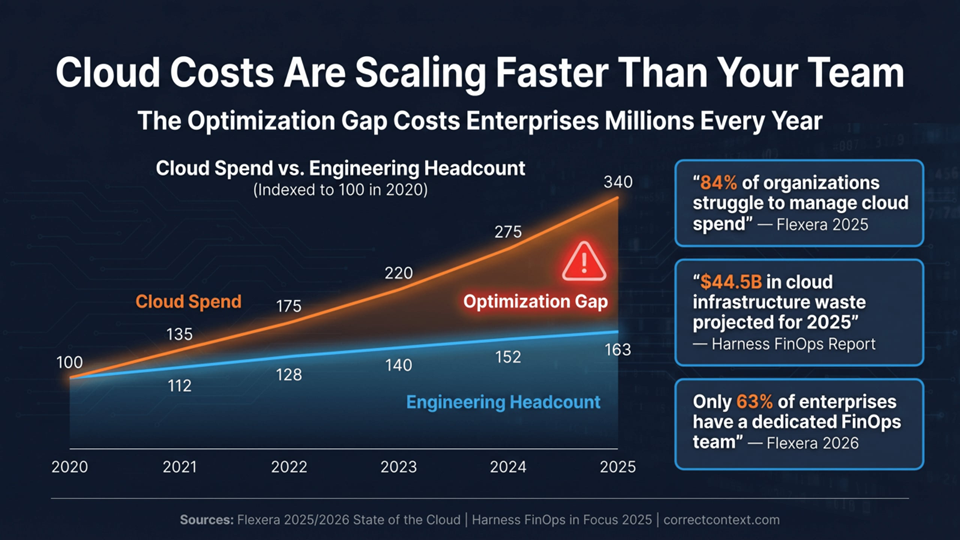
In 2026, enterprise cloud spending is accelerating at an unprecedented pace. While many Fortune 5000 organizations in FinTech, Software, and Media scale their engineering teams to drive innovation, they frequently overlook the underlying architecture of their cloud environments. This disconnect leads to massive, unchecked AWS, Azure, and GCP bills. For Chief Financial Officers (CFOs) and Chief Technology Officers (CTOs), the alarm bells are ringing: cloud infrastructure scaling costs are consistently outpacing the financial growth of the engineering departments themselves [1] [2].
The core question facing these executives is straightforward but critical: Do we need to hire specialized cloud engineering teams or DevOps teams for hire to optimize our infrastructure spend, and how can we do this without breaking the bank?
The State of Cloud Waste in the Enterprise
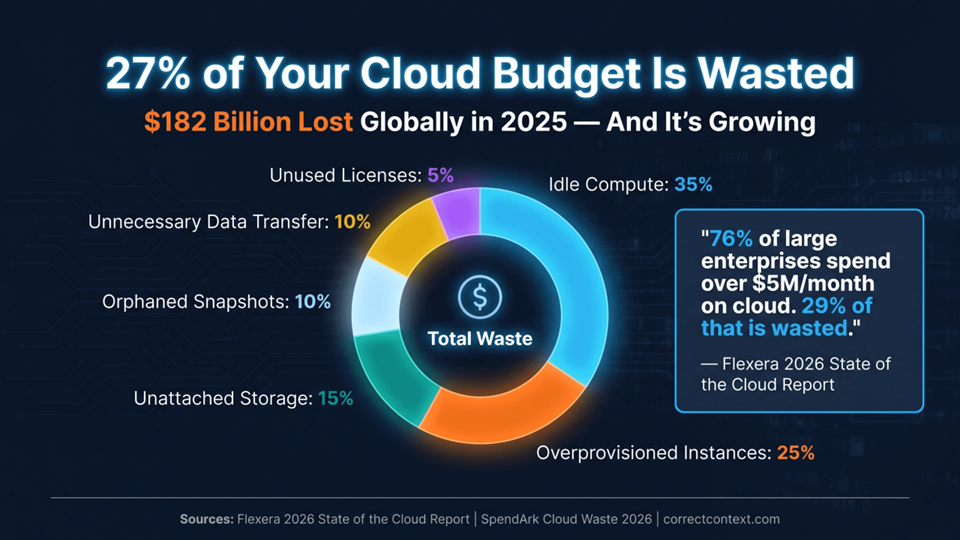
The shift to the cloud was supposed to democratize computing and lower capital expenditures. Instead, it has introduced a new paradigm of variable, often unpredictable, operational expenses. According to the 2025 Flexera State of the Cloud Report, approximately 27% to 29% of all cloud spend is wasted, a figure that translates to over $100 billion globally in unnecessary expenditures [1] [3].
This waste is not uniform; it is heavily concentrated in a few key areas. Idle compute resources account for roughly 35% of this waste, while overprovisioned instances contribute another 25% [3]. As organizations adopt generative AI and machine learning technologies, the problem is exacerbating. AI workloads have driven an increase in wasted cloud spend for the first time in five years, as companies struggle to right-size GPU instances and manage the massive data transfer costs associated with training and running models [1].
For large tech enterprises, the financial impact is staggering. More than three-quarters of large enterprises now spend over $5 million monthly on cloud services [1]. Wasting 27% of a $60 million annual cloud budget means $16.2 million is evaporating into the ether—capital that could be reinvested into product development, market expansion, or hiring an extended engineering team.
The Disconnect Between Engineering Growth and Cloud Optimization
Why are companies scaling their engineering teams but failing to optimize their cloud architecture? The answer lies in the traditional incentives and structures of software development.
When a company decides to scale engineering teams, the primary metric for success is often feature velocity. Developers are incentivized to build and deploy quickly. In this environment, overprovisioning resources is a rational, albeit costly, choice for an engineer. Provisioning a larger AWS EC2 instance or an Azure Virtual Machine with more memory than strictly necessary ensures that the application will not crash under peak load, thereby protecting the engineer’s key performance indicators (KPIs).
However, this safety margin is rarely revisited. The result is a sprawling, inefficient infrastructure where the AWS cost reduction or cloud cost optimization engineering is treated as an afterthought rather than a core architectural principle [3].
Furthermore, generalist software engineers often lack the deep, platform-specific expertise required to navigate the Byzantine pricing models of modern cloud providers. Understanding the nuances of AWS Reserved Instances, Azure Hybrid Benefit, or GCP Sustained Use Discounts requires specialized knowledge that falls outside the purview of a standard backend development team.
The ROI of Hiring Specialized DevOps and Cloud Engineers
To combat this structural inefficiency, enterprises must invest in specialized talent. Hiring a dedicated DevOps team for hire or a cloud engineering team focused on FinOps (Financial Operations) and cost optimization is no longer a luxury; it is a financial necessity.
The Return on Investment (ROI) for these specialized roles is highly compelling. A skilled cloud optimization engineer can typically identify and remediate 20% to 30% of a company’s cloud waste within the first few months of engagement. For an enterprise spending $5 million a month, a 20% reduction yields $1 million in monthly savings.
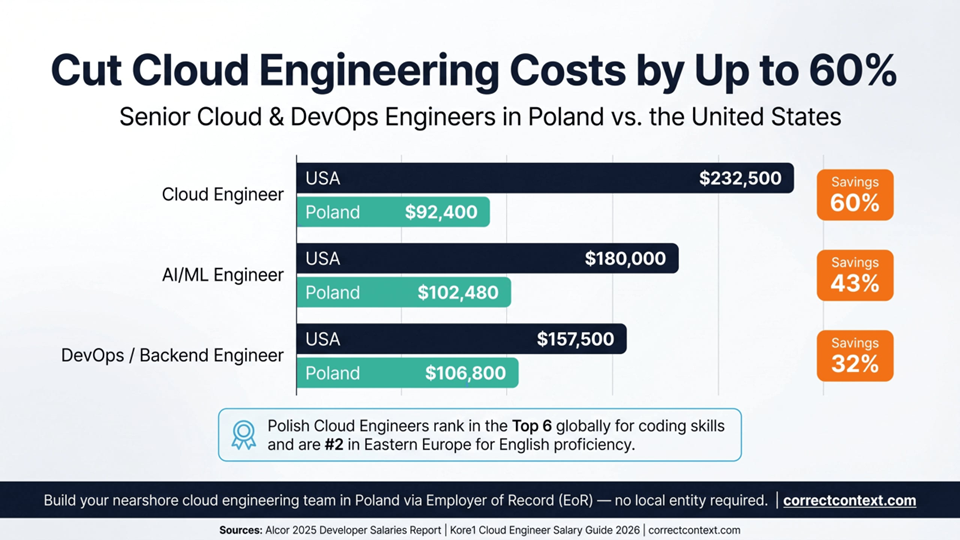
However, the cost of acquiring this talent in traditional tech hubs is steep. In the United States, the average salary for a senior cloud engineer or DevOps specialist ranges from $135,000 to over $170,000, with total compensation packages often exceeding $230,000 when factoring in benefits, recruitment fees, and bonuses [4] [5].
The Nearshore Advantage: Poland and CEE
This is where the strategic advantage of nearshoring and offshoring becomes apparent. For enterprises located in the East Coast US, UK, DACH, and Nordics, building an engineering hub Europe offers a powerful solution to the talent shortage and cost constraints.
Poland and the broader Central and Eastern European (CEE) region have emerged as premier destinations for sourcing top-tier technical talent. Polish software developers rank among the top 6 globally for coding skills and are highly proficient in English, making them ideal candidates for integration into global, distributed teams [5].
When evaluating the economics, the case for a nearshore development team Europe is undeniable. The total annual cost of employing a senior cloud engineer in the US—including gross salary, recruitment, and benefits—averages around $232,500. In contrast, the total cost for a comparable senior cloud engineer in Poland is approximately $92,400 [5]. This represents a cost savings of over 60%, without sacrificing technical quality or operational efficiency.
| Position | Total Annual Cost (USA) | Total Annual Cost (Poland) | Cost Savings (%) |
|---|---|---|---|
| Cloud Engineer | $232,500 | $92,400 | ~60% |
| AI/ML Engineer | $180,000 | $102,480 | ~43% |
| DevOps / Backend | $157,500 | $106,800 | ~32% |
Data Source: Alcor 2025 Developer Salaries Report [5]
By partnering with a European employer of record or utilizing payroll services Poland, enterprises can hire employees without entity establishment. This model allows companies to rapidly deploy a dedicated software team or an offshore development team focused on AWS / Azure / GCP engineers team specializations.
Strategic Implementation for CFOs and CTOs
For executives alarmed by rising cloud bills, the path forward requires a structural shift in how engineering and infrastructure are managed.
- Implement FinOps Practices: Establish a Cloud Center of Excellence (CCOE) that brings together finance, engineering, and business units. This team should be responsible for monitoring cloud spend, setting budgets, and enforcing accountability.
- Right-Size and Remediate: Immediately target the low-hanging fruit of cloud waste. Eliminate unattached storage volumes, delete orphaned snapshots, and right-size idle compute instances.
- Leverage Nearshore Talent: Do not let local talent shortages or high salaries deter your optimization efforts. Utilize EoR Poland or EoR CEE services to build a remote development team in Poland. This allows you to hire developers Poland who specialize in cloud cost optimization engineering at a fraction of the domestic cost.
- Integrate Optimization into the CI/CD Pipeline: Shift cost optimization left. Ensure that your dedicated development team is evaluating the financial impact of architectural decisions during the design phase, rather than post-deployment.
Conclusion
As cloud infrastructure costs continue to grow faster than engineering teams, enterprise leaders must take decisive action. The era of treating cloud resources as an infinite, unmanaged utility is over. By recognizing the structural causes of cloud waste and strategically deploying specialized nearshore developers Europe, organizations can regain control of their infrastructure economics.
Investing in a remote software engineers team based in Poland not only provides immediate AWS cost reduction but also establishes a sustainable, scalable model for future technological innovation. For CFOs and CTOs, the choice is clear: optimize your cloud architecture with specialized talent, or watch your profit margins evaporate into the cloud.
References
[1] Flexera. (2026). 2026 State of the Cloud Report.
[2] Gartner. (2025). Gartner Forecasts Worldwide IT Spending to Grow.
[3] SpendArk. (2026). The State of Cloud Waste 2026: $100B+ in Unnecessary Spend.
[4] Kore1. (2026). Cloud Engineer Salary Guide 2026.
[5] Alcor. (2025). Polish Software Developers: Salaries and Insights 2025.