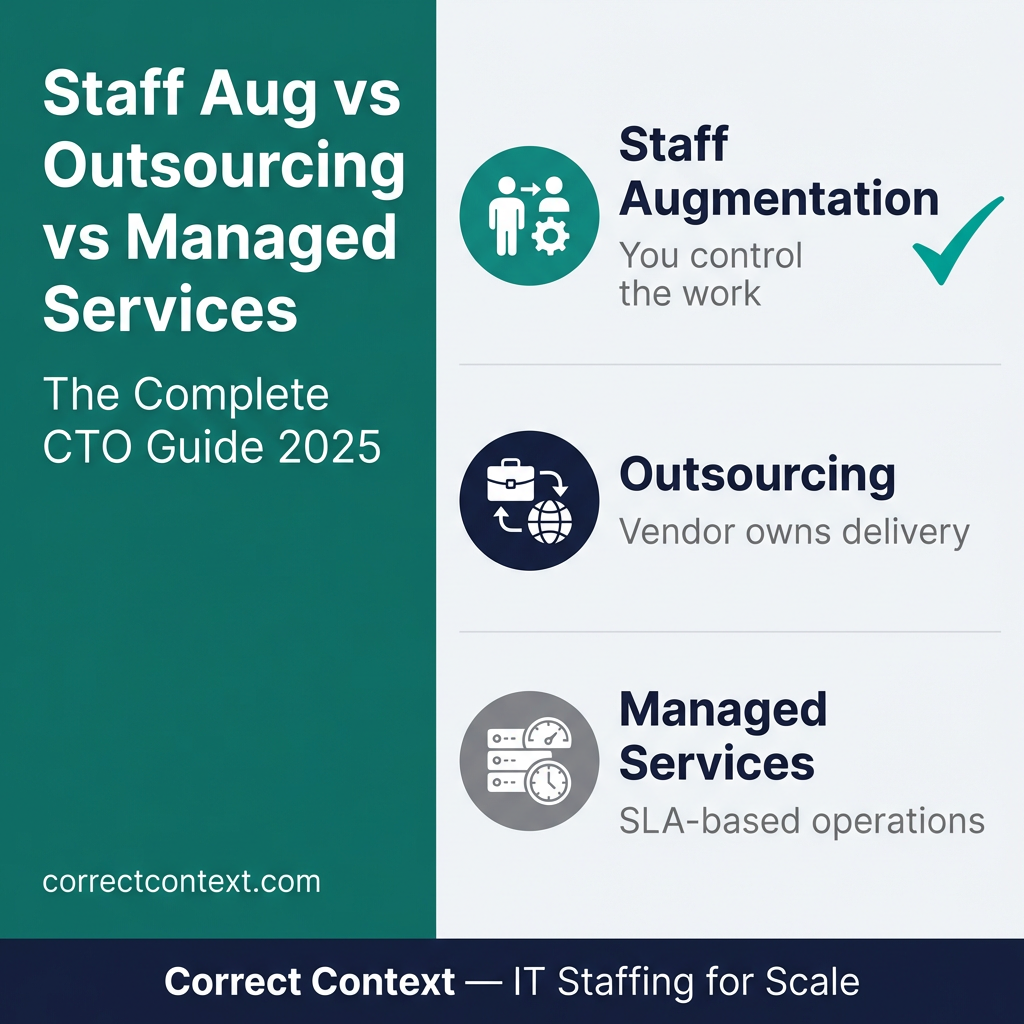
You need to scale your engineering team. The business is moving fast. But should you augment your existing team with external specialists, outsource an entire project to a vendor, or hand over an IT function to a managed services provider? The answer depends on how much control you want to retain — and what kind of outcome you’re actually hiring for.
This guide cuts through the noise. We’ll explain each model clearly, compare them across 10+ criteria, and give you a decision framework to choose the right approach for your situation — with real cost numbers from the Polish and CEE market.
What Is IT Staff Augmentation?
Staff augmentation is the model where external engineers, data scientists, or other tech professionals join your existing team — working under your direct management, in your tools, following your processes. You control the work. The augmentation partner handles recruitment, legal employment, payroll, and HR.
Think of it as temporarily expanding your internal headcount — without the overhead of permanent hiring. The best staff augmentation providers don’t just send bodies; they vet candidates deeply and ensure cultural and technical fit before day one.
How Staff Augmentation Works in Practice
- You define the role — seniority, tech stack, timezone, and soft skills
- Partner sources and vets candidates using deep technical screening
- You interview and approve the final shortlist (2–3 candidates)
- Engineer joins your team — in your Slack, sprints, code reviews
- You manage day-to-day; the partner handles payroll, compliance, HR
At Correct Context, our full-cycle hiring process delivers vetted engineers in 2–6 weeks. Our 360° vetting covers technical depth (live coding, architecture review), communication, and cultural alignment — resulting in a 98% probation pass rate across 140+ hires.
What Is IT Outsourcing?
IT outsourcing means handing an entire project, product, or deliverable to an external vendor. The vendor manages their own team, sets the development approach, and is responsible for delivering a defined outcome. You’re the client — not the manager.
Outsourcing works best for well-defined, scoped work where you don’t need (or want) to manage the day-to-day. The trade-off is control: once you’ve scoped the project, changing direction mid-stream usually means change orders, renegotiation, and friction.
Key Characteristics of Outsourcing
- Vendor manages the team — you’re not in Jira tickets or PRs daily
- Deliverable-based contracts — fixed-price or time & materials with milestones
- Less management overhead for you — but less visibility too
- Works well for: MVPs, isolated projects, mobile apps, internal tools
- Weaker for: ongoing product development, evolving scope, core IP
What Are Managed Services?
Managed services means outsourcing an entire IT function — not just a project. A managed services provider (MSP) takes ownership of a defined operational area: cloud infrastructure management, QA, security operations, helpdesk, data engineering pipelines. They operate autonomously within an agreed SLA.
You measure them on outcomes and uptime, not individual engineer hours. It’s the most “hands-off” model of the three — ideal when you need a function reliably running in the background and don’t want to build internal expertise for it.
Key Characteristics of Managed Services
- Outcome and SLA-based — you define the service level, they deliver it
- Full function ownership — not individual roles or projects
- Predictable monthly cost — easier to budget long-term
- Works well for: infrastructure ops, security monitoring, QA automation, helpdesk
- Weaker for: core product engineering, mission-critical IP, evolving tech stacks
Staff Augmentation vs Outsourcing vs Managed Services: Head-to-Head Comparison
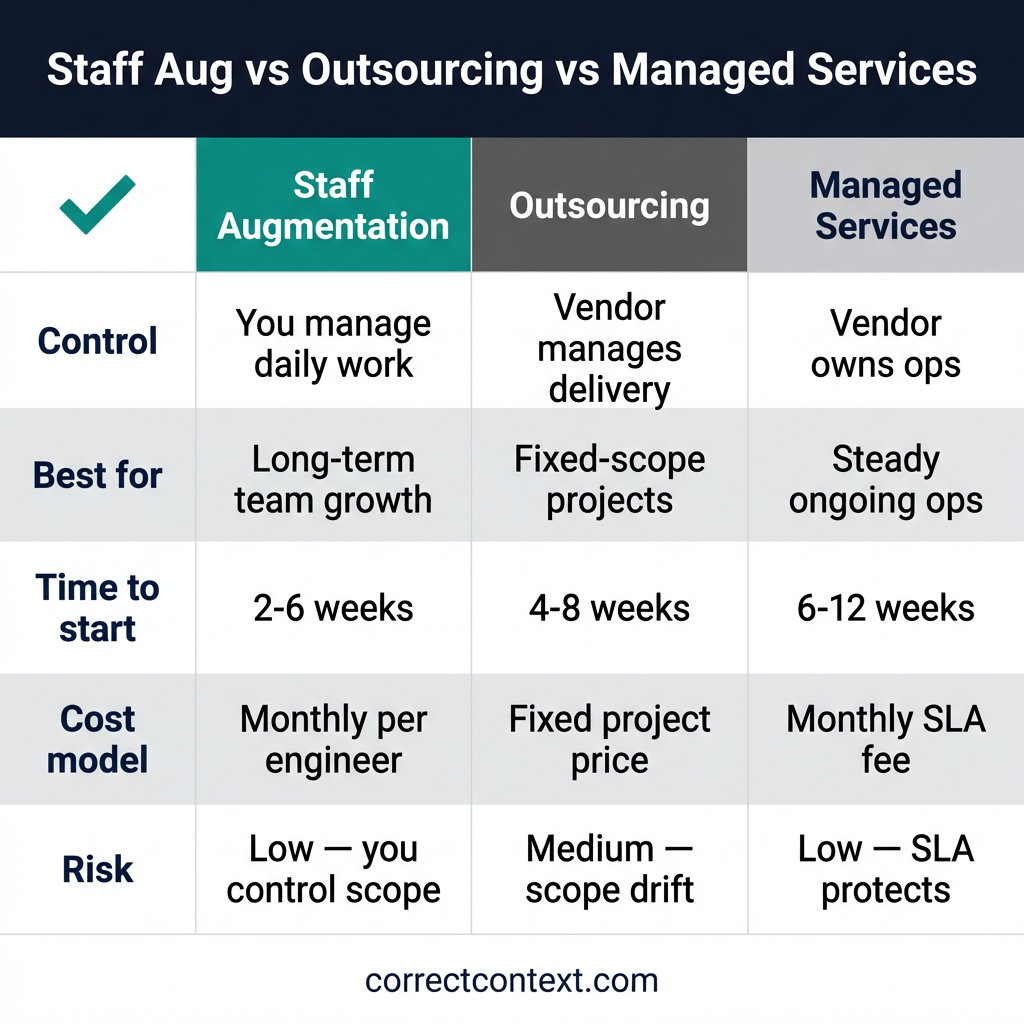
Here’s how the three models compare across the dimensions that matter most for tech leaders:
| Criteria | Staff Augmentation | Outsourcing | Managed Services |
|---|---|---|---|
| Who manages the team? | You do | Vendor does | MSP does |
| Control level | High | Medium | Low |
| Hiring speed | 2–6 weeks | 4–8 weeks (scoping) | 6–12 weeks (setup) |
| Contract type | Time & materials per engineer | Fixed price or T&M | Monthly retainer / SLA |
| Flexibility / scope changes | Very high | Low (change orders) | Medium |
| IP and code ownership | Fully yours | Negotiated in contract | Usually yours |
| Management overhead | Medium (you lead) | Low | Very low |
| Cost predictability | Medium | Medium (risk of overruns) | High |
| Best for | Ongoing product engineering, core teams | Scoped projects, MVPs | Ops functions, infra, QA |
| Worst for | Companies lacking tech leadership | Evolving, core IP products | Active product dev |
The Control vs. Overhead Trade-Off: The Core Decision
Every choice between these three models is fundamentally a decision about how much control you want to retain — and how much management overhead you’re willing to accept.
- Staff augmentation gives you maximum control — engineers work inside your systems, under your technical direction. But you need competent engineering leadership to make use of that control. If your CTO or VP of Engineering doesn’t have bandwidth to onboard and direct external engineers, augmentation creates friction.
- Outsourcing reduces control but also management overhead — the vendor handles team dynamics, delivery, QA. You describe the outcome; they figure out how to reach it. This works when the problem is well-defined and you can wait for a deliverable.
- Managed services offload an entire function — you don’t think about how it’s done, only whether the SLA is being met. The ideal model when you want a capability running reliably without internal resource investment.
When to Choose Staff Augmentation
Staff augmentation is the right model when:
- You have internal technical leadership (CTO, VP Eng, tech leads) who can onboard and direct engineers
- You’re building or scaling a core product that’s central to your business — IP you can’t outsource
- Your scope is evolving — requirements change sprint to sprint and you need team members who can adapt in real time
- You need speed — you can’t wait 3 months to go through a full outsourcing procurement cycle
- You’re hiring for long-term positions — augmented engineers often become full-time employees after proving their fit
- You want nearshore talent — engineers in your timezone, same working culture, no 12-hour lag
“Staff augmentation is what you choose when you want to stay in the driver’s seat. You need someone who fits your team — not a black box delivering a ZIP file in 90 days.”
— Correct Context, Engineering Hiring Desk
When to Choose Outsourcing
Outsourcing makes sense when:
- The project has a clear, bounded scope — a mobile app, internal admin tool, or data migration with defined requirements
- You don’t have (or want) the internal bandwidth to manage engineers
- Speed-to-output matters more than control — you want the deliverable, not the process
- The work is non-core — supporting infrastructure, tooling, or auxiliary features
- You can tolerate change order risk — outsourced projects often hit scope creep
Warning: Outsourcing core product engineering is the most common and expensive mistake we see. When the vendor controls the architecture decisions and code, you lose strategic leverage. For anything central to your competitive advantage, keep control in-house — even if that means augmenting your team externally.
When to Choose Managed Services
Managed services is the right call when:
- You need a stable function running autonomously — cloud infra management, security monitoring, helpdesk
- Outcomes are measurable via SLA — uptime, ticket resolution time, pipeline reliability
- You don’t want to build internal expertise in a supporting function (e.g., SOC operations, data labeling)
- Predictable costs matter — fixed monthly retainer is easier to budget than hourly teams
- You’re scaling operations, not product
Why Poland? The Cost and Quality Case for CEE Staff Augmentation
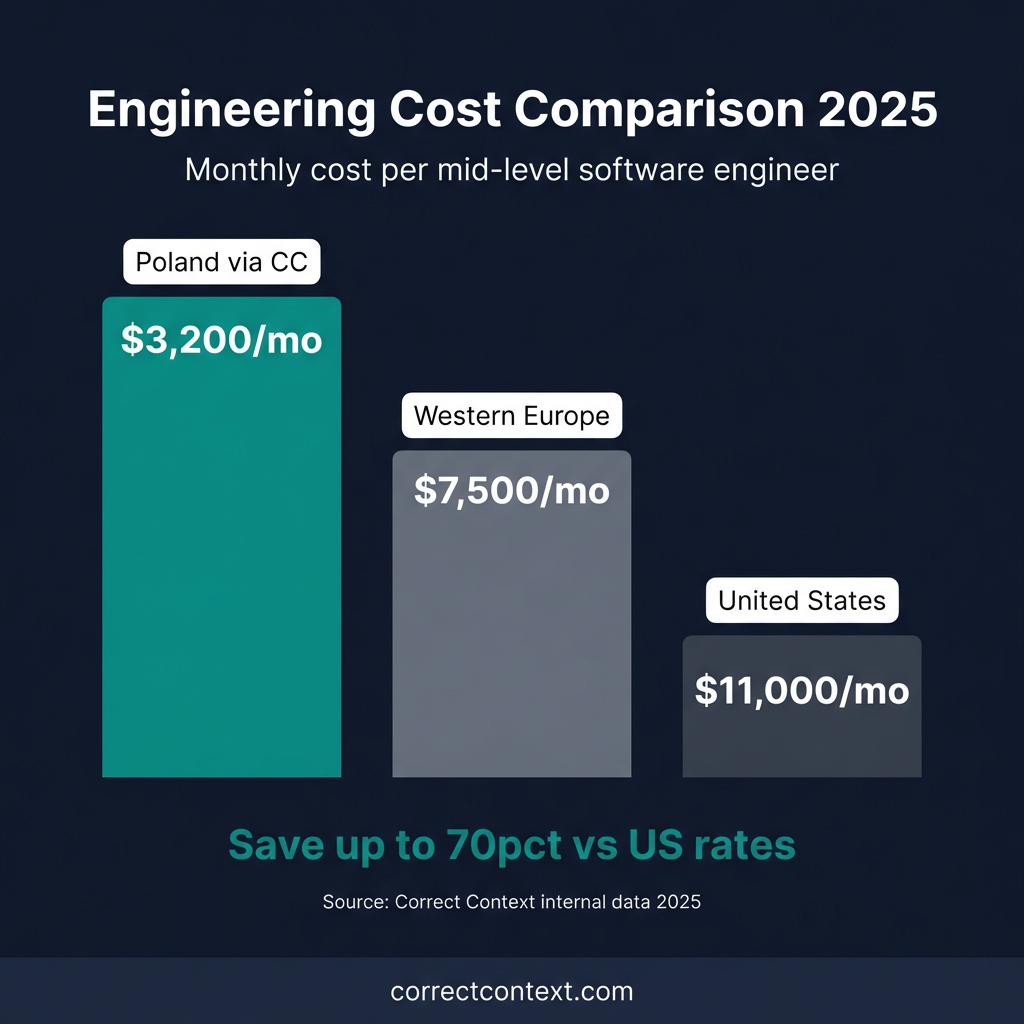
If you’re choosing staff augmentation, the next question is: where? For companies in DACH, Benelux, UK, and the Nordics, Poland and CEE offer the best balance of cost, quality, and timezone overlap in the world.
Poland’s Competitive Advantages for Staff Augmentation
- 650,000+ tech professionals — one of Europe’s largest developer pools
- 40–60% lower total cost of employment vs US and Western Europe (without quality compromise)
- GMT+1/+2 timezone — full overlap with Germany, Netherlands, UK, France, Nordics
- EU jurisdiction — GDPR compliance, stable legal framework, no exotic labor risks
- English proficiency — consistently ranked among Europe’s highest non-native English speakers
- Deep talent in AI/Data, Backend, and Cloud — Poland is #1 in CEE for tech skills (Harvard Business Review ranking)
- Strong engineering culture — AGH, Warsaw University of Technology, Wrocław Polytechnic produce world-class graduates
The Hybrid Approach: Using Multiple Models Together
The smartest tech leaders don’t pick one model and apply it to everything. They use a portfolio approach:
- Staff augmentation for the core engineering team building your product
- Outsourcing for a one-off project (new mobile app, legacy migration) running in parallel
- Managed services for infrastructure operations, security, and support functions
This lets you maintain control where it matters most, get fast deliverables on bounded work, and keep operational functions running efficiently — all simultaneously.
Common Mistakes Leaders Make When Choosing a Model
- Outsourcing core IP — the most dangerous mistake. Once your competitive architecture lives in a vendor’s codebase, you’ve lost leverage.
- Augmenting without internal tech leadership — external engineers need direction. If your CTO is unavailable, augmentation underdelivers.
- Choosing managed services for product engineering — MSPs optimize for stability, not innovation. Your product team can’t operate under an SLA.
- Optimizing for rate, not TCO — a cheap hourly rate means nothing if onboarding takes 3 months and churn is high. Factor in hiring speed, retention (2.5-year average tenure at Correct Context), and probation pass rate (98%).
- Ignoring timezone and culture fit — offshore staff augmentation with a 8–10 hour timezone gap creates severe asynchrony. Nearshore CEE engineers work synchronously with European teams.
How Correct Context Fits Into This Picture
Correct Context specializes in full-cycle staff augmentation and core team hiring for companies building in AI/Data, Backend, and Cloud infrastructure. We’re not a project outsourcing shop. We’re not a managed services provider. We are the partner that builds the team that builds your product.
Our process:
- Deep role scoping — we understand your tech stack, team dynamics, and growth stage before we source a single candidate
- 360° vetting — technical depth, architecture thinking, communication, cultural alignment
- 2–6 week delivery — from signed brief to engineer joining your team
- Employer of Record option — no local entity needed; we handle employment contracts, payroll, ZUS social insurance, and Polish labor law compliance
- Ongoing people ops — salary benchmarking, HR support, career development, so your engineers stay
Our track record: 140+ hires for global companies, 98% probation pass rate, ~2.5 years average tenure (vs. 1.8 years global average). Companies in DACH, Benelux, UK, and the Nordics trust us to build their core teams in Poland.
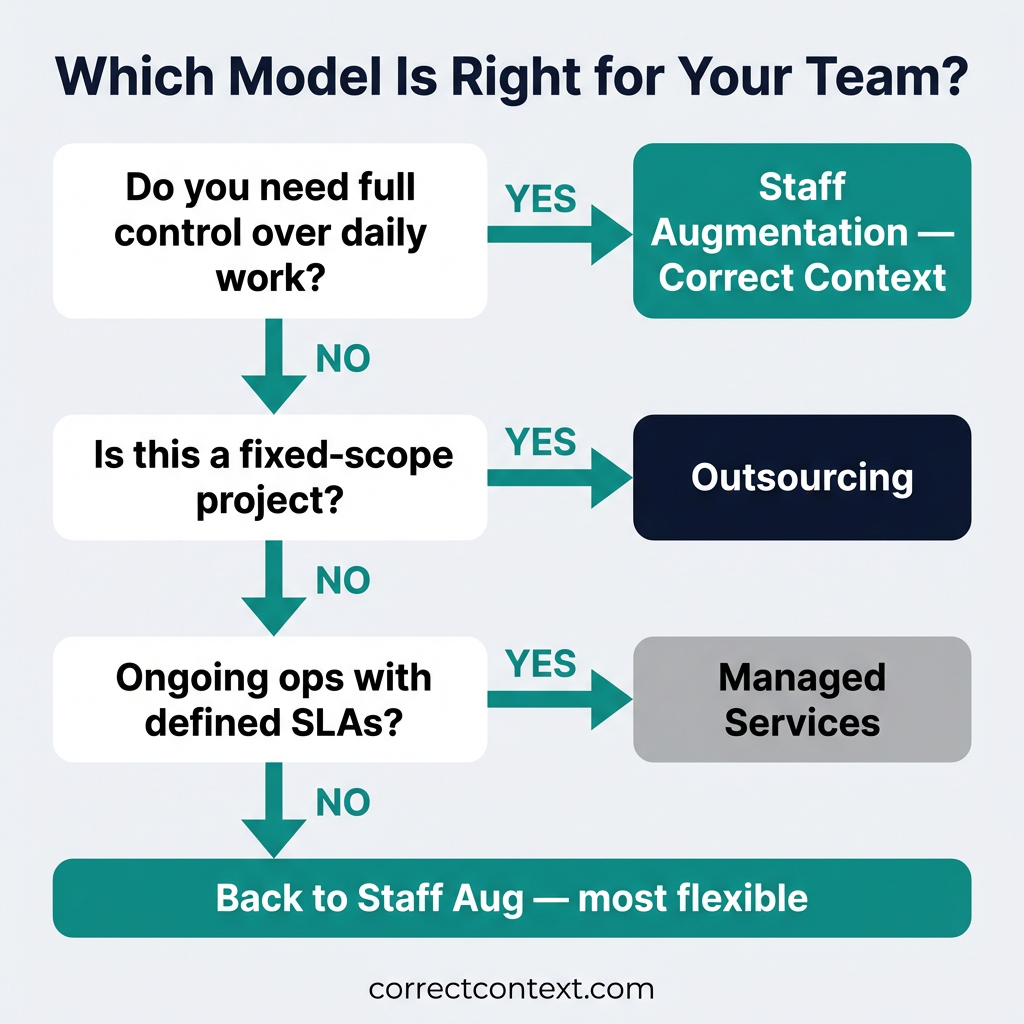
Your Decision Checklist: Which Model Is Right for You?
Answer these questions before you sign anything:
- Do you have a CTO or VP of Engineering with bandwidth to manage external engineers? (If no → lean toward outsourcing or MSP)
- Is this for core product engineering or a supporting function? (Core → staff augmentation. Supporting → MSP or outsourcing)
- Will requirements change significantly over the next 6 months? (Yes → staff augmentation. No → outsourcing or MSP)
- Do you need engineers working in your timezone? (Yes → nearshore CEE staff augmentation)
- Is this a one-time deliverable or an ongoing capability? (One-time → outsourcing. Ongoing → staff augmentation or MSP)
- Do you care who specifically is doing the work? (Yes → staff augmentation. No → managed services)
Conclusion
There’s no universal winner. Staff augmentation, outsourcing, and managed services each solve a different problem. The right answer depends on your control requirements, leadership bandwidth, IP sensitivity, and whether you’re building a long-term capability or a bounded deliverable.
For most tech companies scaling their core engineering teams, especially in DACH, Benelux, and the UK, nearshore staff augmentation in Poland hits the best balance: the speed of augmentation, the quality and cost-efficiency of CEE talent, and the regulatory safety of EU employment.
If you want to explore whether staff augmentation in Poland is the right fit for your team, get in touch with us. We’ll scope your exact needs — no commitment required.
Frequently Asked Questions
What is the main difference between staff augmentation and outsourcing?
In staff augmentation, you manage the external engineers directly as part of your team. In outsourcing, a vendor manages their own team and delivers a defined outcome or project. Staff augmentation gives you more control; outsourcing gives you less management overhead.
Is staff augmentation cheaper than outsourcing?
For ongoing work over 6+ months, staff augmentation is typically 15–30% cheaper than outsourcing once you factor in change orders, vendor project management markup, and discovery costs. For short-term, scoped projects, outsourcing can be simpler to budget.
What does an Employer of Record (EoR) do in staff augmentation?
An Employer of Record legally employs the augmented engineers on your behalf, handling employment contracts, payroll, tax withholding, social insurance contributions, and compliance with local labor law — in Poland’s case, ZUS contributions and the Polish Labour Code. This means you don’t need a local legal entity to hire Polish engineers.
How long does it take to onboard an augmented engineer in Poland?
With a specialist partner like Correct Context, the full process — from role scoping to engineer joining your team — takes 2–6 weeks. This includes sourcing, 360° vetting, client interviews, offer, and onboarding.
Can I convert an augmented engineer to a full-time employee later?
Yes. Most staff augmentation contracts include a conversion clause. After the augmented engineer proves their fit, you can hire them directly. Many companies use staff augmentation as a low-risk tryout before a full-time commitment.