
When you scale a software engineering team rapidly, your primary concern as a CTO or VP of Engineering is ensuring that new hires start contributing to the codebase and product roadmap as quickly as possible. The cost of a slow ramp-up is staggering, particularly when hiring senior talent. According to recent data from TeamCalc.ai, engineering attrition sits at 13.2% annually, with replacement costs ranging from 50% to 200% of an engineer’s salary [1]. In a landscape where time to productivity engineers is a critical metric, waiting three to six months for a senior developer to hit their stride is no longer acceptable.
For enterprise innovation units, Fortune 5000 companies, and Series A+ startups globally scaling in the FinTech, Software, and Media sectors, building a high-performing tech hub requires a strategic approach to integration. This article explores the data behind engineer onboarding best practices, the impact of structured autonomy versus micromanagement, and how to effectively onboard senior developers without stifling their expertise.
The High Cost of a Slow Ramp-Up
Many engineering leaders are afraid that new engineers won’t deliver quickly enough, and the data validates this concern. A study by Zippia reveals that new hires operate at merely 25% of their full productivity during their first 30 days [2]. Furthermore, AlliedOneSource reports that losing a new hire within the first few months costs between $7,500 and $28,000 in direct recruitment and replacement expenses alone [3].

When you scale engineering teams, especially when you hire developers for startup environments or build a dedicated development team, the financial drain of poor onboarding is compounded by lost opportunity costs. If a senior engineer spends their first month untangling undocumented legacy code or waiting for access permissions, the entire project timeline shifts.
| Onboarding Metric | Statistical Impact | Source |
|---|---|---|
| First 30 Days Productivity | New hires operate at ~25% capacity | Zippia [2] |
| Retention Boost | Strong onboarding improves retention by 82% | Brandon Hall Group [4] |
| Early Attrition | 20% of new hires quit within the first 45 days | Zippia [2] |
| Productivity Increase | Standardized onboarding yields 50% greater productivity | SHRM [5] |
Structuring the Onboarding of Senior Developers
A common misconception is that experienced engineers require little to no onboarding because of their technical proficiency. In reality, onboarding senior developers requires a highly structured yet autonomous approach. They do not need to be taught how to code; they need to understand your system architecture, deployment pipelines, and business context.
Research from the Society for Human Resource Management (SHRM) indicates that new employees who go through a structured onboarding program are 58% more likely to remain with the organization after three years [5]. However, structure should not be confused with micromanagement.
The Danger of Micromanagement
Senior engineers thrive on autonomy. A survey by StartWiseHires found that 70% of employees report micromanagement actively hurts their morale and productivity [6]. For a VP of Engineering, the goal is to provide a clear roadmap without hovering over every pull request.
When you build tech hub Poland or establish an engineering hub Europe, you are likely dealing with highly skilled professionals who expect a certain level of trust. Micromanagement is a silent threat that can cause a newly hired machine learning engineers team or cloud engineering team to disengage rapidly. Instead, leaders should focus on “aligned autonomy”—providing the necessary context and tools, and then stepping back to let the engineers execute.
Engineer Onboarding Best Practices for Fast Productivity
To achieve a fast ramp up engineers need a combination of technical readiness, clear documentation, and immediate integration into the team’s workflow. Here are the core strategies to accelerate the process.
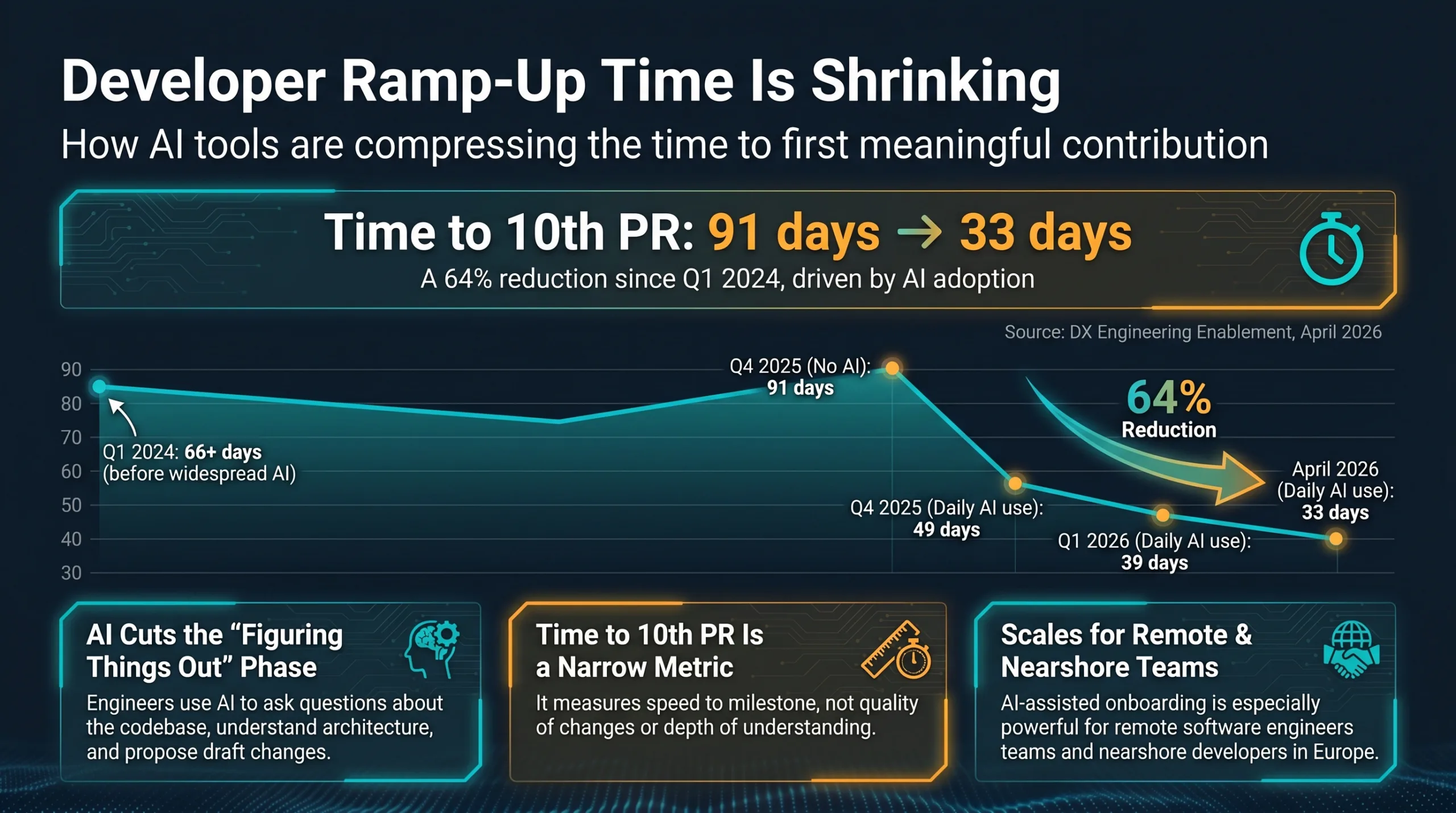
1. Optimize the “Time to 10th PR” Metric
The most effective way to measure onboarding success is through tangible engineering metrics. The “Time to 10th PR” (Pull Request) is a standard benchmark for developer ramp-up time. According to the DX Engineering Enablement newsletter from April 2026, the average Time to 10th PR across a sample of 400 companies is currently 33 days [7].
This metric has seen a significant reduction recently, largely driven by the integration of AI tools. For companies utilizing enterprise ai tools, the Time to 10th PR dropped from 91 days (with no AI usage) to just 49 days with daily AI use in late 2025, and has continued to accelerate [7]. If you want to hire ai engineers or use ai tools inside corporation environments, embedding these tools into the onboarding process allows new hires to ask questions about the codebase and understand architectural decisions without constantly interrupting their peers.
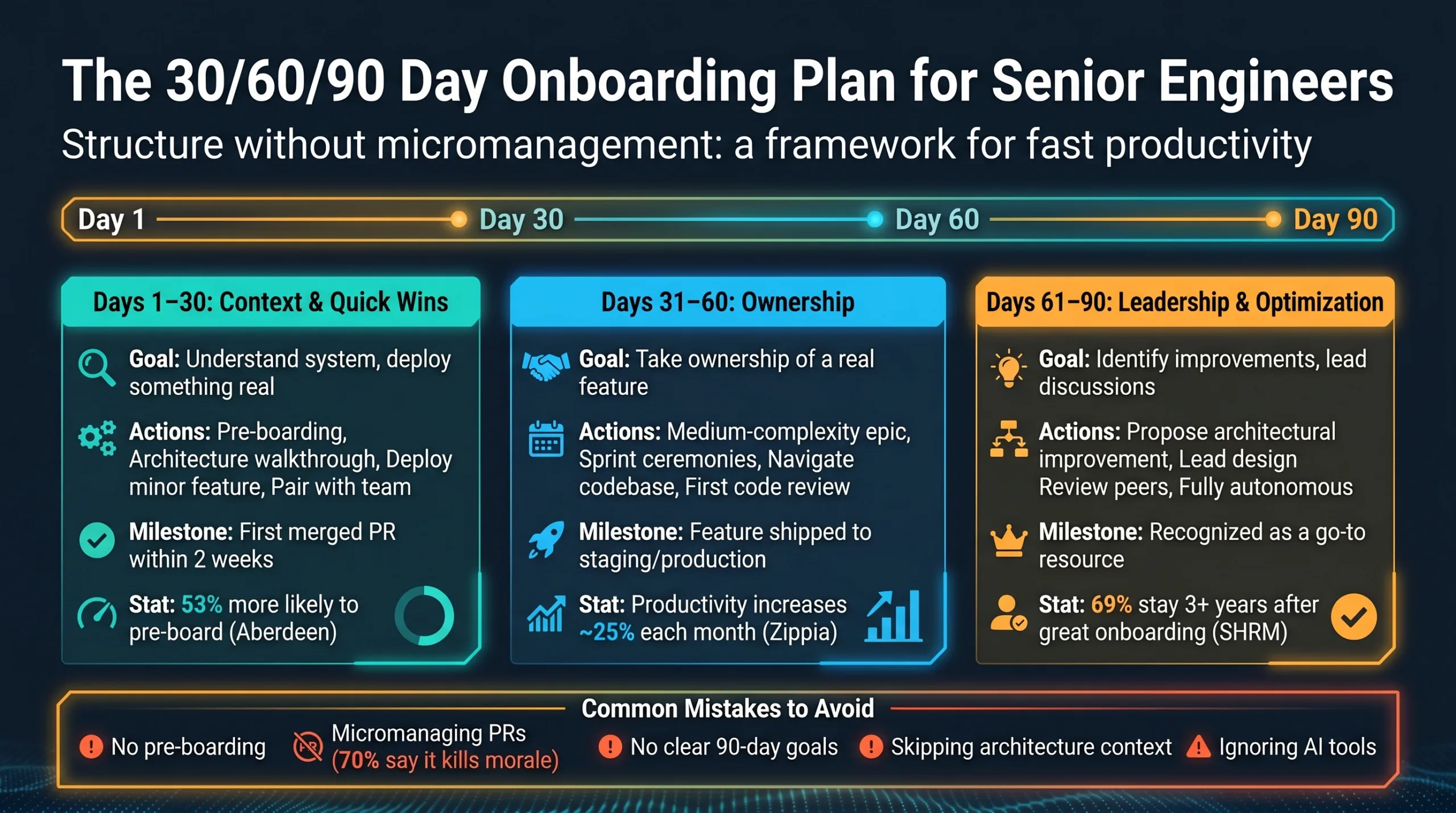
2. Implement a 30-60-90 Day Plan Tailored for Autonomy
A structured 30-60-90 day plan is essential, but for senior developers, the milestones should reflect their experience level.
- First 30 Days (Context & Quick Wins): Focus on system architecture, business goals, and deploying their first minor feature. They should be pairing with existing team members to understand the deployment pipeline.
- Next 60 Days (Ownership): The engineer should take ownership of a medium-sized epic or feature. They should be fully integrated into the agile ceremonies and comfortable navigating the codebase independently.
- By 90 Days (Leadership & Optimization): A senior developer should be identifying technical debt, proposing architectural improvements, and actively participating in code reviews for others.
3. Leverage Pre-Boarding for Administrative Tasks
Do not waste an engineer’s first week on HR paperwork and laptop setup. According to Aberdeen, best-in-class organizations are 53% more likely to engage in pre-boarding [8]. Ensure that all access rights, repository permissions, and hardware are fully operational before Day One. This is especially crucial when managing a remote development team or an offshore development team.
Scaling with Nearshore and Offshore Teams in CEE
For enterprises and Series A+ startups located in the US East Coast, UK, DACH, and Nordics, scaling engineering capacity locally is often prohibitively expensive and slow. This has led to a surge in companies looking to hire developers Poland and establish an extended engineering team in Central and Eastern Europe (CEE).
Working with a nearshore development team or nearshore developers Europe offers a strategic advantage. Countries like Poland boast a deep talent pool in specialized areas such as Big Data analytics, Cloud (AWS, Azure, GCP), and Artificial Intelligence. When you partner with an employer of record Poland or utilize payroll services Poland, you can seamlessly integrate an engineering team Poland / CEE without the legal and administrative burden of setting up a local entity.
Overcoming Remote Onboarding Challenges
While the benefits of an offshore team for startup growth are clear, remote onboarding presents unique hurdles. Workable reports that 37% of remote organizations identify remote onboarding as their top challenge [9].
To ensure your remote software engineers team or dedicated software team reaches productivity quickly, you must over-communicate context. A backend development team or data engineering team in Poland needs the exact same access to product managers and business stakeholders as your in-house team. Utilizing an EoR Poland or European employer of record (such as an employer of record CEE) ensures that employment compliance Europe is handled flawlessly, allowing your engineering leadership to focus purely on technical onboarding and team integration.
Embracing AI for Faster Integration
The landscape of software development is shifting rapidly with ai trends enterprise adoption. When you scale software development, integrating AI into the onboarding workflow is no longer optional; it is a competitive necessity.
Whether you are looking to hire ai programmers, hire ai coders, or build a comprehensive data analytics team and platform engineering team, leveraging AI coding assistants helps new hires decode legacy systems faster. The data is clear: AI integration cuts the “figuring things out” phase drastically, allowing affordable senior developers to deliver value in weeks rather than months.
Conclusion
Accelerating the onboarding process for experienced engineers requires a delicate balance of structured guidance and professional autonomy. By focusing on metrics like Time to 10th PR, avoiding the pitfalls of micromanagement, and leveraging AI tools, CTOs and VPs of Engineering can ensure their new hires deliver value rapidly.
Furthermore, for companies looking to scale efficiently, utilizing an EoR Europe to hire in Europe without company infrastructure allows you to build a world-class big data development team or DevOps team for hire in the CEE region. When you hire employees without entity constraints, you remove the administrative friction, allowing your technical leadership to focus on what matters most: shipping exceptional products.
References
[1] TeamCalc.ai. The True Cost of Engineering Talent 2025 – White Paper. TeamCalc.ai Research, 2025.
[2] Zippia. Employee Onboarding Statistics. Zippia Research.
[3] AlliedOneSource. The Silent Killer of Workforce ROI: How Poor Onboarding Costs You Thousands. AlliedOneSource Insights, 2025.
[4] Brandon Hall Group. The True Cost of a Bad Hire. Brandon Hall Group Research.
[5] Society for Human Resource Management (SHRM). Don’t Underestimate the Importance of Good Onboarding. SHRM Talent Acquisition News, 2017.
[6] StartWiseHires. How Micromanagement Scares Off Senior Candidates. StartWiseHires Blog, 2025.
[7] DX Engineering Enablement. Developer ramp-up time continues to accelerate with AI. DX Newsletter, April 9, 2026.
[8] Aberdeen Group. Onboarding: The First Line of Defense Against Employee Turnover. Aberdeen Research.
[9] Workable. Remote Onboarding Challenges. Workable HR Resources.
Table of content
Related articles



About the Author: Marta