
10 Best Practices for Managing Remote and Hybrid Engineering Teams in Poland (2025)
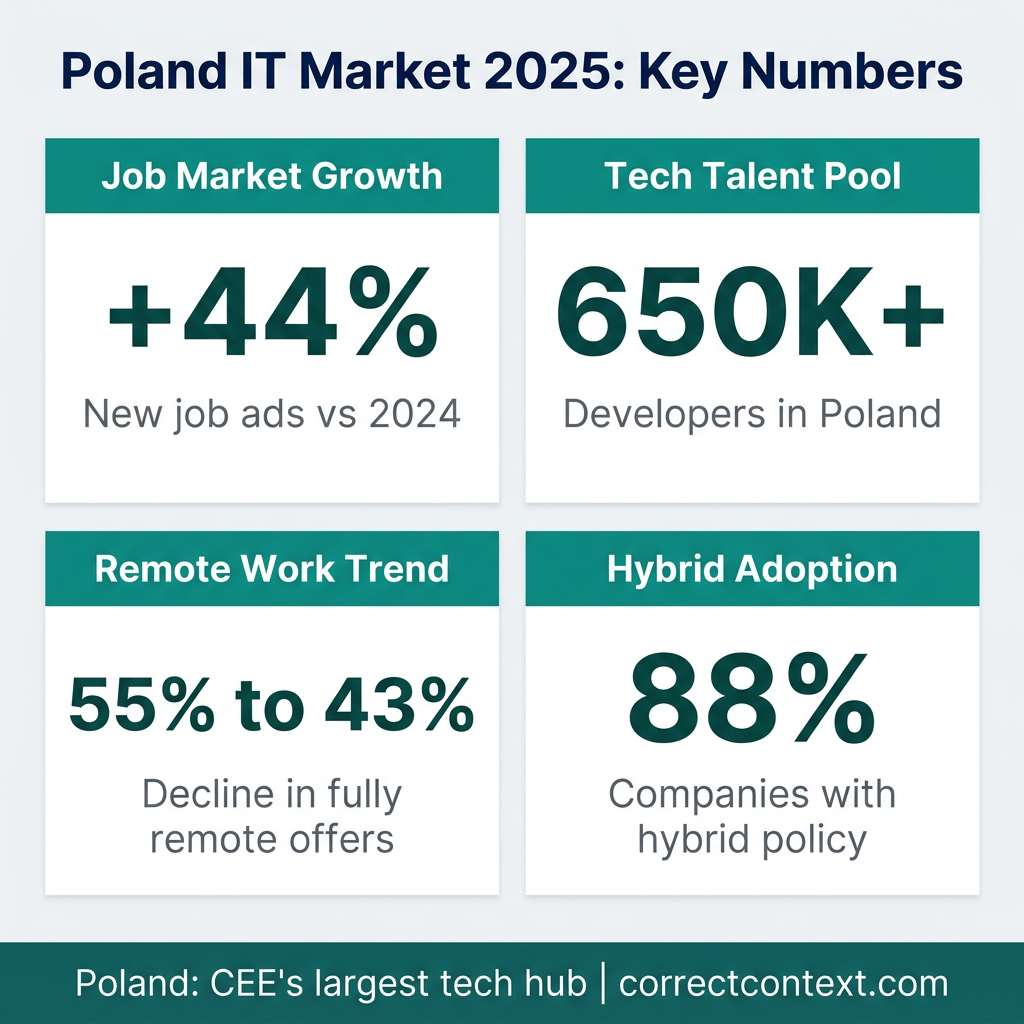
Here’s a number that should get every CTO’s attention: 83% of global employees prefer a hybrid work environment, yet fully remote job offers in Poland have dropped from 55% to just 43% in the past two years. The pendulum is swinging, and engineering leaders who don’t adapt their management practices risk losing their best talent to competitors who will.
Poland has emerged as Central and Eastern Europe’s largest tech hub, with over 650,000 developers and 60,000+ IT companies. But hiring here in 2025 isn’t what it was in 2021. The market has matured. Competition for top-tier engineers remains fierce despite a 44% increase in job postings. And how you structure your remote and hybrid work policies has become a decisive factor in whether you can attract and retain the talent your engineering roadmap demands.
This article draws on data from the No Fluff Jobs 2025/2026 IT Market Report, Stack Overflow’s 2025 Developer Survey, Cisco’s Global Hybrid Work Study, and real-world practices from companies successfully scaling distributed engineering teams in Poland. These ten best practices aren’t theoretical—they’re what separates high-performing remote teams from those that struggle with coordination, culture, and delivery.
The State of Remote and Hybrid Work in Poland’s IT Sector
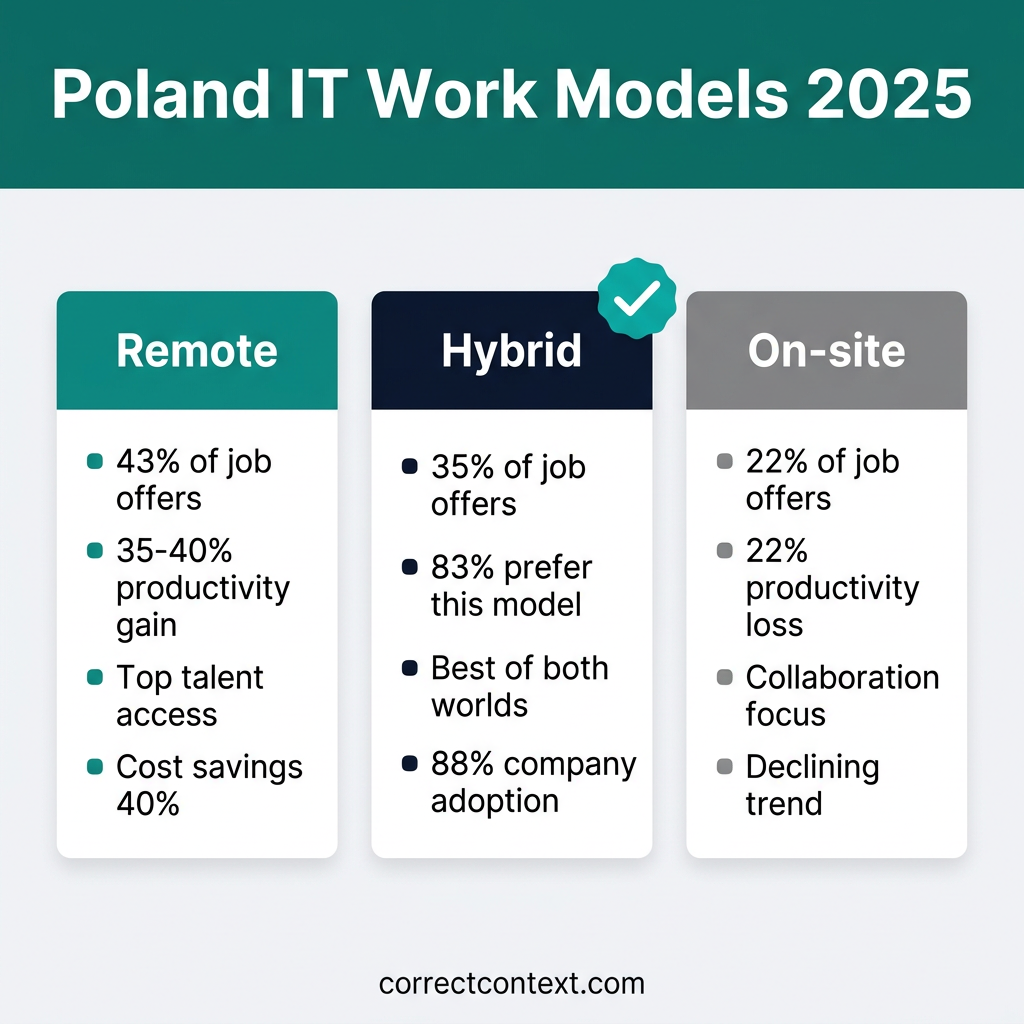
Before diving into best practices, let’s ground ourselves in the current reality. Poland’s IT job market has rebounded strongly in 2025, with 44% more job advertisements than in 2024. But the composition of those offers has shifted dramatically:
- Fully remote positions: Down from 55% to 43% of job offers
- Hybrid positions: Up to 35% of job offers and climbing
- On-site positions: Holding steady but increasingly limited to specific roles
This shift isn’t arbitrary. After the pandemic-era experiment with full remote work, Polish companies—and the international firms hiring here—have settled on hybrid as the sustainable middle ground. The data supports this: 88% of Polish IT companies have now adopted some form of hybrid work policy, according to LinkedIn workforce data.
But here’s the critical insight for engineering leaders: the model matters less than the execution. A poorly managed hybrid setup creates all the coordination overhead of remote work with none of the flexibility benefits. A well-run remote team often outperforms a dysfunctional hybrid one.
1. Default to Asynchronous Communication
The most productive distributed engineering teams have learned a counterintuitive lesson: async tools don’t replace meetings—they prepare teams to make the meetings that do happen shorter, sharper, and more decisive.
McKinsey’s analysis of 500 companies found that remote teams waste 45% less time in meetings than office-based teams. But this doesn’t happen automatically. It requires intentional design.
Here’s what async-first communication looks like in practice:
- Written updates replace status meetings. Daily standups become written threads in Slack or Teams. Team members post updates on their own schedule, within a defined window (e.g., before 10 AM local time).
- Decisions happen in documentation, not chat. Use Notion, Confluence, or similar tools for architectural decisions, RFCs, and design docs. Chat is for coordination; documentation is for decisions.
- Meetings have pre-reads. Every meeting has an agenda and pre-read material shared at least 24 hours in advance. No pre-read, no meeting.
The Polish developers we work with at Correct Context consistently cite “fewer unnecessary meetings” as a top benefit of well-managed remote roles. This isn’t about eliminating human connection—it’s about preserving focused work time.
2. Document Everything (Yes, Everything)
In a co-located office, institutional knowledge lives in whiteboards, breakroom conversations, and the heads of senior engineers. In distributed teams, undocumented knowledge doesn’t exist.
High-performing remote engineering teams maintain:
- Onboarding runbooks that new hires can follow independently
- Architecture Decision Records (ADRs) explaining why systems are built the way they are
- Runbooks for operational procedures—how to deploy, how to rollback, how to respond to incidents
- Team working agreements documenting how the team communicates, makes decisions, and handles conflicts
The investment in documentation pays compound returns. New hires become productive faster. Senior engineers aren’t constantly interrupted with “how do I…” questions. And when key people leave, knowledge walks out the door at a much slower pace.
Stack Overflow’s 2025 Developer Survey found that access to quality documentation is one of the top three factors in developer satisfaction—ranking above compensation for many respondents.
3. Establish Clear Overlap Hours
One of the most common mistakes in distributed engineering teams is trying to maintain synchronous collaboration across too many time zones. The result is either burnout (from early morning or late night calls) or coordination gridlock.
The solution: define explicit overlap hours and protect the rest.
For teams working with Polish developers from Western Europe, this is straightforward—Poland shares the CET/CEST timezone with Germany, France, and most of the EU. But for US-based companies hiring in Poland, the 6-9 hour time difference requires intentional design.
Best practices for overlap hours:
- 2-3 hours of daily overlap is sufficient for standups, sprint planning, and code reviews
- Schedule complex collaborative work during overlap; reserve non-overlap hours for deep work
- Rotate meeting times if you have team members in significantly different time zones—don’t always make the same people take the early or late calls
| Team Distribution | Recommended Overlap | Best Practices |
|---|---|---|
| Poland + Western Europe | 4-6 hours | Full collaboration possible; schedule complex sessions mid-day |
| Poland + UK | 5-7 hours | Minimal timezone friction; standard work hours align well |
| Poland + US East Coast | 2-3 hours | Poland afternoon / US morning; use for sync meetings only |
| Poland + US West Coast | 0-1 hours | Async-first required; overlap for emergencies only |
4. Measure Output, Not Hours
This principle sounds obvious but proves surprisingly difficult to implement in practice. Engineering leaders often fall back to proxy metrics—Slack responsiveness, hours logged, meeting attendance—because measuring actual output requires more sophistication.
Here’s what measuring output looks like for distributed engineering teams:
- Sprint velocity trends (not absolute velocity, which varies by team)
- Cycle time—how long from code commit to production deployment
- Pull request review time and quality (rejection rate, comment depth)
- Incident frequency and resolution time
- Feature delivery against roadmap commitments
The 2025 Stack Overflow Developer Survey found that developers on teams with clear output metrics reported 34% higher job satisfaction than those on teams measured by activity proxies.
Importantly, these metrics should be used for team improvement, not individual performance management. When developers trust that the data is used to remove blockers rather than police behavior, they engage with it constructively.
5. Invest in Onboarding as a Competitive Advantage
The first 90 days determine whether a new hire becomes a productive, engaged team member or a costly mis-hire. This is doubly true for remote and hybrid positions, where new hires can’t absorb culture and context through osmosis.
World-class remote onboarding includes:
- A structured 30-60-90 day plan with clear milestones and success criteria
- Dedicated onboarding buddy—not the hiring manager, but a peer who can answer “stupid questions” without judgment
- Week 1: Environment and tools—get the new hire fully set up and able to build/deploy independently
- Week 2-3: First contribution—a meaningful but scoped first task that ships to production
- Month 2-3: Increasing ownership—progressively larger features with appropriate support
At Correct Context, we’ve found that engineering teams with structured remote onboarding programs achieve full productivity 40% faster than those with ad-hoc approaches. For companies hiring through our Employer of Record service in Poland, we provide onboarding templates and checklists tailored to Polish labor law and cultural norms.
6. Use the Right Tool Stack (And Stick to It)
Tool proliferation is a hidden tax on distributed engineering teams. When different subteams use different project management tools, communication platforms, or documentation systems, the friction compounds quickly.
The 2025 Stack Overflow Survey identified the most common tool stacks for high-performing distributed teams:
| Category | Primary Tools | Purpose |
|---|---|---|
| Communication | Slack, Microsoft Teams, Discord | Real-time coordination, team culture |
| Documentation | Notion, Confluence, GitBook | Knowledge management, decision records |
| Project Management | Jira, Linear, GitHub Projects | Sprint planning, issue tracking |
| Code Collaboration | GitHub, GitLab, Bitbucket | Version control, code review |
| Video Calls | Zoom, Google Meet, Teams | Synchronous collaboration |
| Async Video | Loom, Vimeo Record | Demos, explanations, updates |
The specific tools matter less than consistency. A team that fully commits to a single stack outperforms one with “best-of-breed” fragmentation.
7. Build Social Connection Intentionally
Remote work doesn’t have to mean isolation, but social connection requires deliberate effort. The best distributed engineering teams create space for human relationships that aren’t purely transactional.
Practical approaches that actually work:
- Virtual coffee roulette—randomly pair team members for 15-minute non-work chats
- Donut channels in Slack—automated introductions for cross-team connections
- Quarterly in-person gatherings—for hybrid teams, regular offsites rebuild social capital
- Non-work channels—gaming, cooking, pets, books—whatever your team is into
- Celebration rituals—shipping announcements, milestone recognition, team wins
The Cisco Global Hybrid Work Study 2025 found that teams with intentional social connection practices reported 47% higher engagement scores than those that left it to chance.
8. Protect Focus Time Ruthlessly
Engineering work requires sustained concentration. The constant context-switching of a meeting-heavy schedule destroys the deep work that produces quality code.
High-performing remote teams implement:
- No-meeting blocks—at minimum, mornings protected for deep work
- Meeting-free days—some teams declare Wednesdays or Fridays meeting-free
- Async standups—written updates instead of synchronous calls
- Meeting hygiene—default 25/50-minute meetings instead of 30/60, with hard stops
The data supports this approach. Studies consistently show 35-40% productivity increases among remote employees who can control their schedules, driven primarily by fewer interruptions and better focus.
9. Prioritize Mental Health and Burnout Prevention
Remote work blurs the boundary between professional and personal life. Without the physical separation of leaving an office, many engineers struggle to disconnect—and burnout follows.
Engineering leaders must actively model healthy boundaries:
- Respect timezone boundaries—no messages or expectations outside work hours
- Encourage actual vacation—fully disconnected, not “working vacations”
- Monitor workload distribution—ensure no one person is the bottleneck
- Provide mental health resources—EAP programs, counseling, wellness stipends
- Lead by example—leaders should visibly take time off and respect boundaries
The Owl Labs State of Hybrid Work 2025 report found that 65% of workers are interested in “microshifting”—working in short, non-linear blocks based on personal energy and productivity patterns. Rigid 9-to-5 expectations in remote roles increasingly conflict with how people actually do their best work.
10. Iterate Based on Feedback
No team gets remote work perfect on the first try. The best teams treat their working model as a product—continuously gathering feedback, measuring outcomes, and iterating.
Feedback mechanisms that work:
- Quarterly team health checks—structured surveys on collaboration, clarity, and satisfaction
- Retrospectives that include remote/hybrid experience—not just what was built, but how the team worked
- 1-on-1s that dig into working experience—not just project status, but how the person is experiencing the work environment
- Exit interviews that capture remote work feedback—understand why people leave
The No Fluff Jobs 2025 report notes that Polish IT professionals are increasingly selective about employers. Companies that demonstrate responsiveness to feedback about remote work practices have a measurable advantage in both hiring and retention.
Key Takeaways
- Hybrid is the new default in Poland’s IT sector—88% of companies have adopted hybrid policies, but execution varies widely
- Async-first communication is foundational—remote teams that master async collaboration outperform those that try to replicate office dynamics online
- Documentation is non-negotiable—in distributed teams, undocumented knowledge doesn’t exist
- Measure output, not activity—focus on delivery metrics rather than proxy indicators like hours logged
- Onboarding is a competitive advantage—structured remote onboarding accelerates time-to-productivity by 40%
- Social connection requires intention—the best remote teams deliberately create space for human relationships
- Protect focus time—deep work requires sustained concentration; meeting-heavy schedules destroy productivity
- Mental health is a business issue—burnout is expensive; prevention is cost-effective
- Iterate continuously—treat your remote work model as a product that improves with feedback
- Poland’s IT market rewards quality employers—with 44% more job postings in 2025, candidates have options; your remote work practices are a differentiator
Frequently Asked Questions
Is remote work declining in Poland’s IT sector?
Yes, but context matters. Fully remote job offers have declined from 55% to 43% of the market, while hybrid positions have grown to 35%. The shift reflects a maturation from pandemic-era extremes to sustainable long-term models. Companies aren’t abandoning flexibility—they’re refining it.
What’s the typical salary range for remote software engineers in Poland?
According to the Just Join IT Salary Report 2026, mid-level software engineers in Poland earn PLN 15,000-22,000 net monthly on B2B contracts (approximately €3,400-5,000). Senior engineers command PLN 22,000-32,000+ net (€5,000-7,200+). Remote positions typically pay at the higher end of these ranges due to competition for talent.
How do Polish developers feel about returning to the office?
The 2025 Stack Overflow Developer Survey found that 83% of developers prefer hybrid arrangements over fully remote or fully on-site. Polish developers value the flexibility of remote work but also recognize the benefits of in-person collaboration. The key is giving them control over when and how they work in the office.
What are the biggest challenges for foreign companies hiring remote engineers in Poland?
The most common challenges include: (1) navigating Polish labor law and contract types (UoP vs B2B), (2) building trust and culture across distance, (3) managing time zone differences, and (4) ensuring compliance with local employment regulations. Many companies address these through Employer of Record (EoR) services that handle legal employment, payroll, and compliance.
How important is English proficiency for remote roles in Poland?
English proficiency is essential for remote positions serving international teams. Most Polish developers in the international job market have strong English skills, particularly in written communication. However, clear documentation and communication protocols become even more important when working across language backgrounds.
Sources
- No Fluff Jobs — IT Job Market in Poland 2025/2026 Report (February 2026)
- Stack Overflow — 2025 Developer Survey (March 2026)
- Cisco — Global Hybrid Work Study 2025 (January 2026)
- Owl Labs — State of Hybrid Work 2025 Report (February 2026)
- Zoom — Hybrid Work Statistics 2025 (March 2026)
- Optiveum / Just Join IT — IT Salaries in Poland 2026 Report (January 2026)
- HRK — Poland Recruitment Market 2026 Trends Report (April 2026)
- Agiliway — Poland’s Most Prominent Tech Hubs 2026 (March 2026)