
When enterprise leaders set out to build a high-performing engineering team in Poland / CEE, one requirement almost always makes it to the top of the list: cultural fit. It sounds like a reasonable demand. After all, when you hire developers in Poland or anywhere else, you want them to integrate seamlessly with your existing staff, communicate smoothly, and share your organization’s core values. However, for many enterprise innovation and data units, the pursuit of cultural fit has become a double-edged sword. Instead of fostering collaboration, it often leads to team friction, excludes top-tier talent, and masks unconscious biases.
In the competitive landscape of tech hiring, the concept of cultural fit is frequently misunderstood. Hiring managers often conflate shared hobbies, similar backgrounds, or a conversational “click” with genuine professional alignment. This misunderstanding can be particularly damaging when trying to scale engineering teams across borders. As large tech enterprises in the US, UK, DACH, and Nordics increasingly rely on an offshore development team or a nearshore development team, rethinking how we assess cultural alignment is no longer just an HR initiative—it is a business imperative.
The Misuse of Cultural Fit in Tech Hiring
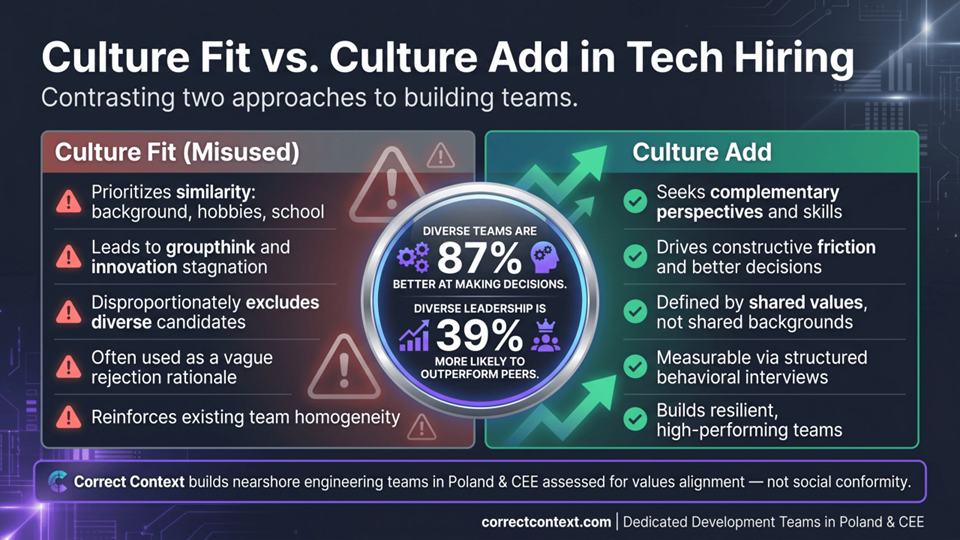
The original intent behind cultural fit was to ensure that new hires shared the organization’s core values and mission. Over time, however, the definition has blurred. In many tech interviews, assessing cultural fit has devolved into a conformity test. Interviewers look for candidates they would enjoy having a beer with, rather than those who can constructively challenge the status quo and drive innovation.
Lauren Rivera, a professor at the Kellogg School of Management, extensively researched hiring practices at elite firms. Her findings revealed that when interviewers felt they “clicked” with a candidate, it usually meant they shared similar socioeconomic backgrounds, attended the same schools, or enjoyed the same leisure activities [1]. This approach to cultural fit tech hiring inevitably leads to homogeneity. When hiring panels—often composed of individuals from similar demographics—prioritize candidates who look, think, and act like them, they inadvertently perpetuate systemic biases.
This misuse is particularly detrimental when building a dedicated software team or a specialized data analytics team. In fields like Big Data development, Artificial Intelligence / Machine Learning, and Cloud engineering (such as an AWS / Azure / GCP engineers team), complex problem-solving requires diverse perspectives. When “cultural fit” is used to reject good candidates simply because their communication style or background differs from the norm, companies miss out on the exact cognitive diversity needed to tackle intricate technical challenges.
How Cultural Mismatch and Homogeneity Drive Team Friction
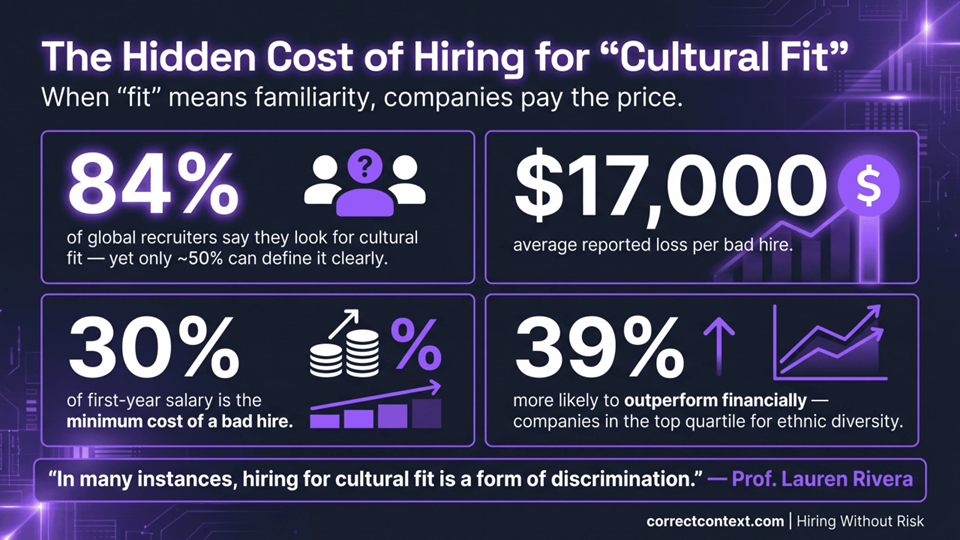
A common fear among enterprise hiring leaders is that a cultural mismatch in tech will lead to team friction and delayed project delivery. It is a valid concern; a bad hire can cost a business between 15% and 30% of that employee’s first-year salary, with some estimates suggesting the total cost of a bad hire can reach up to $17,000 or more when factoring in lost productivity and architectural rework [2] [3]. However, the assumption that homogeneity prevents friction is fundamentally flawed.
While homogeneous teams might reach consensus faster, they often make poorer decisions. Diverse teams, on the other hand, are forced to engage in more rigorous debate, leading to better outcomes. According to research by McKinsey & Company, companies in the top quartile for ethnic and cultural diversity on executive teams were 39% more likely to experience above-average profitability than those in the bottom quartile [4].
When an enterprise seeks to hire AI engineers or build a platform engineering team, avoiding interpersonal friction at the cost of diversity is a strategic mistake. Constructive friction—where different viewpoints clash and synthesize—is the crucible of innovation. A team composed entirely of individuals who think alike is highly susceptible to groupthink, leaving the organization vulnerable to blind spots in product development and security.
The True Cost of Exclusionary Hiring
Relying heavily on vague notions of cultural fit not only stifles innovation but also exposes companies to significant risks. Consider the following impacts of exclusionary hiring practices:
| Impact Area | Description of Consequence |
|---|---|
| Innovation Deficit | Teams lacking cognitive diversity struggle to develop novel solutions, particularly in cutting-edge fields like enterprise AI tools and machine learning. |
| Financial Loss | The cost of a bad hire is substantial, but the opportunity cost of rejecting a top-tier candidate due to a perceived lack of “fit” can be even higher in lost revenue and market share. |
| Legal and Reputational Risk | Hiring practices that consistently favor specific demographics can lead to discrimination claims and damage an employer’s brand in the competitive tech talent market. |
| Erosion of Trust | When candidates are rejected for ambiguous “culture fit” reasons after acing technical rounds, it breeds cynicism and damages the broader tech ecosystem’s trust in the hiring process. |
Shifting the Paradigm: From Culture Fit to Culture Add
To build a resilient and innovative remote software engineers team, organizations must shift their focus from “culture fit” to “culture add.” Culture add asks a fundamentally different question during the interview process: What unique perspectives, experiences, or skills does this candidate bring that our team currently lacks?
This shift is crucial for enterprises looking to scale software development by utilizing an extended engineering team or an offshore team for startup growth. When integrating a nearshore development team in Europe, leaders should not expect these engineers to perfectly mirror the home office’s culture. Instead, they should value the diverse problem-solving approaches and work ethics that these professionals bring to the table.
Ruchika Tulshyan, writing for the Society for Human Resource Management (SHRM), emphasizes that hiring for culture fit is an exclusionary practice that often defaults to hiring for sameness [5]. By embracing culture add, companies can systematically dismantle unconscious biases and actively seek out candidates who enrich the organizational fabric rather than just blending into it.
Assessing Collaboration and Alignment Without Bias
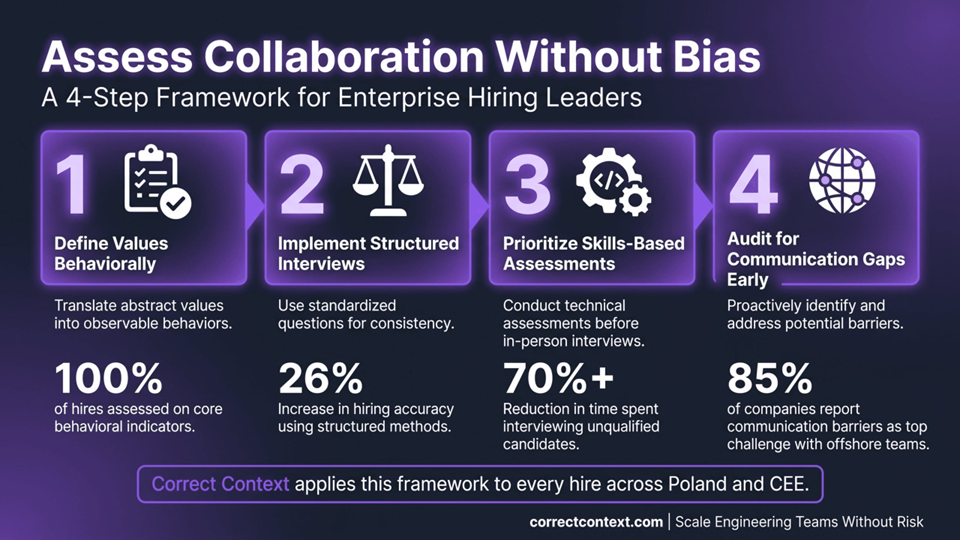
For enterprise hiring leaders, the challenge remains: how do you ensure that a candidate will collaborate effectively and align with the company’s core mission without falling into the trap of affinity bias? The answer lies in structured, objective assessment methods.
1. Define Core Values in Behavioral Terms
Before initiating the process to hire developers for startup or enterprise projects, clearly define what your company values actually mean in practice. If your company values “innovation,” do not ask candidates what they do for fun. Instead, ask them to describe a time they proposed an unconventional solution to a technical problem. Translating abstract values into specific, observable behaviors helps interviewers assess alignment objectively.
2. Implement Structured Interviews
Structured interviews are one of the most effective tools for reducing unconscious bias. This approach involves asking every candidate the same predetermined set of questions and evaluating their responses against a standardized scoring rubric. By focusing on job-related competencies and behavioral indicators rather than unstructured conversation, structured interviews ensure a fair and equitable evaluation process.
3. Utilize Skills-Based Assessments
When evaluating candidates for a DevOps team for hire or a backend development team, prioritize technical and problem-solving skills over conversational chemistry. Provide candidates with realistic, job-specific tasks or coding challenges. As Lauren Rivera suggests, conducting skills-based screenings before in-person interviews helps anchor the evaluation in actual capability, mitigating the influence of first impressions and unconscious biases [1].
4. Audit for Mismatches Early
When integrating an engineering team in Poland / CEE, proactively monitor for communication and collaboration challenges. Research indicates that 85% of companies experience communication barriers as their primary cultural challenge when working with offshore teams [6]. Address these issues not by demanding assimilation, but by establishing clear communication protocols, shared goals, and mutual respect for different working styles.
The Strategic Advantage of Nearshore Teams in Poland and CEE
For Fortune 5000 companies and large tech enterprises, leveraging software developers in Poland offers a strategic advantage that goes beyond cost savings. The Central and Eastern European (CEE) region is renowned for its exceptional technical talent, particularly in specialized areas like cloud engineering, data engineering, and corporate AI use.
When utilizing an employer of record in Poland (EoR) or seeking payroll services in Poland, companies can seamlessly integrate these high-caliber professionals into their core operations. An EoR in Europe handles the complexities of employment compliance in Europe, allowing enterprise leaders to focus on what truly matters: building a cohesive, high-performing team.
By partnering with experts to build a tech hub in Poland or an engineering hub in Europe, organizations can access affordable senior developers who are not only technically proficient but also highly adaptable. The key to success lies in applying the principles of culture add. Rather than expecting nearshore developers to perfectly replicate the culture of a New York or London office, successful enterprises embrace the unique cultural perspectives and rigorous engineering standards that CEE professionals bring, fostering a richer, more dynamic collaborative environment.
Conclusion
The reliance on “cultural fit” as a primary hiring criterion has outlived its usefulness in the modern tech industry. For enterprise innovation units and large tech firms, clinging to this outdated concept perpetuates bias, stifles diversity, and ultimately hinders technological advancement. By shifting the focus to “culture add” and implementing structured, objective assessment methods, hiring leaders can build truly exceptional teams.
Whether you are looking to hire in Europe without a company entity or assemble a dedicated AI development team, the goal should be to gather diverse minds that can challenge each other constructively. Embracing cognitive diversity and cultural addition is the most reliable path to driving innovation, reducing team friction, and securing a competitive edge in the global market.
References
[1] Rivera, L. (2020). Stop Hiring for “Cultural Fit”. Kellogg Insight.
[2] ExpressChan. (2025). The True Cost of a Bad Hire: A Financial Breakdown for Employers.
[3] INOP. (2026). Cost of a Bad Hire Statistics 2026 & Salary Percentages.
[4] McKinsey & Company. (2023). Diversity matters even more: The case for holistic impact.
[5] Tulshyan, R. (2022). Don’t Hire for Culture Fit. Society for Human Resource Management (SHRM).
[6] Correct Context. (2025). How do you align your company’s culture with your offshore IT team?