Hiring in Polish Startups: The Complete Guide for 2025 and Beyond
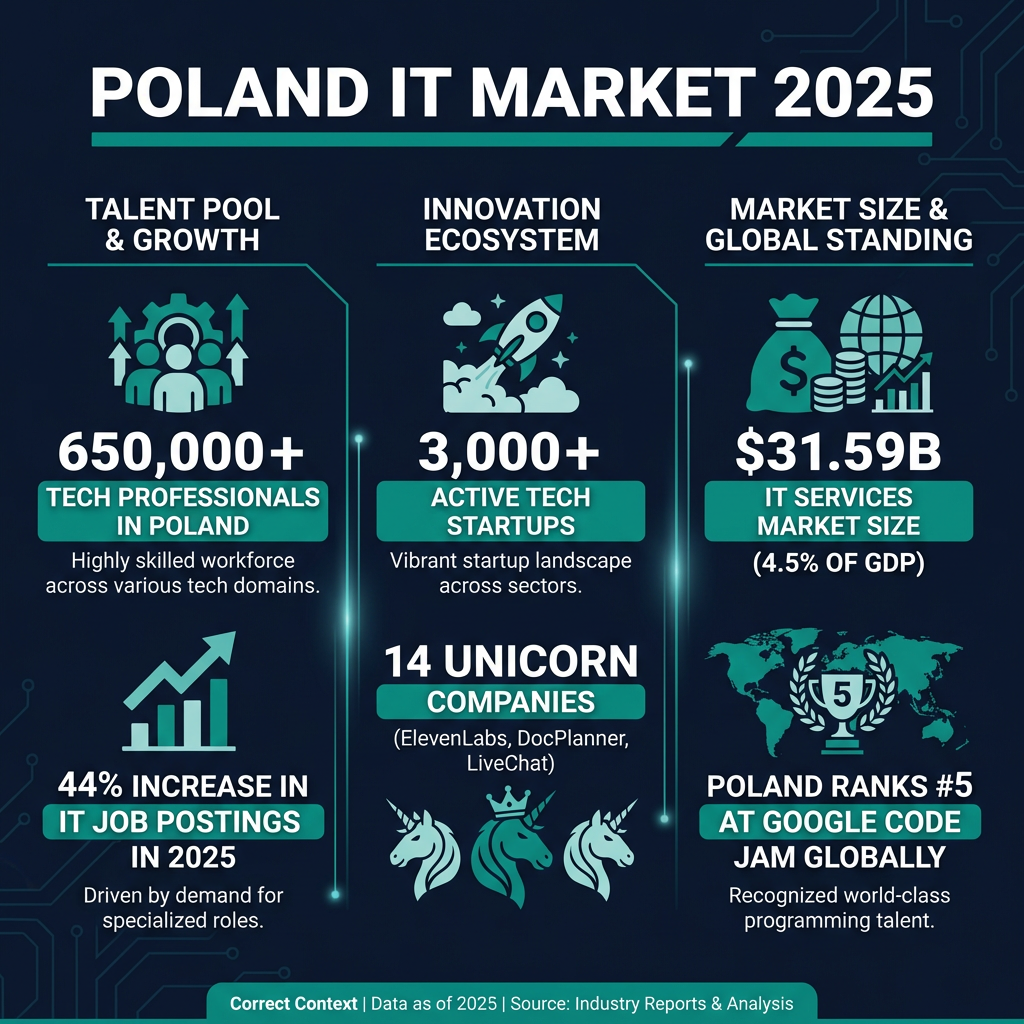
Poland’s tech job market posted 44% more IT job openings in 2025 compared to the year before — the strongest rebound the market has seen since the post-pandemic hiring freeze of 2023–2024. For founders and engineering leads at Polish startups, that number cuts both ways. More openings mean more competition for the same pool of 650,000+ tech professionals. If your hiring process isn’t sharp, you’ll lose candidates to better-organized companies — sometimes within hours of making an offer. This guide covers everything you need to know about hiring in Polish startups right now: where to find candidates, how to structure the process, what compensation actually looks like, and how to build teams that stay.
The State of the Polish Startup Ecosystem in 2025
Poland has quietly become one of Europe’s most serious tech hubs. Warsaw, Kraków, Wrocław, and the Tri-City area (Gdańsk, Gdynia, Sopot) together host thousands of product companies, SaaS startups, fintech players, and engineering centers for global firms. The numbers back this up: Poland counts over 3,000 active startups and 14 unicorn companies — including ElevenLabs, DocPlanner, and LiveChat. Poland’s IT services market is projected to reach $31.59 billion in 2025, which represents 4.5% of the country’s entire GDP.
That growth didn’t happen by accident. Poland produces roughly 15,000 new IT graduates per year across more than 60 universities, including the Warsaw University of Technology and Wrocław University of Science and Technology. Polish developers rank among the best in the world — they hold the #5 position at Google Code Jam and rank 7th on TopCoder globally. Harvard Business Review has listed Poland among the top tech-skilled labor markets worldwide.
What makes the ecosystem particularly relevant for startups is the mix: you have big tech multinationals (Google, Microsoft, Samsung) running major R&D centers in Poland, sitting next to fast-growing local product companies competing for the same talent. Startup funding, while it dipped sharply in 2023–2024 (down 42% in one year according to one industry report), has begun recovering. The talent market didn’t fully contract during that period — developers who lost jobs at laid-off startups quickly found positions at larger firms or international companies expanding into Poland.
This creates a specific challenge for startups in 2025: you’re competing not just against other startups, but against mature corporations, foreign tech giants, and remote-first international employers who can pay in dollars or euros. The old assumptions — that Polish engineers prefer working for startups because of the culture, or that they’ll take a lower salary for equity — are much weaker now. Candidates have choices, and they know it.
The good news is that startups still have real advantages over corporates. Speed of decision-making, technical ownership, visible impact, and genuinely interesting problems all matter to engineers. The challenge is learning how to communicate those advantages credibly — and how to build a hiring process that doesn’t scare off good candidates before they even get to the offer stage.
What Developers in Poland Actually Want: Beyond the Salary Number
Salary matters — a lot. But it’s rarely the only thing, and in Poland’s current market it’s almost never the deciding factor on its own. Understanding what candidates are actually optimizing for will change how you write job posts, how you conduct interviews, and how you structure offers.
The most significant structural shift in the Polish IT job market over the past three years is the shift from fully remote to hybrid. According to the No Fluff Jobs 2025 IT Job Market Report, remote roles dropped from 55% of all job postings just two years ago to under 43% in 2025. Hybrid work now appears in 35% of all IT job ads, and that number is growing. This shift reflects employer behavior more than candidate preference — most engineers still prefer remote or hybrid arrangements — but it means candidates now evaluate commute, office quality, and team presence more seriously than they did in 2021.
Technical challenge and career growth consistently rank at the top of what Polish engineers say they want. Stack Overflow’s Developer Survey data shows that globally, developers prioritize learning opportunities and interesting work nearly as highly as compensation. In Poland specifically, engineers who stay at the same company for 2–3 years typically cite technical mentorship, ownership of meaningful projects, and a clear path to senior or lead roles as the main reasons. Companies that offer just a job title and a salary — without a visible technical growth trajectory — struggle with retention even when they pay competitively.
Contract type is another uniquely Polish consideration. A large portion of experienced developers work on B2B contracts (self-employment invoicing), not traditional employment (umowa o pracę). The tax structure in Poland makes B2B significantly more tax-efficient for engineers above certain income levels. Startups that can accommodate B2B contracts access a larger and more experienced candidate pool. Those that only offer employment contracts will find themselves filtered out early — many senior developers won’t even apply.
Employer branding has gone from a buzzword to an actual competitive variable. Polish developers actively research companies before applying or responding to outreach. They check LinkedIn, look for engineering blog posts, look at Glassdoor equivalents (like GoWork or Pracuj.pl reviews), and ask in developer communities. A company with no visible engineering culture online — no posts about technical decisions, no talks at meetups, no GitHub presence — signals that there’s nothing interesting happening there technically. This hurts startups that are genuinely doing interesting work but haven’t invested in communicating it.
| Factor | % of Candidates Rating as “Very Important” | Notes |
|---|---|---|
| Salary and compensation package | 87% | B2B contract availability significantly widens talent pool |
| Technical challenge and interesting problems | 76% | Especially important for senior engineers |
| Remote or hybrid work flexibility | 74% | Hybrid now more common than fully remote in job ads |
| Career growth and learning opportunities | 71% | Conference budgets, training, mentorship matter |
| Team culture and engineering quality | 68% | Code quality, technical debt, review culture |
| Company stability and financial health | 61% | Increased post-2023 startup layoff wave |
| Equity or profit sharing | 34% | Lower than Western markets; cash preferred by most |
Where to Find Engineering Talent in Poland
The days of posting a job and waiting for great candidates to apply are largely over, especially at the senior level. According to data reported by The Pragmatic Engineer, some companies receive 23,000 applications for eight positions in a single month — yet 90% of actual hires still come from active sourcing or referrals, not inbound applications. This is even more pronounced for senior and specialist roles in Poland’s competitive market.
That said, job boards still matter as part of a broader strategy. Here’s where Polish tech candidates actually are:
No Fluff Jobs is the dominant tech-specific job board in Poland. It’s known for requiring transparent salary ranges in every job posting — a practice that filters out companies unwilling to show their hand but significantly increases candidate trust and application quality for those that do comply. Backend, Data/BI, Fullstack, and DevOps roles see the most postings and the most candidate activity.
JustJoinIT is the other major player, with a strong focus on IT and startup culture. It has a large following among younger developers and is popular for frontend and mobile roles. Optiveum partnered with JustJoinIT on the 2026 Poland IT Salary Report, which gives the platform significant credibility in the senior developer community.
LinkedIn is the primary sourcing tool for headhunters and internal recruiters doing outreach. Most experienced Polish developers maintain a LinkedIn profile, even if they’re not actively looking. Response rates to cold InMails depend heavily on personalization — generic “great opportunity” messages get ignored. Messages that reference specific work (a GitHub repo, a conference talk, a published article) get much higher response rates.
GitHub is increasingly used for passive sourcing, particularly for backend, open source contributors, and niche technology specialists. Developers who actively contribute to public projects are often the most technically strong and the most receptive to outreach that references their actual code.
Developer communities in Poland include local Slack groups, Discord servers, and meetup communities organized around Warsaw JS, Kraków JUG, Wrocław Python User Group, and dozens of specialized tech communities. Sponsoring a meetup, giving a technical talk, or even showing up and participating in these communities over time builds the kind of brand recognition that makes recruiting easier. It’s a long game — but it works.
Employee referrals remain the highest-quality source of candidates for most Polish tech companies. Engineers tend to refer people they’ve worked with before, which means referrals come pre-screened for both technical ability and professional behavior. Building a formal referral program — with clear rewards and a process that makes it easy to submit referrals — consistently outperforms almost every other sourcing channel on quality-per-hire metrics.
Recruitment agencies are also a legitimate tool, particularly for hard-to-fill roles or when you need to hire fast without a dedicated internal recruiting function. The Polish IT recruitment market has matured considerably — agencies like Sowelo Consulting, Optiveum, and Correct Context operate as specialist partners rather than CV-pushers, offering market salary data, candidate pipeline management, and in some cases Employer of Record services for international clients hiring Polish developers.
Structuring a Hiring Process That Doesn’t Lose Good Candidates
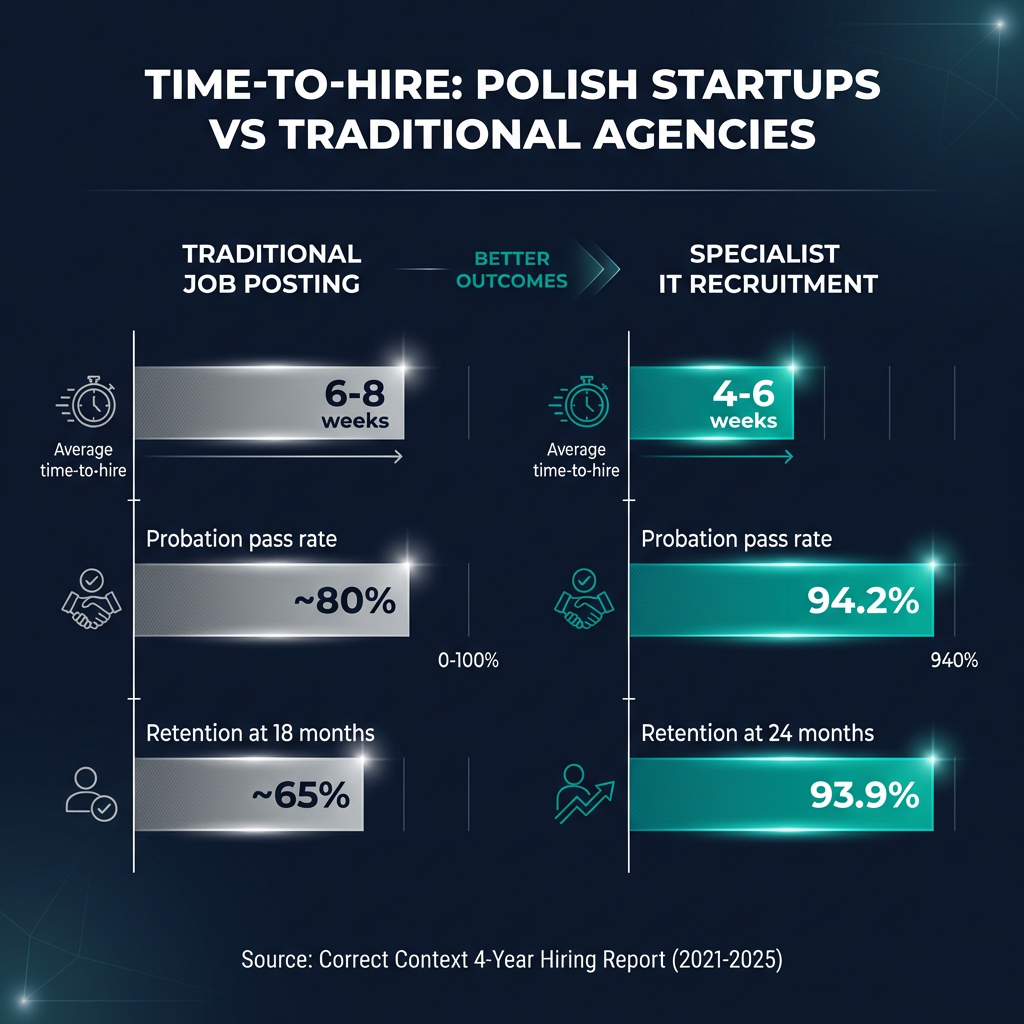
The average time-to-hire in the Polish IT market runs 6–8 weeks for companies using traditional job-posting approaches. Specialist recruitment partners typically bring that down to 4–6 weeks. But speed is only part of the equation — the structure and candidate experience of your hiring process matters just as much.
Polish developers, particularly those with 5+ years of experience, are increasingly vocal about rejecting overly long or opaque hiring processes. Multi-stage take-home assignments that require 10+ hours of unpaid work are a consistent source of frustration. Companies that ask for lengthy projects as a standard part of the process — especially early in the funnel — lose candidates to competitors who either pay for the work or skip the take-home entirely in favor of structured technical discussions.
The most effective hiring processes in Polish startups tend to follow this pattern:
Stage 1 — Initial screen (30 minutes): A recruiter or engineering lead talks with the candidate about their background, motivations, and high-level fit. This stage should also convey genuine information about the role, team, and technical context — not just be an interrogation. Candidates who feel respected in the first call are significantly more likely to continue through the process.
Stage 2 — Technical assessment: This varies by company and role, but the trend is moving away from algorithmic puzzles (LeetCode-style) toward practical, role-relevant assessments. For backend engineers, this might be a code review exercise or a system design discussion. For frontend, a review of a component architecture decision. The best assessments take 60–90 minutes maximum and can be done live with an engineer present — which also gives the candidate a sense of how the team thinks and communicates.
Stage 3 — Team and culture interviews: Meeting 2–3 members of the team in structured but informal conversations. This stage is bidirectional — the candidate is assessing you as much as you’re assessing them. Prepare your team members to sell the role authentically, including being honest about challenges, not just pitching the company.
Stage 4 — Offer: Move fast. The biggest source of candidate loss in Polish startup hiring is not rejection — it’s delay. Candidates who’ve reached the offer stage are often in conversations with 2–4 other companies simultaneously. An offer extended within 48 hours of the final interview closes significantly more often than one that takes a week.
AI is entering the hiring process in Poland, though it’s generating controversy. According to ITCompare’s 2025 report on IT recruitment in Poland, AI video interviews and automated pre-screening tools are becoming more common. Candidates describe these as “dehumanizing” and are wary of processes that feel opaque or algorithmic. For startups, this is actually an opportunity: a process that’s personal, fast, and led by real people who know what they’re talking about will stand out positively against corporate hiring processes that feel like getting through airport security.
Compensation Benchmarks: What You’re Actually Competing Against
Salary transparency is now effectively mandatory in the Polish tech hiring market. No Fluff Jobs requires salary ranges on all postings. JustJoinIT displays salary data prominently. Candidates routinely share offer details in community Slack channels and forums. If you’re not prepared to discuss compensation openly from the first screen, you’re creating friction that eliminates candidates early.
The data from Correct Context’s four-year hiring report (2021–2025) gives the clearest picture of what’s actually being paid in the market for engineers placed through specialist recruitment:
- Average salary, all levels: 282,925 PLN / ~$76,927 USD per year
- Median salary, all levels: 262,950 PLN / ~$71,496 USD per year
- Average salary, senior engineers: 349,050 PLN / ~$94,907 USD per year
- Median salary, senior engineers: 326,075 PLN / ~$88,660 USD per year
Separate data from Motife’s 2025 Kraków IT Market Report puts the median salary for a software engineer with 3–5 years of experience on a permanent employment contract at 17,000 PLN gross per month (~4,000 EUR). On B2B contracts, equivalent experience typically commands 20,000–28,000 PLN per month net, depending on specialization.
Whatisthesalary.com’s 2026 Poland data shows a broader range: average software engineer salaries span PLN 120,000–250,000 gross per year (~$29,000–$60,000), with seniors reaching PLN 200,000–350,000+, and top roles at international tech companies hitting PLN 500,000–800,000+ total compensation including equity.
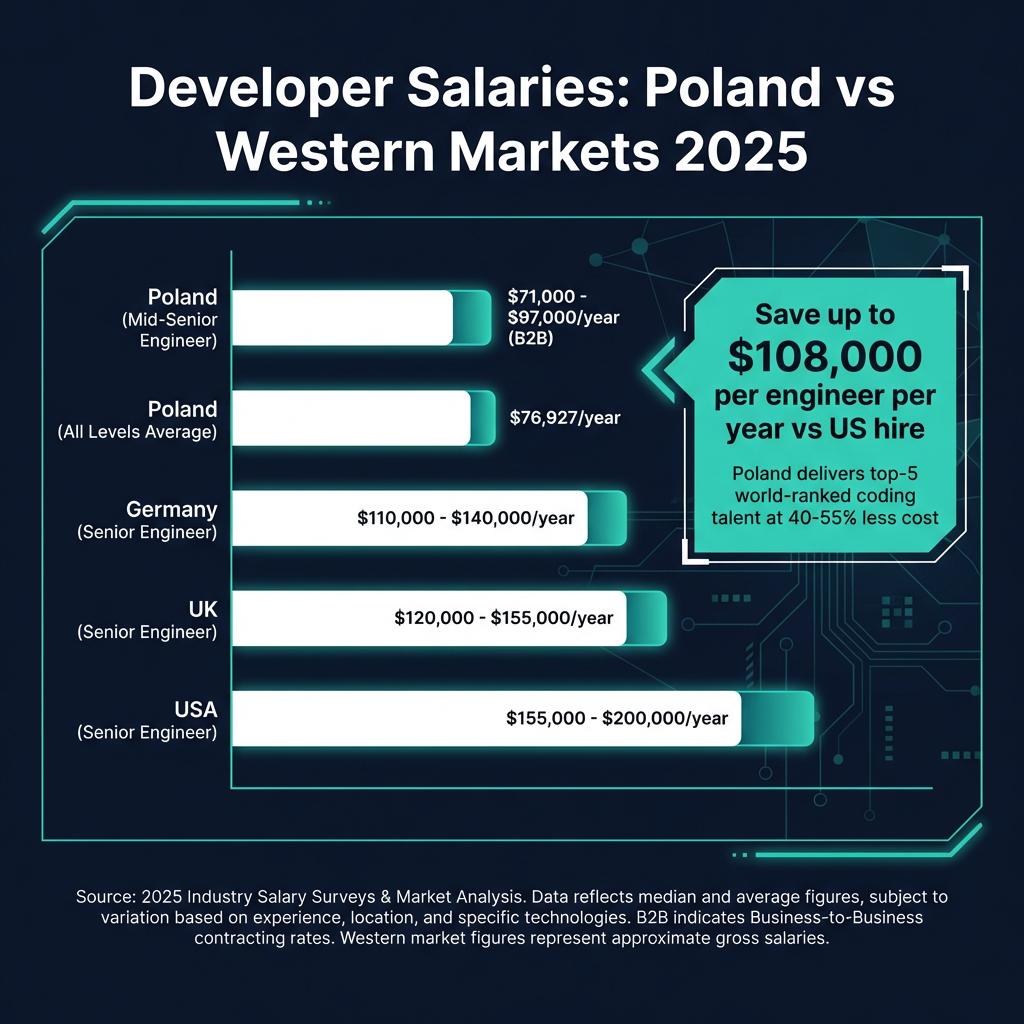
RemoDevs’ 2026 data for senior engineers on B2B contracts reports a range of $71,000–$97,000 per year — roughly 40–55% less than equivalent US-based hires. This is the central economic argument that makes Poland attractive to international companies. For domestic Polish startups, the comparison is different — you’re competing against those international salaries, not just local corporate rates.
| Role | Junior (0–2 yrs) | Mid (3–5 yrs) | Senior (6+ yrs) | Contract Type |
|---|---|---|---|---|
| Backend Engineer | 8,000–12,000 PLN/mo | 14,000–20,000 PLN/mo | 22,000–32,000 PLN/mo | B2B net / CoE gross |
| Frontend Engineer | 7,000–11,000 PLN/mo | 13,000–19,000 PLN/mo | 20,000–30,000 PLN/mo | B2B net / CoE gross |
| DevOps / Platform | 9,000–14,000 PLN/mo | 16,000–24,000 PLN/mo | 24,000–36,000 PLN/mo | B2B net / CoE gross |
| Data Engineer / BI | 8,500–13,000 PLN/mo | 15,000–22,000 PLN/mo | 23,000–34,000 PLN/mo | B2B net / CoE gross |
| Software Architect | N/A | 20,000–28,000 PLN/mo | 28,000–40,000+ PLN/mo | B2B net (median upper band: 32,000 PLN) |
| QA / Testing Engineer | 6,000–9,000 PLN/mo | 11,000–17,000 PLN/mo | 17,000–26,000 PLN/mo | B2B net / CoE gross |
Note: B2B figures are net (take-home); CoE (Contract of Employment) figures are gross. The effective take-home on CoE is approximately 25–30% lower after taxes and contributions. Many experienced engineers will factor this into salary negotiations — if you offer employment contracts only, expect candidates to ask for a gross salary that’s proportionally higher than B2B rates to compensate.
Legal Compliance and Contract Structures in Polish Startup Hiring
Poland’s labor law is detailed and employer obligations are real. Startups that try to simplify by treating employees as contractors — or that get employment contract terms wrong — create legal and financial exposure that can be significant. Here’s what you need to know.
The three main contract types:
Umowa o pracę (Employment contract) is the standard employment contract under Polish labor law. It carries the full set of employee protections: paid leave (20 days per year for employees with under 10 years of experience, 26 days for those with 10+ years), notice periods, social security contributions split between employer and employee, sick pay obligations, and protection against arbitrary dismissal. The employer’s total labor cost is typically 20–25% above the gross salary due to employer-side ZUS (social security) contributions.
Umowa zlecenia (Civil mandate contract) is used for part-time or temporary work. It provides fewer protections than a full employment contract but still requires some social security contributions. It’s appropriate for genuinely part-time or project-based arrangements but misusing it as a way to avoid employment obligations creates legal risk.
B2B (Business-to-Business) involves the developer setting up as a sole proprietor or single-member company (działalność gospodarcza or spółka z o.o.) and invoicing the client company. This provides maximum tax efficiency for the developer (flat 19% or lump-sum taxation, lower social contributions if structured correctly) and simplicity for the hiring company (no employer-side contributions, no leave obligations, simple invoice-based payments). The legal boundary is that a B2B relationship must genuinely be a business relationship — if it functions identically to employment (fixed hours, single client, exclusive arrangement, employer directing the work), Polish labor inspectors and tax authorities can reclassify it as employment with back-payment of all contributions.
For international startups hiring Polish developers without a Polish legal entity, the Employer of Record (EOR) model has become the standard solution. An EOR provider (like Correct Context) acts as the legal employer in Poland — handling payroll, ZUS contributions, tax filings, and employment contracts — while the developer works for and is directed by the foreign client. This removes the need to register a Polish entity while remaining fully compliant with local law.
Intellectual property assignment is a critical and often overlooked area. Under Polish copyright law, the default position on copyright ownership can be complex — authors of creative works (including software) have certain moral rights that can’t be fully waived. Employment contracts and B2B agreements should include explicit IP assignment clauses that cover work for hire, specifying that all code, documentation, and inventions created within the scope of the engagement belong to the company. Legal review of your standard contract is worth the cost.
Retention: Keeping the Team You’ve Built
Hiring is expensive. Losing someone you hired is more expensive. The U.S. Department of Labor’s widely cited estimate is that a bad hire costs at least 30% of that person’s first-year salary — but that figure covers only the direct costs. The indirect costs (reduced team productivity, morale impact, knowledge loss, management time, restart of the hiring process) routinely push the real figure to 50–100% of annual salary or higher.
Correct Context’s four-year data on engineers placed through specialist recruitment in Poland shows a 93.9% retention rate and an average tenure of 2.5 years. In an industry where job-hopping every 12–18 months was common during the 2021–2022 boom, keeping engineers for 2.5 years represents a significant competitive advantage in team stability and knowledge accumulation.
The data from Randstad and Pollster’s Q1 2025 Poland survey adds another dimension: employee turnover in Poland actually decreased in Q1 2025, and the average job search duration for engineers rose to a record 3.3 months. This suggests the market has cooled from the peak churn of the hiring-frenzy years. Developers are more cautious about leaving secure positions. That’s good news for retention — but it also means that when someone does decide to leave, the warning signs often appeared much earlier and were missed.
Practical retention measures that work in Polish startups:
Technical growth paths with real substance. Not just a title change from “developer” to “senior developer” — but a defined framework of what technical leadership looks like, mentorship relationships with more experienced engineers, access to conferences (React Summit, KubeCon, PyCon Poland, 4Developers), and a budget for courses and certifications. Engineers who can point to specific ways they’ve grown since joining will not be looking elsewhere.
Genuine ownership of meaningful work. The startup advantage over corporations is real here, but it needs to be actual. Engineers who are given ownership of systems — who make architectural decisions, who can see their work in production, who are credited for their contributions — stay longer than those who are given tickets and told to implement requirements from a product document.
Regular honest salary reviews. The Polish market has been moving. An engineer hired at a competitive salary two years ago may now be paid below market. Companies that proactively adjust salaries based on market data (rather than waiting for engineers to come with competing offers) see significantly better retention. A 10% raise given proactively is worth more to retention than a 20% counter-offer made in desperation after someone has already decided to leave.
Transparency about the company’s financial situation. Post-2023, Polish engineers are much more attuned to startup financial risk. Companies that communicate openly about funding status, runway, and business trajectory — even when the news isn’t all positive — build more trust than those that operate in information blackouts. Employees who feel informed will ride out rough patches. Those who feel they’re the last to know will quietly start looking.
Building a Technical Interview Process That Actually Predicts Performance
The technical interview is where most Polish startup hiring processes either win or lose candidates. Get it right and you build a reputation as a company that treats engineers with respect. Get it wrong — with opaque processes, trick questions, or grueling multi-day take-home projects — and developers will warn each other in the communities where you’re trying to recruit.
The shift away from algorithmic puzzle interviews (the LeetCode/HackerRank model popularized by big tech companies) is well underway in Poland’s startup ecosystem. Polish developers are vocal critics of this format, particularly when applied to roles that will never involve implementing sorting algorithms from scratch. The argument against it is practical: performance on algorithmic puzzles under timed pressure doesn’t predict performance on the actual work most startup engineers do — designing systems, debugging complex issues, collaborating across teams, reviewing code, making architecture decisions under constraints.
What does predict performance? Here’s what the research and practitioner experience both support:
Structured technical discussions about past work. Asking an engineer to walk you through a technically complex problem they solved — what the constraints were, what options they considered, what they chose, and why — tells you far more than their ability to reverse a linked list under time pressure. This format rewards depth of real experience, not ability to memorize CS textbook solutions.
Code review exercises. Give a candidate a piece of code (from your actual codebase, anonymized if needed, or a realistic equivalent) and ask them to review it: identify issues, suggest improvements, ask clarifying questions. This tests not just technical knowledge but communication style, ability to give constructive feedback, and how they think about code quality — all things they’ll do every day if hired.
System design conversations for senior roles. “Design a notification system that needs to handle 10 million events per day with reliability guarantees” is a much better interview format for senior engineers than any coding puzzle. It tests for breadth of systems knowledge, ability to identify tradeoffs, communication of reasoning, and comfort with ambiguity — exactly the skills that separate senior engineers from mid-level ones.
Pair programming sessions. Some teams invite candidates to do a real pair programming session with one of their engineers — working on something simple together for 60–90 minutes. This gives the candidate a genuine preview of the team’s working style and gives you the most realistic signal on how they communicate, how they approach problems collaboratively, and what it’s actually like to work with them.
One practice that Polish candidates consistently flag as negative: scheduling multiple rounds of technical interviews with no clear explanation of the process or timeline upfront. Engineers who are in multiple hiring conversations will drop out of a process that feels endless or poorly organized. Communicating the complete interview structure — number of stages, who they’ll meet, what each stage tests, and expected timeline — at the start of the process increases completion rates significantly and signals organizational competence.
According to the ITCompare 2025 Poland recruitment report, the average IT recruitment process in Poland involves 3–4 stages. The most respected processes are ones that are transparent about what’s coming, give the candidate something of value in return for their time (clear feedback, insight into the technical team’s thinking), and move quickly between stages.
Employer Branding for Polish Startups: The Long Game That Pays Off
Polish developers research companies before applying or responding to outreach. They check LinkedIn company pages, look for engineering team members’ public profiles, search for the company on GoWork and Pracuj.pl for employer reviews, and ask in developer communities whether anyone has worked there or heard anything about the culture. If they find nothing — no posts, no visible team, no technical content — they’re likely to deprioritize your outreach or decline to apply.
Employer branding for startups doesn’t require a dedicated marketing budget or a PR agency. What it does require is consistent, authentic communication about the technical work you’re doing. Here’s what works:
An engineering blog with real technical content. Not marketing dressed up as engineering — actual posts about architectural decisions, production incidents you learned from, how you approached a particularly tricky scaling problem, or why you chose one technology over another. These posts accomplish two things: they build credibility with the exact technical people you want to hire, and they give those people something to reference in their application (“I read your post about migrating to event sourcing — I’ve been thinking about the same problem”). The bar is lower than people think — one quality technical post per month is enough to create a visible presence.
Meetup and conference participation. Sponsoring a local meetup costs a few hundred PLN and puts your company name in front of 50–200 local developers who are exactly your target hiring pool. Speaking at a meetup or conference — even a short lightning talk about a technical problem you solved — builds personal relationships and reputation simultaneously. In Poland’s developer community, reputation travels. Engineers who’ve seen your team members give thoughtful talks are much more likely to respond positively to later outreach.
Transparent job postings. This sounds basic but it’s consistently underrated. Job posts that include: the actual salary range (not “competitive”), a real description of the tech stack including the parts that are challenging or legacy, honest information about team structure and working hours, and a description of the engineering culture (how decisions are made, how code review works, what “engineering autonomy” actually means in practice) outperform generic job posts both in application volume and in candidate quality. Developers who apply after reading a genuinely transparent job posting arrive at the first interview already bought in on what makes the role interesting.
Glassdoor and GoWork management. Employer review platforms matter. Polish developers check these. A company with no reviews — or with reviews that are all suspiciously perfect — doesn’t build trust. A company that has some mixed reviews but responds to them professionally and specifically demonstrates that leadership is paying attention. If your company has had layoffs, restructuring, or other difficult episodes, addressing them honestly in employer review responses shows more maturity than pretending they didn’t happen.
The longer-term employer branding play is community investment. Companies that consistently show up — at meetups, in Slack communities, in developer forums — and contribute genuinely (not just to advertise their open roles) build the kind of recognition that makes recruiting easier over time. When you eventually post a job opening, some of those community members will already know who you are, have a positive impression, and be more likely to apply or refer someone. This is a 12–24 month investment, not a quick fix. But companies that have made it consistently report that it meaningfully reduces cost-per-hire and improves candidate quality compared to companies that only show up in communities when they’re hiring.
When to Use Staff Augmentation vs Direct Hiring in Poland
Not every engineering need in a Polish startup is best served by a direct hire. Understanding when to use staff augmentation — bringing in specialist contractors on a temporary basis through a staffing partner — versus when to invest in a permanent hire can save significant time and money while keeping projects moving.
Staff augmentation makes the most sense when:
You need to fill a specific skill gap for a defined project period. Building out a data pipeline, migrating infrastructure to Kubernetes, or completing an integration project are examples where you need specific expertise for 3–12 months, not necessarily forever. Staff augmentation lets you bring in someone with exactly the right skillset for the duration of the project without the overhead of a permanent hire.
You’re in a period of rapid scaling that may not be linear. Early-stage startups that have just raised a funding round often need to scale engineering headcount fast — faster than a methodical direct hiring process allows. Staff augmentation can fill seats quickly (typically 1–3 weeks versus 4–8 weeks for permanent hires) while the permanent hiring process runs in parallel.
You’re testing a new technical direction. If you’re exploring a new technology area — say, adding ML capabilities to a product that’s been purely backend-focused — bringing in a contractor who specializes in that area lets you validate the approach and build internal knowledge before committing to a permanent hire with that specialization.
Direct permanent hiring makes more sense when:
The role requires deep institutional knowledge. Core product engineers, technical leads, and anyone who needs to understand the full history and context of a system are much better served by permanent employment. The investment in onboarding, knowledge transfer, and relationship-building only pays off over time.
You need someone to own a domain long-term. Technical ownership — the kind that drives architectural decisions, mentors junior engineers, and carries the culture of the team — doesn’t work well as a temporary arrangement. Startups that try to run their entire engineering team on staff augmentation end up with a lack of institutional continuity that eventually creates serious technical and organizational problems.
You’re building a culture and team, not just shipping code. Culture is built by people who are invested in the long-term success of the company. Permanent hires have that investment in a way that contractors typically don’t. If building a strong engineering culture is a priority (and for most startups, it should be), permanent hiring needs to be a meaningful part of the team composition.
The most effective approach for most Polish startups is a hybrid: a stable core of permanent engineers who own the product and culture, augmented by specialist contractors for project peaks and specific skill needs. This combination provides the flexibility of staff augmentation without the cultural and continuity risks of running a team that’s entirely contract-based.
Key Takeaways
- Poland’s IT job market grew 44% in job postings in 2025, making it more competitive than ever — but also confirming that strong demand for Polish engineering talent is structural, not a blip.
- Senior engineers on B2B contracts in Poland earn $71,000–$97,000/year — roughly 40–55% less than US equivalents, while delivering top-5 globally ranked technical talent.
- Hiring processes longer than 4 stages or with unpaid take-homes exceeding 4 hours will cost you candidates to faster, more respectful competitors.
- B2B contract availability is a filter for senior candidates — startups that only offer employment contracts limit their accessible talent pool significantly.
- Remote work in job ads dropped from 55% to under 43% in two years; hybrid is now the dominant model and should be built into your working arrangement from day one.
- Referrals and active sourcing generate 90% of quality hires — a passive job-posting-only approach doesn’t work at senior levels.
- Companies that proactively offer salary reviews based on market data retain engineers significantly better than those that wait for competing offers.
Frequently Asked Questions
How long does it take to hire a software engineer in Poland in 2025?
The average time-to-hire using traditional job postings is 6–8 weeks in Poland. Companies working with specialist IT recruitment partners like Correct Context typically close placements in 4–6 weeks. Senior and specialized roles (e.g., Staff Engineer, DevOps architect, ML engineer) can take longer if the search is purely passive. Active outreach to pre-vetted talent pools consistently reduces time-to-hire at the senior level.
Should we offer B2B or employment contracts to Polish developers?
Ideally, both. Senior developers strongly prefer B2B for tax efficiency reasons — the effective take-home on B2B is 25–30% higher than on an equivalent gross employment salary. Companies that offer B2B arrangements access a larger experienced talent pool. Employment contracts are standard for junior developers and are sometimes required for roles that include management responsibilities. Consult a Polish labor law specialist before structuring either type of contract to ensure compliance, particularly around the B2B misclassification risk.
What are the biggest mistakes Polish startups make when hiring engineers?
The three most common: (1) Posting without salary ranges, which filters out the most senior candidates who know their market value and won’t waste time applying blind; (2) Multi-stage processes with long take-home assignments, which lose candidates to faster competitors; (3) Failing to communicate technical substance — startups that can’t articulate what’s technically interesting about their stack and problems signal to engineers that the work isn’t worth exploring. A fourth issue, increasingly important: failing to move fast at the offer stage. Candidates at offer stage are almost always talking to multiple companies.
How do we compete with large corporations and international employers for Polish engineers?
Speed, substance, and authenticity. Corporations are slow to make decisions and often have generic, bureaucratic hiring processes. International employers can pay in dollars but often lack the presence and trust of a local company. Startups that move fast, have clear technical vision, give genuine ownership to engineers, and build authentic employer brands (engineering blogs, meetup presence, open source contributions) win candidates that corporations simply can’t move quickly enough to close. The story you tell about the technical challenge matters — if engineers find it interesting, they’ll take the startup risk.
Is it worth using a recruitment agency for IT hiring in Poland?
For most startups without a dedicated in-house recruiting function, yes — particularly for senior roles where passive sourcing doesn’t work. The cost of a bad hire (at minimum 30% of first-year salary per the U.S. Department of Labor, often much more) exceeds typical agency fees when the hire is at senior level. Good IT recruitment agencies in Poland maintain active talent pools, know current market rates precisely, and can advise on contract structures. Look for agencies that specialize in IT and can provide probation pass rate and retention data for their placed candidates — those metrics tell you whether the agency screens for cultural fit, not just technical keywords.
Sources
- No Fluff Jobs — IT Job Market in Poland 2025/2026: A Return to Stability (2026)
- Correct Context — Beyond the Resume Flood: What We Learned From Four Years of Tech Hiring in Poland (2025)
- RemoDevs — Polish Software Engineer Salaries 2026: The Ultimate Data Report (2026)
- Motife — Understanding IT Salaries in Poland in 2026: A Guide for Prospective Employers (2026)
- Optiveum / JustJoinIT — IT Salaries in Poland: Poland IT Salary Report 2026 (2026)
- Techneeds — Understanding Poland’s Technology Landscape and Its Recruitment Impact (2025)
- Warsaw Business Journal / Randstad — The Time It Takes to Find a New Job Has Increased, Turnover Is Not High (2025)
- Motife — The 2026 Guide to IT Recruitment in Poland for US Companies (2026)
Table of content
- The State of the Polish Startup Ecosystem in 2025
- What Developers in Poland Actually Want: Beyond the Salary Number
- Where to Find Engineering Talent in Poland
- Structuring a Hiring Process That Doesn’t Lose Good Candidates
- Compensation Benchmarks: What You’re Actually Competing Against
- Legal Compliance and Contract Structures in Polish Startup Hiring
- Retention: Keeping the Team You’ve Built
- Building a Technical Interview Process That Actually Predicts Performance
- Employer Branding for Polish Startups: The Long Game That Pays Off
- When to Use Staff Augmentation vs Direct Hiring in Poland
- Key Takeaways
- Frequently Asked Questions
- How long does it take to hire a software engineer in Poland in 2025?
- Should we offer B2B or employment contracts to Polish developers?
- What are the biggest mistakes Polish startups make when hiring engineers?
- How do we compete with large corporations and international employers for Polish engineers?
- Is it worth using a recruitment agency for IT hiring in Poland?
- Sources
Related articles



About the Author: Duke Vu