
For CTOs and COOs navigating the complexities of scaling their engineering capabilities, the decision of how to structure the team is critical. You are likely mid-buying journey, facing the core problem: Confusion about which hiring model balances cost, quality, and control. The fear of choosing a model that saves money but ultimately hurts delivery is a valid concern that keeps many technical leaders up at night.
This guide breaks down the reality of nearshore vs offshore vs onshore models, specifically tailored for Enterprise innovation & data units, Fortune 5000 / large tech enterprises, and Series A+ Startups in the FinTech, Software, and Media sectors. Whether you are based in the Eastcoast US, UK, DACH, or Nordics, this analysis will help you decide which engagement model fits your risk tolerance and growth stage.
The Onshore Engineering Team: Maximum Control, Maximum Cost
Building an onshore engineering team means hiring developers within your own country or region. For a company in New York or London, this means local hires or remote workers within the same national borders.
The Appeal of Onshore Development
The primary advantage of an onshore team is seamless integration. There are no language barriers, cultural nuances are shared, and time zones align perfectly. For highly regulated industries or projects requiring intense, real-time collaboration on sensitive intellectual property, onshore teams offer unparalleled peace of mind.
The Reality of Onshore Costs
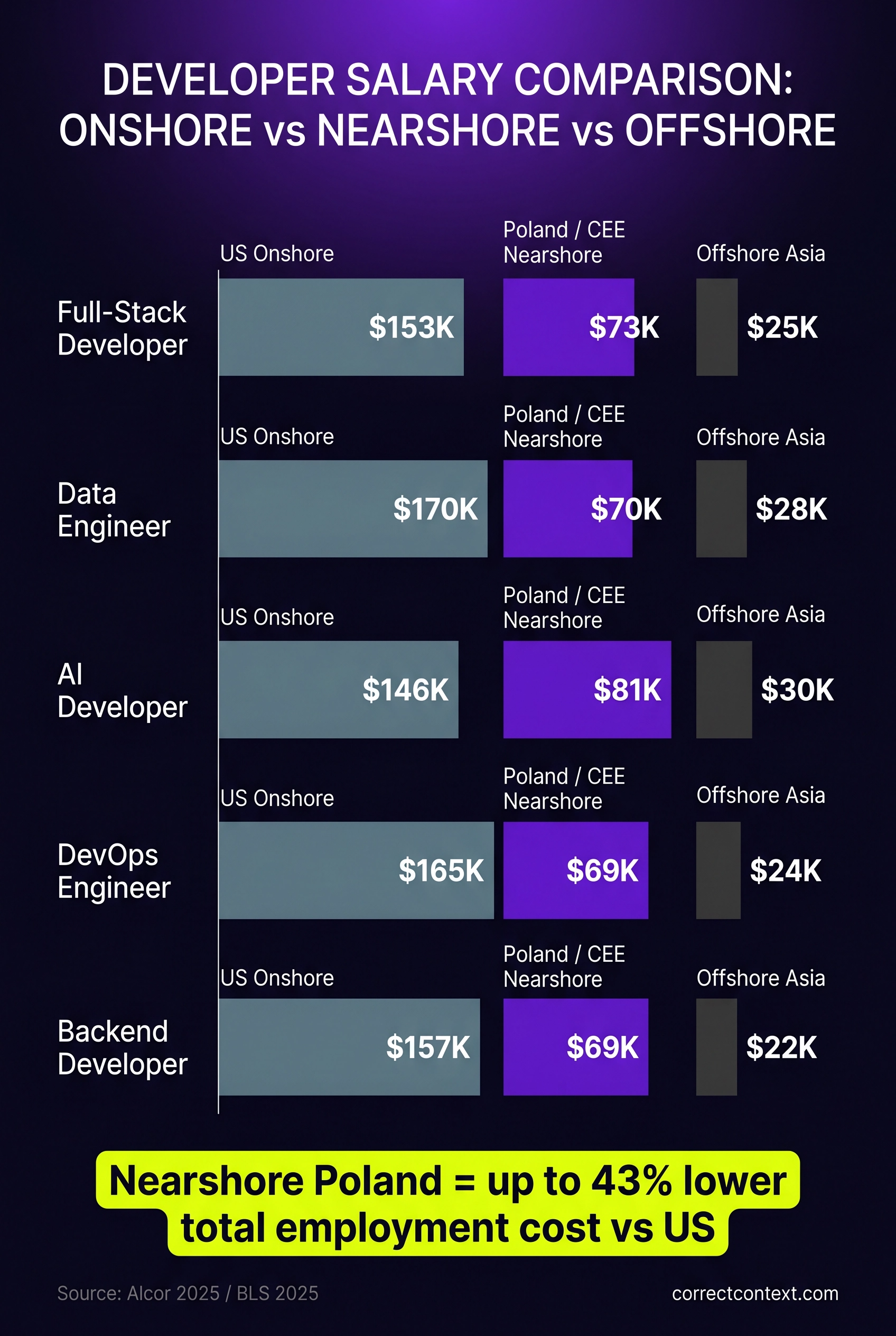
However, the cost of onshore development is staggering. The US Bureau of Labor Statistics reports a median annual wage of $148,100 for software developers in 2025 [1]. When factoring in benefits, taxes, and overhead, the true cost of an onshore developer easily exceeds $200,000 annually. If you are looking to hire an AI development team or a specialized cloud engineering team, these costs escalate further due to fierce competition for top-tier talent.
For many globally scaling startups and enterprise innovation units, relying solely on onshore talent is financially unsustainable and limits the speed at which they can scale.
The Offshore Development Team: Maximum Savings, Maximum Risk
An offshore development team involves hiring talent in distant countries, often with a significant time zone difference (typically 6 to 12 hours). Popular offshore destinations have historically included India, the Philippines, and Vietnam.
The Allure of Offshore Savings
The driving force behind offshore outsourcing is cost reduction. Hourly rates can be significantly lower, allowing companies to stretch their budgets and hire larger teams. For simple, well-defined tasks that require minimal synchronous communication, an offshore team for startup operations can seem like a highly attractive option.
The Hidden Risks of Offshore Development
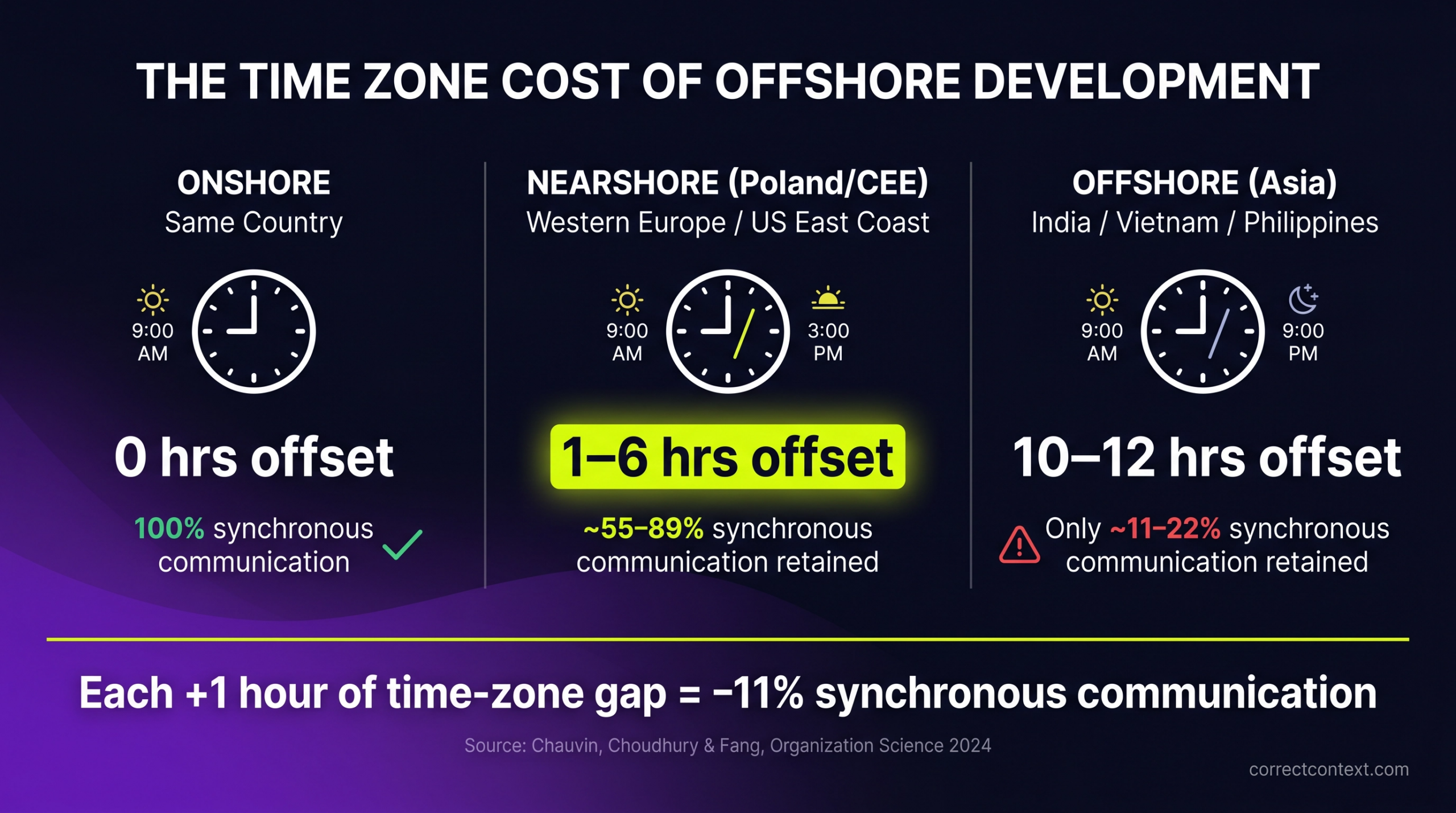
The reality of offshore development is often fraught with hidden risks that erode the initial cost savings. The most significant challenge is the time zone gap. A peer-reviewed study at a Fortune 100 multinational found that each additional hour of time-zone separation reduces synchronous communication by 11% [1]. When your offshore software engineers team is 10 hours away, you lose over 70% of synchronous communication opportunities.
This lack of overlap means that a simple blocker discovered during a morning standup in New York cannot be resolved until the next day, turning a 20-minute fix into a 24-hour delay. Furthermore, cultural differences in communication styles and varying levels of English proficiency can lead to misunderstandings, requiring extensive rework and frustrating your local product managers.
When you factor in the cost of delayed product launches and the management overhead required to bridge the gap, the true cost of an offshore development team is often much higher than the hourly rate suggests.
The Nearshore Engineering Team: The Strategic Sweet Spot
A nearshore development team strikes the balance between the cost savings of offshore and the collaboration benefits of onshore. For companies in Western Europe and the US East Coast, nearshore developers Europe, specifically in Poland and the broader Central and Eastern Europe (CEE) region, have emerged as the premier destination.
Why Nearshore Works for Engineering
Nearshoring to Poland offers a unique combination of advantages that directly address the fears of CTOs and COOs:
- Time Zone Alignment: Poland operates on Central European Time (CET), which perfectly overlaps with the UK, DACH, and Nordics, and offers a significant morning overlap with the US East Coast. This allows for real-time collaboration, agile sprint planning, and immediate issue resolution.
- World-Class Talent Pool: Poland is home to over 500,000 IT specialists and boasts a robust STEM education system [2]. Polish developers consistently rank among the top globally for technical skills, particularly in high-demand areas like big data analytics, machine learning engineers team, and AWS / Azure / GCP engineers team.
- Cultural and Linguistic Compatibility: Poland shares a similar business culture with Western Europe and the US. Furthermore, Poland ranks 13th in Europe for English proficiency, ensuring seamless communication [2].
- Cost Efficiency: While not as cheap as traditional offshore destinations, a nearshore engineering team Poland / CEE offers significant savings compared to onshore. The full employment costs for a senior developer in Poland can be up to 43% lower than in the US [3].
The Correct Context Advantage in Poland
When you decide to scale engineering teams or build tech hub Poland, partnering with a specialized provider like Correct Context is crucial. We offer the hiring of IT core teams offshored / nearshored to Poland / CEE without the client needing to build local infrastructure.
Our services cover the entire lifecycle, including recruitment, payrolls, HR, accounting, law, and office management. As a European employer of record (EoR Poland / EoR CEE), we allow you to hire employees without entity and ensure strict employment compliance Europe. Whether you need a dedicated software team, a data analytics team, or a platform engineering team, Correct Context provides the infrastructure and talent access to make your nearshore strategy a success.
Comparing the Models: A Data-Driven Approach
To help you decide which model fits your risk tolerance, let’s compare the three approaches across key dimensions.
| Feature | Onshore | Offshore (e.g., Asia) | Nearshore (Poland/CEE) |
|---|---|---|---|
| Cost | Highest ($150-$180+/hr) | Lowest ($40-$50/hr) | Moderate/High Value ($60-$80/hr) |
| Time Zone Overlap | 100% | Minimal (0-2 hours) | High (Full for EU, 4-6 hours for US East) |
| Communication Risk | Lowest | Highest | Low |
| Talent Pool Access | Limited by local market | Massive | Large and highly specialized |
| Cultural Alignment | Perfect | Low to Moderate | High |
| Best For | Core IP, highly regulated, intensive real-time needs | Well-defined, isolated tasks, tight budgets | Agile development, complex engineering, scaling teams |
Data synthesized from industry reports and Accelerance 2026 Global Software Development Rates Guide [1] [3].
Making the Decision: Which Model Fits Your Growth Stage?
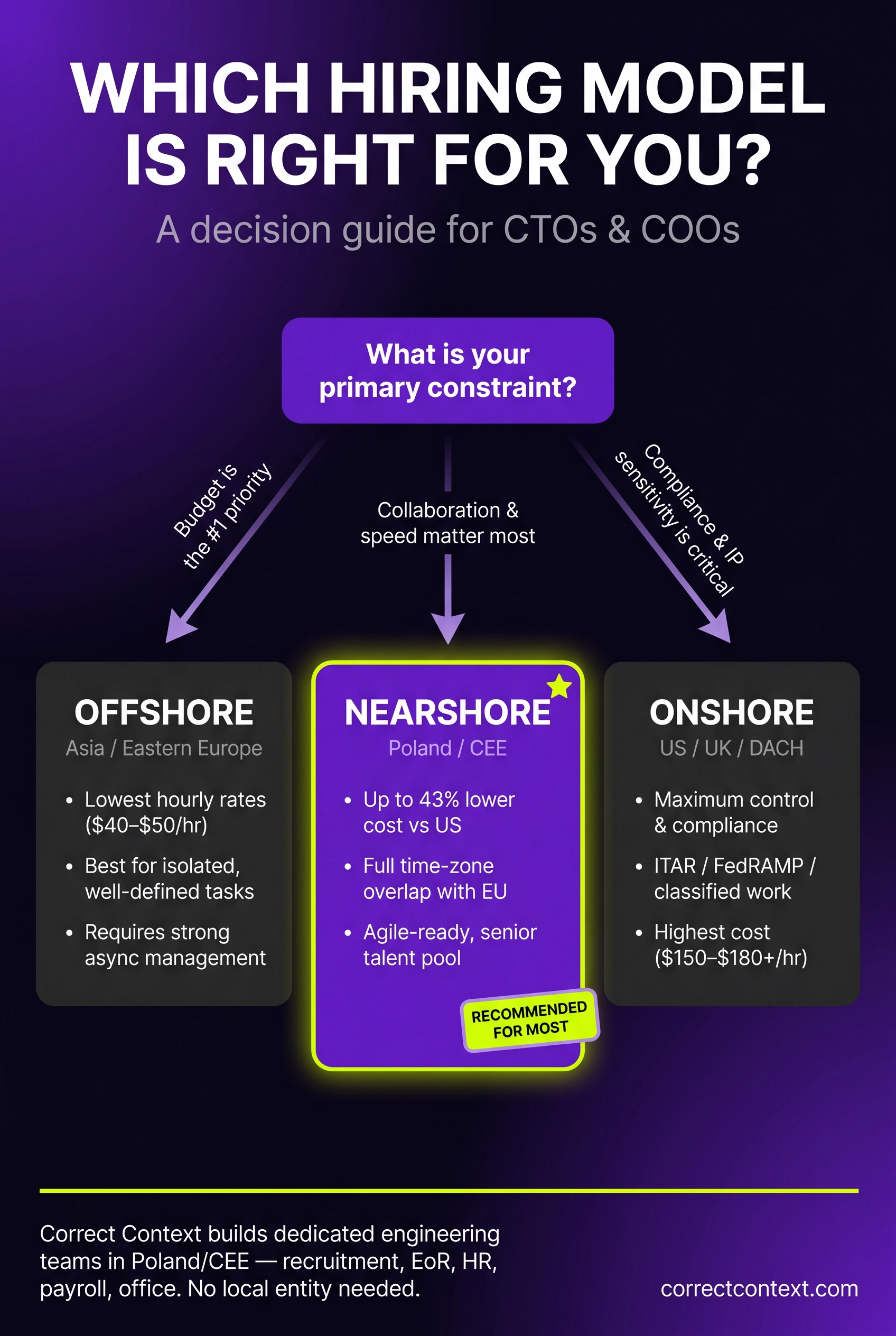
The choice between nearshore vs offshore vs onshore ultimately depends on your specific needs, budget, and risk tolerance.
- Choose Onshore if: You have an unlimited budget, require perfect real-time collaboration for highly sensitive core IP, and operate in a strictly regulated environment (like defense).
- Choose Offshore if: You have a very tight budget, your projects are well-documented and require minimal synchronous communication, and you have the internal management capacity to handle significant time zone and cultural gaps.
- Choose Nearshore if: You need to scale software development rapidly with high-quality talent, require agile collaboration, and want to optimize costs without sacrificing quality or control. For enterprise ai tools development or when you need to hire ai engineers, the nearshore model in Poland offers the best balance of expertise and integration.
For Series A+ startups and enterprise innovation units, the nearshore development team model, particularly in Poland, is increasingly becoming the standard. It provides the affordable senior developers needed to drive innovation while mitigating the offshore development risks that can derail critical projects.
By leveraging a partner like Correct Context for payroll services Poland and EoR capabilities, you can hire in Europe without company setup delays, allowing you to focus on what matters most: building exceptional software.
References
[1] First Factory. (2026). Nearshore vs Offshore vs Onshore: Which Model Wins in 2026?
[2] Intellias. (2024). Nearshoring to Poland: The Definite Guide to IT Outsourcing.
[3] Alcor. (2025). Nearshoring to Poland: A Deep Dive into IT Outsourcing.
[4] Correct Context. (2026). Outsourcing vs Nearshoring to Poland: The Complete 2026 Guide for Tech Leaders
Table of content
Related articles



About the Author: Marta