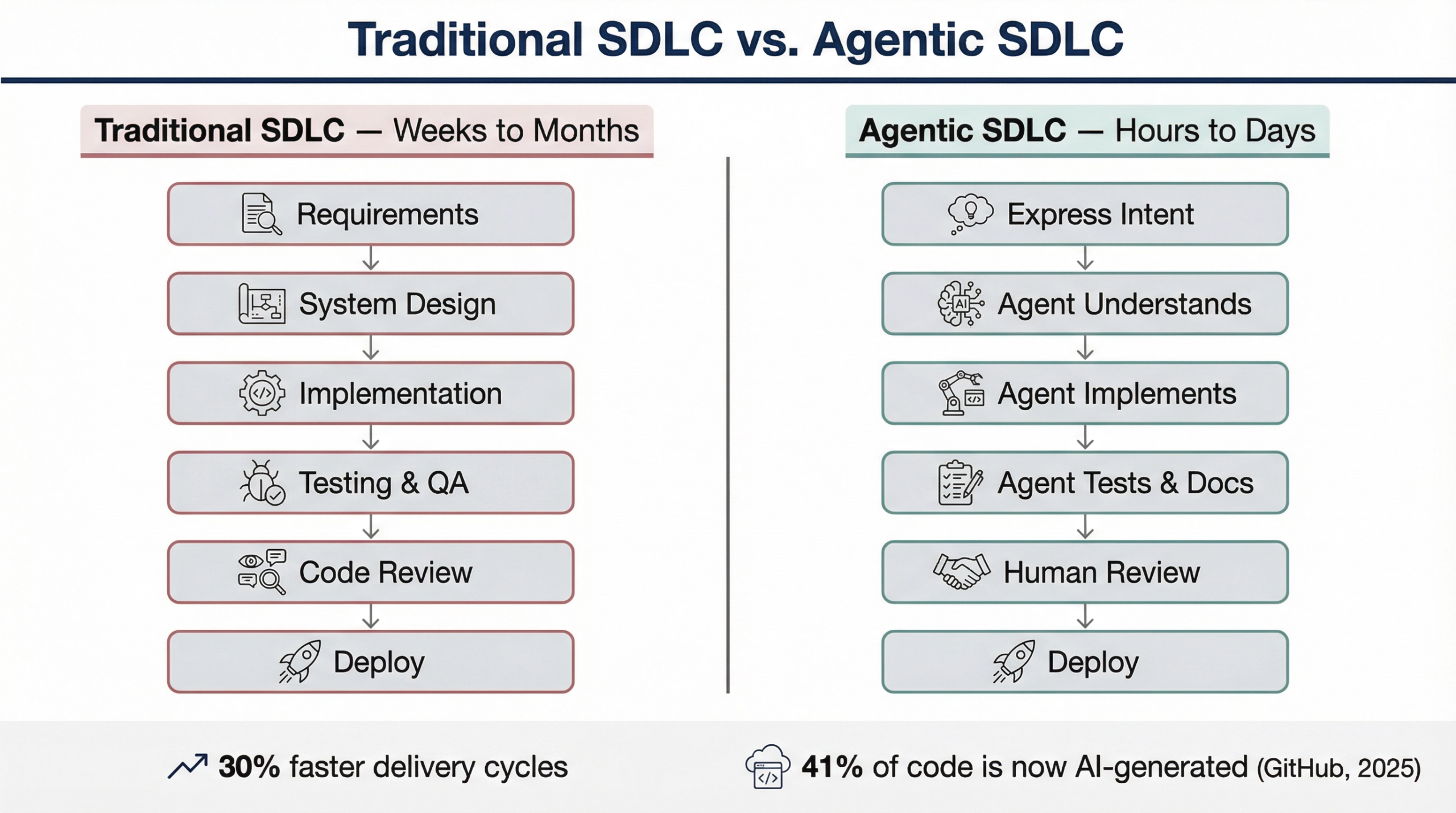
Agentic SDLC vs Traditional SDLC
The Shift: AI Coding Enterprise Changes the Game
Remember when software engineers were mainly coders? They wrote line after line of code, debugging syntax errors, and wrestling with APIs. That role is evolving fast. Today, AI coding enterprise tools handle much of the repetitive, syntax-heavy work. These AI systems can generate boilerplate code, fix bugs, and even suggest optimizations in real-time. The result? Engineers no longer need to be syntax experts-they need to be strategic thinkers.
Take a large fintech company using AI-assistants to generate backend microservices. The AI churns out the initial code, but the human engineer decides how those services communicate, how data flows securely, and how the system scales under load. The engineer is no longer a code factory worker; they’re an architect and conductor.
Why Orchestration Matters More Than Ever
With AI handling syntax, the focus shifts to orchestration-the art of coordinating multiple components, tools, and teams to build a cohesive, secure system. This means engineers must understand the bigger picture: How does this module fit into the product? How do we protect sensitive data? What are the long-term maintenance costs?
Security is a prime example. AI can’t fully grasp the nuances of enterprise-level security policies. Humans must define access controls, encryption standards, and compliance measures. In a healthcare app, for instance, the engineer ensures patient data stays private and meets HIPAA regulations, even if AI generates the code itself.
Strategy also falls squarely on human shoulders. Choosing the right tech stack, aligning development with business goals, and planning for future growth are decisions no AI can make autonomously. A CTO can’t just rely on AI-generated code; they need engineers who think like strategists.
Becoming a Full-Stack Orchestrator
The demand is rising for engineers who are not just full-stack coders but full-stack orchestrators. This means mastering everything from frontend UI/UX to backend infrastructure, cloud deployment, and security frameworks. But more importantly, it means knowing when and how to leverage AI tools without losing control.
Imagine a product team working on a complex e-commerce platform. An orchestrator engineer oversees the AI-generated code for inventory management, integrates it with payment gateways, and ensures compliance with PCI DSS standards. They coordinate between AI, DevOps pipelines, and customer support teams. This is the future engineer-part coder, part architect, part project manager.
Hiring AI Engineers: The New Talent Frontier
For hiring AI engineers, companies need to rethink their criteria. It’s no longer enough to find someone who can write flawless code. You want someone comfortable working alongside AI tools, who understands system design deeply, and can drive security and strategy conversations.
Poland has emerged as a hotspot for this kind of talent. The country’s strong STEM education system produces engineers who combine technical skills with strategic thinking. Plus, with IT nearshoring to Poland gaining momentum, companies get access to full-stack orchestrators who can manage AI-assisted development effectively.
Real-World Example: A Polish Software House Leading the Charge
Consider a Warsaw-based software house specializing in enterprise solutions. They’ve integrated AI coding assistants into their workflow, cutting development time by 30%. But their engineers don’t just accept AI outputs blindly. Instead, they review, adapt, and secure the AI-generated code, ensuring it fits client-specific needs and security requirements.
Their CTO emphasizes that their engineers are trained to think holistically. “We don’t just want code generators,” he says. “We want leaders who understand architecture, security protocols, and how to align development with business goals. AI helps us get there faster, but humans still steer the ship.”
What CTOs and HR Directors Should Know
For CTOs, the takeaway is clear: invest in upskilling your engineers to become orchestrators. Provide training on cloud architecture, security best practices, and AI tool integration. Encourage a mindset shift from coding to coordinating.
HR directors and talent acquisition should update job descriptions to reflect this new reality. Look for candidates with experience in both development and system design, who can navigate AI coding environments confidently. Emphasize adaptability and strategic thinking over pure coding prowess.
Wrapping Up the Role Evolution
The software engineer’s role is no longer about writing every line of code. It’s about orchestrating complex systems, leveraging AI to handle syntax, and focusing human energy on architecture, security, and strategy. Companies that embrace this shift and prioritize hiring AI engineers with orchestrator mindsets will lead the pack. With Poland’s growing pool of such talent, nearshoring offers a smart path to building next-gen teams ready for this new era.
Sources
[1] Taskade. “State of Vibe Coding 2026: Market Size, Adoption & Trends.“ [2] Anthropic. “2026 Agentic Coding Trends Report.“ [3] Refonte Learning. “AI Engineering in 2026: Trends, Skills, and Career Opportunities.“ [4] World Economic Forum. “How we can balance AI overcapacity and talent shortages.“ [5] RemotelyTalents. “AI Engineer Salaries in 2026: US vs Europe vs Latin America.“ [6] RemoDevs. “The 2026 Polish IT Market Report: Salaries, Trends & Talent.“ [7] Itelence. “IT Nearshoring to Poland: 30-50% Cost Savings in 2025.“ [8] Sowelo. “Polish programmers among top 10 software developers in the world.“ [9] Morgan Stanley. “How AI Coding Is Creating Jobs.“ [10] Valley Central. “SignalHire Reveals Top 10 Most In-Demand AI Jobs for 2026.“ [11] Fungies.io Help Center. “Crypto and Stablecoins.“