
As artificial intelligence adoption accelerates across global enterprises, the regulatory landscape is shifting dramatically. For US C-level executives expanding operations or deploying AI systems in Europe, the European Union’s Artificial Intelligence Act (EU AI Act) introduces unprecedented legal and financial liabilities. With penalties for non-compliance reaching up to €35 million or 7% of global annual turnover [1], the stakes have never been higher.
The core challenge facing enterprise innovation units, Fortune 5000 companies, and Series A+ startups is how to maintain rapid AI development while mitigating the extreme legal risks associated with European AI regulations. This article explores how leveraging Central and Eastern European (CEE) tech hubs — specifically Poland — through an Employer of Record (EOR) model can effectively shift liability and ensure EU AI Act compliance.
The Extreme Risks of the EU AI Act
The EU AI Act, which entered into force on August 1, 2024, and became fully applicable on August 2, 2026, is the world’s first comprehensive legal framework for artificial intelligence [2]. It categorizes AI systems based on their potential risk to fundamental rights and safety, imposing stringent requirements on both developers and deployers.
Risk Categories and Compliance Deadlines
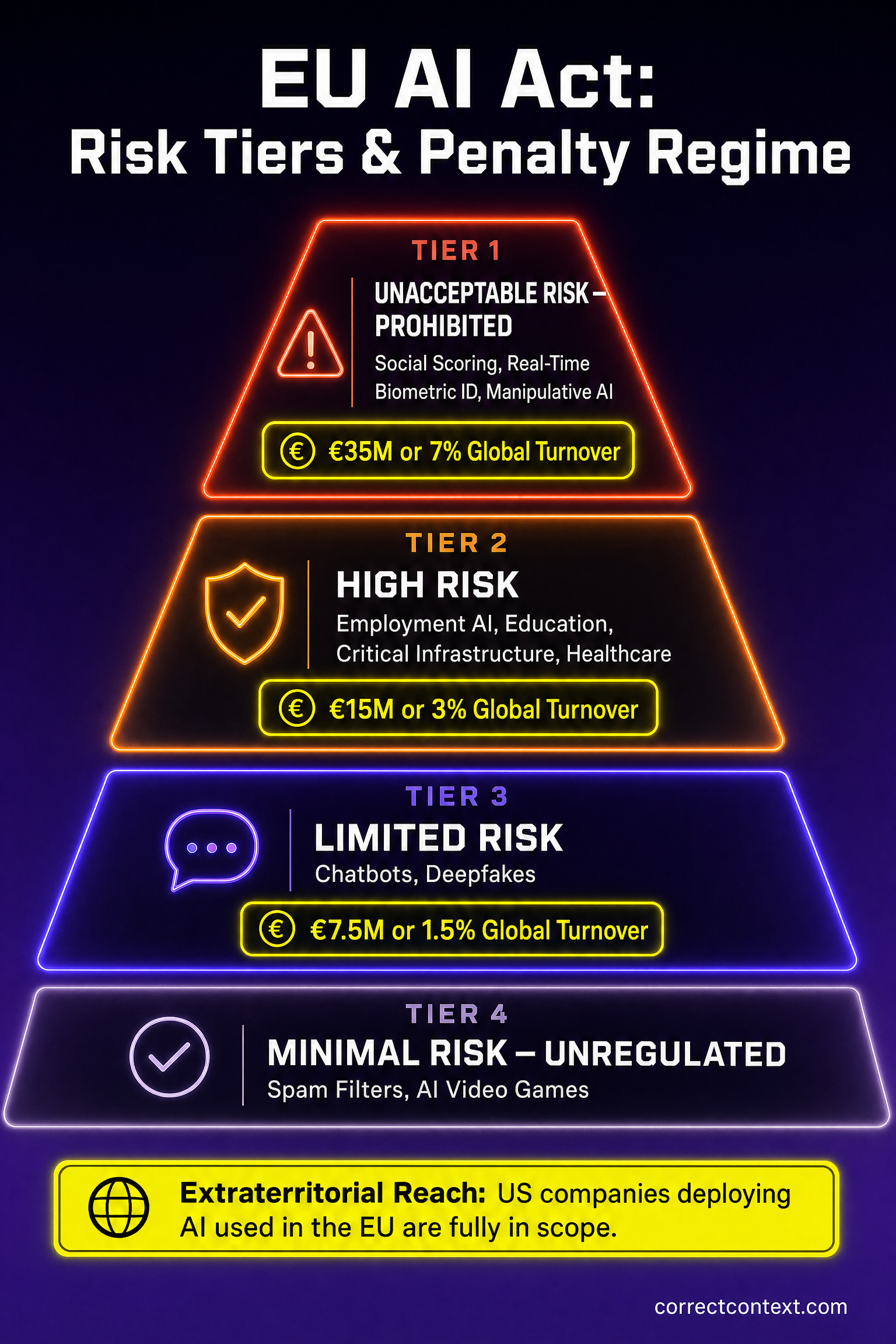
| Risk Tier | Examples | Key Obligations | Penalty Exposure |
|---|---|---|---|
| Unacceptable (Prohibited) | Social scoring, real-time biometric ID, manipulative AI | Full ban | Up to €35M or 7% global turnover |
| High Risk | AI in employment, education, critical infrastructure | Risk management, data governance, human oversight, technical documentation | Up to €15M or 3% global turnover |
| Limited Risk | Chatbots, deepfakes | Transparency obligations (disclose AI interaction) | Up to €7.5M or 1.5% global turnover |
| Minimal Risk | Spam filters, AI-enabled video games | No specific obligations | N/A |
The regulation’s extraterritorial reach is a critical point for US executives: if an AI system’s output is used within the EU, the provider is subject to these regulations, regardless of where the company is headquartered [2]. This means a San Francisco-based enterprise deploying an AI-powered HR screening tool used by its European workforce is fully within scope.
The €35 Million Penalty Regime
The financial penalties are designed to force compliance even from the world’s largest technology companies. Non-compliance with prohibited AI practices can result in fines of up to €35 million or 7% of a company’s total worldwide annual turnover, whichever is higher [1]. Violations of obligations related to high-risk AI systems or general-purpose AI (GPAI) models can incur fines of up to €15 million or 3% of global turnover [1]. Providing incorrect or misleading information to authorities can lead to fines of up to €7.5 million or 1.5% of turnover [1].
For a Fortune 500 company with $10 billion in annual revenue, a worst-case violation could result in a $700 million fine. The message from Brussels is unambiguous: compliance is not optional.
The AI TRiSM Framework: Moving Beyond Policy
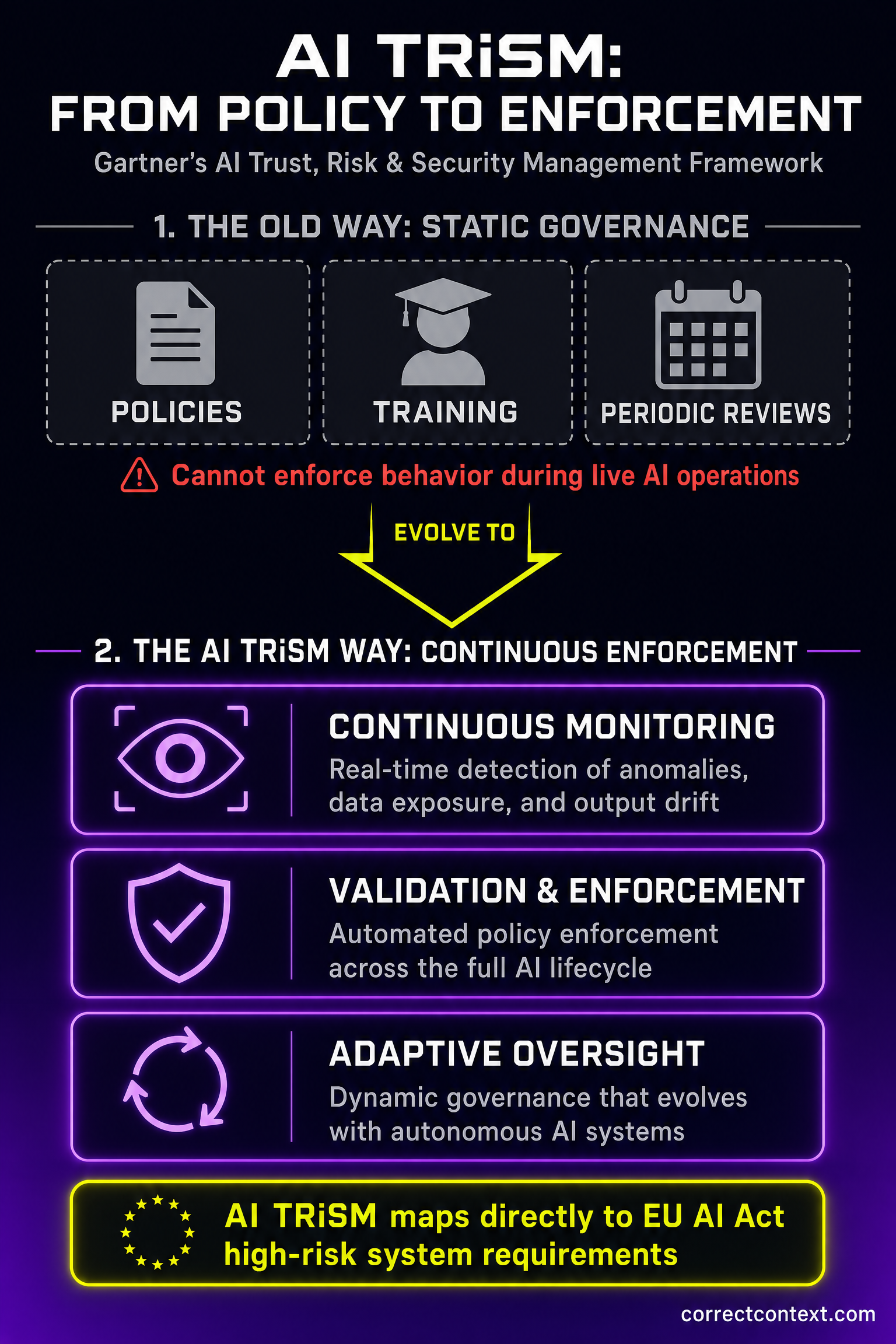
To navigate these regulatory waters effectively, organizations must move beyond static compliance policies and adopt enforceable technical controls. Gartner’s AI Trust, Risk and Security Management (AI TRiSM) framework provides a blueprint for ensuring AI systems are trustworthy, secure, and compliant [3].
As AI becomes more pervasive and increasingly autonomous, governance must evolve into an operational, continuously enforced capability. The traditional approach — relying on policies, training, and periodic oversight — establishes intent but cannot enforce behavior during real-time AI operations, where risks emerge dynamically [3].
AI TRiSM introduces capabilities for continuous monitoring, validation, and runtime enforcement, allowing organizations to:
- Detect and manage data risks: Exposure, misuse, or improper access to training and operational data.
- Control output risks: Inaccurate, biased, or harmful AI-generated outcomes that could trigger regulatory scrutiny.
- Maintain compliance in real time: Continuously verify that AI systems behave as expected across increasingly complex and autonomous environments [3].
For enterprises subject to the EU AI Act, implementing AI TRiSM is not merely best practice — it is the operational backbone of a defensible compliance posture. The Act’s requirements for high-risk systems, including risk management throughout the AI lifecycle, data governance, technical documentation, and human oversight mechanisms, map directly onto the AI TRiSM framework’s core capabilities [2].
Mitigating Risk: The Polish EOR Advantage
Building and scaling an AI development team or a machine learning engineers team in Europe requires deep expertise in both technology and local regulations. Establishing a legal entity in an EU member state exposes the parent company directly to the full liabilities of the AI Act. This is where the Employer of Record (EOR) model, particularly in a mature tech hub like Poland, offers a decisive strategic advantage.
Shifting Legal Liability Through EOR
An Employer of Record acts as the legal employer for your workforce in a foreign country. They manage employment contracts, payroll, statutory taxes and benefits, and HR compliance, while you retain full day-to-day management of the employees and their work output. This structure allows US enterprises to hire employees without a local entity and hire in Europe without a company — a critical distinction when it comes to regulatory exposure.
In the context of the EU AI Act, utilizing an EOR partner like Correct Context provides a structural buffer. The EOR assumes the burden of local employment law compliance and provides on-the-ground expertise in navigating the EU regulatory environment. This allows US executives to focus on product development and AI innovation rather than wrestling with unfamiliar European legal structures, while ensuring that the local team operates within a fully compliant employment framework.
Poland: The Premier CEE Tech Hub for AI Compliance
Poland has emerged as the largest technology hub in the CEE region, boasting a talent pool of over 650,000 tech experts [4]. The country offers a unique combination of world-class engineering talent, a favorable business environment, and a strategically advantageous approach to AI regulation.
Elite AI and Engineering Talent: Polish developers consistently rank among the top globally in programming skills. The country’s strong STEM tradition produces thousands of graduates annually, providing a deep reservoir of talent for building a dedicated development team, an extended engineering team, or a specialized data engineering team or cloud engineering team [5].
Cost-Effective Innovation: While offering top-tier skills comparable to Western Europe, Poland remains significantly cost-competitive, making it an ideal location to hire affordable senior developers or build a tech hub in Poland without sacrificing quality.
Regulatory Alignment and Clarity: As an EU member state, Poland is fully integrated into the European regulatory framework. Critically, Poland has taken a distinctive and business-friendly approach to implementing the AI Act. It is establishing a centralized Commission for the Development and Safety of Artificial Intelligence (KRiBSI), making it one of only two EU countries to designate a single entity as its sole market surveillance authority for AI [6]. This centralized model provides a single point of contact for enterprises seeking regulatory clarity — a stark contrast to the fragmented oversight models planned by other member states, such as France’s proposed 14 separate oversight bodies [6].

Strategic Implementation for Enterprises
For US enterprises and scaling startups looking to harness European AI talent without absorbing the full brunt of the €35M risk, a structured approach is vital.
Step 1: Assess AI Portfolio Risk. Evaluate current and planned AI initiatives against the EU AI Act’s risk categories. Identify systems that fall under high-risk or prohibited classifications. Pay particular attention to any AI used in HR, recruitment, performance management, or customer-facing financial services — all of which fall under the high-risk Annex III categories.
Step 2: Implement AI TRiSM. Adopt Gartner’s framework to embed continuous monitoring and validation into AI workflows. Move beyond static policies to active, operational governance that can demonstrate compliance to regulators in real time.
Step 3: Partner with a Regional Expert. Engage a specialized partner to build a tech hub in Poland. Correct Context facilitates the hiring of IT core teams offshored or nearshored to Poland and the broader CEE region, handling recruitment, payroll, HR, accounting, law, EOR, and office management. This allows enterprises to scale engineering teams and scale software development without the need to build local infrastructure or establish a legal entity.
Step 4: Build Specialized Compliance-Ready Teams. Leverage the Polish talent pool to assemble specialized units — a data analytics team, AWS/Azure/GCP engineers team, or platform engineering team — ensuring your AI initiatives are supported by robust infrastructure and deep technical expertise aligned with EU compliance requirements.
Conclusion
The EU AI Act represents a paradigm shift in technology regulation, imposing severe penalties that demand immediate attention from any enterprise operating in or selling into the European market. For US executives, the fear of these regulations should not stifle innovation or European expansion. By adopting robust governance frameworks like AI TRiSM and strategically utilizing an Employer of Record in Poland, enterprises can effectively mitigate legal risks while accessing some of the world’s best AI engineering talent.
Partnering with Correct Context to establish a nearshore development team or engineering hub in Europe allows companies to access elite talent, ensure employment compliance in Europe, and confidently navigate the complex landscape of European AI regulations — turning a regulatory challenge into a competitive advantage.
References
[1] EU AI Act: Article 99 — Penalties. Artificial Intelligence Act Explorer. https://artificialintelligenceact.eu/article/99/
[2] High-level summary of the AI Act. Artificial Intelligence Act Explorer. https://artificialintelligenceact.eu/high-level-summary/
[3] Gartner. “AI Governance Requires More Than Policies.” Gartner, June 10, 2026. https://www.gartner.com/en/articles/ai-governance-trism
[4] Technology and IT Industry in Poland. Alcor, 2025. https://alcor.com/poland-technology-sector/
[5] “How CEE can become a hub for Tech Talent.” PwC Central and Eastern Europe. https://cee.pwc.com/cee-in-the-spotlight/how-cee-can-become-a-hub-for-tech-talent.html
[6] Króliński, Jan. “The AI Act’s enforcement gap: what Poland’s new regulator reveals about Europe’s challenge.” Blavatnik School of Government, University of Oxford, March 24, 2026. https://www.bsg.ox.ac.uk/blog/ai-acts-enforcement-gap-what-polands-new-regulator-reveals-about-europes-challenge
Table of content
Related articles



About the Author: Marta