
For US technology companies, the choice between B2B vs UoP contracts in Poland is not a choice between a cheap model and an expensive model. It is a choice between two fundamentally different operating relationships. A UoP (Umowa o Pracę = Contract of Employment) is Polish employment. A B2B arrangement usually means an individual operates a sole proprietorship – commonly a JDG – and invoices the customer for defined services. The right model depends first on how the work will actually be done, then on the total compensation package, and only then on comparative tax outcomes.
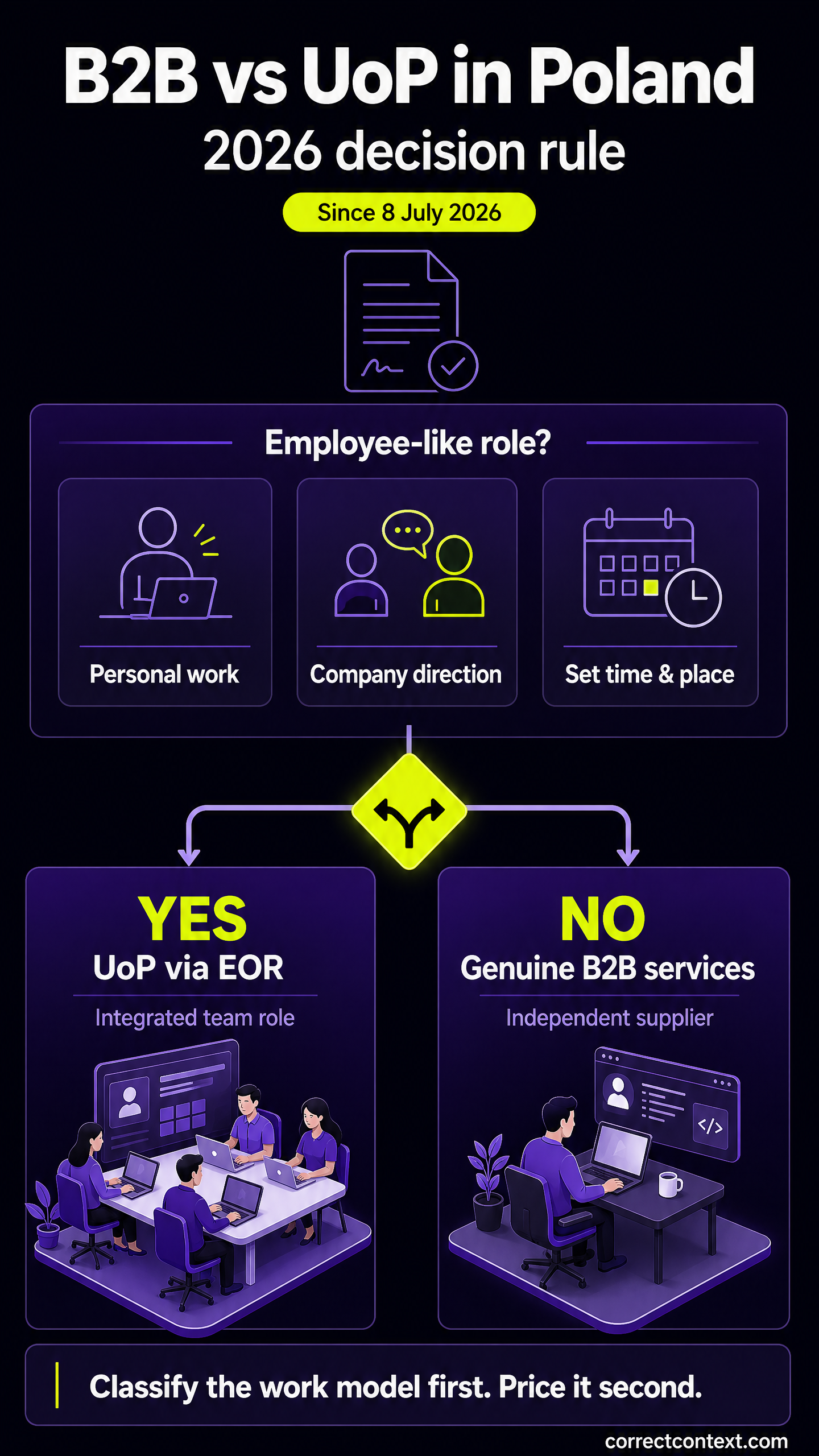
That ordering matters more in 2026. Since 8 July 2026, Poland’s Labour Inspectorate reform has supplied a clearer enforcement path for arrangements that are labelled B2B or civil-law contracts but in substance should be employment. Proper B2B and civil-law arrangements remain permissible; the issue is a mismatch between the label and the factual working relationship.[1]
Executive answer: Use UoP – often administered through an Employer of Record Poland partner – when the individual will function as an integrated, managed team member. Use B2B for a genuinely independent supplier relationship. Do not use the contractor model as a payroll workaround for employee-like work.
This guide gives HR, finance, legal, procurement, and engineering leaders a practical decision framework, a transparent 2026 cost illustration, and a package-design approach that starts with target net compensation rather than a misleading comparison of salary versus invoice rate.
The two models: what your company is actually buying
With a UoP, the company buys an employment relationship. The employer controls the work within the limits of employment law, runs payroll, withholds and remits employment deductions, and funds the employer-side contribution burden. The employee receives the statutory protections attached to the employment relationship, including paid annual leave, paid sickness absence, paid parental leave, and protection against abrupt or unjustified termination.[1]
With B2B, the company buys services from a business. The individual normally manages their own tax filings, social contributions, insurance choices, working-time arrangements, equipment and business costs. The invoice rate therefore needs to recognize not only cash compensation but also the value and risk shifted from the enterprise to the contractor. An invoice is not a gross salary equivalent, and a contractor’s estimated tax saving is not the company’s TCO saving.
| Dimension | UoP (employment) | B2B / JDG (independent business) | Enterprise implication |
|---|---|---|---|
| Legal character | Employment relationship governed by Polish labour law | Commercial services relationship between businesses | Select based on real operating facts, not title or preference alone. |
| Direction and integration | The employer may manage the role and integrate it into a team | Supplier independence should be real and demonstrable | The more the role resembles a managed employee, the stronger the case for UoP. |
| Payroll and social insurance | Employer runs payroll and contributes its share | Contractor administers their own taxes and contributions | UoP adds visible payroll cost; B2B shifts administration and individual risk. |
| Paid time off and leave | Statutory employee protections apply | Only if the services agreement provides for them | To compete for senior talent, cost the value of time off explicitly in B2B packages. |
| Termination mechanics | Statutory notice rules apply; for fixed and indefinite contracts, standard notice rises from two weeks to one or three months with tenure | Notice, termination and suspension terms are contractual, subject to the agreement and applicable law | UoP improves predictability for the worker; B2B can be more flexible but needs careful drafting. [2] |
| Package language | Gross salary plus benefits | Invoice rate plus any agreed commercial benefits | Recruit against a clear target net and a full value proposition, not just a headline number. |
Why 2026 changed the B2B risk conversation
Polish law has long prohibited substituting a civil-law contract for employment when the facts constitute an employment relationship. The 2026 reform changes the enforcement environment rather than creating a new rule of thumb. The Ministry’s guidance points to three high-level indicators: the person performs specific work personally, works under the direction or supervision of the employer, and has a set place and time of work.[1]
The point is not that every contractor must be free to work at any hour or never collaborate with a client. It is that the whole delivery model must support a supplier relationship. A productized specialist who controls the method of delivery, serves more than one customer, prices a defined scope, can provide a substitute where appropriate, and accepts genuine commercial risk looks materially different from an engineer who is rostered into a US company’s stand-ups, reports to its line manager, works fixed hours from its designated location and delivers personally as an ongoing team member.
Where the Inspectorate sees a problem, its published process contemplates an initial order to remedy the breach. If that is not complied with, the inspector can seek a regional inspector decision converting the defective arrangement into employment. Either party can appeal to the labour court, which suspends execution while the court decides the matter.[1] For enterprise buyers, that makes contract governance a real TCO input: remediation, back-pay exposure, operational disruption, advisory costs and employee-relations damage can outweigh a superficially lower invoice budget.
A practical pre-engagement test
Before approving a B2B requisition, document the answer to these questions. The goal is not to create paperwork that contradicts daily practice; it is to align the contract, implementation and evidence with the real commercial model.
| Question | Lower-risk B2B signal | UoP / EOR signal |
|---|---|---|
| Who controls how the result is achieved? | Contractor controls method, sequencing and professional judgment against agreed deliverables. | Company manager directs day-to-day work and prioritizes tasks. |
| What is being purchased? | A defined service, project outcome, advisory capacity, or specialist deliverable. | An ongoing seat in an internal function. |
| Is personal service essential? | Agreement allows a qualified substitute or subcontracting subject to reasonable controls. | Individual must perform personally and cannot be replaced. |
| How fixed are time and place? | Contractor has meaningful autonomy, subject to delivery and security needs. | Company sets habitual work hours and location. |
| How integrated is the worker? | Limited access necessary for the service, supplier-style governance and external branding where practical. | Internal title, manager, recurring performance process, mandatory company rhythms and indistinguishable team participation. |
| Who carries commercial risk? | Contractor bears some responsibility for business costs, continuity and delivery. | Company supplies all tools, controls the work and pays for availability much like payroll. |
A single answer does not decide the classification. However, a pattern of right-hand answers is a strong reason to structure the engagement as UoP, especially for a long-term software-engineering role embedded in a product squad.
Polish IT salary guide: model from target net pay, not from contract labels
A credible Polish IT salary guide for enterprise hiring should begin with the candidate’s desired recurring net income and the value of stability, leave and benefits – not with a conversion that assumes “B2B = 19% tax.” Contractors may choose different tax methods, and their outcome depends on eligible service classification, revenue, deductible costs, health contributions and individual circumstances.
For 2026, the standard employment PIT scale is 12% up to PLN 120,000 of tax base and 32% above that threshold, with a PLN 3,600 tax-reducing amount. The ordinary employment deduction for one local employment relationship is PLN 250 per month, capped at PLN 3,000 annually.[3] Employee social contributions are generally 13.71% of gross salary. Employer social contributions are generally 19.21%–22.41% of gross salary, with the exact range affected in part by accident-insurance treatment.[4]
For a qualifying sole proprietor, the flat-tax option is 19% of income; the Ministry of Finance also lists 12% lump-sum taxation for certain IT services, including categories connected with software, software installation and network/system management. The correct lump-sum rate depends on the service’s PKWiU classification – it is not automatically available merely because a candidate works in “tech.”[5] Entrepreneurs on lump-sum tax whose annual revenue exceeds PLN 60,000 but does not exceed PLN 300,000 have a 2026 monthly health contribution of PLN 830.58; once annual revenue exceeds PLN 300,000, it rises to PLN 1,495.04.[6]
A like-for-like 2026 cash-envelope illustration
The following model holds the enterprise’s direct annual cash envelope constant at PLN 289,152, excluding VAT. This deliberately illustrates a common recruiting conversation: “What happens if the company has the same cash budget, but offers an employment contract rather than a B2B invoice?” It does not conclude that either arrangement is legally interchangeable.
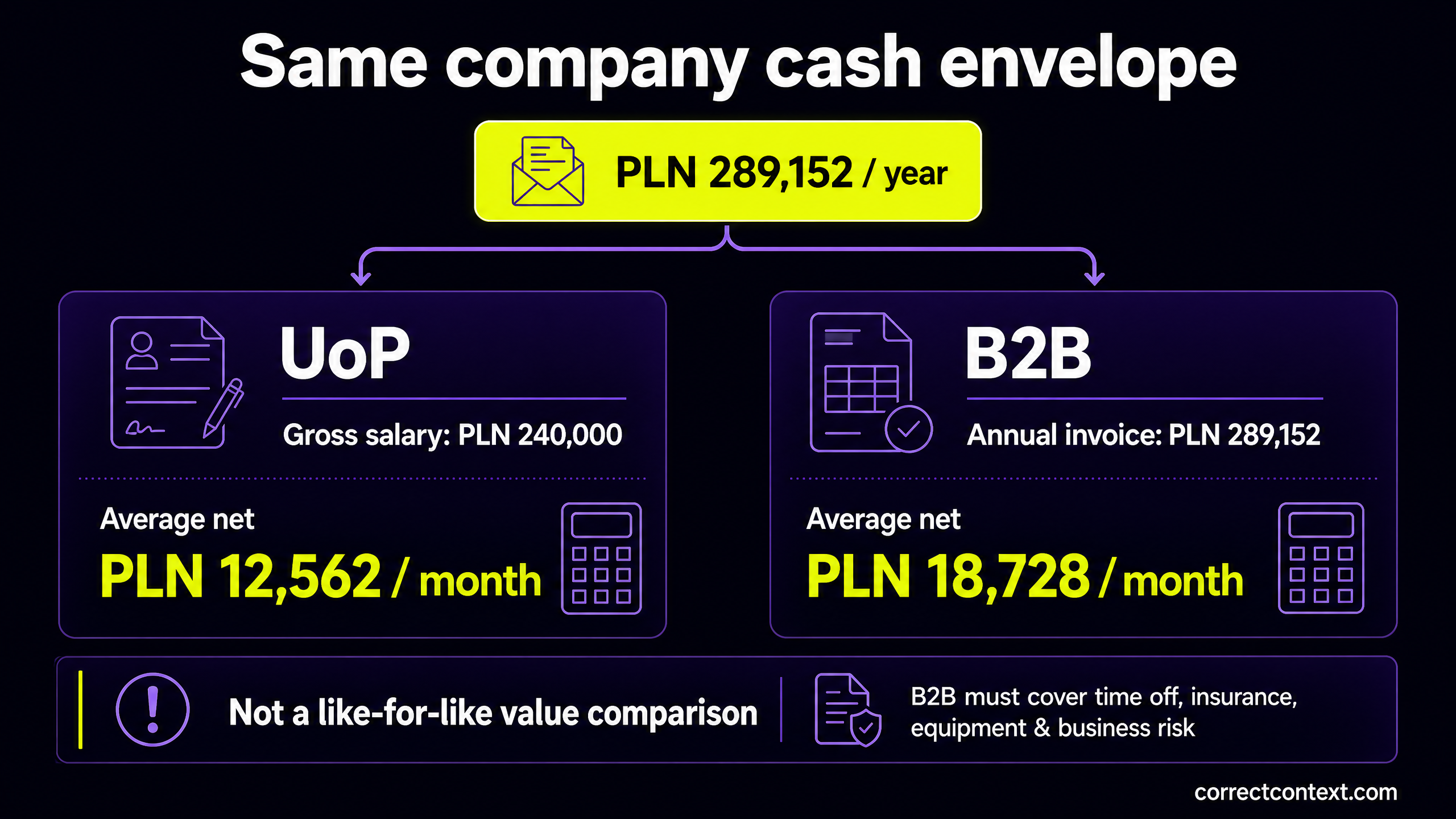
The UoP case assumes PLN 240,000 annual gross salary (PLN 20,000 monthly) plus a 20.48% modeled employer contribution burden, using the foreign-employer accident-rate convention in the published contribution range. It assumes one locally based employee, standard employment deduction, no dependants, no special exemptions, no creative 50% cost treatment, and no non-cash benefits. The annual employee and employer pension/disability contribution cap is not reached in this case; the 2026 cap is PLN 282,600.[4] [7]
The B2B case assumes an established JDG with full standard – not start-up – social contributions, voluntary sickness cover, a 12% lump-sum rate only where the actual IT service classification supports it, and no deductible business expenses. It includes the PLN 830.58 monthly health contribution tier and the statutory ability to deduct 50% of paid health contributions from revenue under lump-sum taxation.[6] [8] The calculations are mechanical illustrations, rounded to the nearest PLN in the table, and are not personal tax advice.
| Annual calculation input / output | UoP employee | B2B contractor |
|---|---|---|
| Company annual cash envelope | PLN 289,152 | PLN 289,152 invoice value |
| Salary or invoice before individual deductions | PLN 240,000 gross salary | PLN 289,152 revenue |
| Employer-side contributions | PLN 49,152 | Included in invoice; contractor handles own coverage |
| Individual social contributions assumed | PLN 32,904 | PLN 23,121 |
| Individual health contributions assumed | PLN 18,639 | PLN 9,967 |
| Modeled income tax | PLN 37,711 | PLN 31,326 |
| Estimated annual take-home | PLN 150,747 | PLN 224,738 |
| Average monthly take-home | PLN 12,562 | PLN 18,728 |
The B2B take-home is higher in this particular cash-equivalent illustration because the contractor’s invoice replaces employment compensation and because the scenario assumes an eligible 12% revenue tax regime. That difference is not disposable surplus. The contractor’s side of the comparison must fund unpaid holidays, sick time beyond any contractual protection, accounting, equipment, professional insurance, training, bench risk, financing gaps and potential tax or contribution changes. Conversely, the UoP employee receives employment protections and a more stable compensation structure that a high-demand candidate may value materially.
| TCO component often missed in a first model | Why it matters | Recommended budgeting treatment |
|---|---|---|
| EOR fee and payroll administration | A US entity without a Polish employing entity needs a compliant employment vehicle and local administration. | Price separately; do not bury it in gross salary. |
| Private medical, life cover, pension and wellbeing benefits | These influence offer competitiveness and may have payroll effects. | Standardize a benefits envelope by level and contract type. |
| Paid-time-off value | A B2B day rate and a UoP monthly salary carry different availability assumptions. | State expected annual billable days, leave and holiday treatment explicitly. |
| Equipment, security and home-office support | Enterprise controls and productive delivery still cost money in either model. | Allocate per employee/contractor and refresh cycle. |
| Recruitment, onboarding and attrition | Replacements and delayed productivity are genuine nearshore costs. | Include an annualized attrition and backfill provision. |
| FX and payment costs | US buyers often budget in USD while Polish compensation is negotiated in PLN. | Use treasury-approved FX assumptions and decide who bears variance. |
| Classification and advisory exposure | Reclassification can turn a “saving” into a remediation event. | Treat legal review and delivery-model governance as a required cost, not an exception. |
How an EOR fits the answer for US technology companies
An EOR is best understood as an employment-enablement model, not a mechanism for converting an employee-like relationship into a contractor relationship. The EOR becomes the local employer for payroll and employment administration while the US company leads the business work. For a US company building an integrated Poland engineering pod, that typically supports the legal and employee-experience logic of UoP without waiting to establish a local subsidiary.
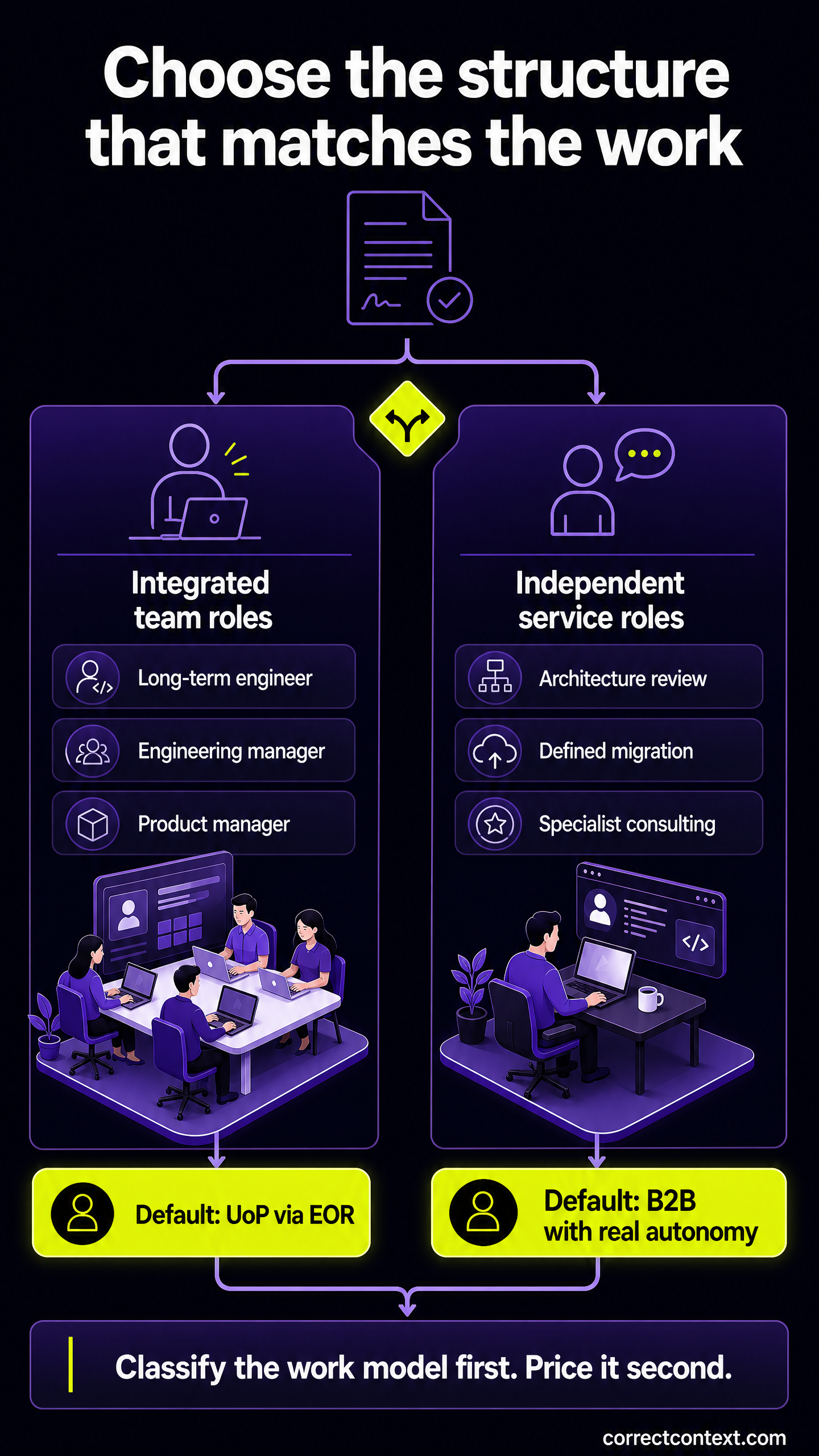
The best use case is clear: a long-term engineer, engineering manager, product manager, SRE or security specialist who will be embedded in company systems, managed by company leaders and evaluated as part of the internal organization. Structure that role as UoP through an established Polish entity or carefully selected EOR partner. Then spend the compensation budget where candidates feel it: a competitive gross salary, a credible benefits package, predictable review cadence, paid leave and a transparent employer-of-record explanation.
B2B still has a legitimate place. It can be well suited to an independent architecture review, a time-bounded migration, specialized security testing, implementation consulting, a fractional leadership assignment or a vendor that accepts a defined statement of work. In those cases, design the engagement like procurement: scope, acceptance, security controls, confidentiality, IP ownership or licence, change control, service levels, insurance expectations, invoice terms and genuine autonomy. Ask local counsel to ensure the daily delivery plan supports the commercial agreement.
A compensation architecture that stays competitive and defensible
The most resilient enterprise policy uses a role-based default rather than letting every hiring manager choose the lowest apparent cost. Start by placing roles into two tracks: integrated team roles and independent service roles. UoP via an EOR is the default for the first track. B2B is available for the second when the documented delivery model supports it.
For candidate conversations, publish a clear total-reward view. On UoP, explain gross salary, estimated net pay under standard assumptions, paid leave and benefits. On B2B, discuss the invoice rate, expected availability, notice period, whether paid non-billable time is included, reimbursable expenses, equipment and review cadence. Do not represent contractor tax treatment as guaranteed. Instead, say that the candidate should validate their own IT contractor taxes with a Polish accountant, particularly service classification, social-insurance status and health-contribution tier.
90-day implementation checklist
| Workstream | First 30 days | Days 31–60 | Days 61–90 |
|---|---|---|---|
| Role governance | Classify open roles as integrated employment or independent service engagements. | Review borderline roles with Polish counsel and HR. | Audit actual working practices against approved classifications. |
| EOR / local employment | Select an EOR or confirm local entity readiness; define employer-versus-client responsibilities. | Build salary bands, benefits and onboarding paths. | Test payroll, tax forms, emergency contacts and manager workflows. |
| Contractor governance | Create a B2B intake record with scope, autonomy, invoice, security and IP terms. | Train managers not to operate contractors as employees. | Check access, timesheets, renewal decisions and evidence of delivery model. |
| Finance | Adopt a PLN-based compensation model with a separate FX assumption. | Add EOR, benefits, equipment and attrition to TCO templates. | Compare offer acceptance and retention outcomes by track. |
| Data and security | Apply least-privilege access and appropriate data-processing terms. | Complete device, access and offboarding controls. | Revalidate controls for renewals and material scope changes. |
FAQs
Is B2B legal in Poland for IT professionals?
Yes. Poland’s government expressly states that correctly concluded civil-law arrangements remain legal when an employment relationship is absent. The issue is a B2B label applied to a relationship that, in fact, meets the characteristics of employment.[1] An enterprise should assess the actual operating model for each role.
Is UoP always more expensive than B2B?
UoP has visible employer contributions and employee benefits, while B2B shifts costs and risks to the contractor. But the relevant comparison is full TCO and expected availability, not salary versus invoice. A senior contractor may require a materially higher rate to cover commercial risk, unpaid leave and independent administration; a reclassification-prone contractor model can be more expensive than an EOR-led employment model once risk is priced.
What should US companies use to calculate a Polish employee’s net pay?
Use a Poland-specific payroll calculator or payroll provider using the individual’s current tax declarations, residence facts, benefits, creative-income treatment where relevant, and any exemptions. The statutory scale, standard deductions and social contributions are starting inputs – not a substitute for a personal payroll calculation.[3] [4]
Can an EOR engage Polish workers on UoP?
An EOR model is commonly used to provide local employment, payroll and administrative infrastructure when the operating need is an employee relationship. Before rollout, confirm the provider’s Polish employing entity, scope of employment-law support, payroll responsibilities, benefits administration, IP and confidentiality documentation, data-processing position, and exit/transition mechanics.
The decision in one line
If the company needs a managed, long-term member of its Polish engineering organization, choose UoP through an EOR or local entity and budget on full TCO. If it needs an independent business to deliver defined services with real autonomy, use B2B and price the commercial relationship honestly. This is the durable answer to B2B vs UoP contracts Poland in 2026: structure for the work you are actually buying, then make the compensation package competitive within that structure.
This article is general information for enterprise planning, not legal, tax, employment or accounting advice. Polish classification and individual tax outcomes depend on specific facts and should be validated with qualified Polish counsel, payroll advisers and tax professionals before contracting or making an offer.
References
[1] Reforma Państwowej Inspekcji Pracy
[2] Stosunek pracy – Państwowa Inspekcja Pracy
[3] Serwis o podatkach – Dochody z pracy
[4] Poland – Individual – Other taxes
[5] Serwis o podatkach – Stawki i limity
[7] Nowe wysokości składek na ubezpieczenia społeczne w 2026 r..
[8] Serwis o podatkach – Odliczenie składek na ubezpieczenie zdrowotne PIT
Table of content
- The two models: what your company is actually buying
- Why 2026 changed the B2B risk conversation
- Polish IT salary guide: model from target net pay, not from contract labels
- A like-for-like 2026 cash-envelope illustration
- How an EOR fits the answer for US technology companies
- A compensation architecture that stays competitive and defensible
- FAQs
- The decision in one line
- References
Related articles



About the Author: Marta