
Enterprise AI adoption is accelerating at a pace that would have seemed implausible just three years ago. Companies spent $37 billion on generative AI in 2025, a 3.2x year-over-year increase from $11.5 billion in 2024 [1]. Yet for many Chief Technology Officers and Chief Financial Officers, the expected returns remain elusive. Productivity gains are modest, pilots stall before reaching production, and a quiet financial drain continues to grow in the background. This drain has a name: the Hallucination Tax.
The Hallucination Tax is not a metaphor. It is the measurable, compounding cost of AI models generating false, fabricated, or misleading information—and the organizational overhead required to catch, correct, and recover from those errors. For enterprise leaders struggling to see positive ROI from basic LLM integrations, understanding this tax is the first step toward eliminating it. The second step is investing in Context Engineering.
The Real Cost of AI Hallucinations in the Enterprise
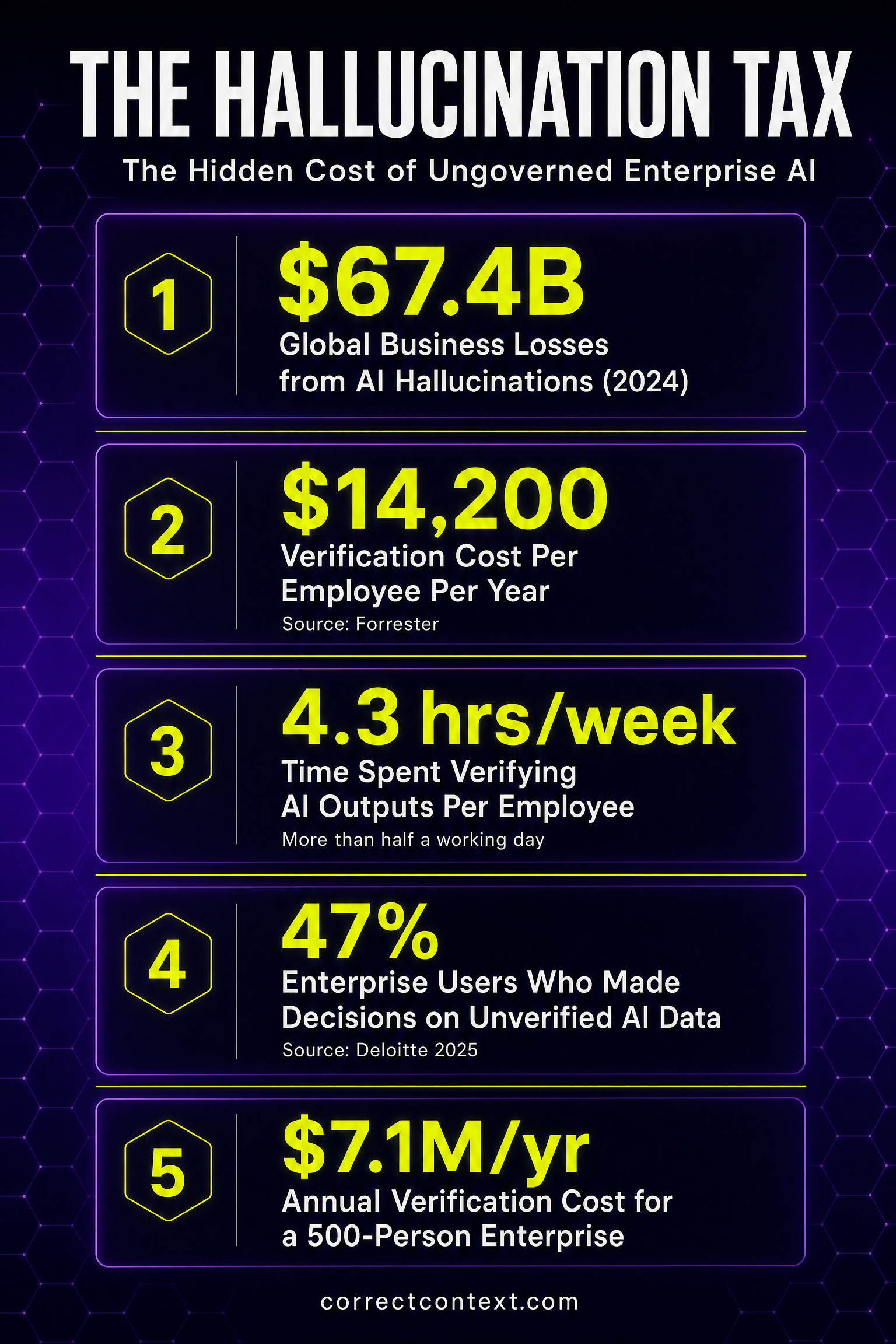
The numbers are stark. Global business losses attributed to AI hallucinations reached an estimated $67.4 billion in 2024 [2]. That figure is not driven by exotic edge cases or reckless deployments. It is the cumulative result of thousands of organizations running general-purpose AI tools against enterprise workflows without the data architecture to support them.
The most direct line item is verification overhead. Research cited by Forrester found that enterprise employees using AI tools spend an average of 4.3 hours per week verifying outputs—more than half a working day, every week, for every employee using the tool [3]. At a loaded hourly rate, this translates to approximately $14,200 per employee per year in pure verification cost [3]. For a 500-person organization, that is $7.1 million annually spent checking the AI’s homework, before a single deliverable leaves the building.
The cost compounds further when verification fails. A 2025 Deloitte global survey found that 47% of enterprise AI users admitted to making major business decisions based on AI output they had not verified [3]. The reason is not carelessness—it is the nature of how LLMs present incorrect information. Research from MIT found that AI models use 34% more confident language when they are wrong than when they are correct [3]. The worse the answer, the more certain the tone.
“The savings story is loud. The cost story is invisible. And the cost story is always bigger than the savings story, because hallucinations are not a bug in the AI you bought. They are the operating condition.” — Optimum Partners, 2026 [3]
| Cost Category | Per Employee (Annual) | 500-Person Enterprise |
|---|---|---|
| Verification Overhead (4.3 hrs/week) | $14,200 | $7.1 Million |
| Decisions Made on Unverified AI Data | 47% of users affected | Systemic risk |
| Global Business Losses (2024) | — | $67.4 Billion (global) |
| Projected Losses (2025) | — | $112 Billion (projected) |
| Cost per Major Hallucination Incident | $18,000–$2.1M | Varies by sector |
Sources: Forrester (2025), Deloitte (2025), AllAboutAI (2025)
Why Prompt Engineering Is Not Enough
For the first wave of enterprise AI adoption, prompt engineering was positioned as the primary lever for controlling model behavior. Teams were trained to craft precise instructions, and vendors sold prompt libraries as competitive differentiators. While prompt engineering remains a useful practice, it addresses only one dimension of the problem.
Prompt engineering focuses on the instruction—the phrasing of the request sent to the model. It does not address the quality, relevance, or authority of the data the model uses to generate its response. If an LLM is asked a complex question about internal compliance policy, the most carefully crafted prompt cannot prevent a hallucination if the model lacks access to the current, authoritative policy document. As Anthropic’s engineering team notes, building with language models is becoming less about finding the right words and more about answering the broader question of “what configuration of context is most likely to generate the desired behavior?” [4]
This is the distinction that separates organizations achieving genuine enterprise AI ROI from those still paying the Hallucination Tax. The former have moved beyond prompts. They have invested in the discipline of Context Engineering.
Context Engineering: The Architecture of Reliable AI
Context Engineering is the systematic practice of designing, managing, and optimizing the information supplied to an AI model during inference time [5]. It ensures that the AI operates within a precise, relevant, and governed knowledge environment, dramatically reducing hallucination rates and improving the accuracy and auditability of outputs.
Where prompt engineering asks how to instruct the model, Context Engineering asks what the model should know, where that knowledge comes from, and how it is governed before it enters the model’s context window. This shift in framing has profound implications for how enterprises budget for and staff their AI programs.
Anthropic defines context as the complete set of tokens included when sampling from an LLM—system instructions, tool definitions, retrieved knowledge, conversation history, and external data [4]. The engineering challenge is optimizing the utility of those tokens against the inherent constraints of the model. LLMs have a finite “attention budget,” and as context length increases, the model’s ability to accurately recall and reason over that context degrades—a phenomenon researchers have termed context rot [4].
Effective Context Engineering, therefore, is not about flooding the model with more data. It is about delivering the right data, from verified sources, at the right moment.
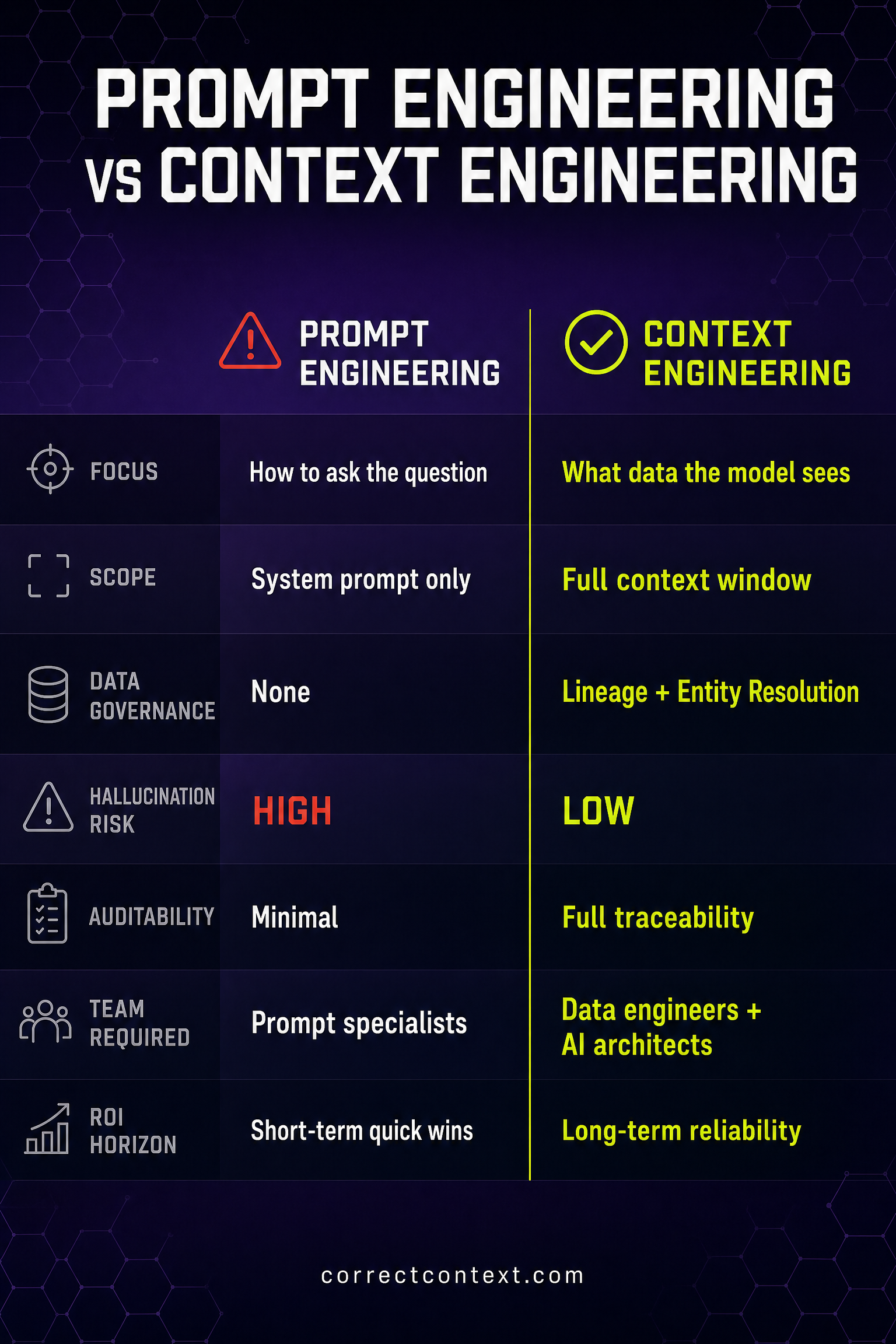
| Dimension | Prompt Engineering | Context Engineering |
|---|---|---|
| Focus | How to ask the question | What data the model sees |
| Scope | System prompt and instructions | Full context window management |
| Data Governance | None | Lineage, entity resolution, constraints |
| Hallucination Risk | High (model relies on parametric memory) | Low (grounded in verified sources) |
| Auditability | Minimal | Full traceability to source |
| Team Required | Prompt specialists | Data engineers, AI architects |
| ROI Horizon | Short-term (quick wins) | Long-term (sustainable reliability) |
The Three Pillars of Enterprise Context Engineering
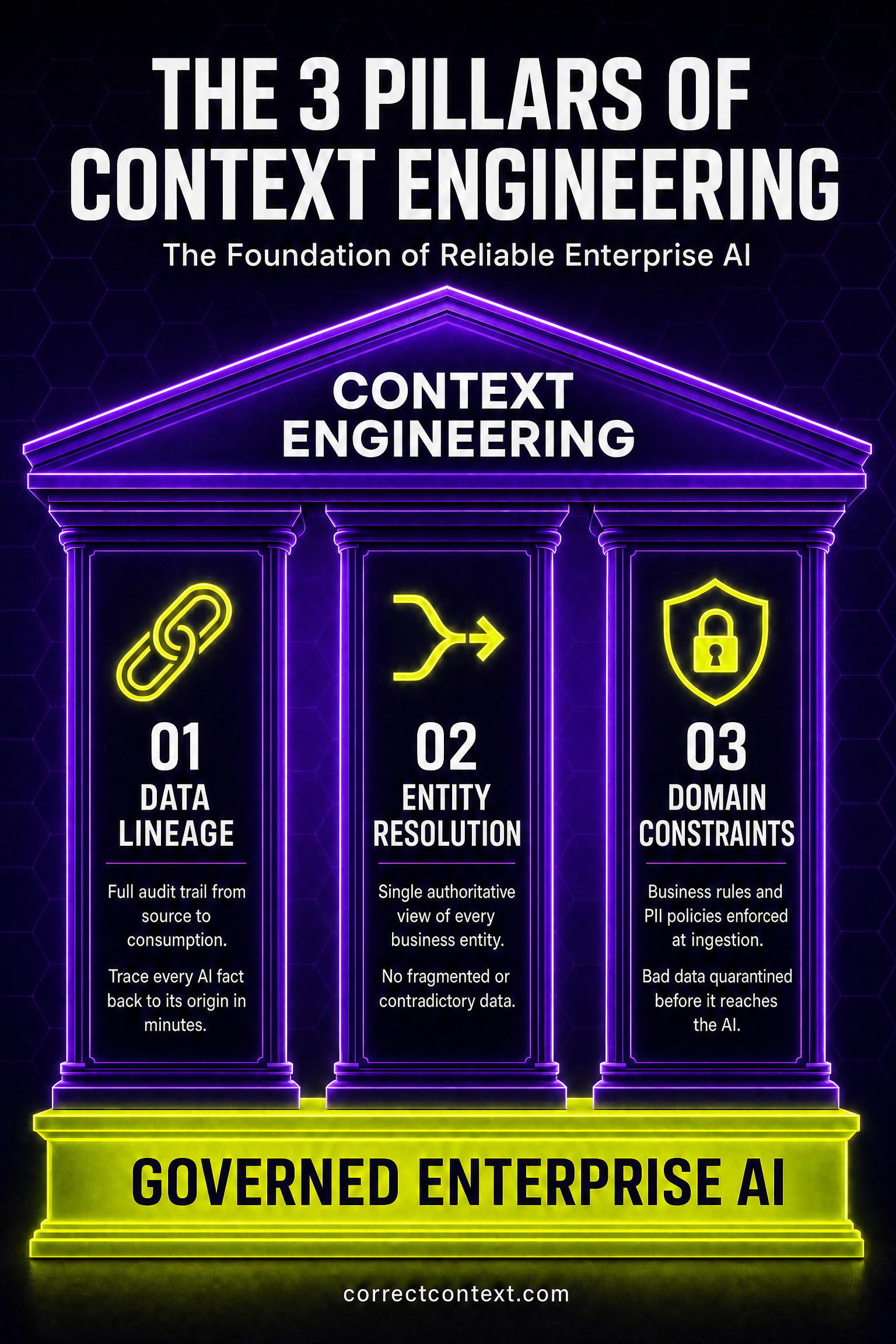
Building a reliable AI system on a foundation of Context Engineering requires investment in three core capabilities [5]:
- Data Lineage and Provenance. For every piece of data an AI model consumes, the enterprise must be able to answer: where did this come from, what transformations were applied, and who approved it? This creates an unbreakable audit trail from source to consumption. When an AI cites a revenue figure or a policy clause, lineage guarantees that the enterprise can trace it back to the authoritative source in minutes, not days. This is non-negotiable for regulated industries and for any organization subject to audit.
- Entity Resolution. Enterprise data is fragmented by nature. The same supplier may exist under multiple IDs following a merger. A customer’s profile may be scattered across three CRM systems. Without entity resolution—the process of creating a single, authoritative view of each business entity—an AI model assembles a contradictory picture and makes unreliable calls. Effective AI data architecture must resolve these identities upstream, before data enters the context pipeline.
- Domain Constraints and Governance. Business rules, valid data ranges, PII masking requirements, and access control policies must be encoded directly into the data flow. Bad data should be quarantined at the point of ingestion, not discovered in the model’s output. This is the difference between reactive hallucination management—catching errors after they occur—and proactive context governance that prevents them from entering the system.
Shifting the AI Budget: From LLM APIs to Context Infrastructure
For CTOs and CFOs evaluating their AI investment strategy, the practical implication is clear: the marginal return on additional LLM API spending diminishes rapidly when the underlying context is ungoverned. Enterprises that continue to increase model spend without investing in context infrastructure are, in effect, choosing to pay the Hallucination Tax indefinitely.
The reallocation does not require abandoning existing AI investments. It requires adding the missing layer. Concretely, this means:
Building internal knowledge bases grounded in verified, proprietary sources that the model cannot fabricate information about. This is typically implemented through Retrieval-Augmented Generation (RAG) architectures, where the model retrieves relevant documents from a governed internal corpus at query time rather than relying on parametric memory.
Investing in context infrastructure—the data pipelines, vector databases, metadata management systems, and governance tooling necessary to deliver clean, relevant, and traceable data to the AI at runtime. This is the “missing line item” in most enterprise AI budgets [6].
Establishing AI Evaluation Intelligence—a continuous observability practice that monitors AI outputs, tracks hallucination rates by workflow, and provides the feedback loops necessary to refine context quality over time. Without measurement, there is no improvement.
Building dedicated Context Engineering teams that sit at the intersection of data engineering, AI architecture, and domain expertise. These teams are responsible for the quality of the knowledge environment the AI operates within—a function that is as critical to AI performance as the model itself.
Infographic 3: The Enterprise AI ROI Stack — Where to Invest
| Investment Layer | Current Typical Spend | Recommended Shift | Expected Outcome |
|---|---|---|---|
| LLM API Costs | High (and growing) | Stabilize / Optimize | Reduce marginal cost |
| Prompt Engineering | Moderate | Maintain | Baseline quality |
| Context Infrastructure | Low (underinvested) | Increase significantly | Reduce hallucination rate |
| AI Evaluation Intelligence | Minimal | Build as core practice | Measurable ROI tracking |
| Context Engineering Team | Absent in most orgs | Hire / Build | Sustainable AI reliability |
The Compliance Dimension: When the Tax Becomes a Liability
The financial cost of the Hallucination Tax is significant. The legal cost is potentially existential. Over 300 US federal judges have issued standing orders specifically addressing AI use in court filings. Individual sanctions for submitting AI-fabricated case citations have crossed $100,000 in some circuits [3]. In regulated industries—financial services, healthcare, legal, government—the risk profile of ungoverned AI is not a technology problem. It is a board-level governance issue.
The only configuration that has been shown to move hallucination rates from problematic to manageable in regulated production environments is grounding the model in a verified, internal source, retrieved at query time, cited at answer time, inside an environment the organization controls [3]. This is not a vendor pitch. It is the operational conclusion that every serious enterprise AI deployment has reached after running the math on verification overhead, legal exposure, and reputational risk.
What This Means for Enterprise AI Teams in 2026
The enterprises achieving genuine enterprise AI ROI in 2026 share a common characteristic: they treat context as a strategic asset, not a technical afterthought. They have moved beyond the question of which model to use and are focused on the quality of the environment in which the model operates.
For organizations still in the early stages of this transition, the path forward is sequential. Audit the verification overhead currently embedded in your AI-enabled workflows. Quantify the Hallucination Tax you are already paying. Then build the business case for context infrastructure investment on the basis of that number—not on the basis of vendor benchmarks measured in lab conditions.
The AI data architecture required to eliminate the Hallucination Tax is not a future capability. It is available today, built on well-established data engineering practices applied to the specific requirements of LLM inference. The teams that build it now will compound that advantage as model capabilities continue to improve. The teams that defer it will continue to pay the tax.
Building and operating that context infrastructure requires specialized talent—data engineers, AI architects, and platform engineers who understand both the data governance requirements and the operational realities of production AI systems. For enterprises in the US, UK, DACH, and Nordic markets looking to build these capabilities without the overhead of establishing local infrastructure from scratch, dedicated AI development teams with deep expertise in data engineering and machine learning provide a practical path to accelerating this investment.
References
[1] Menlo Ventures. 2025: The State of Generative AI in the Enterprise | Menlo Ventures
[2] Tendem AI. The True Cost of AI Hallucinations in Business Data
[3] Optimum Partners. The Hallucination Tax: What Your AI Pilot Is Already Costing You
[4] Anthropic. Effective context engineering for AI agents \ Anthropic
[5] Nexla. Context Engineering: Key to Trustworthy Enterprise AI | Nexla
[6] Atlan. The Missing Line Item in Your 2026 AI Budget: Context Infrastructure
Table of content
- The Real Cost of AI Hallucinations in the Enterprise
- Why Prompt Engineering Is Not Enough
- Context Engineering: The Architecture of Reliable AI
- The Three Pillars of Enterprise Context Engineering
- Shifting the AI Budget: From LLM APIs to Context Infrastructure
- Infographic 3: The Enterprise AI ROI Stack — Where to Invest
- The Compliance Dimension: When the Tax Becomes a Liability
- What This Means for Enterprise AI Teams in 2026
Related articles



About the Author: Marta