In 2026, the definition of a top-tier software engineer has fundamentally changed. As AI tools like GitHub Copilot, Claude, and specialized coding agents become ubiquitous, traditional coding tests are failing to evaluate how engineers actually work. The new benchmark for technical recruitment is the AI Fluency Standard—a framework designed to identify true AI native developers who orchestrate systems rather than just writing syntax.
For Enterprise innovation units, Fortune 5000 companies, and Series A+ Startups, the challenge is no longer just finding talent; it is finding talent that can leverage AI to ship products 10x faster. The traditional technical interview, focused on whiteboard algorithms and syntax memorization, is obsolete. Tech leaders are struggling to spot true AI native builders versus those who merely follow tutorials. Adopting live-coding and 360-degree technical validation processes is critical to building a high-performing engineering team in Poland, the CEE region, or anywhere globally.
The Productivity Illusion: Why Traditional Metrics Fail
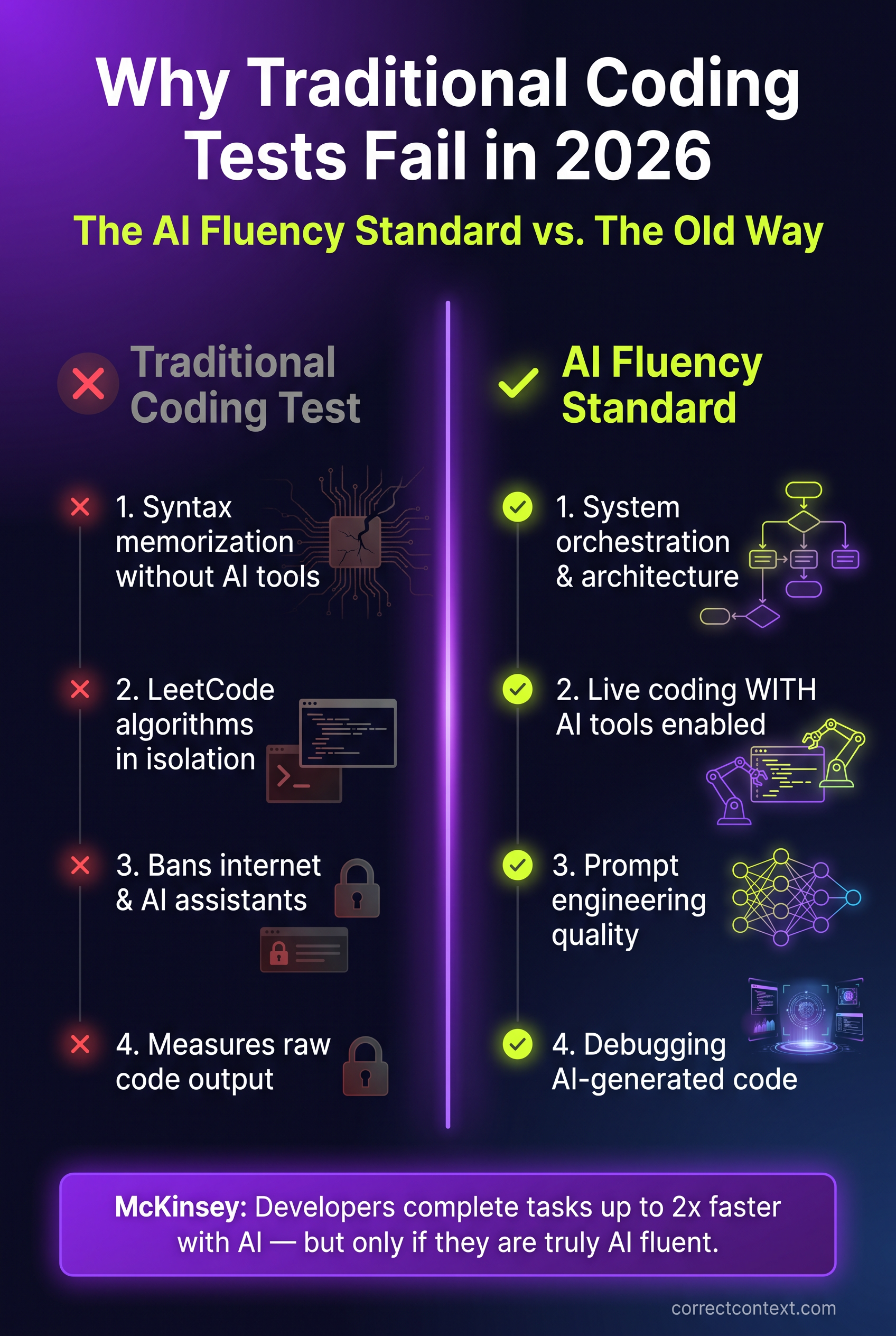
The promise of AI in software development has always been increased productivity. A McKinsey study highlighted that software developers can complete coding tasks up to twice as fast with generative AI [1]. However, this massive surge in productivity is not guaranteed simply by providing access to tools. The same study revealed that time savings shrank to less than 10 percent on tasks that developers deemed high in complexity, and in some cases, tasks took junior developers longer with the tools than without them [1].
This discrepancy highlights the core problem: having an AI tool does not make a developer AI fluent. The industry is seeing a widening gap between those who use AI as an advanced autocomplete and those who use it to architect and orchestrate entire systems. As Forrester predicted for 2026, AI is moving beyond generating code snippets to delivering engineering-grade outputs from high-level intent, fundamentally changing the developer’s role from jamming to conducting a full orchestra [2].
Defining the AI Fluency Standard
The AI Fluency Standard is a comprehensive evaluation framework that measures an engineer’s ability to effectively integrate AI into the software development lifecycle (SDLC). It moves beyond basic coding assessments to evaluate system design thinking, prompt engineering, debugging AI-generated code, and maintaining software quality in an accelerated environment.
True AI native developers possess a distinct set of skills that differentiate them from traditional coders:
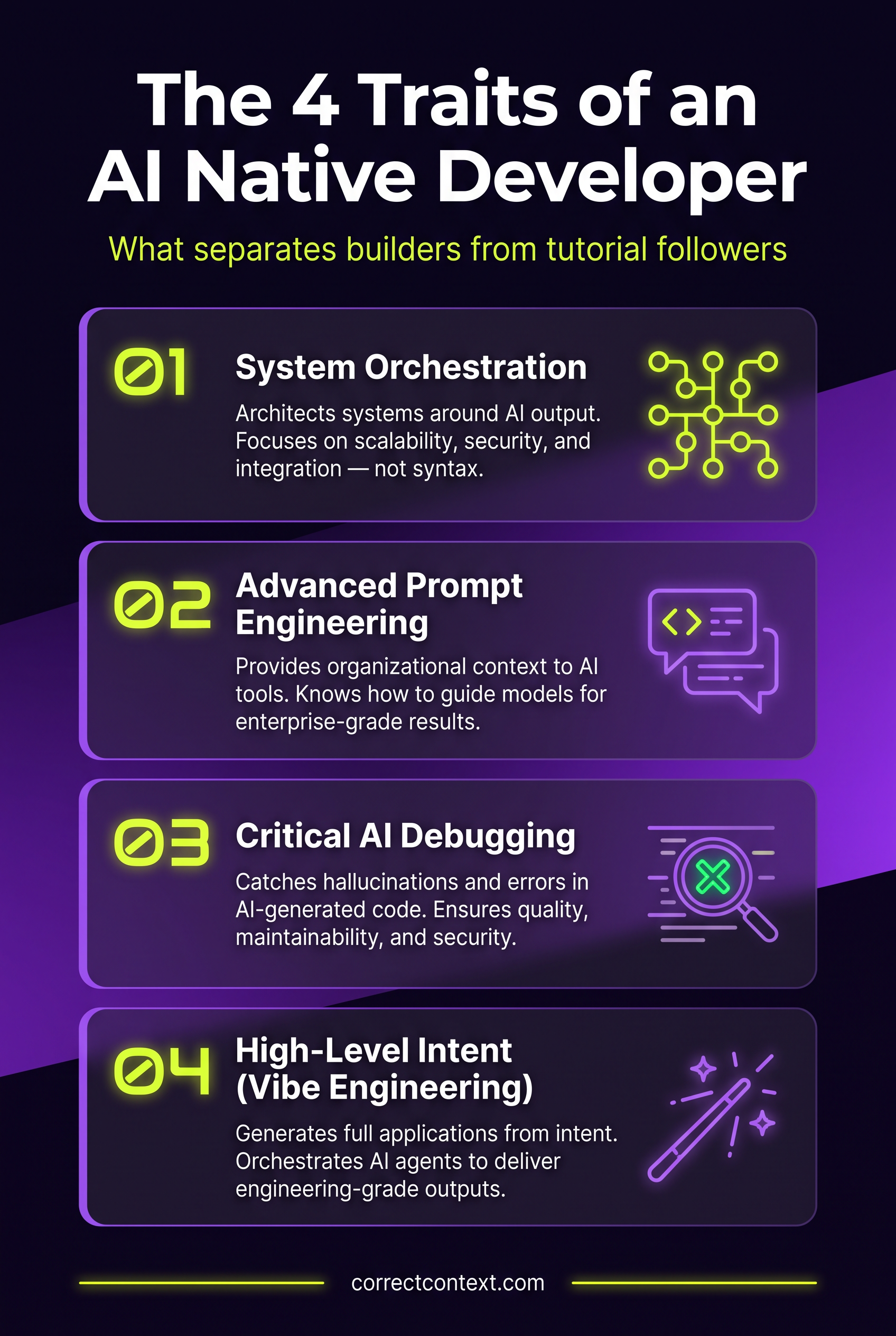
- System Orchestration Over Syntax: AI native developers focus on how different components interact. They use AI to generate the boilerplate, while they concentrate on the architecture, security, and scalability of the system.
- Advanced Prompt Engineering: They understand how to provide the necessary organizational context to AI tools. Off-the-shelf generative AI models do not know a company’s specific security requirements or integration needs; the developer must provide this context [1].
- Critical Debugging and Quality Assurance: AI tools can introduce errors or hallucinations. An AI fluent developer excels at reviewing AI-generated code for bugs, maintainability, and reusability, ensuring that the output meets enterprise standards [1].
- Vibe Engineering and High-Level Intent: As Forrester notes, “vibe engineering” is becoming the new beat. Developers are increasingly generating entire applications by guiding agents and ensuring harmony across complex systems, rather than just writing code [2].
The Failure of Traditional Coding Tests
Traditional coding tests are failing in the AI era because they measure the wrong skills. Asking a candidate to invert a binary tree without internet access does not reflect the reality of modern software development.
Gartner research indicates that current AI implementation is focused on augmenting and automating less complex tasks traditionally performed by entry-level workers [3]. This means the baseline of what is considered “entry-level” has shifted. Assessing a senior developer on tasks that an AI can complete in seconds is a waste of time and fails to evaluate their true value.
Furthermore, traditional assessments ignore the collaborative nature of AI-assisted coding. The goal is to observe how candidates identify logical errors in AI-generated output, which is more critical than writing boilerplate code.
Implementing 360-Degree Technical Validation
To accurately assess the AI Fluency Standard, organizations must adopt new methods for evaluating AI assisted coding skills. This requires a shift towards 360-degree technical validation.
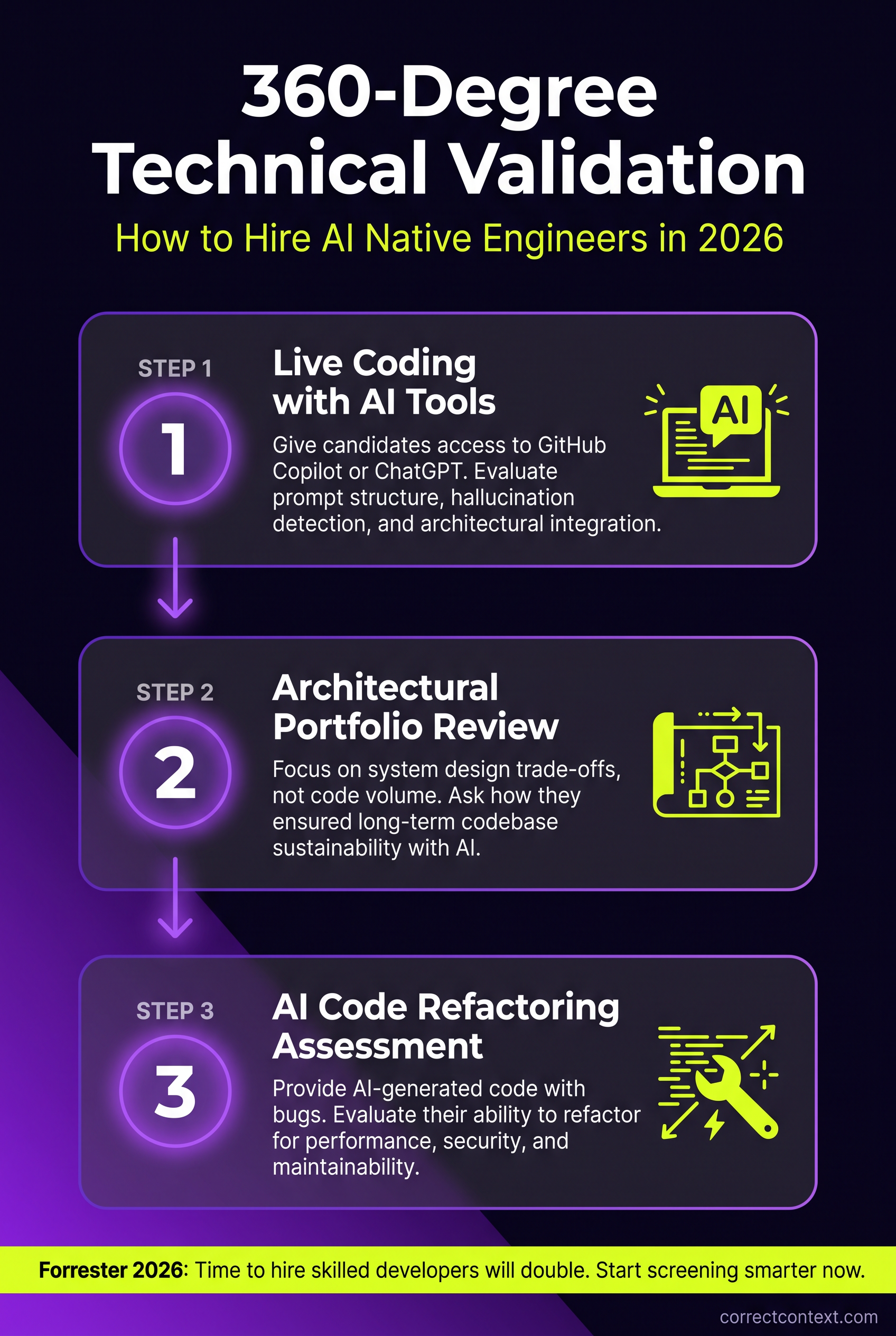
1. Live-Coding with AI Tools
Instead of banning AI tools during interviews, embrace them. Provide candidates with a complex problem and access to their preferred AI assistants (e.g., GitHub Copilot, ChatGPT). Evaluate them on:
- How they structure their prompts.
- How quickly they identify and correct AI hallucinations.
- Their ability to explain the logic behind the AI-generated code.
- How they integrate the generated code into a larger system architecture.
2. Architectural Portfolio Reviews
Shift the focus from raw code volume to system design thinking. Ask candidates to present a project where they utilized AI tools. Discuss the architectural trade-offs they made and how they ensured the long-term sustainability of the codebase.
3. Code Refactoring and Optimization Assessments
Provide candidates with a suboptimal, AI-generated codebase and ask them to refactor it for performance, security, and maintainability. This tests their ability to understand and improve upon code they did not write themselves, a crucial skill in an AI-driven environment.
Building Your AI Development Team in Poland and CEE
For enterprises and scaling startups, building an AI development team or an extended engineering team requires access to top-tier talent. Poland and the broader Central and Eastern European (CEE) region have emerged as premier hubs for sourcing AI fluent engineers.
When looking to hire developers in Poland or establish an engineering hub in Europe, partnering with a specialized Employer of Record (EoR) that understands the technical recruitment 2026 landscape is vital. An effective partner will not just provide headcount; they will ensure that every candidate meets the rigorous AI Fluency Standard.
Whether you need a machine learning engineers team, a data analytics team, or a full DevOps team for hire, focusing on AI fluency ensures that you are hiring builders, not just coders. By implementing robust evaluation processes, you can scale your software development capabilities and leverage AI as a true force multiplier.
Conclusion
The AI Fluency Standard is not just a recruitment buzzword; it is a fundamental shift in how we define software engineering excellence. By moving away from outdated coding tests and embracing 360-degree technical validation, tech leaders can identify the true AI native developers who will drive innovation and efficiency in 2026 and beyond.
References
[1] Unleashing developer productivity with generative AI. McKinsey & Company.
[2] Predictions 2026: Software Development Goes From Jamming To A Full Orchestra
Table of content
Related articles


About the Author: Marta