
When enterprise operations leaders and startup founders sit down to budget for engineering talent, the comparison often seems deceptively simple: a senior software engineer in the United States commands a base salary of $153,000 or more, while a similarly skilled engineer in Poland earns $70,000 to $89,000 per year [1]. The arithmetic looks compelling. But for CFOs, founders, and enterprise innovation units scaling globally, this salary-only perspective creates a costly blind spot.
The true cost of engineers Poland — and the true cost of engineers in the US — extends far beyond the number on an offer letter. When recruitment fees, benefits, onboarding, management overhead, and compliance are factored in, the financial reality shifts dramatically. This article provides a comprehensive breakdown of US vs Poland engineering costs, grounded in real data, so that leaders can move beyond the salary mirage and make decisions based on the full picture.
The Salary Mirage: Why Base Pay Is Only the Beginning
In high-cost markets like the US East Coast, the UK, DACH, and the Nordics, the demand for specialized engineering talent — particularly for AI development teams, cloud engineering teams, and big data development — drives salaries to significant heights. But base salary is just the tip of the iceberg.
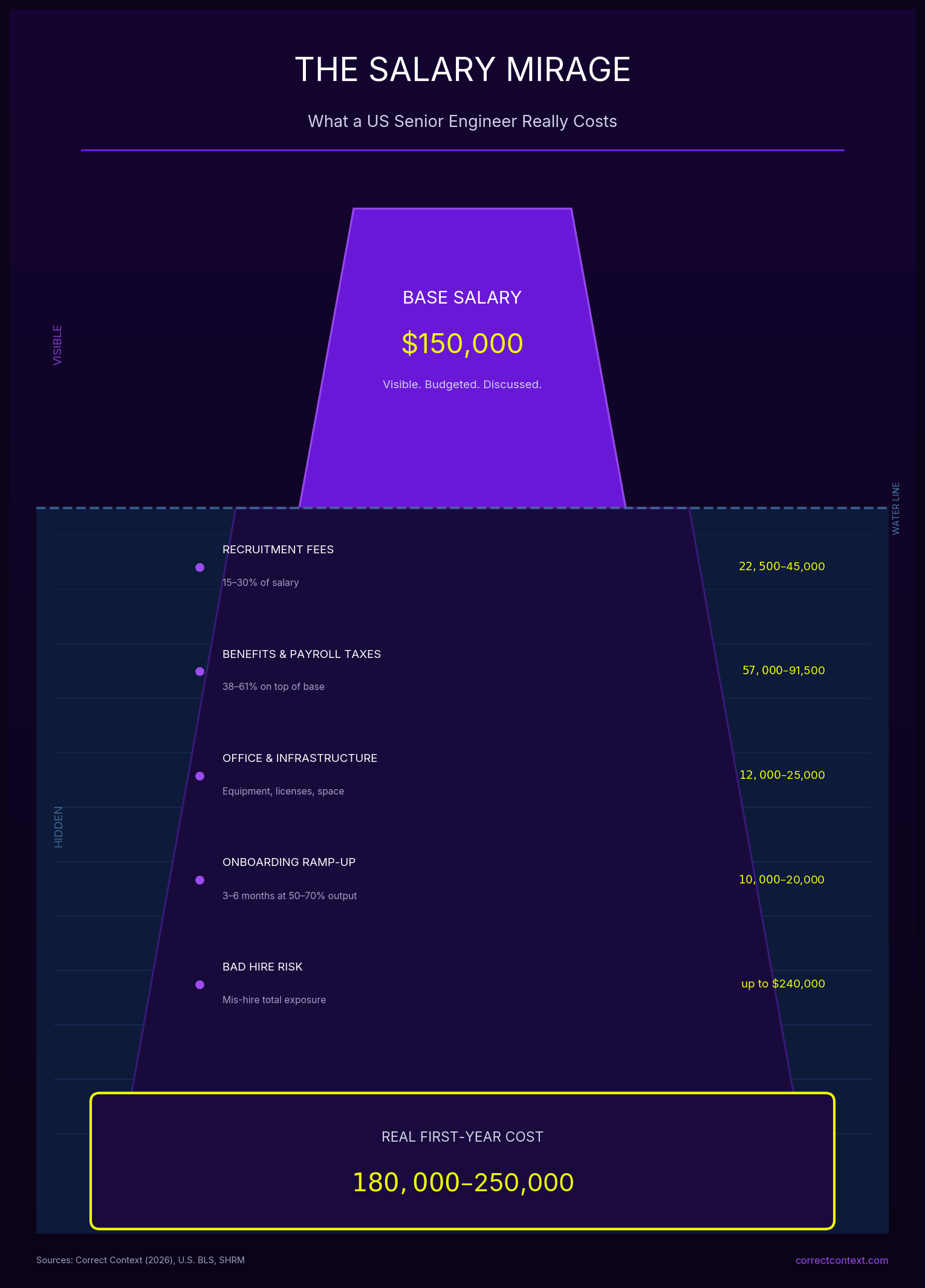
According to industry analysis, the true cost of an employee is typically 1.25 to 1.4 times their base salary [2]. For highly skilled roles like software engineers, this multiplier can reach 1.5 to 2.5 times [2]. The U.S. Bureau of Labor Statistics confirms that benefits account for approximately 30% of total employee compensation costs in the private sector [2]. For a $150,000 salary, that translates to roughly $63,000 in additional annual benefit costs alone.
The hidden cost stack for a US-based engineer includes:
- Recruitment and hiring costs: Agency recruiter fees range from 15% to 30% of the first-year salary [2]. For a senior engineer at $150,000, this is $22,500 to $45,000 per hire.
- Benefits and payroll taxes: Health insurance, retirement contributions, PTO, and legally required payroll taxes add 38% to 61% on top of base salary [2].
- Infrastructure and overhead: High-end equipment, software licenses, and office space in major US tech hubs add $10,000 to $20,000 per employee annually. Management overhead can add $30,000 to $75,000 per developer per year [2].
- Onboarding and productivity ramp-up: New engineers typically reach full productivity only after 3 to 6 months, contributing at 50% to 70% of their potential output during that period [2].
- Bad hire risk: A mis-hire can cost up to $240,000 when recruitment fees, training time, lost productivity, and team morale impact are factored in [2].
The bottom line is stark: hiring a software engineer with a $100,000 base salary in the US actually costs a company between $180,000 and $250,000 in the first year alone [2]. This is the salary mirage — and it is the lens through which nearshore engineering costs must be evaluated.
The Real Numbers: US vs Poland Salary Comparison
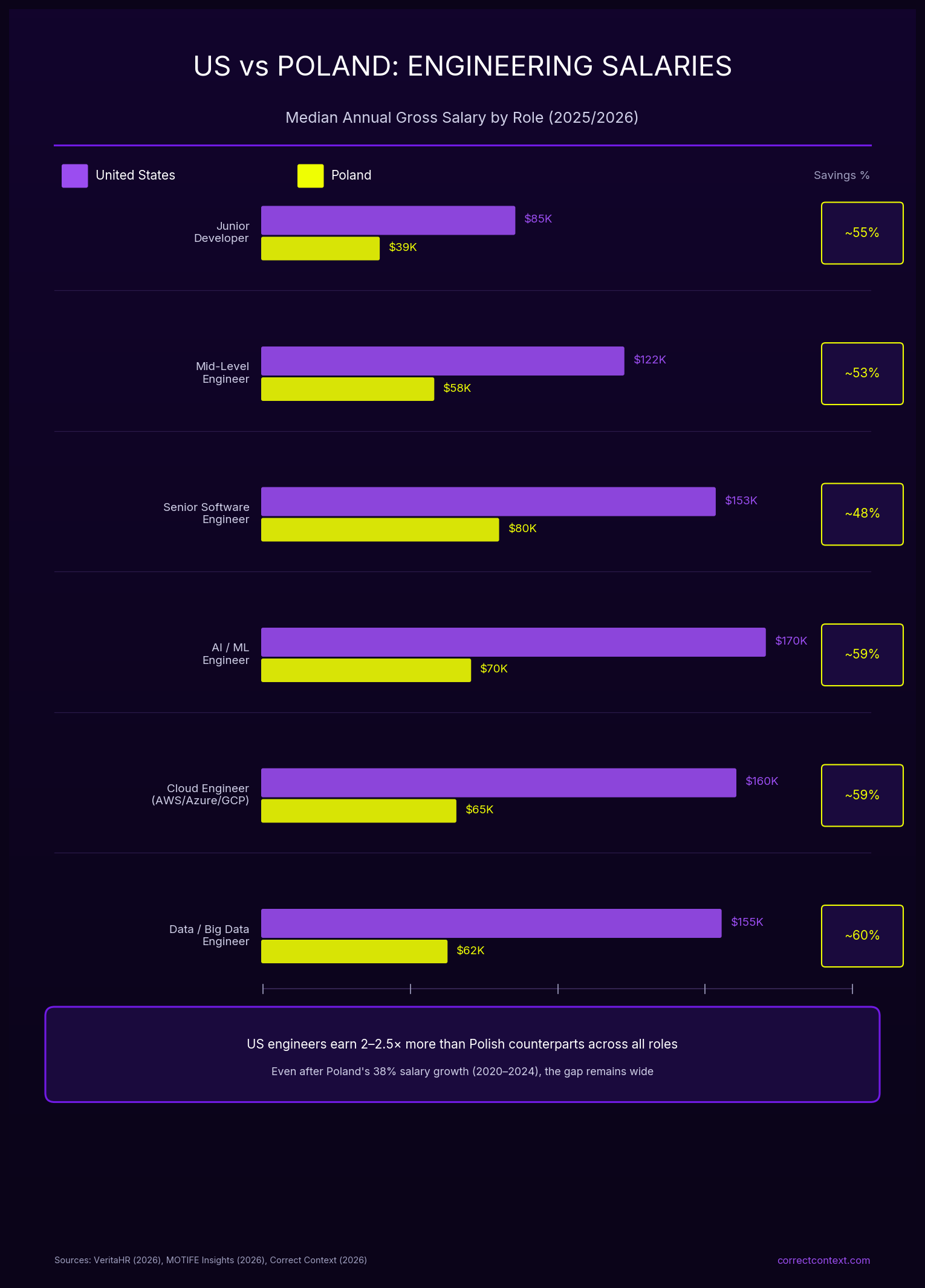
Poland’s cost of engineers is substantially lower across all seniority levels and specializations. The data from 2025 and 2026 benchmarks is consistent.
| Role | Median Salary (USA) | Median Salary (Poland) | Potential Savings |
|---|---|---|---|
| Junior Developer | $85,000 | $35,000 – $43,000 | ~50–60% |
| Mid-Level Engineer (3–5 yrs) | $122,000 | $55,000 – $60,000 | ~50–55% |
| Senior Software Engineer | $153,000+ | $70,000 – $89,000 | ~40–45% |
| AI / Machine Learning Engineer | $170,000 | $70,000 | ~59% |
| Cloud Engineer (AWS/Azure/GCP) | $160,000 | $65,000 | ~59% |
| Data / Big Data Engineer | $155,000 | $62,000 | ~60% |
Sources: VeritaHR (2026), MOTIFE Insights (2026), Correct Context (2026) [1] [2] [3]
For most roles, US professionals earn between 2 and 2.5 times more than their counterparts in Poland, even when comparing the total cost of employment [3]. Between 2020 and 2024, IT salaries in Poland increased by 38%, compared to a 15% rise in the United States [3]. Despite this faster growth, the absolute salary gap remains wide and is expected to persist through the end of the decade.
Total Cost of Ownership: The Full Picture
The most meaningful comparison is not salary-to-salary but TCO-to-TCO. When the full cost stack is modeled for a five-person senior engineering team, the difference is transformative.
| Cost Component | US-Based Team | Poland via EoR (Correct Context) |
|---|---|---|
| Base Salaries (5 engineers) | $900,000 | $375,000 |
| Benefits & Payroll Taxes (~30%) | $270,000 | $112,500 |
| Recruitment Costs (avg. 20% of salary) | $180,000 | $75,000 |
| Office & Infrastructure | $60,000 | Included in EoR |
| HR, Legal, Accounting, Admin | $50,000 | Included in EoR |
| Total Annual TCO | $1,460,000 | $562,500 |
| Annual Savings | — | ~$897,500 (61%) |
Source: Correct Context TCO Analysis (2026) [2]
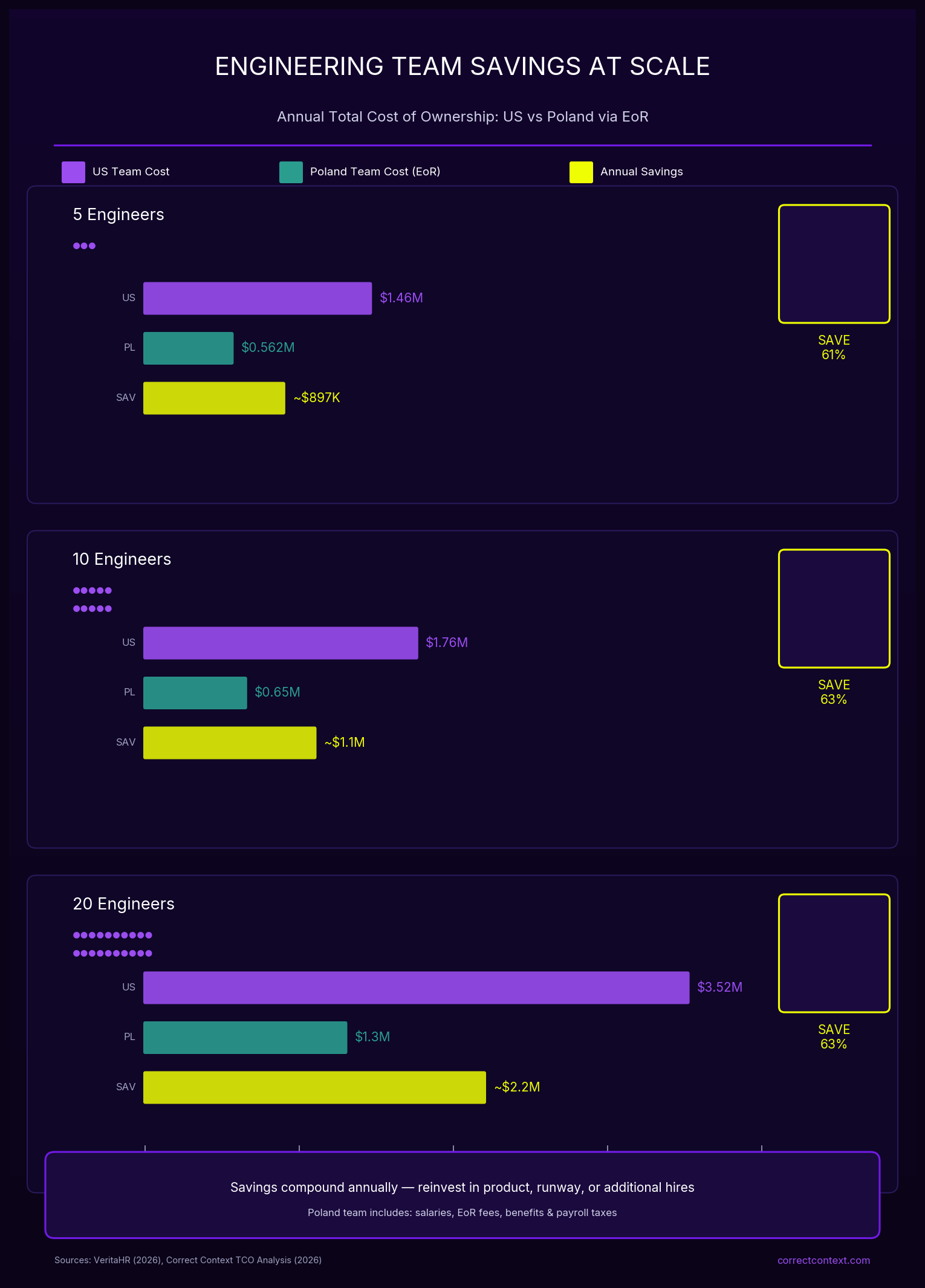
For a 10-person dedicated development team, the US cost reaches approximately $1.75 million per year. The same team in Poland, utilizing a mixed B2B and employment structure, costs between $600,000 and $700,000 — an annual saving of over $1 million [1]. These savings compound annually, freeing budget for product development, extended runway, or additional hires.
Understanding Poland’s Hiring Structures
To accurately calculate nearshore engineering costs, leaders must understand the two primary employment models in Poland’s tech market.
B2B Contracts (Business-to-Business): Most experienced Polish developers prefer operating as independent contractors. They invoice monthly for services and manage their own taxes and social security contributions. For US companies without a Polish entity, B2B contracts offer a clean, administratively simple solution. Rates typically run 15–25% higher than equivalent employment contracts, but there are no employer-side social security contributions [1]. Despite the premium, B2B rates still deliver significant savings compared to US rates.
Employment Contracts (Umowa o Prace): Traditional employment contracts provide more stability and are governed by Poland’s Labor Code, which includes statutory benefits such as paid vacation, sick leave, and maternity leave. Employers pay approximately 20% in social security (ZUS) contributions on top of the gross salary [1]. This model requires either a Polish legal entity or an Employer of Record Poland service. For companies building long-term operations, employment contracts are the preferred structure.
The Hidden Costs of Nearshoring: What Leaders Miss
While the salary savings in Poland are clear, nearshore engineering costs are not without additional considerations. A rigorous TCO model must account for the following.
Rework and QA Debt. When vetting is weak, approximately 15% to 26% of total project hours go to rework and defect correction [4]. This is not a Poland-specific risk — it applies to any distributed team where hiring standards are not rigorously maintained. Proper technical assessment during hiring, combined with Poland’s exceptional talent quality, mitigates this risk significantly.
Management Overhead. Managing a remote software engineers team requires consistent weekly oversight. Governance and management overhead can add 15% to 30% on top of the developer rate [4]. For a five-person team, this represents $16,000 to $32,000 per year in internal management costs — a real line item that must be included in any honest TCO calculation.
Tooling and Communications. Project management licenses, security infrastructure, and time-zone coordination add approximately $150 to $300 per developer per month [4]. For a five-person team over 12 months, this is $9,000 to $18,000.
Onboarding Ramp. Any new developer, regardless of geography, requires 4 to 8 weeks to reach full productivity. Ramp-up costs are estimated at $2,000 to $3,750 per developer [4]. For a four-person team, this is $8,000 to $15,000 before anyone hits full velocity.
Even after accounting for all of these add-ons, the Poland advantage holds decisively. A senior US developer at $153,000 plus 15% in benefits and taxes ($176,000 total) still costs more than double a senior Polish developer on either contract structure [1].
The Quality Coefficient: Why Poland Wins on Value
Cost savings are strategically irrelevant if they come at the expense of quality. This is where Poland’s value proposition becomes undeniable.
Polish developers consistently rank among the best in the world. In HackerRank’s global developer skills assessment, Poland placed 3rd globally, with particular strength in Java, algorithms, and Python [5]. The country produces over 74,000 ICT graduates annually from strong technical universities, and approximately 75% of IT professionals hold degrees in computer science or related fields [1] [3].
English proficiency is exceptionally high. Poland ranks in the “very high proficiency” tier on the EF English Proficiency Index, placing 15th out of 116 countries [3]. This ensures seamless communication for distributed teams operating across time zones.
Poland’s time zone (CET/CEST) provides 4 to 6 hours of daily real-time overlap with the US East Coast — significantly better than Asian offshore alternatives, where overlap is often limited to early morning or late evening hours [1]. This overlap is critical for reducing rework caused by asynchronous communication gaps.
The proof is in the market. As of 2024, approximately 40% of Krakow’s IT talent works for US-based companies, including Cisco, IBM, Motorola Solutions, JPMorgan, and Google [3]. These organizations are not simply outsourcing services — they are building strategic, long-term engineering hubs in Europe focused on innovation and growth.
The Strategic Solution: Employer of Record (EoR) in Poland
For US companies without an existing Polish entity, the most efficient path to accessing Poland’s talent pool is through an Employer of Record Poland model. Setting up a foreign subsidiary can cost $25,000 to $100,000 upfront and take months to complete [2]. An EoR eliminates this barrier entirely, enabling companies to hire in Europe without a company entity and onboard talent in days rather than months.
The EoR Poland model handles all legal and administrative aspects of employment: payroll processing, ZUS filings, benefits administration, and compliance with the Polish Labour Code. The EoR cost in Poland typically ranges from €349 to $599 per employee per month [2] — a fraction of the cost of entity setup and ongoing compliance management.
For startups and scale-ups that need to move quickly, and for enterprise innovation units that need to avoid the administrative burden of a foreign subsidiary, the EoR model is the optimal entry point. A full-service partner like Correct Context goes beyond a standard EoR, providing end-to-end support including recruitment, office management, HR, accounting, and legal services — all without the client needing to build local infrastructure. This allows teams to focus entirely on building their dedicated software team or extended engineering team in Poland.
What This Means for Your Budget
The savings scale predictably with team size. For enterprise innovation units and Series A+ startups evaluating scale engineering teams strategies, the numbers are compelling at every level.
| Team Size | US Annual Cost | Poland Annual Cost | Annual Savings |
|---|---|---|---|
| 5 engineers | $1,460,000 | $562,500 | ~$897,500 |
| 10 engineers | $1,759,500 | $600,000 – $700,000 | ~$1,050,000 – $1,150,000 |
| 20 engineers | $3,519,000 | $1,200,000 – $1,400,000 | ~$2,100,000 – $2,300,000 |
Sources: VeritaHR (2026), Correct Context TCO Analysis (2026) [1] [2]
These are not hypothetical projections. Companies building tech hubs in Poland consistently report these cost structures. The savings compound annually, and when reinvested into product development or additional headcount, they create a durable competitive advantage.
Conclusion: Real Numbers, Real Trade-Offs
The decision to hire developers in Poland is not simply about finding affordable talent. It is a strategic investment in engineering excellence — one that delivers measurable financial returns while accessing a world-class talent pool.
The salary comparison is the starting point, not the conclusion. When the full TCO is modeled — including recruitment, benefits, onboarding, management overhead, and compliance — the case for nearshore development teams in Poland is compelling for virtually every company operating in a high-cost market.
For CFOs and founders who are mid-research on this decision, the key insight is this: engineering TCO Europe is not just about what you pay engineers. It is about what you pay to find, hire, retain, manage, and support them. On that full-spectrum basis, Poland’s combination of cost, quality, time zone alignment, and talent depth is unmatched in the European market.
The numbers are real. The trade-offs are manageable. The strategic case is clear.
References
[1] VeritaHR. (2026). Should You Hire Developers in Poland or the US?
[2] Correct Context. (2026). The Salary Mirage: Why Focusing on Salary Alone Blinds Leaders to the Real Cost of Engineering Talent. Salary vs Total Cost of Hiring Engineers: What Leaders Miss
[3] MOTIFE Insights. (2026). IT Salaries Poland vs US: How Do They Compare in 2026?| Blog | MOTIFE
[4] Kore BPO. (2026). Offshore Developer Cost Comparison: Full TCO Guide – korebpo.com
[5] HackerRank. (2016, updated 2024). Which Country Would Win the Programming Olympics? – HackerRank
[6] DevsData LLC. (2025). Polish Software Developers: Salaries, Pros, and Cons