
Tech Leadership and CTO Challenges: The Complete 2026 Guide for Engineering Leaders
Here’s a sobering statistic to start: 86% of enterprise leaders say their organizations are not ready to integrate AI into daily operations — despite AI being the single biggest investment priority for 2026. This gap between ambition and readiness captures the essence of what it means to be a CTO today. You’re expected to deliver transformative innovation while wrestling with talent shortages, cybersecurity threats, technical debt, and organizational inertia.
This guide examines the critical challenges facing Chief Technology Officers and engineering leaders in 2026. Drawing on data from Deloitte, McKinsey, Gartner, and the State of the CIO Survey, we’ll explore the five major pain points that keep CTOs awake at night — and provide actionable frameworks for addressing them. Whether you’re a first-time CTO at a Polish startup or a seasoned engineering leader at a global enterprise, this guide offers the data-driven insights you need to navigate the year ahead.
The Evolving Role of the CTO: From Technical Lead to Strategic Executive
The Chief Technology Officer role has undergone a fundamental transformation over the past decade. Where CTOs were once primarily technical architects focused on infrastructure decisions and engineering management, today’s CTOs are strategic executives who shape business direction, drive revenue growth, and increasingly report directly to the CEO rather than through the CIO.
According to Deloitte’s 2025 Tech Exec Survey, 52% of organizations now view their technology function as a revenue generator rather than a cost center. This shift has elevated the CTO from a support role to a core driver of enterprise value. The modern CTO must balance three competing mandates: maintaining operational excellence, driving innovation, and managing risk — all while navigating an unprecedented pace of technological change.
The Three Mandates of Modern Tech Leadership
Effective CTOs in 2026 must simultaneously deliver on three distinct objectives:
Operational Excellence: The foundation of any technology organization is reliable, secure, performant systems. When systems fail, customers leave, revenue drops, and trust evaporates. CTOs must ensure their teams can deliver consistent service levels while managing complexity, technical debt, and security threats. This operational mandate never goes away — it only becomes more challenging as systems scale.
Innovation and Differentiation: Beyond keeping the lights on, CTOs are expected to identify and exploit emerging technologies that create competitive advantage. Whether that’s AI-powered features, real-time data pipelines, or novel customer experiences, the CTO must separate genuine opportunities from hype and deliver innovations that move business metrics.
Risk Management: Every technology decision carries risk — security vulnerabilities, compliance gaps, vendor lock-in, talent dependencies. The CTO must identify, quantify, and mitigate these risks while still enabling the business to move fast. This balancing act is particularly acute in regulated industries like fintech, healthcare, and enterprise software.
The CTO Career Path: From Engineer to Executive
Understanding how CTOs develop helps explain why the role varies so dramatically across organizations. Most CTOs follow one of three paths:
The Technical Founder: Started the company based on technical expertise, often the original architect of the product. Strengths include deep domain knowledge and credibility with the engineering team. Challenges include potential gaps in management experience and the need to evolve from builder to leader as the company scales.
The Career CTO: Rose through engineering management ranks, often at multiple companies. Brings patterns and frameworks from previous experiences. Strengths include knowing what good looks like at various stages and having a network of potential hires. Challenges include avoiding the “this is how we did it at my last company” trap.
The Business-Technical Hybrid: Background spans both engineering and business roles — perhaps product management, consulting, or even sales engineering. Particularly effective at translating between technical and business stakeholders. Strengths include communication and strategic thinking. Challenges include potentially less technical depth than pure engineering backgrounds.
In the Central and Eastern European context, this evolution carries particular weight. Poland has emerged as the undisputed powerhouse of CEE tech talent, with 1 in 4 regional startups founded here and over 15,000 computer science graduates entering the workforce annually. For CTOs building teams in Poland and the broader CEE region, this represents both an opportunity and a challenge: access to world-class engineering talent, but intense competition for that talent from global tech giants who have established major R&D centers in Warsaw, Kraków, and Wrocław.
Challenge 1: Talent Shortages and the Engineering Skills Gap
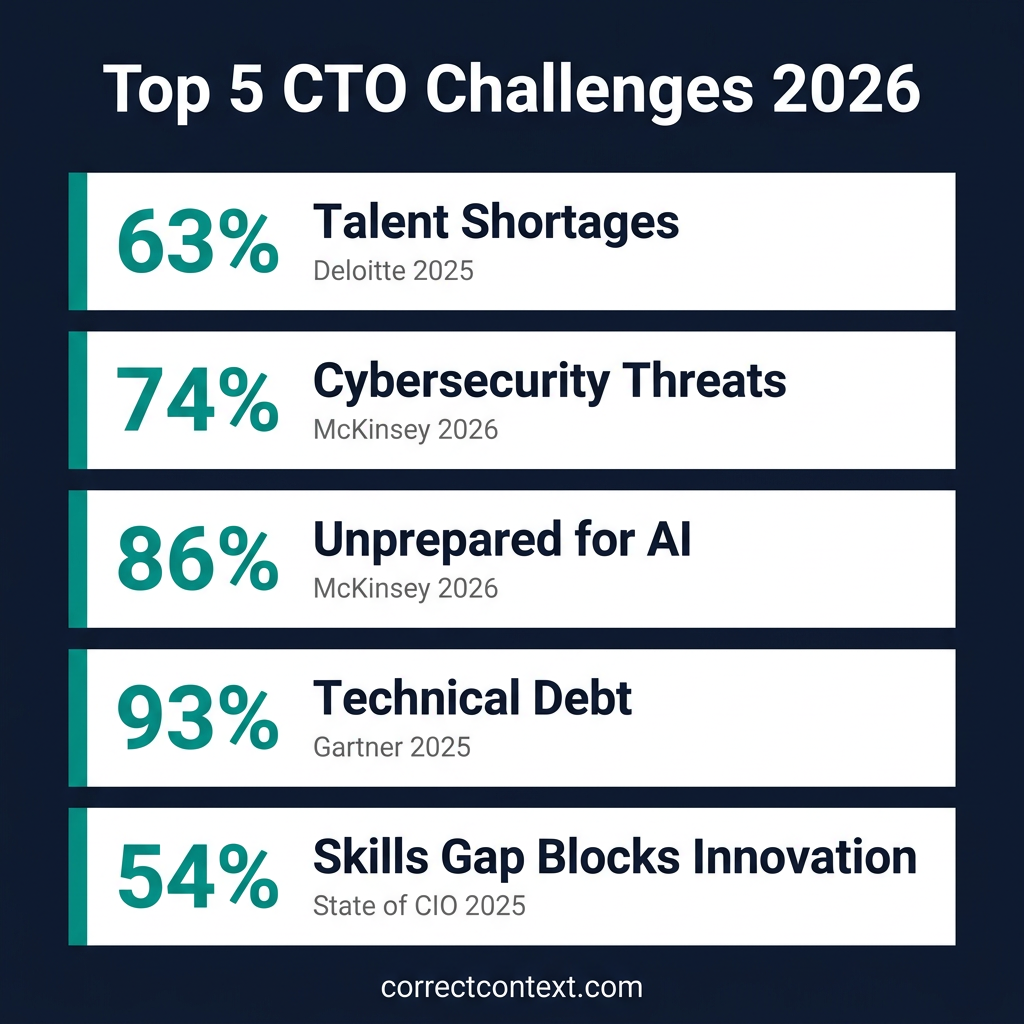
The talent shortage isn’t news — but its severity in 2026 demands attention. According to the 2025 Deloitte Global CIO Survey, 63% of CTOs report that talent shortages are a significant challenge. This shortage is particularly acute in high-demand areas: AI and machine learning, cloud architecture, cybersecurity, and data engineering.
McKinsey’s 2025 research puts the problem in even starker terms: only 16% of executives feel comfortable with the amount of technology talent they have available to drive digital transformation. The remaining 84% are operating with significant capability gaps that limit their ability to execute on strategic initiatives.
The AI Talent Crunch
The demand for AI expertise has created a talent market unlike anything seen before. Job postings for agentic AI roles rose nearly 1000% between 2023 and 2024, according to McKinsey data. In AI specifically, 46% of leaders cite skill gaps as a major barrier to adoption — more than any other factor including technology limitations or budget constraints.
This shortage has created a compensation arms race. Senior AI engineers in major European tech hubs now command salaries exceeding €180,000 annually, with total compensation packages at US tech giants often reaching €300,000 or more. For CTOs at mid-market companies and startups, competing on salary alone is impossible.
The Innovation Tax of Skills Shortages
The talent shortage doesn’t just make hiring harder — it actively prevents strategic work. According to the 2025 State of the CIO Survey, 54% of CIOs report that staffing and skills shortages took time away from more strategic and innovation pursuits. When your senior engineers are firefighting operational issues because you can’t hire enough people, transformation projects stall.
This creates a vicious cycle: you can’t innovate because you’re understaffed, but you can’t attract talent because your technology stack and engineering culture haven’t kept pace. Breaking this cycle requires CTOs to think beyond traditional hiring and consider alternative talent strategies.
The True Cost of Talent Turnover
When discussing talent shortages, it’s essential to understand the full cost of losing experienced engineers. Direct recruitment costs — agency fees, advertising, interview time — typically run 15-25% of annual salary. But the hidden costs are far greater:
- Productivity loss: It takes 6-12 months for a new engineer to reach full productivity
- Knowledge drain: Departing engineers take institutional knowledge that isn’t documented
- Team disruption: Remaining team members pick up slack, increasing their burnout risk
- Morale impact: High turnover signals problems, making retention even harder
For a senior engineer earning €100,000 annually, the total cost of replacement often exceeds €200,000 when all factors are considered. This math makes retention investments — competitive compensation, career development, work-life balance — clearly worthwhile.
Solutions for the Talent Challenge
Leading CTOs are addressing talent shortages through three primary strategies:
1. Upskilling and Reskilling: Rather than competing for scarce external talent, invest in developing your existing team. The 2025 State of the CIO Survey found that upskilling/reskilling is the preferred approach for most CIOs, enabling them to grow AI, cloud, and cybersecurity capabilities from within. Platforms like Coursera, Udacity, and internal academies can bridge critical skill gaps at a fraction of the cost of external hiring.
Effective upskilling programs share common characteristics: they’re structured (not ad-hoc), time-protected (engineers have dedicated learning time), and applied (learning is immediately used on real projects). One Polish fintech CTO described their approach: “We dedicate 10% of engineering time to learning, with quarterly hackathons where teams apply new skills to business problems. This creates a culture of continuous improvement while delivering real value.”
2. Strategic Staff Augmentation: For specialized skills needed on a project basis, staff augmentation offers a compelling alternative to full-time hiring. A CTO at a Series B fintech company in Warsaw described their approach: “We maintain a core team of generalists and augment with specialists for AI/ML projects, security audits, and cloud migrations. This gives us access to expertise we couldn’t afford full-time while keeping our burn rate manageable.”
The key to successful staff augmentation is treating augmented team members as true collaborators, not contractors. They should participate in standups, have access to documentation and tools, and be measured by the same standards as permanent staff. When done well, augmented engineers often become long-term partners who deeply understand your business.
3. Remote-First and Distributed Teams: The shift to remote work has expanded the talent pool beyond geographic constraints. CTOs who embrace distributed teams can access talent across Poland, the broader CEE region, and beyond. However, this requires intentional investment in remote culture, asynchronous communication practices, and engineering processes that don’t depend on physical proximity.
Successful distributed teams typically invest heavily in documentation, written communication, and meeting hygiene. Decisions are made asynchronously when possible, with meetings reserved for discussion rather than information sharing. Time zone overlap is managed strategically — having at least 3-4 hours of shared working time enables real-time collaboration while still allowing for deep work during non-overlapping hours.
Challenge 2: Cybersecurity Threats and Data Privacy Complexity
If talent shortages are the chronic condition facing CTOs, cybersecurity is the acute crisis. A 2026 McKinsey report found that 74% of CTOs believe cybersecurity threats are growing in sophistication and frequency. The attack surface has expanded dramatically: cloud infrastructure, remote work endpoints, third-party integrations, and AI systems all present new vulnerabilities.
The World Economic Forum’s Global Cybersecurity Outlook 2026 reveals the scope of the challenge. Among large companies, the greatest barriers to cyber resilience include:
- 65% cite third-party and supply chain vulnerabilities
- 63% point to the rapidly evolving threat landscape
- 49% struggle with legacy systems
- 29% face cybersecurity skills and expertise shortages
The Regulatory Maze
Beyond the technical challenges, CTOs must navigate an increasingly complex regulatory environment. GDPR in Europe, CCPA in California, and emerging AI-specific regulations create compliance burdens that require dedicated resources and expertise. A single data breach can result in fines exceeding 4% of global revenue under GDPR — enough to threaten the survival of mid-sized companies.
The regulatory landscape is still evolving. The EU AI Act, which began taking effect in 2024-2025, imposes specific requirements on high-risk AI systems including documentation, human oversight, and conformity assessments. For CTOs deploying AI in production, compliance is no longer optional — it’s a core engineering requirement.
The Rising Cost of Security Incidents
The financial impact of security breaches continues to escalate. According to IBM’s Cost of a Data Breach Report, the average total cost of a data breach reached $4.88 million in 2024 — a 10% increase from the previous year. For organizations in highly regulated industries, costs can be substantially higher when regulatory fines, legal fees, and customer compensation are included.
Beyond direct costs, breaches inflict lasting reputational damage. Customer trust, once lost, takes years to rebuild. Stock prices typically drop 5-10% following major breach announcements, and customer churn increases measurably. For CTOs, security is no longer just an IT concern — it’s existential business risk.
Building Security-First Organizations
Leading CTOs are moving beyond reactive security measures to build security into their organizational DNA. This includes:
Zero Trust Architecture: The traditional perimeter-based security model is obsolete in a world of cloud infrastructure and remote work. Zero trust assumes breach and verifies every access request regardless of source. Implementing zero trust requires significant architectural changes but provides the foundation for modern security.
The core principles of zero trust include: never trust, always verify (every access request is authenticated and authorized); assume breach (design systems as if attackers are already inside); verify explicitly (use multiple signals to verify identity and device health); and use least privilege access (grant only the minimum permissions needed). For CTOs, implementing zero trust is a multi-year journey that touches identity, network, application, and data layers.
DevSecOps Integration: Security can no longer be a final gate before production. CTOs are embedding security into the entire development lifecycle, with automated security testing, dependency scanning, and infrastructure-as-code security policies. This shift-left approach catches vulnerabilities early when they’re cheaper to fix.
Effective DevSecOps implementations typically include: static application security testing (SAST) integrated into CI/CD pipelines; software composition analysis (SCA) to identify vulnerable dependencies; dynamic application security testing (DAST) for runtime vulnerability detection; and infrastructure-as-code scanning to catch misconfigurations before deployment. The goal is to make security feedback as immediate and actionable as unit test failures.
Security Automation: Given the volume and sophistication of threats, manual security operations can’t keep pace. CTOs are investing in SOAR (Security Orchestration, Automation and Response) platforms, AI-powered threat detection, and automated incident response to augment their security teams.
Security automation delivers value in three areas: detection (AI-powered tools can identify anomalies and potential threats faster than human analysts); response (automated playbooks can contain threats within minutes rather than hours); and prevention (infrastructure-as-code policies prevent misconfigurations before they reach production). For resource-constrained teams, automation is the force multiplier that enables effective security at scale.
Challenge 3: AI Adoption and the Readiness Gap
Perhaps no challenge encapsulates the CTO’s dilemma quite like AI adoption. The pressure to implement AI is immense — from boards, investors, competitors, and employees. Yet McKinsey’s 2026 State of Organizations report found that 86% of leaders feel their organizations are not very prepared to adopt AI in day-to-day operations.
This readiness gap manifests in several ways:
The Experimentation Trap
Most organizations have AI pilots running. Few have scaled AI to production. According to McKinsey’s 2025 State of AI report, only 5.5% of companies are seeing real financial returns from their AI investments. The majority are stuck in what McKinsey calls “pilot purgatory” — running interesting experiments that never translate to business impact.
The reasons are organizational, not technical. AI adoption requires clean data, clear use cases, change management, and often, process redesign. CTOs who treat AI as a technology implementation rather than a business transformation initiative consistently underperform.
The Investment Imbalance
Deloitte’s CTO Bill Briggs highlighted a striking statistic: companies are spending 93% of their AI budget on technology and only 7% on the people expected to use it. This lopsided investment strategy ignores the reality that AI value comes from adoption, not deployment. Tools sitting unused deliver zero ROI.
For CTOs, this means shifting investment toward change management, training, and workflow redesign. The technology is often the easy part; the human and process changes are where initiatives succeed or fail.
AI Governance and Ethics
Beyond implementation challenges, CTOs must grapple with AI governance. Inaccuracy and cybersecurity are the top AI-related risks identified by McKinsey, with 74% and 72% of respondents respectively citing them as highly relevant concerns. Hallucinations in LLMs, bias in training data, and security vulnerabilities in AI systems all present real business risks.
Establishing AI governance frameworks — covering data quality, model validation, bias testing, and human oversight — is becoming a core CTO responsibility. Organizations that deploy AI without these guardrails risk regulatory penalties, reputational damage, and operational failures.
Practical AI Implementation for CTOs
Given the challenges outlined above, how should CTOs approach AI adoption? Here’s a phased framework that balances ambition with pragmatism:
Phase 1: Foundation (Months 1-3): Before building AI features, ensure your data house is in order. Establish data governance, quality standards, and access controls. Identify 2-3 high-value use cases where AI could deliver measurable business impact. Build a small AI working group with representatives from engineering, product, and business teams.
Phase 2: Pilot (Months 4-6): Run controlled pilots for your identified use cases. Start with internal-facing applications where failure has limited customer impact. Document lessons learned, measure results against baseline, and build organizational knowledge. This is also the time to establish your AI ethics guidelines and review processes.
Phase 3: Scale (Months 7-12): Based on pilot results, select 1-2 use cases for production deployment. Invest in monitoring, observability, and rollback capabilities. Build feedback loops to continuously improve model performance. Begin training programs to help employees work effectively with AI tools.
Phase 4: Transform (Year 2+): With proven AI capabilities and organizational readiness, expand to customer-facing applications and more ambitious use cases. Consider building internal AI platforms that enable product teams to experiment safely. Establish centers of excellence that disseminate best practices across the organization.
The CTOs who succeed with AI are those who treat it as a capability to be built over time, not a feature to be shipped. They invest in data infrastructure, change management, and governance alongside the technology itself. And they measure success in business outcomes, not model accuracy or deployment counts.
Challenge 4: Technical Debt and Legacy System Burden
Technical debt is the silent killer of engineering velocity. According to a Gartner Peer Community survey, 93% of development teams report currently experiencing technical debt, with architecture debt being the most frequently cited form. For CTOs, this debt represents a tax on every new feature, every innovation initiative, every competitive response.
The costs are substantial. Poor management of technical debt increases security risk, slows innovation, and raises cloud costs by up to 30% annually. Legacy platforms limit access to AI, automation, and modern integration opportunities. Every dollar spent “keeping the lights on” is a dollar not invested in growth.
The Compounding Nature of Technical Debt
Technical debt follows the same mathematics as financial debt — it compounds. A Fortune 500 audit uncovered $67 million in annual waste attributable to accumulated technical debt across 1,247 websites and applications. The cost of a complete overhaul was 3-4x what it would have cost to address systematically over time.
For CTOs, the challenge is balancing debt reduction against feature delivery. Business stakeholders want new capabilities; engineering teams want to refactor legacy code. The CTO must make visible the true cost of technical debt and build the business case for strategic investment in platform health.
The Hidden Costs of Legacy Systems
Technical debt isn’t just about messy code — it’s about the opportunity cost of maintaining systems that no longer serve business needs. A Gartner analysis found that organizations spend 60-80% of their IT budgets maintaining legacy systems, leaving only 20-40% for innovation and growth initiatives.
Legacy systems create drag in multiple dimensions:
- Integration complexity: Connecting modern APIs to legacy databases often requires brittle middleware that breaks with every change
- Security exposure: Legacy systems often run on unsupported operating systems and libraries with known vulnerabilities
- Skill scarcity: Finding engineers willing to work on COBOL, Fortran, or even older Java frameworks becomes increasingly difficult
- Operational fragility: Legacy systems often have complex manual procedures and tribal knowledge that creates operational risk
For CTOs, the challenge is building the business case for modernization in terms that resonate with non-technical stakeholders. Frame technical debt in terms of risk (security exposure, compliance gaps), cost (maintenance overhead, opportunity cost), and capability (inability to deliver features customers want).
Modernization Strategies That Work
Effective technical debt management requires a structured approach:
Debt Inventory: You can’t manage what you can’t measure. Leading CTOs maintain a technical debt register that catalogs known issues, estimates remediation effort, and quantifies business impact. This inventory enables data-driven prioritization and makes the debt visible to non-technical stakeholders.
A good debt inventory includes: the location of the debt (system, component, service); the type of debt (code quality, architecture, infrastructure, documentation); estimated remediation effort; business impact if not addressed; and risk level (security, compliance, operational). Review this inventory quarterly with business stakeholders to ensure alignment on priorities.
Allocation Model: Many CTOs allocate a fixed percentage of engineering capacity to debt reduction — typically 15-25% of sprint capacity. This ensures continuous attention to platform health without stopping feature development entirely.
The right allocation depends on your debt level and business context. Early-stage startups might allocate less (10-15%) to prioritize speed to market. Mature enterprises with significant legacy estates might need 30-40% to make meaningful progress. The key is making the allocation explicit and protected — debt work shouldn’t be the first thing cut when deadlines loom.
Strangler Fig Pattern: For legacy system replacement, the strangler fig pattern — gradually replacing functionality rather than big-bang rewrites — reduces risk and delivers value incrementally. This approach is particularly valuable for core systems where downtime is unacceptable.
The strangler fig approach works by: building new functionality alongside the legacy system; routing traffic incrementally to the new components; gradually retiring legacy functionality as it’s replaced; and maintaining the legacy system as a read-only archive until full migration is complete. This pattern has been successfully applied to mainframe modernization, monolith decomposition, and database migrations across thousands of organizations.
Challenge 5: The CTO-VP Engineering Partnership
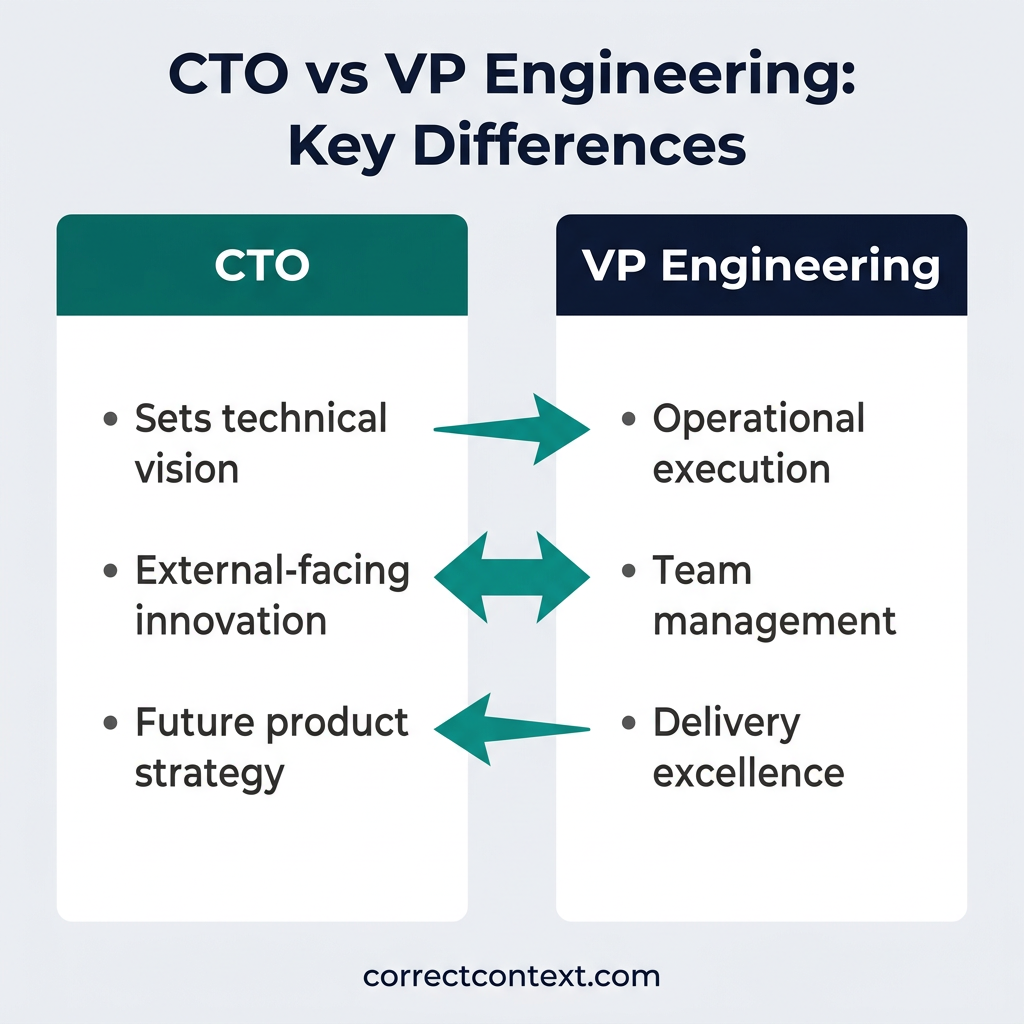
As organizations scale, the CTO role often splits into two distinct positions: the CTO focused on external-facing innovation and technical vision, and the VP of Engineering focused on operational excellence and team execution. Understanding how to structure this partnership is critical for scaling engineering organizations.
| Dimension | CTO | VP of Engineering |
|---|---|---|
| Primary Focus | Technical vision and innovation | Operational execution and delivery |
| Time Horizon | 2-5 years (future products) | 0-12 months (current products) |
| External Activities | Industry speaking, partnerships, board presentations | Recruiting, vendor management |
| Team Interaction | Architecture reviews, innovation workshops | 1:1s, performance reviews, sprint planning |
| Success Metrics | Technical differentiation, platform capabilities | Delivery velocity, team health, quality metrics |
This division of responsibilities allows each leader to focus on their strengths while maintaining alignment through shared goals and regular communication. The CTO sets the technical direction; the VP of Engineering ensures the team can execute against that direction.
When to Hire a VP of Engineering
Most startups begin with a CTO who handles both strategic and operational responsibilities. The transition to separate roles typically occurs when:
- Engineering team exceeds 25-30 people
- The CTO is spending more time on management than technical strategy
- Delivery predictability becomes a concern
- The company needs to scale hiring rapidly
Hiring a VP of Engineering is often the CTO’s most important hiring decision. This person becomes their partner in building the engineering organization and their proxy for day-to-day operational decisions.
Making the Partnership Work
The CTO-VP Engineering relationship can be incredibly powerful when structured well, or a source of constant friction when boundaries are unclear. Successful partnerships share these characteristics:
Clear Decision Rights: Document who owns which decisions to avoid constant negotiation. Typically, the CTO owns technical vision, architecture standards, and technology choices. The VP Engineering owns hiring decisions, team structure, performance management, and delivery processes. Both should input on decisions that cross boundaries, but ownership should be clear.
Shared Goals: Both leaders should be measured on the same outcomes — business results, not just functional metrics. When the CTO and VP Engineering are jointly accountable for product delivery, quality, and team health, alignment follows naturally.
Regular Communication: Weekly 1:1s between CTO and VP Engineering are essential for maintaining alignment. These shouldn’t be status updates — they should be strategic discussions about challenges, priorities, and organizational health. Monthly business reviews with shared dashboards ensure both leaders have the same visibility into performance.
Complementary Skills: The best CTO-VP Engineering pairs have complementary strengths. If the CTO is visionary but disorganized, the VP Engineering should bring operational rigor. If the CTO is deeply technical but struggles with communication, the VP Engineering should excel at stakeholder management. The combination should be stronger than either individual.
The Poland and CEE Advantage for CTOs
For CTOs building engineering teams, Poland and the broader CEE region offer distinct advantages that can address many of the challenges outlined above. The region has quietly become the talent backbone of global tech operations, with major players like Microsoft, Google, Amazon, and Visa establishing significant R&D centers across Poland, Czech Republic, Romania, and beyond.
Why CEE Tech Talent Stands Out
The CEE region’s engineering strength isn’t accidental — it’s the product of decades of STEM-focused education and a post-2010 tech ecosystem boom. Poland alone graduates over 15,000 computer science students annually. Ukraine’s technical universities have produced engineers now leading teams at Meta, Grammarly, and GitLab. Romania’s mathematics and computer science tradition dates back to the communist era, creating a deep bench of algorithmic thinkers.
Three structural factors define CEE’s competitive position:
Educational Foundation: The region’s education systems emphasize mathematics, physics, and computer science from an early age. Polish high school students consistently rank in the top 10 globally in mathematics competitions. This foundation produces engineers with strong fundamentals who can adapt to new technologies quickly.
English Proficiency: English is widely spoken among tech professionals, with Poland ranking in the top 15 globally for English proficiency among non-native speakers. This eliminates the communication barriers that often complicate offshore development relationships.
Cultural Alignment: CEE engineers typically work in Western-style business environments, with experience at global companies and familiarity with agile methodologies, product thinking, and direct communication styles. This cultural alignment reduces the friction that can plague offshore partnerships.
| Factor | Poland/CEE | Western Europe/US |
|---|---|---|
| Computer Science Graduates (Annual) | 15,000+ (Poland alone) | Limited pipeline |
| Average Senior Developer Salary | €60,000-€90,000 | €120,000-€180,000 |
| Time-to-Hire (Experienced) | 2-6 weeks | 8-16 weeks |
| English Proficiency | High (top 10 globally) | Native |
| Cultural Alignment | Strong Western business practices | Varies |
| Time Zone | GMT+1/GMT+2 (EU overlap) | GMT-8 to GMT+1 |
These advantages make Poland and CEE particularly attractive for CTOs facing talent shortages and budget constraints. Companies like Microsoft, Google, Amazon, and Visa have established major R&D centers in the region, validating the quality of the talent pool.
A Framework for CTO Success in 2026
Given the challenges outlined above, what should CTOs prioritize? Here’s a practical framework:
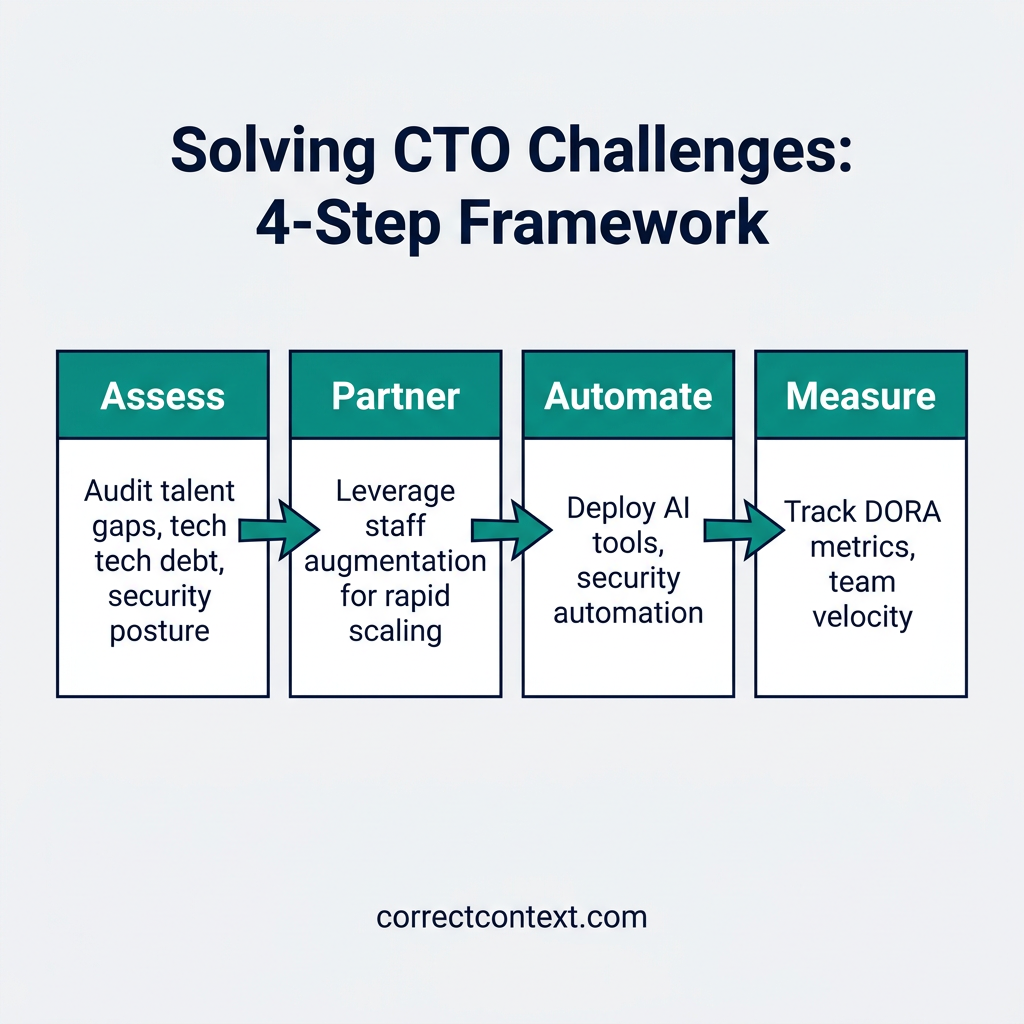
Step 1: Assess Your Current State
Before making strategic investments, understand where you stand:
- Conduct a talent gap analysis against your 12-month roadmap
- Audit your technical debt and quantify its impact
- Assess your security posture and compliance readiness
- Evaluate your AI readiness across data, infrastructure, and skills
Step 2: Build Strategic Partnerships
No CTO can solve every challenge internally. Strategic partnerships extend your capabilities:
- Staff augmentation for specialized skills and rapid scaling
- Managed security services for 24/7 threat monitoring
- Cloud partners for infrastructure modernization
- AI vendors with proven enterprise deployment experience
Step 3: Automate Relentlessly
Automation is the force multiplier that lets lean teams punch above their weight:
- CI/CD pipelines that eliminate manual deployment steps
- Infrastructure as Code for consistent environment management
- Security scanning integrated into the development workflow
- AI-assisted development tools that accelerate delivery
Step 4: Measure What Matters
CTOs need visibility into engineering performance. The DORA metrics (Deployment Frequency, Lead Time for Changes, Change Failure Rate, Time to Recovery) provide a proven framework for measuring software delivery performance. Supplement these with:
- Team health and retention metrics
- Technical debt indicators
- Security incident rates
- AI adoption and ROI measures
Key Takeaways
- Talent shortages are structural, not cyclical. With only 16% of executives satisfied with their tech talent, competition will intensify. CTOs need multi-pronged strategies combining upskilling, strategic partnerships, and distributed teams.
- Cybersecurity is a board-level concern. With 74% of CTOs reporting increased threat sophistication, security investment is non-negotiable. Zero trust architecture and security automation are baseline requirements.
- The AI readiness gap is real. Despite massive investment, 86% of organizations aren’t ready for AI adoption. Success requires equal investment in people and process change, not just technology.
- Technical debt is a business risk. With 93% of teams experiencing technical debt, CTOs must make visible its impact on velocity and cost. Allocate 15-25% of capacity to continuous debt reduction.
- The CTO-VP Engineering partnership is critical for scale. As teams grow beyond 25-30 engineers, separating strategic and operational leadership becomes essential for effectiveness.
- Poland and CEE offer a talent advantage. For CTOs facing talent shortages, the region provides deep technical expertise at competitive costs with strong cultural alignment to Western business practices.
Frequently Asked Questions
What is the difference between a CTO and a VP of Engineering?
The CTO focuses on external-facing innovation, technical vision, and future product strategy. The VP of Engineering focuses on operational execution, team management, and delivery excellence. In early-stage companies, one person often fills both roles. As organizations scale beyond 25-30 engineers, separating these responsibilities allows each leader to focus on their strengths.
How can CTOs address AI talent shortages?
CTOs should pursue three strategies: (1) upskill existing engineers through structured training programs, (2) engage staff augmentation partners for specialized AI/ML project needs, and (3) build distributed teams that can access talent beyond local markets. Given that AI job postings increased nearly 1000% from 2023-2024, competing for full-time hires alone is unsustainable for most organizations.
What percentage of engineering capacity should be allocated to technical debt?
Industry best practice suggests allocating 15-25% of engineering sprint capacity to technical debt reduction. This ensures continuous platform health improvement without stopping feature development entirely. The exact percentage should be based on a quantified assessment of debt impact on velocity and risk.
How are CTOs in Poland and CEE addressing cybersecurity challenges?
CTOs in the region are implementing zero trust architecture, integrating security into DevOps workflows (DevSecOps), and leveraging managed security services for 24/7 monitoring. The EU’s strong regulatory framework (GDPR, NIS2) has created a security-conscious culture, and many Polish engineers have experience working with global enterprises that demand high security standards.
What is the biggest mistake CTOs make with AI adoption?
The most common mistake is treating AI as a technology implementation rather than a business transformation. Success requires equal investment in change management, training, and process redesign — not just tools. With companies spending 93% of AI budgets on technology and only 7% on people, it’s no surprise that only 5.5% are seeing real financial returns.
Sources
- Deloitte — Global Technology Leadership Survey 2025 (2025)
- McKinsey — Top Technology Trends 2026 (2026)
- McKinsey — State of Organizations 2026 (2026)
- McKinsey — State of AI Global Survey 2025 (2025)
- Foundry — State of the CIO Survey 2025 (2025)
- Gartner — Top Strategic Technology Trends for 2026 (2025)
- IT Convergence — Managing Technical Debt in 2025 (2025)
- Codelevate — CTO Survey: Main Pain Points and Issues in 2026 (2026)
- World Economic Forum — Global Cybersecurity Outlook 2026 (2026)
- CIO Magazine — 7 Challenges IT Leaders Will Face in 2026 (2025)
Table of content
- The Evolving Role of the CTO: From Technical Lead to Strategic Executive
- Challenge 1: Talent Shortages and the Engineering Skills Gap
- Challenge 2: Cybersecurity Threats and Data Privacy Complexity
- Challenge 3: AI Adoption and the Readiness Gap
- Challenge 4: Technical Debt and Legacy System Burden
- Challenge 5: The CTO-VP Engineering Partnership
- The Poland and CEE Advantage for CTOs
- A Framework for CTO Success in 2026
- Key Takeaways
- Frequently Asked Questions
- What is the difference between a CTO and a VP of Engineering?
- How can CTOs address AI talent shortages?
- What percentage of engineering capacity should be allocated to technical debt?
- How are CTOs in Poland and CEE addressing cybersecurity challenges?
- What is the biggest mistake CTOs make with AI adoption?
- Sources
Related articles


About the Author: Duke Vu