
The mandate for technology executives today is clear: scale fast and ship faster. However, the path to building large-scale engineering organizations is fraught with operational challenges. For enterprise CTOs and COOs, the fear that large-scale European teams are hard to manage is a significant barrier to expansion. As the competition for top-tier talent intensifies, many leaders are questioning whether Europe—and specifically tech hubs like Poland—can support stable, high-performing teams of 100 or more engineers.
The reality is that scaling engineering teams in Europe is not only possible but increasingly necessary. With the right strategy, enterprises and Series A+ startups can build resilient, distributed organizations that drive innovation without succumbing to operational breakdowns. This article explores the dynamics of scaling engineering globally, the realities of the European tech landscape, and the proven models for successfully managing large distributed teams.
The Imperative to Scale Engineering Globally
The global demand for software engineering talent continues to outpace supply, creating a critical bottleneck for technology-driven enterprises. According to recent forecasts, IT spending in Europe is projected to reach $1.4 trillion by 2026, an 11.1% increase driven heavily by investments in AI, cloud infrastructure, and cybersecurity [1]. This surge in investment is exacerbating the existing talent shortage.
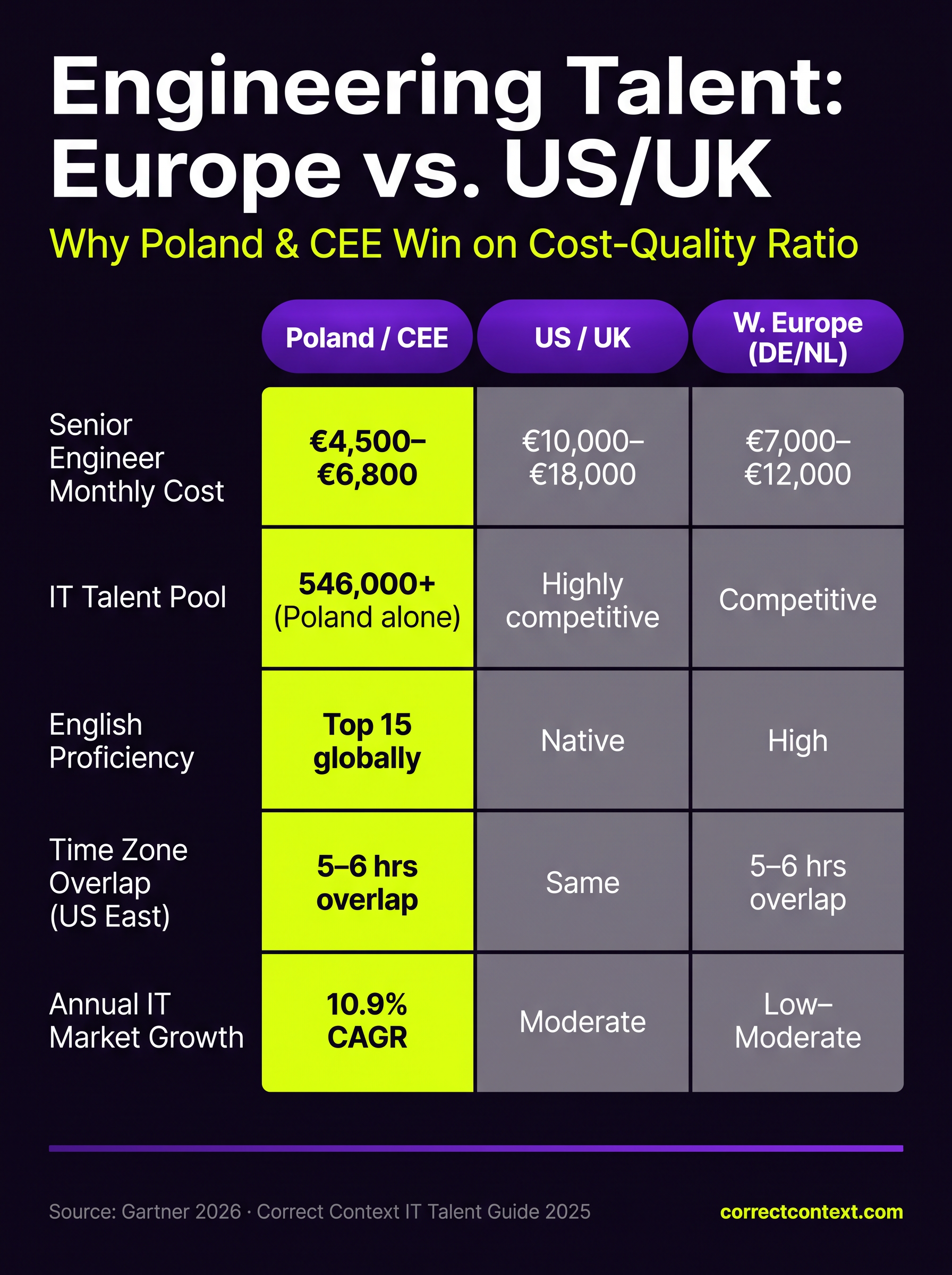
For enterprise innovation units and globally scaling startups, relying solely on local talent pools in high-cost regions like the US East Coast, UK, DACH, or Nordics is no longer viable. The prolonged time-to-hire and the intense competition for specialized skills—such as an AI development team, machine learning engineers team, or a cloud engineering team—force companies to look outward.
Building an engineering hub in Europe has emerged as a strategic imperative. Central and Eastern Europe (CEE), particularly Poland, offers a compelling solution. With a massive talent pool of over 546,000 IT professionals and a strong emphasis on STEM education, Poland provides the scale and expertise required to build a dedicated software team [2].
Overcoming the Fear of Scale
The primary concern for executives nearing a final decision on European expansion is the fear of operational breakdown. When a team scales from 20 to 100+ engineers, the communication overhead increases exponentially. Conway’s Law states that organizations design systems that mirror their communication structures. If the communication structure of a distributed team is chaotic, the resulting software architecture will be equally disjointed.
However, the failure of large distributed teams is rarely a failure of the talent; it is a failure of the organizational model. Companies that struggle to scale often attempt to apply small-team processes to large-scale operations or treat their European hub as a mere offshore execution center rather than an integrated part of the core engineering organization.
The Myth of the Unmanageable Distributed Team
The notion that large, distributed teams cannot maintain high velocity and quality is a misconception. In fact, McKinsey’s research on technology trends highlights that successful companies are those that master the integration of distributed talent and advanced technologies [3].
When structured correctly, an extended engineering team in Europe can operate with the same, if not greater, efficiency as a co-located team. The key is to implement robust frameworks that empower local autonomy while maintaining global alignment.
Proven Models for Scaling to 100+ Engineers
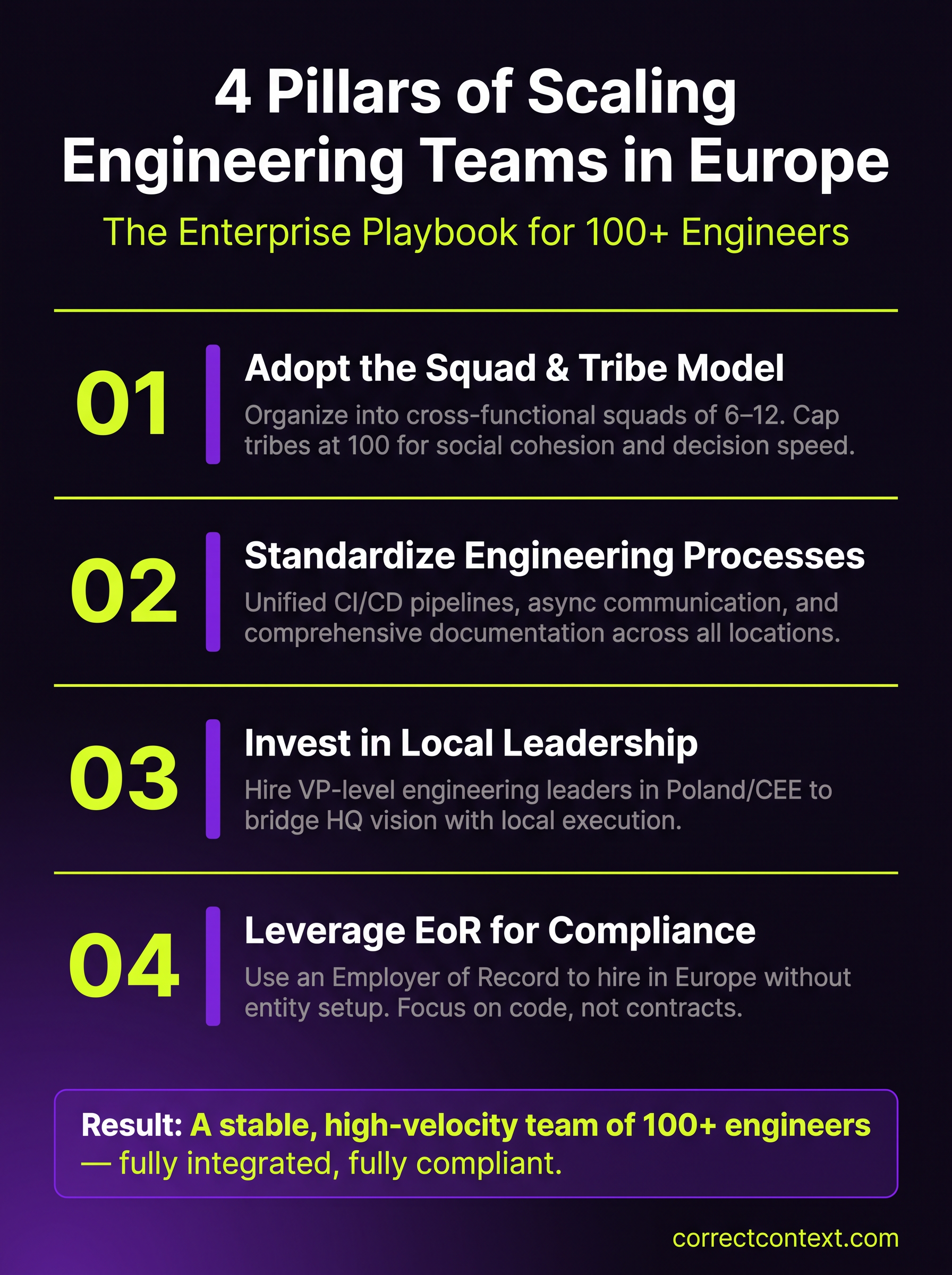
Successfully managing a large engineering organization requires a deliberate approach to team structure, communication, and culture. Here are the critical strategies for scaling engineering teams in Europe.
1. Adopt the Squad and Tribe Model
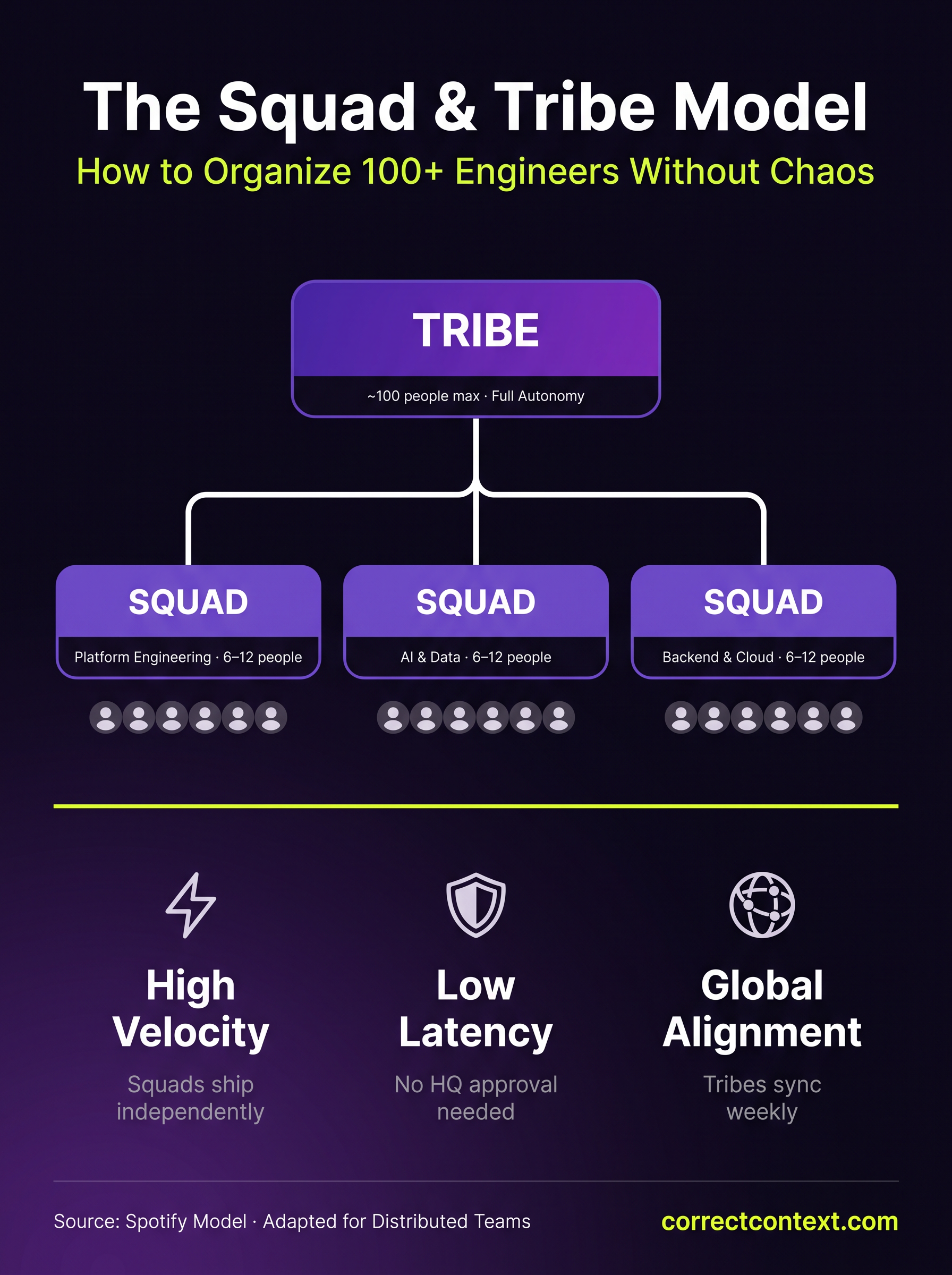
As engineering organizations grow beyond 50 people, traditional hierarchical structures become bottlenecks. To maintain agility, many successful enterprises adopt variations of the “Spotify Model.” This approach organizes engineers into small, cross-functional “Squads” (typically 6-12 people) that have end-to-end ownership of a specific product feature or domain.
Multiple Squads working on related areas form a “Tribe,” which is capped at around 100 people to maintain a cohesive social dynamic. This structure allows a remote development team in Poland to operate with high autonomy. Instead of waiting for top-down directives from the US or UK, the Tribe has the authority to make technical decisions and drive delivery, significantly reducing communication latency.
2. Standardize Engineering Processes
When scaling to 100+ engineers, ad-hoc processes are a recipe for disaster. Standardization is the bedrock of stability. This includes:
- Unified CI/CD Pipelines: Ensure that code deployment is automated and consistent across all locations.
- Comprehensive Documentation: Shift from a culture of oral tradition to written documentation. A remote software engineers team must have access to the same context and architectural guidelines as the core team.
- Asynchronous Communication: Minimize the reliance on synchronous meetings, which are difficult to coordinate across time zones. Embrace asynchronous tools and practices to keep the team aligned without constant interruption.
3. Invest in Local Leadership
A common mistake is attempting to manage a 100-person European hub entirely from headquarters. This approach invariably leads to bottlenecks and a sense of disenfranchisement among the remote team.
To succeed, companies must hire strong local engineering leaders—Directors of Engineering or VP-level executives—who understand the local culture and can translate the global vision into actionable local strategies. These leaders act as the bridge between the core organization and the engineering team in Poland / CEE, ensuring that the hub operates as a true partner rather than a subordinate entity.
4. Leverage Strategic Partners for Compliance and Operations
Scaling rapidly in a new geography involves significant administrative and legal complexities. Navigating local labor laws, payroll, and tax regulations can distract leadership from their core focus: building software.
This is where leveraging an Employer of Record (EoR) becomes a strategic advantage. Utilizing an employer of record Poland or EoR Europe allows enterprises to hire employees without entity setup. The EoR partner handles all local compliance, payroll services Poland, and HR administration. This enables companies to scale their tech hub Poland quickly and compliantly, focusing entirely on integrating the new engineers into their development lifecycle.
The Strategic Value of the European Tech Hub
When executed correctly, a European tech hub provides far more than just cost arbitrage. It delivers strategic value that accelerates the overall business.
Access to Specialized AI and Data Talent
As AI becomes central to enterprise strategy, the demand for specialized talent is skyrocketing. Gartner predicts that end-user spending on GenAI models in Europe will grow 78.2% in 2026 [1]. Building an AI development team or a big data development team in Europe provides access to highly educated specialists who can drive corporate AI use and implement AI trends enterprise solutions.
Increased Delivery Velocity
A well-structured extended engineering team operates as a force multiplier. By distributing the workload across time zones, companies can achieve a “follow-the-sun” development cycle, increasing the overall velocity of product delivery.
Enhanced Resilience
Relying on a single geographic location for engineering talent creates a single point of failure. A distributed model enhances organizational resilience, ensuring that development can continue even if one region faces disruptions.
Conclusion
The fear that large-scale European teams are hard to manage is rooted in outdated paradigms of offshore development. Today, scaling engineering teams in Europe is a proven strategy for enterprises and Series A+ startups that need to accelerate delivery and access top-tier talent.
By adopting scalable team structures, standardizing processes, investing in local leadership, and leveraging strategic partners for employment compliance Europe, companies can successfully scale to 100+ engineers. Poland and the broader CEE region stand ready to provide the dedicated development team needed to turn ambitious product roadmaps into reality. The decision is no longer whether Europe can support large teams, but how quickly you can integrate them into your global engineering strategy.
References
[1] Gartner. Gartner Forecasts IT Spending in Europe to Grow 11% in 2026
[2] Correct Context. When to Build a European Tech Hub | Guide
[3] McKinsey & Company. McKinsey technology trends outlook 2025
Table of content
Related articles



About the Author: Marta