
The great remote work experiment of the early 2020s succeeded in proving that software development can happen anywhere. However, as enterprise innovation units and rapidly scaling Series A+ startups transition from emergency remote measures to permanent, distributed engineering hubs, a critical realization has emerged: shipping a laptop to a developer is not an operational strategy. It is merely the beginning of a complex logistical challenge.
Companies today struggle profoundly with the logistics of setting up remote engineers. From securing enterprise-grade IT infrastructure to managing compliance, payroll, and physical equipment across borders, the operational overhead of a remote development team can quickly erode the productivity gains it was meant to deliver. For operations and HR leaders tasked with supporting a new remote team, the fear of logistical nightmares is entirely justified.
This article explores the critical operational backbone required to build a productive remote engineering team. It provides a comprehensive framework to help enterprise leaders decide whether to handle remote engineering team logistics in-house or partner with a specialized local operational provider—particularly when building an engineering hub in Europe or Poland.
The True Cost of Remote Engineering Team Logistics
When evaluating the cost of an offshore development team or a nearshore development team, companies often focus solely on salary arbitrage. While a senior software engineer in Poland typically costs between €4,500 and €6,800 per month—significantly less than their US or UK counterparts [1]—the total cost of ownership (TCO) must account for operational logistics.
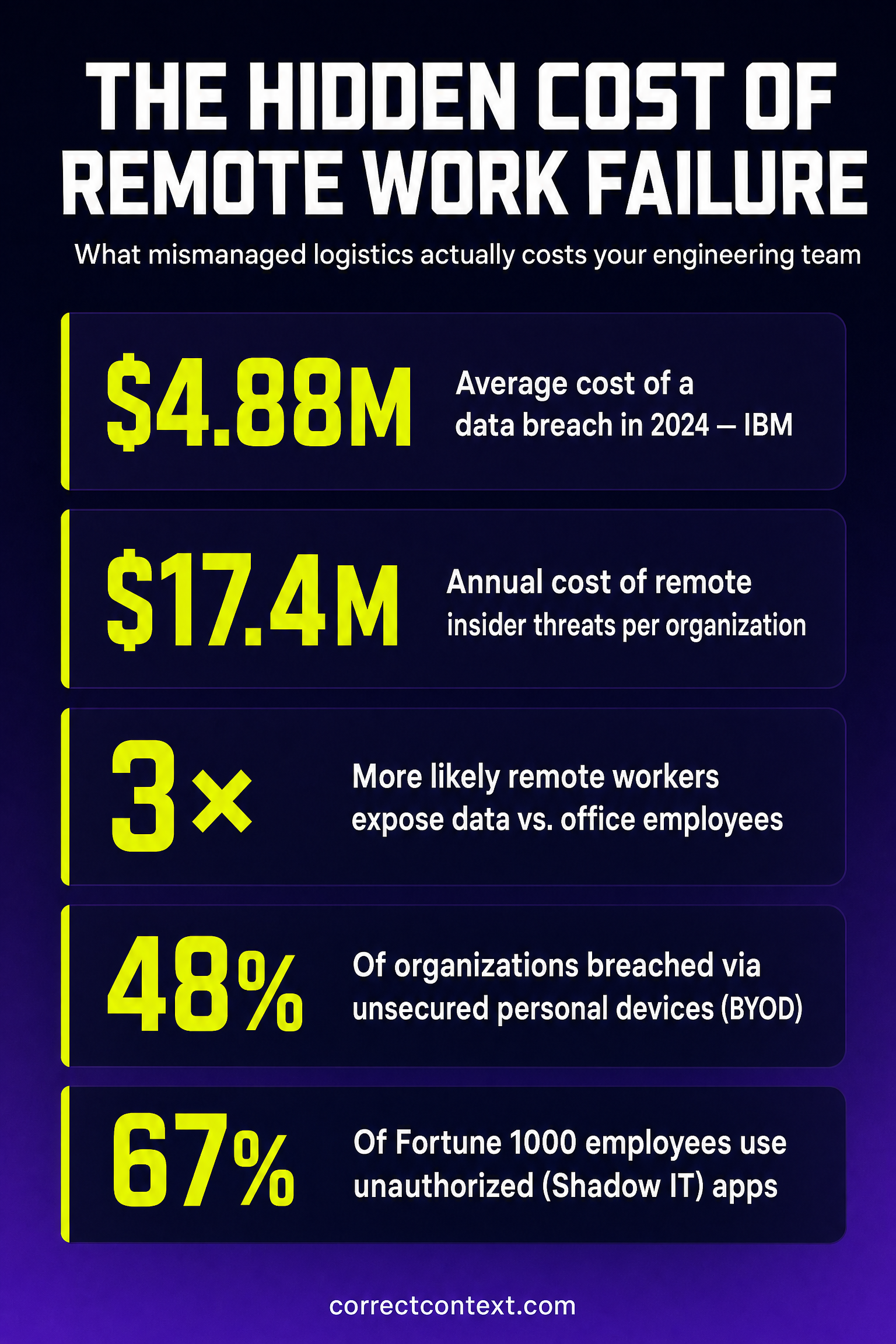
The financial impact of mismanaging these logistics is staggering. According to IBM, the global average cost of a data breach reached $4.88 million in 2024, with insider threats and remote work vulnerabilities acting as significant multipliers [2]. Remote workers are three times more likely to accidentally expose data than office employees, and incidents linked to remote work cost an average of $17.4 million annually per organization [3].
Furthermore, the invisible costs of poor operational setup directly impact engineering productivity. Research indicates that 58% of engineering teams lose more than five hours per developer weekly to invisible costs—such as managing provisioning issues, dealing with subpar equipment, or navigating complex access protocols. When developers spend their time acting as their own IT support rather than coding, the ROI of a remote software engineers team plummets.
The Four Pillars of Remote IT Infrastructure
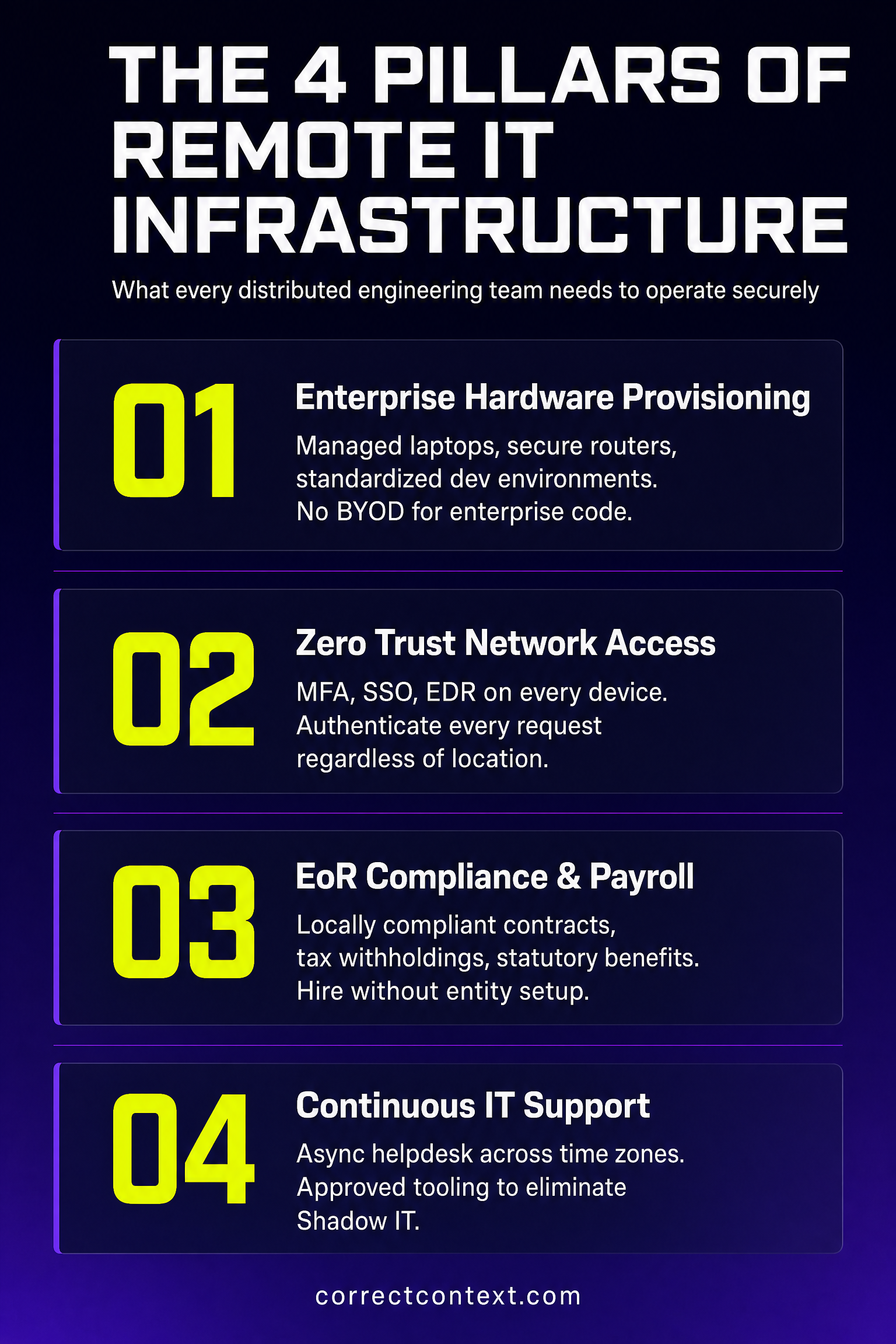
To build a high-performing remote development team, operations leaders must establish a robust framework across four critical pillars: hardware provisioning, secure network access, compliance and payroll, and continuous IT support.
1. Enterprise-Grade Hardware Provisioning
The days of allowing engineers to use personal devices for enterprise software development are over. Bring Your Own Device (BYOD) policies have proven disastrous for corporate security. In 2024, 48% of organizations suffered data breaches linked to unsecured personal devices, despite 95% of companies allowing their use for work [3].
When setting up remote developers, companies must provision enterprise-grade hardware. This goes beyond a high-performance laptop. A dedicated software team requires a secure, managed router to bypass vulnerable home networks (where over 50% of IoT devices have critical vulnerabilities [3]), an ergonomic workstation setup to ensure long-term physical health and productivity, and a standardized development environment pre-configured with necessary IDEs, containerization tools, and security agents.
Managing this hardware lifecycle across international borders—including procurement, customs clearance, deployment, and eventual secure decommissioning—is a logistical labyrinth that many HR departments are ill-equipped to handle.
2. Zero Trust Network Access and Endpoint Security
The traditional corporate perimeter no longer exists. With 32.6 million Americans projected to work remotely by 2025 [4], and countless more globally, security must shift from the network to the endpoint and the identity.
Gartner predicts that by 2025, 45% of global organizations will have faced attacks on their software supply chains [5]. To protect intellectual property and customer data, remote engineering hubs must implement Zero Trust Network Access (ZTNA). This ensures that every access request is authenticated and authorized, regardless of the user’s location.
Key security measures for an extended engineering team include mandatory Multi-Factor Authentication (MFA) and Single Sign-On (SSO), Endpoint Detection and Response (EDR) software installed on all provisioned devices, strict Data Loss Prevention (DLP) policies to prevent unauthorized code exfiltration, and regular, automated patching and vulnerability management.
3. Compliance, Payroll, and the Employer of Record
One of the most complex aspects of hiring a remote engineering team in Poland / CEE or elsewhere in Europe is navigating local labor laws and tax regulations. Deloitte’s Global Remote Work Survey highlights that almost 80% of organizations allow some form of remote work, yet many struggle to operationalize policies without exposing the business to tax compliance and legal risks [6].
If an enterprise hires developers directly without establishing a local legal entity, they risk severe penalties for permanent establishment and misclassification. This is where an Employer of Record (EoR) becomes invaluable.
An employer of record Poland or EoR Europe allows companies to hire employees without entity setup. The EoR handles locally compliant employment contracts, accurate payroll services Poland including tax withholdings and social security contributions, and administration of statutory benefits, healthcare, and paid time off. By utilizing an EoR CEE, companies can rapidly scale software development capabilities while completely offloading the compliance burden.
4. Continuous IT Support and Shadow IT Mitigation
When remote engineers encounter technical issues, they cannot simply walk over to the IT helpdesk. If official support is slow or cumbersome, developers will inevitably find workarounds. This leads to the proliferation of Shadow IT.
Statistics reveal that 67% of Fortune 1000 employees use unauthorized applications, and the average company has 975 unknown cloud services operating outside of IT visibility [3]. This Shadow IT bypasses established security controls, creating massive vulnerabilities.
To mitigate this, operations leaders must provide rapid, asynchronous IT support tailored to the time zones of their distributed teams. Furthermore, providing seamless, secure access to approved cloud engineering team tools and AI enterprise tools is essential to prevent developers from seeking unsanctioned alternatives.
Deciding Your Operational Strategy: In-House vs. Local Partner
For operations and HR leaders, the core decision is whether to build the operational backbone for a remote development team in-house or leverage a specialized local partner.
The In-House Approach
Handling remote engineering team logistics in-house requires establishing internal capabilities for international procurement, cross-border IT support, and global legal compliance.
Pros: Absolute control over all processes and hardware; direct integration with existing corporate IT systems.
Cons: Massive upfront investment in legal and tax consultations; significant distraction for existing HR and IT teams; slow time-to-market when building a tech hub Poland or elsewhere.
This approach is generally only viable for massive Fortune 500 enterprises planning to hire hundreds of engineers in a single location over a multi-year timeline, justifying the creation of their own legal entity.
The Local Operational Partner Approach
For Series A+ startups and enterprise innovation units needing to scale engineering teams quickly, partnering with a local operational provider—such as an EoR or managed team provider—is often the superior strategy.
Pros: Speed (a dedicated development team can be operational in weeks, not months); risk mitigation (the partner assumes the legal and compliance risks of employment compliance Europe); logistical simplicity (the partner handles all hardware procurement, office management, and local IT support); and focus (internal leadership can concentrate entirely on product strategy and engineering execution).
Cons: Requires a trusted partnership and clear Service Level Agreements (SLAs); slightly higher ongoing operational fee compared to a fully mature, scaled in-house operation.
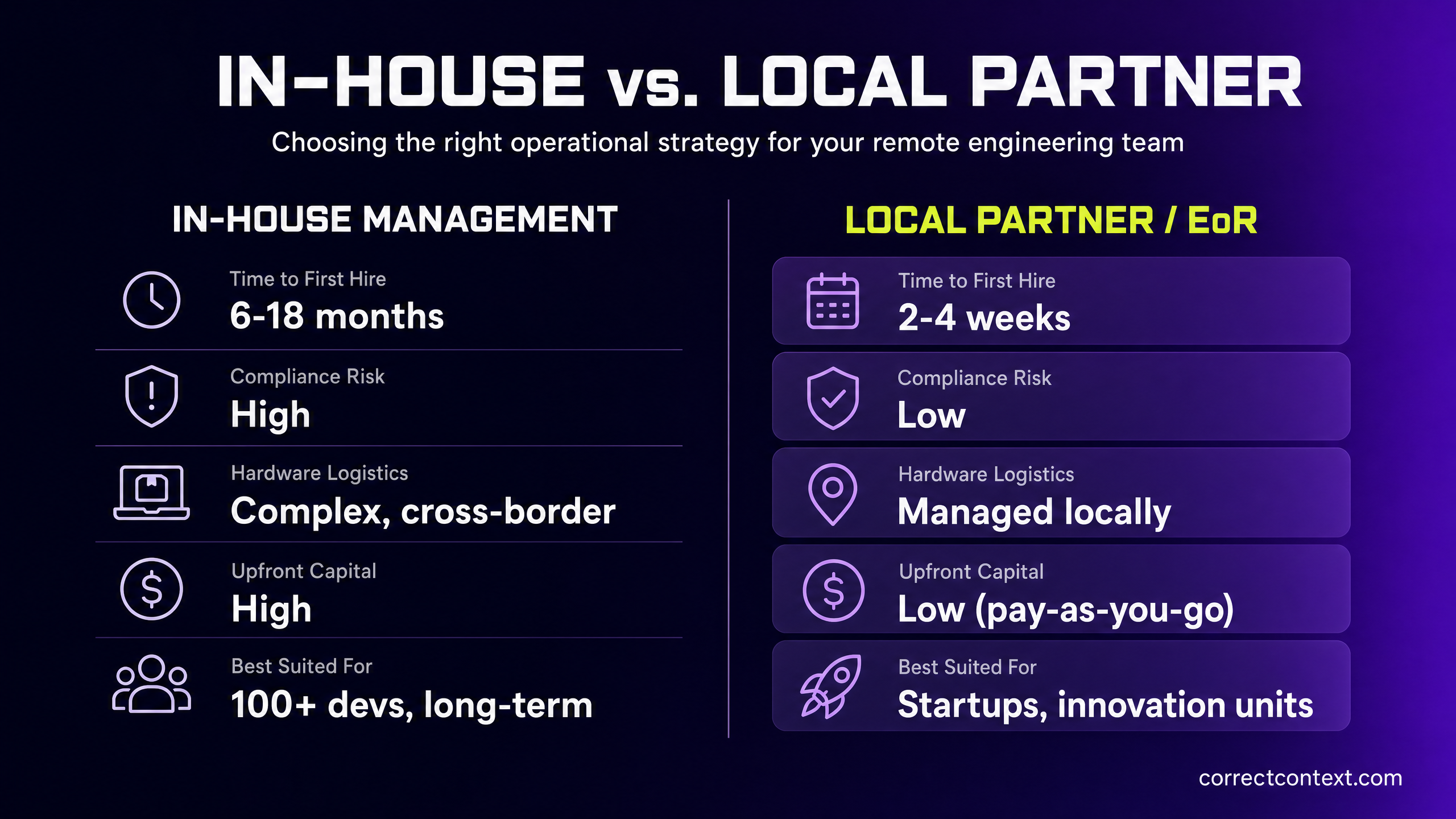
| Operational Factor | In-House Management | Local Partner / EoR |
|---|---|---|
| Time to First Hire | 6–18 months (entity setup) | 2–4 weeks |
| Compliance Risk | High (borne by enterprise) | Low (absorbed by partner) |
| Hardware Logistics | Complex, cross-border shipping | Managed locally by partner |
| Upfront Capital | High (legal, infrastructure) | Low (pay-as-you-go model) |
| Best Suited For | Massive, long-term hub (100+ devs) | Rapid scaling, startups, innovation units |
Maximizing the ROI of Your Engineering Hub
When building a tech hub Poland or an engineering hub Europe, the goal is not just to hire developers for a startup or enterprise; it is to integrate them seamlessly into the global engineering culture.
McKinsey’s research on developer productivity emphasizes that maximizing the amount of time developers spend in the “inner loop”—coding, building, and unit testing—is crucial [7]. Outer-loop activities, such as dealing with infrastructure provisioning or navigating complex administrative tasks, drain productivity and morale.
By investing in a robust operational backbone—whether through sophisticated internal systems or a trusted local partner—companies ensure their remote software engineers team remains focused on the inner loop. This translates directly to faster time-to-market, higher code quality, and a stronger competitive advantage.
Conclusion
The success of a remote engineering team hinges on logistics as much as it does on coding ability. Equipping an AI development team, a data analytics team, or a cloud engineering team requires a comprehensive strategy encompassing secure hardware, Zero Trust access, rigorous compliance, and dedicated support.
For operations leaders afraid of logistical nightmares, the path forward is clear: do not attempt to reinvent the wheel. Leverage the expertise of specialized partners who understand the nuances of the CEE market. By utilizing services like an employer of record Poland, companies can bypass the operational friction and focus on what truly matters—building exceptional software and scaling their business globally.
References
[1] Correct Context. When to Build a European Tech Hub | Guide
[2] IBM. Cost of a Data Breach Report 2026 | IBM
[3] InsideRisk. Remote Work’s Dark Secret: Why 70% of Companies Fear Their Own Hybrid Employees
[4] Forbes Advisor. Top Remote Work Statistics And Trends – Forbes Advisor
[5] Gartner. Gartner Identifies Top Security and Risk Management Trends for 2022.
[6] Deloitte. Operationalize remote work: Five steps to manage tax and business risks
[7] McKinsey & Company. Yes, you can measure software developer productivity