
For enterprise HR and finance leaders steering innovation units or scaling globally, Poland has emerged as a premier destination for tech talent. However, the administrative complexity of running payroll in Poland can be a significant hurdle. Navigating the nuances of Poland payroll taxes, mandatory employee benefits in Poland, and local compliance requires a deep understanding of the regulatory landscape — and getting it wrong can be costly. This guide is designed to help you decide whether you need local operational support to manage payroll in Poland for developers effectively.
The Tech Talent Landscape in Poland
Poland boasts one of the most highly skilled and educated workforces in Europe, particularly in IT and engineering. The country has become a magnet for Enterprise innovation and data units, Fortune 5000 companies, and Series A+ Startups — especially those in the FinTech, Software, and Media sectors located in the East Coast US, UK, DACH, and Nordics.
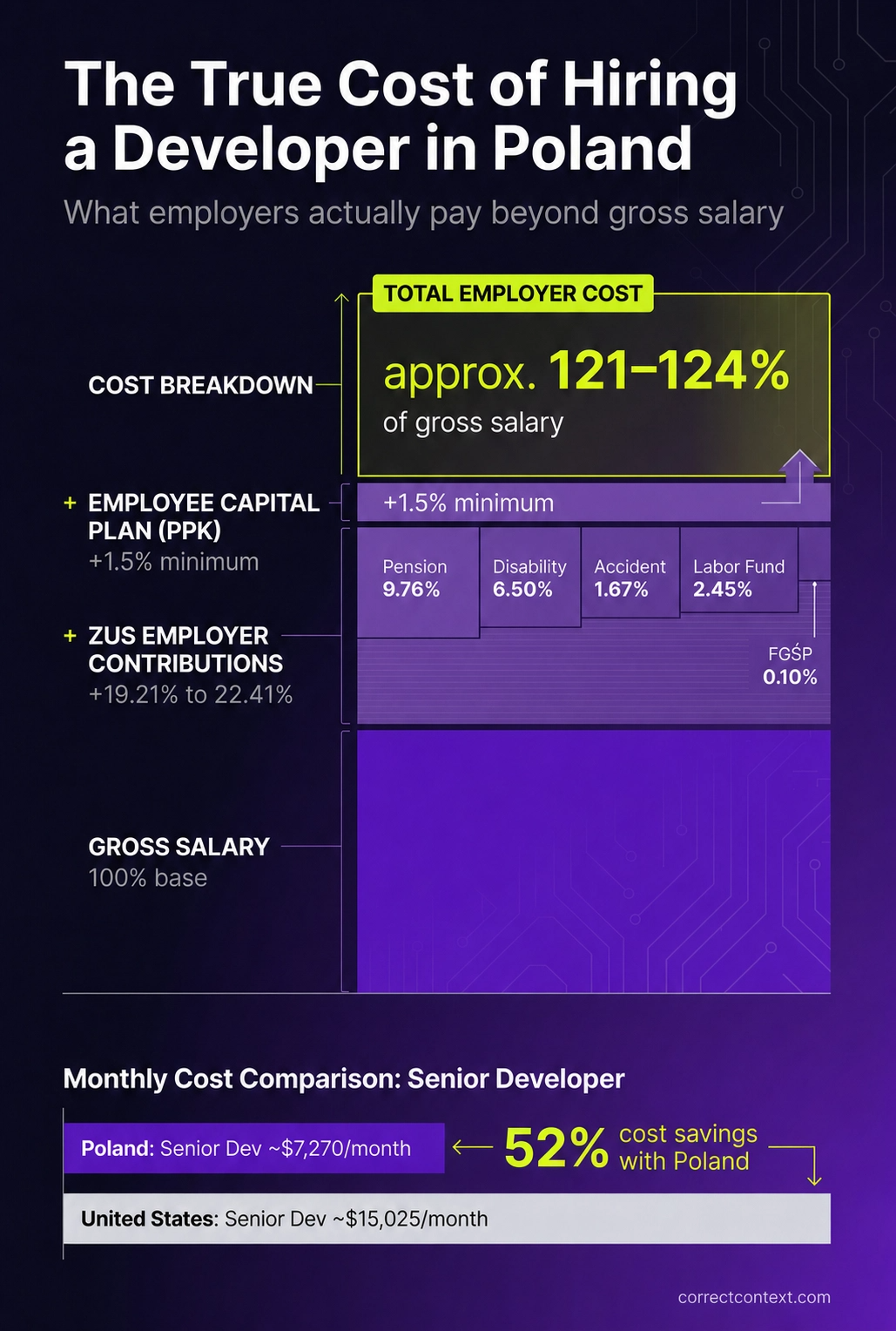
The cost advantages are compelling. Hiring developers in Poland can yield significant savings: senior tech talent in Poland costs around $7,270 per month compared to $15,025 per month in the US, representing roughly a 52% salary reduction [1]. However, these savings can quickly erode if compliance risks and payroll complexities are not managed properly. The total employer cost of a Polish employee is not just the gross salary — it includes a stack of mandatory social contributions, benefits, and administrative obligations that require dedicated expertise.
Understanding Payroll in Poland for Developers
When you hire engineers in Poland, you must adhere to a strict set of payroll regulations. The Polish payroll system is characterized by its dual-tier income tax structure and standardized social security contributions, but recent legislative changes — most notably the 2022 “Polish Deal” (Polski Ład) reforms — have significantly increased its complexity [2].
Employment Contracts: UoP vs. B2B
In Poland, tech professionals typically work under one of two primary contract types, and the choice has significant payroll implications.
The Employment Contract (Umowa o Pracę — UoP) is the standard arrangement governed by the Polish Labor Code. It provides employees with full statutory rights, including paid leave, sick pay, and protection against dismissal. Payroll services in Poland must meticulously calculate all associated taxes and contributions for UoP employees. This is the model that triggers the full range of employer obligations described in this article.
The Business-to-Business (B2B) Contract is highly popular among senior software developers in Poland. Under this arrangement, the developer registers as a sole trader and invoices the company monthly. They are responsible for their own taxes and social security contributions. While this simplifies payroll for the employer and often results in higher net income for the developer, it carries the risk of misclassification if the working relationship functionally resembles traditional employment [3]. Polish authorities can reclassify a B2B relationship as employment, triggering back-payment of all unpaid contributions and penalties.
Personal Income Tax (PIT)
Poland employs a progressive personal income tax system. As of 2025, the rates are structured as follows [2]:
| Annual Income (PLN) | Tax Rate |
|---|---|
| Up to PLN 30,000 | 0% (tax-free allowance) |
| PLN 30,001 – PLN 120,000 | 12% |
| Above PLN 120,000 | 32% |
| Above PLN 1,000,000 | 32% + 4% solidarity surcharge |
Employers are responsible for withholding PIT advances on a monthly basis and remitting them to the tax authorities by the 20th of the following month. Annual reconciliation forms — PIT-11 for employees and PIT-4R for the employer — must be filed by January 31 of the following year [4].
One notable relief: employees under the age of 26 benefit from the “PIT-0 for the young” exemption, which waives income tax on qualifying employment income up to PLN 85,528 per year [4]. This is a meaningful incentive when hiring junior engineers and recent graduates.
Social Security Contributions (ZUS)
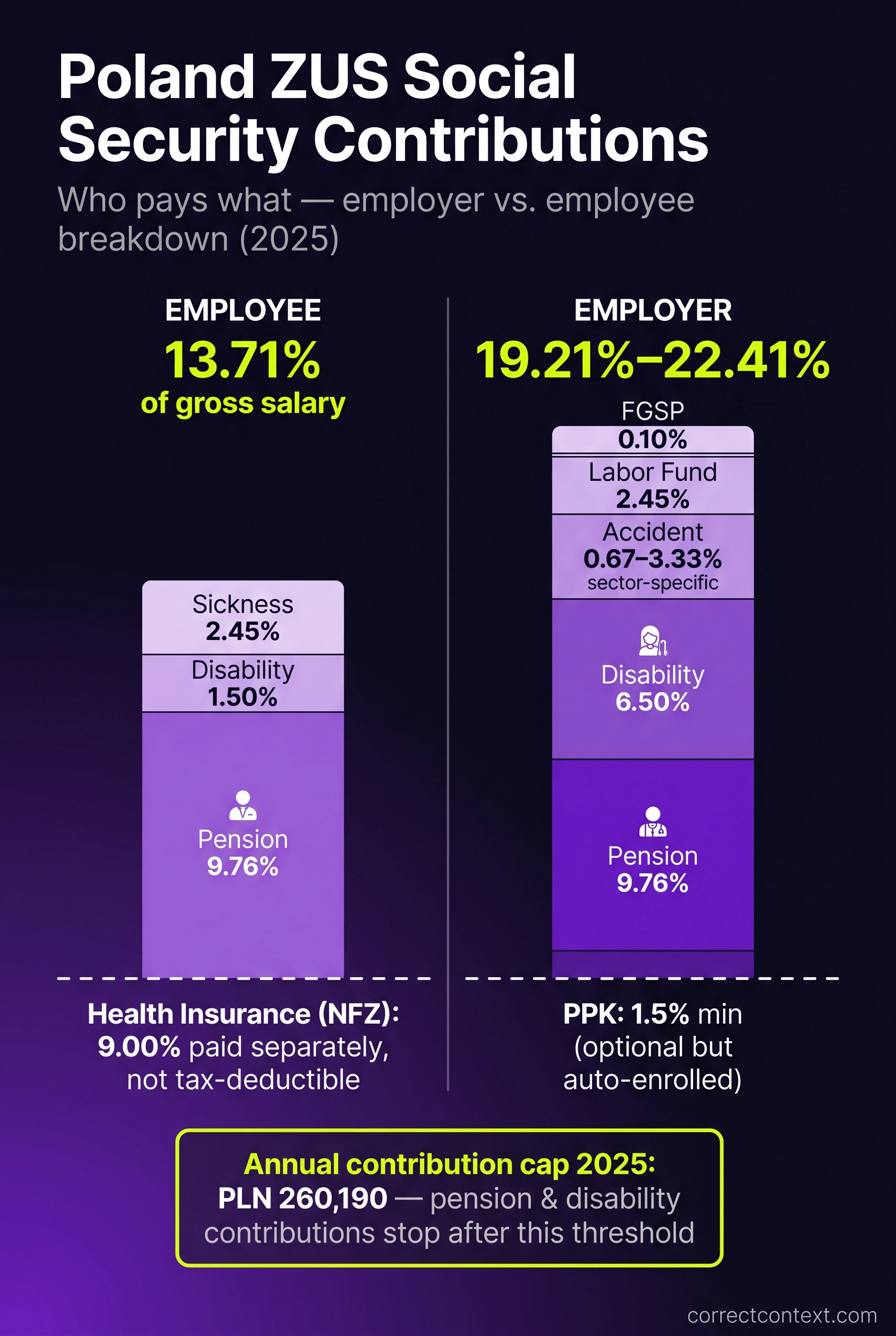
Both the employer and the employee must contribute to the Social Insurance Institution (ZUS). These contributions fund pension, disability, sickness, and accident insurance and are shared between both parties.
| Contribution Type | Employee Rate | Employer Rate |
|---|---|---|
| Pension Insurance | 9.76% | 9.76% |
| Disability Insurance | 1.50% | 6.50% |
| Sickness Insurance | 2.45% | — |
| Accident Insurance | — | 0.67% – 3.33% (sector-specific) |
| Labor Fund | — | 2.45% |
| Guaranteed Employee Benefits Fund | — | 0.10% |
| Total | 13.71% | 19.21% – 22.41% |
Source: PwC Tax Summaries, Lano, Boundless [2][4][5]
Pension and disability contributions are subject to an annual income cap — PLN 260,190 in 2025. Once an employee’s earnings exceed this threshold, these specific contributions cease for the remainder of the calendar year, though sickness contributions continue to apply [2]. Employers must actively monitor this cap, particularly for higher-earning senior engineers.
Health Insurance (NFZ)
In addition to ZUS contributions, employees must contribute 9% of their gross salary (calculated after deducting social security contributions) to the National Health Fund (NFZ). Following the 2022 Polish Deal reforms, this contribution is no longer tax-deductible — a change that effectively increased the net tax burden for most employees [2]. This contribution is withheld by the employer and remitted to ZUS, which then transfers it to the NFZ.
Employee Capital Plans (PPK)
The Employee Capital Plan (PPK — Pracownicze Plany Kapitałowe) is Poland’s mandatory workplace retirement savings scheme, introduced in 2018. Employers must automatically enroll all eligible employees aged 18 to 55, unless the employee explicitly opts out.
The scheme is funded by three parties [4]:
- Employer: Minimum 1.5% of gross salary (can be voluntarily increased to 4%).
- Employee: Minimum 2% of gross salary (can be reduced to 0.5% for lower earners).
- Polish State: A PLN 250 welcome payment plus a PLN 240 annual top-up for eligible participants.
PPK contributions are treated as a taxable benefit for PIT purposes but are excluded from the ZUS contribution base. Employees who opt out will be automatically re-enrolled during periodic national re-enrollment cycles.
Mandatory Employee Benefits in Poland
Beyond salary and taxes, employment compliance in Europe — and specifically in Poland — requires providing specific statutory benefits. These are non-negotiable and apply to all employees on UoP contracts.
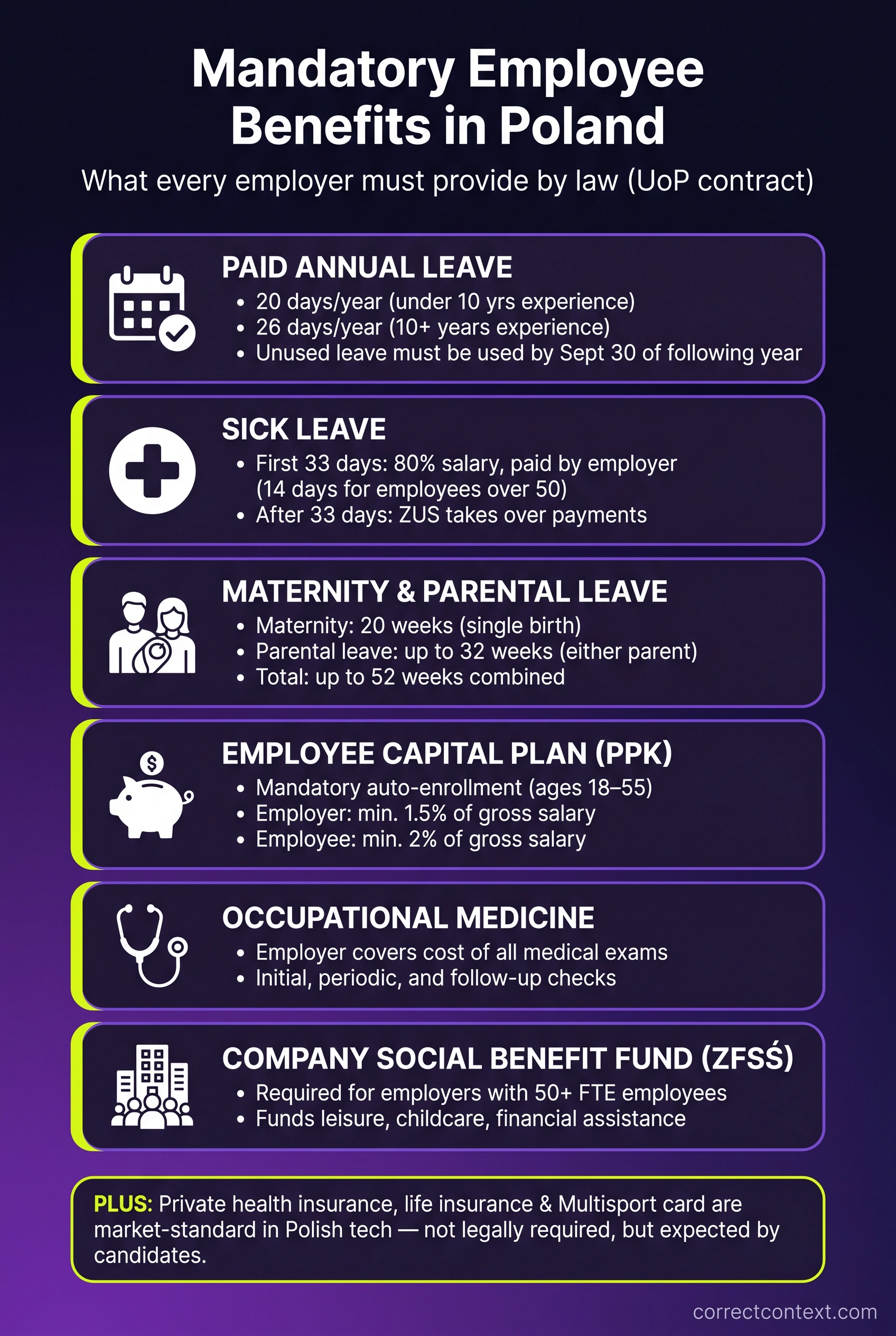
Paid Annual Leave is set at a minimum of 20 days per year for employees with less than 10 years of total employment history (including higher education). This increases to 26 days after 10 years of experience [6]. Unused leave can be carried over but must be used by September 30 of the following year.
Sick Leave is employer-funded for the first 33 days of illness in a calendar year (14 days for employees over 50), at 80% of the employee’s remuneration. After this period, ZUS takes over payment of sickness benefits [6].
Maternity and Parental Leave entitles female employees to 20 weeks of maternity leave for a single birth, extendable proportionally for multiple births. Either parent can take up to 32 weeks of additional parental leave, for a combined total of up to 52 weeks [6].
Occupational Medicine requires employers to cover the cost of initial, periodic, and follow-up medical examinations to certify that employees are fit for their specific roles. This is a mandatory employer expense.
Company Social Benefit Fund (ZFŚS) must be established by employers with at least 50 full-time equivalent employees. The fund is financed by a mandatory annual employer contribution per employee and is used to support social activities, leisure, and financial assistance for the workforce [7].
Supplemental Benefits to Attract Top Tech Talent
To successfully scale engineering teams and attract the best software developers in Poland, statutory benefits alone are rarely sufficient. The Polish IT market is competitive, and candidates — particularly senior engineers — expect a robust total compensation package.
Private Health Insurance is considered a market standard in the Polish tech sector. While public healthcare (NFZ) is available, private medical subscriptions from providers such as Luxmed or Medicover offer significantly faster access to specialists and are a near-universal expectation among IT professionals [6][7].
Life and Income Protection Insurance through group policies is another highly valued supplemental benefit. Employer-paid premiums are treated as a taxable benefit in kind but are excluded from ZUS contributions under specific conditions [7].
Flexible Working and Lifestyle Allowances — including home office stipends, gym memberships (the Multisport card is ubiquitous in Polish tech), and flexible working hours — are essential for retaining a high-performing remote development team or extended engineering team [7].
Navigating Compliance: The Administrative Reality
The administrative complexity of running payroll in Poland is substantial and ongoing. Foreign employers must register with ZUS within seven days of their first hire, manage monthly social security reporting (ZUS DRA, RCA, RSA forms), ensure accurate PIT withholding, administer PPK, and — for larger teams — contribute to PFRON (the State Fund for the Rehabilitation of Disabled Persons) [4][5].
All of these obligations come with strict deadlines. ZUS contributions are due by the 15th of the following month for entities with legal personality. PIT advances must be remitted by the 20th. PPK contributions follow the same 15th deadline. Annual filings — PIT-11 and PIT-4R — must be submitted by January 31 [4].
Failing to comply can result in financial penalties, legal disputes, and — critically — the risk of creating a permanent establishment (PE) for corporate tax purposes, which would expose the foreign parent company to Polish corporate income tax obligations [8].
The Employer of Record (EoR) Solution
For many foreign companies looking to build a tech hub in Poland or rapidly deploy a dedicated software team without establishing a local legal entity, partnering with an Employer of Record in Poland is the most strategic choice. An EoR assumes the legal responsibility for employment, handling all aspects of payroll services in Poland, tax compliance, benefits administration, and HR management.
By leveraging an EoR in CEE, Enterprise innovation units and scaling startups can onboard engineers quickly while completely mitigating local legal and financial risks. This approach allows you to focus on your core business — developing cutting-edge software, AI, and Big Data solutions — while specialists handle the complexities of employment compliance in Europe.
If you are evaluating whether to manage these operations internally or seek external support, the intricate web of Polish labor laws, tax codes, and benefit requirements strongly points toward utilizing specialized local partners to ensure seamless, compliant, and cost-effective operations.
References
[1] Alcor, Polish Software Developers: Portrait, Salaries, and Insights for 2026
[2] lano.io, Running Payroll in Poland
[3] UoP vs B2B for IT (perks and reviews) : r/poland
[4] Boundless, Payroll in Poland: ZUS, PIT, and employer costs (2026)
[5] PwC, Poland – Individual – Other taxes
[6] Remote, Employee Benefits in Poland: All You Need to Know
[7] Ben, Employee Benefits in Poland 2025 | HR & Compliance Guide
[8] accace, Payroll in Poland: Your efficient overview for business compliance in 2025 – Accace
Table of content
Related articles



About the Author: Marta