10 Trends Shaping the Future of Work in Polish Tech (2026 Guide)
The way we work is changing faster than ever. In Poland, a country that exports more IT services than Japan or South Korea, the future of work is not some distant concept—it is happening right now. From a government-backed four-day work week pilot involving 90 companies and over 5,000 employees, to AI systems that could automate significant portions of current work tasks, Polish tech professionals are navigating one of the most transformative periods in the industry’s history.
This article breaks down the 10 most significant trends reshaping how Polish developers, engineers, and tech leaders work in 2026 and beyond. Whether you are a CTO building a team in Warsaw, a startup founder in Krakow, or an HR leader trying to retain top talent in Wroclaw, these are the forces you need to understand. The data comes from extensive research including the World Economic Forum’s Future of Jobs Report 2025, Polish government pilot programs, industry surveys from Hays and LinkedIn, McKinsey workforce analyses, and real market data from companies operating across the CEE region.
1. The Four-Day Work Week Goes Mainstream
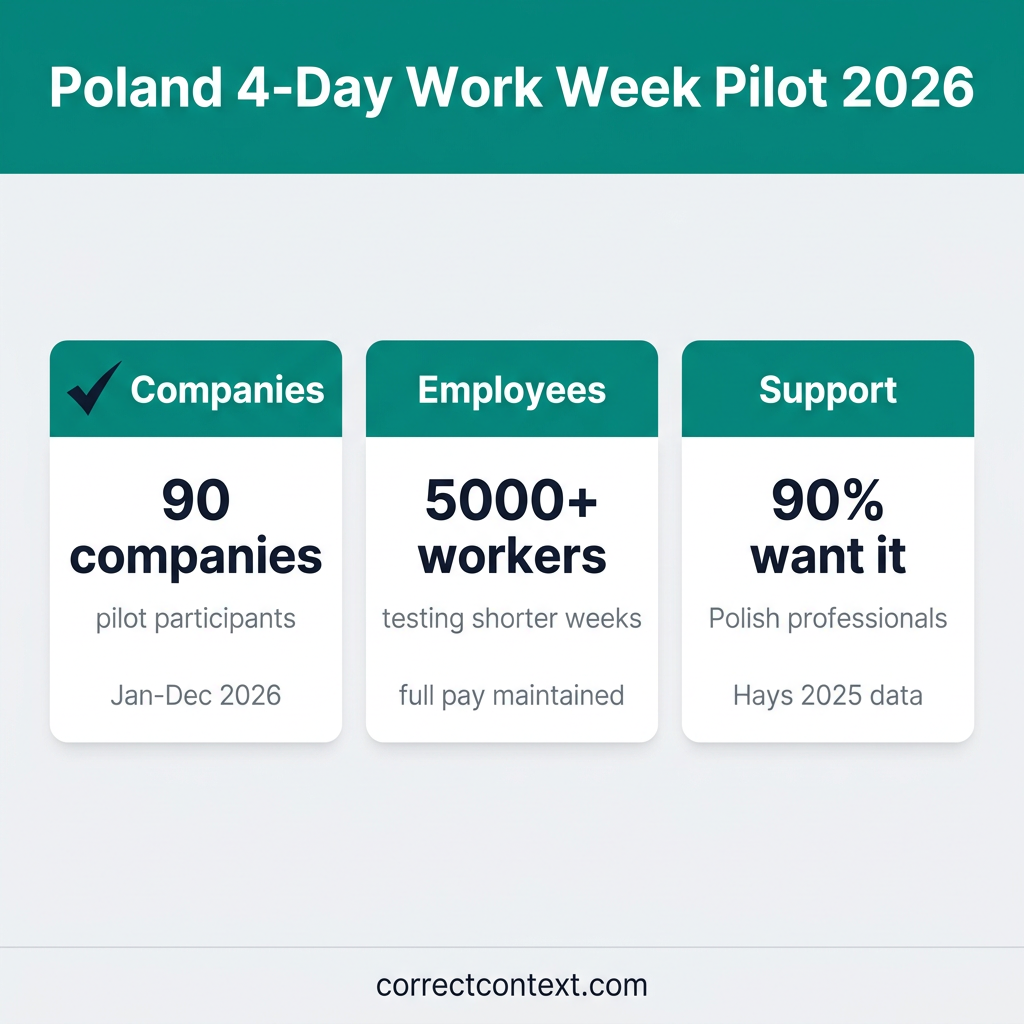
On January 1, 2026, Poland launched one of Eastern Europe’s most ambitious work-life balance experiments. The “Shortened Working Time—It’s Happening!” pilot program, organized by the Ministry of Family, Labour, and Social Policy, enrolled 90 companies covering more than 5,000 employees to test reduced working hours while maintaining full pay. This represents a significant policy shift for a country that has traditionally maintained longer working hours than many Western European counterparts, where the standard 40-hour week has been the norm for decades.
The timing is not accidental. According to a 2025 Hays Poland report, 90% of Polish professionals said they would prefer a four-day, 32-hour work week if it did not involve a pay cut. This aligns with the global “100-80-100” model that has gained traction in countries like the UK, Iceland, Belgium, and New Zealand: 100% pay, 80% time, 100% productivity. The model challenges the traditional assumption that more hours equal more output, replacing it with a focus on efficiency, focus, and results-based evaluation.
The pilot offers several implementation models designed to accommodate different industry needs and operational realities. Companies can choose the classic four-day week with 8-hour days, compressed schedules with four 10-hour days, or even shortened daily hours spread across five days. Each participating organization receives up to PLN 1 million in support, capped at PLN 20,000 per employee included in the test. This funding helps offset the transition costs, technology investments, and potential productivity adjustments during the adaptation period.
Why does this matter specifically for tech companies? Because the data from previous international pilots is compelling and directly applicable to knowledge work. A comprehensive UK trial involving 61 companies found that 92% continued the four-day week after the experiment ended. Employee turnover dropped by 57%, representing massive savings in recruitment and onboarding costs. Stress levels fell by 39%, with corresponding improvements in mental health and job satisfaction. And critically, company revenue stayed broadly the same—some firms even reported productivity increases of several dozen percent as employees eliminated low-value activities and focused on high-impact work.
The mechanism behind these gains is straightforward: shorter working hours force better organization of the day, eliminate unnecessary meetings, reduce redundant processes, and sharpen focus on the most important tasks. Management styles shift toward outcome-based evaluation rather than presence-based monitoring. Employees have less time to complete responsibilities, but they tend to act more intensively, more deliberately, and with greater concentration. The constraint drives creativity and prioritization.
However, not everyone is convinced. The Lewiatan Confederation reports that 76% of Polish entrepreneurs express skepticism about implementing this model, citing operational risks and industry-specific constraints. The Polish Economic Institute found that 51% of employers consider a four-day week impossible due to their industry’s nature—particularly in manufacturing, logistics, retail, and healthcare where physical presence is required. These concerns are legitimate and highlight that the four-day week is not a universal solution but rather one option in a spectrum of flexible work arrangements.
For tech companies specifically, the barriers are lower than in many other industries. Software development is inherently knowledge work that depends on focus and creativity rather than physical presence. The asynchronous nature of much development work—code reviews, documentation, architecture discussions—lends itself well to compressed schedules. Early adopters in Poland’s tech sector, including companies like Senuto, Andersen Lab, and DotLineCode, are already offering four-day weeks as a competitive differentiator in the talent market.
The implications for international companies hiring in Poland are significant. As the four-day week becomes normalized, candidates will increasingly expect this flexibility. Companies that can accommodate shorter work weeks—or at least offer compressed schedules or generous time-off policies—will have a measurable advantage in attracting top talent. Those that insist on traditional five-day, 40-hour structures may find themselves limited to candidates who cannot secure positions with more progressive employers.
2. AI Reshapes Job Roles, Not Just Tasks
The conversation about AI in the workplace has shifted dramatically in the past two years. We are no longer asking whether AI will affect jobs—we are measuring how deeply and how quickly. According to research from OpenAI and MIT, 80% of US workers could have at least 10% of their work tasks affected by large language models. More strikingly, 19% of workers could see more than half of their tasks automated by current AI capabilities. These are not projections about distant futures; they describe impacts that are already beginning to materialize.
McKinsey’s 2025 analysis projects that by 2030, 30% of current US jobs could be automated, with 60% significantly altered by AI tools. Goldman Sachs predicts up to 50% of jobs could be fully automated by 2045, driven by generative AI and robotics. Larry Fink, CEO of BlackRock, has warned of a “restructuring” of white-collar work by 2035, with particular impact on finance, legal services, and technology sectors. The timeline for these changes is shorter than many professionals realize.
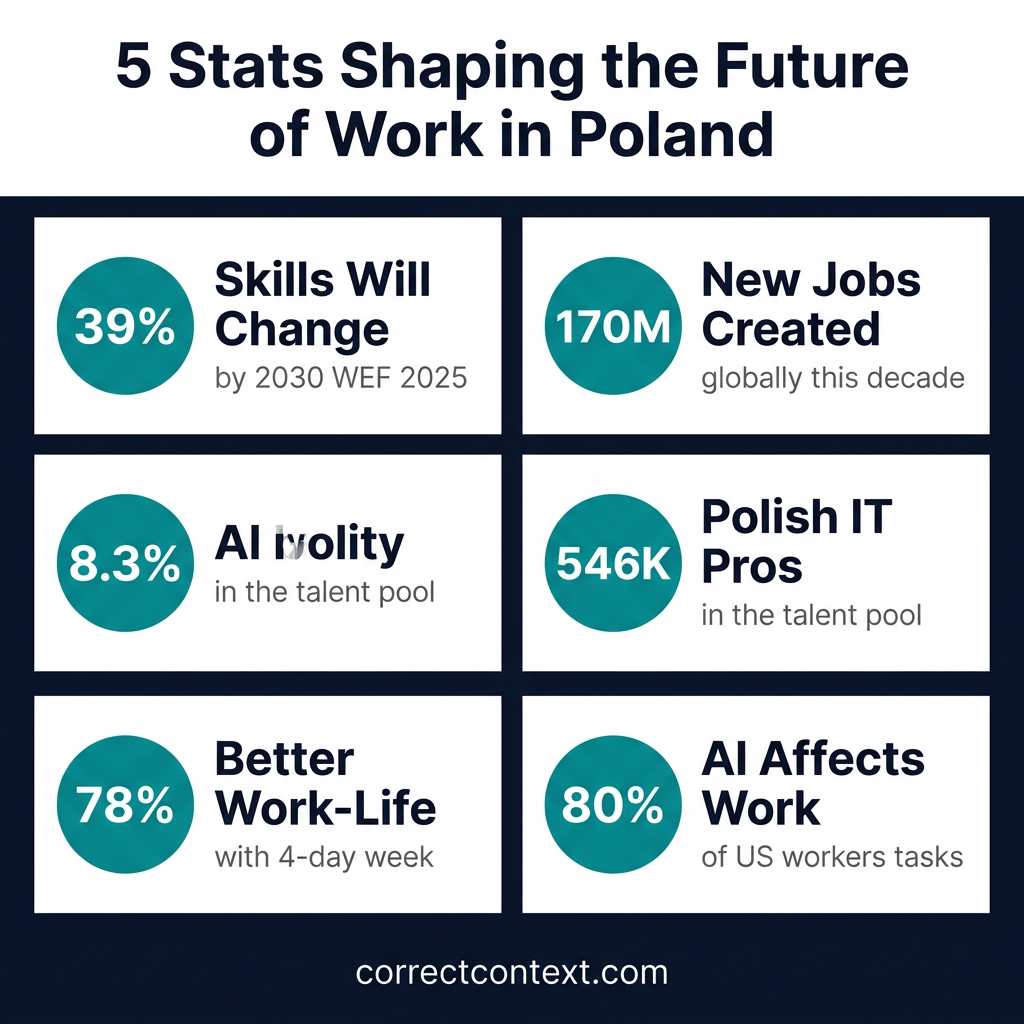
But here is what gets missed in the headlines designed to generate anxiety: AI will reshape more jobs than it replaces. A 2026 BCG analysis found that agentic AI may drive high levels of task automation in 43% of jobs, but the net effect is transformation, not elimination. The World Economic Forum’s Future of Jobs Report 2025 projects that while 92 million roles will be displaced by technological and economic shifts, 170 million new jobs will be created this decade—a net increase of 78 million positions globally. The challenge is not a shortage of work but a mismatch between existing skills and emerging requirements.
For Polish tech workers specifically, the implications are nuanced and require careful analysis. Developers who embrace AI coding assistants like GitHub Copilot, Cursor, or JetBrains AI report productivity gains of 30-50% on routine tasks such as boilerplate generation, documentation, and simple debugging. But the value of purely technical execution—the ability to write standard code that implements well-understood patterns—is dropping rapidly. What matters now is the ability to architect complex systems, understand business context deeply, make judgment calls that AI cannot, and integrate AI tools effectively into development workflows.
At Correct Context, we are seeing this play out in real time with clients building teams in Poland. Companies hiring Polish engineers increasingly prioritize candidates who can demonstrate AI literacy—not just using AI tools, but understanding their limitations, integrating them into workflows, knowing when human judgment must override algorithmic suggestions, and maintaining code quality when significant portions are AI-generated. The engineers who treat AI as a productivity multiplier while developing higher-level capabilities are seeing their market value increase. Those who compete with AI on routine coding tasks face downward pressure on rates and opportunities.
The transformation extends beyond individual roles to team structures and project approaches. AI is compressing the timeline for MVP development, making small teams more powerful but also raising expectations for output. Companies can achieve more with fewer people, but those people need to operate at a higher level of abstraction. The “10x engineer” concept—always somewhat mythical—is being replaced by the “architect-engineer” who can leverage AI to multiply team productivity across multiple developers.
For employers, this shift requires rethinking job descriptions, evaluation criteria, and development paths. The resume that lists years of experience with specific frameworks matters less than demonstrated ability to learn new tools quickly and apply judgment to ambiguous problems. Interview processes need to evolve to assess these capabilities, not just technical knowledge.
3. The Skills Revolution: 39% of Core Skills Will Change by 2030
The World Economic Forum’s Future of Jobs Report 2025 contains a sobering statistic that should inform every hiring decision and career plan: employers expect 39% of workers’ core skills to change by 2030. This represents massive disruption to established career paths and competency models. Interestingly, this figure is actually down from 44% in 2023, suggesting that organizations are getting better at anticipating and managing skill transitions rather than being surprised by them.
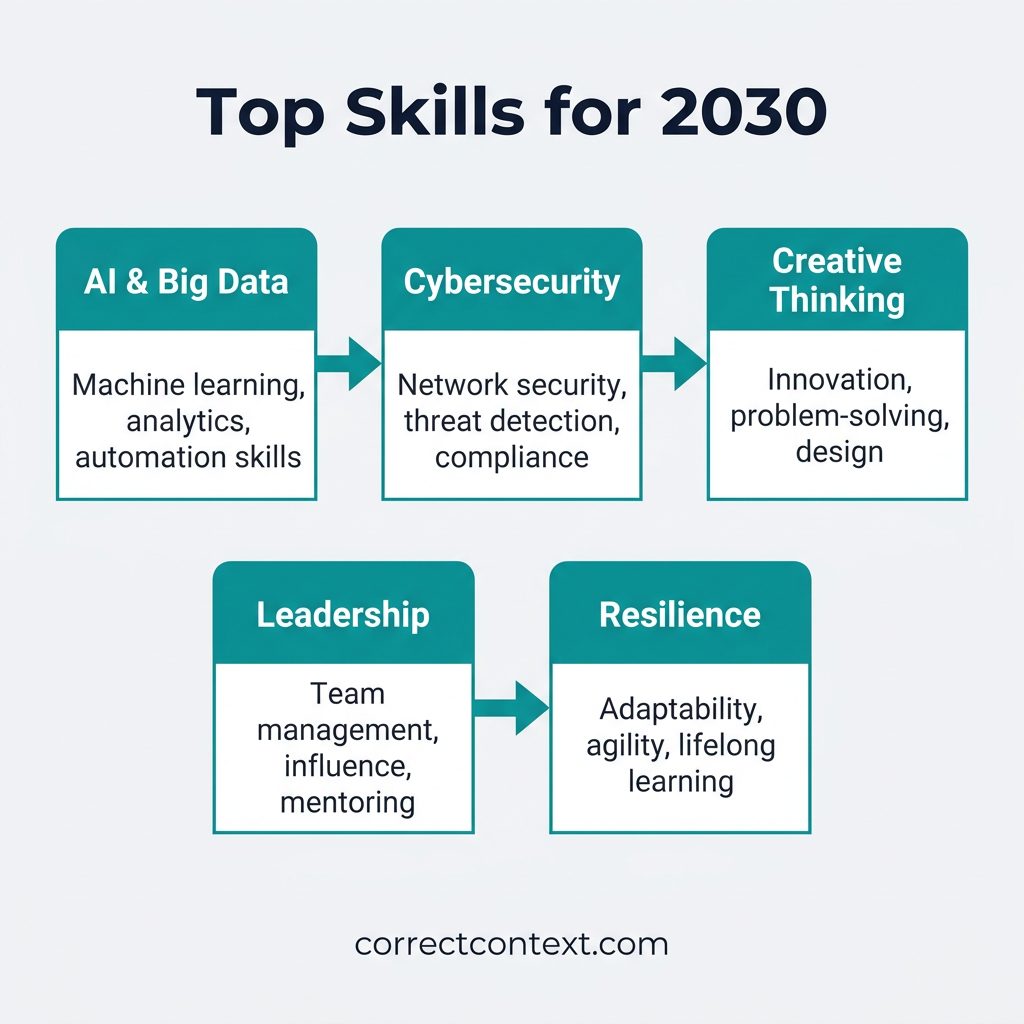
The skills rising fastest in importance tell a clear story about where value is migrating in the labor market. Topping the list are AI and big data capabilities, reflecting the technological transformation sweeping every industry. Networks and cybersecurity follow, driven by escalating digital threats and regulatory requirements. Technological literacy—broad comfort with digital tools and concepts—occupies third place. Then the list shifts: creative thinking, resilience and flexibility, curiosity and lifelong learning, leadership and social influence, talent management, analytical thinking, and environmental stewardship.
What is striking about this ranking is the blend of technical and human capabilities. Purely technical skills dominate the top three positions, but human-centric capabilities occupy four of the remaining seven spots. The future workplace demands both deep technical expertise and sophisticated interpersonal skills. Engineers who can code but cannot communicate, collaborate, or think creatively about novel problems will find themselves commoditized. Those who combine technical depth with human skills will command premium compensation.
For Polish tech professionals, this creates a clear imperative that conflicts with traditional career development patterns. The engineers who will thrive are those who combine deep technical expertise with the “soft” skills that AI cannot replicate. A senior Python developer who can also facilitate cross-functional collaboration, mentor junior team members, think creatively about architectural decisions, and communicate effectively with non-technical stakeholders is exponentially more valuable than one who simply writes clean code in isolation.
Companies are responding with aggressive upskilling investments that would have seemed extravagant five years ago. According to LinkedIn’s 2025 Workplace Learning Report, over 50% of the workforce has already undergone reskilling training—a steep jump from previous cycles. Skill cycles are getting shorter as technology moves faster than traditional training systems can adapt. What this means in practice is that the half-life of technical skills is shrinking. A capability that represented cutting-edge expertise five years ago may be commoditized today.
The implications for hiring are significant. When evaluating candidates, past experience with specific technologies becomes less predictive of future success than demonstrated learning velocity and intellectual curiosity. A mid-level developer who has consistently expanded their skill set, contributed to open-source projects, and stayed current with industry trends will likely outperform a senior engineer who stopped learning five years ago. Interview processes need to evolve to assess learning ability, not just accumulated knowledge.
For organizations building teams in Poland, this skills revolution suggests investing heavily in continuous learning infrastructure. Companies that provide time, resources, and cultural support for skill development will retain talent longer and get more value from their teams. Those that treat training as an expense to minimize will find their workforce obsolescing faster than they can replace it.
4. Remote Work Becomes the Default, Not the Perk
The pandemic forced a global remote work experiment at unprecedented scale. In 2026, we are seeing the results crystallize into permanent patterns that vary significantly by market and role type. For Polish tech talent, remote work has evolved from an emergency measure to a baseline expectation—and increasingly, a competitive advantage in the global talent market.
Poland’s 2024 amendments to the Labor Code created a robust legal framework for remote employment and B2B contracting. These provisions eliminated the legal ambiguities that previously complicated cross-border IT outsourcing, making Poland a safe, predictable jurisdiction for international staff augmentation. The changes addressed key concerns around data protection, intellectual property, and employment classification that had made some companies hesitant to engage Polish remote workers.
The market has effectively split into two distinct segments with different remote work patterns. For international hiring, fully remote B2B contracts dominate. Senior engineers and specialists overwhelmingly prioritize 100% remote arrangements with international firms to maximize compensation, work on cutting-edge technology stacks, and maintain geographical flexibility. Companies like HERE Technologies, Motorola Solutions, and Comarch now offer remote roles as standard, allowing Polish tech professionals to work from anywhere in the country while serving global clients.
For domestic Polish companies, hybrid models have become the operational baseline. However, a concerning trend emerged in 2025: the percentage of employees whose employers increased mandatory office days jumped from 15% to 35%. This push for return-to-office creates tension, particularly as Polish developers have demonstrated over four years that they can deliver exceptional results working remotely. The mandatory return policies often feel like managerial theater—actions taken to assert control rather than improve outcomes.
The implications for hiring are stark and growing more pronounced. Companies that insist on full-time office presence are increasingly limited to local talent pools and junior candidates who lack the leverage to demand flexibility. To access the top 5% of Polish engineering talent—the senior architects, specialists, and leaders who can drive transformational projects—remote flexibility is non-negotiable. This top tier of talent has options, and they consistently choose employers who respect their autonomy.
At Correct Context, we observe this dynamic constantly. Clients who require office presence struggle to fill senior roles regardless of compensation. Those offering genuine flexibility—defined as employee choice rather than mandated hybrid schedules—attract stronger candidate pools and achieve better retention. The correlation is so consistent that we now treat flexibility as a primary recruiting lever, not a secondary perk.
The geographic implications are also significant. Remote work allows Polish engineers to access opportunities with companies in Western Europe, the US, and globally without relocating. This increases competition for their services and drives up compensation expectations. Companies hiring in Poland are no longer competing only with local employers but with international firms offering global salary benchmarks.
5. The Gig Economy Expands into High-Skill Tech Work
The gig economy is no longer just about ride-sharing, food delivery, and task-based platforms. In Poland’s tech sector, short-term contracts, freelance engagements, and project-based work are becoming mainstream career choices rather than stopgap measures between permanent positions. This shift has profound implications for how companies build and maintain technical teams.
Globally, the gig economy tech platforms market is witnessing strong growth as businesses and workers embrace flexible, on-demand work models. According to Fortunly’s 2026 gig economy statistics, 43% of Gen Z workers engage in gig work—representing the highest participation rate of any generation at the same life stage. Perhaps more tellingly, 63% of workers participate in the gig economy because they view a portfolio of clients as more reliable than working with a single employer. This represents a fundamental shift in risk perception: diversification beats concentration.
In Poland specifically, the Tracxn database identifies 207 companies operating in the gig economy sector, including 26 funded companies that have collectively raised $4.18 million in venture capital. While much of this activity focuses on platform-based work like delivery and transportation, the trend extends meaningfully into high-skill professional services including software development, design, and consulting.
Polish IT professionals are increasingly opting for B2B contracts that provide greater flexibility and often better net pay than traditional employment. This is particularly true for specialists in AI/ML, cybersecurity, and cloud architecture—fields where demand significantly outstrips supply and skilled practitioners can command premium rates for project-based engagements. The B2B model allows optimization of tax treatment while maintaining the ability to work with multiple clients sequentially or simultaneously.
For companies hiring in Poland, this creates both opportunities and challenges that require strategic thinking. On one hand, access to freelance talent allows flexible scaling without long-term employment commitments, ideal for project-based work or specialized needs. On the other hand, building stable, cohesive teams becomes harder when top performers view every engagement as temporary. The tribal knowledge, cultural cohesion, and long-term thinking that characterize great engineering teams are difficult to maintain with purely transactional relationships.
The organizations that thrive will be those that create compelling value propositions for long-term collaboration—even if that collaboration takes non-traditional forms. This might include ongoing retainer relationships, preferred contractor status with guaranteed minimums, or project-based work that evolves into longer-term partnerships. The key is moving beyond transactional gig work to genuine relationship-based collaboration.
For employers, the gig economy trend also means rethinking retention strategies. If top engineers can earn equivalent or better income with more flexibility as contractors, what reasons do they have to stay employed? The answer typically involves career development, community, interesting challenges, and stability—factors that require intentional cultivation.
6. Poland’s Tech Talent Pool Reaches 546,000 Professionals
Scale matters in talent markets. According to LinkedIn and Ntiative’s 2024 Talent Insights report, Poland now has approximately 546,000 active IT and tech professionals. This places the country firmly among Europe’s top five technology talent markets, behind only the UK, Germany, France, and Spain—countries with significantly larger populations and longer tech industry histories.
The significance of this number becomes clear when you consider Poland’s population—approximately 37 million, compared to Germany’s 84 million or the UK’s 67 million. On a per-capita basis, Poland punches well above its weight in tech talent production. The country has developed a self-reinforcing ecosystem: strong technical universities produce graduates, tech companies hire them, successful exits create capital and experienced founders, who then start new companies and hire more graduates.
This talent base is not static but growing steadily. Polish universities produce thousands of computer science graduates annually, with particularly strong programs at institutions like the Warsaw University of Technology, Jagiellonian University in Krakow, Wroclaw University of Science and Technology, and AGH University of Krakow. The country’s tech hubs—Warsaw, Krakow, Wroclaw, Poznan, and the Tri-City area of Gdansk, Gdynia, and Sopot—each offer distinct specializations and talent characteristics, creating options for companies with specific needs.
The economic impact of this talent base is substantial and growing. By 2023, Polish IT exports reached 70.7 billion PLN (approximately $17.5 billion), more than double the 33.1 billion PLN from 2019. To put this in perspective: Poland now exports more IT services than Japan or South Korea, remarkable for a country that was transitioning from communism just 35 years ago. The IT sector has become one of Poland’s most important export industries, competing with traditional strengths like manufacturing and agriculture.
For international companies considering Poland for team expansion, this scale creates genuine options. Whether you need a single senior architect, a five-person product squad, or a 50-person engineering center, the talent exists. The challenge is not finding people—it is finding the right people, vetting them effectively against often-inflated claims, and creating the conditions for long-term retention in a competitive market.
7. The Fastest-Growing Tech Roles Reveal Market Direction
The World Economic Forum’s analysis of job growth through 2030 reveals clear patterns about where the tech market is heading. While farmworkers and delivery drivers top the absolute growth list due to demographic and economic factors, the technology-specific roles tell a more targeted story about where investment and opportunity are concentrating.
Software developers rank among the top five fastest-growing professions globally by absolute numbers. Within tech specifically, the highest-growth specializations include AI and machine learning specialists, big data analysts and scientists, cybersecurity and network engineers, renewable and green energy engineers, and fintech engineers. These roles share a common thread: they all involve managing complexity, handling sensitive systems, or working at the intersection of technology and highly regulated domains.
Poland’s job market reflects these global trends with some local variations. According to ITCompare’s 2025/2026 analysis of Polish tech job postings, the most in-demand technologies include SQL (approximately 20% of postings), Python (19%), Java (19%), JavaScript (11%), TypeScript (11%), and PHP (8%). For cloud and infrastructure roles, AWS dominates with approximately 5% of all tech postings, followed by Azure and GCP at lower levels.
What is particularly notable for hiring managers is the elevated bar for frontend developers. React plus TypeScript has become virtually the standard expectation, with other frameworks like Angular considered advantageous but secondary. Full-stack skills—particularly Node.js for backend JavaScript—are increasingly tipping hiring decisions in candidates’ favor. Frontend in 2025 is a tough recruitment market: there are fewer postings relative to backend roles, but the bar is set high for those that exist.
For companies building teams in Poland, these trends suggest a strategic approach to hiring. Rather than hunting for unicorns with every hot skill, successful organizations identify their core technology stack and hire specialists who can demonstrate deep expertise in those specific areas. The market is too competitive to waste time on mismatched candidates. A strong Java developer who knows Spring Boot deeply will deliver more value than a mediocre full-stack generalist.
| Technology | Share of Postings (2024/25) | Primary Use Case |
|---|---|---|
| SQL | ~20% | Databases, BI/Data |
| Python | 19% | Backend, AI/ML, Data Science |
| Java | 19% | Backend, Enterprise Applications |
| JavaScript | 11% | Frontend, Full Stack |
| TypeScript | 11% | Frontend (Modern JS), Full Stack |
| PHP | 8% | Backend (Web Development) |
| C# / .NET | 6% | Backend (.NET Apps, Unity) |
| React | ~5% | Frontend (Web Interfaces) |
| AWS | ~5% | Cloud Computing, DevOps |
8. Work-Life Balance Becomes a Competitive Weapon
The four-day work week pilot is just the most visible manifestation of a broader shift in employee priorities. Work-life balance has evolved from a nice-to-have perk to a core component of employer value propositions—and increasingly, a decisive factor in hiring and retention decisions, particularly for senior talent.
According to PBS research conducted in Poland, 78% of employees say a shorter work week directly translates into better management of their time outside work. The 4 Day Week Global UK study found that companies maintaining previous productivity levels while reducing hours saw multiple benefits: stress levels dropped by 39%, employee turnover fell by 57%, sick days decreased significantly, and engagement metrics improved across the board. The data is consistent across multiple pilots and countries.
The mechanism behind these gains is straightforward but powerful. Shorter working hours force better organization of the day, eliminate unnecessary meetings, reduce redundant processes, and sharpen focus on high-impact tasks. Management styles shift toward outcome-based evaluation rather than presence-based monitoring. Employees have less time to complete responsibilities, but they tend to act more intensively, more deliberately, and with greater concentration. The constraint drives creativity.
For Polish tech companies competing with international employers for the same talent pool, this creates a strategic opening. While Western European and US companies often win on raw compensation, Polish employers can differentiate through quality-of-life factors that genuinely matter to candidates. A well-designed four-day week, generous remote work policies, respect for boundaries, and reasonable working hours can offset salary gaps of 20-30% in candidate decision-making.
The data supports this approach emphatically. A comprehensive study published in Nature Human Behaviour covered 141 companies testing four-day weeks; 90% decided to implement the policy permanently after completing their six-month experiments. The benefits are real, measurable, and sustainable—not a temporary novelty effect. Companies that figure out how to make this work will have a structural advantage in talent acquisition for years to come.
9. Continuous Learning Becomes Non-Negotiable
The half-life of technical skills is shrinking rapidly. A capability that represented cutting-edge expertise five years ago may be commoditized or automated today. For Polish tech professionals, continuous learning is no longer a career accelerator—it is a survival requirement in a market that punishes stagnation.
The World Economic Forum identifies curiosity and lifelong learning among the top ten skills rising in importance through 2030. This is not abstract philosophy or corporate training rhetoric; it reflects the reality that skill cycles are getting shorter as technology evolves faster than traditional training systems can adapt. What you knew five years ago matters less than your ability to learn what you will need five years from now.
LinkedIn’s 2025 Workplace Learning Report found that mature career development initiatives correlate with positive outlooks for profitability, confidence in attracting and retaining talent, and successful generative AI adoption. Companies investing in employee development outperform those that treat training as an expense to minimize. The correlation is strong enough that learning culture has become a predictor of organizational health.
For individual engineers, this means allocating significant time to skill maintenance and expansion—often 10-20% of working hours. The developers who thrive are those who treat learning as a core job responsibility, not something to squeeze in after hours or during vacation. This includes formal training, conference attendance, side projects, open-source contributions, deliberate practice with emerging tools, and systematic exploration of adjacent domains.
Organizations hiring in Poland should evaluate candidates on their learning trajectory, not just their accumulated knowledge. A mid-level developer with demonstrated growth velocity and intellectual curiosity will outperform a senior engineer who stopped learning five years ago. Interview processes need to evolve to assess learning ability: ask candidates what they have learned recently, how they stay current, what skills they are actively developing, and how they approach unfamiliar technologies. Their answers reveal their future potential more accurately than their current resume.
10. The Green Transition Creates New Tech Opportunities
While often overshadowed by AI headlines in tech discourse, the green transition is reshaping tech employment in meaningful ways that create new specializations and career paths. The World Economic Forum projects that efforts to reduce carbon emissions and adapt to climate change will create 34 million additional jobs by 2030, adding to the 200 million existing positions in green-related fields globally.
Renewable and green energy engineers rank among the fastest-growing tech specializations globally. Within Poland, this trend intersects with the country’s broader energy transition strategy. As Poland reduces its historical dependence on coal and invests in renewable infrastructure, demand grows for software engineers who can build energy management systems, smart grid applications, industrial IoT solutions, and carbon accounting platforms.
This creates opportunities for Polish tech talent that extend beyond traditional software development into domain-specific applications. Engineers with knowledge of energy systems, manufacturing processes, or environmental science—combined with strong technical skills—are increasingly valuable and harder to replace. The ability to bridge technical implementation with sector-specific context is a genuine differentiator in a market where generic web development skills are commoditized.
For companies building teams, the green transition suggests looking beyond generic software development capabilities when evaluating candidates. Those with experience in industrial systems, hardware integration, regulated industries, or physical infrastructure bring perspectives that pure software backgrounds may lack. As the tech industry increasingly intersects with the physical world—through IoT, smart cities, energy systems, and manufacturing automation—these hybrid skill sets become more valuable and harder to develop from scratch.
| Trend | Key Statistic | Implication for Employers |
|---|---|---|
| 4-Day Work Week | 90% of Polish professionals want it | Competitive advantage for early adopters |
| AI Impact | 39% of core skills changing by 2030 | Invest in upskilling programs now |
| Remote Work | 35% of employers increasing office days | Flexibility required for top talent |
| Gig Economy | 43% of Gen Z in gig work | Alternative engagement models needed |
| Talent Pool | 546,000 IT professionals in Poland | Scale available but competition is fierce |
| Skill Demand | Python/Java at 19% of postings each | Focus hiring on proven stack alignment |
| Job Growth | 170M new jobs created this decade | Net positive but displacement requires planning |
| Work-Life Balance | 78% report better time management | Quality-of-life factors offset salary gaps |
| Learning Culture | 50%+ of workforce already reskilled | Continuous development is baseline expectation |
| Green Tech | 34M new green jobs by 2030 | Domain expertise increasingly valuable |
Key Takeaways
- The four-day work week is moving from experiment to expectation. With 90% of Polish professionals wanting shorter weeks and a major government pilot underway, companies that figure out how to make this work will have a significant hiring advantage over those that dismiss it.
- AI will transform jobs more than eliminate them. While 80% of workers will see some task automation, the net effect is 78 million new jobs globally this decade. The key is preparing workers for transformed roles rather than protecting existing task definitions.
- Skills have a shorter shelf life than ever. With 39% of core capabilities expected to change by 2030, hiring for current skills is less important than hiring for learning ability. Curiosity and adaptability trump specific technical certifications in long-term value.
- Remote work is the price of admission for top talent. Companies insisting on full-time office presence are increasingly limited to junior candidates and local markets. Flexibility is non-negotiable for senior engineers with options.
- The gig economy is mainstream for tech professionals. With 43% of Gen Z engaged in gig work and 63% preferring client portfolios to single employers, traditional employment models face real competition from flexible arrangements.
- Poland’s talent scale creates genuine opportunity. With 546,000 IT professionals and growing, companies can build teams of any size. The challenge is vetting and retention, not raw availability.
- Work-life balance is a competitive weapon. Quality-of-life factors can offset salary gaps of 20-30% when competing with international employers. Well-designed policies drive retention and engagement.
- Continuous learning is survival, not luxury. Engineers who treat skill development as a core job responsibility will thrive. Those who rely on existing capabilities will be commoditized by AI and market evolution.
- Green tech creates new specialization opportunities. The energy transition demands engineers who can bridge software development with industrial domain knowledge in energy, manufacturing, and infrastructure.
- The future belongs to adaptable organizations. The companies that thrive will be those that experiment aggressively, measure results honestly, and iterate based on evidence rather than ideology or tradition.
Frequently Asked Questions
Is the four-day work week legally required in Poland?
No. As of 2026, the four-day work week remains optional. The Polish government is conducting a pilot program through December 2026, with results to be analyzed by May 2027. Companies can volunteer to participate and receive funding support up to PLN 1 million per organization, but there is no mandate requiring shorter work weeks. The pilot is designed to test feasibility across different industries before any legislative changes are considered.
How will AI specifically affect software developer jobs in Poland?
AI is automating routine coding tasks—boilerplate generation, simple debugging, documentation, and test writing—but increasing demand for higher-level capabilities like system architecture, business analysis, security review, and AI integration itself. Polish developers who embrace AI tools as productivity multipliers while developing judgment-based skills will see increased opportunities and compensation. Those who compete with AI on routine tasks face downward pressure on rates and job security.
What is the average salary for Polish software developers in 2026?
According to Alcor’s 2026 research, senior developers in Poland earn approximately $7,270 per month on B2B contracts—about 52% less than equivalent US roles but highly competitive within Europe. Mid-level developers typically earn $4,500-6,000 monthly, while juniors start around $2,500-3,500. These figures vary significantly by technology stack (AI/ML commands premiums), city (Warsaw and Krakow lead), and employment model (B2B typically yields 20-30% more net than UoP).
How competitive is hiring Polish tech talent?
Extremely competitive, particularly for senior roles. While Poland has 546,000 IT professionals, demand from both domestic and international employers outstrips supply for experienced candidates. Companies offering above-market compensation, genuine remote flexibility, interesting technical challenges, and quality-of-life benefits have the best success. Those with rigid requirements, below-market offers, or poor employer branding struggle regardless of their company name recognition.
What are the most in-demand skills for Polish developers right now?
Based on job posting analysis from 2025/2026, SQL (~20%), Python (19%), and Java (19%) dominate backend roles. For frontend, React with TypeScript is virtually standard. Cloud skills—particularly AWS—are increasingly expected for senior positions. AI/ML capabilities are rapidly rising in demand but still represent a smaller share of total postings. Full-stack JavaScript (Node.js + React) is increasingly valuable for startups and smaller teams.
Should companies hire Polish developers as employees or contractors?
It depends on your goals and timeline. Employment (UoP – Umowa o Pracę) offers stronger retention, deeper integration, and clearer IP assignment but requires a Polish legal entity or Employer of Record services. B2B contracting provides flexibility, can be 20-30% cheaper due to tax differences, and allows faster engagement, but creates less organizational commitment. Many successful companies use a hybrid approach: core team on employment, specialized or project-based skills on contract.
Sources
- Antal Poland — A 4-day working week in Poland (2026)
- 4dayweek.io — 4 Day Week Companies in Poland (2026)
- World Economic Forum — Future of Jobs Report 2025
- World Economic Forum — Skills Outlook (2025)
- ITCompare — The most in-demand IT technologies in Poland (2025/2026)
- Flying Bisons — Polish IT Industry Outlook for 2026
- Alcor — Technology and IT Industry in Poland in 2025
- Fortunly — Gig Economy Statistics and Facts for 2026
- Tracxn — Gig Economy in Poland (2025)
- Exploding Topics — 70+ Stats On AI Replacing Jobs (2026)
- Forbes — Jobs AI Will Replace First in the Workplace Shift (2025)
- BCG — AI Will Reshape More Jobs Than It Replaces (2026)
- RemoDevs — Remote Work in Poland: The 2026 Landscape for IT
- JobTrackr.it — IT Job Market in Poland: Opportunities & Trends 2026
- LinkedIn Learning — Closing the Tech Talent Gap (2025)
Table of content
- 1. The Four-Day Work Week Goes Mainstream
- 2. AI Reshapes Job Roles, Not Just Tasks
- 3. The Skills Revolution: 39% of Core Skills Will Change by 2030
- 4. Remote Work Becomes the Default, Not the Perk
- 5. The Gig Economy Expands into High-Skill Tech Work
- 6. Poland’s Tech Talent Pool Reaches 546,000 Professionals
- 7. The Fastest-Growing Tech Roles Reveal Market Direction
- 8. Work-Life Balance Becomes a Competitive Weapon
- 9. Continuous Learning Becomes Non-Negotiable
- 10. The Green Transition Creates New Tech Opportunities
- Key Takeaways
- Frequently Asked Questions
- Is the four-day work week legally required in Poland?
- How will AI specifically affect software developer jobs in Poland?
- What is the average salary for Polish software developers in 2026?
- How competitive is hiring Polish tech talent?
- What are the most in-demand skills for Polish developers right now?
- Should companies hire Polish developers as employees or contractors?
- Sources
Related articles



About the Author: Duke Vu