
For Series A+ startups in FinTech, Media, and Software, the mandate from the board is usually simple: scale fast and ship faster. But for a CTO under immense delivery pressure, that mandate introduces a dangerous paradox. To hit ambitious product roadmaps, you need to scale engineering teams rapidly. Yet, the very act of hiring during growth often forces your best engineers to shoulder the burden of interviewing, onboarding, and mentoring—leading to severe engineering team burnout.
The biggest bottleneck in software delivery is rarely the code itself; it is the logistics of scaling teams to write it without breaking the people you already have. When scaling efforts burn out current engineers, productivity plummets, technical debt compounds, and you risk losing the foundational talent that got your startup to Series A in the first place.
This article explores the data behind team burnout, the hidden costs of overloading your core developers, and how CTOs can strategically decide when to add external capacity—such as a dedicated development team—instead of pushing their internal team harder.
The Silent Crisis: Engineering Team Burnout by the Numbers
It is a common misconception that developers only burn out from writing too much code. In reality, they burn out from cognitive overload, context switching, and the invisible labor required to scale a company.
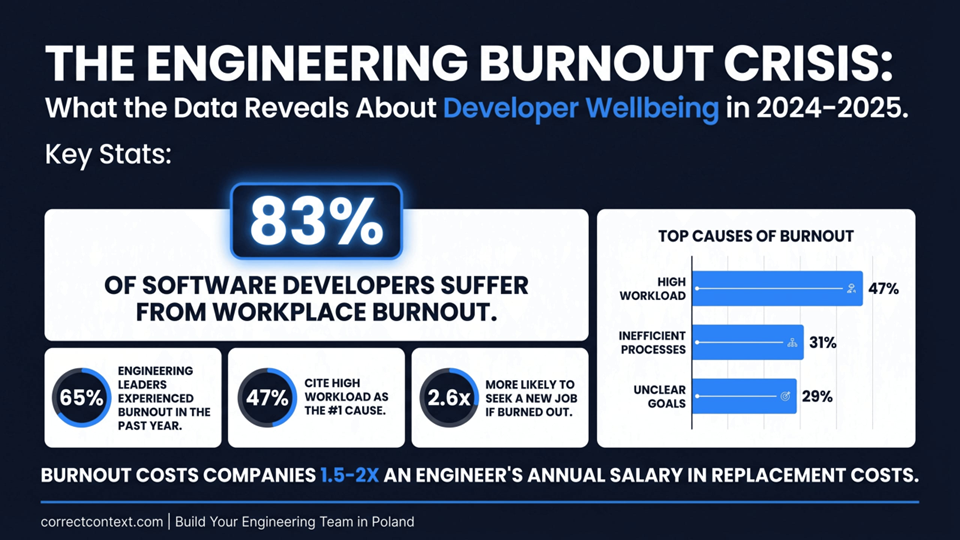
Recent industry data paints a stark picture of the current state of developer well-being:
- A study by Haystack Analytics found that a staggering 83% of software developers suffer from workplace burnout, with 47% citing high workload as the primary cause [1].
- The 2024 State of Engineering Management Report by Jellyfish revealed that 65% of all respondents experienced burnout in the past year, with the problem being particularly acute for short-staffed engineers and leaders overseeing large organizations [2].
- Gallup’s State of the Global Workplace report highlights that employees experiencing burnout are 63% more likely to take a sick day and 2.6 times as likely to be actively seeking a different job [3].
When a startup enters hypergrowth, the pressure to deliver new features collides with the necessity of hiring engineers without overloading your existing team. Senior engineers, who should be architecting scalable systems, are instead pulled into endless technical interviews and code reviews for new hires. This dynamic creates a vicious cycle: as the team grows, the core engineers become less productive and more exhausted.
“The biggest bottleneck in software delivery was never the code. It was the logistics of scaling teams to write it.” — The Death of Headcount Scaling [4]
The True Cost of In-House Hiring During Hypergrowth
When evaluating how to expand capacity, CTOs often default to hiring full-time, in-house employees. However, the true cost of an in-house hire extends far beyond their base salary.
1. The Time-to-Hire Trap
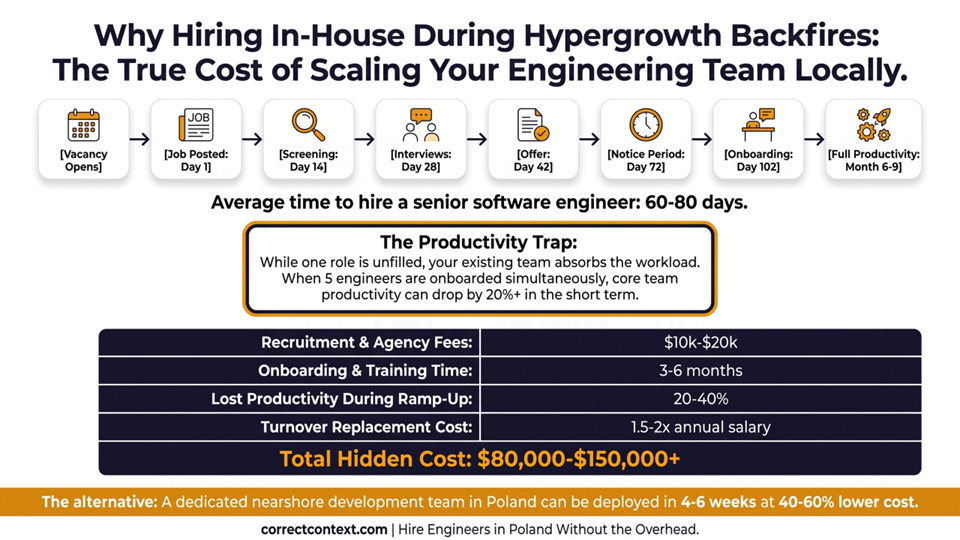
In the US and UK tech markets, the average time to hire a software engineer ranges from 40 to 60 days, and for senior roles, it can stretch to 80 days or more [5]. During this prolonged search, your existing team is left to absorb the workload of the unfilled position, accelerating scaling team burnout.
2. The Productivity Dip During Onboarding
Once a new engineer is hired, they do not contribute immediately. The onboarding ramp-up period typically takes 3 to 6 months before a developer reaches full productivity. During this time, your senior engineers must dedicate hours each week to pairing, explaining the codebase, and reviewing early pull requests. If you hire five engineers simultaneously, the collective productivity of your core team can drop by 20% or more in the short term.
3. The Financial Burden of Turnover
If overloading engineers leads to your top performers quitting, the financial impact is devastating. The cost of replacing a specialized software engineer is estimated to be between 1.5x and 2x their annual salary when factoring in recruitment costs, onboarding time, and lost institutional knowledge [6]. For a Series A startup, losing a founding engineer can delay a critical product launch by quarters.
When to Add External Capacity: The Extended Engineering Team Model
To prevent engineering team burnout, CTOs must recognize when the internal team has reached its cognitive limit. If your senior developers are spending less than 50% of their time writing code and more time managing the hiring pipeline, it is time to look outward.
Instead of competing in the hyper-competitive and expensive talent markets of the US East Coast, UK, DACH, or Nordics, smart tech leaders are turning to the extended engineering team model. By partnering with an offshore development team or a nearshore development team, startups can rapidly inject fully formed, high-performing pods into their development lifecycle.
Why Poland and CEE are the Premier Destinations for Tech Hubs
For companies scaling globally, Central and Eastern Europe (CEE)—specifically Poland—has emerged as the gold standard for tech talent. If you want to hire developers Poland offers a unique combination of elite technical skills, cultural alignment, and cost efficiency.
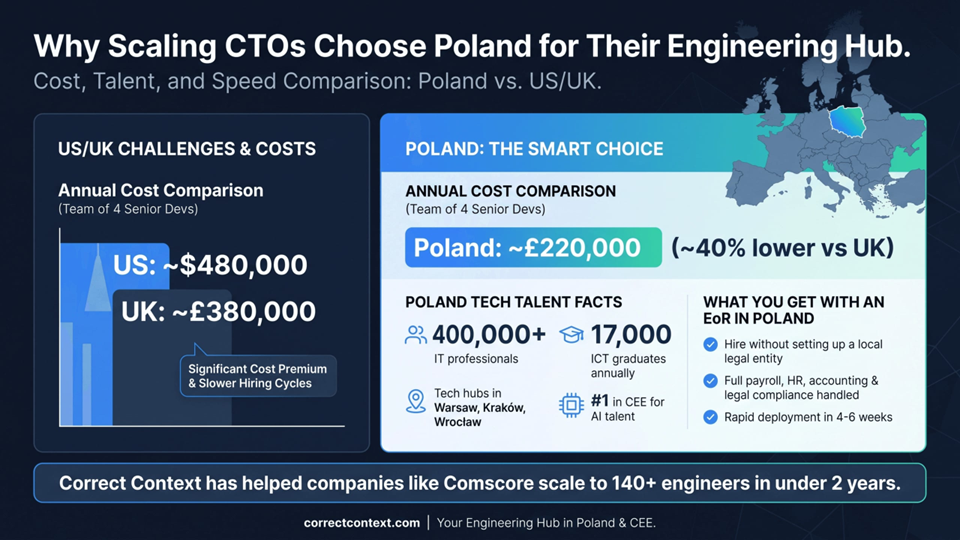
- Massive Talent Pool: Poland boasts a growing talent pool of over 400,000 IT professionals, with a strong emphasis on STEM education producing thousands of new graduates annually [7].
- Specialized Expertise: Whether you need an AI development team, machine learning engineers team, data engineering team, or a cloud engineering team (with deep AWS, Azure, or GCP experience), Poland has the specialized talent required by tech-first enterprises.
- Cost Efficiency: The cost savings are substantial. UK companies spend roughly £360,000 per year for a team of 4 senior in-house developers. The same team in Poland costs around £220,000—delivering top-tier talent at a fraction of the price [8].
The Power of Employer of Record (EoR) Services
Historically, the barrier to building an engineering hub Europe was the legal and administrative complexity of setting up a foreign entity. Today, that friction has been eliminated by Employer of Record Poland (EoR) services.
An EoR CEE provider allows you to hire employees without entity setup. The EoR handles all local compliance, including payrolls services Poland, HR, accounting, law, and office management. This means you can hire in Europe without company registration, ensuring employment compliance Europe while your CTO focuses purely on product and technology.
Strategic Steps to Scale Without Burnout
To successfully scale software development while protecting your core team, consider implementing the following strategies:
1. Isolate the Core Team
Protect your founding engineers by isolating them from the noise of the hiring machine. Allow them to focus on high-impact architecture and complex problem-solving. When you need to clear a massive backlog or build an adjacent product module, deploy a dedicated software team from a nearshore partner to handle the execution.
2. Leverage Managed Onboarding
When you engage a remote software engineers team through a premium partner like Correct Context, the onboarding burden is significantly reduced. These teams are accustomed to integrating rapidly into existing agile workflows and CI/CD pipelines. Because they operate as a cohesive unit, they require far less hand-holding from your internal leads.
3. Embrace AI and Automation
To further reduce cognitive load, equip your teams with enterprise ai tools. Encourage corporate ai use to automate repetitive coding tasks, testing, and deployments. When you hire ai programmers or a big data development team, they can implement ai trends enterprise solutions that multiply the output of your entire engineering organization.
4. Monitor Developer Experience (DevEx)
Treat developer experience as a critical business metric. Track indicators like cycle time, deployment frequency, and most importantly, team sentiment. If surveys show rising frustration with processes or persistent fatigue, intervene immediately by bringing in an affordable senior developers team to absorb the overflow.
Conclusion: Protect Your Greatest Asset
For a Series A+ startup, your core engineering team is the engine of your valuation. Pushing them to the brink of exhaustion to meet arbitrary hiring quotas is a strategic failure. Scaling efforts burn out current engineers only when leadership refuses to explore alternative models of growth.
By embracing an offshore team for startup scaling and utilizing an European employer of record, you can bypass the local talent crunch. You gain immediate access to a startup development team in Poland that can execute your roadmap flawlessly, allowing your in-house engineers to breathe, innovate, and lead.
When the pressure mounts, remember: the goal is not just to grow the headcount; it is to scale the output. Choose the path that protects your people while accelerating your product.
References
[1] Haystack Analytics. 83% of Developers Suffer From Burnout, Haystack Analytics Study Finds.
[2] Jellyfish. Insights from the 2024 State of Engineering Management Report.
[3] Gallup. State of the Global Workplace 2024 Report.
[4] Manoj Mohan. The Death of Headcount Scaling: Why Your 2024 Engineering Plan Is Broken. LinkedIn Pulse.
[5] Paraform. Average Time To Hire Software Engineer.
[6] ThirstySprout. Software Development Cost: The 2025 Budgeting Guide.
[7] Correct Context. The Ultimate Guide to IT Offshoring in Poland 2025.
[8] Code & Pepper. Offshore Development Team Cost 2025: UK vs World vs India.
Table of content
Related articles



About the Author: Marta