
The cost of a bad engineering hire isn’t just a hit to your recruitment budget—it’s a drain on your team’s momentum. When you hire senior developers, you expect them to hit the ground running, architect scalable solutions, and mentor your mid-level talent. But what happens when the candidate with a decade of experience and a polished resume turns out to be a mid-level developer in disguise?
According to recent data, nearly 50% of new hires are terminated or quit within their first 18 months [1]. For engineering leaders, comparing candidates and trying to distinguish real seniors from mid-level engineers is a high-stakes challenge. The fear of hiring someone who looks senior but can’t deliver is real, especially when building an extended engineering team or a dedicated development team.
In this guide, we will explore the signals that truly indicate senior-level capability and how to validate engineering skills effectively. Whether you are building an engineering hub Europe or looking to hire developers Poland, understanding how to assess true seniority is critical.
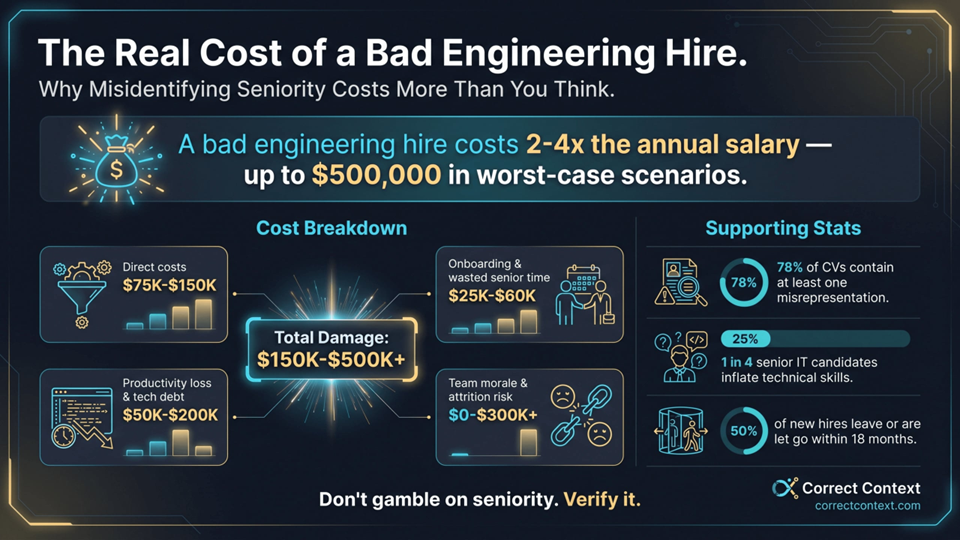
Infographic 1: The Real Cost of a Bad Engineering Hire
The Resume Illusion: Why Years of Experience Don’t Equal Skill
It is a common misconception that years of experience automatically translate to seniority. A developer with ten years of experience might just have one year of experience repeated ten times. When you are looking to scale engineering teams, relying solely on a resume is a dangerous game.
Research shows that 78% of all CVs contain at least one misrepresentation, and 1 in 4 senior IT candidates misrepresents at least one element of their experience [2] [3]. The most common exaggerations? Inflated technical skills and exaggerated team leadership responsibilities.
This resume inflation makes senior engineer assessment incredibly difficult. Interviews can quickly become interrogations designed to catch candidates in a lie rather than genuine assessments of capability. To validate engineering skills, you need to move beyond the resume and look for specific behavioral and technical signals.
Signal 1: Ownership and Handling Ambiguity
The most defining characteristic of a true senior engineer is their ability to handle ambiguity. Mid-level developers are great at building simple solutions to simple problems, and they know how to get tasks done. Senior developers, however, build simple solutions to complicated problems. They know which tasks matter, how to shape them, and how to keep others from going down dead ends.
When you test senior engineer skills, look for ownership. A mid-level engineer might ask, “What exactly do you want me to build?” A senior engineer will ask, “Why are we building this, and what is the underlying business problem?” They don’t just solve the problem; they define it.
During an interview, present an ambiguous, open-ended problem. A candidate lacking true seniority will rush to a solution. A true senior will spend time asking clarifying questions, exploring edge cases, and understanding the constraints before writing a single line of code.
Signal 2: Architectural Thinking and System Design
Resumes rarely reveal how well someone understands system design. When looking for an offshore development team or a nearshore development team, you need engineers who can think architecturally.
In your senior engineer assessment, dive into past architectural decisions:
- Why did they choose a specific database or framework?
- How did they ensure scalability, security, or maintainability?
- What trade-offs did they make, and what were the consequences?
A true senior engineer can discuss the pros and cons of different approaches without dogmatism. They understand that there is rarely a “perfect” solution, only the right solution for the specific context. This level of architectural thinking is especially crucial for a cloud engineering team, a big data development team, or an AI development team.
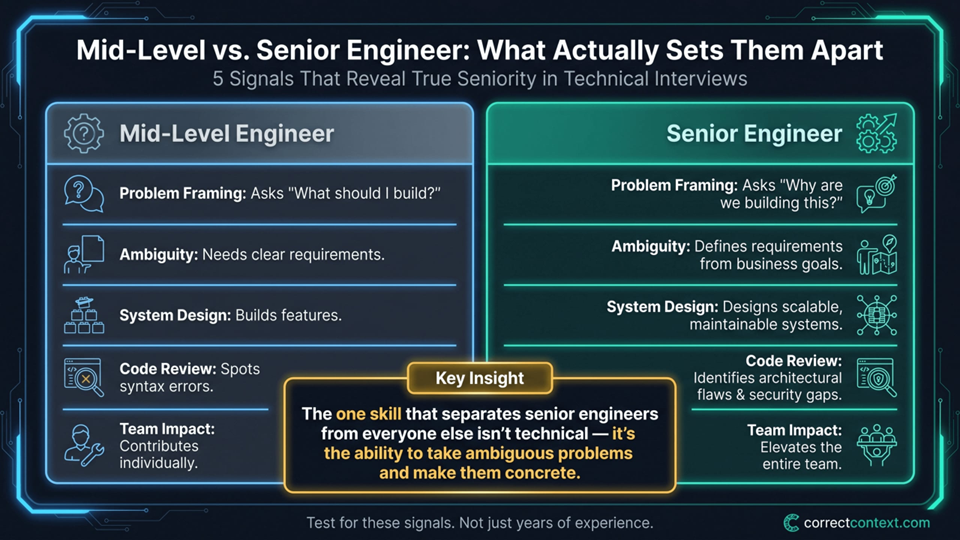
Infographic 2: Mid-Level vs. Senior Engineer: Key Differences
Signal 3: Mentorship and Elevating the Team
A senior engineer’s value extends far beyond their individual code output—they influence and elevate the entire team. While everyone is expected to mentor, the scope changes at the senior level. A senior engineer proactively identifies knowledge gaps, improves documentation, and leads design discussions.
When interviewing, assess their communication and mentorship skills. Ask them to explain a complex technical concept as if they were speaking to a junior developer or a non-technical stakeholder. Strong communicators can elevate your entire remote software engineers team, reducing bottlenecks and increasing cohesion.
If you are looking to hire AI engineers or build a machine learning engineers team, the ability to translate complex AI concepts to the rest of the business is a non-negotiable senior trait.
How to Test Real Seniority: Effective Assessment Frameworks
To truly validate engineering skills, you need a robust assessment framework that goes beyond algorithmic puzzles.
1. Scenario-Based Evaluations
Instead of generic coding tests, use scenario-based evaluations. Ask candidates how they approached scaling issues, debugging in production, or migrating critical systems. Look for structured thinking, trade-off analysis, and context awareness.
2. Real-World Code Reviews
Give the candidate a piece of flawed code and ask them to review it. A mid-level developer will spot syntax errors and basic bugs. A senior developer will identify architectural flaws, security vulnerabilities, and suggest improvements for maintainability.
3. Collaborative System Design
Conduct a collaborative system design session. This isn’t about getting the “right” answer on a whiteboard; it’s about seeing how the candidate collaborates, handles feedback, and justifies their decisions.
The Strategic Advantage of Nearshoring to Poland and CEE
Finding true senior talent is challenging, especially in highly competitive markets. This is why many Enterprise innovation units and Series A+ Startups are looking to hire developers Poland and build an engineering team Poland / CEE.
Poland has emerged as a top hub for tech talent, offering affordable senior developers without compromising on quality. Whether you need a dedicated software team, a DevOps team for hire, or a data analytics team, the CEE region provides access to world-class engineers.
Partnering with an employer of record Poland or an EoR CEE allows companies to hire in Europe without company setup. Services like payroll services Poland and employment compliance Europe make it seamless to build a tech hub Poland. You can focus on product development while your partner handles the local infrastructure, recruitment, and HR.
Whether you are looking for an offshore team for startup or need to integrate enterprise ai tools and ai trends enterprise into your corporate strategy, the right nearshore partner ensures you get the seniority you pay for.
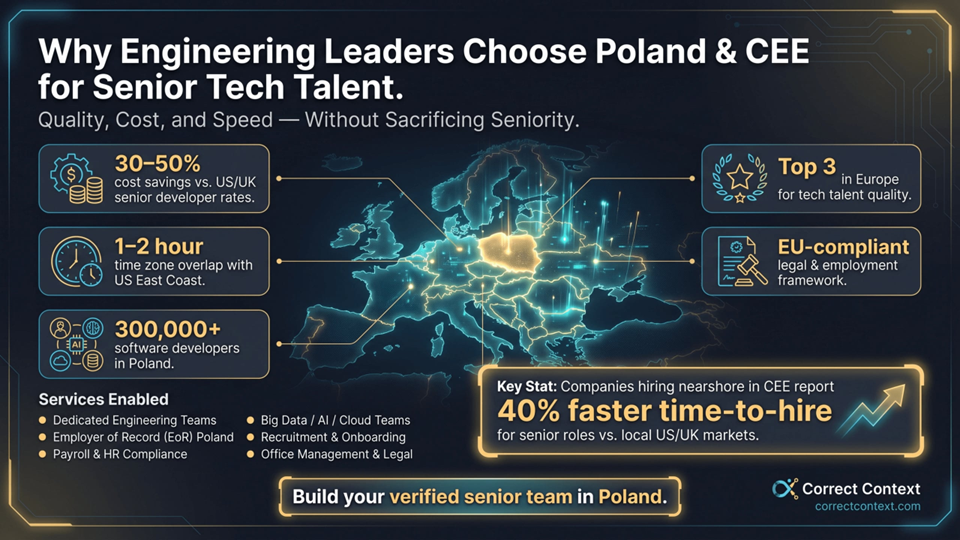
Infographic 3: The Nearshore Advantage: Why Poland is the Top Tech Hub
Conclusion
Hiring senior engineers is fraught with risk, but it doesn’t have to be a gamble. By looking beyond the resume and focusing on ownership, architectural thinking, and mentorship, you can accurately assess true seniority.
When you are ready to scale software development and build a high-performing team, remember that where you look is just as important as what you look for. Exploring nearshore developers Europe and leveraging an European employer of record can give you the competitive edge you need to succeed.
References
[1] Transforming HR: The Rise of Skills-Based Hiring and Retention Strategies. SHRM.
[2] Resume Fraud Statistics 2026 — CV Misrepresentation Data and Trends. AscentPassport.
[3] Beyond the Resume: How to Vet a Senior Engineer’s True Capabilities. DataBarque.
Table of content
- The Resume Illusion: Why Years of Experience Don’t Equal Skill
- Signal 1: Ownership and Handling Ambiguity
- Signal 2: Architectural Thinking and System Design
- Signal 3: Mentorship and Elevating the Team
- How to Test Real Seniority: Effective Assessment Frameworks
- The Strategic Advantage of Nearshoring to Poland and CEE
- Conclusion
Related articles



About the Author: Marta