
The global demand for artificial intelligence and data engineering talent is reaching critical levels. For enterprise innovation units and globally scaling startups, the pressure to build robust data and AI capabilities has never been higher. Yet, for many Chief Technology Officers (CTOs) and VP of Engineering leaders tasked with assembling these teams, a significant hurdle remains: assessing specialized AI and Data engineering skills when they themselves may lack deep internal expertise in these rapidly evolving domains.
As the tech landscape shifts toward advanced machine learning and cloud infrastructure, traditional hiring methods are proving inadequate. This article explores why general tech interview processes fail to accurately assess specialized AI, Big Data, and Cloud skills, and provides a structured framework for leaders to evaluate candidates effectively. It also highlights how partnering with a dedicated development team can mitigate these challenges and accelerate your AI initiatives.
The Flaws in Traditional Technical Interviews
For decades, the standard software engineering interview has relied heavily on whiteboard coding challenges and algorithmic puzzles. While these methods might evaluate a candidate’s grasp of basic computer science principles, they often fail to predict performance in complex, real-world environments.
The Volatility of Standard Assessments
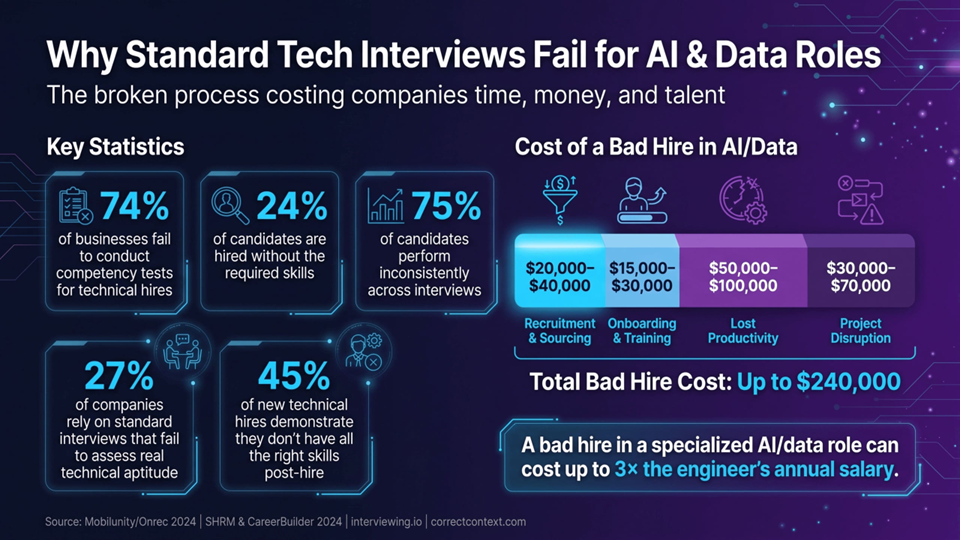
Groundbreaking research from interviewing.io has demonstrated the inherent volatility of traditional technical interviews. Their analysis revealed that 75% of candidates perform inconsistently from one interview to the next [1]. A candidate who excels in the morning might fail a similar assessment in the afternoon with a different company.
“Generally, when we think of interviewing, we think of something that ought to have repeatable results and carry a strong signal. However, the data we’ve collected… tells a different story.” – interviewing.io [1]
This inconsistency is particularly problematic when evaluating data engineering skills or hiring machine learning engineers. These roles require deep domain knowledge, systems thinking, and the ability to navigate ambiguous data landscapes—skills that are rarely captured in a 45-minute coding test.
Missing the Real-World Context
Traditional interviews often test for academic skills rather than practical application. They fail to measure a candidate’s ability to collaborate, debug complex systems, navigate legacy code, or make pragmatic architectural decisions [1]. In a corporate AI use environment, these practical skills are far more critical than the ability to invert a binary tree on a whiteboard.
Furthermore, research by Mobilunity highlights that 74% of businesses fail to conduct competency tests specific to technical hires, and 24% of candidates are hired without the required skills [2]. This reliance on generic assessments exacerbates the tech skills shortage and leads to costly hiring mistakes.
The High Cost of a Bad Hire in AI and Data
The financial implications of a poor hiring decision in specialized fields are staggering. While the base salary for a senior AI engineer is significant, the total cost of a bad hire extends far beyond compensation.
Calculating the True Cost
The U.S. Department of Labor estimates the cost of a bad hire at up to 30% of the employee’s first-year earnings. However, for specialized roles like a data engineering team or machine learning engineers team, the true cost is much higher. A study highlighted by SHRM and CareerBuilder indicates that the total cost of a bad hire can reach up to $240,000 when factoring in recruitment fees, training time, lost productivity, and the impact on team morale [3].
| Cost Category | Estimated Financial Impact |
|---|---|
| Recruitment and Sourcing | $20,000 – $40,000 |
| Onboarding and Training | $15,000 – $30,000 |
| Lost Productivity | $50,000 – $100,000 |
| Disruption to Projects | $30,000 – $70,000 |
| Total Estimated Cost | $115,000 – $240,000 |
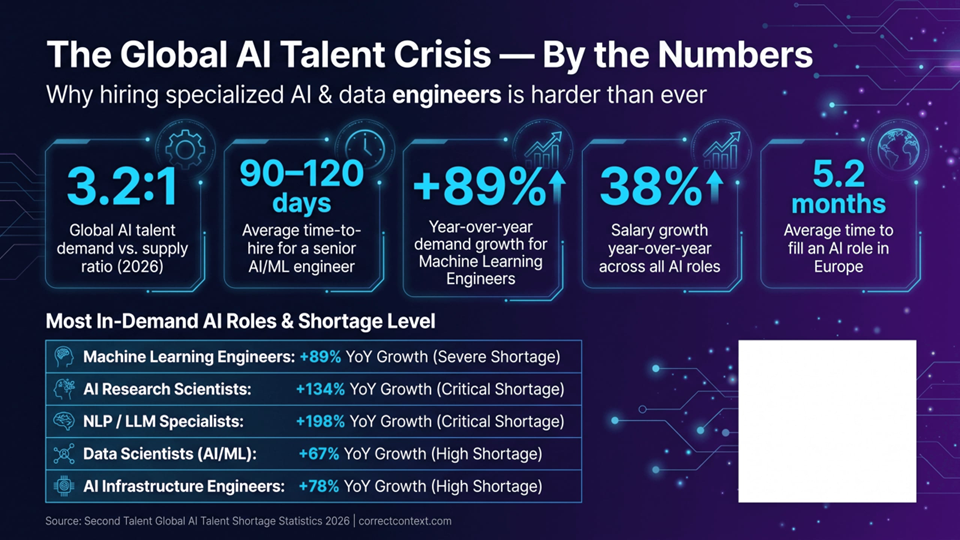
When you consider that the global AI talent demand outpaces supply by 3.2 to 1, with over 1.6 million open AI roles worldwide and only 518,000 qualified candidates [4], the margin for error is razor-thin. Leaders cannot afford to waste months on a hiring process that ultimately yields a candidate who cannot deliver.
A Structured Framework for Assessing Specialized Skills
If you are a CTO or VP of Engineering building a new data or AI unit, how can you effectively vet candidates without being an expert yourself? The answer lies in structuring the assessment process to focus on practical application, system design, and behavioral competencies.
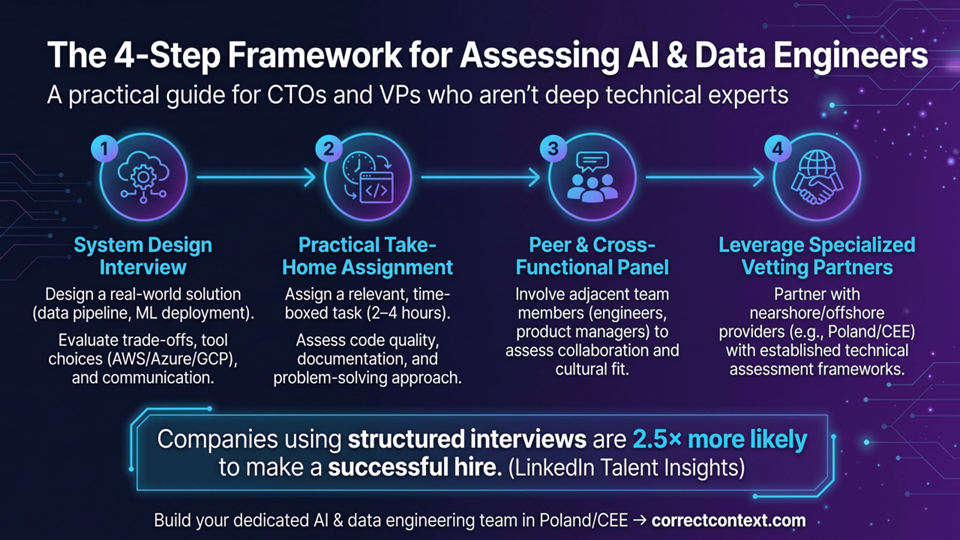
1. Focus on System Design and Architecture
When interviewing data engineers and AI specialists, shift the focus from micro-level coding to macro-level system design. Provide candidates with a high-level business problem and ask them to design a solution.
- Data Engineering: Ask them to design a data pipeline that ingests, processes, and stores large volumes of streaming data. Evaluate their choices of cloud engineering team tools (e.g., AWS, Azure, GCP), their understanding of data governance, and how they handle data quality issues.
- AI/ML Engineering: Present a scenario where they need to deploy a machine learning model into production. Assess their knowledge of MLOps, model monitoring, and how they address issues like data drift and model degradation.
The goal is not to find a perfect technical answer, but to understand their thought process, the trade-offs they consider, and their ability to communicate complex concepts clearly.
2. Utilize Take-Home Assignments (With Caveats)
A well-crafted take-home assignment can provide a more accurate reflection of a candidate’s abilities than a live coding test. It allows them to work in a realistic environment, use their preferred tools, and demonstrate their problem-solving approach.
However, be mindful of the candidate’s time. The assignment should be relevant to the actual work they will perform and should not take more than a few hours to complete. When reviewing the submission, focus on code quality, documentation, and the robustness of their solution.
3. Implement Peer and Cross-Functional Interviews
Even if you lack deep technical expertise, your existing team members might have adjacent skills that can provide valuable insights. Involve software engineers, product managers, or data analysts in the interview process. They can assess the candidate’s ability to collaborate, communicate technical constraints to non-technical stakeholders, and integrate with existing workflows.
4. Leverage External Expertise and Specialized Partners
If your organization lacks the internal capacity to evaluate specialized skills, consider leveraging external expertise. This is where partnering with an extended engineering team or an offshore development team becomes highly advantageous.
Companies specializing in building tech hubs, such as those offering employer of record Poland services, have established rigorous vetting processes for AI and data talent. They possess the domain expertise to conduct deep technical assessments, ensuring that you hire developers Poland who are truly qualified.
The Strategic Advantage of Nearshoring and Offshoring
For Enterprise innovation units and Series A+ startups located in the Eastcoast US, UK, DACH, and Nordics, scaling an AI development team locally can be prohibitively expensive and time-consuming. The average AI engineer time-to-hire has stretched to 90–120 days for senior specialized roles [5].
Tapping into Global Talent Pools
To overcome these challenges, forward-thinking leaders are turning to nearshore development team and offshore models. Regions like Central and Eastern Europe (CEE), particularly Poland, have emerged as premier destinations for top-tier technical talent.
- Affordable Senior Developers: By choosing to hire developers for startup or enterprise needs in Poland, companies can access highly skilled professionals at a fraction of the cost of local hires, without compromising on quality.
- Speed to Market: Partnering with an employer of record CEE allows you to rapidly scale engineering teams and bypass the lengthy recruitment cycles typical of the US and Western European markets.
- Employment Compliance Europe: Utilizing payroll services Poland and EoR solutions ensures that you can hire in Europe without company entity, mitigating legal and administrative risks.
Whether you need a big data development team, a platform engineering team, or specialized AWS / Azure / GCP engineers team, nearshoring offers a strategic pathway to accelerate your innovation roadmap.
Conclusion: Rethinking the Assessment Paradigm
Building a high-performing data and AI unit requires a fundamental shift in how we assess technical talent. General tech interview processes are insufficient for evaluating the nuanced skills required for enterprise ai tools and advanced analytics.
By implementing structured assessments focused on system design, practical problem-solving, and cross-functional collaboration, leaders can make more informed hiring decisions. Furthermore, by leveraging global talent pools and partnering with specialized offshore team for startup and enterprise providers, organizations can secure the expertise they need to thrive in the AI-driven future.
For companies looking to build a robust engineering hub Europe, partnering with experts like Correct Context provides access to vetted, top-tier talent in Poland and the CEE region, enabling you to scale your software development and AI initiatives efficiently and securely.
References
[1] Correct Context. (2026). Why Technical Interviews Don’t Predict Engineering Performance.
[2] Onrec. (2024). New research reveals flaws in tech recruitment process, with one in four candidates being hired without required skills.
[3] Correct Context. (2026). The Salary Mirage: Why Focusing on Salary Alone Blinds Leaders to the Real Cost of Engineering Talent.
[4] Second Talent. (2026). Top 50+ Global AI Talent Shortage Statistics 2026.
[5] GoGloby. (2026). How to Hire AI Engineers in 2026: A Complete Guide.
Table of content
Related articles



About the Author: Marta