
For enterprise innovation and data units across the Fortune 5000, and for Series A+ tech-first startups scaling globally, the decision to build a European tech hub is no longer a question of if, but how. As the demand for top-tier engineering talent outpaces supply in domestic markets, establishing an engineering team in Poland or the broader Central and Eastern European (CEE) region has become a strategic imperative. However, the path to a successful international expansion is fraught with operational, legal, and financial complexities.
The core problem many enterprise leaders face is the uncertainty about whether to manage this expansion internally or to leverage an expansion partner in Europe. At the final decision point, the fear of costly missteps—such as compliance failures, talent acquisition delays, or cultural misalignment—can paralyze progress. This article explores the critical factors that determine when to use an expansion partner versus going it alone, helping you decide whether partnering reduces risk, time, and long-term costs.
The State of European Tech and the Talent Imperative
Europe’s technology ecosystem is experiencing a “moonshot moment.” According to a 2025 report by McKinsey & Company, the continent’s tech sector is gaining significant momentum, driven by advances in AI, cloud computing, and a growing pool of highly skilled talent. [1] Over the last decade, the number of European software start-ups has grown fivefold, and the region has raised over $425 billion in venture funding—ten times the previous decade’s total. [1]
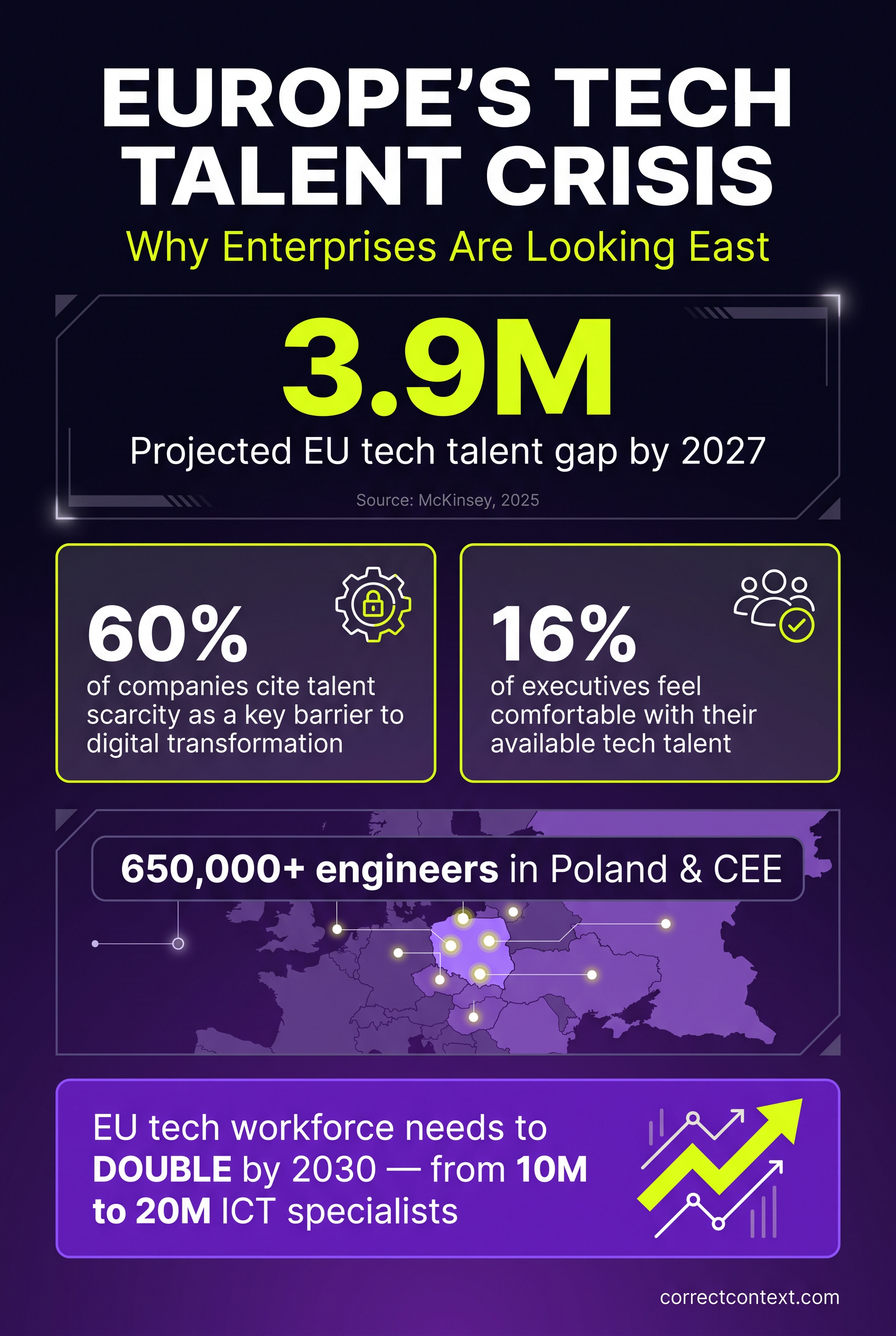
Yet, this growth is accompanied by a severe talent shortage. McKinsey estimates that the tech talent gap in the European Union could reach between 1.4 million and 3.9 million people by 2027. [2] Only 16 percent of executives feel comfortable with the amount of technology talent they have available to drive their digital transformation, and 60 percent of companies cite the scarcity of tech talent and skills as a key inhibitor of that transformation. [2]
For US and UK-based enterprises, this talent scarcity is a major bottleneck. The demand for specialized skills—such as an AI development team, machine learning engineers team, or cloud engineering team—is at an all-time high. To bridge this gap, companies are increasingly looking to build a tech team in Europe, particularly in regions like Poland, which boasts Central and Eastern Europe’s largest tech workforce with over 650,000 engineers and tech professionals. [3]
However, accessing this talent pool requires more than just posting job ads. It demands a deep understanding of the local market, competitive compensation benchmarking, and an attractive employer brand. This is precisely where the choice between going alone and using a hiring partner in Europe becomes critical.
The Risks of Going It Alone
When considering an international expansion, the “go alone” strategy often seems appealing on the surface. It promises total control over the operation and the potential to save on third-party fees. However, the reality is far more complex, and the risks of a flawed expansion strategy can be severe.
1. The Cost of Legal and Compliance Errors
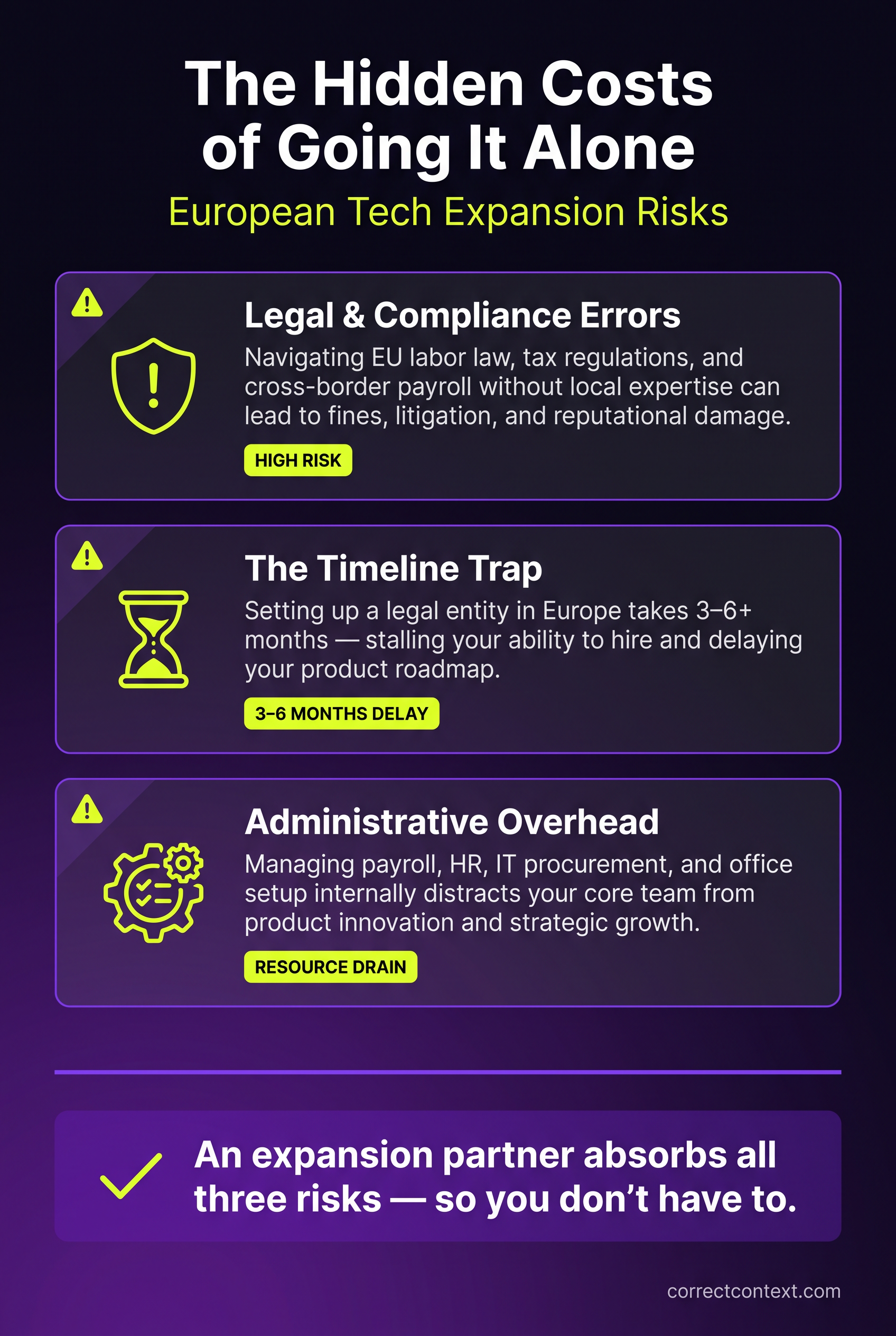
Setting up a legal entity in a new European country is a time-consuming and expensive process. It requires navigating a labyrinth of local corporate laws, tax regulations, and employment compliance in Europe. A misstep here can lead to significant financial penalties, operational delays, and reputational damage.
For instance, understanding the nuances of European employment law is critical. Failing to adhere to local labor laws—such as working hours, statutory benefits, and termination procedures—can result in costly litigation. Furthermore, managing cross-border tax implications, such as transfer pricing and permanent establishment risks, requires specialized expertise. As Deloitte notes, “inadvertently establishing an overseas branch or putting undue pressure on tax residence status can lead to more operational and administrative complexity, compliance costs, tax risks and in extreme cases, litigation.” [4]
2. The Timeline Trap
Time is a critical factor in global scaling. The process of establishing a legal entity, opening local bank accounts, and registering with tax authorities can take anywhere from three to six months—or even longer in some jurisdictions. During this time, your ability to hire developers in Poland or other European markets is stalled, delaying your product roadmap and giving competitors an edge. For a fast-scaling startup or an enterprise under pressure to deliver, this delay is not a minor inconvenience—it is a strategic liability.
3. The Burden of Administrative Overhead
Managing a nearshore development team or an offshore development team requires a significant investment in administrative overhead. From running local payroll and managing HR processes to securing office space and handling IT procurement, the operational burden can quickly distract your core team from strategic initiatives. Enterprise leaders who have attempted to manage this internally often find themselves spending disproportionate time on administrative minutiae rather than driving product innovation.
When to Choose an Expansion Partner
Given the risks and complexities of going it alone, partnering with a specialized expansion firm is often the most strategic choice for enterprises and fast-growing startups. An expansion partner in Europe acts as an extension of your organization, providing the local expertise, infrastructure, and European expansion support needed to build and scale your tech team efficiently.
Here are the key scenarios when using an expansion partner is the optimal strategy:
1. Speed to Market is Critical
If your primary objective is to scale engineering teams quickly, an expansion partner is invaluable. By leveraging an Employer of Record (EoR) in Poland or the broader CEE region, you can bypass the lengthy process of entity setup. An EoR in Europe allows you to hire in Europe without a company entity, acting as the legal employer of your team on paper while you retain full control over their day-to-day work.
This approach can reduce the time to hire from months to weeks, enabling you to onboard your dedicated development team and accelerate your product delivery. Gartner forecasts that IT spending in Europe will reach $1.4 trillion in 2026, growing at 11.1% year-over-year, driven by AI, cloud, and cybersecurity investments. [5] Companies that can move quickly to secure the right talent will capture a disproportionate share of this value.
2. Risk Mitigation and Compliance are Priorities
For enterprise leaders, managing risk is paramount. An expansion partner assumes the burden of local compliance, ensuring that your operations adhere to all legal, tax, and HR regulations. They handle the complexities of payroll services in Poland, administer statutory benefits, and manage employment contracts, shielding your organization from potential liabilities.
This is particularly crucial when dealing with complex scenarios, such as granting share options to overseas employees or navigating the intricacies of cross-border taxation. Deloitte explicitly cautions that using an Employer of Record without proper guidance can lead to complications with share plan rules, tax-advantaged employee awards, and in the worst case, can invalidate an entire option scheme. [4] A knowledgeable expansion partner navigates these complexities proactively.
3. You Need Access to Top-Tier Talent
Building a high-performing remote software engineers team requires a deep understanding of the local talent landscape. An expansion partner with a strong presence in the region can provide invaluable insights into salary benchmarks, talent availability, and candidate expectations.
They can help you source and recruit specialized talent, such as a data analytics team, big data development team, or AWS / Azure / GCP engineers team, ensuring that you attract the right skills to drive your innovation agenda. Furthermore, a partner can assist in building a strong local employer brand, which is essential for retaining top talent in a competitive market. McKinsey’s research confirms that “partnering can offer greater access to key skills than traditional outsourcing,” with talent less likely to leave when partnership agreements include structured training, coaching, and career progression pathways. [2]
4. You Want to Focus on Core Competencies
By outsourcing the administrative and operational burden of your European tech hub, your internal team can focus on what they do best: driving product innovation and strategic growth. An expansion partner handles the day-to-day management of your extended engineering team, including HR support, office management, and IT infrastructure, allowing you to maintain a lean and agile organization.
Cost Comparison: Entity Setup vs. Expansion Partner
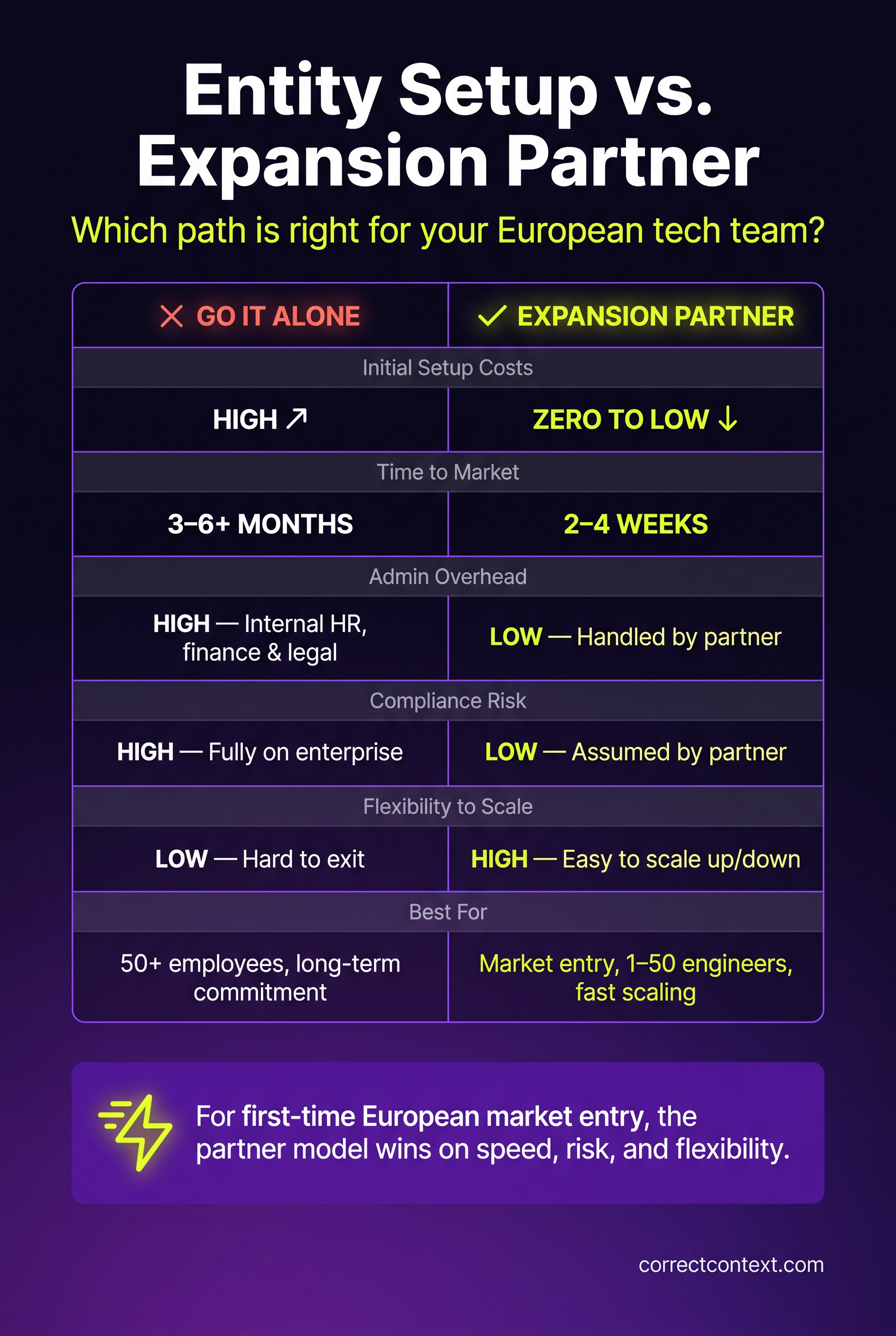
When evaluating the financial implications of your expansion strategy, it is essential to consider both the direct and indirect costs. The table below provides a structured comparison to guide your decision-making.
| Cost Category | Entity Setup (Go Alone) | Expansion Partner (EoR Model) |
|---|---|---|
| Initial Setup Costs | High — legal fees, registration, minimum share capital | Zero to low |
| Time to Market | 3–6+ months | 2–4 weeks |
| Administrative Overhead | High — internal HR, finance, and legal resources required | Low — handled by the partner |
| Compliance Risk | High — assumed entirely by the enterprise | Low — assumed by the partner |
| Flexibility to Scale | Low — difficult to exit the market quickly | High — easy to scale up or down |
| Long-Term Cost (50+ employees) | More cost-effective at scale | Higher per-employee cost at scale |
While setting up a legal entity may become more cost-effective in the long run for very large teams—typically at the 50+ employee threshold—the EoR model offered by an expansion partner is significantly more efficient and less risky for initial market entry and scaling phases. For most enterprises entering the European market for the first time, the speed, flexibility, and risk mitigation offered by a partner far outweigh the marginal cost savings of going alone.
The Decision Framework: Partner or Go Alone?
The following framework helps enterprise leaders determine the right path based on their specific situation:
| Scenario | Recommended Approach |
|---|---|
| First-time market entry in Europe | Expansion Partner (EoR) |
| Need to hire 1–50 engineers quickly | Expansion Partner (EoR) |
| Scaling to 50+ employees with long-term commitment | Evaluate entity setup |
| Limited internal HR/legal expertise in European law | Expansion Partner |
| High compliance risk tolerance | Entity Setup (with expert legal counsel) |
| Need for specialized talent (AI, cloud, data) | Expansion Partner with local recruitment expertise |
Conclusion
Building a European tech team is a strategic imperative for enterprises and scaling startups seeking to secure top-tier engineering talent in an increasingly competitive market. However, the complexities of international expansion—ranging from legal compliance to talent acquisition—demand a nuanced and well-informed approach.
For organizations at the final decision point, partnering with an expansion partner in Europe offers a compelling solution. It reduces the risk of costly missteps, accelerates time to market, and provides the local expertise needed to build a tech hub in Poland or the broader CEE region. As McKinsey’s research underscores, the demand for technology talent will exceed supply for the foreseeable future, and companies that strategically employ the right combination of workforce levers—including partnering—will be best positioned to secure the talent they need. [2]
By leveraging an expansion partner, you can confidently scale your tech capabilities, ensuring that your organization remains competitive in the global innovation race. The question is not whether to expand to Europe—it is whether you can afford to go it alone.
References
[1] McKinsey & Company. Europe’s moonshot moment: Fueling its tech ecosystem for scale
[2] McKinsey & Company. Tech talent gap: Addressing an ongoing challenge | McKinsey & Company
[3] Karat. “Poland’s Top Nearshore Hubs for CIOs Hiring Engineers.” June 18, 2025.
[4] Deloitte. International Expansion: 3 Key Considerations | Deloitte UK
[5] Gartner. Gartner Forecasts IT Spending in Europe to Grow 11% in 2026
Table of content
Related articles



About the Author: Marta