As a CTO or founder of a Series A+ startup, you’re no stranger to rapid growth. Your team is shipping code, your user base is expanding, and your product is gaining traction. But as you scale, a new challenge emerges: your hiring process can’t keep up. Your once-nimble internal recruiting team is now a bottleneck, and the pressure to build out your engineering team is mounting.
This article explores the limits of in-house recruiting, when it’s time to look beyond your internal team, and how to scale your hiring efforts to match your company’s growth trajectory.
The Breaking Point: When Internal Hiring Hits a Wall
For early-stage startups, an in-house recruiter or a small talent acquisition team is often enough to handle the hiring load. But as your company grows, so does the complexity and volume of your hiring needs. The very team that helped you build your initial engineering team can quickly become overwhelmed. Here’s why:
- Increased Hiring Velocity: The demand for new hires, especially in specialized roles like AI development, machine learning engineering, and big data analytics, can outpace your internal team’s capacity.
- Recruiter Burnout: With a surge in open requisitions, your recruiters are stretched thin. Since 2022, the average recruiter headcount has dropped by 23%, while open roles per recruiter have jumped by 56% [1]. This leads to burnout, decreased efficiency, and a longer time-to-hire.
- Slower Time-to-Hire: The average time-to-fill for tech roles has reached 52 days [2]. For a fast-growing startup, this is a lifetime. Delays in hiring can mean missed product deadlines, lost market opportunities, and a significant impact on your bottom line.
The Internal Recruiter Bottleneck
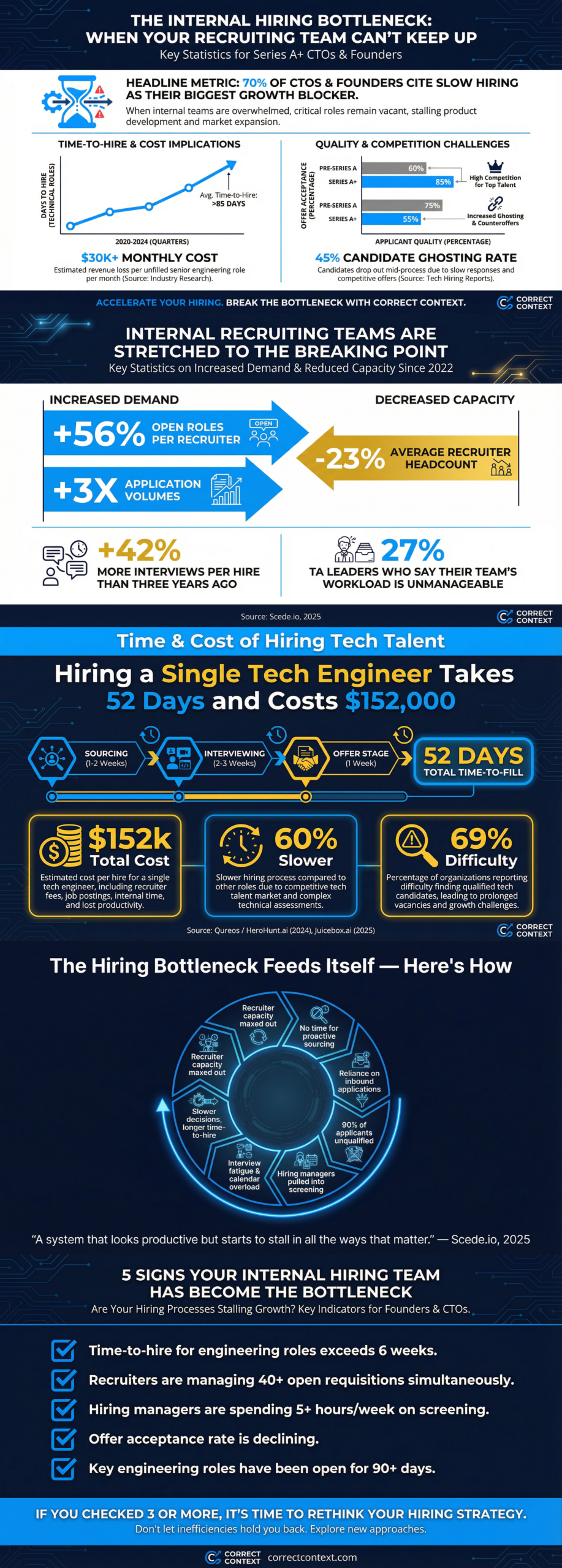
Infographic 1: The Internal Hiring Bottleneck — By the Numbers
| Metric | In-House Recruiting (Scaling) | External Partner (Nearshore/Offshore) |
| Time-to-Hire (Tech Roles) | 52+ days [2] | 2-4 weeks |
| Cost-per-Hire (Tech Roles) | ~$6,200 (US) [3] | 40-60% less [4] |
| Recruiter Capacity | 30-40 open requisitions [5] | Scalable to demand |
| Access to Talent | Limited to local market | Global talent pool |
Your internal recruiters are likely wearing multiple hats – sourcing, screening, scheduling, and onboarding. As the number of open roles increases, they are forced to switch from a proactive, strategic approach to a reactive, transactional one. Instead of hunting for top talent, they are buried in a mountain of applications, many of which are unqualified. This is where the bottleneck forms.
“Since 2022, average recruiter headcount has dropped by nearly a quarter (23%), while the number of open roles per recruiter has jumped 56%. Application volumes? Almost triple. And hiring teams are now running 42% more interviews per hire than they were just three years ago.” [1]
This “capacity crunch” means your team has no time for strategic sourcing, leading to a reliance on inbound applications. The result is a slower, less effective hiring process that yields lower-quality candidates. Your hiring managers are frustrated, your recruiters are burnt out, and your growth is stalled.
What’s Next? The Hybrid Model: Extended and Dedicated Teams
When your internal hiring process is no longer serving your company’s needs, it’s time to consider a hybrid model. This doesn’t mean replacing your internal team, but rather supplementing it with an external partner. An extended engineering team or a dedicated development team can provide the scalability and expertise you need to keep your hiring on track.
An extended engineering team is a flexible solution that allows you to quickly add skilled developers to your existing team. This model is ideal for startups that need to scale their development capacity for a specific project or a set period. A dedicated development team, on the other hand, is a long-term solution that provides you with a full-fledged, remote team of developers who are fully integrated into your company’s culture and workflow.
The CEE Advantage: Why Poland is Your Next Tech Hub
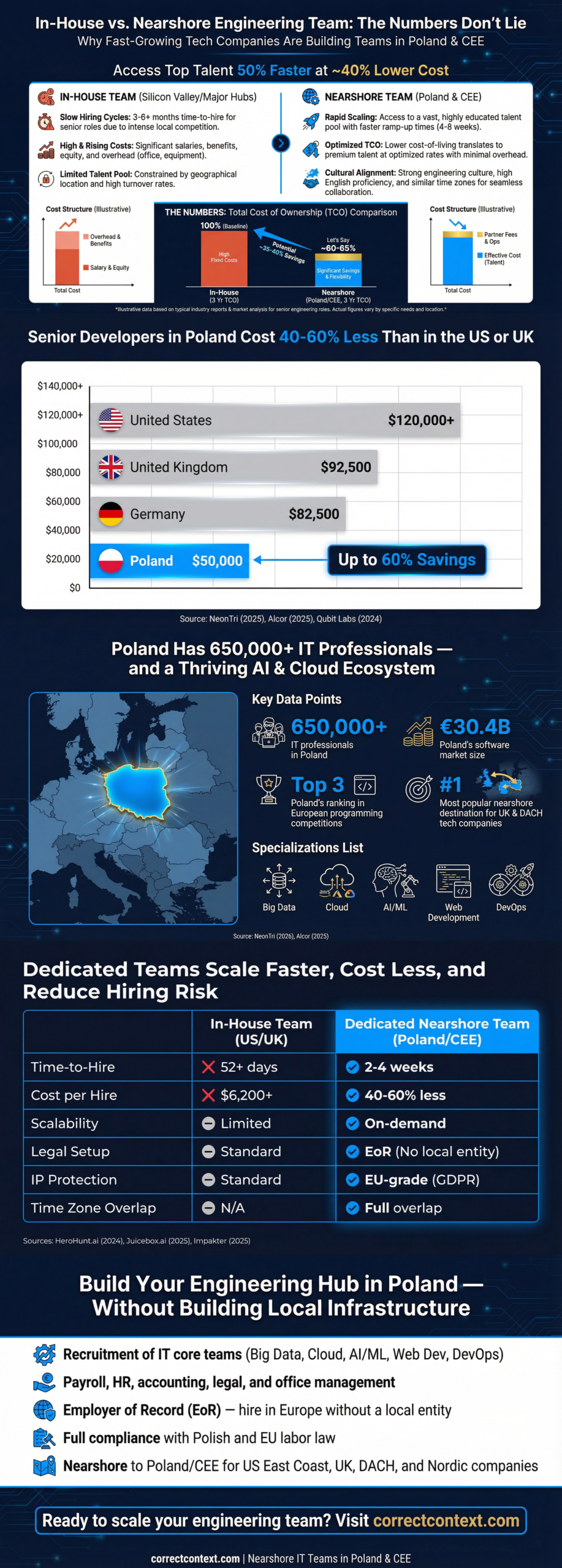
Infographic 2: In-House vs. Nearshore Engineering Team — The Real Comparison
When considering an external partner, Central and Eastern Europe (CEE), and specifically Poland, should be at the top of your list. The region has emerged as a global hub for tech talent, offering a unique combination of technical expertise, cost-effectiveness, and cultural alignment with Western companies. Here’s why you should hire developers in Poland:
- Vast Talent Pool: Poland has a large and growing pool of highly skilled software developers, with over 650,000 IT professionals. The country is home to a thriving tech ecosystem, with a strong focus on AI development, machine learning, big data analytics, and cloud engineering (AWS, Azure, GCP).
- Cost Savings: Hiring a dedicated software team in Poland can result in significant cost savings. The average salary for a software developer in Poland is significantly lower than in the US or Western Europe, with potential savings of up to 50% on development costs.
- High-Quality Education: Poland has a strong education system that produces a steady stream of highly qualified IT graduates. The country consistently ranks high in international programming competitions, a testament to the quality of its tech talent.
| Country | Average Software Engineer Salary (Annual) |
| United States | $120,000+ |
| United Kingdom | $80,000 – $100,000 |
| Germany | $70,000 – $90,000 |
| Poland | $40,000 – $60,000 |
*Source: Data compiled from various 2024/2025 salary reports.*
The Employer of Record (EoR) Solution: Hiring in Europe Without the Hassle
One of the biggest challenges of hiring internationally is navigating the complex legal and administrative requirements of setting up a local entity. This is where an Employer of Record (EoR) comes in. An EoR in Poland or another European country allows you to hire employees without a legal entity, handling all the legal, HR, and payroll responsibilities on your behalf.
An EoR partner like Correct Context makes it easy to build your engineering hub in Europe. We handle everything from employment contracts and payroll to taxes and benefits, ensuring full compliance with local labor laws. This allows you to focus on what you do best: building great products and scaling your business.
Conclusion: Scale Your Engineering Team with Confidence
As your startup grows, your hiring strategy needs to evolve. When your internal recruiting team becomes a bottleneck, it’s time to explore new solutions. By supplementing your in-house team with a dedicated development team in Poland or CEE, you can access a global talent pool, reduce your hiring costs, and scale your engineering team with confidence. And with an Employer of Record partner, you can do it all without the legal and administrative headaches of setting up a local entity.
Ready to build your remote development team and accelerate your growth? Contact us to learn more about our nearshore development services in Poland and CEE.
References
[1] The TA Capacity Crunch: 56% More Roles, Smaller Teams, Slower Hires
[2] 2024 Recruitment Statistics: Hiring and Technology
[3] Cost Per Hire Guide: Formula & Benchmarks [2026]
[4] How Nearshore Software Development in Eastern Europe Boosts Innovation for SMEs