
For COOs and Founders, budget season is a tightrope walk. Nowhere is the wire more taut than in engineering hires. The temptation to anchor on salary as the primary cost metric is immense – but it is a dangerously misleading illusion. The real cost of a software engineer – their Total Cost of Ownership (TCO) – extends far beyond the number on their offer letter. This salary-only thinking creates a blind spot that can lead to budget overruns, project delays, and a frustrated leadership team asking, “How did we get this so wrong?”
In a competitive landscape – especially for enterprise innovation units and high-growth Series A+ startups – understanding the true cost of building and scaling an engineering team is not just a financial exercise; it is a strategic imperative. This is particularly true for companies in high-cost markets like the US, the UK, DACH, and the Nordics. The pressure to innovate, especially with the rise of enterprise AI tools and the need to hire AI engineers, intensifies the need for a sustainable and predictable cost structure.
This article dismantles the salary-only myth and provides a clear framework for evaluating the TCO of engineering hires. We will explore the hidden costs that leaders often miss and demonstrate how a strategic approach to hiring – such as building a nearshore development team in a talent-rich location like Poland – can provide a significant competitive advantage.
The Anatomy of Total Cost of Ownership (TCO)
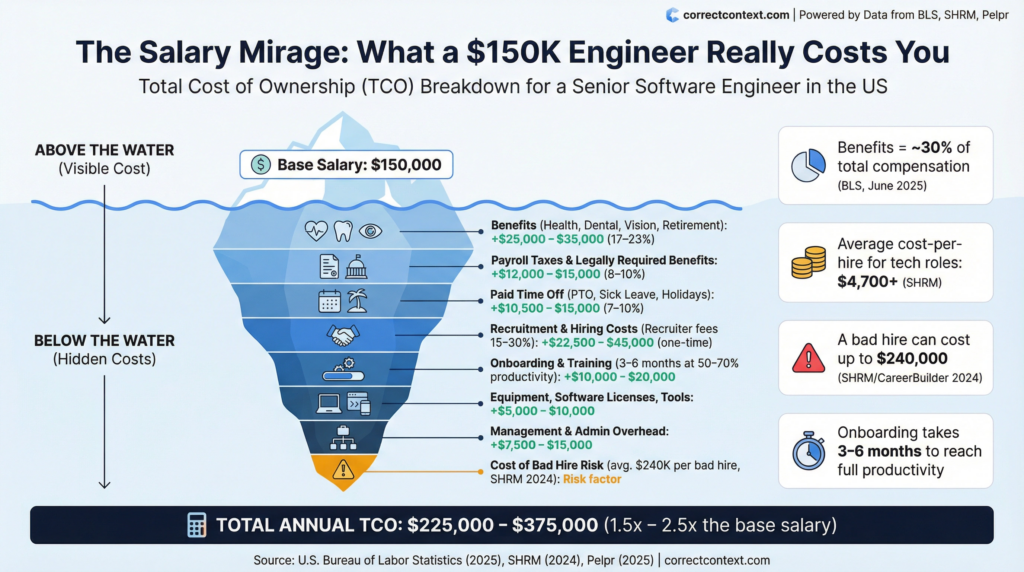
The base salary is just the tip of the iceberg. A common rule of thumb is that the true cost of an employee is 1.25 to 1.4 times their base salary [1]. However, for highly skilled roles like software engineers, this multiplier can be significantly higher – often reaching 1.5 to 2.5 times the base salary [2]. When you factor in benefits, taxes, recruitment fees, onboarding, training, tools, and the cost of keeping engineers motivated and productive, the numbers climb quickly. A developer with a median salary effectively costs $142,741 per year in direct compensation alone, with recruitment expenses adding another $28,548 on top [2].
1. Recruitment and Hiring Costs
The hunt for top engineering talent is expensive and time-consuming. Agency recruiter fees typically range from 15% to 30% of the first-year salary [3]. For a senior engineer with a $150,000 salary, this alone amounts to $22,500–$45,000. Beyond agency fees, the time your existing team spends sourcing, screening, interviewing, and onboarding candidates is a significant hidden cost. If senior developers spend 10–20 hours per week mentoring a new hire, that translates to $5,000–$10,000 in lost productivity from your existing team [2]. The Society for Human Resource Management (SHRM) reports the average cost-per-hire is around $4,700 – but for specialized technical roles, this number is substantially higher [4].
2. Compensation Beyond Salary: The 30% Rule
Benefits and other forms of compensation are a major component of TCO. According to the U.S. Bureau of Labor Statistics (BLS), benefits account for approximately 30% of total employee compensation costs in the private industry [5]. Wages and salaries averaged $32.07 per hour worked, while benefit costs averaged $13.58 – meaning for every dollar in salary, employers pay an additional 42 cents in benefits. For a $150,000 salary, that is roughly $63,000 in additional annual benefit costs.
Table 1: Breakdown of Compensation Costs Beyond Salary (for a $150,000 Base Salary)
| Cost Component | Description | Est. Cost (% of Salary) |
| Health, Dental & Vision Insurance | Premiums for medical, dental, and vision coverage | 10–15% |
| Retirement Contributions | 401(k) matching or other retirement plan contributions | 3–6% |
| Paid Time Off (PTO) | Vacation, sick leave, and public holidays | 7–10% |
| Bonuses & Stock Options | Performance-based bonuses and equity compensation | 10–20%+ |
| Payroll Taxes & Legally Required Benefits | Social Security, Medicare, unemployment insurance | 8–10% |
| TOTAL ADDITIONAL COST | Beyond base salary | ~38–61% |
3. Infrastructure, Tools, and Operational Overhead
Your engineers need the right tools and environment to be productive. These costs include high-end laptops and monitors ($2,000–$5,000 per engineer), software licenses and SaaS subscriptions ($1,500–$3,000 per year), and IT support infrastructure. For in-office or hybrid teams, office space in major US tech hubs can add $10,000–$20,000 per employee annually. Management overhead for a team of developers can add $30,000–$75,000 per developer annually, while HR administrative costs represent an additional 5%–8% of total compensation [2].
4. Onboarding, Training, and the Productivity Ramp-Up Gap
The onboarding process typically takes 3 to 6 months for a developer to become fully productive. During this time, they are learning your systems, processes, and codebase while contributing at only 50%–70% of their potential output – yet you are paying full salary. Other team members spend significant time mentoring and supporting new hires, creating a compounding productivity drain across the entire team. This hidden cost is rarely captured in budget models but can represent $10,000–$20,000 per new hire in lost output [2].
5. The Staggering Cost of a Bad Hire
A mis-hire is one of the most expensive mistakes a company can make. A study highlighted by SHRM and CareerBuilder (2024) indicates that the total cost of a bad hire can reach up to $240,000 when factoring in recruitment fees, training time, lost productivity, and the impact on team morale [6]. The U.S. Department of Labor estimates the cost of a bad hire at up to 30% of the employee’s first-year earnings. For a senior engineer earning $150,000, that is a $45,000 minimum risk exposure – and that is a conservative estimate. Studies show a bad hire can cost up to 3 times the employee’s annual salary when all ripple effects are accounted for.
💡 KEY INSIGHT: When you add up all hidden expenses, hiring a software engineer with a $100,000 base salary actually costs your company $180,000 to $250,000 in the first year alone – before accounting for the risk of a bad hire. (Source: Pelpr, 2025)
INFOGRAPHIC 1: The Salary Mirage – TCO Breakdown for a US Senior Engineer
The Strategic Advantage of Nearshoring to Poland
For companies in high-cost locations, the TCO of building an in-house engineering team can be prohibitive. This is where a nearshore development team in a location like Poland offers a compelling and increasingly popular alternative. By partnering with an Employer of Record (EoR) in Poland, companies can access a world-class talent pool without the cost and complexity of setting up a local legal entity. This model is particularly powerful for building dedicated software teams focused on specialized areas such as Big Data analytics, Cloud engineering (AWS, Azure, GCP), AI/ML development, and platform engineering.
Significant Cost Savings Without Sacrificing Quality
The most immediate benefit of nearshoring to Poland is the significant cost savings. While a senior software engineer in the US commands a salary of $150,000–$200,000+, a similarly skilled engineer in Poland might have a salary in the range of $60,000–$90,000 [7]. According to MOTIFE Insights (2026), US professionals earn between 2 and 2.5 times more than their counterparts in Poland, even when comparing the total cost of employment. A Java developer in Poland earns around $70,000 gross annually, while the same role in the US commands a median of $126,000. The overall cost difference remains significant even after adjusting for benefits and administrative costs.
Table 2: Salary Comparison – USA vs. Poland (2025/2026 Estimates)
| Role | Median Salary (USA) | Median Salary (Poland) | Potential Savings |
| Senior Software Engineer | $180,000 | $75,000 | ~58% |
| AI / Machine Learning Engineer | $170,000 | $70,000 | ~59% |
| Cloud Engineer (AWS/Azure/GCP) | $160,000 | $65,000 | ~59% |
| Data / Big Data Engineer | $155,000 | $62,000 | ~60% |
World-Class Talent at a Fraction of the Cost
Poland is not just a low-cost location; it is a hub of highly skilled and experienced engineering talent. The country boasts a large and growing pool of over 500,000 IT professionals, with more than 74,000 new graduates entering the market annually [8]. Polish developers are consistently ranked among the best in the world, placing 3rd globally in HackerRank‘s developer skills assessment – behind only Russia and China [9]. Around 75% of Polish IT professionals hold degrees in computer science or related fields, and nearly half of all specialists in Krakow report more than 10 years of professional experience. In the 2024 EF English Proficiency Index, Poland ranked 15th out of 116 countries, placing it in the ‘very high proficiency’ category. As of 2024, around 40% of Krakow’s IT talent works for US-based companies, including Cisco, IBM, and Motorola Solutions – a testament to the quality and reliability of the workforce.
The Employer of Record (EoR) Model: Hire Fast, Stay Compliant
For companies looking to hire developers in Poland, partnering with an Employer of Record (EoR) is the most efficient and cost-effective approach. An EoR handles all the legal, administrative, and HR aspects of employment, allowing you to hire employees without establishing a legal entity in the country. Setting up a foreign subsidiary can cost $25,000–$100,000 upfront and take months to complete [10]. An EoR in Poland eliminates this barrier entirely, enabling you to onboard talent in days rather than months. The EoR cost in Poland typically ranges from €349 to $599 per employee per month – a fraction of the cost of entity setup and ongoing compliance management.
This model is particularly beneficial for startups and scale-ups that need to move quickly and avoid the significant upfront investment and administrative burden of setting up a foreign subsidiary. A full-service partner like Correct Context goes beyond a standard EoR, providing end-to-end support including recruitment, payroll, HR, legal, accounting, and office management – without the client needing to build any local infrastructure. This means you can build a dedicated development team in Poland focused entirely on delivering value, while your partner handles everything else.
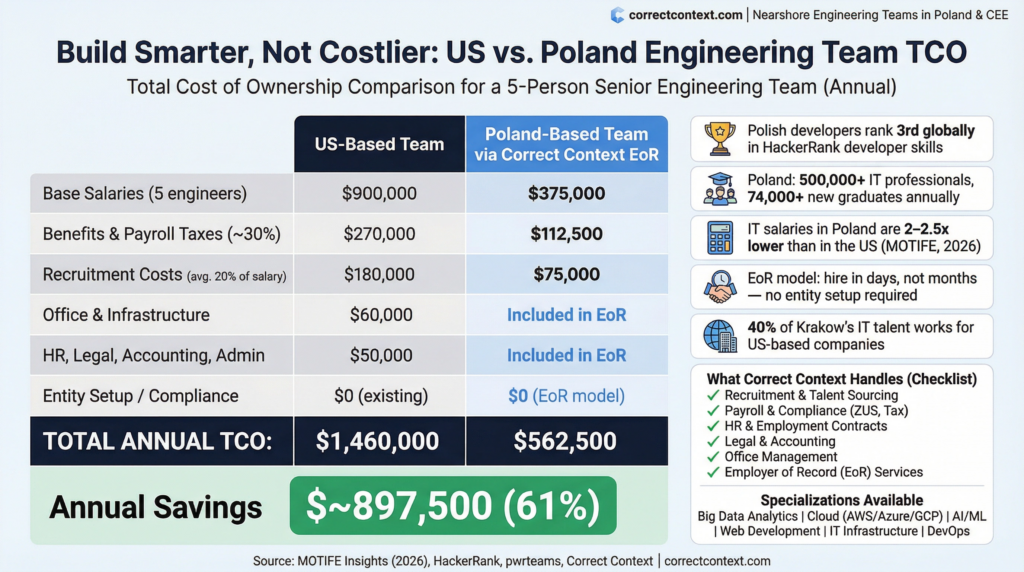
Table 3: Annual TCO Comparison – 5-Person Senior Engineering Team, US vs. Poland via EoR
| Cost Component | US-Based Team | Poland via EoR (Correct Context) |
| Base Salaries (5 engineers) | $900,000 | $375,000 |
| Benefits & Payroll Taxes (~30%) | $270,000 | $112,500 |
| Recruitment Costs (avg. 20% of salary) | $180,000 | $75,000 |
| Office & Infrastructure | $60,000 | Included in EoR |
| HR, Legal, Accounting, Admin | $50,000 | Included in EoR |
| Entity Setup / Compliance | $0 (existing) | $0 (EoR model) |
| TOTAL ANNUAL TCO | $1,460,000 | $562,500 (savings: ~$897,500 / 61%) |
INFOGRAPHIC 2: US vs. Poland Engineering Team TCO Comparison
Conclusion: A Smarter Way to Scale Your Engineering Team
In the relentless pursuit of innovation and growth, salary-only thinking is a luxury that no COO or Founder can afford. The Total Cost of Ownership of an engineering hire is a complex equation with many hidden variables – from recruiter fees and benefits to onboarding costs and the risk of a bad hire. By understanding the full picture, leaders can make more informed decisions and avoid the budget shocks that come from underestimating the real cost of talent.
For companies in high-cost markets, the strategic advantages of building a nearshore development team in Poland are undeniable. The combination of significant cost savings (up to 61% on a 5-person team), access to a world-class talent pool ranked 3rd globally by HackerRank, and the operational efficiency of an Employer of Record model provides a powerful solution for scaling your engineering team without breaking the bank. Whether you need to scale software development, hire AI engineers, build a data engineering team, or stand up a cloud engineering team with AWS, Azure, or GCP expertise, Poland and the broader CEE region offer an unmatched combination of quality and value.
As you plan your next budget, look beyond the salary mirage. Embrace a TCO-driven approach to hiring and discover how a dedicated software team in Poland – supported by a full-service partner like Correct Context – can become your secret weapon in the war for engineering talent. The question is not whether you can afford to nearshore. It is whether you can afford not to.
Correct Context provides end-to-end hiring of IT core teams nearshored to Poland/CEE – including recruitment, payroll, HR, accounting, legal, EoR, and office management. Specializations: Big Data Analytics, Cloud (AWS/Azure/GCP), AI/ML. No local entity required. Let’s talk >>
References
[1] Vena Solutions. (2025, December 30). How Much Does an Employee Cost Your Company?
[2] Pelpr. (2025, November 12). The Real Cost of Hiring Software Engineers.
[3] ProdensaHR. (2025, November 19). The Hidden Costs of Hiring Locally in the U.S.
[4] SHRM. (2022, April 11). The Real Costs of Recruitment.
[6] SHRM / CareerBuilder. (2024). 2024 Talent Trends Research.
[7] MOTIFE Insights. (2026, January 10). IT Salaries Poland vs US: How Do They Compare in 2026?
[8] pwrteams. (n.d.). Build your dedicated tech team in Poland | IT Staff Augmentation.
[9] HackerRank. (2024). Developer Skills Report.
[10] Rippling. (n.d.). EOR or Entity Cost Calculator: Which path is right for you?